Friday, 31 October 2025

Langford Lodge

Armorial Bearings of the Barons Longford
THE PAKENHAMS WERE MAJOR LANDOWNERS IN COUNTY ANTRIM, WITH 14,629 ACRES


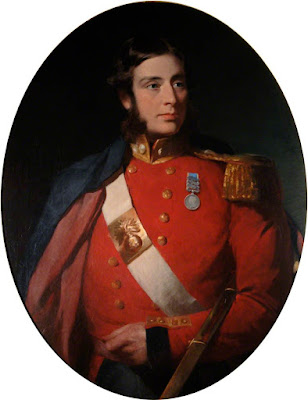
EDWARD WILLIAM PAKENHAM (1819-54), of Langford Lodge, County Antrim, Lieutenant-Colonel, Grenadier Guards, eldest son of Lieutenant-General the Hon Sir Hercules Robert Pakenham KCB and Emily, daughter of Thomas, 12th Baron Le Despenser, was killed in action at the battle of Inkerman.

Lt-Col Edward William Pakenham (Image: Hampshire County Council)

His only surviving brother,

LIEUTENANT-GENERAL THOMAS HENRY PAKENHAM CB JP DL MP
(1826-1913), of Langford Lodge, married, in 1862, Elizabeth Staples, eldest daughter of William Clarke, of New York, USA, and had issue,
HERCULES ARTHUR, his heir;
Harry Francis.
The elder son,

COLONEL HERCULES ARTHUR PAKENHAM CMG JP DL (1863-1937), of Langford Lodge, High Sheriff of County Antrim, 1906, wedded, in 1895, Lillian Blanche Georgiana, daughter of Evelyn Ashley and sister of Lord Mount Temple, and had issue,
HERCULES DERMOT WILFRED, his heir;
Joan Esther Sybilla; Beatrix Helen Constance.
His only son,

HERCULES DERMOT WILFRED PAKENHAM (1901-40), Major, Grenadier Guards, killed in action, espoused, in 1927, Hetty Margaret, daughter of Captain Roland Stuart Hebeler, and had issue,
HERCULES MICHAEL ROLAND, his heir;
Anne Penelope; Katherine Susan.
Major Pakenham's only son,

HERCULES MICHAEL ROLAND PAKENHAM (1935-), of Southampton, Hampshire, married firstly, in 1957, Susan Elizabeth Moon, daughter of Philip, 3rd Viscount Leverhulme, and has issue,
DERMOT PHILIP MICHAEL (b 1961);Caroline Susan Margaret.
He wedded secondly, in 1973, Margaret, daughter of Charles William Fisher, and has further issue,
Hetty Kate Pakenham.

LANGFORD LODGE, near Crumlin, County Antrim, was a three-storey Georgian house of ca 1821 on a headland jutting out into Lough Neagh.

The house had an entrance front of three bays between two deep, curved bows, a Doric portico and a two-storey side wing.

The end elevation was of two bays with another deep, curved bow.

The Georgian mansion replaced a two-storey house of 1785 (said to be similar in appearance to Castle Upton) built by Sir Hercules Pakenham (1781-1850).

Sir Hercules had demolished a modest two-room fishing lodge of 1785.


The Lodge passed to the Pakenham family, Barons Longford and Earls of Longford, through the marriage of Catherine, Viscountess Langford, to the 2nd Baron Longford.
The offspring of this marriage included the Hon Catherine "Kitty" Pakenham, later Duchess of Wellington and wife of the great Duke of Wellington; Major-General the Hon Sir Edward Pakenham GCB; and Lieutenant-General the Hon Sir Hercules Pakenham KCB, from whom were descended the subsequent owners of Langford Lodge.
Sir Hercules (1781-1850), of Langford Lodge, had been wounded at the siege of Badajoz in 1812; was MP for Westmeath.

He married, in 1817, the Hon Emily Stapleton (1798-1875), daughter of Lord Le Despencer. 

Langford Lodge subsequently passed to their eldest son, Edward William Pakenham, who died at the battle of Inkerman in 1854.

The estate subsequently passed to the Rev Arthur Hercules Pakenham (son of Lt-Gen the Hon Sir Hercules Robert Pakenham), who died unmarried in 1895, when the estate  passed to Colonel Hercules Arthur Pakenham, CMG, who died in 1937.

Glenavy History Society has published an article about Langford Lodge and the Pakenhams.


WHEN Chichester was governor of Carrickfergus three of his officers were Hugh Clotworthy, Henry Upton and Roger Langford.

These men were rewarded for their services by receiving Crown grants of choice lands once belonging to the O'Neills.

Clotworthy acquired Massereene; Upton, Templepatrick; and Langford sited his residence on a slight peninsula projecting into Lough Neagh, which he called Langford Lodge.

Later on, the Langford and Longford (Pakenham) families were united.

Clive Moore has contacted me to explain that the RAF's Northern Ireland Base Command only existed very briefly during 1942, and at Wilmont House

Langford Lodge was acquired by the Ministry of Aircraft Production (MAP) in early 1941 as a Satellite Landing Ground (SLG) to be used by 23 Maintenance Unit at Aldergrove for aircraft storage.

"That was little more than a grass landing strip and a few huts. Any aircraft there were parked in the open. Incidentally, Murlough, Ballywalter and Blaris also served as SLGs."

"The site [Langford Lodge] was included on one of the reconnaissance visits by the American Special Observers later that year and planning and policy changes led to it being taken over by the Americans." 

"Construction of the Air Depot began in February, 1942, by the MAP, ahead of the US Government's contract with Lockheed being signed in May, 1942; with the first of their men arriving on site at the end of June."


THE present Gartree parish church, which was once the private chapel of the Pakenhams, was built in the 1830s by Lieutenant-General Sir Hercules Pakenham.

His elder brother, General Edward Pakenham, was commander of the defeated British Army at New Orleans.

The last of his family to die in war was Major Hercules Dermot Pakenham, who died from wounds received at Dunkirk.

In 1959, the estate was bought by the Martin Baker Aircraft Company and, subsequently, Territorial Army sappers blew up the mansion house.

Former London residence ~ 19 Hertford Street.

First published in April, 2010. 

Thursday, 30 October 2025

1st Baron Beresford

LORD CHARLES BERESFORD WAS A MAJOR LANDOWNER IN COUNTY CAVAN, WITH 8,817 ACRES

ADMIRAL LORD CHARLES WILLIAM DE LA POER BERESFORD, BARON BERESFORD, GCB, GCVO, was born in 1846 at Philipstown, County Offaly.

He was the second son of John, 4th Marquess of Waterford, and brother of John, 5th Marquess.

Lord Charles married, in 1878, Mina, daughter of Richard Gardner, in London.

He was educated at Bayford School, and Mr Foster's School, Stubbington, Hampshire.


His distinguished career is very well documented already.

Admiral Beresford was elevated to the peerage, in 1916, in the dignity of BARON BERESFORD, of Metemmeh and Curraghmore, County Waterford.

Lord Beresford died three years later, in 1919, when the barony became extinct.


He died at Langwell, Berriedale, Caithness, aged 73.

After a State funeral at St Paul's Cathedral,  Lord Beresford was buried at Putney Vale Cemetery in south London.


Lord Beresford inherited the County Cavan estate of his relation, the Most Rev Lord John Beresford.

The Most Reverend and Right Honourable Lord John George de la Poer Beresford (1773-1862), Lord Archbishop of Armagh and Primate of all Ireland, possessing great wealth, was known for his considerable largesse.

His patronage extended largely to Trinity College, Dublin; to the College of Saint Columba; and he restored Armagh Cathedral, at a cost of £30,000.

Furthermore, His Grace augmented the salaries of his clergy.

The bust of this distinguished prelate stands in the private chapel at Curraghmore, County Waterford.

He is interred in Armagh Cathedral.

The Archbishop bequeathed his County Cavan estate to Lord Charles Beresford.

Learmount Castle in County Londonderry, belonged to the same family through marriage.

First published in May, 2013. Beresford arms courtesy of European Heraldry.

Garron Tower

LORD HERBERT LIONEL HENRY VANE-TEMPEST WAS A MAJOR LANDOWNER IN COUNTY ANTRIM, WITH 13,781 ACRES


GARRON TOWER is a romantic, castellated, cliff-top Victorian mansion of black basalt, built as a summer retreat by Frances, 3rd Marchioness of Londonderry, daughter and heiress of Sir Henry Vane-Tempest, 2nd Baronet.

Lady Londonderry's mother was Anne, 2nd Countess of Antrim suo jure.

Her daughter, the Lady Frances Anne Emily (Fanny) Vane, married the 7th Duke of Marlborough and their son, Lord Randolph, was later to become the father of Winston Churchill.

The estate lies midway between Cushendall and Carnlough on the County Antrim coast.

The problems of the Antrim estates were compounded by the failure of the 6th Earl of Antrim to produce a male heir.

Although he was granted a new patent for the earldom, which allowed his daughters to inherit and transmit the title to their children, the inheritance of the estate itself proved much more problematical.

The 6th Earl bequeathed his estates in his will to his three daughters and the resulting litigation lasted more than twenty years.

The Antrim estate itself was eventually divided: Lady Antrim's daughter, Lady Frances, who married the 3rd Marquess of Londonderry, received one sixth; and the remainder passed to Lady Charlotte, afterwards 3rd Countess of Antrim suo jure (Lady Mark Kerr) and her descendants.

Frances, Lady Londonderry, eventually bequeathed her portion of the estate to her younger son, who had no love for Garron Tower and neglected it.

After his death in 1884, the estate passed to her grandson, Lord Herbert Vane-Tempest KCVO VD JP (1862-1921), who was tragically killed in a train accident in Wales.

After his death the estate, including the property which is now the Londonderry Arms Hotel in Carnlough, passed to his second cousin, Sir Winston Churchill, who owned it until after the 2nd World War.

Being the Prime Minister, Sir Winston had no time for Garron Tower so it was donated to the British Tourist Industry which transformed it into a hotel.

Garron Tower was subsequently devastated by fire and was later turned into a school which it remains today.

The main portion of the estate remained in the hands of the Earls of Antrim.

Following the death of her mother in 1834, Frances Lady Londonderry inherited a portion of the Antrim Estate, almost 10,000 acres lying mostly between Glenarm and Glenariff.

Following much debate she decided to build a summer residence and in 1848 the foundation stone was laid for Garron Tower.

The principal guest at the opening of the Tower was the Lord Lieutenant of Ireland, Lord Clarendon.

Coinciding with the end of the Famine in 1849, the four Coastguard cottages at 91 Garron Road were built as part of that estate.

Lady Londonderry showed a considerable interest in the day to day administration of her estate, demanding detailed reports from her agents.

She was a relentlessly improving landowner, encouraging agricultural improvement and endowing schools, clothing societies, etc.

The link with Lady Antrim's ancestral seat, Glenarm Castle, a few miles to the south is such that it was suspected Lady Londonderry's intention had been to upstage Glenarm Castle with the erection of Garron Tower.

Garron Tower (Timothy Ferres, 2022)


GARRON TOWER, near Carnlough, County Antrim, was built in stages from 1848-56, initially to the designs of Charles Campbell, architect, of Newtownards, who had selected the site in 1847.

The house was ready for occupation by 1850.

(Timothy Ferres, 2022)

A new hall, with a projecting rectangular bay facing eastwards, was added to the north of the polygonal tower in 1852, attributed to Lewis Valliamy of London.

A front porch was added in 1854.

The oak doors, which still survive inside, were carved by Austrian craftsmen.

Garron Tower with Gun Terrace and Tennis Court (Image: Robert John Welch)


After Lady Londonderry's death in 1865, it remained in the private hands of the family until rented by Henry McNeill of Larne in 1889 and opened as a hotel.

Garron Tower was leased from 1898.

Many of the original contents were sold by public auction in 1911.

The house was badly damaged by accidental fire in 1914; then it was bought by McNeill's firm in 1915.

It was burnt maliciously in 1922; and closed as a hotel in 1939.

From 1941-46, it was occupied by evacuated residents from the Belfast Charitable Society home at Clifton House, Belfast.

The Tower was converted for use as a school for the Catholic diocese of Down and Connor in 1951 to the design of Padraic Gregory, a Belfast architect, whose firm also designed various school buildings, added to the rear from time to time.

The battlemented retaining wall to the terrace walk in the garden, terminating in a circular magazine, was built in 1848 to the design of Campbell.

(Timothy Ferres, 2022)

The cannon on the terrace were reputedly used at the Battle of Waterloo, and originally stood here on their original wheeled carriers.

The gate lodge was built in 1854; the stable block added in 1860 to the design of Lanyon and Lynn; and the new chapel built in 1956 to the design of Mr Gregory.

The main gateway originally comprised two openwork iron piers with a pair of gates, all cast at the Londonderry foundry in Seaham, County Durham.

(Timothy Ferres, 2022)

Garron has a dominant tower at one end of a lengthy building, polygonal with a square turret.

At the opposite end of the front a short wing projects forwards, ending in a rectangular tower and turret.

With the exception of somewhat prosaic machicolations and crenellations, the walls are quite featureless.

The mansion was enlarged in 1852 with the addition of a hall.

The main front used to be flanked by a terrace with a battery of cannon. Is this still the case today?

Motor Cars at Garron Tower Hotel (Image: Robert John Welch)

The position of Garron Tower is spectacular, on a plateau above the County Antrim coast.

There is some natural shelter on the west side from steeply rising ground and this has been clothed with trees.

Formerly the ornamental and productive gardens were to the west, somewhat protected from sea breezes by the castle, which stood facing south amid severe lawns decorated with urns.

Trees cover the area below the plateau, which drops sharply to the sea.

The grounds are adapted for school use and cultivated areas have disappeared.

There are notable specimens of Eucalyptus Globulus, planted in 1857.

Garron Tower is now a school,  St Killian's College.

First published in April, 2010.   Londonderry arms courtesy of European Heraldry.

Wednesday, 29 October 2025

West of White Park

THE REV WILLIAM JAMES WEST OWNED 2,061 ACRES OF LAND IN COUNTY TYRONE


GEORGE WEST, of Blessington, County Wicklow, died in 1716, leaving by his wife Jane, with other issue, a son,

JACOB WEST, of Quinsborough, County Wicklow, and Hutton Read, County Kildare, baptized at Blessington, 1703, who married Mary, daughter of Matthew Pretious, of Quinsborough and Purefoy's Place (Clonbollogue), County Kildare, and had issue,
Pretious, settled in London;
John, of Dublin;
MATTHEW, of whom presently.
The youngest son,

MATTHEW WEST (1747-1806), wedded, in 1770, Mary Ann, daughter of Thomas Roan, of Kildare, and had issue,
Jacob West, of Loughlinstown House, Co Dublin;
MATTHEW, of whom presently;
James Lyster, of Fort William, Co Roscommon;
Rebecca.
The second son,

MATTHEW WEST (1777-1820), of Ederney, County Fermanagh, and Harcourt Street, Dublin, Lord Mayor of Dublin, 1821, High Sheriff of Dublin City, 1810, espoused, in 1802, Maria Louisa, younger daughter of Jean Jasper Joly, of Charlemont Place, County Dublin, and Carton, County Kildare, and had issue,
Charles Matthew (1803-23);
Henry Jasper (1804-29);
WILLIAM JAMES, of whom presently;
Augustus William (Very Rev), Dean of Ardagh;
George White, of Ardenode;
Maria Louisa; Emily Matilda.
The third son,

THE REV WILLIAM JAMES WEST (1809-59), of Harcourt Street, Dublin, Ederney, County Fermanagh, Balix and Legcloghfin, County Tyrone, Rector of Delgany, County Wicklow, married, in 1838, Elmina, daughter and co-heir of Alexander Erskine, of Balhall, Forfarshire, and Longhaven, Aberdeenshire, and had issue,
William Alexander Erskine WEST-ERSKINE, of Ederney, and Hindmarsh Island, Australia;
AUGUSTUS GEORGE, of whom we treat;
Henry Matthew (Rev);
Alexander, of Balhall;
Frederick John, of Glenelg, S Australia;
Arthur FitzGerald, died in infancy;
Alfred Edward;
Elmina Eliza; Amelia Louisa (Nina).
The second son,

AUGUSTUS GEORGE WEST (1841-1911), of White Park, near Brookeborough, County Fermanagh, and of Balix and Legcloghfin, County Tyrone, Lieutenant, 76th Regiment, wedded, in 1867, Sara (of White Park), fourth daughter of the Rev Canon Richard Booth Eyre, of Eyre Court, County Galway, and had issue,
ERSKINE EYRE, his heir;
Augustus William, of Leixlip House, Co Kildare;
Dudley Alexander, of Salisbury, Rhodesia;
Richard Annesley, VC DSO MC;
Adeline Elizabeth; Sara Elmina Erskine; Georgiana Geraldine de Blaisy.
The eldest son,

ERSKINE EYRE WEST (1868-1950), Barrister, of the King's Inns, Dublin, Captain, Londonderry Royal Garrison Artillery, espoused, in 1899, Annette Eileen Maude, elder daughter of Cuthbert Henry Cooke Huddart, of Shoyswell Manor, Etchingham, East Sussex, and Brynkir, Carnarvonshire, and had issue
AUGUSTUS CUTHBERT ERSKINE (1900-68), married with issue;
Dudley Somerset Erskine, b 1904.

I am seeking images and information about White Park, near Brookeborough, County Fermanagh.

First published in October, 2019. West arms courtesy of the NLI.

Tuesday, 28 October 2025

Owden of Brooklands

JOHN OWDEN
(1764-1811), of Talbot House, Cuckfield, and Brighton, Sussex (son of Richard Owden, Royal Navy, of London), married, in 1796, Anne, daughter of Thomas Scambler, of London (lineal descendant of the Rt Rev Dr Edmund Scambler, Lord Bishop of Peterborough).

His son,

JOHN OWDEN (1799-1867), of Brooklands, Belfast, and SEA PARK, near Carrickfergus, County Antrim, wedded Jane, daughter of John Greer, of Bernagh, County Tyrone, by Margaret his wife, daughter of Thomas Sinton, of Moyallon, County Down.

His only child,

MARGARET OWDEN (1842-1917), of Brooklands, wedded, in 1864, Thomas Greer JP, of Sea Park, near Carrickfergus, and Grove House, Regent's Park, London, High Sheriff of Carrickfergus, 1870, County Tyrone, 1876, MP for Carrickfergus, 1880-85 (and last representative at Westminster for that ancient borough), and had issue,
Thomas MacGregor (1869-1941); sold Sea Park & leased Tullylagan from his cousin Frederick;
Helena MacGregor (1865-1948);
Georgina Beatrice (1872-1956);
Eva Mildred (1874-1951).

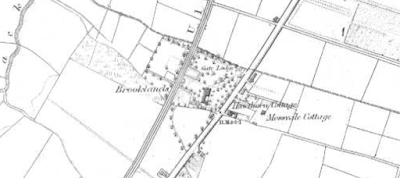
BROOKLANDS, Belfast, was a stuccoed Neo-Classical Georgian house of two storeys, built ca 1840 by John Owden on the site of an old farm.

It had a three-bay front, prolonged at one end by a two-bay single-storey wing, and a five-bay side; with a pilastered porch and a single-storey, partly-bowed projection on the side elevation.

The roof was eaved on a bracket cornice.

The original farm fronted the present Malone Road, though it was broken up by the new Lisburn Road in 1819.

The new railway line traversed the estate twenty years later.

Click to Enlarge

It was located approximately where Brookland Street is today, at 481 Lisburn Road.

*****

GROVE HOUSE, Regent's Park, London (initially called Grove Lodge) was designed by Decimus Burton and built in 1823-24 for George Bellas Greenough (the first president of the Geological Society and President of the Royal Geographical Society 1830-40), who had obtained a building lease from the Crown Estate.

On the death of Greenough in 1855, Grove House passed to Francis Smedley (High Bailiff of Westminster) and then to his son the author Francis Edward (Frank) Smedley.

Following his death Mrs Smedley continued to occupy the house until 1877.

The family connection was maintained by Thomas Greer who occupied the house from Christmas 1878 until death in 1905.

When the Greer family returned to Ulster in 1907, Grove House was purchased at auction by the artist Sigismund Goetze.

First published in October, 2013.  Owden-Greer arms courtesy of the NLI.

Monday, 27 October 2025

Rockport House

THE NEILLS OWNED 94 ACRES OF LAND IN COUNTY DOWN

ROCKPORT HOUSE, Craigavad, County Down, is a two-storey, three-bay Georgian house with basement and attic storey.

It has a single-storey porch with columns and Ionic-style columns.

The walls are rendered, with quoins.

A large wing or extension was added to the eastern elevation in 1919.

Rockport, engraved by E K Proctor, 1832 (historic OS map)

Rockport was built by John Turnly, of DRUMNASOLE, County Antrim, between 1800-1815.

John Turnly's younger brother Francis (1765-1845) of RICHMOND LODGE, Knocknagoney, County Down, had made a fortune in China and the East Indies.

The Turnlys appear to have sold all their land and property in County Down before 1870.

Click to Enlarge

Atkinson’s survey of 1823 described the house thus:-
"A good modern edifice ... embellished with plantations, and very neatly laid out. The lands appear in high heart; and in point of prospect, nothing can be more beautiful than that view of the town of Carrickfergus over the crystal surface of the bay which this seat commands.”
It is listed in the Townland Valuation of 1834 as a house and offices with steward and gardener’s houses, occupied by Mr Turnly.

Numerous outbuildings are listed, including piggeries, a boiling house and a carpenter’s shop.

In the late 1850s Turnly leased Rockport to Edward Stephen May, a son, I think, of the Rev Edward May, Vicar of Belfast, and very likely related to the MAY BARONETS.

It was remarked at the time that the house was,
“A fine substantial block of a house, but plainly built and furnished ... does not appear to be kept in very good order, offices inferior...Mr Turnly, the proper heir of this is a lunatic but John Turnly is his brother and receives the rent.”
Some time after 1867 the house was leased by a Greenock and Belfast merchant, Robert Neill, a partner in Neill, Fleming & Reid.

His son, Henry James Neill (1831-91), proprietor of Gelston's Irish Whiskey, purchased the property outright.

Although the Neills owned 94 acres in 1870, I feel confident that the original acreage, when Turnly lived there, would have been considerably greater.

Rockport pre-1919

A key-block within the front porch is dated 1871, with a corresponding monogram, HJN.

A third key-block is carved with a lion (presumably the Neill crest) and appears throughout the house on fireplaces (the school crest is a lion).

Henry James Neill had made a fortune providing a provisioning service for Australian gold miners.

Having married in Australia in 1856, he bought Rockport on his return to his native land and took on an ailing wine and spirits business which he directed to financial success.

Neill had a large family of twelve children and a grandson, the Rt Rev Stephen Neill, became a celebrated missionary, bishop and scholar.

Coachman’s and steward’s houses were added to the plot in 1882.

Column detail at Front Porch (Image: Timothy Ferres)

Henry James Neill died in 1891 and left the house to his widow Isabella, who herself died in 1898 in Cannes.

In 1904, the property was taken over by James T Barrett, when it was said to be "a very fine house, but old – a long way from road; vacant for a long time."

The owner had spent £200 on renovations.

At this time there were three sitting-rooms, nine bedrooms and a bathroom with hot and cold water; a large basement; and the house obtained water from a private supply.

In 1906, Rockport was taken over by Geoffrey Bing, who converted the house for use as a boys’ preparatory boarding school.

The first enrolment was four boys and Mr Bing, the headmaster, was assisted by one master and a matron.


In 1919 a large wing or extension was added to the eastern side of the house.

Adaptations included a football and cricket pavilion, and dormitory cubicles.

Geoffrey Bing was headmaster until 1945.

He was succeeded in the headmastership, from 1945-74, by Eric Tucker.

Entrance Front, 2017 (Image: Timothy Ferres)

Towards the end of his tenure the school became a charitable trust which introduced girls as well as weekly boarders and day pupils.

Building work took place in the 1970s which added a classroom block, additional changing-rooms and shower facilities.

Garden Front, 2017 (Image: Timothy Ferres)

A pre-prep section was also added to the school.

In the 1980s, pre-school and day care facilities were introduced; and in 1998 a Senior School.

The school now caters for about 200 pupils.

The grounds are thought to extend to 64 acres, and command a fine prospect of Belfast Lough and Carrickfergus on the County Antrim side.

First published in October, 2017.

Sunday, 26 October 2025

Pottinger Memorial

Armorial Bearings of Sir Henry Pottinger at St George's Church, Belfast

St George's Church, High Street, Belfast, is directly opposite the Merchant Hotel.

Prior to checking out of the hotel in July, 2011, I paid this elegant Georgian church a visit.

Click to Enlarge

There is a memorial plaque on the wall to Lieutenant-General the Right Honourable SIR HENRY POTTINGER Bt GCB, the first Governor of Hong Kong.

The supporters in Sir Henry's coat-of-arms are a mandarin holding a scroll in his right hand; and a Scinde soldier.

Sir Henry was born on the 25th December, 1789, at the family residence of Mount Pottinger, Ballymacarrett, County Down.

Henry and his two brothers attended Belfast Royal Academy in Academy Street, off Donegall Street, Belfast.

He left, however, at the age of thirteen, when Lord Castlereagh obtained for him a cadetship in the East India Company.

Henry Pottinger rapidly learned the principal languages of East Asia and gained a reputation as an exceptionally experienced soldier and traveller.

Consequently he was rapidly promoted and, in 1840, Lord Palmerston, then Foreign Secretary, appointed him Envoy and Plenipotentiary to the Emperor of China.

Following the Chinese defeat by British forces in the first opium war, Pottinger, in 1842, obliged the Emperor to sign the Treaty of Nanking, in which Hong Kong was ceded to the United Kingdom.

Pottinger became its first governor.

After serving in other colonial posts, Pottinger, his health declining, decided to return to the UK, but he died in Malta in 1856 and was buried in Valetta.

Despite his remarkable achievements, Pottinger was never really accepted by the establishment.

Despite being granted a baronetcy in 1839 (seemingly a hereditary peerage had been considered), his County Down accent was said to have been mocked by some aristocratic English politicians, and such financial rewards as he received were grudgingly conceded.

It was for this reason that, after his death, his brother William had a plaque erected in St George’s Church, Belfast, on which he bitterly lamented the ungracious treatment of Henry, which he attributed to “Hostile Influence” in governing circles.

The marble memorial in the church reads: 
ON CONCLUDING HIS SUCCESSFUL TREATY WITH CHINA,
IN THE YEAR 1842,
HE WAS DESTINED FOR THE PEERAGE
BY HER GRACIOUS MAJESTY QUEEN VICTORIA THE FIRST,
BUT LOST THIS HIGH DISTINCTION THROUGH THE SAME HOSTILE INFLUENCE
WHICH WAS EXERTED IN VAIN TO PREVENT PARLIAMENT REWARDING
HIS EMINENT SERVICES TO THE STATE

The Windsor Garden

The Windsor Garden painted by Mary Ward ca 1864

The Sunken Garden at CASTLE WARD, County Down, lies adjacent to the stable-yard.

To their great credit the National Trust has restored the sunken garden recently.

During the Victorian era, this parterre was particularly elaborate.

My old Nuttall's dictionary neatly describes a parterre as "a lay-out of flower-beds with intervening spaces to walk on."

Castle Ward's sunken garden had little or no grass at all, in fact.

Prior to its acquisition by the National Trust, it was known as The Windsor Garden.

(Image: The National Trust, 2018)

An extract from Irish Farming World, ca 1902 remarks:
The Windsor Garden, so called from being arranged according to a design at Windsor, is very interesting. The design is most admirably worked out of 61 beds of flowers in the flat all stocked at present with tuberous begonias, dwarf varieties of geraniums, with blue lobelia and yellow pyrethrum for bordering.

On the next terrace there are several beds of roses of the choicest and latest varieties; ascending a few steps more we came across a collection of beautiful and nicely coloured begonias...ascending to the archway is a good line of Florence Court yews here so tall and stately and the admiration of visitors...to the Pinetum where there is a beautiful collection of trees and shrubs with which his lordship manifests a great interest...
There used to be a small circular pond with a statue of Neptune brandishing his trident in the middle of the garden.

I've seen a water-colour (top) of the original Windsor Garden by MARY WARD as it was in Victorian times.

During the CASTLEWARD OPERA season  I occasionally picnicked on the terrace during the interval.

The Sunken Garden in 2013

There used to be a parterre at the elevated garden immediately to the rear of Florence Court House.

Parterres are thought to be particularly labour-intensive or time-consuming today.

 First published in May, 2009.

Saturday, 25 October 2025

Laganview House

Bank of Ireland Chambers (Image: Timothy Ferres, 2015)

93-95, ANN STREET, BELFAST, occupies a corner site which returns to 1, Oxford Street.

It comprises a three-storey, L-shaped, red-brick block with an attic floor.

The southern elevation is abutted by a three-storey building; whereas the western side comprises four storeys.

The ground floor has a door to the west with a sandstone pediment on brackets above the moulded granite architrave.

Dormer copings (below) boast octagonal finials, panels with relief carvings of urns and foliate decoration over dentilled cornices.

(Image: Timothy Ferres, 2015). Click to Enlarge.

The building is situated on a prominent corner of Ann Street and Oxford Street, facing the river Lagan and Queen's Bridge.

The Long Bridge, by Andrew Nicholl (1804-86)

In the 19th century the Pork Market occupied most of this block, and the Long Bridge crossed the river.

Riddel's Warehouse, at 87-91 Ann Street, stands directly beside Laganview House.

Ann Street elevation

The building was constructed in 1899 and designed by the architects Millar & Symes.

Construction of the Bank of Ireland (Queen's Bridge branch) began in the same year.

Aside from operating as a bank branch, the upper floors of Bank of Ireland Chambers were utilised as office space for a variety of local firms and organisations.

In 1907, for instance, the offices were occupied by insurance firms, grain merchants, and the headquarters of the Belfast Boys' Brigade, among others.
By 1918, the upper offices were occupied by the same Insurance agencies and merchants; however, the Boys' Brigade had vacated the site, whilst new occupants included an engineering firm and a boiler-making company.
During the 2nd World War the upper floors were occupied by the Northern Ireland Port Area Grain & Flour Committee, the Royal Liver Friendly Society, and Government offices.

By the 1950s, many of the upper offices were occupied by the Belfast Mersey & Manchester Steamship Company, a shipping and ferry firm that navigated the route between the two cities.

In 1993, the bank was described by Marcus Patton OBE, in his excellent historical gazetteer of central Belfast, as a
three-storey building in red brick on red sandstone ground floor and grey granite plinth, with attic gable and full height canted bay at chamfered corner entrance; ground floor pilasters with small rosettes at capitals.
In more recent years an attempt to demolish the former bank with the sole retention of the listed facade was rejected by the Planning Appeals Commission.

The former Bank of Ireland Chambers was occupied by the Northern Ireland Housing Executive until 2013.

OX Restaurant (Image: Timothy Ferres, 2015)

1, Oxford Street, is now the premises of the acclaimed restaurant OX.

I passed the premises on a Sunday morning; traffic was light, which made it easy to snap away to my heart's content.

Housing Executive signage remains at the main corner entrance to the block.

(Image: Timothy Ferres, 2015)

The outline of Bank of Ireland signage can still be discerned.

OX restaurant has a simple, unpretentious, almost austere aspect.

(Image: Timothy Ferres, 2015)

A simple sign hangs from the wall.


(Image: Timothy Ferres, 2015)

Its prospect is of the Beacon of Hope sculpture at the Queen's Bridge, at what was known as Canal Quay.

Laganview House, as it became known, was sold in January, 2017.

A bridal store opened on the ground floor in July, 2018.

First published in April, 2015.

Friday, 24 October 2025

Macartney of Lissanoure

THE MACARTNEYS WERE MAJOR LANDOWNERS IN COUNTY ANTRIM, WITH 12,532 ACRES

Of the Auchinleck branch of the ancient Scottish family of Macartney, MacCartney, or MacCarthy, was

GEORGE MacCARTNEY, who wedded, in 1522, Margaret, daughter of Godfrey MacCullogh, of Bank of Fleet, Kirkcudbright, Ayrshire.

His son,

PATRICK MacCARTNEY, married the daughter of John McLellan, and had an eldest son,

BARTHOLOMEW MacCARTNEY, of Auchinleck, Kircudbright, in 1597; who espoused, 1587, Mary, only daughter of John Stewart, of Auchinleck, and was father of

BARTHOLOMEW MacCARTNEY, who wedded Catherine, daughter of George Maxwell, and dvp leaving a son,

GEORGE MACARTNEY (1626-91), a Captain of Horse, born at Auchinleck, who removed to Ulster, 1649, and settled in County Antrim, where he acquired a large estate, and represented Belfast in parliament.

In 1671 he served as High Sheriff of County Antrim, and in 1688 proclaimed WILLIAM & MARY at Belfast, for which he was soon after obliged to flee to England, and was attainted at JAMES II's parliament held at Dublin, 1689.

Captain Macartney was restored on the settlement of the Kingdom.

He married firstly, Janet, daughter of Quentin Calderwood, and had issue (with three daughters),
James, MP for Bridport 1692-5;
Arthur, father of George, MP for Belfast 1721;
John, died young;
Bartholomew, died young;
George, died young;
Quentin, died young.
Captain Macartney wedded secondly, Elizabeth, daughter of Sir Stephen Butler, and had further issue (with a son, Chichester, dsp),

GEORGE MACARTNEY (1671-1757), MP for Belfast, 1692-1757, Limavady, 1703-13, Donegal Borough, 1713-14, called to the Bar, 1700, High Sheriff of County Antrim, Deputy Governor and Colonel of a Regiment of Militia Dragoons.

He married firstly, in 1700, Letitia, daughter and co-heir of Sir Charles Porter, LORD CHANCELLOR OF IRELAND; and secondly, Elizabeth Dobbin.

Colonel Macartney left issue by his first wife (with two other sons),

GEORGE MACARTNEY, who wedded, in 1732, Elizabeth, daughter of the Rev George Winder, and had issue,
GEORGE, 1ST EARL MACARTNEY, dsp 1806;
Letitia, m Godfrey Echlin, and dsp;
Elizabeth, m Major John Blaquiere; mother of ELIZABETH.
His granddaughter,

ELIZABETH BLAQUIERE (niece of Lord Macartney), married, in 1785, THE REV TRAVERS HUME (son of Gustavus Hume, of Dublin, State Surgeon, and had issue,
GEORGE, who assumed the name and arms of MACARTNEY;
Gustavus Thomas;
John;
Robert (Rev);
Elizabeth; Georgiana; Alicia; Anna.
The eldest son,

GEORGE HUME MACARTNEY JP DL (1793-1869), of LISSANOURE, MP for County Antrim, 1852-8, espoused, in 1828, Ellen, only surviving child and heir of Townley Patten Filgate, of Lowtherstone, County Dublin, and Drumgoolstown, County Louth, and had issue,
GEORGE TRAVERS, his heir;
Townley Patten Hume Macartney Filgate, of Lowther Lodge;
Martha Ellen; Elizabeth Jane; Anne Sophia.
This gentleman, whose patronymic was HUME, assumed, by Royal Licence, 1814, the surname and arms of MACARTNEY under the will of his grand-uncle George, 1st Earl Macartney.

He was succeeded by his eldest son,

GEORGE TRAVERS MACARTNEY JP DL (1830-74), of Lissanoure, Captain, 15th King's Hussars, who married, in 1865, Henrietta Frances, third daughter of Robert Smyth, of Gaybrook, County Westmeath, and had issue,
CARTHANACH GEORGE, his heir;
Helen Henrietta; Mabel Constance; Frances Rose.
Mr Macartney was succeeded by his son,

CARTHANACH GEORGE MACARTNEY JP (1869-1936), of Lissanoure, who wedded, in 1890, his cousin Margaret Tryphena Mabel, eldest daughter of Townley Patten Hume Macartney Filgate, of Lowtherstone, County Dublin, and had issue,
Dervock George Auchinleck (1891-1900);
GEORGE TRAVERS LUCY (1896-1943), of Lissanoure.
George Travers Lucy Macartney was the last member of the Macartneys to live at LISSANOURE CASTLE.

He was said to be eccentric and a spendthrift.

Mr Macartney purchased the Torr Head fishery and initiated several fruitless projects.

He died on holiday in County Cork on the 11th July, 1943.

Lissanoure estate was subsequently sold to the Mackie family, of Belfast, industrialists, but had already been requisitioned by the Ministry of Defence as a training base for British and American troops during the 2nd World War.

There was also a German prisoner-of-war camp at Lissanoure, and the Mackies did not get full possession until the end of the war in 1945.

First published in September, 2017.

Thursday, 23 October 2025

Burton Hall

THE  BURTONS WERE MAJOR LANDOWNERS IN COUNTY CARLOW, WITH 5,964 ACRES

SIR EDWARD BURTON, Knight, of Longner, Shropshire, representative of the family, was with EDWARD IV, successful in fourteen set battles between the Houses of York and Lancaster; and for his great loyalty and services, he was made knight-bannaret, under the royal standard in the field, in 1460.

Sir Edward was succeeded by his son,

SIR ROBERT BURTON, of Longner, who was knighted by EDWARD IV in 1478.

This gentleman received a grant of arms from John Writhe, Norroy King of Arms, in the same year, and was father of

SIR EDWARD BURTON, Knight, of Longner, Master of the Robes to HENRY VII. who wedded Jocosa, daughter of Thomas Cressett, of Upton Cressett, Shropshire.

He died in 1524, leaving, with a younger son, Thomas, an elder son, his successor,

JOHN BURTON, of Longner, who married Elizabeth, daughter of Thomas Poyner, of Boston, Shrophire, and had issue,
EDWARD, his successor;
Jane; Eleanor; Ankekoka; Ann; Ankred; Mary.
Sir Edward died in 1543, and was succeeded by his only son,

EDWARD BURTON (1510-58), of Longner, who wedded Ann, daughter and heir of Nicholas Madocks, of Wem and Coton, Shrophire, and had issue,
THOMAS, his heir (ancestor of BURTON of Longner);
EDWARD, of whom we treat;
Humphrey;
Timothy;
Mary; Dorothy; Katherine.
Mr Burton's second son,

EDWARD BURTON, had issue, two sons, who both settled in Ireland in 1610,
Francis, dsp;
THOMAS, of whom hereafter.
The younger son,

THOMAS BURTON, of Buncraggy, County Clare, whose will was proved in 1666, married Ann, daughter of _____ Shepherd, of Baycote, Herefordshire, and had issue (with two daughters), an only son,

SAMUEL BURTON, of Buncraggy, who married Margery Harris, and died in 1712, leaving issue,
Francis, of Buncraggy, MP;
Charles;
BENJAMIN, of whom hereafter;
Dorothea.
The third son,

BENJAMIN BURTON (c1665-1728), becoming an eminent banker in Dublin, was Lord Mayor of that city, 1706, MP for Dublin City, 1703-27, and High Sheriff of County Carlow, 1724.

He espoused, in 1686, Grace, elder daughter of Robert Stratford, of Belan, County Kildare, and had six sons, with as many daughters,
SAMUEL;
Robert;
Benjamin;
Edward;
Charles (Sir), MP for Dublin; cr a
BARONET;
Francis;
Mary; Grace; Elizabeth; Lettice; Abigail; Jane.
Mr Burton was succeeded by his eldest son,

SAMUEL BURTON (c1708-67), of Burton Hall, MP for Knocktopher, 1741-60, County Carlow, 1761-7, High Sheriff of County Carlow, 1724, espoused firstly, in 1708, Anne, daughter of Charles Campbell, of Dublin, and by her (who was killed by the fall of a scaffold at the coronation of GEORGE I in 1714) had issue,
BENJAMIN, his heir;
Hughes;
Samuel;
Katherine; Mary.
He was succeeded by his eldest son,

THE RT HON BENJAMIN BURTON (1736-63), of Burton Hall, MP for County Sligo, 1757-60, Boyle, 1761-3, High Sheriff of County Carlow, 1736,  a distinguished politician and statesman, who wedded, in 1734, the Lady Anne Ponsonby, daughter of Brabazon, 1st Earl of Bessborough, and had issue,
Benjamin, High Sheriff, 1760; MP for Sligo, 1757; d unm, 1763;
WILLIAM, succeeded to the estates;
Campbell;
Ponsonby;
Sarah; Anna. 
His second but eldest surviving son, 

WILLIAM HENRY BURTON (1739-1818), of Burton Hall, MP for Carlow County, 1768-1800, High Sheriff of County Carlow, 1760, married, in 1765, Mary, only child of Henry Aston, County Wicklow, and had issue,
BENJAMIN, his heir;
William Henry;
Martha.
Mr Burton's eldest son, 

BENJAMIN BURTON, of Walcot House, Stamford, Lincolnshire, born in 1766, married and was father of

WILLIAM FITZWILLIAM BURTON JP (1796-1844), of Burton Hall, High Sheriff of County Carlow, 1822, who wedded twice and had a numerous family.

His eldest son, 

WILLIAM FITZWILLIAM BURTON JP (1826-1909), of Burton Hall, High Sheriff of County Carlow, 1849, 4th Light Dragoons, married twice and was succeeded by his eldest son,

WILLIAM FITZWILLIAM BURTON (1849-1927), of Burton Hall, County Carlow, and Goltho Hall, Wragby, Lincolnshire, who married, in 1877, Georgiana Spencer, fourth daughter of Captain the Hon William Henry George Wellesley RN, and granddaughter of Henry, 1st Lord Cowley.

Mr Burton, High Sheriff of County Carlow, 1910, sold Goltho Hall in 1918.

His children assumed the additional surname of Mainwaring.

He was succeeded by his eldest son, 

MAJOR WILLIAM MAINWARING-BURTON (1881-1964), of Marsham Lodge, Gerrard's Cross, Buckinghamshire, who married and had issue.


BURTON HALL, near Carlow, County Carlow, a house of considerable significance, was begun in 1712.

It contained three storeys on a lofty plinth and nine bays, with a three-bay breakfront centre.

The doorway was rusticated, with many steps; bold quoins; a solid roof parapet.

A bow window was added to the garden front ca 1840, and the top storey was removed.

Burton Hall was sold by William Fitzwilliam Burton in 1927 (who died in the same year) and demolished five years later.

All that remains of Burton Hall's former existence is a three-bay, single-storey (over basement) granite building, originally a wing of the house, with carved stone dressings.

First published in May, 2012.