Thursday, 4 June 2026

Marley Grange

THE ROWLEYS WERE MAJOR LANDOWNERS IN COUNTY DUBLIN, WITH 3,659 ACRES

The noble family of ROWLEY is of Saxon origin, and was seated at Kermincham, Cheshire, in the reign of EDWARD II, in the person of RANDOLFE DE ROWLEY. This branch of the family settled in Ireland in the reign of JAMES I.


THE HON HERCULES LANGFORD BOYLE ROWLEY JP DL (1828-1904), of Marley Grange, County Dublin, younger son of Hercules, 2nd Baron Langford, High Sheriff of County Meath, 1859, Honorary Colonel, 5th Battalion, Prince of Wales's Own Leinster Regiment, married, in 1857, Louisa Jane, sister of 1st Baron Blythswood, and had issue,
HERCULES DOUGLAS EDWARD, his heir;
Arthur Sholto, 8th BARON LANGFORD;
Armine Charlotte; Gladys Helen Louisa; Evelyn Augusta.
Colonel Rowley was succeeded by his eldest son,

HERCULES DOUGLAS EDWARD ROWLEY JP DL (1859-1945), of Marley Grange, Lieutenant, 5th Battalion, Leinster Regiment, who wedded, in 1884, Agnes Mary, only daughter of A Allen, of Devizes, Wiltshire, and had issue,
Ivy Mabel Armine Douglas, b 1889;
Monica Evelyn Douglas, b 1893.

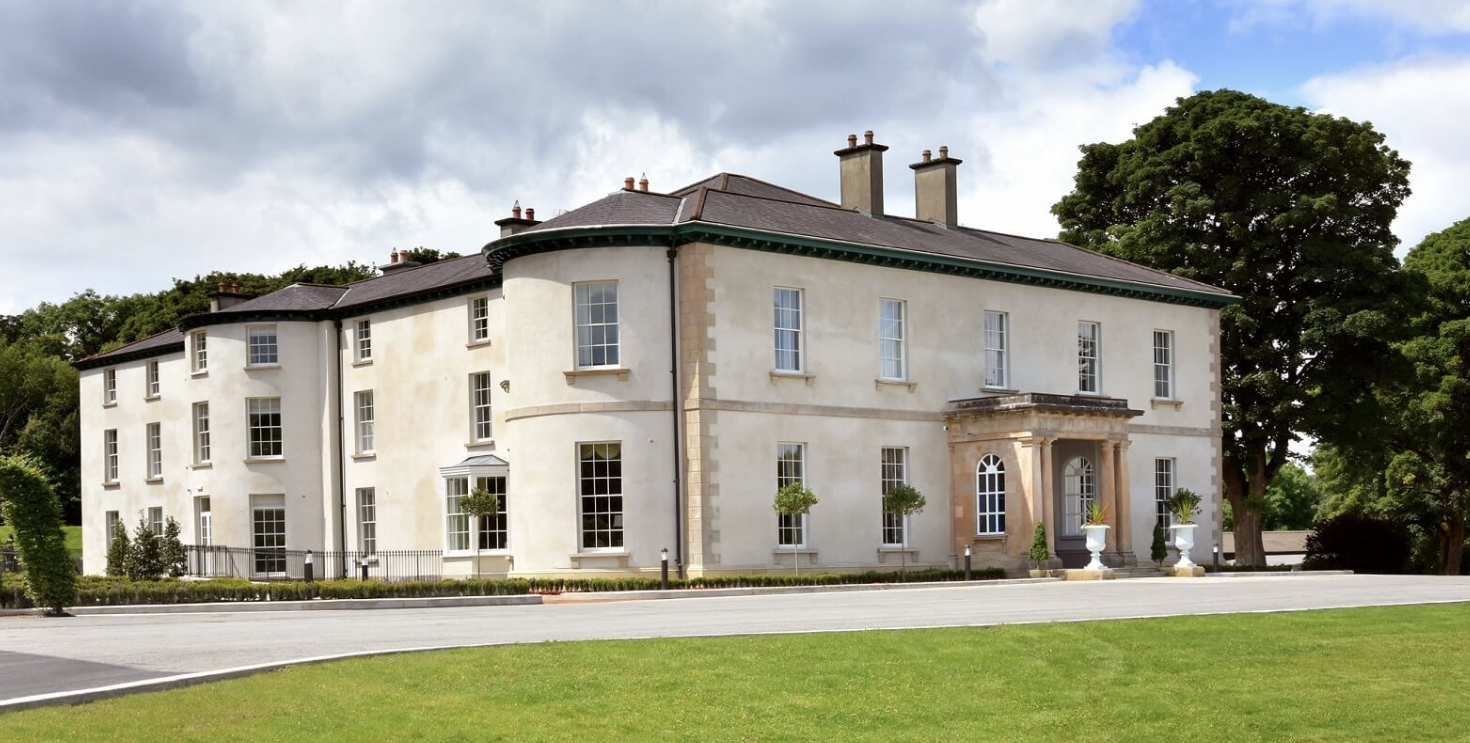
MARLEY GRANGE, near Rathfarnham, County Dublin, is an important cut-stone two storey high-roofed Victorian house built in the Gothic style ca 1850 in a woodland setting.

The house has gables, dormer gables, plus a tower with a truncated pyramidal roof.

There is a two-storey gate lodge located at the entrance.

Marley Grange is approached through an impressive entrance, via a long tree lined avenue, that leads to a large gravelled forecourt to the front of the house.

The extensive are interspersed with specimen trees, two ornamental ponds, trellis covered sunken pathway enclosing a semi-circular formal garden on the south gable of the house.

There is also a paddock and extensive woodland.

The property is bounded to the east by Three Rock Rovers hockey grounds; to the west by Grange Golf Club; and is beside Marley Park.

The house and estate were sold by the former owners, the McGrane family, in 2000, to the British Embassy in Dublin for £6.4 million.

It was intended to replace the ambassador's residence at Glencairn House.

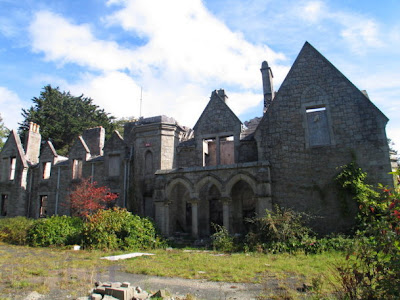
The house suffered a disastrous fire in 2010.

The estate agents Colliers apparently then agreed sale terms on the ten-bedroom house, which is acknowledged to be one of the few examples of late Victorian Gothic revival architecture in Ireland.

Colliers are understood to have settled for a price close to €2.5 million for the listed building and its 12.4 acres of woodland next to Marley Park, which are owned by the property developer and charity founder Niall Mellon.

The house was unoccupied and uninsured when it was set ablaze in July, 2010.

All that remain of the imposing cut-stone, two-storey, high-roofed structure dating from the 1870s are the walls.

However, because of its architectural and historical significance, the planners are anxious to have it restored to its former glory – a challenging project, which one expert says could cost anything from €1.5 million to €2 million.

Mellon bought Marley Grange from the British Embassy in 2008 after it dropped plans to use it as its ambassadorial residence.

The embassy had previously sold its long term residence Glencairn and its 34-acre grounds in Sandyford in 1999 for security reasons.

The entire property was acquired by Michael Cotter of Park Developments for €35.6 million.

The Foreign Office in London then wished to buy back Glencairn, without its substantial grounds.

Former town residence ~ 8 Cambridge Place, Kensington, London.

First published in May, 2012.

Chambré of Hawthorn Hill

THE CHAMBRÉS OWNED 1,281 ACRES OF LAND IN COUNTY ARMAGH


This family descends from JOHN DE LA CHAMBRÉ, who settled in Denbighshire, under Henry de Lacy, 3rd Earl of Lincoln, in 1275. He is stated (in a very ancient pedigree in Norman French) to have been descended from Johan de la Chaumbré, "a nobelle Normanne, who entered England in ye traine of King William ye Conqueraure." 

This John de la Chambré married Mawith, daughter of Blethyn Vaughan, and had a son,

HENRY CHAMBRÉ, of Lleweni, living in 1236, who wedded Katherine, daughter of Edmond Charlton, and was father of

JOSHUA CHAMBRÉ, of Lleweni.

The lineal descendent of this gentleman,

RICHARD CHAMBRÉ, Lord of the Manor of Petton, Shropshire, espoused Mary, daughter of John Hill, of Ludlow, Shropshire, and died in 1563, leaving a second son,

GEORGE CHAMBRÉ, of Petton, who married Judith, daughter and co-heir of Walter Calcott, of Williamscote, Oxfordshire, and had issue, with a daughter, three sons, all named Calcott,
Calcott, dsp;
Calcott, MP, of Carnew and Shillelagh;
CALCOTT, of whom hereafter;
Hester.
The youngest son,

CALCOTT CHAMBRÉ, of Coolatrindle, County Wexford, born in 1602, left issue, two sons, viz.
Calcott;
CALCOTT, of whom hereafter.
The younger son,

CAPTAIN CALCOTT CHAMBRÉ (-1753), of Wexford, married Mary, daughter of Oliver Walsh, of Dollardstown, County Kildare, and Ballykilcavan, Queen's County, by Edith his wife, sister of Raphael Hunt and had issue,
HUNT CALCOTT, his heir;
Chaworth Calcott, in holy orders;
Olivia.
The elder son,

HUNT CALCOTT CHAMBRÉ (-1782), of Carnew Castle, County Wicklow, wedded, in 1735, Anna Maria, eldest daughter and co-heir of William Meredith, and had, with other children (who died unmarried),
MEREDITH CALCOTT, his heir;
Ellinor; Anne; Henrietta.
The eldest surviving son,

MEREDITH CALCOTT CHAMBRÉ (1742-1812), of Hawthorn Hill, County Armagh, married, in 1785, Margaret, daughter and co-heir of George Faulkner, of County Dublin, and had issue,
HUNT WALSH, his heir;
William, Major-General;
Maria, m Rev R Henry, Rector of Jonesborough.
Mr Chambré was succeeded by his eldest son,

HUNT WALSH CHAMBRÉ JP (1787-1848), of Hawthorn Hill, Captain, Mullaglass Yeomanry, High Sheriff of County Armagh, 1829, who wedded, in 1813, Rebecca, only daughter of William Upton, of Ballinabarney, County Limerick, and had issue,
Meredith, 1814-79;
William;
HUNT WALSH, of whom hereafter;
John, of Hawthorn Hill;
Catherine; Anna Maria; Rebecca; Margaret Elizabeth;
Olivia Henrietta Elizabeth; Mary Frances; Jane Hunt.
The third son,

HUNT WALSH CHAMBRÉ JP (1831-1914), of Dungannon House, County Tyrone, espoused, in 1860, Mary Anne Brunette, daughter of John Brett Johnston, of Ballykilbeg, County Down, and had issue,
Hunt Walsh Alan, b 1861, his heir;
John Brett Johnstone Meredith;
William Thomas Meredith;
CHARLES BARCLAY MACPHERSON, of whom we treat;
John;
William Henry;
Thomasina; Rebecca Mary Brunette; Olivia Isabella Kathleen;
Jane Henry Wray Young Mabel; Kathleen Georgaina Evelyn.
The fourth son,

CHARLES BARCLAY MacPHERSON CHAMBRÉ JP (1870-1950), of Hawthorn Hill, High Sheriff of County Armagh, 1929, married, in 1906, Nina Lisa Francis Ochiltree, daughter of the Rev Alexander Stuart, and had issue, a son,

ALAN STUART HUNT CHAMBRÉ JP DL (1908-89), of Ringdarriff, Annahilt, County Down, who wedded, in 1933, Violet Aileen, daughter of Wickham Hercules Bradshaw Moorhead, and had issue,
JOHN ALAN, his heir;
Jean Mary, b 1938;
Rosaleen Aileen, b 1946.
His only son,

JOHN ALAN CHAMBRÉ (1939-), married, in 1968, Elizabeth Mildred, daughter of John Horace Willcox, and had issue,
WILLIAM WICKHAM MEREDITH, b 1969;
Thomas John Charles, b 1976;
Sophia Gabrielle, b 1971;
Kate Mabel Elizabeth, b 1978.

Hawthorn Hill pre-1922 (JAK Dean, Plight of the Big House)

HAWTHORN HILL was located at the foot of Slieve Gullion Mountain between Forkhill, County Armagh, and Newry, County Down.


It was built ca 1820 by Hunt Walsh Chambré.

The family is buried in Killeavy churchyard.

The house was burnt by the IRA on the 22nd May, 1922, as a consequence of which one third of the block was demolished (compare the two images).

Judging by the number of chimneys, at least seven rooms were abandoned.

The front door with its former semi-circular fanlight and Doric columns stands to the right in the image.

Hawthorn Hill (Image: Stately Homes)

The Chambré family continued to live at Hawthorn Hill, the last owner being Charles Barclay MacPherson Chambré, whose son, Alan Stuart Hunt Chambré, sold the land to the Department of Agriculture in 1951.

The sale of the house followed in 1968, though a member of the family continued to live in it until the early 1970s when it was abandoned due to bomb threats from the IRA.

In 1968, the Chambré family sold the remainder of the estate to the Northern Ireland Forestry Commission.

Hawthorn House was therafter used as its headquarters.

The demesne lies on the east-facing slopes of Slieve Gullion.

There are mature trees from the early 19th century, later exotics, and forest planting from the 1950s.

Modern landscaping and ornamental planting now form part of the walled garden and outbuildings, which now house the visitor centre for Slieve Gullion Forest Park.

The gate lodge of ca 1834 is opposite the entrance and replaced a lodge that was contemporary with the house.


SLIEVE GULLION COURYARD, Killeavy, County Down, remains and is used commercially for weddings and other functions.

It is located at the foot of Slieve Gullion with a walled garden to its north-west and Hawthorn House to its South.

There are two gate lodges: a modified back lodge to the north; and a restored gate lodge to the east, opposite the entrance gates to the park.

The early 19th century rectangular courtyard is enclosed to all sides by former stables and related farm buildings, now all refurbished as offices, apartments, conference centre and restaurant or service block by the Forest Service.

All buildings are constructed in coursed granite rubble with natural slate roofs.

The eastern side of the courtyard assumed its present form between 1861 and 1907.

It was sold to the Forestry Commission in 1968.

The present buildings were developed to provide resources for the local community and tourists and opened to the public in 1995.

The complex was taken over in 1999 by Clanrye Employment and Training Services, Newry.

I am seeking photographs of Hawthorn Hill

First published in March, 2016.

Wednesday, 3 June 2026

Sir Charles Lanyon

SIR CHARLES LANYON OWNED 1,951 ACRES OF LAND IN COUNTY ANTRIM


SIR CHARLES LANYON JP DL (1813–1889), son of John Jenkinson Lanyon, of Eastbourne, East Sussex, married, in 1835, Elizabeth Helen, daughter of Jacob Owen, of Portsmouth, and had issue, ten children, including, 
JOHN (1839-1900);
WILLIAM OWEN, of whom hereafter;
Louis Mortimer (1846-1919), m Laura, daughter of CV Phillips;
Herbert Owen (1850-1919), m Amelia, daughter of J Hind.
Sir Charles's second surviving son,

COLONEL SIR WILLIAM OWEN LANYON KCMG CB (1842-1887), Knight Commander of the Most Distinguished Order of St Michael and St George, Companion of the Most Honourable Order of the Bath.

 *****

Photo Credit: The Queen's University of Belfast

SIR CHARLES LANYON designed the famous Antrim coast road between Larne and Portrush.

He also designed and erected many bridges in the county, including the Ormeau Bridge (1860–63) over the River Lagan in Belfast.

Sir Charles laid out the Belfast and Ballymena railway lines, and its extensions to Cookstown and Portrush; was engineer of the Belfast, Holywood and Bangor Railway; and the Carrickfergus and Larne line.

He was the principal architect of some of Belfast's best-known buildings, including the Queen's College, now University (1846-9); the old Court-House (1848-50); Crumlin Road Gaol (1843-5); and the Custom House (1854-7).

His palm house at the Botanic Gardens, Belfast, built in two phases between 1840-52, is notably one of the earliest examples of curvilinear iron and glass.

Much of Lanyon's work was carried out in private practice, in which he was assisted by two partners: W H Lynn; and latterly his eldest son John, from 1860.

Lanyon resigned the county surveyorship in 1860, and then retired from practice completely following the breakup of his firm in 1872, to devote his energies to public life, in which he was already involved.

Sir Charles served the office of Mayor of Belfast, 1862,  and was MP for Belfast, 1865-68.

He was one of the Belfast Harbour Commissioners, a Deputy Lieutenant, and a magistrate.

In 1862, Sir Charles was elected President of the Royal Institute of Architects of Ireland, and held office until 1868, when he received the honour of Knighthood, which was conferred by His Grace the Duke of Abercorn, Lord Lieutenant of Ireland.

In 1876, he served as High Sheriff of County Antrim.


Sir Charles died, after a protracted illness, at his residence, The Abbey, in 1889, and was buried at Knockbreda cemetery, near Belfast.


THE ABBEY, Whiteabbey, County Antrim, was designed by Charles Lanyon for Richard Davison MP (1796-1869), on the site of Demyat, a gentleman’s cottage on the site inhabited by Samuel Gibson Getty (1817-77).

Abbey House is an imposing two-storey, multi-bay, Italianate stucco house, built ca 1855 to designs by Sir Charles Lanyon, as a private residence for a client, though shortly afterwards becoming his own home and reflecting his personal taste.

Entrance Front in 2017

Despite the degradation of its setting and years of neglect, the house remains a handsome edifice, with ornate stucco detailing and the Italianate styling typical of Lanyon’s work.

Internally, while the house has undergone some remodelling for use as an administrative block, its plan from and detailing survive, although suffering serious decay.

It is said that Abbey House is an important structure, historically and architecturally, of robust character, especially given its association with Lanyon.

The Abbey takes its name from the ancient monastery which originally stood in a field near by.


The abbey was built by the Cistercian religious order (Trappist Monks) ca 1250, but was damaged by the army of Edward the Bruce in 1315.

The ruins of the White Abbey survived for centuries but today there are no visible remains.

The present Victorian house is ‘L’ shaped in plan, with an additional rectangular building located to the north-west.

Garden Front with Annexe in 2017

In 1832, the the site was occupied by a smaller, though fairly substantial, dwelling occupied by Mrs Matthews.

At that time the description detailed a ballroom, stable, scullery and dairy and a square tower.

The Abbey, inhabited by Richard Davison, was described thus:-
'…a very superior first class house built 12 years ago… Cemented and stone finished with stone quoins and dressings…very [finely] situated and close to Whiteabbey Station’.
The gate lodge was  '…very neat & well finished’.

Also listed in the entry for The Abbey was a cow-house, stables with a bell [tower attraction], and a green house.

Garden Front in 2017

Documents of 1862-64 list the occupier as Charles Lanyon.

Following Lanyon’s death in 1889, The Abbey remained vacant for about six years.

Records show that the leasehold has transferred to Granville Hotels Company, although the freehold was still owned by the Lanyon family.

In 1906, the house was described as ‘auxiliary workhouses, gate lodges and land’.

The ownership was revised from Guardians of Belfast Union to Belfast Corporation in 1916, and the property was described as ‘auxiliary workhouse, gate lodges, office, hospital for consumptives and land’.

In 1913 this entry was crossed out with the exception of the gate lodges, and "electric power house" was inserted, indicating a change of use.

Abbey House was listed as a "municipal sanatorium, gate lodges, electric power, house, office and land" about 1935, with the occupier stated as being Belfast Corporation (City Council).

The private treatment centre became Whiteabbey Sanatorium during the 1st World War, and became Whiteabbey Hospital in the 1930s.

Admittedly I haven't visited Whiteabbey Hospital - or whatever it's called today - though it seems to have been spoiled by hideous painting.

Its future is uncertain.

First published in May, 2014.

Tuesday, 2 June 2026

Parkanaur Manor

THE BURGESES OWNED 2,485 ACRES OF LAND IN COUNTY TYRONE


The surname of this family, as appears from ancient documents, was formerly De Burges, afterwards Burches, and subsequently, in 1747, the present one was adopted. Richard De Burges was High Sheriff of Herefordshire, 1351-2.

SAMUEL BURCHES, born in Dublin, ca 1645, married, in 1684, Margaret Williams, of Llanelian, North Wales, and had issue,
David (Rev), Rector of St Mark's, Dublin;
Wilham;
JOSEPH, of whom we treat;
Katherine; Deborah.
Both brothers eventually moved northwards to the city of Armagh during the primacy of Archbishop Lindsay, with whom they were connected.

The youngest son,

JOSEPH BURCHES (1689-1747), baptized at St Michan's Church, Dublin, wedded, in 1716, Elizabeth, daughter of Ynyr Lloyd, of East Ham, Essex (Deputy Secretary of the East India Company), and had issue,
Joseph (Rev), 1717-46;
JOHN, of whom hereafter;
YNYR, of East Ham;
Molly; Margaret; Alice.
Mr Burches' second son,

JOHN BURGES (1722-90), espoused, in 1763, Martha, daughter of Robert Ford, and had issue,
JOHN HENRY, his heir;
Mary, m 1784, G Perry, of Mullaghmore, Co Tyrone;
Martha, m 1787, J Johnston, of Knappagh, Co Armagh;
Alice, died in infancy.
His only son and heir,

JOHN HENRY BURGES JP (c1768-1822), of Woodpark, Tynan, and Parkanaur, both in County Armagh, High Sheriff of County Armagh, 1802, married, in 1795, Marianne, eldest daughter and eventually co-heir of Sir Richard Johnston Bt, of Gilford, and had issue,
JOHN YNYR, his heir;
Richard, deceased;
Margaret Anne;
Matilda, d 1805.
The only surviving son,

JOHN YNYR BURGES JP DL (1798-1889) of Parkanaur, County Tyrone, Thorpe Hall, Essex, and East Ham, Essex, High Sheriff of County Tyrone, 1829, wedded, in 1833, the Lady Caroline Clements, youngest daughter of Nathaniel, 2nd Earl of Leitrim KP, and had issue,
YNYR HENRY, his heir;
Charles Skeffington, 1835-45;
Clements Keppel, d 1840;
John Richard Alexander Wamphray, 1843-50;
Mary Anne Margaret; Alice Caroline.
The eldest son,

YNYR HENRY BURGES JP DL (1834-1908), of Parkanaur, High Sheriff of County Tyrone, 1869, espoused, in 1859, Edith, third daughter of the Hon Richard Bootle-Wilbraham, and sister of the 1st Earl of Latham, and had issue,
YNYR RICHARD PATRICK (1866-1905), High Sheriff of Co Tyrone, 1898; father of YNYR ALFRED;
John Ynyr Wilbraham (1871-95);
Edith Alice; Ethel Margaret; Lilian Adela; Myrtle Constance; Beatrice Annette; Irene Caroline.
Colonel Burges, officer commanding 6th Brigade, Northern Ireland Division, Royal Artillery, married secondly, in 1896, Mary, daughter of George Pearce, of Bishops Lydeard, Somerset.

He was succeeded by his grandson,

YNYR ALFRED BURGES JP DL (1900-83), of Parkanaur, High Sheriff of County Tyrone, 1939, County Armagh, 1951, who wedded, in 1930, Christine, daughter Colonel George Iver Patrick O'Shee (by his wife, the Lady Edith King-Tenison), and had issue,
MICHAEL YNYR, b 1931;
Susan Elizabeth, b 1934;
Patricia Anne, b 1936.
Major Burges, who lived, in 1976, at Catsfield Manor, Battle, Sussex, was succeeded by his son,

MICHAEL YNYR BURGES, Lieutenant, Royal Inniskilling Fusiliers; in the Belfast Linen trade, 1950-74, at Belfast; who lived, in 1976, at Skinners, Edenbridge, Kent.

*****

The BURGES estate, East Ham, Essex, was established by Ynyr Burges, Paymaster, East India Company, between 1762 and his death in 1792, at a total cost of £20,700.

He was succeeded by his daughter Margaret, wife of Sir John Smith-Burges Bt, a director of the East India Company.

In 1799, the estate comprised 422 acres.

Sir John died in 1803.

In 1816, his widow married John, Earl Poulett.

Lady Poulett, who was childless, was succeeded by John Ynyr Burges, grandson of her father's elder brother.
In 1838, the estate produced an income of £1,549, but by 1840 this had been increased to £2,471. An estate map drawn in 1881, which includes details of recent and later changes, shows that most of the property lay near the present town centre.
John Ynyr Burges, who died in 1889, was succeeded by his son, Colonel Ynyr Henry Burges, who was largely responsible for developing the estate for building.

He had started to do so, on his father's behalf, about 1887, and continued until his own death in 1908.

Colonel Burges was succeeded by his grandson, Major Ynyr Alfred Burges, who completed the development of the estate during the 1920s.

Ynyr Burges (d 1792) lived at East Ham for most of his life.

As a boy he was adopted by his uncle, Ynyr Lloyd, deputy secretary of the East India Company.


PARKANAUR MANOR, near Castlecaulfield, County Tyrone, is a large, rambling, romantic, Tudor-Revival house which has evolved over many years.

Originally the land was held by the O’Donnellys until granted by JAMES I to Sir Toby Caulfeild in the early 1600s.

The growing importance of the house from retreat to home to seat is reflected in the graduated scale of the different parts.

When Ynyr Henry Burges settled on the estate in the 1820s, the cottage was enlarged.

His son, John Ynyr, added further to the building from 1839-54, encasing the original building and adding a west wing.

This new house was then named Parkanaur and was built from block rubble on a larger scale.


Parkanaur has a grand, terraced front with octagonal shafts (or pinnacles) and gables at each projection of the façade; a big bay window and an upper oriel; and is comparable to Narrow Water Castle in County Down, again by the Newry Architect, Thomas Duff.

The original two-storey dwelling is still visible with the new building adjoined to it.

The large plate windows of the 1820 and 1839 additions have mullioned windows with leaded lights and transformed frames.

They are shielded by block drip-stones.


The present, higher west wing, lying along the terrace, was laid in 1843.

It doubles back to form an upper yard which has a coach house and a tower intended for hanging meat.

A free-standing office block was added in 1870.

A plaque above the doorway leading to the court is inscribed “This house and offices were built by John Ynyr and Lady Caroline Burges without placing any debt upon the property (A.D. 1870)”.

The cost of the works was specified not to exceed £5,000.

The house remained within the ownership of the Burgeses until 1955, when Major Ynyr Burges and his family moved to Catsfield Manor in East Sussex.

The house lay vacant until 1958 when it was bought by the millionaire Thomas Doran for £13,000 as a gift for his friend, the Rev Gerry Eakins.

Mr Doran had originally come from near Castlecaulfield but had emigrated to the USA as a teenager, where he made his fortune as the founder of The Cheerful Greetings Card Company.

The reason for purchasing the house was to facilitate his friend Gerry Eakins in developing a new centre for the education of handicapped young adults.

The house reopened in 1960 as The Thomas Doran Training Centre (Parkanaur College) and much of the house continues today in this role.

Parkanaur boasts rich, Elizabethan-style interiors.

It has a great hall lit by its three perpendicular windows, with a Tudor-style, arched screen and minstrel's gallery at its south end.

Older work includes the 17th Century Jacobean carved, wooden mantel with male and female figures, and an imported dining-room chimney-piece dated 1641 with Ionic columns, decorated with bunches of grapes and interspersed with spiralling vines and cherub heads below the shelf.

In the Duff Wing, Mrs Burges's sitting room, the drawing room (which has a strap work mantel) and a further octagonal room have lofty Jacobean ceilings.

There is a pretty, mid-17th century Baroque organ-case in the gallery.

Parkanaur is set in beautiful grounds. It boasts a rare herd of white fallow deer.

Much of the original estate remains in the ownership of the NI Forest Service.

As previously stated, the present Tudor-Revival house was begun in 1839 by John Ynyr Burges after he succeeded to the property in 1838, though this building may incorporate elements of the 18th century house on the site.

A wing was added by Duff in 1858 and the whole complex of house and yards completed by 1870 as detailed above, including stable-yard, terrace, retaining wall, gates and urn.

The mansion is enhanced by lawns and parkland, with a small, modern ornamental garden.

Formal gardens on the west side of the house are not planted, but yews and a terrace survive.

The demesne dates from the late 18th century and is on undulating ground; is well planted, with a mixture of mature trees in woodland and parkland, including some unusual trees, exotics and forest planting.

The NI Forestry Service is developing the site as an oak forest and for native conifers.

It is referred to now as ‘a lowland broad-leaved estate’.

This continues a tradition noted by Deane, who describes the demesne thus:
… immaculately tended grounds, wooded by the planting of 40,000 trees by John Henry (Burges) are two avenues leading from two gate lodges added in the mid 1840s.
There is a walled garden, no longer planted up, which has a castellated potting shed in the eastern corner and a large, fine lean-to glasshouse used for peaches, with an extending centre piece.

This was erected in 1873 by J Boyd & sons for £250.

There are remnants of an ornamental area east of the house, between the house and the walled garden, which is oval in shape; retained paths, yews and an urn.

A pond and riverside walks in woodland have been maintained by the Forest Service.

The gate lodge, gates and screen, also by Duff ca 1845, are fine and are listed.

The local and main road have been realigned.

In 1976 the NI Department of Agriculture bought 161 hectares and subsequently more land was acquired, including the stable yard, to allow the provision of facilities for the Forest Park.

Five white fallow deer arrived from Mallow Castle, County Cork, in 1978 and they are the basis of the present herd.

The grounds were opened to the public as Parkanaur Forest Park in 1983.

Parkanaur is open to visitors for functions. 

First published in October, 2010.  Burges arms courtesy of the NLI.

Randalstown

EDITED EXTRACTS FROM THE TOPOGRAPHICAL DICTIONARY OF IRELAND, 1837


RANDALSTOWN, a market and post-town (formerly a parliamentary borough), in the parish of Drummaul, barony of Upper Toome, County Antrim.

Timothy Ferres, 2024

This place, which is situated on the River Maine, was from that circumstance called Mainwater, and also Ironworks, from the forges and furnaces formerly in extensive operation.


In the war of the Revolution the town was the headquarters of the Earl of Antrim's forces, who marched hence for the siege of Derry; and in the disturbances of 1793, a body of the insurgent forces attacked it, burned the market-house, and continued their devastations till the approach of Colonels Clavering and Durham, on the evening of the same day, when they retreated to Toome bridge.

In 1683, CHARLES II, in consideration of a fine of £200, granted to Rose, Marchioness of Antrim, the Manor of Edenduffcarrick [Shane's Castle], with all its rights and privileges, and constituted the town of Ironworks a free borough, with power to return two members to Parliament, to be chosen by the majority of the inhabitants, on precept to the seneschal of the manor issued by the sheriffs of Antrim.

The borough continued to return two members till the Union, when the franchise was abolished.

The town is pleasantly situated on the western bank of the River Maine, over which is a handsome bridge of nine arches.

Former barracks (Timothy Ferres, 2024)
The barracks for the staff of the county militia, whose headquarters and depot are here, are well built. This row of terraced houses was built in 1816 by the Earl O'Neill, Colonel, to serve as the barracks, which at that time comprised four officers and 93 soldiers; and it cost £2,000 (about £162,000 in 2024). Part of the parade ground remains in front of the houses, though originally it extended for about 120 yards beyond the viaduct. The barracks were sub-divided into separate dwellings in the 1860s, when the front porches were added.
Former hotel (Timothy Ferres, 2024)
The former inn was reputedly built in 1750 by Charles O'Neill, father of 1st Viscount O'Neill, as the O'Neill Arms Hotel and Posting House. Between 1824-35 it was leased to John Cooper, Quartermaster-Sergeant of the Antrim militia, and became Cooper's Hotel. In the early 20th century the erstwhile hotel became a private residence; while the curved section fronting onto Main Street became a police barracks from 1897-1936.
THE chief trade is the spinning of cotton and the weaving of calico, for which there are extensive mills; and there is a large bleach-green.

Market House, Randalstown (Timothy Ferres, 2024)

The market is on Wednesday and is abundantly supplied with wheat, flour, meal, and pork being sent to Belfast; there is also a market for linen and linen-yarn.


The market-house, in which are an assembly-room and rooms for holding the various courts, is a neat and well-arranged building.

There is a constabulary police station in the town.

(Timothy Ferres, 2024)

A manorial court, which is the property of the [first and last] Earl O'Neill, is held before the seneschal every month, at which debts not exceeding £20 are recoverable; and a court leet annually, at which a weigh-master, a market jury, and constables are appointed.

Memorial in parish church to 1st Earl O'Neill (Timothy Ferres, 2024)

The parish church, a handsome structure built in the early English style, 1832, with an octagonal freestone spire, is situated in the town, and stands on the site of a church erected in 1709.

Memorial to 3rd Viscount O'Neill (Timothy Ferres, 2024)

It cost £1800 [about £168,000 in 2024], of which the Earl O'Neill subscribed £300, besides giving a fine-toned organ.

O'Neill vault in graveyard of Drummaul parish church (Timothy Ferres, 2024)

Lord O'Neill has also built a beautiful mausoleum for his family close to the church, the family burial-place having been at Edenduffcarrick [Shane's Castle] since 1722.
The mausoleum was built ca 1838 at a cost of £500. It  is made of sandstone in classical style standing on a stepped base in a flagged enclosure bounded by a low plinth wall surmounted by iron railings. Fluted brackets and pediments adorn each face of the tomb; railings are ornamented with Palmette motifs alternating with spear-like finials. Inside the gateway are two large stone blocks set with iron rings for lifting and revealing access to the vault below. The tomb has a raised shield-like stone plaque on each short face; there are, however, no inscriptions. There are niches for eighteen coffins.
O'Neill vault (Timothy Ferres, 2024)

There are also a spacious and well-built RC chapel, two Presbyterian places of worship, and a dispensary.

Randalstown ca 1830 (Image: historic OS map). Click to enlarge.

THE land in the parish of DRUMMAUL, with the exception of a few farms, is in a very indifferent state of cultivation; there are bogs containing about 2,800 acres.

The Earl O'Neill's gorgeously wooded demesne of Shane's Castle, and for many years the seat of his family, occupies most of the vale southward to Lough Neagh, and the grounds and plantations extend far on both sides of the River Maine.

The mansion was destroyed by fire in 1816, and is now in ruins; the park, which is well stocked with deer, is ornamented with fine timber.

Millmount, the seat of agents to Lord O'Neill, Hollybrook, and Sharvogues are also in the parish.

The living is a vicarage, in the diocese of Connor, and in the gift of the Marquess of Donegall, in whom the rectory is impropriate.

My friend Heather visited Randalstown recently:-
"Yesterday I  discovered Antrim and Newtownabbey Borough Council's wonderful work in maintaining the top of the Randalstown viaduct as a charming walk with lovely views over the village and the river, and with planting and seating (essential for those of us beginning to crumble!) along its length." 
 
"The 73ft (22m)-high Victorian viaduct was designed by Charles Lanyon and built by William Dargan in 1855-6, its eight arches carrying steam trains over the River Maine on the routes from Belfast to Cookstown and Ballymena."
 
"Randalstown railway station closed in 1950, and the final train passed over the viaduct in 1959. A regeneration programme in the late 1990s saw the creation of a walkway, and in 2022 the Elevation Community Garden was opened." 
"Today Antrim and Newtownabbey Borough Council maintain the walkway and planting to the same high standards as those seen in the Antrim Castle Gardens."

Monday, 1 June 2026

Stewart of Rockhill

THE STEWARTS, OF ARDS, OWNED 39,306 ACRES OF LAND IN COUNTY DONEGAL


ALEXANDER STEWART (1746-1831), second son of Alexander Stewart MP, of MOUNT STEWART, County Down, and younger brother of Robert, 1st Marquess of Londonderry, purchased the estate of ARDS from the Wray family, and settled there in 1782.

Mr Stewart, High Sheriff of County Donegal, 1791, espoused, in 1791, the Lady Mary Moore, younger daughter of Charles, 1st Marquess of Drogheda, by the Lady Anne Seymour his wife, daughter of Francis, 1st Marquess of Hertford, and had issue (with other children, who died young),
Alexander Robert, of Ards, his heir;
Charles Moore (Rev);
JOHN VANDELEUR, of whom we treat;
Maria Frances; Gertrude Elizabeth.
The youngest son,

JOHN VANDELEUR STEWART DL (1802-72), of Rock Hill, near Letterkenny, County Donegal, High Sheriff of County Donegal, 1838, wedded, in 1837, the Lady Helen Graham-Toler, daughter of Hector John, 2nd Earl of Norbury, and had issue,
ALEXANDER CHARLES HECTOR, his heir;
Hector Brabazon (Rear-Admiral);
Robert Seymour;
CHARLES JOHN, of whom hereafter;
Elizabeth Georgina.
Mr Stewart was succeeded by his eldest son,

ALEXANDER CHARLES HECTOR STEWART (1838-1917), of Rock Hill, a major-general in the army, High Sheriff of County Donegal, 1881, who married, in 1872, Gertrude Mary, daughter of Eric Carrington Smith, and had issue, an only child,
Kathleen, b 1875; m, 1904, Captain P A MacGregor DSO.
John Vandeleur Stewart's youngest son,

SIR CHARLES JOHN STEWART KBE (1851-1932), of Rockhill, espoused, in 1884, the Lady Mary Catherine Graham-Toler, daughter of Hector John, 3rd Earl of Norbury, and had issue,
Gerald Charles (1888-1915), killed in action;
John Maurice (1895-1915), killed in action;
Helen Margaret; Eirene Mary; Marjorie Alice.
Rockhill House (Rockill House website, 2021)

ROCK HILL HOUSE, near Letterkenny, County Donegal, was originally a three-storey Georgian house of ca 1760, with basement, comprising three bays on either side of a central curved bow.

Its new owner, John Vandeleur Stewart, built a two-storey, five-bay addition to the original house about 1853.

The Victorian building was the same height as the Georgian one.

The present mansion appears to have replaced an earlier Plantation dwelling of the early 1600s, associated with the Pratt family of CABRA, County Cavan.

Captain Thomas Chambers acquired the lands in 1660, and the Chambers remained there until 1832, when Daniel Chambers sold the house and its 237 acre estate to John Vandeleur Stewart for £900 (equivalent to about £70,000 in 2021).

Rockhill House (Robert French/Lawrence Collection/NLI)

J V Stewart proceeded to build a large two-storey block, attached to the original Georgian house, ca 1853. 

His son,  Major-General Alexander Charles Hector Stewart, used Rockhill occasionally; as did his son, Sir Charles John Stewart, KBE, a barrister based in London.

Sir Charles and Lady Stewart were bereft by the deaths, in 1915, of their two sons, both killed in action during the 1st World War, and Rockhill was abandoned in 1927.

Many of the house contents were shipped to the Stewarts' new home in Scotland, and they authorized the sale of the estate.

Rockhill House: Georgian block (Rockhill House website, 2021)

With nobody occupying the estate, Rockhill was taken over by Anti-Treaty IRA forces upon the outbreak of Civil War in Ireland in 1922.

In 1927-30 Rockhill became a Preparatory College for student teachers; the estate, however, thereafter fell into decline and, in 1937, was sold in various lots to the Irish Commissioners of Public Works.

The Irish Department of Defence occupied 29 acres of grounds from the 1940s, and accommodated the Irish Army on a permanent basis from 1969 until 2009, when it closed due to government cutbacks.

Rockhill House has recently been extensively renovated and re-opened as a country house hotel.

First published in May, 2022.  Stewart arms courtesy of the NLI.

The Macartney Baronets

GEORGE MACARTNEY (c1630-1702), son of George Macartney, the last of the Macartneys of Blacket, parish of Urr, Kirkcudbrightshire, settled in Belfast in the 1650s.

He married and had two sons,
George,  Lieutenant-General in the army;
ISAAC, of whom we treat.
Mr Macartney, sometimes known as "Black George" to distinguish him from his kinsman, George Macartney (1626-91), prospered in the town of Belfast, where he was a merchant and ship-owner; Burgess, 1665; and served four terms as Sovereign or Mayor.

Mr Macartney's younger son,

ISAAC MACARTNEY (c1670-1738), possessed a large estate in Ulster, and served as High Sheriff of County Antrim, 1690.

Mr Macartney spent £40,000 in constructing the docks and quays at the port of Belfast.

He wedded Anne, sister and co-heiress (with her sister, the wife of John MacDowall, of Freugh, and grandmother of Patrick, Earl of Dumfries) of John Haltridge, of Dromore, County Down, MP for Killyleagh, 1703-25, and had issue,
GEORGE, High Sheriff of Co Antrim, 1743, Sovereign of Belfast, 1749/50/51/56/59/63;
WILLIAM, of whom hereafter;
Grace, m Sir Robert Blackwood Bt.
The younger son,

WILLIAM MACARTNEY (1714-93), MP for Belfast, 1747-60, espoused Catherine, daughter of Thomas Bankes, of the family of Bankes of Corfe Castle, Dorset, and had issue,
ARTHUR CHICHESTER (1744-1827), KC, of Murlough, County Down;
JOHN, of whom we treat;
five daughters.
William Macartney MP, his wife Catherine, and their daughter

The second son,

JOHN MACARTNEY (1747-1812), of Lish, County Armagh, MP for Fore (Co Westmeath), 1792-7, Naas, 1798-1800, received the honour of knighthood in 1796 for his exertions in promoting the inland navigation of Ireland.

Sir John was created a baronet in 1799, designated of Lish, County Armagh.
The territorial designation "Lish" is somewhat curious, given that there is no townland or civil parish by that name to the best of my knowledge. 
It might refer to the townland of TULLYLISH, which sits on the River Bann between Banbridge, County Down, and Portadown, County Armagh.
He married firstly, Miss Anne Scriven, descended from the Barclays of Urie, in Scotland, and had issue,
WILLIAM, his successor;
Isaac;
John;
Arthur;
Elizabeth; Maria; Anna.
Sir John wedded secondly, Catherine, daughter of the Rt Hon Walter Hussey Burgh, Chief Baron of the Irish Exchequer, and had a son and daughter,
Hussey Burgh;
Catherine.
He was succeeded by his eldest son, 

THE REV SIR WILLIAM ISAAC MACARTNEY, 2nd Baronet (1780-1867), of Lish, Rector of Desertegny, County Donegal, who married Ellen, daughter of Sir James Barrington Bt, and had issue,
JOHN;
William;
Sophia; Anna; Georgina; Fanny; Maria.
Sir William was succeeded by his eldest son,

SIR JOHN MACARTNEY, 3rd Baronet (1832–1911), who migrated to Jolimont, Mackay, Queensland, Australia, and wedded, in 1865, Catherine, daughter of Alexander Miller, by whom he had issue,
WILLIAM ISAAC, his successor;ALEXANDER MILLER, 5th Baronet;
John Barrington, father of the 6th Baronet;
Herbert Charles;
Robert Graham;
David Edwin;
Harold Eric Joseph;
Victor Alan.
The eldest son,

SIR WILLIAM ISAAC MACARTNEY, 4th Baronet (1867-1942), died unmarried, when the title devolved upon his brother,

SIR ALEXANDER MILLER MACARTNEY, 5th Baronet (1869-1960), who died unmarried, when the baronetcy reverted to his first cousin,

SIR JOHN BARRINGTON MACARTNEY, 6th Baronet (1917-99), a dairy farmer, who espoused, in 1944, Amy Isobel Reinke, and had issue, an only child,

SIR JOHN RALPH MACARTNEY, 7th and present Baronet (1945-), of Mount Pleasant, Queensland, Australia, who married, in 1966, Suzanne Marie Fowler, and has issue, four daughters,
Donna Marie;
Karina Lee;
Katharine Ann;
Anita Louise.
Sir John is a former Petty Officer, Royal Australian Navy; Malaya and Vietnam 1968–69; in 1979, a teacher at Bruce College Technology.

Isaac Macartney

ISAAC MACARTNEY (c1670-1738), merchant and shipowner of Belfast, was the son of another merchant and shipowner, "Black" George Macartney.

This Isaac was High Sheriff of County Antrim, 1690, and a Burgess of Belfast, 1701-07.

He built George and Hanover Quays in Belfast at his own expense; though was ruined by his brother-in-law's debts, his own "inattention to business", and the inefficiency of trustees appointed to manage his estates.

Mr Macartney was a Presbyterian and a leading elder of First Belfast Presbyterian Church between 1709-16.

He had an annual income of £400 from leasehold properties in Belfast and inherited his wife's estates in Counties Down and Armagh. His wife was Anne Haltridge (d 1748), daughter of William Haltridge, a wealthy Dromore merchant.

Macartney was gradually drawn into the financial affairs of his brother-in-law, which caused his financial ruination.


I have discovered a fascinating article by the Rt Hon Sir William Grey Ellison-Macartney KCMG (1852-1924), a statesman who served as Governor of several Australian states:-
In dealing with the two branches of the Macartney family, which settled in Belfast in the second quarter of the 17th century, the author of Benn's History of Belfast and the editor of The Town Book of Belfast have fallen into several inaccuracies.

Though both these publications were issued during my father's lifetime, neither of these writers made any enquiries of him for the purpose of identifying the respective personalities of the two George Macartneys who came from Scotland, and who occupied very prominent positions in Belfast, during the second half of the 17th century.

One was George Macartney, of Auchinleck, whose son George acquired in 1742 an estate in the north of Antrim, and whose descendants are known as the Macartneys of Lissanoure; the other was George Macartney of Blacket, from whom are descended, with others,
  • Col John Merton Macartney, late of Dorset Regiment, the male representative of this branch; 
  • Edward Henry Macartney MP, of Glenallan, Brisbane, Queensland;
  • The Rt Hon Sir William Ellison-Macartney;
  • Sir John Macartney Bt, of Queensland;
  • The Very Rev Hussey Burgh Macartney, Dean of Melbourne.
First published in December, 2010.