Sunday, 31 March 2024

Sketches of Olden Days


I usually visit Coleraine, County Londonderry, one of my favourite towns, several times a year.

There's a little book-shop tucked up a little street - Society Street - close to the parish church, which sells vintage books among other items.


On one occasion, I think in 2015, I found a small hardback book written in 1927, six years after the formation of Northern Ireland.

Click To Enlarge

It was by the Rev Canon Hugh Forde, with a forward by the Rt Hon Sir James Craig Bt (later 1st Viscount Craigavon), first Prime Minister of Northern Ireland.

Hugh Forde was born in Derry in 1847, educated at Dungannon Royal School, County Tyrone, and Trinity College, Dublin, where he achieved a master's degree and a doctorate.

The Roamer column in the Newsletter newspaper remarks that, following curacies in Macosquin and Maghera, Hugh became Rector in Kilcronaghan, Ballynascreen, and Tamlaght Finlagan (Ballykelly) successively before becoming a Canon of St Columb's Cathedral, Londonderry, from 1897 to 1922.

He had five children, including Kathleen, during his first marriage to Mary Ross from Limavady.

After Mary died he married Dorothea Millar from Buncrana, in 1884, and had three more children, one of whom, Lieutenant Kenneth Forde, was killed in action in Flanders on the 24th July, 1915, during the 1st World War.

Canon Forde retired to Portrush, County Antrim, in 1922 where he remained until his death in 1929.

He wrote and published four books: Round the Coast of Northern Ireland; Ulster at Bay; The Giant’s Causeway and Dunluce Castle; and Sketches of Olden Days in Northern Ireland.

I heartily concur with Lord Craigavon when he wrote:
In commending these brilliant sketches to the people of Ulster, and to visitors to our shores, I do so with all the more pleasure, although our native country is teeming with historical interest and is well supplied with ancient monuments, suitable books of reference are comparatively few. 
Canon Forde has done a public service in compiling so accurate a record of Olden Days, and providing an interesting glimpse of the life led by Ulstermen of bygone times.
Seek it out if you can.

First published in July, 2016.

Friday, 29 March 2024

Franklin Maxims: III

  • "HE THAT SPEAKS MUCH IS MUCH MISTAKEN."
First published in April, 2020.

Thursday, 28 March 2024

Stephenstown House

THE FORTESCUES WERE MAJOR LANDOWNERS IN COUNTY LOUTH, WITH 5,262 ACRES

This is a cadet branch of FORTESCUE of Dromiskin (from whom descended the EARLS OF CLERMONT, and the BARONS CLERMONT and CARLINGFORD).


WILLIAM FORTESCUE, of Newrath, County Louth, younger son of SIR THOMAS FORTESCUE, of Dromiskin, married Margaret, daughter and heiress of Nicholas Gernon, of Milltown, County Louth, and died in 1734, leaving, with other issue, a third son,

CAPTAIN MATTHEW FORTESCUE, Royal Navy, who wedded, in 1757, Catherine Doogh, and had (with a daughter, Catherine) a son,

MATHEW FORTESCUE, of Stephenstown, who espoused Mary Anne, eldest daughter of John McClintock MP, of Drumcar, and had issue,
MATHEW, his heir;
Anna Maria; Harriet; Emily.
The only son,

MATHEW FORTESCUE DL (1791-1845), of Stephenstown, married, in 1811, Catherine Eglantine, eldest daughter of Colonel Blair MP, of Blair, and had issue,
Mathew Charles, died in infancy;
JOHN CHARLES WILLIAM, his heir;
Frederick Richard Norman, father of
MATTHEW CHARLES EDWARD;
William Hamilton;
Clermont Mathew Augustus.
Mr Mathew Fortescue was succeeded by his eldest surviving son,

JOHN CHARLES WILLIAM FORTESCUE JP DL (1822-91), of Stephenstown, and Corderry, Lieutenant-Colonel, RA; High Sheriff of County Louth, 1861, Vice Lord-Lieutenant of County Louth, 1868-79, who wedded, in 1857, Geraldine Olivia Mary Anne, daughter of the Rev Frederick Pare, by the Hon Geraldine de Ros his wife.

He dsp in 1891, and was succeeded by his nephew,

MATTHEW CHARLES EDWARD FORTESCUE JP DL (1861-1914), of Stephenstown, High Sheriff of County Louth, 1903, Major, 6th Battalion, Royal Irish Rifles, who wedded, in 1894, Edith Magdalen, eldest daughter of Sir Charles Arthur Fairlie-Cunninghame Bt, though the marriage was without issue.

*****

After the death of Mrs Pike-Fortescue in 1966, Stephenstown was inherited  by her nephew, Major Digby Hamilton, who sold it about 1974.


STEPHENSTOWN HOUSE, near Dundalk, County Louth, was a square Georgian house of two storeys over a basement, five bays long and five bays deep.

The house was extended in 1820 by the addition of two wings of one storey over the basement.

One of these wings was demolished later in the 19th century.

At some time in the earlier part of the 19th Century the windows were given Tudor-Revival hood mouldings, but later the house was refaced with cement and the hood mouldings replaced by classical pediments and entablatures.


Alas, the once-great mansion is now ruinous.

Although neglected in recent years, Stephenstown House continues to play a vital role in its surroundings.

It is located on the highest point in the locality dominating the skyline and providing a point of drama in the landscape.

The outlying buildings are in fair condition and their survival contributes further to Stephenstown's significance.

The house became ruinous by the 1980s.

Abandoned Ireland has an interesting article about it here.

Other former seat ~ Wymondham Cottage, Oakham, Rutland.

First published in March, 2012.

Wednesday, 27 March 2024

Franklin Maxims: II

  • HE THAT WOULD LIVE IN PEACE AND AT EASE, MUST NOT SPEAK ALL HE KNOWS, NOR JUDGE ALL HE SEES.
First published in April, 2020.

Carrigglas Manor

THE LEFROYS WERE MAJOR LANDOWNERS IN COUNTY LONGFORD, WITH 4,229 ACRES


The LEFROYS are of Flemish extraction, and emigrated from Cambrai to England in the time of the Duke of Alva's persecutions, settling at Canterbury, Kent.

The first settler, about 1559, was ANTOINE LEFROY, a native of Cambrai, who settled in Canterbury ca 1587, where his descendants followed the business of silk dying.

His descendent in the fourth generation, 

THOMAS LEFROY (1680-1723), of Canterbury, married Phœbe, daughter of Thomas Thomson, of Kenfield, by Phœbe his wife, daughter of William Hammond, of St Alban's Court, Kent, and granddaughter of the Rt Hon Sir Dudley Digges, of Chilham Castle, Kent, Master of the Rolls, and had a son,

ANTHONY LEFROY (1703-79), of Leghorn and Canterbury, who married, in 1738, Elizabeth, sister of  Benjamin Langlois MP, many years Under Secretary of State, and had (with one daughter, Phoebe, married to an Italian nobleman), two sons,
ANTHONY PETER;
Isaac Peter George.
The elder son, 

ANTHONY PETER LEFROY (1742-1819), Lieutenant-Colonel, 9th Dragoons, married, in 1765, Anne, daughter of Colonel Gardiner, and had issue,
THOMAS LANGLOIS, of whom hereafter;
Anthony, an army captain;
Benjamin, ancestor of Jeremy John Elton Lefroy MP;
Christopher;
Henry (Rev), Vicar of Santry.
The eldest son, 

THE RT HON THOMAS LANGLOIS LEFROY  (1776-1869), of Carrigglas Manor, LORD CHIEF JUSTICE OF IRELAND, espoused, in 1799, Mary, only daughter and heir of Jeffry Paul, of Silver Spring, County Wexford, member of the younger branch of the family of Sir Robert Paul Bt, and had issue,
ANTHONY, his heir;
THOMAS PAUL, succeeded his brother;
Jeffry (Very Rev), Dean of Dromore;
George Thomson, High Sheriff of Co Longford, 1845;
Jane Christmas; Anne; Mary Elizabeth.
Lord Chief Justice Lefroy, one of the most distinguished lawyers of his time, was called to the Bar in 1797, and appointed a Bencher of the King's Inn, 1819.

He was MP for Trinity College, Dublin, from 1830 until his elevation to the Bench, which took place in 1841, when he was appointed a Baron of the Exchequer.

He was appointed Lord Chief Justice in 1852.


The eldest son,

ANTHONY LEFROY JP DL (1800-90), of Carrigglas Manor, MP for Trinity College, Dublin, 1858-70, County Longford, 1830-47, High Sheriff of County Longford, 1849, married, in 1824, Jane, eldest daughter of Robert Edward, 1st Viscount Lorton, and granddaughter of Robert, 2nd Earl of Kingston, and had issue,
Thomas, died an infant;
Frances Jane; Mary Louisa.
Mr Lefroy was succeeded by his brother,

THOMAS PAUL LEFROY QC (1806-91), of Carrigglas Manor, County Court Judge of Down, Chancellor of the Diocesan Court of Down, Connor and Dromore, Bencher of the King's Inns, who wedded, in 1835, the Hon Elizabeth Massy, daughter of Hugh, 3rd Baron Massy, and had issue,
THOMAS LANGLOIS HUGH, his heir;
AUGUSTINE HUGH, successor to his brother;
Anthony William Hamon (Rev);
Charles Edward;
George Henry;
Alfred Henry;
Margaret Everina; Mary Georgina; Millicent Elizabeth; Grace Elizabeth; Frances Anna.
Judge Lefroy was succeeded by his eldest son,

THOMAS LANGLOIS HUGH LEFROY JP DL (1836-1902), of Carrigglas Manor, High Sheriff of County Longford, 1892, Barrister, who espoused, in 1894, Dorothy Winifred, daughter of Robert Carreg DL, of Carreg, Carnarvonshire.

He dsp 1902, and was succeeded by his brother,

AUGUSTINE HUGH LEFROY JP DL (1839-1915), of Carrigglas Manor and The Lodge, Boxted, Colchester, Essex, High Sheriff of County Longford, 1909, who wedded, in 1878, Isabel Mary, eldest daughter of John Hebblethwaite, of St Clair, Cheltenham, Gloucestershire, and had issue,
HUGH PERCIVAL THOMSON, his heir;
Augustine George Victor;
Mary Elizabeth; Kathleen Grace.
The eldest son,

HUGH PERCIVAL THOMSON LEFROY DSO MC (1880-1954).

It is believed that Jeffry and Tessa Lefroy were the last of the family to live at Carrigglas.

They had moved in to the house in 1976 and opened to visitors in 1985.

Sadly, the cost of maintaining the mansion house was unsustainable and, after twenty-nine years, they sold the estate in 2005.


CARRIGGLAS MANOR, near Longford, County Longford, is one of the larger and more impressive country estates still extant in that county.

It features buildings from two distinct periods and in two different architectural styles.

The present manor house is built on, or close to, the site of an earlier house.

The estate was originally a manor of the Anglican Bishops of Ardagh.

It was left to Trinity College, Dublin, in the 17th century and was later leased by Trinity College, ca 1695, to the Newcomen family (later the Gleadowe-Newcomen family).


The estate appears to have been later bought by the Newcomens in 1772.

The owner or resident at the turn of the 19th-century, Sir William Gleadowe-Newcomen, commissioned the eminent neoclassical architect James Gandon (1742-1823) to design for him an unusual house/villa.

Gleadowe-Newcomen later went bankrupt, following financial troubles that led to the eventual collapse of the Newcomen Bank, before work could start on this house/villa.

However, a magnificent stable block and farmyard with central pedimented archways, and an elegant triumphal arch gateway incorporating gate lodges to either side, designed by Gandon were built at Carrigglas.

An unusual walled garden on oval-plan and a gardener's house may also have been built to designs by Gandon.

Carrigglas was leased to, and later bought by, Thomas Lefroy (1776-1869) ca 1833.

Reputedly the character Mr Darcy in Jane Austen's Pride and Prejudice was based on Judge Lefroy (they met in England when Lefroy was attending college there during the late-18th century).

Lefroy engaged the architect Daniel Robertson (d 1849) to design a new house for him at Carrigglas, ca 1837, demolishing the earlier country house to site.

Robertson designed the new house in an Elizabethan/Tudor architectural idiom, creating a highly picturesque building with a dramatic roof-line of tall Tudoresque chimney-stacks, crenellated turrets and gabled projections that ranks as one of the finest buildings of its type in Ireland.

Robertson was also an accomplished landscape architect, well-known for his work on the Italian gardens at Powerscourt, and he also carried out extensive landscaping at Carrigglas.

The Lefroy family remained at Carriglass Manor until about 2005, when they sold the estate and grounds. 

Other former seat ~ The Lodge, Boxted, Colchester, Essex.

First published in June, 2012.

Tuesday, 26 March 2024

Franklin Maxims: I

Benjamin Franklin (1706-90), a Founding Father of the United States of America, published an almanac entitled Poor Richard's Almanack.

This series of pamphlets ran from 1732 until 1758.

They contained many wise and profound maxims.

I've been so impressed by them that I'm going to post some on the blog.

Here's the first:-

A LITTLE NEGLECT MAY BREED GREAT MISCHIEF;
FOR WANT OF A NAIL THE SHOE WAS LOST;
FOR WANT OF A SHOE THE HORSE WAS LOST;
AND FOR WANT OF A HORSE THE RIDER WAS LOST, BEING OVERTAKEN AND SLAIN BY THE ENEMY, ALL FOR WANT OF CARE ABOUT A HORSE-SHOE NAIL.

First published in April, 2020.

Thursday, 21 March 2024

Adare Manor

THE EARLS OF DUNRAVEN AND MOUNTEARL WERE THE SECOND LARGEST LANDOWNERS IN COUNTY LIMERICK, WITH 14,298 ACRES 


The descent of the Earls of Dunraven from the ancient Milesian princes is certified by the recognition of the pedigree of their ancestor, Thady Quin, of Adare, in a record entered in Ulster King-of-Arms' office by Sir Richard Carney, Knight, Ulster King of Arms, 1688.

Con Cead Caha, or Con of the Hundred Battles, described by genealogists as monarch in Ireland during the 2nd century, is represented as the founder of the family of QUIN; his grandson, Cormac, who is said to have reigned in AD 254, was the first who adopted the surname of QUIN, which signifies a descendant of Con. The family certainly possessed large territories in Ireland, and governed as hereditary chieftains, before the invasion of the English in the reign of HENRY II

The Earls of Dunraven descended from a branch which for many centuries possessed great feudal power in County Clare, whence their ancestors were finally expelled by the more powerful family of O'Brien, and settled in County Limerick.

JAMES QUIN, of Kilmallock, County Limerick (whose brother, John Quin, a Dominican friar, was Bishop of Limerick, 1521), had a son,

DONOUGH QUIN, who was father of

DONOUGH QUIN, who married Judith, heiress of the family of O'Riordan, which had been settled for more than five centuries in County Limerick.

He died in 1621, leaving a son,

THADY QUIN (1645-1726), of Adare, who wedded firstly, Bridget, daughter and heir of Andrew Rice, of Dingle, County Kerry; and secondly, Frances, daughter of Major Hull, son of Sir William Hull, Knight; and thirdly, Catherine, daughter of Piers Morony, by whom he had issue,
VALENTINE, his heir;
John;
James;
Catherine; Eleanor; Judith.
Thady Quin was succeeded by his eldest son,

VALENTINE QUIN, of Adare, who espoused Mary, eldest daughter and co-heir of Henry Widenham, of The Court, County Limerick, and had issue,
WINDHAM, his heir;
George, of Quinsborough;
Mary; Margaret; Alice; Catharine; Anne.
Mr Quin died in 1744, and was succeeded by his elder son,

WINDHAM QUIN (1717-89), of Adare, High Sheriff of County Limerick, 1747, MP for Kilmallock, 1768-76, who married, in 1748, Frances, daughter of Richard Dawson, of Dawson's Grove, County Monaghan, and had issue,
VALENTINE RICHARD, his successor;
Windham, lt-col in the army;
John, in holy orders;
Elizabeth; Mary; Catherine; Frances.
Mr Quin's eldest son,

VALENTINE RICHARD QUIN (1732–1824), MP for Kilmallock, 1800, was created a baronet in 1781, designated of Adare, County Limerick.

Sir Valentine was elevated to the peerage, in 1800, in the dignity of Baron Adare, of Adare, County Limerick; and advanced to a viscountcy, in 1816, as Viscount Mount-Earl.

His lordship was further advanced, in 1822, to the dignities of Viscount Adare and EARL OF DUNRAVEN AND MOUNTEARL.

He wedded firstly, in 1777, Frances, daughter of Stephen, 1st Earl of Ilchester, and had issue,
WINDHAM HENRY, his successor;
Richard George;
Elizabeth; Harriett.
His lordship espoused secondly, Mrs Blennerhasset, widow of Colonel Blennerhasset, but had no further issue.

He was succeeded by his elder son,

2nd Earl of Dunraven (Image: National Library of Wales)

WINDHAM HENRY, 2nd Earl (1782-1850), MP for County Limerick, 1802-20, who married, in 1810, Caroline, daughter of Thomas Wyndham, and had issue,
EDWIN RICHARD, his successor;
Windham Henry, father of the 5th Earl;
Anna Maria Charlotte.
His lordship was succeeded by his eldest son,

EDWIN RICHARD, 3rd Earl (1812-71), KP, MP for Glamorgan, 1837-51, who wedded firstly, in 1836, Augusta, daughter of Thomas Gould, and had issue,
WINDHAM THOMAS, his successor;
Augusta Emily; Mary Frances; Caroline Adelaide; Edith; Emily Anna.
His lordship was succeeded by his only son,

WINDHAM THOMAS, 4th Earl (1841-1926), KP CMG OBE PC, who espoused, in 1869, Florence Elizabeth, daughter of Lord Charles Lennox Kerr, and had issue, three daughters,
Florence Enid; Rachael Charlotte; Aileen May.
His lordship died without male issue, when the titles reverted to his cousin,

WINDHAM HENRY, 5th Earl (1857-1952), CB DSO DL, High Sheriff of County Kilkenny, 1914, who married, in 1885, the Lady Eva Constance Aline Bourke, daughter of Richard, 6th Earl of Mayo, and had issue,
RICHARD SOUTHWELL WINDHAM ROBERT, his successor;
Valentine Maurice;
Olein Eva Constance; Kathleen Sybil.
His lordship was succeeded by his eldest son,

RICHARD SOUTHWELL WINDHAM ROBERT, 6th Earl (1887-1965), CB CBE MC, who espoused firstly, in 1915, Helen Lindsay, daughter of John Swire; and secondly, in 1934, Nancy, daughter of Thomas B Yuille, by whom he had issue,
THADY WINDHAM THOMAS, his successor;
Melissa Eva Caroline; Caroline Olein Geraldine.
His lordship was succeeded by his only son,

THADY WINDHAM THOMAS, 7th Earl (1939-2011), who married, in 1969, Geraldine, daughter of Air Commodore Gerald Ward McAleer CBE, and had issue, an only child,

THE LADY ANNA ELIZABETH WYNDHAM-QUIN (1972-), who wedded, in 2009, Duncan Yeats, son of Patrick Johnson, and has issue,
Tarka Valentine Mary (b 2015);
India Catherine Nancy (b 2016).
Following the death of the 7th Earl without male issue, the titles expired.

Unable to bear the expense of maintaining Adare Manor, the 7th Earl sold it and its contents in 1984.

The mansion was purchased by an Irish-American businessman, Tom Kane, and subsequently converted into a hotel.


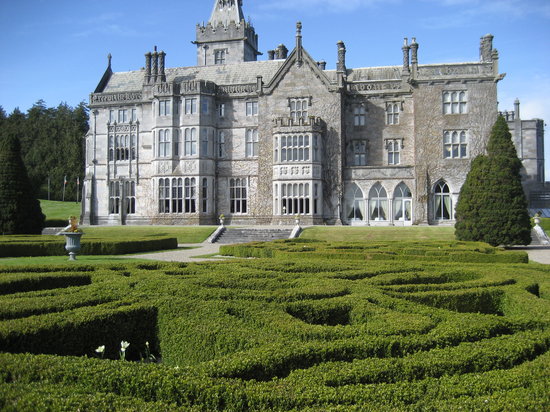
Adare Manor was originally a two-storey, seven-bay early 18th century house, most likely built about 1725 by Valentine Quin, grandfather of the 1st Earl of Dunraven.

From 1832, the 2nd Earl, started rebuilding the house in the Tudor-Revival style as a way of occupying himself (his wife was handicapped).


When the house was almost completed in 1846, A W Pugin was commissioned to design some features of the Great Hall.

Between 1850-62, the 3rd Earl finally completed the mansion by building the principal garden front.


The Great Hall is a room of vast size and height, divided down the middle by a screen of giant Gothic arches of stone.

A carved oak Minstrels' Gallery runs along one side; originally there was once an organ loft.

Mark Bence-Jones remarks that Adare Manor, as completed, is a picturesque and grey stone pile, composed of various elements that are rather loosely tied together; some of which are reproduced from Tudor originals in England. viz. the entrance tower, bearing a verisimilitude to the Cloister Court at Eton College.


The Long Gallery above is 132 feet long and 26 feet in height.

The mansion is set in a 840-acre estate and now operates as a luxury hotel, featuring the Adare Golf Club, Elemis Treatment Rooms, Townhouses and Villas on the rest of the resort.

President Clinton stayed at Adare Manor in September, 1998.

First published in August, 2011.

Lower Crescent, Belfast

Lower Crescent in 2014:  looking towards Botanic Avenue and Cameron Street

Lower Crescent and Upper Crescent, both in the University quarter of south Belfast, have always inspired me, even since childhood.

Lower Crescent, which runs from 4, University Road to Botanic Avenue, is to the north of Upper Crescent.

Upper Crescent runs from 28, University Road to Crescent Gardens.

Number 5 for sale in 2014

The sale of much of Lord Donegall's Belfast estate in the early to mid-19th century freed large areas of land around the town for development.

The lands to the south, along the Malone Ridge, were particularly attractive to developers and fostered the construction of many fine late Georgian-style terraces from the mid 1830s onwards, a trend accelerated by the establishment of Queen's College (now Queen's University) in the area, in the later 1840s.

These grand, new terraces were occupied by the city's professional and business classes, vacating their former residences in the town centre, which, in turn, were gradually turned into shops and offices.

Upper Crescent was perhaps regarded as the grandest terrace development undertaken to the south of Belfast, an elegantly curving row of three-storey town-houses in a late Regency style, built in 1846 by the timber merchant Robert Corry.

Dr Paul Larmour has suggested that Sir Charles Lanyon may have been consulted about the design.

Corry himself undertook the building work and took up residence at 16 Upper Crescent.

For the first few years of its existence, this row was known as Corry's Crescent.

To the immediate north of Upper Crescent, where Crescent Church now stands, there was a large lawn which Corry used as a garden.

Shortly after this garden was laid out, however, Corry had it ploughed up and used for the cultivation of vegetables for relief of local workers suffering as a result of the famine.

To the north of this garden ran an old water course; to the east, some smaller gardens (belonging to other occupants of Upper Crescent); and further to the east and to the north-east ran Albion Lane.

In 1852, Robert Corry built another terrace to the north of his garden and just south of the old water course.

This new development, Lower Crescent, was much in the same vein as that to the south, and was occupied by the same mix of professionals and businessmen; though, by as early as 1860, the ground floors of some of the properties were used as offices.

In the late 1860s, a railway line was laid to the immediate north of Lower Crescent (along the line of the old water course).
In 1873, the large sandstone building, (originally Ladies Collegiate, later Victoria College), was added to the west end of the terrace, with two houses added to the east end by the end of the decade, the most easterly of which, Rivoli House, originally contained a dance academy run by a Frederick Brouneau.
The new railway line cut across Albion Lane and presaged the laying out of a new, broader thoroughfare, to be named Botanic Avenue.

Upper Crescent also witnessed further building in the 1860s and 70s, with two large William Hastings-designed properties erected to the west end in 1869, one of which, Crescent House (latterly a bank) also fronted on to University Road.

In 1878-79, two further houses were added to this end, on the ground between those of 1869.

In 1885-7, the large Presbyterian church (the present Crescent Church) was erected to plans by the Glasgow architect, John Bennie Wilson, on the west side of Robert Corry's former garden, with a two-storey terrace, the present Crescent Gardens, built on the site of smaller garden plots to the east end, in 1898.

During the first half of the 20th century, most of the properties of Upper and Lower Crescent, as well as Crescent Gardens, remained private dwellings.

However, by 1960 many were given over to business use; others divided into flats, with the former Rivoli House, (later called Dreenagh House), becoming a hotel.

This trend continued, and by the beginning of the 21st century none were occupied as private dwellings.

In the mid 1990s, three of the 1860-70 houses at the west end of Upper Crescent were demolished and a modern office block built in their place; whilst in 2000 the railway cutting to the south of Lower Crescent was built over, in preparation for a new development.

1 LOWER CRESCENT:
occupied by Frederick Gee, commission merchant. Gee appears to have remained there until at least 1882, though a Charles McDowell is listed by 1877. By 1899, it was in the hands of neighbouring Victoria College. When the Victoria College building changed hands to become the Crescent Arts Centre in 1978, this property remained associated with it, becoming The Octagon Gallery. It is largely used as a store by the Arts Centre.
2 LOWER CRESCENT:
One of the eleven houses which made up the original 1852 section of Lower Crescent. In 1858, it was occupied by John Savage, flax merchant. John Corry (a relative of the abovementioned Robert Corry) is listed as resident in 1862; Mrs Cuppage in 1877; and Mrs McDowell in the 1890-1900. The property came into possession of Victoria College at some time between 1910-20 and remained as such until that institution left Lower Crescent in the 1970s; however, for much of this period, it appears to have been leased to various businesses and private tenants. In the 1980s, it became a health centre (which appears to have been integrated with its neighbour, number 3); then a stationery shop; and later, offices.
3 LOWER CRESCENT:
In 1858, was listed as vacant, but was occupied by Henry Smith in 1860; the Rev John Moore in 1861; and William Moffat, 1877. In the 1890s and early 1900s, it was occupied by Mrs Margaret Byers, ounder of Victoria College. It was still in possession of Victoria College for some years after Mrs Byers' decease in 1912, but was either sold or leased out by the school by 1930, for by this date it had become a private dwelling once again. The property remained a dwelling house until the 1970s.
4 LOWER CRESCENT:
Thomas Hanlon, of Messrs George McTear & Company, Steam Packet Agents, Donegall Quay; Miss Jane Vance, by 1860. Miss Vance was followed a few years later by Dr Peter Redfern, who remained there until ca 1915. The property appears to remained a private dwelling until the 1950s, when it was divided into flats. It remained as such until the early 1980s, when the flats were converted to offices. The return is recorded as two storey in the valuation of 1860. The decoration to the second floor landing (which matches that to the first floor) suggests that it may have been raised a storey not long after this date.
5-6 LOWER CRESCENT:
Number 5 was occupied by Mrs Andrews; Henry Dickson resided at number 6. By 1860, number 5 was occupied by Aylward Connor, with its ground floor used as offices. Connor appears to have remained there until the late 1870s, when the property became home to Colonel Audain. Number 6 passed to Mrs Charnock in 1870, with both she and the Audain family occupying both houses until 1910 at least. Both buildings appear to have remained private dwellings until the 1970s, but by 1980 number 6 was an office. In the late 1980s, number 5 was coverted to a bar and night club, The Fly. In the late 1990s, this bar was greatly expanded, when its owners acquired number 6 and added a large extension to the rear of the newly-created single property.
7 LOWER CRESCENT:
Robert Cassidy, a solicitor, who, (by 1860 at least) used the ground floor as an office. In 1870,  James Campbell is listed as resident; Henry F Thomas in 1877; Samuel Alexander in 1882; and Mrs Orr in 1910. The property appears to have been divided into flats in the 1960s, but had become an office (once again) by 1980.
8 LOWER CRESCENT:
Tobias Porter, Belfast Flour Mills Manager, who appears to have remained there until at least 1882. In 1899, Mrs Lyons is recorded as resident; with Miss Lyons in occupation from about 1910-40s. From the mid 1950s until the late 1970s, this property and number 9 served as the canteen for Victoria College. No doubt much of the internal changes to both buildings date from this period. The building has housed various offices from the late 1970s onwards.
9 LOWER CRESCENT:
Samuel Delacherois, gentleman. In 1860, it was occupied by a John K McCausland, who appears to have remained there until at least 1882. The next occupant was Miss Vance, who was followed by Mrs Jackson about 1915. In the 1940s, the property came into the possession of Victoria College; and in the following decade became, (along with neighbouring number 8), the college's canteen. After the departure of Victoria College from Lower Crescent in the late 1970s, the property was converted to offices.
10 LOWER CRESCENT:
And its neighbour to the east (11) were used as offices for the Ordnance Survey, but by 1860, number 10 was a private dwelling once again, occupied by Robert W Corry. Corry was followed in 1862 by John Arnold, who remained there until the mid 1880s at least. In 1899, Mrs McKnight is listed as resident; Miss Warner in 1910; Mr T Kernaghan, linen merchant, in 1920. By 1940, the property appears to have been divided into two flats. In 1960, three flats are recorded, with four in 1970. These fluctuating divisions of the property appear to have changed again in the later 1970s, when the first floor became amalgamated with the first floors of numbers 8 and 9 to form a large office suite.
11 LOWER CRESCENT:
Was, by 1860, occupied by Charles Gaussen, who was followed in 1861 by Henry Cuppage, who remained there until at least 1882. In 1899, William Pedlow, District Inspector, National Schools, Belfast South, is listed as resident; then David Wright, bottle merchant and representative of the Chilean Nitrate Committee; T  Kernaghan in 1920; and Mr S E Fitchie, wholesale stationer, in 1930. By 1940, the property became a nursing home; then a guest house in 1951; but reverted to a private residence from the late 1950s to the 1970s. By 1980, the property was converted to offices.
12 LOWER CRESCENT:
Built in 1877-78 to designs by architect William Hastings, who had also worked on the larger property to the east (13) two years earlier. The building was originally occupied by William J Morrison, with William Campbell in residence in 1899. Campbell remained there until some time between 1910-20. Miss Gardener occupyed the house in 1921. In 1930, a journalist named Alex Riddle and Professor Ivor Arnold are recorded as residents; with three occupants listed in 1940, two in 1951 and three in the 1960s and 1970s. Clearly the property must have been split into flats ca 1930. In the late 1980s, the building was converted to a restaurant, linked with the neighbouring hotel (13), with hotel rooms to the upper floors. In the late 1990s, the restaurant was converted to a public bar. 
Sources: Henderson's Belfast Directory; Belfast & Province of Ulster Directory; ST Carleton, The Growth of South Belfast (QUB MA thesis, 1967); John Caughey, Seize Then The Hour: A history of James P Corry & Compnay (Belfast, 1974), pp.28-29; David Evans, Historic buildings of Queen's University (revised edition, 1980); Alison Jordan: Margaret Byers, Pioneer of Women's Education (QUB Institute of Irish Studies).

First published in March, 2014.

Monday, 18 March 2024

Kinlough House

THE JOHNSTONS WERE MAJOR LANDOWNERS IN COUNTY LEITRIM, WITH 14,395 ACRES


ROBERT JOHNSTON (1768-1843), of Kinlough House, County Leitrim, and 23 Mountjoy Square, Dublin, married Florence, daughter of Henry Rathborne, of Dunsinea, County Dublin, and had, with other issue,
WILLIAM, of whom presently;
Henry (Ven.), Archdeacon of Elphin;
St George Robert.
The eldest son,

WILLIAM JOHNSTON JP (1814-88), of Kinlough House and Mountjoy Square, High Sheriff of County Leitrim, 1850, wedded, in 1856, Sarah Jane, daughter of the Rev William Percy, Rector of Carrick-on-Shannon, and had issue,
JAMES, his heir;
Florence Elizabeth; Sophia Mary;
Emma Caroline; Lucy Katherine.
Mr Johnston was succeeded by his son,

JAMES JOHNSTON JP DL (1858-), of Kinlough House, High Sheriff of County Leitrim, 1884, who married, in 1890, Rebecca Ceely, daughter of Maurice Ceely Maude, of Lenaghan Park, County Fermanagh, and had issue,
William James, 1891-3;
ROBERT CHRISTOPHER, b 1896.
I have been unable to find much information relating to the Johnstons of Kinlough.


KINLOUGH HOUSE, originally known as Oakfield House, was the seat of the Johnston family in the early 18th century.

It was remodelled in the 1820s by Robert Johnston, who renamed it Kinlough House.

In 1943 the Irish Tourist Association Survey recorded that the house had been destroyed by fire twenty years earlier, but that the gardens were still open to the public.

Housing development is occurring on the site, adjacent to the walled garden.

It was a five-bay, two-storey over basement house, built ca 1800 by Robert Johnston; now ruinous.


Its roof has been removed.

There were two ashlar chimney-stacks with string courses; sandstone walls with ruled-and-lined render; and tooled limestone quoins and string course.

It had a Doric portico to the façade, with tripartite window and pediment above.

Segmental-arched openings to basement with cast-iron railings.

Although this impressive former country house now lies in ruins, the grandeur and elegance of the building still survives.

Detailing such as the flower motif to the tripartite window contributes to the artistic quality of the house.

First published in March, 2012.   Sir James (Jim) Kilfedder MP (1928-1995) was born at Kinlough, County Leitrim.

Saturday, 16 March 2024

Upper Crescent, Belfast

Upper Crescent in 2014

Lower Crescent and Upper Crescent, both in the University Quarter of south Belfast, have inspired me since childhood.

Lower Crescent, which runs from 4 University Road to Botanic Avenue, is to the north of the Upper Crescent; whereas Upper Crescent runs from 28 University Road to Crescent Gardens.

Most of the 2nd Marquess of Donegall's Belfast estate was sold in the early to mid-19th century, thereby freeing large areas of land around the town for development.

The lands to the south, along the Malone Ridge, were particularly attractive to developers, and fostered the construction of many fine late Georgian-style terraces from the mid 1830s onwards, a trend accelerated by the establishment of the prestigious Queen's College (Queen's University) in the area, in the later 1840s.

13-15 Upper Crescent in 2014

These new, grand terraces were occupied by the city's professional and business classes, who vacated their older residences in the centre of the town (like College Square North); which, in turn, eventually became shops and offices.

Upper Crescent was perhaps the grandest terrace development undertaken in south Belfast.

This was an elegantly curving row of three-storey dwellings in a late Regency style, built in 1846 by the timber merchant Robert Corry.

It has been suggested that the celebrated Belfast architect Sir Charles Lanyon may have been involved in the design of the crescents.

Corry himself undertook the building work and took up residence at 16 Upper Crescent.

For the first few years of its existence it was known as Corry's Crescent.


To the immediate north of Upper Crescent, where Crescent Church now stands, there was a large, grassed area which formed part of Mr Corry's gardens.

Shortly after this plot was laid out, however, Corry had it ploughed up and used for the cultivation of vegetables (for the relief of local workers suffering as a result of the famine).

To the north of this garden ran an old water course; to the east, some smaller gardens (belonging to other residents of Upper Crescent); and further to the east and to the north-east, Albion Lane.

In 1852, Robert Corry built another terrace to the north of his garden and just south of the old water course.

This new development, called Lower Crescent, was much in the same vein as that to the south and was occupied by the same mix of professional and business men; though, by as early as 1860, the ground floors of some of the properties were utilized as offices.

In the late 1860s, a railway line was laid to the immediate north of Lower Crescent (along the line of the old water course).
In 1873, the large sandstone building, (originally Ladies Collegiate, later Victoria College), was added to the west end of the terrace, with two houses added to the east end by the end of the decade, the most easterly of which, Rivoli House, originally contained a dance academy run by a Frederick Brouneau.
The railway line cut across Albion Lane and presaged the laying out of a new, broader thoroughfare, to be named Botanic Avenue.

Upper Crescent was further extended in the 1860s and 70s, with two large William Hastings-designed properties erected to the west end in 1869, one of which, Crescent House (latterly a bank) also fronted on to University Road.

In 1878-79, two further houses were added at this end.

In 1885-7, a large Presbyterian church (the present Crescent Church) was erected to plans by the Glasgow architect, John Bennie Wilson, on the west side of Robert Corry's former garden, with a two-storey terrace, the present Crescent Gardens, built on the site of smaller garden plots to the east end in 1898.

During the first half of the 20th century, most of the properties of Upper and Lower Crescent, as well as Crescent Gardens, remained private residences.

By 1960, however, many had become businesses; while others were divided into flats, and Rivoli House (later Dreenagh House) became a hotel.

This trend continued and by the beginning of the 21st century none of the properties were occupied as private dwellings.

In the mid 1990s, three of the 1860-70 houses at the west end of Upper Crescent were demolished and a modern office block was built in their place.

In 2000, the railway cutting to the south of Lower Crescent was built over in preparation for a new development.

1 UPPER CRESCENT:
Originally named Crescent House, was built in 1869 to designs by William Hastings. Its original resident was Dr Wilberforce Arnold, whose family remained there until the early 1900s. The next occupant was Dr John Campbell, who was followed by a Dr William Campbell (presumably his son). Both Campbells (and possibly Dr Arnold before them) appear have used the University Road section of the property as a surgery. In the 1970s, the building was acquired by Queen's University and served as the University's Institute of Professional Legal Studies. In 2001-02 the property was converted to a branch of the Bank of Ireland (and practically rebuilt in the process), with half of the first floor and all of the second floor converted to offices, linked to the large modern office block to the east.
7 UPPER CRESCENT:
Built in 1849, occupied by Robert Workman, who remained there until the mid-1850s, when he was followed by John Coates, secretary of the County Antrim Grand Jury. By 1860, the building was in the hands of a John P Corry, a relative of the builder of the Crescent, Robert Corry. At this stage (according to valuation records), the ground floor was used as offices. James P Corry remained in residence until 1877, when he was succeeded by MrWilliam Dobbin. John Morrow, of the Ayr Steamship Company, is listed as the householder in 1899 and 1910; with P T Crymble in 1920. In the later 1920s, the property was acquired by a Miss Wallace, who remained there until the 1970s; and for part of this time used the premises as a nursing home. Thereafter the property was converted to offices. The current occupant acquired the building in 1983.
8 UPPER CRESCENT:
Occupied, in 1849, by a merchant named Edward Tucker, who was followed by the Rev William Patterson (Professor of Mathematics, Queen's College) in the early 1850s; Peter Keegan, wine merchant, in the later 1850s; James Glass from ca 1860-77; and then Mrs Shillington. In the 1899 directory, Robert Workman, Junior, is listed as the occupant; William Harper in 1910; Joseph Walsh, 1915-40s; then H M Hamilton; and Herbert Kearney. In the 1970s the property was converted to offices.
9 UPPER CRESCENT:
Mrs Grueber; followed in the mid 1850s by Professor Charles McDowell, who remained there until the early 1880s. In the 1899 and 1910 directories, a W H Ward (of the Ulster Damask & Linen Company) is listed as the occupant; with a Robert Robinson in 1920-30. By 1951, the property had become converted to offices, occupied firstly by the Forestry Division of the NI Department of Agriculture, and then by a firm of quantity surveyors.
10 UPPER CRESCENT:
Mrs Murdock in 1849; followed in the 1850s by James Green and then James P Corry (a relative of the above mentioned Robert). Corry was succeeded by Jane Vance, who remained there until the later 1870s. The next resident was Alexander Taylor; with a solicitor, J S Mahon, listed in the 1899 and 1910 directories. About 1918, the property was acquired by a family named Matthews, who remained there until the 1950s, when the building was converted into offices (financiers, then a travel agent).
11 UPPER CRESCENT:
James Greene, (1st clerk, Custom House); followed by Mrs Herdman; and, by 1860, William McNeill; and, by the late 1870s, James Festu. By 1899, the building was home to William Yates; then, pre-1920, the Rev William Beatty; and then T Bell, who remained there from the mid 1920s to the 1960s. By 1970 the property had been converted to an office.
12 UPPER CRESCENT:
Between 1849-1910/20, the house was occupied by Robert Boag, of Albion Clothing Company, possibly the same person, though likely a father and son. By 1920, it had become The Crescent Private Nursing Home, but had reverted to an conventional dwelling again by 1930, with Miss Mabel Simms in residence. Miss Simms remained there until at least 1960, but by 1970 the building had been converted to an office.
13 UPPER CRESCENT:
William Brown, of Day, Bottomley & Company, who, in the 1850s, leased the house to Mrs Esther Orr, who remained there until about 1880. The next occupant was James Hyndman; followed in the early 1900s by Mrs Cron. Mr E Matthews and his family remained there from the 1920s until the 1960s. By 1970, the house was being used by a group of elocution teachers, but appears to have reverted to a private dwelling in the late 1970s. The property appears to have become offices from the mid 1980s.
14 UPPER CRESCENT:
Mrs Dickey; Henry Smith, linen manufacturer, by 1852; and Jane Millford by 1860. The Rev W S Darley became resident in the later 1870s; with Mrs Thompson listed in the 1899 directory; William Galloway (damask designer) in 1920; and the Rev R H White in 1930. In the 1950s, this building and its two neighbours to the east (nos.15 & 16) served as the Ulster Nature Cure Clinic. In the 1960s all three were acquired by Queen's University and converted to student residences. It was probably at this point that the major internal changes to the buildings were carried out; however, it's not improbable that the earlier presence of the Ulster Nature Cure Clinic probably entailed some alterations, perhaps the creation of doorways between the formerly separate properties.
15 UPPER CRESCENT:
Robert Cassidy, solicitor, who remained here until about 1853, when he moved to the newly-built Lower Crescent; followed by the Rev Robert Wilson, whose family in turn were followed by Mr John Downing. By 1899, Mrs Manley was in residence; and by 1920 a "druggist" named John Clarke; Mrs Rankin, by 1930. A decade later the property served as a nursing home. In the 1950s, this building and its two neighbours to each side (nos.14 and 16) were the Ulster Nature Cure Clinic.
Sources: Henderson's Belfast Directory; Belfast & Province of Ulster Directory; ST Carleton, The Growth of South Belfast (QUB MA thesis, 1967); John Caughey, Seize Then The Hour: A history of James P Corry & Compnay (Belfast, 1974), pp.28-29; David Evans, Historic buildings of Queen's University (revised edition, 1980); Alison Jordan: Margaret Byers, Pioneer of Women's Education (QUB Institute of Irish Studies).

First published in March, 2014.

Thursday, 14 March 2024

House of Cole

By a deed of WILLIAM THE CONQUEROR, it appears that the Coles were of the rank of barons, and were resident in Hampshire in that monarch's reign. The first of this family who settled in Ulster was

SIR WILLIAM COLE, Knight (c1571-1653), who fixed his abode in County Fermanagh early in the reign of JAMES I.
He was the son of Emmanuel Cole (c1545-c1625), third son of Thomas Cole, of London; whose father, John, was son of William Cole, who was a younger son of John Cole, who was second son of Sir John Cole, of Nethway, Devon, by Anne, daughter and heir of Sir Nicholas Bodrugan, Knight, son of John Cole, of Hittisleigh, Devon, during the reign of EDWARD III, great-grandson of William Cole, of Hittisleigh, living in 1243.
Sir William was appointed captain of the longboats and barges at Ballyshannon and Lough Erne, by patent, in 1607.

This gentleman became an undertaker in the plantation of Ulster, and had an assignment, in 1611, of 1,000 acres of escheated lands, in the county wherein he resided; to which, in 1612, were added 320 acres in the same county.

Eighty acres whereof were assigned for the town of Enniskillen; and that town was then incorporated by charter, consisting of a provost and twelve burgesses, Sir William being the first provost.

Sir William raised a regiment, which he commanded against the rebels, in 1643, with important success.

He wedded twice: Firstly, to Susan, daughter and heiress of John Croft, of Lancashire, by whom he had two daughters.

This gentleman's second wife was Catherine, daughter of Sir Laurence Parsons, of Birr, second baron of the Irish Exchequer, by whom he left, at his decease (with at least two daughters),
MICHAEL, his successor;
John, MP for Fermanagh; cr baronet, 1660.
The elder son,

SIR MICHAEL COLE (1644-c1711), Knight, MP for Enniskillen, 1665-6, 1692-3, 1695-9, 1703-11, wedded Alice, daughter of Chidley Coote, of Killester, County Dublin, and was succeeded by his only surviving child,

SIR MICHAEL COLE, Knight, who wedded, in 1671, Elizabeth, daughter of Sir John Cole Bt; and dying in 1710, was succeeded by his eldest son,

JOHN COLE (c1680-c1726), of Florence Court, County Fermanagh, MP for Enniskillen, 1703-26, who espoused Florence, only daughter of Sir Bourchier Wrey, 4th Baronet, of Trebitch, in Cornwall, and was succeeded by his eldest son,

JOHN COLE (1709-67), of Florence Court, MP for Enniskillen, 1730-60, who was elevated to the peerage, in 1760, in the dignity of Baron Mount Florence, of Florence Court, County Fermanagh.

John, 1st Baron Mount Florence (Image: National Trust)

His lordship espoused Elizabeth, daughter of Hugh Willoughby Montgomery, of Carrow, County Fermanagh, and had, with several daughters, two sons,
WILLIAM, his successor;
Arthur, m Letitia Hamilton.
His lordship was succeeded by his elder son, 

WILLIAM WILLOUGHBY, 2nd Baron (1736-1803), who was created, in 1776, Viscount Enniskillen; and advanced to the dignity of an earldom, in 1789, as EARL OF ENNISKILLEN.

His lordship married, in 1763, Anne, daughter of Galbraith Lowry-Corry, of Aghenis , County Tyrone, and sister of Armar, 1st Earl of Belmore, and had issue,
JOHN WILLOUGHBY, his successor;
Galbraith Lowry (Sir), GCB, general in the army;
William Montgomery (Very Rev), Dean of Waterford;
Arthur Henry, MP;
Henry, died young;
Sarah; Elizabeth Anne; Anne; Florence; Henrietta Frances.
He was succeeded by his eldest son,

JOHN WILLOUGHBY, 2nd Earl (1768-1840), KP, who married, in 1805, the Lady Charlotte Paget, fourth daughter of Henry, 1st Earl of Uxbridge, and had issue,
WILLIAM WILLOUGHBY, his successor;
Henry Arthur;
John Lowry;
Lowry Balfour;
Jane Anne Louisa Florence.
His lordship was appointed a Knight of St Patrick, 1810.

He was created, in 1815, Baron Grinstead, of Grinstead, Wiltshire, in the peerage of the United Kingdom.

His Lordship was succeeded by his eldest son,

WILLIAM WILLOUGHBY, 3rd Earl (1807-86), Honorary Colonel, Royal Inniskilling Fusiliers.

The heir presumptive is the present holder's first cousin Berkeley Arthur Cole (b 1949). He is the eldest son of the Hon Arthur Gerald Cole (1920–2005), younger brother of the 6th Earl.
First Published in January, 2012.

Wednesday, 13 March 2024

Ballyfin House

THE COOTE BARONETS WERE THE GREATEST LANDOWNERS IN THE QUEEN'S COUNTY, WITH 47,451 ACRES


This is the parent stock whence the noble houses of COOTEEarls of Mountrath, and COOTE, Barons Castle Coote, both now extinct, emanated. 

This noble family derives its origin from

SIR JOHN COOTE, a native of France, who married Isabella, the daughter and heir of the Seigneur Du Bois, of that kingdom, and had issue,

SIR JOHN COOTE, Knight, who coming into England, settled in Devon, and married a daughter of Sir John Fortescue, of that county.

His lineal descendant,

JOHN COOTE, heir to his uncle, 28th Abbot of Bury St Edmund's, wedded Margaret, daughter of Mr Drury, by whom he had four sons,
Richard;
FRANCIS, of whom we treat;
Christopher;
Nicholas.
Mr Coote's second son,

FRANCIS COOTE, of Eaton, in Norfolk, served ELIZABETH I; and by Anne, his wife, had issue,

SIR NICHOLAS COOTE, living in 1636, who had two sons,
CHARLES, his heir;
William (Very Rev), Dean of Down, 1635.
Sir Nicholas's elder son,

SIR CHARLES COOTE (1581-1642), Knight, of Castle Cuffe, Queen's County,
Who served in the wars against O'Neill, Earl of Tyrone, at the head, as captain of the 100th Foot Regiment, with which corps he was at the siege of Kinsale, and was appointed, by JAMES I (in consequence of the good and faithful services he had rendered to ELIZABETH I), provost-marshal of the province of Connaught for life. 
In 1620, he was constituted vice-president of the same province; and created, in 1621, a baronet, designated of Castle Cuffe, Queen's County. Sir Charles distinguished himself, subsequently, by many gallant exploits; but the most celebrated was the relief of Birr, in 1642. 
Being dispatched, with Sir Thomas Lucas and six troops of horse, to relieve that garrison, and some other fortresses, it was necessary, in order to effect the objective, to pass the causeway broken by the rebels, who had thrown up a ditch at the end of it. 
Sir Charles, leading thirty dismounted dragoons, beat the enemy, with the loss of their captain and twenty men; relieved the castles of Birr, Borris, and Knocknamase; and having continued almost forty hours on horseback, returned to the camp with the loss of only one man.
This is the surprising passage through Mountrath woods which justly caused the title of MOUNTRATH to be entailed upon his son,

Sir Charles, who married Dorothea, youngest daughter and co-heir of Hugh Cuffe, of Cuffe's Wood, County Cork, and had issue,
CHARLES, his heir;
Chidley, of Killester, Co Dublin;
Richard, ancestor of the EARL OF BELLAMONT;
Thomas, of Coote Hill;
Letitia.
Sir Charles being slain in a sally to protect the town of Trim, in 1642, was succeeded by his eldest son,

SIR CHARLES COOTE, 2nd Baronet (c1610-61), who was elevated to the peerage, in 1661, in the dignities of Baron Coote, Viscount Coote, and EARL OF MOUNTRATH; and the baronetcy merged in the superior dignity, until the demise of

CHARLES HENRY (1725-1802), 7th Earl, without male issue, when the earldom expired.

A new barony, that of Castle Coote, which his lordship obtained, passed accordingly and ceased likewise, in 1827; while the ancient baronetcy reverted to 

SIR CHARLES HENRY COOTE, 9th Baronet (1792-1864), of Ballyfin, great-grandson of the Rev Chidley Coote DD, lineal descendant of Chidley Coote, by his second wife, Eliza Anne.


*****

Sir Algernon Charles Plumptre Coote, 12th Baronet (1847–1920), was Lord-Lieutenant of Queen's County, 1900-20.

Sir Ralph Algernon Coote (1874-1941), 13th Baronet, was the last representative of his line to occupy Ballyfin House.
Thereafter the estate was purchased by the Irish Land Commission, while the noble mansion and portion of the demesne were acquired in 1930 by the Patrician Order, a distinguished Irish teaching brotherhood long associated with successful educational work in the district.
The 14th Baronet, Rear-Admiral Sir John Coote, CB CBE DSC, was Director of Naval Ordnance, 1955-58. 

Sir Christopher John Coote, 15th Baronet (b 1928) is married and lives in Wiltshire.


BALLYFIN HOUSE, situated at the foot of the Slieve Bloom mountains near Mountrath in County Laois, is said to be "the grandest and most lavishly appointed early 19th century Classical house in Ireland" (Bence-Jones). 

The mansion was built between 1821-26 for Sir Charles Coote, 9th Baronet, replacing a house of 1778 which belonged to William Wellesley-Pole, 3rd Earl of Mornington and brother of the 1st Duke of Wellington.


Sir Charles purchased the estate from Wellesley-Pole about 1812 and apparently employed an architect called Madden to design the initial phase of Ballyfin; then switched to the Morrisons.

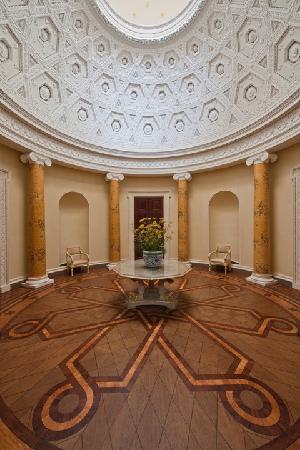
Ballyfin is a two-storey maansion house with a long library running at one side from front to back, extending into a curved bow in the centre of the side elevation, containing a top-lit rotunda.

The library wing is of one bay on either side of the central curved bow, fronted by a colonnade of large Ionic columns. 

The side elevation is prolonged by an elegantly-curving glass and iron conservatory of about 1850.


The principal front consists of thirteen bays with a massive Ionic, pedimented portico; the two end bays on either side being stepped back.

The interior is quite magnificent and exquisitely furnished, with a riot of notable effects and a wealth of heavy, opulent plasterwork; Scagliola columns in Siena, porphyry, green and black; inlaid parquetry floors.


The saloon is flanked by the rotunda (above), which is surrounded by Ionic columns and has a coffered dome.

The entrance hall is said to be more constrained, with a coffered ceiling and a mosaic Roman floor. 

This leads into the splendid top-lit saloon in the centre of the mansion, which boasts a coved ceiling adorned with superlative plasterwork and a screen of Corinthian columns at either end.

The drawing-room has a typical Morrison ceiling and gilded Louis Quinze on the walls of ca 1840s.

Today the demesne comprises 600 acres of parkland, a lake and ancient woods, delightful garden buildings, follies and grottoes.

The landscape, laid out in the 18th century, is among the finest examples in Ireland of the natural style of gardening inspired by ‘Capability’ Brown.

Ballyfin House was formerly the Patrician College.

Patrician College Ballyfin operated from 1930 to 2009.

Sir Ralph Algernon Coote (1874-1941), 13th Baronet, was the last representative of his line to occupy Ballyfin House.

Thereafter the estate was purchased by the Irish Land Commission, while the noble mansion and portion of the demesne were acquired in 1930 by the Patrician Order, a distinguished Irish teaching brotherhood long associated with successful educational work in the district. 

Its architectural beauty has, however, been carefully preserved, and nothing has been lost in the change of ownership to deteriorate from the graceful lines of the building that Sir Charles Coote, 9th Baronet, expended a fortune in perfecting.

The Patrician Order sold the estate in 2009.

In 2011, Ballyfin became a country house hotel.

Among other features are a medieval-style tower, built as a folly in the 1860s and said to command a view of seven counties; and walled gardens.

London residence ~ 5 Connaught Place.

First published in May, 2011.  Images of Ballyfin House courtesy of Ballyfin Demesne.