Tuesday, 14 April 2026

Victoria Park

During the pandemic lockdown in 2020 I paid a visit to Victoria Park in east Belfast.

There's a footbridge at the Sydenham railway halt, which is particularly useful for pedestrian access to Belfast City Airport and the Park.

I occasionally manhandle my bike over the footbridge if I'm going to the airport for a flight.

Though its official address is given as Park Avenue, Victoria Park stands directly beside the Sydenham by-pass and Belfast City Airport.

East Belfast Yacht Club, renowned for its concrete boats, is at the north-east of the Park.

According to my 1974 street directory, the Park comprises sixty-three acres, and was formed from land reclaimed from the eastern shores of Belfast Lough.

In 1974 it contained a salt-water boating lake some twenty acres in extent.

Click to Enlarge

A bowling green and football pitches - seven within the inner island -  remain, though there was also a putting green.

There were formerly cricket pitches, tennis courts, and an open-air swimming-pool at the north-western end.

An open-air theatre was added in 1969, though has recently been demolished.

Victoria Park also has a cycling and BMX track, and two walking trails that surround the lake.

The Sam Thompson Bridge, which links the Park to Belfast Harbour Estate (at Shorts' head office) was officially opened in 2014, and a splendid feature it is.

I use it quite regularly to cycle into the city centre.

2020 Map of Victoria Park

Belfast City Council explains that the idea of creating a public park near the river Connswater was first suggested by the Harbour Commissioners in 1854.

Progress was slow because the land was very marshy, inaccessible to the public and generally unsuitable for a public park.

After many meetings, surveyors' reports and drainage schemes, the idea was approved and Victoria Park opened in 1906.

It was landscaped by Charles McKimm, who also built the Tropical Ravine in Botanic Gardens.

First published in April, 2020.

1st Viscount Bangor

THE VISCOUNTS BANGOR WERE MAJOR LANDOWNERS IN COUNTY DOWN, WITH 9,861 ACRES 


The family of WARD is of Norman origin, and was seated at Capesthorne, in Cheshire, which Daniel King, in his book Vale Royal, calls "a great lordship and demesne, giving name to the ancient seat of the Wards."

WE FIND in the roll of Battle Abbey, that the family of WARD attended WILLIAM THE CONQUEROR into England, where, after some centuries, it appeared in three respectable branches; of which the Wards of Capesthorne, Cheshire.

For several centuries, having possessed many extensive lordships, descended the family of WARD, of Bangor, in the person of

BERNARD WARDwho married a daughter of the ancient family of Leigh, of High Leigh, Cheshire, and settled in Ulster about 1570.

Mr Ward acquired the lands known as Carrickshannagh from the Earl of Kildare, and renamed it CASTLE WARD.

His son and heir,

NICHOLAS WARD, born ca 1580, High Sheriff of County Down, 1620 and 1624, married Joan, daughter of Ralph Leycester, of Toft Hall, Cheshire, and had issue (with several daughters, one of whom, Eleanor, wedded Thomas Russell, of Lecale),
BERNARD, his heir;
Robert (Sir), created a Baronet, designated of Killough;
Thomas, colonel in the army, died at the battle of Worcester, 1651;
Nicholas.
The eldest son,

BERNARD WARD, born in 1606, High Sheriff of County Down, 1656, who married Anne, daughter of Richard West, and had issue,

NICHOLAS WARD, born in 1630, High Sheriff of County Down, 1662, MP for Downpatrick, 1661-66, who married Sarah, daughter of the Rt Rev Theophilius Buckworth, and had issue,
Charles (Rev);
BERNARD, of whom hereafter.
The younger son,

BERNARD WARD (1654-90), wedded Mary, sister of Michael Ward, Provost of Trinity College, Dublin, and afterwards Lord Bishop of Derry, by whom he had four sons and three daughters.

Mr Ward was killed in a duel, 1690, whilst Sheriff of Down, by Jocelyn Hamilton, of the Clanbrassil family (who was mortally wounded at the same time), and was succeeded by his second, but eldest surviving son,

MICHAEL WARD (1683-1759), MP for County Down, 1713-27, who espoused, in 1709, Anne Catherine, daughter and co-heir of James Hamilton, of Bangor, County Down, and had issue,
BERNARD, his heir;
Anne; Sophia.
Judge Ward, Photo Credit: The National Trust

Judge Ward was succeeded by his only son,

BERNARD WARD (1719-81), MP for County Down, 1745-70, who married, in 1747, Anne, daughter of John, 1st Earl of Darnley, and relict of Robert Hawkins Magill, of Gill Hall, County Down, and had issue,
NICHOLAS, his successor;
John, died young;
Edward, father of EDWARD SOUTHWELL WARD;
Robert (Rt Hon);
Anne Catharine; Sophia; Amelia; Harriet.
Colonel Ward was elevated to the peerage, in 1770, in the dignity of Baron Bangor, of Castle Ward, County Down.

His lordship was advanced to a viscountcy, in 1781, as VISCOUNT BANGOR, of Castle Ward, County Down.

He was succeeded by his eldest son,

NICHOLAS, 2nd Viscount (1750-1827), who died unmarried, in 1827, when the family honours reverted to his nephew,

EDWARD SOUTHWELL, 3rd Viscount (1790-1837), who wedded, in 1826, Harriet Margaret, daughter of Henry, 6th Baron Farnham, and had issue,
EDWARD, his successor;
Henry William Crosbie;
William John;
Bernard Matthew, Lieutenant-General;
Somerset;
Crosbie Richard Maxwell.
His lordship was succeeded by his eldest son,

EDWARD, 4th Viscount (1827-81), who died unmarried, when the family honours devolved upon his brother,

HENRY WILLIAM, 5th Viscount (1828-1911), JP DL, who espoused firstly, in 1854, Mary, daughter of the Rev Henry King, and had issue,
Henry Somerset Andrew (1857-60);
Edward William Henry (1863-87);
MAXWELL RICHARD CROSBIE, of whom hereafter;
Harriette Mary; Kathleen Annette Norah; Bertha Jane; Henrietta; Emily Georgiana.
Following his first wife's untimely death in 1869, his lordship married secondly, in 1874, Elizabeth, only daughter of Major Hugh Eccles, of Cronroe, County Wicklow.

He was succeeded by his youngest and only surviving son,

MAXWELL RICHARD CROSBIE, 6th Viscount (1868-1950), OBE PC, who married, in 1905, Agnes Elizabeth, daughter of Dacre Mervyn Archdale Hamilton, and had issue,
EDWARD HENRY HAROLD, his successor;
Mary Helen Kathleen; Helen Elizabeth; Margaret Bertha.
His lordship was succeeded by his son,

 EDWARD HENRY HAROLD, 7th Viscount (1905-93), of London, who married firstly, in 1933, Elizabeth, daughter of Thomas Balfour; secondly, in 1937, May Kathleen, daughter of William B O Middleton; and thirdly, in 1947, Leila Mary, daughter of David Rimington Heaton, by whom he had issue,
WILLIAM MAXWELL DAVID, his successor.
His lordship wedded fourthly, in 1951, Marjorie Alice, daughter of Peter Banks, and had further issue,
Edward Nicholas, heir presumptive to the titles;
Sarah.
His lordship was succeeded by his elder son,

WILLIAM MAXWELL, 8th Viscount (1948-), of London, who married, in 1976, Sarah Mary Malet (Sarah Bradford), daughter of Brigadier Hilary Anthony Hayes, without issue.

The heir presumptive is Lord Bangor's half-brother, the Hon Edward Nicholas Ward (b 1953). 

The 8th and present Viscount lives in London with his wife, the celebrated royal biographer Sarah Bradford, the Viscountess Bangor.

Lord Bangor is thought to be an antiquarian book-seller.

His family's ancestral seat is CASTLE WARD, near Downpatrick, County Down.


When the 6th Viscount died in 1950, Castle Ward was accepted by the Northern Ireland Government in part payment of death duties, and presented by the Government with an endowment to the National Trust.


There is an apartment at Castle Ward House for the use of Lord and Lady Bangor which, it is thought, is used by them mostly during the summer.
About twenty years ago, when we stayed on the Estate, we were in the local butcher's shop in Strangford for some fillet steak. Young Duffy grimaced and told us that he was sold out; not surprising since the previous customers who had been right in front of us and had literally just left the shop, the then Hon William and Mrs Ward, who had collected a whole fillet of beef!

A former estate worker who is now, sadly, deceased, Ernest Swail, once told us that he was the last boatman to Lord Bangor. 
First published October, 2009. 

Monday, 13 April 2026

Snow Hill

THE JOHNSTONES OWNED 482 ACRES OF LAND IN COUNTY FERMANAGH


WILLIAM JOHNSTONE settled in Ulster about 1660, and married Prudence, daughter of William Goodfellow, of County Londonderry, by whom he had one son,

JAMES JOHNSTONE (born 1683), of County Fermanagh, who wedded Joanna Gunnis, County Donegal, and (with a younger son, Christopher, Surgeon of the 17th Lancers, who was father of Christopher Johnstone, Colonel of the 8th Hussars)had an elder son and heir,

JAMES JOHNSTONE (1738-1808), of Snow Hill, County Fermanagh, who espoused Anne, daughter of John Johnstone, of Adragoole House, County Leitrim, and had issue,
JOHN DOUGLAS, his heir;
Andrew, Lieutenant, 8th Hussars, died unmarried at Calcutta, 1810;
Margaret; Mary.
Mr Johnstone was succeeded by his son,

JOHN DOUGLAS JOHNSTONE (1769-1842), of Snow Hill, who married, in 1798, Samina, youngest daughter of Samuel Yates, of Moone Abbey, County Kildare, by his second wife, Catherine, daughter of Sir Richard Johnston Bt, of Gilford, County Down, by whom he had issue,
JAMES DOUGLAS, father of JOHN DOUGLAS JOHNSTONE;
Richard Gosford (1807-40), died in Upper Canada;
John Douglas, CB, Major-General;
Fairholme;
SAMUEL YATES, of whom hereafter;
William;
Catherine; Anna Douglas, Samina.
The fifth son,

SAMUEL YATES JOHNSTONE JP DL (1815-95), of Snow Hill, a barrister, succeeded his nephew, John Douglas Johnstone, 1862; and died unmarried, 1895.

Mr Johnstone was succeeded by his nephew,

COLONEL JOHN DOUGLAS JOHNSTONE JP DL (1836-1906), of Snow Hill, High Sheriff of County Fermanagh, 1899, Colonel, Duke of Wellington's West Riding Regiment, Royal Sussex Regiment, and 101st Regimental District, who wedded, in 1869, the Hon Augusta Anna Margaretta Plunkett, daughter of Thomas Oliver, 12th Baron Louth, and had issue,
JOHN DOUGLAS, his heir;
Anna Maria; Randalina Augusta Caroline.
The son and heir,

JOHN DOUGLAS JOHNSTONE (1874-), of Snow Hill, espoused, in 1903, May, youngest daughter of Patrick Murphy, of St Andrew's, Milltown.

He served with the Mashonaland, 1897, with the British South African Company, also during the South African War with the RSA Field Force.

Snowhill (Image: A Postcard from County Fermanagh)


SNOWHILL, near Lisbellaw, County Fermanagh, is a handsome Georgian country house of ca 1740-50, comprising two storeys over a basement.

The front door is pedimented; and the house is gabled, with prominent quoins.

Snowhill ca 1830 (historic OS map)

The land where the house stands belonged to a family called Crawford at the beginning of the 18th century.
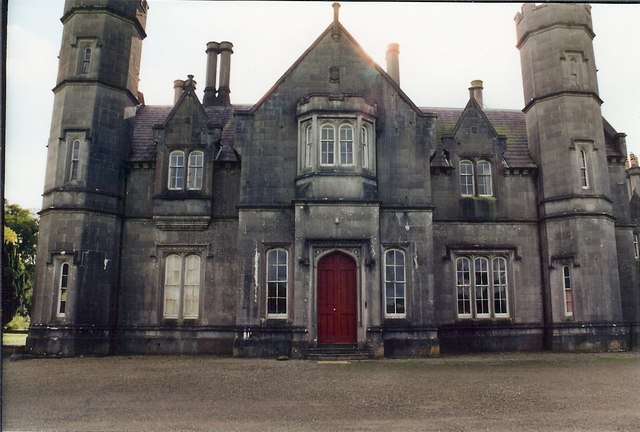
James Johnstone acquired Snowhill demesne in the 1780s, and the Johnstones occupied the house until 1921.

Ir was subsequently owned by the Eadies and John Judd, who sold the property in 1985.

Newtownbarry House

THE HALL-DARES WERE MAJOR LANDOWNERS IN COUNTY WEXFORD, WITH 5,627 ACRES

ELIZABETH EATON, eldest daughter and co-heir of Henry Eaton, of North Lodge, Essex, by Elizabeth, his wife, last surviving child of George Mildmay, of Corbett's Stye, Essex, married firstly, in 1779, JOHN DARE, of Bentry Heath, Essex, and by him she had an only child, JOHN HOPKINS DARE, of Theydon Bois, Essex, who died unmarried in 1805.

Mrs Dare married secondly, in 1791, JOHN MARMADUKE GRAFTON, of Cranbrook House (only son of John Marmaduke Grafton, of Romford), who took the surname of DARE in addition to that of GRAFTON, in 1805, and died in 1810.

Mrs Dare died in 1823, leaving by her second husband an only child,

ELIZABETH GRAFTON GRAFTON-DARE (1793-), who wedded, in 1815, ROBERT WESTLEY HALL, of Wyefield, and of Cranbrook, High Sheriff of Essex, 1821, MP for South Essex, who took the surname and arms of DARE, 1823, in addition to those of HALL.

Mr Hall-Dare and his sister, Elizabeth Catherine, were the offspring of Robert Westley Hall, of Ilford Lodge and FitzWalters, Essex, by Maria Elizabeth his wife, widow of Abraham de Codyn, of Demerara, and daughter of Cornelius Brower, of the same place and grandchildren of the Rev Westley Hall, who died in London ca 1770.

The Rev Westley Hall was a son of one of the Halls of Hillsborough, Kent, who married the sister of Sir Robert Westley, Lord Mayor of London.

Mr Hall-Dare died in 1836, and by his said wife, Elizabeth Grafton Grafton-Dare, left issue,
ROBERT WESTLEY, his heir;
John Grafton, 1818-19;
Henry;
Arthur Charles; died in infancy;
Francis Marmaduke, b 1830;
Mary Elizabeth; Emma Burton; Anne Mildmay; Agnes; Elizabeth.
The eldest son, 

ROBERT WESTLEY HALL-DARE (1817-66), of FitzWalters, Essex, married, in 1839, Frances Anna Catherine, daughter of Gustavus Lambart, of Beauparc, County Meath, and had issue,
ROBERT WESTLEY, his heir;
Charles;
Olivia Frances Grafton; Mabel Virginia Anna; Frances Maria.
Miss Mabel Hall-Dare married, in 1877, James Theodore Bent.

Mr Robert Westley Hall-Dare was succeeded by his eldest son,

ROBERT WESTLEY HALL-DARE JP DL (1840-76), of Newtownbarry House, County Wexford, and Theydon Bois, Essex, High Sheriff of County Wexford, 1872, who wedded, in 1863, Caroline Susan Henrietta, second daughter of Henry Newton, of Mount Leinster Lodge, County Carlow, and had issue,
John Marmaduke, died in infancy;
ROBERT WESTLEY, his heir;
Arthur Mildmay;
Elizabeth Frances; Hilda Mary; Evelyn Una.
Mr Hall-Dare was succeeded by his eldest surviving son,

ROBERT WESTLEY HALL-DARE JP DL (1866-1939), of Newtownbarry House, and East Hall, Wennington, Essex, High Sheriff of County Wexford, 1891, County Carlow, 1896, Captain, 9th Brigade, North Irish Division, RA, who espoused, in 1896, Helen, second daughter of John Taylor Gordon, of Nethermuir, Aberdeenshire, and Blackhouse, Ayrshire, and had issue,
ROBERT WESTLEY, his heir;
Charles Grafton, b 1902;
Audrey; Daphne.
Mr Hall-Dare was succeeded by his eldest son,

ROBERT WESTLEY HALL-DARE (1899-1972), of Newtownbarry House, who married, in 1937, Elizabeth Maria Patricia, daughter of John Brooks Close-Brooks, and had issue, an only child,

CLODY ELIZABETH HALL-DARE (1938-), of Newtownbarry House, educated at Byam Shaw School of the Arts, London, lecturer at City and Guilds College of Art, London, and lived in 1976 at Newtownbarry House.


NEWTOWNBARRY HOUSE, near Bunclody, County Wexford, built between 1883-89, is one of the last country houses designed by Sir Charles Lanyon, assisted by his pupil W H Lynn and his son John.

It is almost entirely a new structure, both extraordinarily austere and Italianate at the same time.

The fenestration of the two adjoining garden fronts reveals a sequence of rooms, expressed with military precision in impeccably detailed granite.


The upstairs windows are framed with a stone surround so that it makes them the same size as the windows below, an idea first used by Lanyon nearly thirty years before at Drenagh, County Londonderry.

Features of the house include a top-lit picture gallery and a richly carved staircase which lets natural light onto the landing, staircase and hall.

There also many finely carved fireplaces.

The library is finely crafted from wood.

Newtownbarry was built by the Hall-Dare family and still remains in the family.

A lot of the information in this script is quoted from an architectural report by Jeremy Williams.

Newtownbarry House is surrounded by beautiful landscapes, gardens and a large pond adjacent to the entrance of the house.

There is an ornamental lake; the Rose Garden; the recently renovated 19th century Sunken Garden.

The prospect from the banks of the River Slaney is to the heights of the Blackstairs Mountains.

The present owner is Clody Norton, the daughter of Robert Westley Hall-Dare, who lives there today with her family.

First published in August, 2012.  Hall-Dare arms courtesy of the NLI.

Sunday, 12 April 2026

Dromore, County Down

Arms of the Bishopric of Dromore

On Sunday, August 7th, 2022, I paid a visit to Dromore, a small town and cathedral city in County Down.

Dromore, in the barony of Lower Iveagh, standing on the River Lagan, is close to Royal Hillsborough in the same county.

An abbey was reputedly established here, in the 6th century, by St Colman, and to have been constituted the cathedral or seat of a bishopric, of which St Colman was made the first bishop.

This abbey had acquired extensive possessions by the 10th century, and was frequently plundered by the Danes; and, moreover, suffered materially from the continued feuds of the powerful septs of the O'Neills, Magennises, and Macartans.

At the Reformation the cathedral was in ruins, and remained thus till 1610, when JAMES I re-founded the see by letters patent, rebuilt the cathedral, and accorded the bishop extensive landed possessions in this and several adjoining parishes.


An episcopal palace was begun by Bishop Buckworth, but previously to its completion the Irish Rebellion of 1641 broke out, and the cathedral, the unfinished palace, and the town were entirely destroyed by the parliamentarian forces. 

Arms of the Bishopric of Down,
Connor, and Dromore

From this time the town was in ruins until the Restoration, when CHARLES II gave the see in commendam to the notable prelate Jeremy Taylor, with Down and Connor, by whom the present church, which is also parochial, was built on the site of the ruined cathedral.

Beneath the communion table in the cathedral is a vault in which Dr Taylor and two of his successors are interred.

Bishop Percy's remains are deposited in a vault in the transept added to the cathedral, as are those of Mrs Percy.

The first Protestant blood of the Revolution was shed in the vicinity of the town; and WILLIAM III marched through on the 24th June, 1690, en route to the field of the Boyne.

Market Square, Dromore (Timothy Ferres, 2022)

Dromore comprises a central square, and radiating streets; and though nominally a city, it's really a rural market town.

Market Square, Dromore (W A Green/NMNI)

The market-house, located in the Square, is a substantial building; while the cathedral and parish church is comparatively small and unpretentious, not cruciform.

The episcopal residence, adjoining the town, was erected in the time of Bishop Bernard; and the woods around it were planted by Bishop Percy, on the model, it is claimed, of those of The Leastowes, seat of William Shenstone.

High Cross of Dromore (Timothy Ferres, 2022)

The High Cross, standing outside the wall of the cathedral today, was formerly in the market square until it was broken up in the 17th century.

High Cross (W A Green/NMNI)

This ancient cross was repaired and removed to its present position in 1887; and an inscription on its shaft reads:
"The ancient historical cross of Dromore. Erected and restored after many years of neglect by public subscription to which the board of public works were contributor under the auspices of the town commissioners of Dromore co. Down 21 D 1887."
During my trip to Dromore I attended divine worship at the Cathedral, where I met the Dean; Sara McCorkell; and other parishioners afterwards.

Memorial to 8th Earl of Clanwilliam (Timothy Ferres, 2022)

The interior has a number of memorials on the walls, including those of the Vaughan family, of Quilly, and the Earls of Clanwilliam, of Gill Hall and Montalto.

Memorial to 3rd Earl of Clanwilliam (Timothy Ferres, 2022)

In the graveyard is the tomb of the Vaughans, just below the High Cross.

Vaughan family tomb (Timothy Ferres, 2022)

NOT far from the cathedral are the ruins of an early 17th century castle built by William Worsley, of Hallan, Nottinghamshire, brother-in-law to Dr John Todd, Lord Bishop of Down, Connor, and Dromore from 1607-12.

Dromore Castle (Timothy Ferres, 2022)

Worsley erected the castle for Bishop Todd's protection, being one of the conditions on which a considerable extent of the see lands was alienated to Worsley, and which led to the Act for restraining bishops from leasing lands beyond a term of twenty-one years.

Dromore Castle interior (Timothy Ferres, 2022)

The castle comprises a square tower, three storeys in height; the first floor being about eight feet above ground floor level.

The Castle, Dromore (W A Green/NMNI)

Narrow slits are on the surviving walls.

First published in August, 2022.

Saturday, 11 April 2026

Pomeroy

EDITED EXTRACTS FROM THE TOPOGRAPHICAL DICTIONARY OF IRELAND, 1837

POMEROY, a parish, in the barony of Dungannon, County Tyrone, 7¼ miles from Dungannon, on the road to Omagh.

The district was granted by JAMES I to Sir Arthur Chichester, Lord Deputy of Ireland, and soon after was created a manor, under the name of Manor Chichester.

It was then altogether an extensive forest, some of the oaks of which, when cut down several years since, measured 29 feet in circumference.

During the unsettled period of 1641 it was nearly stripped of its timber, and for many years after remained in a neglected state, until 1770, when the Rev James Lowry undertook its management: he planted a great portion of the demesne, which now exhibits some very fine timber, and bequeathed a sum to erect the present mansion.

In the demesne, which consists of 556 acres, is a small lake, the borders of which resemble in shape the coast of Ireland, on a scale of about one foot to a mile.

Near it is a very abundant spring of water, strongly impregnated with carbonic acid gas.

Pomeroy from The Diamond  (Image: Donaghmore Historical Society)

The village, which is small and meanly built, on the summit of a hill, consists of a square and long street, the roadway of which having been cut down in order to diminish to ascent, has placed the houses on each side in an unsightly and even dangerous situation.

Pomeroy from The Diamond (Timothy Ferres, 2024)

The eastern and southern parts of the parish are fertile and well cultivated; the western, which forms part of the Altmore mountain, and comprises nearly 3,000 acres, is uncultivated mountain and bog.

Granite, basalt, quartz, limestone, freestone, clay-slate, iron-stone and coal have been found within its limits.

The principal seats are Pomeroy House, the fine residence of R W Lowry; Mulnagore Lodge, of Mrs Stafford; Drummond Lodge, of J Suter; and the Glebe, of the Rev Thomas Twigg.

The parish was erected in 1775, by an Order of Council, at the application of Lord Primate Robinson, by severing 41 townlands from that of Donaghmore: it is a rectory and vicarage, in the diocese of Armagh, and in the patronage of the Lord Primate.

The Glebe House, built in 1786, at an expense of £414 [about £54,000 in 2024], supplied by Primate Robinson, and enlarged in 1793 at a cost of £322 by the then incumbent, has a glebe of 560 statute acres.

The church, built in 1775 on a site three miles from the village, is a handsome edifice, yet, though spacious, it does not afford sufficient accommodation for the congregation during the summer months.

*****

POMEROY is the highest village in County Tyrone.

Central Bar, Pomeroy (Timothy Ferres, 2024)

Facing Altadesert parish church, opposite The Diamond, the Central Bar is celebrated locally as an establishment where a ghost is said to have haunted an attic at the beginning of the 20th century until the parish priest exorcised it.

The parish priest is said to have persuaded the rowdy spirit to enter a bottle, which was hastily corked and bricked into a wall in the back yard.

Friday, 10 April 2026

Synnot of Ballymoyer

THE HART-SYNNOTS WERE MAJOR LANDOWNERS IN COUNTY ARMAGH, WITH 7,321 ACRES


Synnot, Synot and Sinnot, a French family, derived its descent from a Marquis of Lusignan, who came to England either with WILLIAM THE CONQUEROR, or some time after. A younger brother settled in Ireland at a very early period, and among the oldest records of Wexford the name occurs. In that county, the ancestors of the family of which we are about to treat possessed considerable estates, and ranked amongst the most eminent of the gentry of the baronies of Forth and Bargy.


JOHN SYNNOT, of Ballytramon, County Wexford, son of Stephen, and grandson of Pierce Synnot, both of Ballytramon, married and had issue,
WALTER, ancestor of SYNNOT OF BALLYTRAMON;
PIERCE.
The younger son,

PIERCE SYNNOT, of Ballytramon, was father of 


DAVID SYNNOT, of Ballytramon, whose son,


STEPHEN SYNNOT, of Wexford, married Eleanor, daughter of John Bolane, and left issue, an only son,


MICHAEL SYNNOT, of Raheen, County Wexford, 1618, who wedded Elinor, daughter of George Dormer, County Wexford, and had issue,

John;
Michael;
DAVID, of whom presently;
Mary; Margaret; Catherine.
He espoused secondly, Mary, daughter of Edmond Hore, of Harperstown, County Wexford, and had a daughter, Elinor.

The youngest son,


DAVID SYNNOT, a colonel in the army, was the gallant Governor of Wexford when that place was besieged by CROMWELL in 1649.


His son,


TIMOTHY or TOBIAS SYNNOT, of County Londonderry, was brought up a Protestant, and was in Derry during its celebrated siege.
The family is said to have come originally from Flanders, where the name "Sigenod" meant "Victory-bold". Translations and modifications over time saw the name become "Synad". Various explanations of when and how the family travelled to Ireland have been documented, however all revolve around the Norman Invasion of Ireland.
It is believed that a Richard de Synad was one of the Flemish that crossed to Ireland with Strongbow in the invasion force. After various campaigns from Waterford to Wexford and on to Dublin, he returned to the Wexford region to settle down. He later built a castle at Ballybrennan, close to the present village of Killinick, on the main Wexford-Rosslare road.
This was the family's chief castle, which remained until dispossessed in the Cromwellian confiscations. The castle is long gone, but part of its walls is incorporated into the present large dwelling house at the site.
His eldest son,

THOMAS SYNNOT, Town Major (Chief Constable) of the City of Dublin and Captain in Lucas's Regiment of Foot, 1711, left a son and heir,

RICHARD SYNNOT, of Drumcondra, Registrar of the Diocese of Armagh, who married, in 1694, Jane, daughter of Edward Bloxham, of Dublin, and had (with a daughter) a son,

MARK SYNNOT (1696-1754), of Drumcondra, who wedded firstly, Euphemia, daughter of Mr Rivers; and secondly, in 1769, Anne, daughter of Walter Nugent, of Carpenterstown, County Westmeath, and had issue,
Mark, of Drumcondra;
WALTER (Sir), of whom presently;
Mary, W Smyth, of Drumcree.
The younger son, 

SIR WALTER SYNNOT (1742-1821), of BALLYMOYER HOUSE, County Armagh, High Sheriff of County Armagh, 1783, espoused, in 1770, Jane, daughter of John Seton, of New York,  and had issue, 
MARCUS, his heir;
Walter.
Sir Walter married secondly, in 1804, Ann Elizabeth, daughter of the Rev Robert Martin, and had a daughter, Elizabeth (who married the Rev Fitzgibbon Stewart), and a son,
Richard Walter.
By the time of his death, Sir Walter and his son, Marcus, had made considerable improvements to the estate and many of the beautiful trees, buildings and structural improvements date from this time.

The demesne was noted as being very ornate.


He was knighted by Lord Buckingham, Lord Lieutenant of Ireland.


The eldest son and heir,

MARCUS SYNNOT JP (1771-1855), of Ballymoyer, High Sheriff of County Armagh, 1830, wedded, in 1814, Jane, daughter of Thomas Gilson, of Wood Lodge, Lincolnshire, and had issue,
MARCUS, his heir;
MARK SETON, of Ballymoyer, succeeded his brother;
Parker George;
William Forbes;
Mary Marcia; Maria Eliza; Agnes Jane; Barbara Cecilia; Juliana Hewitt.
Mr Synnot was succeeded by his eldest son, 

MARCUS SYNNOT JP DL (1813-74), of Ballymoyer House, High Sheriff of County Armagh, 1852, who married, in 1844, Ann, eldest daughter of William Parker, of Hanthorpe House, Lincolnshire.

Mr Synnot died without issue, when the estates devolved upon his brother,

MARK SETON SYNNOT JP DL (1820-90), of Ballymoyer, High Sheriff of County Armagh, 1876, Captain, Armagh Light Infantry, who espoused, in 1843, Anne Jane, second daughter and co-heir of Mark Synnot, of Monasterboice House, King's County (Offaly), and Grove House, Clapham, Surrey, and had issue,
MARK SETON, late of Ballymoyer;
MARY SUSANNA, of Ballymoyer;
Rosalie Jane; Eva Charlotte; Charlotte Augusta; Ada Maria; Annette Beatrice.
Mr Synnot was succeeded by his only son, 

MARK SETON SYNNOT JP (1847-1901), of Ballymoyer, Captain, Armagh Light Infantry, who died unmarried, where the estate devolved upon his eldest sister,

MARY SUSANNA SYNNOT (1844-1913), of Ballymoyer, who married, in 1868, Major-General Arthur FitzRoy Hart CB CMG (who assumed the name and arms of SYNNOT), and had issue,
ARTHUR HENRY SETON, his heir;
RONALD VICTOR OKES, succeeded his brother;
Beatrice May; Horatia Annette Blanche.
The elder son,

BRIGADIER ARTHUR HENRY SETON HART-SYNNOT CMG DSO, married his nurse, Violet Drower, while convalescing from his wounds, though died without issue in 1942.


Family of Hart

THE REV WILLIAM HART (c1668-1746), of the parish of Netherbury, Dorset, 
possessed land in the county of Dorset, namely Corfe, in the parish of West Milton, Pomice, Hurlands, Colmer's Estate, Camesworth, Greening's Orchard, and Furzelease House, in Netherbury.

He was buried at Netherbury, leaving by Ann, his wife (with other issue who died young), a son,

WILLIAM HART (1707-71), of Netherbury, who wedded, in 1731, Elizabeth, daughter of Richard Henville, of Hincknowle, Netherbury, and had issue (with two daughters, Betty and Ann, who both died unmarried), an only surviving son,

GEORGE HART (1744-1824), of Netherbury, who possessed lands in Dorset, viz. Corfe, Cape Leazne [sic], and Pomice.


His elder son,

LIEUTENANT-COLONEL WILLIAM HART (1764-1818), of Netherbury, had issue, his third son,

LIEUTENANT-GENERAL HENRY GEORGE HART (1808-78), whose fourth son was

MAJOR-GENERAL ARTHUR FITZROY HART-SYNNOT CB CMG.

*****

The tenanted land of BALLYMOYER estate was transferred to the occupiers under the Irish land acts of 1902 and 1909.

Subsequently Brigadier Hart-Synnot and his brother, Ronald Victor Okes Hart-Synnot, sold the farm land of the demesne and, in 1938, donated the avenue and glen to the National Trust, and had the house demolished owing to damage suffered from requisitioning.


The estate is now open to the public.

First published in February, 2012.

Crawfordsburn Park

THE SHARMAN-CRAWFORDS OWNED 5,748 ACRES OF LAND IN COUNTY DOWN


ANDREW CRAWFORD, of Kilbirnie, Ayrshire, one of fifty Scottish undertakers of the plantation, was granted 1,000 acres of land in County Tyrone.

Although he sold this property within ten years, many of the kinsmen he brought over from Scotland remained.

In 1625, Crawford, as a tenant of Sir James Hamilton, was in possession of a mill and lands in County Down.

His descendant,

WILLIAM CRAWFORD, purchased the estate of Crawfordsburn, County Down, from Henry, 2nd Earl of Clanbrassil, about 1670, and was succeeded therein by his son,

JOHN CRAWFORD, of Crawfordsburn, who married Jane, daughter of Crawford, of Rocksavage, County Antrim, and was father of

JAMES CRAWFORD, of Crawfordsburn, who wedded Mabel, daughter of Hugh Johnston, of Rademon, County Down, and heiress of Arthur Johnston (1721-1814), of Rademon, MP for Killyleagh, 1769-76, and had issue,
JOHN, his heir;
Arthur;
James;
William;
Jane;
Anne, m James, 1st Earl of Caledon;
Mary, m David Gordon, of Florida Manor.
Mr Crawford died in 1777, and was succeeded by his eldest son,

JOHN CRAWFORD JP (1745-1827), of Crawfordsburn, married, in 1774, Mary, daughter of John Kennedy, of Cultra, County Down, and had issue,
Arthur Johnston, MP, of Rademon, dvp unmarried;
MABEL FRIDESWIDE, of whom hereafter.
The only daughter,


MABEL FRIDESWIDE CRAWFORD (1785-1844), of Crawfordsburn, eventually sole heiress, espoused, in 1805, WILLIAM SHARMAN, who took the additional surname and arms of CRAWFORD, and had issue,
John, his heir;
ARTHUR JOHNSTON, successor to his brother;
James, of Rademon House, MP;
Frederick;
Charles;
William;
Henry;
Maria; Arminella; Mabel; Eleanor Frideswide.
William Sharman-Crawford assumed the latter surname in 1827, in addition to his paternal one of SHARMAN, in compliance with the will of John Crawford.

He was the eldest son of William Sharman, of Moira Castle, County Down, by Arminella his wife, daughter of Hill Wilson, of Purdysburn, County Down.

William Sharman-Crawford (1781-1861), Photo Credit: Ulster Museum

Mr Sharman-Crawford died at Crawfordsburn and was buried in the family vault at Kilmore, County Down, where there is a monumental inscription.

A great stone obelisk was erected in his memory on a hill at Rademon Estate, near Crossgar, County Down.

He was succeeded by his eldest son,

JOHN SHARMAN-CRAWFORD JP DL (1809-84), of Crawfordsburn, Major, North Down Militia, High Sheriff of County Down, 1839, who died unmarried, and was succeeded by his brother,

ARTHUR JOHNSTON SHARMAN-CRAWFORD JP DL (1811-91), of Crawfordsburn, High Sheriff of County Down, 1888, Barrister, Director, Belfast Banking Company, who married, in 1846, Louisa Alicia, daughter of William Crawford, of Lakelands, County Cork, and had issue,
William Henry;
Arthur Johnston (1850-62);
ROBERT GORDON, of Crawfordsburn;
Arthur Frederick;
Mary Elizabeth; Louisa Mabel; Alice Aimée.
Mr Sharman-Crawford was succeeded by his eldest surviving son,

THE RT HON ROBERT GORDON SHARMAN-CRAWFORD JP DL (1853-1934), of Crawfordsburn, High Sheriff of County Down, 1895, Colonel Commanding, 3rd Battalion, Royal Irish Rifles, 15th Hussars, 16th Lancers, who wedded, in 1882, Annie Helen, eldest daughter of Ernest Arbouin, of Brighton, and had issue,
TERENCE (1892-1913), d unmHelen Mary.

Family of Sharman

JOHN SHARMAN, of Grange, County Antrim (elder brother of Captain William Sharman, MP for Randalstown 1749-60, who married, in 1740, Anne, daughter of John O'Neill, of Shane's Castle), had issue, two sons and three daughters,
WILLIAM, of whom hereafter;
Richard;
Letitia; Anne; Sarah.
The eldest son,

WILLIAM SHARMAN (1731-1803), of Moira Castle, County Down, Barrister, Colonel, the Union Volunteers, MP for Lisburn, 1783, married, in 1773, Arminella, daughter of Hill Wilson, of Purdysburn, County Down, and had issue,
WILLIAM, assumed surname of CRAWFORD, as stated above;
John Hill;
Eleanor, m, in 1884, Hill Wilson, of Rosebrook, Co Antrim.
Crawfordsburn House

CRAWFORDSBURN HOUSE, near Bangor, County Down, was built in 1906 to designs by Vincent Craig, at an estimated cost of £20,000 (about £2.2 million in today's money).

The Irish Builder publication in 1904 invited tenders for the
...erection of a new house at Crawfordsburn Co Down for Colonel Sharman Crawford D.L....This will do away with the rather historic, if excessively ugly old mansion on the shores, at the entrance of Belfast Lough.
The present house replaced an earlier "excessively ugly" building (below) of ca 1820, situated to the west, which itself replaced a house of about 1780.

The Irish Builder was surely suffering from an unfortunate dose of myopia or sycophancy, or had not seen the prosaic Edwardian pile before its Georgian predecessor was demolished.

Crawfordsburn House c820-1905, prior to demolition (Welch Collection/NMNI). Click to enlarge

The first occupant of the new house was the Rt Hon Robert Gordon Sharman-Crawford.


In 1933, a valuer described the building as
a well built modern mansion occupying attractive site on shore of Lough. Built about 30 years ago cost £20,000 + extras also large sums spent on cottages and offices. Well planned house with good approach by drives from both C’burn and Helen’s Bay Roads. 
Extensive lawns, ornamental gardens, kitchen garden (walled in), conservatories and well built offices (none of which are used for agricultural purposes) including garages, carriage and coach ho, stabling for hunters &c. Ho[use] and offices have been well maintained and are in good general condition. 
Own water supply pumped from wells to service tank. Central heating. Lighting from own acetylene gas plant. Drainage to septic tank. House and offices are now somewhat larger than required by occupier.
The accommodation at this time comprised, on the ground floor, an outer hall and porch, a lounge hall, 6 rooms, two cloak rooms (lavatory and basins), a safe room, butler’s pantry, butler’s room and safe, brushing room, lavatory and cloakrooms, servant’s hall, housekeeper’s room, store room, flower room, kitchen, scullery larder, boots and lavatory, dairy, wood stores and coal hole.

On the first floor there was a boudoir, minstrels gallery, 10 principal bedrooms, 3 bathrooms, 3 lavatories, a house maids’ pantry, linen room and sewing-room.

On the second floor there were 8 principal bedrooms, six maids’ rooms, three bathrooms, and two lavatories.

A wine cellar, store and safe were in the basement and cottages for the coachman and gardener in the grounds.

An estate agent’s pamphlet of this period describes the house as having a thoroughly modern interior with 9 reception rooms, 25 bedrooms and 7 bathrooms.

It was thought that the house might have been be used as a private residence, ‘a Country Club, Hotel or Central Headquarters for a Holiday Camp’.

In 1935, that the house was let to W J Stewart, after Crawford’s death.

William John Stewart, MP for South Belfast, 1929-46, was head of the building firm, Stewart & Partners, which built the parliament buildings at Stormont in 1932.

Colonel Crawford’s representatives were obliged to spend ‘over £1,250’ on improvements before the house could be let, including the installation of electric light and extra bathrooms with improved fittings.

Crawfordsburn House was sold in 1948 to the Northern Ireland Tuberculosis Authority.

A nurses home, recreation and school room were to the site in the same year.

In 1959, the Northern Ireland Hospitals Authority took over, using the house as a geriatric hospital.

In the early 1980s it passed into private ownership; and in 2000, was redeveloped to designs by MacRae Hanlon Spence Partnership, who converted the building into thirty-eight apartments with an additional twenty-two apartments in a new courtyard development.

*****

SUBSEQUENTLY a great deal of planting was undertaken, so that today the area is well wooded.

There is extensive woodland and glen-side planting, shelter belts and two fine, twisting approach avenues.

An ornamental garden, known as Mrs Crawford’s Garden was added in the 1880s.

A rockery and pond remain, with some now outsize plants, but it is not maintained.

The walled garden is part used for a tree nursery and not otherwise cultivated. The gardens were probably at their peak at the turn of the century.

Banim says, in 1892, it had,
luxuriant growth of tree … masses of crimson rhododendrons lend rich colour.
Robinson commented in the Garden Annual and Almanac in 1908 and the head gardener, John Whytock, had a regular column in Irish Gardening at that period.

Since the 1970s replanting for the country park has improved the site.

There is a waterfall, numerous bridges, including a stone viaduct by Lanyon and modern buildings and landscaping associated with the park.

The ‘Crawfordsburn Fern’ was discovered here. It is thought to be extinct.

The gates lodges are notable and are all listed: Burn Lodge, of ca 1812, is thought to be by Nash for the first house; Helen’s Bay Lodge of ca 1870; and Home Farm Lodge of ca 1900.

*****

Crawfordsburn’s heyday, like many of Ulster's stately homes, was during the 18th and 19th centuries.

It was then that much of the estate was planted, including the coastal headlands (with Scots Pine, Beech, Beach, Sycamore and Elm) and the Glen (many exotic trees Monterey Cypress, Red Cedar, Californian Redwood as well as Rhodendrons, Beach and Laurel.

Crawfordsburn is now a Country Park.

Crawfordsburn House has been converted into opulent apartments and re-named Crawford House, Sharman Estate.

First published in July, 2010. Sharman-Crawford arms courtesy of the NLI.