Wednesday, 31 July 2024

Lighthouse Island: III

Heligoland Trap on Lighthouse Island (Timothy Ferres, 2012)

IN SEPTEMBER, 2012, I SPENT A WEEKEND ON LIGHTHOUSE ISLAND, ONE OF THE COPELAND ISLANDS


After breakfast on Saturday morning, we gathered our tools, including pitchforks, spades, wire-clippers and heavy gloves.

We placed everything in wheelbarrows and made the short journey - perhaps five minutes - to the location of our day's task.

A Heligoland trap had been erected at one side of the island, though it was incomplete.

A group of young people had built its framework, as part of the Duke of Edinburgh Award scheme.

Our task was to begin where they had left off.

We had plenty of wire mesh, nasty and unforgiving stuff.

It came in rolls of perhaps thirty yards by two yards.

Emma & Phil at the trap door

We had to construct the roof of the trap with this mesh, which necessitated manhandling, pulling and stretching it from one side of the trap to the other.

It is a particularly large trap and this task lasted the whole weekend.

Emma, Phil and self spent a fair amount of time time affixing the trap door.

We managed to do it, despite the Heath Robinson craftsmanship!

We used an ancient step-ladder, which began the day with three steps and ended with a mere one.

Of course we stopped for tea-breaks and lunch.

The weather was warm and sunny for most of the time, with a gentle breeze.

*****

DURING the day, one of the bird observers informed us that they had caught a Common Rosefinch, which was being ringed in the hut.

Its plumage was quite plain: Females, juveniles and first year males have streaked brown heads and somewhat resemble small corn buntings.

This species is a very rare visitor to Northern Ireland, I am apprised.

*****

IN THE EVENING, we all had a hearty steak dinner.

Phil had brought enough rump steaks for everybody.

I assisted, prepared and cooked the vegetables.

We all sat down to a great meal of rump-steak, chips, peas, tomato and onion.

Phil also brought two bottles of red wine, including a Chianti.

Many thanks, Phil!

Pudding was delicious, too: sublime home-made blackberry & apple crumble with custard, made by Rosie & Nick. Many thanks, too!

The trusty nose-bag was firmly attached and the gnashers operated in overdrive.

Fret not, readers: I brought several miniature bottles of gin with me, and cans of tonic-water, with a lime.

After dinner we retired to the common-room, where a cheery log-fire was lit.

Thereafter restoratives were liberally consumed.

Some members of the group left at ten-thirty, in search of Manx Shearwaters on the island; whilst I remained at the fire with the others.

 Next episode ... The Throne-Room!

First published in September, 2012.

Tuesday, 30 July 2024

The O'Conor Don

THE O'CONOR DON OWNED
10,467 ACRES OF LAND IN COUNTY ROSCOMMON

Of the O'CONOR family John O'Donovan says,
No family in Ireland claims greater antiquity and no family in Europe, royal or noble, can trace its descent through so many generations of legitimate ancestors.
It will be unnecessary here to give more than a summary of the pedigree, which is provided in detail in The O'Conors of Connaught by the Rt Hon Charles Owen O'Conor Don.

FERADACH THE JUST, a legitimate descendant of Hermon, son of Milesius, was elected King of Ireland about 75 AD.

Ninth in descent from him was MUIREDACH TIRECH, King of Ireland, whose son, EOCHAID MUGMEDON, was chosen the Hibernian monarch about 358 AD.

His eldest son, BRIAN, King of Connaught, was set aside in the succession of the monarchy of Ireland by a younger son, NIALL OF THE NINE HOSTAGES.

BRIAN died in 397 AD, leaving a son, DAUÍ GALACH, the first Christian King of Connaught.

Eighteenth in descent from him was

CONVOVAR or CONOR, King of Connaught (son of Teige of the Three Towers), from whom the family name of O'CONOR is derived.

He died in 973, leaving a son,

CATHAL O'CONOR, who is said to have reigned for thirty years but was forced to submit to Brian Boru, King of Munster, who assumed the chief sovereignty.

CATHAL died a monk in 1010, and was father of

TEIGE O'CONOR, of the White Steel, who became King of Connaught in 1015, and died 1030.

His son,

HUGH O'CONOR, of the Broken Spear, King of Connaught, acknowledged the supremacy of the Monarch of Ireland.

He was killed in battle near Oranmore, County Galway, in 1067, and was father of

RODERIC O'CONOR, called Rory of the Yellow Birch, King of Connaught, who was, after an eventful reign, blinded by O'Flaherty in 1092, when he was forced to abdicate.

He died in the monastery of Clonmacnoise, 1118.

His son,

TURLOUGH MOR O'CONOR (1088-1156), King of Connaught, and afterwards monarch of Ireland, was inaugurated as King of Connaught at the ford of Termon, 1106, and having subdued the other provincial kings, reigned supreme over all Ireland after the battle of Moin-Mor, near Emly, in 1151.

His son,

RODERIC O'CONOR, was King of Connaught and Monarch of Ireland after the death of Murlough McLoughlin.

During his reign the English invasion of Ireland occurred in 1170, which culminated in the treaty of Windsor, 1175, whereby the kings of England became paramount of Ireland, and Roderic held the Kingdom of Connaught as vassal of the English crown.

RODERIC eventually abdicated in favour of his son, Conor Moin-Mor, 1186, and died in the monastery of Cong, 1198.

Conor Moin-Mor was killed in 1189, and his son, Cathal Caragh, sometime King of Connaught, who was slain, 1202, leaving issue.

The latter was succeeded by his great-uncle,

CATHAL CROBHDEARG (1153-1224), King of Connaught, son of Turlough Mor O'Conor, who submitted to KING JOHN.

He wedded Mor, daughter of O'Brien, King of Munster, and died in 1224. His eldest son,

HUGH O'CONOR, King of Connaught, espoused Rainault, daughter of Auley O'Ferrall, and was murdered 1228. His son,

RORY or RODERIC O'CONOR, who was never King of Connaught, for during his lifetime the sovereignty was held by his uncle FELIM.

He was accidentally drowned in 1244.

His eldest son,

OWEN O'CONOR (1265-74), who for a few months was King of Connaught, was slain by his cousin Rory, son of his uncle Turlough.

His younger son,

HUGH O'CONOR, King of Connaught, acknowledged by the Irish in 1293, though the superiority was claimed by the English king and a great part of Connaught was in the hands of the De Burghs.

He married Finola, daughter of Turlough O'Brien, and was killed in 1309.

His sons, FELIM, ancestor of O'Conor Roe, and TURLOUGH, were successively Kings of Connaught.

The latter,

TURLOUGH O'CONOR, King of Connaught, married firstly, Devorgal, daughter of Hugh O'Donnell, Prince of Tyrconnell.

He divorced her in 1339, and wedded secondly, Slaine O'Brien.

Turlough died in 1342, having had issue, two sons, HUGH and RORY, who were subsequently rulers of the Irish in Connaught; and two daughters, Finola and Una.

The elder son,

HUGH O'CONOR, King of Connaught, espoused Margaret, daughter of Walter de Burgh.

He died in 1356, and was father of

TURLOUGH OGE O'CONOR, called O'CONOR DON to distinguish him from his cousin, another Turlough who was called O'Conor Roe.

At the death, in 1384, of Roderic, King of Connaught, the kingdom was divided between the two cousins, each of whom claimed the sovereignty of the whole province, and from that date the heads of each branch were called respectively O'Conor Don and O'Conor Roe.

O'Conor Don presented himself before RICHARD II at Waterford, and there as Captain of Nation, made his submission to His Majesty in 1395.

He married Evaine O'Kelly, and was killed, in 1406, by his cousin, son of Cathal O'Conor Roe.

He was succeeded in the chieftainship by his son HUGH, who seems to have been succeeded by his brother,

O'CONOR DON, FELIM GEANCACH O'CONOR, who wedded Edwina, daughter of O'Conor Sligo; and died 1474.

His son,

O'CONOR DON, OWEN O'CONOR from 1476, espoused Devorgilla, daughter of Felim Finn O'Conor Roe, and died in 1485. His son,

O'CONOR DON, CARBERY O'CONOR (1475-1546), died at Ballintober, County Longford, leaving issue, DERMOT, afterwards O'Conor Don, and Turlough, who died in 1582.

The elder son,

O'CONOR DON, DERMOT O'CONOR, chief of his sept after 1550, wedded Dorothy, daughter of Teige Buidhe O'Conor Roe, and had issue,
Con, killed 1563;
HUGH, his heir;
Turlough.
Dermot O'Conor Don, who died in 1585, was the last of the O'Conors who exercised jurisdiction over the province of Connaught.

His son and heir,

O'CONOR DON, SIR HUGH O'CONOR (1541-1627), on his father's death, compounded with the Lord Deputy of Ireland, Sir John Perrot, for all his estates, and was knighted by the Earl of Essex.

Sir Hugh, the first knight of the shire returned to Parliament for County Roscommon, wedded Mary, daughter of Brian O'Rourke, Lord of Breffny, and had four sons,
CALVACH, of Ballintubber, his heir, whose male line became extinct;
HUGH OGE, of Castlereagh;
CATHAL, of whose line we treat;
Bryan Roe.
The third son,

CATHAL O'CONOR (1597-1634), married Anne, daughter of William O'Molloy, and was succeeded by his eldest son,

O'CONOR DON, MAJOR OWEN O'CONOR, of Bellanagare, County Roscommon, Governor of Athlone under JAMES II, who died at Chester Castle, 1692.

He married Elinor, daughter of Roger O'Ferrall, and died without male issue, 1692, when the estate passed to his brother,

O'CONOR DON, CHARLES OGE, of Bellanagare, who wedded Cecilia, daughter of Fiachra O'Flynn.

He died in 1696, and was succeeded by his son,

O'CONOR DON, DENIS O'CONOR (1674-1750), of Bellanagare, who espoused Mary, daughter of Tiernan O'Rourke, Chief of Breffny, and had issue,
CHARLES, his heir;
Daniel;
Hugh;
Roger (Rev);
Matthew (Rev);
Charles;
Catherine; Mary; Eleanor; Anne.
The son and heir,

O'CONOR DON, CHARLES O'CONOR (1710-90), of Bellanagare, a learned and distinguished antiquary, married, in 1731, Catharine, daughter of John O'Fagan, and had (with a daughter) two sons,
DENIS, his heir;
Charles, of Mount Allen.
Mr O'Conor was succeeded by his elder son,

O'CONOR DON, DENIS O'CONOR (1732-1804), of Bellanagare, Deputy Governor of Roscommon, who espoused, in 1760, Catherine, daughter of Martin Browne, of Cloonfad, County Roscommon, and had issue,
OWEN, his heir;
Charles (Very Rev Dr);
Martin;
Denis;
Matthew;
Catherine; Mary; Bridget; Elizabeth Frances; Eleanor Anne; Alicia.
Mr O'Conor was succeeded by his eldest son,

O'CONOR DON, OWEN O'CONOR (1763-1831), of Bellanagare, MP for County Roscommon, 1830-31, who, on the death of his kinsman, Alexander O'Conor Don, sp 1820, succeeded to the title of O'CONOR DON, as head of the family.

He married, in 1792, Jane, daughter of James Moore, of Mount Browne, County Dublin, and by her had issue,
DENIS, his heir;
Edward;
Jane; Catherine.
O'Conor Don was succeeded by his eldest son,

O'CONOR DON, DENIS O'CONOR JP (1794-1847), of Bellanagare and Clonalis, MP for County Roscommon, 1831-47, who wedded, in 1824, Mary, daughter of Major Maurice Blake, of Tower Hill, County Mayo, and by her had issue,
CHARLES OWEN;
Denis Maurice, father of
DENIS ARMAR O'CONOR DON;
Jane; Kate; Josephine; Eugenia; Dionysia.
O'Conor Don was succeeded by his elder son,

O'CONOR DON, THE RT HON CHARLES OWEN O'CONOR JP (1838-1906), of Bellanagare and Clonalis, MP for County Roscommon, 1860-80, High Sheriff of County Roscommon, 1884, Lord-Lieutenant of County Roscommon, 1896-1906, who wedded firstly, in 1868, Georgina Mary, daughter of Thomas Aloysius Perry, of Bitham House, Warwickshire, and had issue,
DENIS CHARLES JOSEPH;
Owen Phelim;
Charles Hugh, father of
REV FATHER CHARLES O'CONOR DON;
Roderick Joseph;
O'Conor Don espoused secondly, in 1879, Ellen Letitia, daughter of John Lewis More O'Ferrall, of Lissard, County Longford.

He was succeeded by his eldest son,

O'CONOR DON, THE RT HON DENIS CHARLES JOSEPH O'CONOR JP (1860-1917), of Bellanagare and Clonallis, High Sheriff of County Roscommon, 1898, who died unmarried, when the title devolved upon his brother,

O'CONOR DON, OWEN PHELIM O'CONOR (1870-1943), who wedded firstly, in 1913, Mary, daughter of F C McLoughlin, and had issue,
Hélène Françoise Marie, born 1916.
He married secondly, in 1943, Gwendoline, daughter of Charles Matthew O'Conor.

O'Conor Don died without male issue, and was succeeded by his kinsman,

O'CONOR DON, REV FATHER CHARLES DENIS MARY JOSEPH ANTHONY O'CONOR (1906-81), who was succeeded in the family honours by his second cousin,

O'CONOR DON, DENIS ARMAR O'CONOR (1912-2000), who espoused firstly, in 1937, Elizabeth, daughter of the Rev Stanley P Marris, and had issue,
DESMOND RODERIC.
He married secondly, in 1943, Rosemary June, daughter of Captain James Piers O'Connell-Hewett, and had issue,
Kieran Denis;
Rory Dominic.
O'Conor Don was succeeded by his eldest son,

O'CONOR DON, DESMOND RODERIC (1938-), of Horsegrove House, Rotherfield, Sussex, who wedded, in 1964, Virginia Anne, daughter of Sir Michael Sanigear Williams KCMG, and had issue,
PHILIP HUGH, b 1967;
Emma Joy, b 1965;
Denise Sarah, b 1970. 
Garden Front

CLONALIS HOUSE, near Castlerea, County Roscommon, is a five-bay, two-storey Victorian house, built about 1878.

It has an attic storey in the late Victorian Italianate style.

There is a projecting three-stage entrance tower with pilasters and balcony to a west-facing side elevation; gabled dormers to the garden elevation flank a central pedimented projecting entrance bay.

The walls are cement-rendered with pilasters to ground floor garden elevation.

Entrance Front

The O'Conor Don family crest emblazons one side of the entrance front.

The ruins of old Clonalis House, courtyard and walled garden are to the south of the main house.

The courtyard of two-and single-storey stone stables and outbuildings is now in use as guest accommodation.

An elaborate cast-iron bridge and single-arch rock-faced stone bridge span the River Suck on the avenue approaching the house.

Ashlar gate piers supporting decorative wrought-iron entrance gates are flanked by limestone sweeps to the roadside.

Clonalis House is arguably the finest expression of the Victorian-Italianate style in County Roscommon.

It was designed by Frederick Pepys Cockerell and is one of the first concrete houses constructed in Ireland.

The use of the entrance tower with a pyramidal roof and embellishing pilasters and balconies is representative of the Italian influence that became popular in the mid-19th century.

As the seat of the O'Conor Don family it is an historically significant site.

The original Clonalis House, an early 18th-century Georgian house, survives in a ruinous condition, as a reminder of the continuity of habitation enjoyed by this estate.

An exceptional county residence, its setting is enhanced by the walled garden, outbuildings, bridges and entrance gates.

Former ancestral seats ~ Belenagare; French Park. Chambers: 1 Garden Court, Temple, London.

First published in March, 2016.

Monday, 29 July 2024

Slieve Binnian

Slieve Binnian (Green Collection/NMNI)

SLIEVE BINNIAN, a mountain summit near the centre of the great Mourne Mountains, County Down.

It is situated three miles south-south-west of Slieve Donard, and 4½ north by east of Kilkeel; and has an altitude above sea-level of 2,451 feet, making it the third highest peak in the Mournes.

On Sunday, 28th July, 2024, I drove from home to Carrick Little car park, at the main road, put on my hiking-boots, and began a hike to Slieve Binnian.

Shortly after I'd begun the hike I came to Carrick Little cottage café and glamping site, Head Road, where many vehicles were parked.

The farm track leads gently upwards for almost a mile, until it reaches a sturdy metal gate.

Beyond the gate, and to the right, is Annalong Wood, a picturesque grove popular with campers.

My trek took me adjacent to the wood, and gradually upwards.

Prospect of Blue Lough (Timothy Ferres, 2024)

Along this old quarry road little Blue Lough emerges to the right.

The rocky track continues for another half-mile, and narrows; where at this point we veer leftwards, and the route becomes steeper and more strenuous.

During this ascent there are splendid views of Ben Crom Reservoir.

Ben Crom Reservoir (Timothy Ferres, 2024)

Passing the North Tor, I followed a path on fairly level ground for some distance, towards the iconic Mourne Wall.

I lunched at the location of two old fence posts, a crag between Summit Tor and South Tor.

The Mourne Wall's boundary traverses Slieve Binnian here: two rusty old fence posts still penetrate the craggy rock on the line of the Mourne Wall.

From here one can see Silent Valley reservoir and its grounds on a clear day; indeed there were some fluffy clouds floating past me.


This is the very location (video clip above) where I unpacked the contents of my rucksack; namely, my venison burger, roll, onions and chutney.

I have a little single-burner stove and a small frying-pan; the exposed summit and high wind made it tricky to cook the food properly, and it took what seemed an eternity to fry the burger.

It was, however, worth the effort. Everything tastes better when you're outdoors with a hearty appetite!

I thereafter made my descent skirting the Mourne Wall, eventually rejoining the quarry track at Carrick Little.


The last time I hiked Binnian must have been a few decades ago, and I really wanted to pay it another visit while I'm still fit and able-bodied.

Sunday, 28 July 2024

Lighthouse Island: II

Observatory Kitchen in 2012 (Timothy Ferres)

IN SEPTEMBER, 2012, I SPENT A WEEKEND ON LIGHTHOUSE ISLAND, ONE OF THE COPELAND ISLANDS


On Saturday morning, most of us arose from the bunk-beds swiftly after seven o'clock.

There are sponge mattresses.

Bring your own sleeping-bag and pillow-case; abundant heavy blankets are provided.

It's wise to be self-sufficient here: Bring all food and drink, though there is a limited supply of fresh water from the well.

Washing water comes from a butt, and this must not be used for consumption, even for boiling in a kettle.

I got dressed and, armed with my wash-gear, found the male wash-room, which is outside in an old shed.

The stainless-steel sink is very large and, unfortunately, lacks a plug.

It has no running water, either; so you boil water and bring it from the kitchen to the wash-room outside.

There is no bath or shower in the wash-room.

Given that the island had not been occupied all week, the sink contained a few swallow droppings!

I decided not to avail of the facilities in the wash-room.

Instead, I boiled some water, poured it into a Pyrex bowl from the kitchen, took it outside to the front of the cottage, and washed myself in the open.

This was easier and less fuss.

I don't know what the others did.

Some, I suspect, didn't bother to wash at all!

Others let their beards grow.

The duty officer, I noticed, used an electric razor.

I brought plenty of ingredients for an Ulster Fry, including twenty sausages, potato-bread and soda-bread; while others provided fresh eggs, bacon, tomatoes and mushrooms.

Phil generously supplied rump steaks, oven chips, vegetables, and red wine.

The kitchen is well equipped, with three cookers and an abundance of kitchen knives, forks, spoons, dishes, baking-trays and so on.

Next episode ... off to Heligoland!

First published in September, 2012.

Friday, 26 July 2024

Lighthouse Island: I

Lighthouse Island: East Jetty

IN SEPTEMBER, 2012, I SPENT A WEEKEND ON LIGHTHOUSE ISLAND, ONE OF THE COPELAND ISLANDS


THE COPELAND ISLANDS lie off the south side of the entrance of Belfast Lough, County Down.

They were the property of KER OF PORTAVO.

The Copelands take their name, however, from a family who settled in Ards, in the 12th century, during the time of John de Courcy.

Lighthouse Island lies less than a mile north-northeast of Big Island, and comprises about 40 acres of arable land, with a coastline of about a mile in circumference.

A lighthouse upon it had a square tower with walls seven feet in thickness, and seventy feet in height to the lantern.

Its light could distinctly be seen at Portpatrick and the Mull of Galloway in Scotland.


Timothy Belmont has been incommunicado for forty-eight hours, mainly due to the fact that I have spent that time at Lighthouse Island, one of the Copeland Islands, opposite Donaghadee, County Down.

I arrived at Donaghadee on Friday afternoon at about four-thirty, parked the car, and swiftly made a bee-line for Pier 36, a well-frequented establishment on the sea-front near the harbour.

At Pier 36, I seated myself up at the bar and ordered a G&T.

Rosie and Nick, two fellow National Trust volunteers, arrived soon afterwards.

We had another drink, then ordered a meal.

 I had the halibut with buttery mash and asparagus tips, which was simply delicious.

Craig and his party then arrived, and we proceeded to make for our ferry, MV Mermaid, which took about fifteen of us, including eight NT personnel, to Lighthouse Island.

This compact little island lies behind the main Copeland Island itself.

The journey took about forty-five minutes.

When we arrived at the small jetty, we disembarked and unloaded various provisions and tools for the weekend's task.

Wheelbarrows are used to take bulky items up the hill to the cottage, also known as Copeland Bird Observatory.

Having set up camp and having been told the basic house rules and regulations, I chose my bunk in the male dormitory, which sleeps nine.

Later that evening, we were all invited to join Davy, the duty officer, catching and ringing juvenile Manx Shearwaters, quite remarkable sea-birds which live in burrows and are not great on the feet.

Indeed, they are relatively easy to catch at night.

We also caught and ringed a fair number of swallows.

We were all given the opportunity to release them outside the ringing office.

When darkness fell, these wonderful little birds sat on the palm of my hand for a few minutes, before flying away.

Next episode ... ablutions and eating arrangements

Wednesday, 24 July 2024

Lighthouse Island

Click on Image to Enlarge

LIGHTHOUSE ISLAND, the second of the three Copeland Islands, is located three miles off the mouth of Belfast Lough, and is an Area of Special Scientific Interest.

The island covers an area of 24 acres.

The common name of the islands came from the family of Copeland who settled here in the 12th century in the time of John de Courcy, but the island had earlier connections with the monks of Bangor Abbey till 1612, when it became the property of Sir James Hamilton.

When it was occupied by Bangor Abbey, it was known for a time as John's Island, after a miscreant monk who refused to leave when the monastery closed its island retreat some four centuries or more ago.

He spent the remainder of his existance there as a hermit.

In 1770, DAVID KER, OF PORTAVO, purchased the Copeland Islands.

Little is known of what happened on the island between 1884 and 1941.

It has been said that a woman lived there on her own, or in the early 20th century, surviving on rabbits which she shot.

Lighthouse Island, with Mew Island in Background. Photo Credit: PSNI Air Support

It is most likely that rabbits were only introduced after 1884, because the lighthouse keepers were doubtless diligent gardeners.

The walled garden, built between 1812-16 by two stone-masons, who carved their names on the wall of the cave on the east cliff.

It has also been claimed that, during the 19th century, the walled garden contained a very fine, canker-free orchard of apple and pear trees. 

The original lighthouse and dwelling were built from stones quarried on the island by convicts.

When the tower was built, an iron chafer was erected on top of the three-storied building and the beacon fire came into operation around 1711.


The lighthouse was 44 feet high, standing on an elevation of almost 70 feet. A new light came into operation in 1796.

In 1815 a new 52-foot lighthouse was built, close to the original one.

The work was commenced in 1813 and the new light, equipped with 27 oil burning lamps set in silvered reflectors, 131 feet above high water and visible for sixteen miles, was first exhibited on the 24th January, 1815.

At sunrise on the morning of the 1st November, 1884, the ancient wick lamps of the fixed light on Lighthouse Island were extinguished for the last time; and the same evening Mew Island light and fog signal were brought into operation.


LIGHTHOUSE ISLAND was inhabited in 1742 when a family lived there.

In 1811 there were two families, comprising about fifteen islanders, some employed in looking after the light.

There was a single family on the island in 1875.

They looked after the light and there was a small boat harbour which was probably in the area of the present landing place.

The lighthouse station had two keepers with their wives and families in residence. New houses were built to accommodate them.

For island lighthouses of the time, life on Lighthouse Island was most tolerable: the island was large enough to support goats, sheep and pigs, as well as a donkey.

The two families were virtually self-sufficient in milk, mutton, pork and bacon.

Their walled garden provided ample vegetables; and their poultry gave them chicken for Sunday lunch, and eggs to complement their bacon for breakfast.

A weekly boat from Donaghadee brought provisions and mail.

For many years the island was leased to Robert McConkey for shooting rabbits and sea-birds.

Before the sporting season started, stores were ferried out to the island in readiness for the sportsmen who came out weekly.

In the season there was the harvesting of the eggs by the commercial egg collectors for market on the mainland, and within memory these have been on sale in the relevant season of the year. 


The first recorded ornithological visit was made in 1939 by Douglas Deane.

He dug out a breeding burrow, complete with egg (now in the Ulster Museum), in order to prove that Manx Shearwaters bred on the island.

Another leading ornithologist, Arnold Bennington, brought out parties of enthusiasts after the 2nd World War, between 1947-53, to evaluate the island as a suitable site for an observatory.

His last group, in 1953, was a class of Workers Educational Association adult students. They decided to establish an observatory.

Thus began Copeland Bird Observatory, with a singular lack of formality.

The proprietor of Lighthouse Island, Captain Ker of Portavo, had agreed to let the island for a peppercorn rent of one shilling.

In 1967, he leased the island to the National Trust for 999 years, on the understanding that the observatory could continue as tenants as long as the organization existed.

The observatory's structure was set up swiftly: Three Heligoland traps were erected; accommodation was secured within the derelict lighthouse buildings; and the British Trust for Ornithology sanctioned accreditation in 1956.

The lighthouse keepers' former premises and storehouse now accommodate the Copeland Bird Observatory (CBO) volunteers; and there is a laboratory where migratory birds are captured for examination, ringing, weighing, recorded and then released all within a few minutes from capture to minimise distress.

This island is an important breeding site for Manx Shearwater and Eider.

The rabbits on the island are important to the breeding of the Manx Shearwater, as their grazing keeps a short sward that is desirable for the fledglings and their burrows provide nesting sites.

The island vegetation includes large areas of rank bracken, sea Campions, elder scrub and many more.

Lighthouse Island is now owned by the National Trust, though administered by volunteer wardens of the Copeland Bird Observatory, one of sixteen observatories throughout the British Isles, monitoring bird migration and sea-bird populations.

There is self-catering accommodation at very reasonable rates, in the form of male and female dormitories, with a few family rooms.

Bear in mind, though, that the observatory is not a guest-house, nor a bed & breakfast establishment!

Its prime role is as a bird observatory.

First published in September, 2012.

Monday, 22 July 2024

Rathlin Trip

Timothy Ferres, 2024

"THE island is rather more than six miles in length and one in breadth. It contains an area of 4,000 acres, of which 1,000 are sheltered and capable of cultivation, the rest being heather and rock."

"The approach is at all times dangerous; the tide sets fiercely through the straits which divide the island from the mainland, and when the wind is from the west the Atlantic swell renders it impossible to land."

"The people are simple, laborious, honest, and possess a degree of affection for the island that may surprise strangers."

Thus wrote the Rev Canon Hugh Forde in 1928 about Rathlin Island in his book, Round the Coast of Northern Ireland.

I stayed on Rathlin for three days in July, 2024.

I've stayed on Rathlin many times before, always at the Manor House.

After a hearty breakfast on the first morning I prepared for an invigorating walk to the West Lighthouse in the townland of Kebble, a distance of about 4½ miles.

The walk takes one past quite a number of interesting features and places.

A few miles along the main tarmacked road I came to a lane veering off to the right, with a large open gate and cattle bars.

Track to Knockans and ruinous dwellings (Timothy Ferres, 2024)

It looks private; there are, however, no warning notices about trespassing or private property.

This track still has compacted limestone gravel, and is presumably original.

Famine Wall at gatepost (Timothy Ferres, 2024)

After perhaps five or more minutes a long wall is encountered, bisected by a gate; which, I think, is what's known as the Famine Wall.

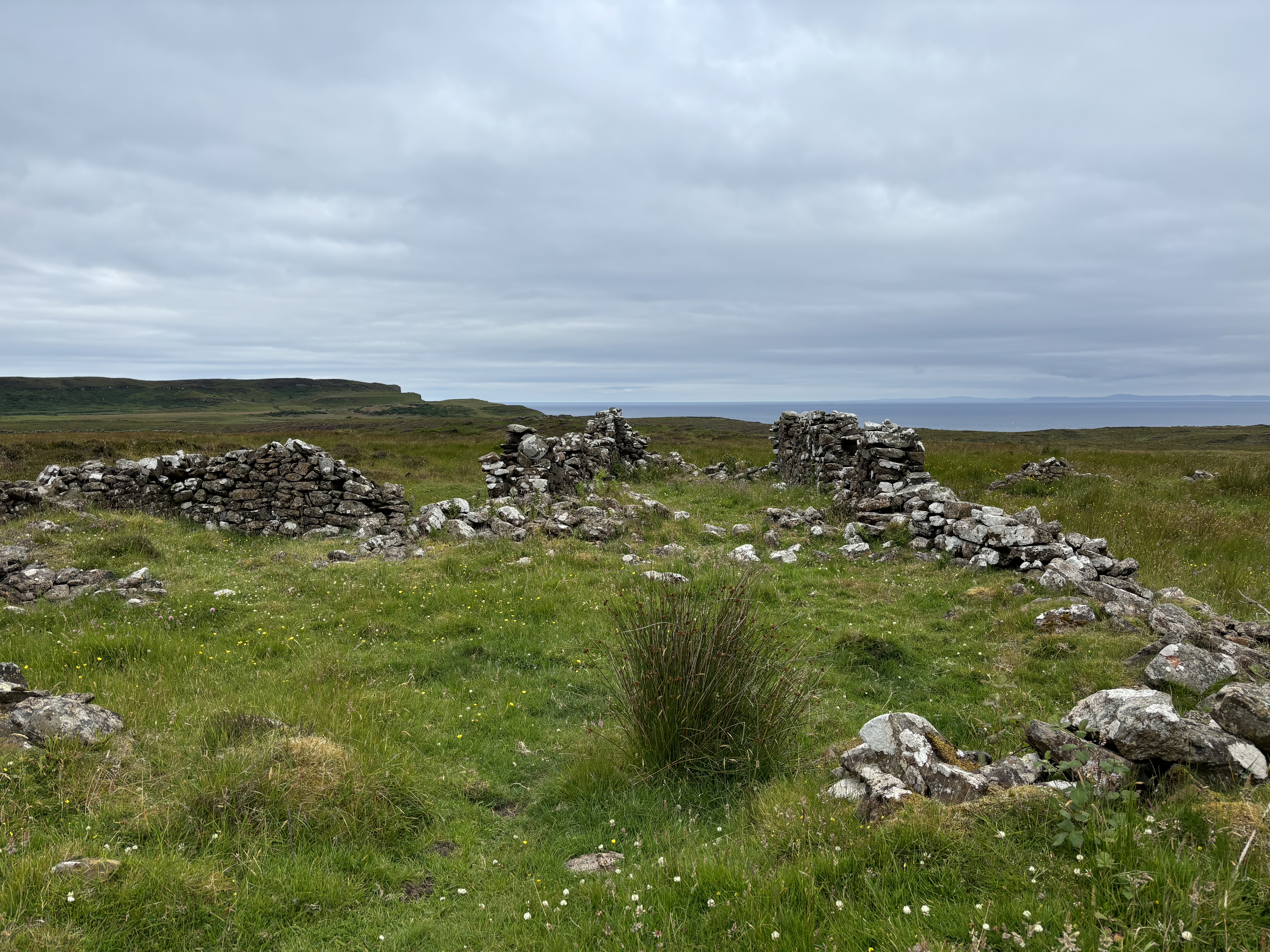
This area of the island - Kilpatrick and Knockans townlands - was reputedly one of the more populous parts.

Remains of farm dwelling at Knockans (Timothy Ferres, 2024)

I saw a number of ruinous and dilapidated cottages, even clachans.

Retracing my way back to the main road, I went westwards and almost immediately saw another ruinous house which was, according to Nick Sebastian, a shop belonging to Hugh and Jessie Spears.

Remains of Spears' house from the main road (Timothy Ferres, 2024)

This shop must have been popular with the islanders up the hill.

Closer to the West Lighthouse, Kebble House - really a cottage - appears to be the most westerly dwelling on Rathlin today.

It has no permanent residents and seems to be owned by a government department today.

Keeper's room in lighthouse (Timothy Ferres, 2024)

The West Lighthouse, including the RSPB bird centre and a little museum, is a highlight of any trip to Rathlin.

It cost no less than £400,000 to construct in 1912 (about £38.4 million in 2024). 


Timothy Ferres, 2024

ON my second day I walked closer to the manor house; to Craigmacagan, now an RSPB walking trail.

It begins on the main road, inland a bit and not far from Mill Bay.

This is probably my favourite walk on the island: over beautiful wild grassy tracks, gently undulating and abounding with wild flora and fauna.


I took a little video clip of Craigmacagan above.

I went for a very brief dip in the sea, despite not having the bulky wetsuit with me.

I'm not - yet - a committed open water swimmer; though who knows? The water was not too cold and the old gnashers were not chattering anyway!

Three dinners and three breakfasts in the manor house; a visit to the celebrated McCuaig's bar at Church Bay (a mere hop, skip, and jump from the manor house; a few hours seated on a side bench with others who were watching England play Spain at football.

I am quite indifferent to team sports, so when I was asked about my choice of team, I pleaded neutrality.

I had reserved a sailing on the larger vehicle ferry at noon, though decided to take the 10am fast ferry back to Ballycastle, County Antrim; merely twenty minutes away.

Sunday, 21 July 2024

Downhill: 1824

Downhill, SEAT OF THE REV SIR HENRY HERVEY ASTON BRUCE, BARONET, FROM ENGRAVINGS BY JOHN PRESTON NEALE


"THIS magnificent seat was erected by Frederick, 4th Earl of Bristol, Bishop of Derry, and is a proof of his great taste in architecture, a science to which his lordship devoted great attention."

"It was bequeathed to its present possessor by the late Earl of Bristol, from whom, in the female line, Sir Henry Bruce is descended, and in the male line, through a noble and honourable race from Robert le Brus, a noble Knight of Normandy, who accompanied WILLIAM THE CONQUEROR into England."

"The mansion is situated near Coleraine, on the edge of the sea, not far from the entrance to Lough Foyle; it is surrounded by pleasure grounds, planned with exquisite skill, the ruggedness of the soil being happily relieved by judicious cultivation of such shrubs as are best adapted to the spot."

"The romantic Glen, including the Lawn, is curved nearly in the form of a horse-shoe, whose two heels are the openings to the north-west."


"From the Lodge, on the Coleraine side, the road winds through a fine wood, having on the left a shady and sequestered glen; a small river runs through the wood, crossed by a bridge, much admired for the singularity of its architecture."

"The view from the Strand Lodge displays at once the beauty of the grounds in front of the house, the rich verdure of the grass giving pasture to fine large Ayrshire cows and Merino sheep."

"On either side of the lawn the plantation displays the grassy green of the larch, contrasted with the bluish hue of the pine and Scots fir; a romantic effect is produced by the appearance of the tabular and columnar basaltic rocks, whose naked protrusions, and wild ruggedness, prevent the smooth-mown lawn and decorated slopes from tiring the fancy too much by the recollection of artificial labour."

"On the right, over the plantation, is seen the Mausoleum, erected by the late Earl of Bristol to the memory of his brother, formerly ambassador to the Court of Spain, where he proved himself a minister of great vigilance, capacity, and spirit, particularly with relation to the family compact between the Houses of Bourbon: he died in 1775."

The Mausoleum is virtually rebuilt by Stephen Price and Peter McMullan in a short video clip here. I'd urge readers to watch this.

"THE Mussenden Temple is a beautiful and singular erection, it is so called after a sister of Sir Henry Bruce, Bart, who married Daniel Mussenden, of Larchfield, County Down; she was a very beautiful lady, and left one son at her decease."

"It is adapted as a library, and contains a small collection of books."

"This building overhangs the sea, and the view of the Strand from thence, during a storm in particular, is truly magnificent; the prospect is bounded by a long range of the Donegal Mountains."

"From the grounds is a view of an old chapel, now a ruin, adjoining which is the burying-ground containing the family vault; at other points the prospect is beautiful and continually varied: the disposition of the whole clearly evinces the hand of taste."

"The interior of the mansion presents also the same claims to our attention; it is richly decorated, and abounds with works of art, collected by the Earl of Bristol."

"In the entrance hall is a statue of the Fighting Gladiator."

"The staircase is extremely light and elegant, it is of stone, with gilt balustrades, the walls painted in fresco, with rustic scenery: from the dome, in which is painted a representation of the Deity dividing light from darkness, depends a large glass chandelier."

"In the corridors of communication are a variety of statues in niches, Flora, Minerva, Leda, Diana, Venus, Apollo, etc, and many busts."

"In the dining-room, the chimney-piece is mosaic, upon which is placed a clock, with the figures of Telemachus and Mentor in a galley; the sideboards, at each end, are supported by Egyptian figures, and adorned with hieroglyphics in ormolu."

"The ante-room to the library is adorned with appropriate busts, and the library, beside an excellent collection of books in four large mahogany cases, and one in the form of an organ, filled with various engravings, contains many curious specimens of art."

"Also a very handsome large mahogany table, holding a musical clock."

"The roof is a dome painted as sky, from which depends a glass chandelier."

"A gallery communicates to the upper part."

Downhill House and Mussenden Temple are virtually revived by Stephen Price and Peter McMullan in this video clip, superbly done if I might add.

First published in June, 2020.

Thursday, 11 July 2024

WILLIAM III at Belfast


WILLIAM III (copy after an original of 1677). (National Portrait Gallery)

KING WILLIAM III's PROGRESS TO THE BOYNE


 FIRST STAGE: CARRICKFERGUS TO BELFAST

About 3 o'clock on the 14th June, 1690, King William landed at Carrickfergus, accompanied by Prince George of Denmark, his brother-in-law, and attended by the Duke of Ormonde, the earls of Oxford, Portland, Scarbrough, and Manchester, besides other distinguished individuals.

His Majesty, on landing, rode through this ancient town, and most probably visited the site of what King James I designated "our royal palace of Mountjoy" [Joymount].

Artist's impression of Joymount (Image: Mid & East Antrim Council)

Crowds of people are stated to have assembled, who welcomed the King with continual shouts and acclamations.

The White House (Image: Abbey Historical Society)

As the forces disembarked at the OLD WHITE HOUSE, the King, without much delay, proceeded to place himself at their head.

The remains of a house are still shown there, where he is said to have rested; having been joined, at that place, by the DUKE OF SCHOMBERG, the Prince of Württemberg, Major-General Kirk, and others.

The former brought with him his coach, drawn by six horses, for the use of the King, having driven over the strand to Belfast, attended by a single troop of horse and a few gentlemen.

The uncertainty of the time and place of His Majesty's landing, and the suddenness of the news was such, that few of the multitude that flocked to Belfast to see it had their ends, the General's motion was so quick; yet before they got into the town there were abundance that met them, and, coming to the North Gate, he was received by the magistrates of Belfast in their formalities.

His Majesty went directly to the castle, which had been some time before prepared for him, where he alighted, and went in to an apartment appointed for him.

ON SUNDAY, 25TH APRIL, 1708, A FIRE DESTROYED BELFAST CASTLE 
WHICH RESULTED IN THE DEATHS OF THREE DAUGHTERS OF LADY DONEGALL:
 LADY JANE, LADY FRANCES AND LADY HENRIETTA CHICHESTER. 
ALSO A FRIEND OF THE GIRLS, (THE DAUGHTER OF PARSON BERKLEY) 
AND A SERVANT GIRL, CATHERINE DOUGLAS.

It has been already mentioned that the King proceeded to the CASTLE OF BELFAST; other notices of this visit state that he remained for five days, and lodged at the house of Sir William Franklin, the site of which became the Donegall Arms Hotel (now the site of Donegall Arcade, 1-15 Castle Place).

It is more probable, however, that some of his suite occupied this house.

The Corporation minutes record that His Majesty stayed five nights in Belfast, and was "very well pleased with the inhabitants and the town and its citizens," and said, when within the Castle, that it was "like Whitehall."

On Sunday, the 15th June, the King attended at the old church in High Street, where St George's now stands, and heard a sermon preached by Dr Boyse.

On that day and the next, he was waited on by the nobility, gentry, and military, and received addresses from the Episcopal and Presbyterian clergy.

The King is understood to have remained in Belfast for five days, and then to have joined his army, which consisted of sixty-two squadrons of cavalry, and fifty-two battalions of infantry, in four divisions.

The van-guard was commanded by Lieutenant-General Douglas; the right wing by Major-General Kirk; the left wing by the earls of Oxford and De Solms; and the main body by His Majesty, in person, the Duke of Schomberg, and Monsieur de Seravemoer.

First published in July, 2012.  Extracts have been taken from the Ulster Journal of Archaeology, Volume One.

Monday, 8 July 2024

Caledon Fête

In June, 2015, I spent a day at the Caledon Estate, the ancestral seat in County Tyrone of the Earl of Caledon KCVO, Lord-Lieutenant of County Armagh.

My first stop, however, was in the village of Caledon itself, a place of considerable character and charm.

Successive Earls have stamped their mark on the village.


There is a water fountain dedicated to the 4th Earl - a Knight of St Patrick -  on the main street.

I stopped opposite a little café called Café Rose, where I had a beaker of tea.

Afterwards I took a stroll along the village. The Caledon Arms Hotel is, sadly, closed down.

Alexander House, Main Street

It's a pity that such a pretty village cannot sustain a good inn or guest-house.

The main entrance to Caledon Estate is just outside the village, through a very grand entrance gate and lodges. It is unmistakable, especially since there are gleaming, gilded earl's coronets attached to the railings.

The drive must easily be a mile in length.


Caledon Park is one of the finest private estates in Northern Ireland, undoubtedly.

The garden fête today was in aid of the local parish church.

Caledon crest outside the portico porch

I arrived early. However,  when I departed in the afternoon, there were hundreds of cars parked in fields within the 3,000 acre estate.

The atmosphere was most agreeable. Lord and Lady Caledon were outside the house in the grounds.

I chatted briefly with Lady Caledon about an item for sale, viz. a pair of black and gold mini skis, presumably for children, which were emblazoned with the Bentley Motors motif.

The Lord-Lieutenant's Flag at Caledon Castle

The Lord-Lieutenant's official flag flew from the Castle's flag-pole.

Prospect from the garden front

At about twelve forty-five I was taken on a guided walk of the arboretum, yew-tree garden, stables and the grounds within the immediate vicinity of the Castle.


There were lots of displays on the lawns outside the Castle, including stalls in marquees, military displays, and police dog-handler demonstrations.

Stableyard

Of course there was no shortage of nosh, either. I could not resist the hog-roast stall.


For a fiver, you received a generous helping of roasted hog, baby roast potatoes, apple sauce, and stuffing.

Former head gardener's cottage

The fête was officially opened by the Lady Mary Peters LG CH DBE, erstwhile Lord-Lieutenant of Belfast.


I left at about three-thirty.

First published in June, 2015.

Wednesday, 3 July 2024

Colebrooke Video

The Viscount Brookeborough, KG, talks about his home, Colebrooke Park in County Fermanagh, in the short video below.

Tuesday, 2 July 2024

Nugent of Portaferry

The very ancient Anglo-Norman house of SAVAGE was settled at Portaferry, County Down, since the time of the first conquest of Ireland by John de Courcy, Earl of Ulster, in 1117.

Under that famous warrior, the original ancestor in Ireland established himself in County Down; and by a written document, dated 1205, in the Tower of London, we find Robert, son of William Savage, named as one of de Courcy's hostages for his appearance before KING JOHN.

The present barony of Lecale was anciently termed the "Territory of the Savages,” wherein, at Ardglass, they and their dependants erected seven castles, the ruins of which are still extant. It appears, also, that a stately monastery of Dominicans was founded at Newtownards, in 1244, by the Savages, "gentlemen of English extraction." 

From the extreme scarcity of records in Ireland, it is impossible, at this remote period, to determine, without liability to error, which is the senior branch of the family, that of PORTAFERRY or ARDKEEN CASTLE.

In 1400, HENRY IV granted to Robert FitzJordan Savage the office of Sheriff of the Ards; and it appears, by an indenture dated 1538, that
Raymond [Savage] should have the chieftainship and superiority of his sept in the Territory of the Savages, otherwise called Lecale. 
However, in 1559, 
The Lord Deputy, Sir William FitzWilliam, made a division between Roland and Raymond Savage of several towns and territories in the Ards.
By pedigree annexed, Roland, in 1572, was in possession of Portaferry Castle, and styled himself "Lord of the Little Ards;" and Lord Deputy Chichester, some years afterwards, addressed him as such by letter.

The ARDKEEN family had some territories in the barony of Lecale, and also in County Antrim, that family always being sore enemies of the O'Neills. 

ROWLAND SAVAGE, Lord of the Little Ards, County Down, representative of the family in the middle of the 16th century, died at Portaferry in 1572, leaving issue, 
PATRICK, his heir;
ROWLAND;
Edmund; Richard; James.
The eldest son,

PATRICK SAVAGE (1535-1603/4), Lord of the Little Ards, wedded Anne Plunket, and left two sons, of whom the elder,

ROWLAND SAVAGE, Lord of the Little Ards, succeeded his father and married Rose, daughter of Russel of Rathmullan, County Down.

He was, however, succeeded by his brother, 

PATRICK SAVAGE,  of Portaferry, who married, in 1623, Jean, only daughter of Hugh, 1st Viscount Montgomery, and had issue,
HUGH, his heir;
ELIZABETH, co-heir to her brother;
SARAH, co-heir to her brother.
Patrick Savage died in 1644 and was succeeded by his son, 

HUGH SAVAGE, of Portaferry, who died unmarried in 1683, and was succeeded in the representation of the family by his cousin, 

PATRICK SAVAGE, of Derry, Parish of Ballyphilip, and afterwards of Portaferry, who, by his wife Anne Hall, of Narrow Water, left issue,

EDWARD SAVAGE, of Portaferry, who died unmarried in 1725, was buried at Portaferry.

His uncle and successor, 

JAMES SAVAGE, of Portaferry, wedded Mabel, daughter of Edmund Magee, of Lisburn, and had issue,
JOHN, his heir;
ANDREW, of whom hereafter;
James; Margaret; Elizabeth.
The eldest son,

JOHN SAVAGE, wedded Catherine, daughter of ___ Savage, and had issue, a son James, who died young.

At his decease he was succeeded by his brother,

ANDREW SAVAGE, of Portaferry, who espoused Margaret, sister and co-heir of Governor Nugent (of Tortola), and daughter of Andrew Nugent, of Dysart, County Westmeath, by his wife, the Lady Catherine Nugent, daughter and co-heir of Thomas, Earl of Westmeath, and had a son and heir,

PATRICK SAVAGE, of Portaferry, who married, in 1765, Anne, daughter of Roger Hall, of Narrow Water, and had issue (with daughters who died unmarried),
ANDREW, of whom presently;
Patrick Nugent, m Hariett, daughter of Rev Henry Sandford;
Roger Hall, Captain RN, died unmarried;
John Levallin, died unmarried;
William, in holy orders;
Barbara; Dorcas Sophia.
Mr Savage died in 1797, and was succeeded by his eldest son  (who assumed the surname of NUGENT and became co-heir of the barony of Delvin),

ANDREW NUGENT JP DL (1770-1846), of PORTAFERRY HOUSE, Lieutenant-Colonel, North Down Militia, High Sheriff of County Down, 1808, who wedded, in 1800, Selina, youngest daughter of Thomas, 1st Viscount de Vesci, and had issue,
PATRICK JOHN, of whom presently;
Thomas Vesey, m Frances, eldest daughter of Sir James Stronge Bt;
Andrew Savage, m Harriet, Viscountess Bangor;
Arthur, m Charlotte, only daughter of Major Brooke, of Colebrooke;
Charles Lavallin, major-general in the army;
Selina, m James, eldest son of Sir James Stronge Bt;
Anne.
Colonel Nugent succeeded his father in 1797 and assumed his present surname, on succeeding to a portion of the estate of his maternal great-uncle, Governor Nugent, 1812.

His eldest son,

PATRICK JOHN NUGENT (1804-57), of Portaferry House, Lieutenant-Colonel, North Down Militia, High Sheriff of County Down, 1843, married, in 1833, his cousin Catherine, daughter of John, 2nd Viscount de Vesci, and had issue,
ANDREW;
JOHN VESEY, lieutenant-colonel;
Arthur Vesey;
Frances Isabella.
The eldest son,

LIEUTENANT-GENERAL ANDREW NUGENT JP DL (1834-1905), of Portaferry House, High Sheriff of County Down, 1882, Colonel, Royal Scots Greys, died unmarried and was succeeded by his brother, 

LIEUTENANT-COLONEL JOHN VESEY NUGENT JP DL (1837-1914), of Portaferry House, who married, in 1886, Emily Georgiana, daughter of Herbert Langham, though the marriage was without issue.

I have written about the Nugent Baronets HERE.

First published in February, 2012.