Showing posts with label County Westmeath Landowners. Show all posts

Monday, 25 May 2026

Magan of Killyon

THE MAGANS OWNED 5,604 ACRES OF LAND IN COUNTY WESTMEATH

The family of MAGAN claims descent from the ancient Irish sept of MacCEAN or MacGEAN, latterly written MacGAN and MAGAN, a collateral branch of the sept of MacDermot Roe. Six successive generations of the MAGANS resided in the townland of Umma More or Emoe, about two and a half miles in distance from Ballymore, County Westmeath.


MORGAN MAGAN
, of Clonearl, County Westmeath, brother of Richard Magan, of Emoe, had issue,
THOMAS, his heir;
MORGAN, successor to his brother;
Susannah.
The elder son,

THOMAS MAGAN, of Togherstown, County Westmeath, a commissioner in the years 1695, 1697 and 1698 for raising a supply in County Westmeath for WILLIAM III, married Sarah Morgan, and dsp 1710, when he was succeeded by his brother,

MORGAN MAGAN, of Togherstown, who wedded Elizabeth ________, and had issue,
Thomas, dsp;
Hubert, dsp;
William, dsp;
Edward, dsp;
Morgan, dsp;
ARTHUR, his heir;
Eliza; Sarah; Ann; Frances.
The sixth son,

ARTHUR MAGAN (1721-77), of Clonearl, Philipstown, King's County (Offaly), High Sheriff of County Westmeath, 1759, MP for Newtown Limavady, 1765, espoused, in 1754, Anne, daughter of Hugh Henry, of Straffan, County Kildare, and had issue,
Edward, dsp 1779;
Hugh Henry;
ARTHUR, who carried on the line;
Anne; Harriet.
The youngest son,

ARTHUR MAGAN (1756-1808), of Clonearl and Togherstown, married Hannah Georgina, daughter and co-heir (with her sister, Elizabeth Anne, wife of Charles, 2nd Baron Castle Coote) of the Rev Dr Henry Tilson, of Eagle Hill, County Kildare, and had issue,
Edward, died young;
WILLIAM HENRY, his heir;
Arthur, Captain RN;
Thomas Tilson, Captain in the army;
GEORGE PERCY, ancestor of GEORGE, cr BARON MAGAN OF CASTLETOWN;
Henry (Rev), dsp;
Charlotte; Eliza; Harriett; Louisa; Emily; Henrietta.
Mr Magan was succeeded by his eldest surviving son,

WILLIAM HENRY MAGAN (1790-1840), of Clonearl, High Sheriff of County Westmeath, 1827, who wedded, in 1817, Elizabeth Georgina, widow of Colonel Thomas Lowther Allen, and second daughter and co-heir of Dudley Loftus, of Killyon, head of the ancient and distinguished house of LOFTUS, and had issue,
WILLIAM HENRY, his heir;
Dudley, died unmarried;
AUGUSTA ELIZABETH, of whom hereafter.
The elder son,

WILLIAM HENRY MAGAN (1819-60), of Clonearl, Captain, 4th Light Dragoons, MP for Westmeath, 1847-57, espoused, in 1849, the Lady Georgiana Charlotte Keppel, youngest daughter of WILLIAM CHARLES, 4TH EARL OF ALBEMARLE; though dsp 1860, and was succeeded eventually by his sister,

MISS AUGUSTA ELIZABETH MAGAN (1825-1905), of Clonearl, King's County, and Killyon, County Meath, who died unmarried.

Her estates included 5,604 acres in County Westmeath, 4,418 acres in County Meath, 2,374 in County Kildare, 1,023 in the King's County, and 165 acres of land in County Dublin.

Miss Magan's paternal uncle,

GEORGE PERCY MAGAN (1799-1857), of County Carlow,  married, in 1824, Ellen, daughter of Valentine O'Connor, and had issue,
PERCY TILSON, his heir;
Thomas Tilson;
Henry;
Henry Augusta;
Edward William;
Hugh Tilson;
Albert Edward;
Valentine John;
Arthur;
Georgina; Mary Monica; Ellen; Charlotte Elizabeth;
Henrietta; Flora Emily; Harriet Honoria.
Mr Magan was succeeded by his eldest son,

PERCY TILSON MAGAN JP (1828-1903), of Correal, County Roscommon, Marlfield House, County Wexford, and Kilcleagh Park, County Meath, who wedded, in 1865, Anne Catherine, daughter of the Rev Edward Richards, and had issue,
Percy Tilson (1867-1947);
ARTHUR TILSON SHAEN, of whom we treat;
Emily Georgina; Muriel Rozel; Rachel Evelyn; Violet Augusta.
The younger son,

ARTHUR TILSON SHAEN MAGAN CMG (1880-1965), of Killyon Manor, Hill of Down, County Meath, Lieutenant-Colonel, Royal Army Service Corps, married, in 1906, Kathleen Jane, daughter of Assheton Biddulph, and had issue,
WILLIAM MORGAN TILSON, his heir;
Francis Shaen;
Annie Sheelagh; Violet Mary; Maureen.
Colonel Magan was succeeded by his eldest son,

BRIGADIER WILLIAM MORGAN TILSON MAGAN CBE (1908-2010), of Killyon Manor, and St Michael's House, Tonbridge, Kent, who wedded, in 1940, Maxine, daughter of  Sir Kenneth Grant Mitchell KCIE, and had issue,
Thomas Kenneth Shaen Biddulph (1941-3);
GEORGE MORGAN, of whom hereafter;
Hugh William;
James Henry.
The eldest surviving son,

GEORGE MORGAN MAGAN (1945-), married, in 1972, Wendy Anne, daughter of Major Chilton, and has issue,
Patrick G B;
Edward William Morgan.
Mr Magan, formerly of CASTLETOWN COX, County Kilkenny, was created a life peer, in 2011, as BARON MAGAN OF CASTLETOWN, of Kensington in the Royal Borough of Chelsea.


In 1876, Mrs Elizabeth Georgina Loftus Magan, of Killyon Manor (above), owned 4,418 acres in County Meath, 5,604 acres in County Westmeath, 2,374 acres in County Kildare, 1,023 acres in County Offaly, and 165 acres in County Dublin, totalling 13,584 acres.

Mrs Magan managed the estates until she died, in 1880, designating her only surviving child Elizabeth Augusta Magan as her heir.

When the Magan family's main residence, Clonearl, was destroyed by fire in 1846, Killyon Manor became their seat.

Killyon was sold about 1970 to Sir Rivers Verain Carew Bt, who lived there for a time until it was purchased by the Purcell family, who have restored the house and gardens.

First published in April, 2018.

Wednesday, 8 April 2026

Middleton Park

THE BOYD-ROCHFORTS WERE THE GREATEST LANDOWNERS IN COUNTY WESTMEATH, WITH 16,397 ACRES


THE REV JAMES BOYD (1725-75), Rector of Erris, County Mayo, married, in 1752, Mary, daughter of Abraham Martin and widow of Arthur Vernon, and left an only son,

ABRAHAM BOYD (1760-1822), Barrister, King's Counsel, who wedded firstly, in 1786, Catherine Shuttleworth, widow of John Davies, by whom he had a daughter, Helena; and secondly, in 1815, Jane, Countess of Belvedere, daughter and eventually sole heiress of the Rev James Mackay, and by her left at his decease an only son,

GEORGE AUGUSTUS ROCHFORT-BOYD JP DL (1817-87), of Middleton Park, County Westmeath, High Sheriff of County Westmeath, 1843, who wedded, in 1843, Sarah Jane, eldest daughter of George Woods, of Milverton Hall, by Sarah his wife, daughter of Hans Hamilton, of Abbotstown (for many years MP for County Dublin), and had issue,
ROCHFORT HAMILTON, his heir;
George, died in infancy;
Charles Augustus, CMG;
George Warren Woods;
Francis;
Alice Jane; Edith Sarah Hamilton; Florence.
Mr Rochfort-Boyd inherited from his mother, the Countess of Belvedere, a great portion of the Rochfort estates situated in County Westmeath, and assumed the surname and arms of ROCHFORT by royal licence in 1867.

He was succeeded by his eldest son,

ROCHFORT HAMILTON BOYD-ROCHFORT JP (1844-91), of Middleton Park, who married, in 1875, Florence Louisa, daughter of Richard Hemming, of Bentley Manor and Foxlidiate, Worcestershire, and had issue,
GEORGE ARTHUR, his heir;
Harold;
Cecil Charles (Sir), KCVO;
Ethel Victoria; Alice Eleanor; Winifred Florence; Muriel.
Major Boyd-Rochfort assumed the surname of ROCHFORT in 1888 on succeeding to the Rochfort estates left by his grandmother, Jane, Countess of Belvedere.

He was succeeded by his eldest son,

GEORGE ARTHUR BOYD-ROCHFORT  VC (1880-1940), of Middleton Park, who married, in 1901, Olivia Ellis, daughter of Christopher Ussher, of Eastwell, County Galway.


MIDDLETON PARK HOUSE, near Mullingar, County Westmeath, was built by George Boyd-Rochfort in 1850.

He commissioned George Papworth, Architect and President of the Royal Academy, to design and oversee the building of the House.

Drawings of part of the interior were exhibited by Mr Papworth during the Royal Hibernian Annual Exhibition of 1850.

Only the very best craftsmen and materials were used in the building and it is a testimony to those craftsmen and materials that Middleton Park House has stood the test of time since then.

It is a fine example of late Georgian architecture favouring the classic Georgian style over the Gothic style evident in other houses of that era.

Acclaimed features of the House are its under-floor heating system, stone bifurcated staircase leading to the Gallery Landing and three-storey high atrium lantern located in the Main Hall.

Middleton Park House also boasts one of a few Richard Turner Conservatories to be found in Ireland.


The House and estate remained in the Boyd-Rochfort family until the early 1960s when it was sold.

Since then it has seen many owners, the most colourful of whom was Barney Curly who famously raffled the House in 1986.

In quite a state of disrepair when acquired by its current owners, it took a lot of time, effort and care to attention to bring it back to life, bringing in specialist professionals to ensure that the original aesthetic and atmosphere remained.

Built between 1840 and 1850, it is unusual in that context, as the Irish famine not only reduced the peasant farmers of Ireland to penury and starvation; it also destroyed the economic basis of the large landed estates held by the old Anglo-Irish aristocracy, as rents could not be paid.

It replaced an older house on the site, which was demolished.

The name Middleton comes from a previous owner of the estate, Mr George Middleton Berry, who subsequently lived in Ballingal House.

Middleton Park House was designed by George Papworth to be a technical wonder of its age.

It had its own gas-house where coal was converted to gas to fuel the house boilers, and an extraordinary heating system buried in its walls, which circulated heated air.

It utilised the most modern materials of the time including cast iron beams for structural supports in the vaulted basement, instead of the usual timber.

Although built well into the Victorian era, it was created in a classical Georgian style, as opposed to the prevailing Victorian Gothic.

It has one of only six turner conservatories left in Ireland.

Richard Turner also built Kew Gardens in London and the Botanic Gardens in Dublin.

Its entrance hall and sweeping stone, cantilevered bifurcated staircase is regarded as one of the finest of its kind in Ireland, and was famously described as “suitable for Citizen Kane” in Burke's Country Houses.

Middleton Park House was built for George Boyd-Rochfort, whose wife was the eldest daughter of the last Earl of Belvedere.

GEORGE III stood as godfather to one of them, and they were high-ranking members of the peerage.

Mr Boyd was granted permission to change his name to Rochfort-Boyd in 1867 by a petition to the House of Lords.

Although the behaviour of George Boyd-Rochfort was questionable during the Irish famine, being cited by the House of Lords for his actions, his successors are remembered today as having been good, progressive landlords.

The various land acts and subsequently the Irish land commission reduced the estates to a fraction (470 acres) of what they were.

A noted stud was established on the estate and it was the venue for point-to-points, and a starting or finishing point for the Westmeath Hunt.

The Westmeath Hunt Ball was also held at Middleton for many years, as well as hare coursing.

The estate was a large employer in the area.

A great many valuable horses were bred here, including Airborne, Winner of the Derby in 1946.

One of the Rochforts (Sir Cecil) also became the royal horse trainer for both KING GEORGE VI and our current sovereign, ELIZABETH II.


*****

THE FAMILY sold the House in the early 1960s, when many of the contents were auctioned, including a Persian rug, now said to be worth in the region of $15m.

A German family bought the estate, which was sold again in the 1960s to the O’Callaghans who, in turn, sold it to Barney Curley, who famously raffled Middleton Park in 1986.

Subsequent owners broke up the estate up into many smaller parcels.

The stud farm ceased to operate around this time as well.

Many of the original fixtures and fittings in the house were sold or removed at this time.

The house, having lost its land, and now existing on only 26 acres, went through a series of owners.

It was, at this stage, in need of major restoration as the roof had deteriorated badly with serous water damage evident throughout the house.

It also lacked modern wiring, plumbing and heating.

The sheer scale of the great mansion, at over 36,000 sq feet, made it impractical as a family home for anybody but the seriously rich.

The current owners purchased it in December 2004.

They set about converting it into a Country House Hotel and planning permission was obtained for this.

The immediate requirement was to repair the roof and make it watertight.

Investigations revealed that the roof in the wing and most of the floors were completely beyond repair, as the roof trusses were rotten and some had been cut in a manner that left the roof liable to collapse.

The Turner conservatory had lost its original glass and the metal work was seriously corroded.

The timber supporting beams in the spectacular entrance hall had also rotted and it was in danger of falling in.

These all had to be replaced also.

A specialist iron working firm from Germany was brought in to repair the conservatory and some new castings to replace those corroded beyond use were sourced in the UK.

Specialist roofers from Austria replaced the wing roof structure.

Bangor Blue slates were used.

The external render on the house had failed and had to be removed and replaced using, as originally, lime plaster.

New Roman cement decorative reveals also had to be cast.

The decorative plasterwork inside the house had to be extensively repaired.

Extensive fire protection works were undertaken.

Three generations of old plumbing and electrics, often surface mounted, were removed and the house completely rewired and re-plumbed.

A new waste treatment plant was installed.

A specialist engineering firm designed the new heating system which includes underfloor heating in the basement to minimise the visual impact of radiators and some elements of the original system are used to duct hot air into the hall.

There are many legends about the house locally most notably that both Napoleon and  T E Lawrence (of Arabia) were conceived here (clearly not true in the case of Napoleon, as the house was not built until 1840 and he had died in 1821!).

The link that Lawrence of Arabia has to the house is that his father was married to one of Mr Boyd-Rochfort’s daughters - Edith - but who also had five illegitimate sons by Miss Sarah Lawrence his children’s Governess.

One of these was T E Lawrence of Arabia.

It is not recorded where he was actually conceived, but he was born in Wales.

Many of the original drawings of the house were lost in the destruction of the RAI archive in 1916, but an extensive file is held by the Irish National Architectural archive in Merrion Square in Dublin, and some of the estate papers and deeds are held by the National Library of Ireland.

First published in July, 2011.

Wednesday, 28 January 2026

Belvedere House

THE EARLS OF BELVEDERE WERE MAJOR LANDOWNERS IN COUNTY WESTMEATH, WITH 9,059 ACRES

The ancient and noble family of ROCHFORT, in old deed and writings styled De Rupe Forti, is stated to have been established in Ireland since its first conquest by the English. Sir Richard de Rochfort was Lord of Crom and Adare, 1243.

Sir Maurice Rochfort was Lord Justice of Ireland, 1302. His son, Sir William, was father of Edmund Rochfort, whose son, Sir John, lord of Tristledelan, 1384, was father of John, who became settled at Kilbride, County Meath, in 1415, and was father of Thomas, whose son, Robert of Kilbride, 1464 and 1472, was father of Christopher of Kilbride, lord of Castledelan, who was succeeded by his son Robert, who was living at Kilbride in 1569.

This Robert Rochfort's second son, Walter, was seated at Brennanstown, and died in 1630.

Walter Rochfort's second son, James Rochfort, of Aughrim, County Wicklow, had a second son,

JAMES ROCHFORT, named Prime-iron, Lieutenant-Colonel in CROMWELL's army, youngest son of James Rochfort, of Agherry, County Wicklow (ninth in descent from Sir William Rochford, Lord of the Manor of Killadoon at the beginning of the 14th century), was executed, under a court-martial, for killing Major Turner in a duel in 1652.

By Thomasine his wife, daughter of Colonel Sir Robert Piggott, he left three daughters and two sons, of whom the youngest,

ROBERT ROCHFORT (1652-1727),  MP for Westmeath, 1692-1707, chosen Speaker of the Irish house of commons, 1695, Chief Baron of the Exchequer, 1707, wedded Hannah, daughter of William Handcock MP, of Twyford, County Westmeath, and left two sons, the elder of whom,

THE RT HON GEORGE ROCHFORT
, MP for Westmeath, 1707-13, Chief Chamberlain of the Court of Exchequer, wedded, in 1704, the Lady Elizabeth Moore, daughter of Henry, 3rd Earl of Drogheda, and had issue,
ROBERT, his heir;
Arthur, MP for Westmeath, 1738;
George;
John;
William;
Mary; Hannah; Elizabeth; Alice; Thomasina; Anne.
The eldest son,

ROBERT ROCHFORT (1708-74), MP for Westmeath, 1731, married, in 1736, Mary, eldest daughter of Richard, 3rd Viscount Molesworth, and had issue,
GEORGE, his heir;
Richard;
Robert, MP;
Jane.
Mr Rochfort was elevated to the peerage, in 1737, in the dignity of Baron Bellfield; and advanced to a viscountcy, in 1751, as Viscount Bellfield.

His lordship was further advanced to the dignity of an earldom, in 1756, as EARL OF BELVEDERE.

He was succeeded by his eldest son,

GEORGE, 2nd Earl (1738-1814), MP for Westmeath, 1761-8, who married firstly, in 1775, Dorothea, second daughter of John Bloomfield, of Redwood; and secondly, in 1803,  Jane, daughter of the Rev James Mackay.

The 2nd Earl died without issue, in 1814, when the titles became extinct.


BELVEDERE HOUSE, near Mullingar, County Westmeath, is an exquisite villa of about 1740, by Richard Castle, on the shores of Lough Ennell.

It was built for Robert Rochfort, 1st Earl of Belvedere, whose original seat was Gaulston, about five miles away.

The house comprises two storeys over a basement; a long frontage; and curved end bows.


The front has a three-bay recessed centre between projecting end bays.

Belvedere itself has only a few rooms, though they are well-proportioned, with rococo ceilings on the ground floor of exceptional quality, including cherubim gazing down from the clouds.


Belvedere House passed, by inheritance, to the Marlay family; thence to Lieutenant-Colonel Charles Howard-Bury DSO JP DL, leader of the 1921 Mount Everest expedition.

In the period following the 2nd World War, Colonel Howard-Bury restored the house and gardens.

He never married and, on his death in 1963, the estate was inherited by Rex Beaumont, who had been Howard-Bury's friend and companion for 30 years.

Mr Beaumont sold the estate to Westmeath County Council in 1982.

Following a multi-million pound restoration the house and gardens have been opened to visitors.

Belvedere also hosts weekend music festivals and intimate garden theatre performances.

First published in June, 2013.  

Wednesday, 15 October 2025

Killua Castle

THE CHAPMAN BARONETS, OF KILLUA CASTLE, WERE MAJOR LANDOWNERS IN COUNTY WESTMEATH, WITH 9,516 ACRES


The parent stock of this family flourished through several generations, in and near the town of Hinckley, Leicestershire. The branch settled in Ireland was established there by  JOHN CHAPMAN and his brother WILLIAM, under the auspices of their first cousin, Sir Walter Raleigh

Through whose influence John obtained grants of land in County Kerry, which, on the fall of his great patron, he was obliged, from pecuniary difficulties, to dispose of to the 1st Earl of Cork, receiving the large sum, in those days, of £26,400 (about £7 million in 2016) from his lordship.

He lived eight years after this transaction, leaving at his decease, his brother,

WILLIAM CHAPMAN, surviving, who lived for several years afterwards, and left at his decease, an only son, 

BENJAMIN CHAPMAN, who entered as a cornet into a cavalry regiment, raised by the Earl of Inchiquin; and obtained, from Cromwell, when Captain Chapman, a grant of a considerable estate in County Westmeath, at Killua, otherwise St Lucy's, formerly a preceptory, or cell, of the knights hospitallers, where he resided during the remainder of his life.

Captain Chapman wedded Anne, daughter of Robert Parkinson, of Ardee, and had two sons, of whom the younger, Thomas, settled in America; and the elder,

WILLIAM CHAPMAN, succeeded his father at Killua.

He married Ismay, daughter of Thomas Nugent; and dying in 1734, was succeeded by his eldest son,

BENJAMIN CHAPMAN, who wedded Anne, daughter of Robert Tighe, by whom he had three sons and two daughters.

He died in 1779, and was succeeded by his eldest son, 

BENJAMIN CHAPMAN (c1745-1810), of Killua Castle, MP for Fore, 1772-6, County Westmeath, 1776-83, who was created a baronet in 1782, designated of Killua Castle, County Westmeath, with remainder in default of male issue, to the male descendants of his father.

Sir Benjamin married Miss Anne Lowther; but dying without an heir, in 1810, the title devolved upon his brother, 

SIR THOMAS CHAPMAN, 2nd Baronet (1756-1837), who had previously received the honour of Knighthood.

Sir Thomas married, in 1808, Margaret, daughter of James Fetherston, of Bracklin Castle, County Westmeath, and had issue,
MONTAGU LOWTHER, his heir;
Benjamin James;
William.
He was succeeded by his eldest son,

SIR MONTAGU LOWTHER CHAPMAN, 3rd Baronet (1808-1853), of Killua Castle, County Westmeath.
The 7th Baronet left his wife to live with his daughters' governess, Sarah Junner. The couple did not marry.


Sir Thomas and Sarah had five sons born out of wedlock, of whom Lieutenant-Colonel Thomas Edward Lawrence CB DSO, better known as Lawrence of Arabia, was the second eldest.

Caroline Margaret, wife of Sir Montagu, the 5th Baronet, was sister of the 7th Baronet, Lawrence's father. 

She was the last Chapman to live in Killua until her death in 1920. She wrote a fascinating little booklet with the history of the house.

Lawrence did visit Killua once, but it was a few weeks before his death when Killua was already a golf club owned by Mr Hackett.

There is a letter by Lawrence at the Imperial War Museum where he mentions his intention to buy the property back into the family.

Alas, it was never meant to be.

 KILLUA CASTLE is situated near Clonmellon, County Westmeath.

The present mansion was built ca 1780 by Sir Benjamin Chapman, 1st Baronet, consisting of a hall, dining room, oval drawing room, breakfast parlour and front and back stairs.

There was also a stable yard, barn and haggard.

From here, the Chapmans administered the surrounding farm lands in the 18th century.

The Castle and its surrounding lands were granted around 1667 to Benjamin Chapman.

On his death the estate passed to his elder son, William; and on William's death in 1734 to his son Benjamin.

Sir Benjamin demolished the original castle.

It passed from him in 1810, by special remainder, to his brother Thomas who, in the early 1820s, commissioned the addition of a large round tower and several other towers, including a library tower, staircase tower and back door tower.

He also completed the castellation and erected the Raleigh obelisk nearby.

When Sir Montagu, 5th Baronet, died childless in 1907, his widow, a cousin, divided the estate between the four legitimate daughters of her brother Sir Thomas, 7th Baronet.

The house and the remaining 1,200 acres of land were sold in 1949.


Until recently, the Castle had become an ivy-clad roofless ruin.

Since 2010, however, Killua Castle has been purchased by a private owner and is undergoing major restoration.


THE OBELISK, erected in 1810 by Sir Thomas Chapman, 2nd Baronet, marks the position where Sir Walter Raleigh planted some of the first potatoes that he imported to Ireland.

The inscription on the obelisk currently reads 'Sir Walter G Raleigh', but there is no other evidence that Raleigh had a middle name, and the 'G' appears to be vandalism added after the original inscription.

The obelisk has been recently restored through a grant from the Irish Georgian Society.

First published in May, 2013.

Tuesday, 15 July 2025

Knockdrin Castle

THE LEVINGE BARONETS WERE MAJOR LANDOWNERS IN COUNTY WESTMEATH, WITH 5,017 ACRES


The first of this name on record is LEVINGE or Lyfing, Archbishop of Canterbury, 1013, who crowned CANUTE in 1017, and died in 1020; next is LEVINGE or Lyfing, Bishop of Worcester and Crediton in 1046, whose nephew possessed, at the time of the Domesday survey, six lordships in Derbyshire and two in Nottinghamshire.

THOMAS LEVINGE, elder brother of Mr Sergeant Levinge, MP and Recorder of Derby during the reign of JAMES I, purchased the Manor of Parwich, Derbyshire, in 1561.

He married Dorothy, daughter of John Beresford, of Newtown Grange, Derbyshire, and was grandfather of

RICHARD LEVINGE, of Parwich, barrister and Recorder of Chester, who married, in 1653, Anne, daughter of George Parker, of Park Hill, Staffordshire, aunt of Thomas, Earl of Macclesfield, LORD CHANCELLOR OF ENGLAND, and was father of

THE RT HON SIR RICHARD LEVINGE (1656-1724), Knight, of the Inner Temple, Parwich, Derbyshire, and High Park, Mullingar, County Westmeath, Recorder of, and MP for Chester, 1690-95, Derby, 1710-11, who wedded firstly, in 1680, Mary, daughter and co-heir of Sir Gawen Corbyn, Knight, of London, by whom he had three sons and three daughters; and secondly, in 1723, Mary, daughter of Robert Johnson, one of the Barons of the Exchequer in Ireland, and by her had one son, Richard, of Calverstown, County Kildare.

Sir Richard Levinge, 1st Baronet (Chester Town Hall)

Sir Richard, MP for Blessington, 1692-3, Longford Borough, 1698-9 and 1703-13, Kilkenny, 1713-14, was created a baronet in 1704, designated of High Park, County Westmeath.

Sir Richard was succeeded by his eldest son,

SIR RICHARD LEVINGE, 2nd Baronet (c1690-1748), of Parwich, and High Park (Knockdrin Castle), MP for County Westmeath, 1723-7, Blessington, 1727-48, who wedded, in 1718, Isabella, daughter of SIR ARTHUR RAWDON Bt, of Moira, County Down; but dying without issue, in 1748, was succeeded by his brother,

SIR CHARLES LEVINGE, 3rd Baronet (1693-1762), who espoused, in 1722, Anne, daughter and co-heir of Major Samuel Greene MP, of Killaghy Castle, County Tipperary, and was succeeded by his only child,

SIR RICHARD LEVINGE, 4th Baronet (c1723-86), High Sheriff of County Westmeath, 1764, who married firstly, in 1748, Dorothea, daughter and co-heir of William Kennedy MP, of County Longford, and had issue,
CHARLES, his successor;
Richard;
Anne; Dorothea; Frances.
Sir Richard was succeeded by his eldest son,

SIR CHARLES LEVINGE, 5th Baronet (1751-96), High Sheriff of County Westmeath, 1791, who wedded, in 1779, Elizabeth Frances, only daughter of Nicholas Reynell, of Reynella, County Westmeath, and had issue,
RICHARD, his successor;
Charles, Lieutenant-Colonel;
Selina; Caroline; Anne; Frances.
Sir Charles was succeeded by his eldest son,

SIR RICHARD LEVINGE, 6th Baronet (1785-1848), of Knockdrin Castle, High Sheriff of County Westmeath, 1808, who espoused, in 1810, Elizabeth Anne, eldest daughter of Thomas, 1st Baron Rancliffe, and had issue,
RICHARD GEORGE AUGUSTUS, his successor;
George Charles Rawdon;
Reginald Thomas John;
Augustus Frederick;
Charles Vere;
Vere Henry;
William James, father of the 9th Baronet;
Edward Parkyns;
Harry Corbyn, High Sheriff of Co Westmeath, 1886;
Elizabeth Anne; Georgiana Frances Caroline.
Sir Richard was succeeded by his eldest son,

SIR RICHARD GEORGE AUGUSTUS LEVINGE, 7th Baronet (1811-84), of Knockdrin Castle, High Sheriff of County Westmeath, 1851, MP for County Westmeath, 1857-65, Lieutenant-Colonel, Westmeath Rifles, who married firstly, in 1849, Caroline Jane, daughter of Colonel Lancelot Rolleston; and secondly, in 1870, Margaret Charlotte, daughter of Sir George Campbell; the marriages, however, were without issue, when the baronetcy devolved upon his brother,

SIR VERE HENRY LEVINGE, 8th Baronet (1819-85), of the Madras Civil Service, who died unmarried, when the title reverted to his cousin,

SIR WILLIAM HENRY LEVINGE, 9th Baronet (1849-1900), who wedded, in 1876, Emily Judith, daughter of Sir Richard Sutton Bt, and had issue,
RICHARD WILLIAM, his successor;
Thomas Vere;
Reginald Augustus;
Charles Horace;
Bernard George;
Gerald Henry;
Dorothy Mary Gertrude; Beatrice Maud Cecil.
Sir William was succeeded by his eldest son,

SIR RICHARD WILLIAM LEVINGE, 10th Baronet (1878-1914), DL, High Sheriff of County Westmeath, 1908, who espoused, in 1910, Irene Marguerite, daughter of J H C Pix, and had issue,
RICHARD VERE HENRY, his successor.
Sir Richard, an army officer killed in action during the First World War, was succeeded by his only child,

SIR RICHARD VERE HENRY LEVINGE, 11th Baronet (1911-84), MBE, of Knockdrin Castle, who espoused firstly, in 1935, Barbara Mary, daughter of George Jardine Kidston, and had issue,
RICHARD GEORGE ROBIN, his successor;
Michael James;
Elizabeth Anne; Patricia Mary; Susan Maureen; Mary Irene.
He married secondly, in 1976, Jane Rosemary, daughter of John Thomas Stacy, without further issue.

Sir Richard was succeeded by his eldest son,

SIR RICHARD GEORGE ROBIN LEVINGE, 12th Baronet (1946-), who married firstly, in 1969, Hilary Jane, daughter of Dr Derek Mark, and has issue,
RICHARD MARK, born in 1970.
Sir Richard wedded secondly, in 1978, Maria Isabella, daughter of daughter of Prince Ferdinando d'Ardia Caracciolo dei Principi di Cursi, and has further issue,
Robin Edward;
Melissa Louise.

KNOCKDRIN CASTLE, near Mullingar, County Westmeath, is an impressive Gothic-Revival mansion of about 1830 by James Shiel.

It was built for Sir Richard Levinge, 6th Baronet, 

The main block comprises two square turrets, joined to a gate-tower by a lower range.

There is an arcaded Gothic central hall; oak carvings; and an Elizabethan-style staircase.


During the 2nd World War the castle was requisitioned for troop accommodation and was occupied by a company of the 6th (Dublin) Infantry of the Irish Army.

The army left in 1945 and handed the castle back to the Levinges.

Sir Richard William Levinge, 10th Baronet, was High Sheriff of County Westmeath, 1908.

The Levinge family owned Knockdrin until 1946, although the 11th Baronet (later a Director of Guinness Ltd) had not been resident there for some time.


In that year the estate was sold to Paddy Dunne-Cullinan, who remained at Knockdrin until 1961, when he in turn sold the estate to Hans and Irene Freiherr von Prondzynski from Germany.

The arable land is now leased out, but the family continues to live in the castle.

Former residences ~ Johnston House, Chapelizod, County Dublin; Castlemount, Castleknock, County Dublin; Clohamon House, Ferns, County Wexford.

Monday, 7 April 2025

Ballynegall House

THE SMYTHS WERE MAJOR LANDOWNERS IN COUNTY WESTMEATH, WITH 9,778 ACRES

This is a branch of SMYTH of Gaybrook, springing more immediately from SMYTH of Drumcree. 

THOMAS HUTCHINSON SMYTH (1765-1830), only son of Thomas Smyth, of Drumcree, by his third wife, Martha (daughter of the Ven Francis Hutchinson, Archdeacon of Down and Connor), served as High Sheriff of County Westmeath, 1792, being then described as of "Smythboro" or Coole.

He married, in 1796, Abigail, daughter of John Hamilton, of Belfast, and had issue,
THOMAS, his heir;
Francis, Captain RN;
John Stewart;
Edward, d 1857;
Arthur (Dr);
Hamilton, barrister (1813-59);
Anna; Emily.
Mr Smyth was succeeded by his eldest son, 

THE REV THOMAS SMYTH (1796-1874), who wedded, in 1832, Mary Anne, daughter of Adam Tate Gibbons, East India Company, and niece of James Gibbons, of Ballynegall, and had issue,
THOMAS JAMES, his heir;
James Gibbons, major in the army;
William Adam, major in the army;
Albert Edward, major in the army;
Elizabeth Abigail Mary Amelia; Mary Anne; Louisa Anna.
The Rev Thomas Smyth was succeeded by his eldest son,

THOMAS JAMES SMYTH JP DL (1833-1912), of Ballynegall, High Sheriff of County Westmeath, 1858, Captain, Westmeath Rifles, who married, in 1864, Bessie, fourth daughter of Edward Anketell Jones, of Adelaide Crescent, Brighton, and had issue,
THOMAS GIBBONS HAWKESWORTH, his heir;
Ellinor Marion Hawkesworth; Maud Emily Abigail Hawkesworth.
Mr Smyth was succeeded by his only son,

THOMAS GIBBONS HAWKESWORTH SMYTH (1865-1953) of Ballynegall, High Sheriff of County Westmeath, 1917, who wedded, in 1895, Constance, younger daughter of Harry Corbyn Levinge, of Knockdrin Castle, Mullingar, and had issue,
THOMAS REGINALD HAWKESWORTH, b 1897;
Marjorie.

BALLYNEGALL HOUSE, near Mullingar, is said to have been one of the greatest architectural losses in the county of Westmeath.

The designs for this elegant and refined Regency house have been traditionally attributed to Francis Johnston, one of the foremost architects of his day and a man with an international reputation.

The quality of the original design is still apparent, despite its derelict and overgrown appearance.

The house was originally constructed for James Gibbons at the enormous cost of £30,000, and was reputedly built using the fabric of an existing castle on site, known as Castle Reynell after the previous owners of the estate.

Ballynagall remained in the Gibbons Family until 1846, when ownership passed on to Mr James W M Berry.

In 1855, ownership later passed on to the Smyth family through marriage.

There is an interesting article here, written by one of the last of the Smyths to live at Ballynegall.


The house was abandoned in the early 1960s and all remaining internal fittings and fixtures were removed at this time.

The original Ionic portico was also removed in the 1960s and now stands at Straffan House, County Kildare.

The remains of a very fine iron conservatory, which has been attributed to Richard Turner (1798-1881), is itself a great loss to the heritage of the county.

Ballynagall House stands in picturesque, mature parkland.

The remains of the house form the centrepiece of one of the best collections of demesne-related structures in County Westmeath, along with the stable block to the north-west and the gate lodge and St Mary's church to the south-east.

First published in February, 2013.

Tuesday, 12 November 2024

Clonyn Castle

THE EARLS OF WESTMEATH WERE MAJOR LANDOWNERS IN COUNTY WESTMEATH, WITH 9,783 ACRES

The noble family of NUGENT was settled in Ireland since the subjugation of that country by HENRY II. Its founder, SIR GILBERT DE NUGENT, originally from the Nogent-le-Rotrou district in France, was one of the knights who, in 1171, accompanied Hugh de Lacy in the expedition to Ireland, having married Rosa, the sister of the said Hugh, obtained thereby the barony of Delvin; 

But, his sons predeceasing him, he was succeeded at his decease by his brother, RICHARD NUGENT, whose only daughter and heiress carried the barony of Delvin into the family of Johns, or Jones, into which she married, and it so remained until brought back by the intermarriage of

SIR WILLIAM FITZRICHARD NUGENT, 1ST BARON DELVIN, of Balrath (descended from Christopher Nugent, third brother of  Sir Gilbert), with Catherine, daughter and heiress of John FitzJones, Baron Delvin.

Sir William was elected Sheriff of Meath, 1401, in which office he was confirmed by the King for one year, and again in 1402.

He was succeeded at his decease, ca 1414, by his eldest son,

RICHARD, 2nd Baron; who, in consequence of his services and expenses in the King's wars, to the impoverishment of his fortune, had an order, dated at Trim, 1428, to receive twenty marks out of the exchequer.

He wedded Catherine, daughter of Thomas Drake, sister and heiress of Nicholas Drake, of Drakerath, County Meath.

His lordship died in 1475, and was succeeded by his eldest son,

CHRISTOPHER, 3rd Baron, who died ca 1483, and was succeeded by his son and heir,

RICHARD, 4th Baron, who had summonses to Parliament in 1486, 1490, and 1493, and was constituted by the Lords Justices and Council, in 1496, commander and leader-in-chief of all the forces destined for the defence of counties Dublin, Meath, Kildare, and Louth.

His lordship was subsequently summoned to parliament in 1498, but failing to appear, he was fined forty shillings for non-attendance.

In 1504, Lord Delvin accompanied the Earl of Kildare to the famous battle of Knockdoe, in Connaught, and was the first to throw a spear into the ranks of the Irish, by which he chanced to kill one of the Burkes.

In 1527, he was nominated Lord Deputy of Ireland, and conducted the public affairs with integrity and honour, until treacherously taken prisoner by O'Connor Faly.

That native chieftain having made inroads upon the confines of the Pale, in 1528, Lord Delvin ordered the detention of a yearly rent due to him out of certain carucates of lands in County Meath; which procedure led to a conference at Rathyn Castle, belonging to Sir William Darcy, when by stratagem the Lord Deputy was seized and detained prisoner, many of his attendants being slain, wounded, and taken.

Walter Wellesley, of Dangan Castle, and Sir Walter Delahyde, of Moyclare, were subsequently deputed to expostulate with O'Connor Faly, and to procure his lordship's liberation, but ineffectually, when another Lord Deputy was appointed to administer the government, and Lord Delvin remained in confinement until O'Connor's pension was restored.

His lordship wedded Elizabeth, daughter of Lord Howth, and had two sons,
CHRISTOPHER;
THOMAS, of Carlanstown, ancestor of the
EARLS NUGENT.
His lordship died in 1538, and was succeeded by his son,

RICHARD, 5th Baron (1523-59), father of

CHRISTOPHER, 6th Baron (1544-1602), was sent prisoner to London, 1580, and committed to the Tower, on suspicion of holding correspondence with the rebels of Leinster; but his innocence being soon afterwards fully established, he returned to Ireland, and was present in Sir John Perrot's parliament, in 1585.

In 1588, he obtained a grant of Fore Abbey, County Westmeath; and being, in 1593, appointed by commission leader of the forces raised in County Westmeath at the general hosting on the Hill of Tara, he brought, with the Nugents, his kinsmen, twenty horsemen there; and so acceptable were his services to ELIZABETH I that, by privy seal, 1597, Her Majesty ordered him a grant in fee farm of so many manors and forfeited lands in counties Cavan and Longford at his election as should amount to the crown rent of £100 per annum.

But this grant not having been executed during his life, on account of the troubles in Ireland, JAMES I, in 1603, ordered £60 in lands, per annum, to be granted to his widow and son.

His lordship espoused Mary, daughter of Gerald, 11th Earl of Kildare, and was succeeded by his eldest son,

RICHARD, 7th Baron (1583-1642), who was arrested in 1607, and committed by the Lord Deputy of Ireland, Sir Arthur Chichester, to Dublin Castle, upon a charge of high treason, being concerned in a conspiracy with the Earls of Tyrone and Tyrconnell, and others, to surprise Dublin Castle, cut off the Lord Deputy and Council, dissolve the state, and set up a government of their own.

His lordship effected, however, his escape, by the assistance of his servant, and was subsequently proclaimed a traitor.

Surrendering in the following year, he obtained a pardon under the Great Seal (1608), and so entirely re-established himself in a few years in royal favour; that he was created, in 1621, EARL OF WESTMEATH.

He wedded Jenet, daughter of Christopher, 9th Baron Killeen; and dying in 1642, was succeeded by his grandson,

RICHARD, 2nd Earl (1621-84), only son of Christopher, Lord Delvin, who pre-deceased his father, by Anne, eldest daughter of Randal, 1st Earl of Antrim.

His lordship espoused Mary, daughter of Sir Thomas Nugent Bt, of Moyrath, and had, with junior issue,
CHRISTOPHER, father of RICHARD, 3rd Earl;
Thomas, 1st Baron Nugent of Riverston;
Anne; Mary.
His lordship was succeeded by his grandson,

RICHARD, 3rd Earl, who, adopting a religious life, became a friar of the Order of Capuchins; and dying in 1714, at Wassey, in a convent of his order, the honours devolved upon his brother,

THOMAS, 4th Earl (1669-1752); who had a colonel's command in the army of JAMES II, and was outlawed in consequence in 1691; but being one of the hostages exchanged for the observance of the articles of Limerick, the outlawry was reversed, and he was restored to his estates and honours.

His lordship wedded Margaret, only daughter of John, 1st Baron Bellew of Duleek, by whom he had issue,
Christopher, Lord Delvin, dsp;
John, dsp;
Katherine; Mary.
His lordship died at the advanced age of 96, and was succeeded by his brother,

JOHN, 5th Earl (1671-1754), a major-general in the army, who married Marguerite Jeanne, daughter of Count Charles Molza, of Modena, Italy, and had issue,
THOMAS, his successor;
James;
John;
Richard;
Edward;
Marie Charlotte; Francois Christine.
His lordship was succeeded by his eldest son,

THOMAS, 6th Earl (1714-92), who conformed to the established church, and wedded firstly, in 1742, Mary, only daughter and heiress of Walter Durand Stapleton, by whom he had an only son, Richard, Lord Delvin, who fell in a duel in 1761.

He espoused secondly, in 1756, Catherine, daughter and co-heiress of Henry White, of Pichfordstown, County Kildare, and had further issue,
Thomas, Lord Delvin, died young;
GEORGE FREDERICK, his successor;
Henry;
Catharine.
His lordship, a founder Knight of the Order of St Patrick, 1783, was succeeded by his eldest surviving son,

GEORGE FREDERICK, 7th Earl (1760-1814), who wedded firstly, in 1784, Maryanne, eldest daughter of Major James St John Jeffries, of Blarney Castle, County Cork, and niece of John, 1st Earl of Clare, LORD HIGH CHANCELLOR OF IRELAND, and had issue, and had issue,
GEORGE THOMAS JOHN, his successor.
His lordship espoused secondly, in 1797, the Lady Elizabeth Emily Moore, daughter of Charles, 1st Marquess of Drogheda, and had further issue,
Robert Seymour;
Thomas Hugh;
Elizabeth Emily; Catherine Anne; Mary Frances.
His lordship was succeeded by his eldest son,

GEORGE THOMAS JOHN, 8th Earl (1785-1871), who wedded, in 1812, the Lady Emily Anne Bennet Elizabeth Cecil, second daughter of James, 1st Marquess of Salisbury, and had issue,
William Henry Wellington Brydges (1818-19);
Rosa Emily Mary Anne.
His lordship, Lord-Lieutenant of County Westmeath, Colonel, Westmeath Militia, was advanced to the dignity of a marquessate, in 1822, as MARQUESS OF WESTMEATH.

He died without surviving male issue, when the marquessate expired.

The Earldom, however, reverted to his kinsman,

ANTHONY FRANCIS NUGENT, as 9th Earl.
The heir apparent is the present holder's son, Sean Charles Weston Nugent, styled Lord Delvin.

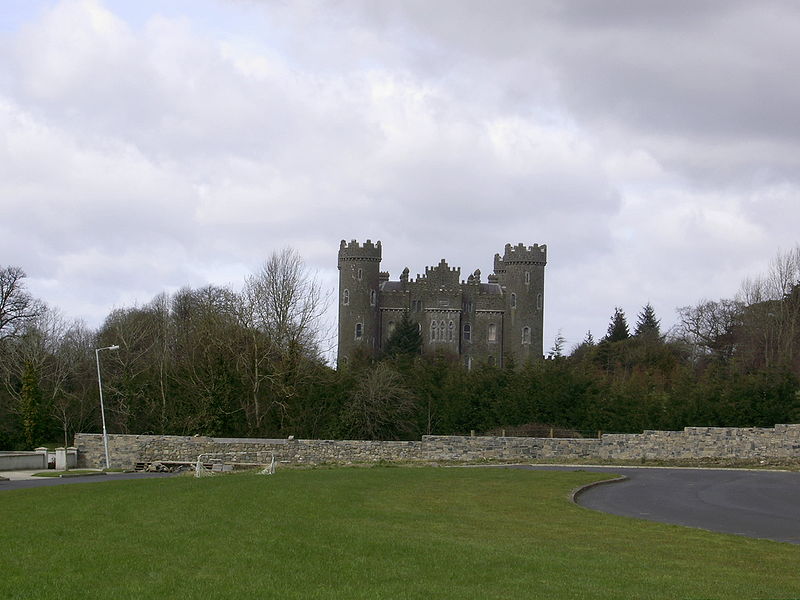
Clonyn Castle (Image: The Times)


CLONYN CASTLE, also known as Delvin Castle, is situated in Delvin, County Westmeath.

The first castle (now in ruins) is believed to have been built in 1181 by Hugh de Lacy the Norman, Lord of Meath for his brother-in-law, Sir Gilbert de Nugent.

Sir Gilbert, originally from the Nogent-le-Rotrou area in France, came to Ireland with Hugh de Lacy in 1171 and settled on some land in Delvin and was granted the title Baron of Delvin.

The ruins of Nugent Castle, burnt when Cromwell's army approached, remain near the centre of the city.


Clonyn Castle is a square, symmetrical, two-storey, 19th century castle of cut limestone.

It has four tall, round corner towers.

The interior has a large two-storey hall with gallery and enormous arcading.

In 1639 Richard Nugent, 1st Earl of Westmeath, build another more recent castle, situated on the dominating ground, and now overlooking Delvin urbanised area today, may be referred to as either Delvin or Clonyn Castle.


Following the death of the 8th Earl and 1st and last Marquess of Westmeath in 1871, Clonyn passed to his only surviving child Lady Rosa, wife of the 1st Lord Greville.

After the 2nd World War, the castle served briefly as a home for 97 Jewish children, most of them orphans of the Holocaust.

A public golf course lies behind the more recent castle, 500 yards from Delvin centre.

First published in July, 2012.