Showing posts with label Hillsborough Castle. Show all posts

Saturday, 27 September 2025

Hillsborough Fort Guard

HILLSBOROUGH FORT was built ca 1650 by Colonel Arthur Hill, the younger son of SIR MOYSES HILL.


The Peerage of Ireland, dated 1789, recounts,
"A castle erected by Sir Arthur Hill in the reign of CHARLES I, which at the Restoration was made a royal fort by CHARLES II, who made Sir Arthur and his heirs hereditary constables, with twenty warders and a well appointed garrison."

"Sir Arthur, having built, at his own charge, and upon his own lands, during the rebellion, for the encouragement of an English plantation, and security of the country, a considerable place of strength, called Hillsborough, fortified with four bastions, or flankers, commanding the chief roads in County Down, leading from Dublin to Belfast and Carrickfergus."

Hillsborough Fort

"His Majesty was pleased to consider that the surprise thereof, upon any insurrection, might prove very prejudicial to his service, and how much it would conduce to His Majesty's service and the safety of the country, that a guard should be placed in that fort for the security thereof."

"He therefore granted a patent at Westminster, 21st December, 1660, for erecting it into a royal garrison by the name of HILLSBOROUGH FORT, with a constable and officers to command it, to be called and known by the name of Constable of Hillsborough Fort, and twenty warders to be nominated and chosen by him; the constable to have the allowance of 3s 4d a day [in 1660 £1 was equivalent to about £206], and the warders 6d each; and this office, which at this day is held and enjoyed by the Earl of Hillsborough, was granted to him, his heirs, and assignees for ever."
In 1690, WILLIAM III stayed for two days at Hillsborough.


The Hill family was effectively authorized "to have, hold, exercise, and enjoy for ever" the office of Constable of Hillsborough Fort; and to raise and maintain a force of twenty men.

Letters patent raised the status of the fort to "a military establishment of the Crown".

Hence the constableship of Hillsborough Fort was vested in the Hill family for ever.

Thereafter the warders were regularly on duty at Hillsborough Castle, wearing "the uniform, somewhat modernised, of the Dutch Guards - blue coat with red lapels; cocked hat trimmed with white lace, and for plume a red feather; white breeches and gaiters."


The navy blue tunic had red cuffs on which was a vertical strip of white lace; collar and shoulder straps were also red; and the tunic was faced with four double bars of white lace.

The sergeant-major's attire was as other ranks, but for a red sash and a steel sword scabbard.

The warders were originally armed with muskets.

The uniform has undergone some alterations over the past three centuries, and that worn by the bugler today is essentially late 18th century in pattern.

Warders were colloquially known as "Castlemen."

Hillsborough Guard during the Queen's Diamond Jubilee celebrations at
Hillsborough Castle  (Image: Kelvin Boyes/Presseye/PA Wire)

Hillsborough Fort Guard was one of only two private armies in the United Kingdom, the other being the Duke of Atholl's Atholl Highlanders.

The War Office attempted to disband the Guard in 1874; law officers, however, advised against it, and the War Office continued to pay £5 per warder per annum (equivalent to £578 in 2020), and a free uniform every two years to twenty of Lord Downshire's estate workers.

Towards the end of the century an agreement must have been reached to discontinue this remuneration. 

Warders on parade at The Square, Hillsborough, County Down


THE Hill family, Earls of Hillsborough and Marquesses of Downshire, are proud to maintain the hereditary constableship of Hillsborough Fort today.

Andrew Carlisle, Bugler of the Hillsborough Fort Guard, tells me that numbers in the guard have ebbed and flowed over the years.

The 3rd Marquess with his favourite hunter, 1833, by George Nairn
(Image: the Marquess of Downshire)

The guard still had its full complement in the early 1900s, comprising a sergeant-major, a bugler, and twenty warders.

It survived for many years in the appointment of the Bugler.

Andrew has had the pleasure of fulfilling this role since 2006.

The Most Hon the Marquess of Downshire & Bugler Carlisle at Hillsborough Fort
(Image: Andrew Carlisle)

Lord Downshire still takes a keen interest in the history and the future of the Guard.

The Hillsborough Fort Guard has grown in numbers in the last few years, and it is hoped that the full complement of 20 warders can be attained in the fullness of time.

The Guard is unique to County Down and, indeed, Northern Ireland, having been the oldest formal military presence in Ireland and one of only two surviving private armies in the kingdom.

The Bugler and six Warders

Today, of course, their role is purely ceremonial, and it is envisaged that they would be on duty at Hillsborough Castle during formal state occasions or functions.
In 2019 Historic Royal Palaces advertized that they wished to create a group of enthusiastic individuals to represent the Hillsborough Fort Guard at Hillsborough Castle, including a sergeant-major, bugler, and two corporals. They envisaged "this team expanding in the future."
 
First published in April, 2021.

Saturday, 17 February 2024

Hillsborough Castle Visit

 
"The mansion, garden, and lawn of the Marquis of Downshire are situated on the west side of the town, and the demesne on the east: "
"the mansion, though a plain-looking structure, has a fine Greek portico; the garden and lawn are extensive and well-kept; "
"and the demesne comprises nearly 800 Irish acres, and is embellished with artificial lakes, and agreeable plantations."
HILLSBOROUGH CASTLE and Gardens, County Down, the ancestral seat of the Hills, Marquesses of Downshire, were thus described by the Parliamentary Gazetteer of Ireland in 1844.

Sir Charles Brett remarked in 1974 that the house was "a pleasant if not very imposing two-storey, rather rambling, ashlar mansion-house...."

I hadn't paid a visit to the Castle and Gardens since the £20 million restoration recently.

Royal connections are advantageous, and a brand new entrance and slip road from the A1 dual-carriageway have been created for visitors.

This "must-see" tourist attraction is now easily accessible.

It's impressive: the gilded embellishments, exquisite detail and craftsmanship; the absolutely wonderful and vast walled garden.

Hillsborough Courthouse and Gates from the Castle

My guided tour of the Castle was at 11am, and I had allowed myself plenty of time, so I had tea in the new Stable Yard Tea Room adjacent to the mansion.

This old stable-yard has an interesting history.

It was originally built ca 1780 as a stable-yard, together with a farm-yard to the north of it.

The two buildings are shown as a pair of interconnecting U-shaped ranges to the east of the Castle on an estate map of 1788.

When Hillsborough Castle was sold to the Government in 1922, the stables were converted for the use of a Guard of ‘A-Specials" of the Ulster Special Constabulary, whose duties were to protect the first Governor of Northern Ireland, the 3rd Duke of Abercorn, from assassination.

Stable-yard

The A- Specials were disbanded in 1935, but the Governor retained a Guard consisting of an officer, two sergeants and sixteen constables, which continued to exist until His Grace retired in 1945.

The Guard-house, as it became known, was listed in 1976.

In 1994 the building was restored and upgraded for use by the Royal Ulster Constabulary.

Further renovations and restorations took place in 2007; and more recently the Stables have been converted into use as a tea-room, shop, and the Clore Learning Centre.


While I waited outside the main entrance of the L-shaped east front I examined the stone plaques set into the wall of the former Governors, including the last holder of that office, the Lord Grey of Naunton.

I met him at a reception in the Castle during the late 1970s or early 1980s.

Entrance Hall ca 1993

The tour of the ground-floor reception rooms was conducted by knowledgeable and attentive guides.

Entrance Hall in 2019

Following my tour of the house I wandered round the gardens, discovering the charming little Friends' Burial Ground, the Lost Garden, LADY ALICE'S TEMPLE (an elegant eye-catcher just beyond the pond overlooking the Ewe Tree Walk).


I walked round the large lake, where a family of swans were preening themselves nonchalantly and oblivious to passers-by.


Having lunched in the main restaurant (salmon, gateau, tea), I explored the adjacent and most impressive walled garden, which comprises four acres.

The Pineapple Gateau

For fear of duplication, I shan't describe the main features; suffice it to remark that Hillsborough Castle and Gardens are worthy of inclusion as one of Northern Ireland's main visitor attractions.

Summer Menu

Incidentally, there are no less than two former pineries (hothouses where pineapples are grown) beside the walled garden.

Only the wealthiest families could afford this exotic fruit in the 18th century: pineapples cost upwards of £34 each (about £5,000 today).

First published in August, 2019.

Wednesday, 29 November 2023

The Downshire Estates

Arms of Wills, 1st Marquess of Downshire,
created Baron Harwich in 1756

During the Victorian era the Downshire estates were vast.

The Hills, Earls of Hillsborough and MARQUESSES OF DOWNSHIRE, had become the largest landowners in County Down.

Arthur, the 6th Marquess, owned 78,051 acres of land in County Down, 15,766 acres in County Wicklow, 13,679 in the King's County, 5,787 in County Antrim, 5,287 in Berkshire, 1,338 in County Kildare, and 281 acres in Suffolk.

This amounted to a grand total of 120,189 acres of land in the realm.

Lord Downshire administered his estates from Hillsborough, County Down.


An article in the Ulster Journal of Archæology, third series, volume twelve, dated 1949, written by E R R Green, explains that

"The wealth of the Hill family was not founded on confiscation, like that of most of the 18th century Irish aristocracy, but on successful land speculation and fortunate marriages."

"SIR MOYSES HILL ... along with HUGH MONTGOMERY and JAMES HAMILTON ... built his fortunes on the ruin of Conn O'Neill of Castlereagh, the last native ruler of South Clandeboy."

"As early as 23 September, 1607, Conn conveyed Castlereagh and some other townlands lying around it to Hill, and in 1616 he granted a further very large tract to Sir Moyses and Sir James Hamilton."

"In 1608, the Corporation of Carrickfergus granted him lands in the liberties of the town."

"He also leased lands from SIR ARTHUR CHICHESTER at Malone, near Belfast, where he built a palisaded fort, the first Hillsborough. He died in 1630."

"His second son, Arthur, was active in buying and leasing land from the Magennises of Kilwarlin ..."

"Before the 1641 rebellion Arthur Hill was building up a considerable estate not only around Cromlyn, later to become his capital with the name of Hillsborough, but also further afield in Upper Iveagh around Carquillan, the later Hilltown."

"Arthur Hill was wise enough to serve Parliament and was rewarded by the grant of over 2,000 acres of land in Kilwarlin, erected, along with his other lands, into the manors of Hillsborough and Growle [Growell] by the Protectorate in 1657."

"Arthur's son, Moyses, married the daughter of his cousin, Francis Hill, of Hillhall, and so united the Castlereagh and Kilwarlin estates."

"All the children of this marriage died unmarried and his half-brother, William, inherited the estate."

"William's first wife, Eleanor Boyle, daughter of the Archbishop of Armagh, brought him the BLESSINGTON estate; and his second wife, Mary Trevor, brought him the third part of Sir Marmaduke Whitechurch's estate at LOUGHBRICKLAND, County Down."

"A townland exempted from King James I's grant of the Lordship of Newry was purchased at the end of the seventeenth century."

"The growth of the linen trade in the 18th century brought great prosperity to the west Down estates of the Hills."

"Banbridge, which passed into their hands in 1748, when Richard White sold Lord Hillsborough four townlands there ..."

"Wills Hill (1718-93) was a prominent figure in the world of his day, being President of the Board of Trade from 1763-5 and again in 1768, and Secretary of State for the Colonies from 1768 until his resignation in 1772."

"The wealth which enabled him to cut to fine a figure in politics was not stinted on his estates."

"He built the beautiful parish church at Hillsborough in 1773, the mansion, and most of the village."

"He became Earl of Hillsborough in 1751, and Marquis of Downshire in 1789."

"Arthur, the 2nd Marquis (1753-1801), married Mary Sandys, an heiress, who brought him East Hampstead Park in Berkshire, DUNDRUM in County Down, and Edenderry in King's County."

"Mary Sandys inherited these Irish properties from her grandmother, sister of the ... Viscount Blundell who had died in 1756."

"The house of Downshire had now reached its fullest expansion ..."

First published in August, 2021.

Sunday, 1 August 2021

Hillsborough Fort Guard Revival

One of my earliest articles on this blog was about the HILL family, Earls of Hillsborough and Marquesses of Downshire.

I have also written quite a lot about the splendid village of HILLSBOROUGH, Royal Hillsborough as it will formally be known later in the year.

My invitation stated Robes, Uniforms, Lounge Suit; Medals, Decorations optional; so I wore a lounge suit.

I thought, a week ago, that I'd need to wear a hat to protect my head from the blazing sun; this requirement was, however, unnecessary. It was mainly overcast, with occasional drizzle.

If anything, I omitted to bring an umbrella.

IN 1660, CHARLES II granted a Royal Charter to HILLSBOROUGH FORT, County Down.

Coat-of-arms of Wills, 1st Marquess of Downshire,
created Baron Harwich in 1756

This fort was erected by the Hill family, and its purpose was to maintain a military presence in the district.

Moreover, this Royal Charter also bestowed the title of Hereditary Constable of Hillsborough Fort on Colonel Arthur Hill, his successors, and assigns.

Furthermore, Colonel Hill was entitled to raise and maintain a Guard of twenty troops to occupy the fort.

The duty of these Fort Warders was to guard the military garrison between Dublin and Carrickfergus.

The Fort Guard remained at full strength until the early 20th century, when government payments ended.

In 1954, the last surviving Warder, a First World War veteran, Jack Green, died and, in order to keep the tradition alive, the 7th Marquess of Downshire decided to retain the post of Fort Bugler.

This post remains to this day, and Fort Bugler Andrew Carlisle has held it since 2006.

Sergeant Bugler Andrew Carlisle & Mark Thompson
(Image: Hilary Thompson)

Recently it was felt, quite appropriately to my mind, that this historic tradition should be revived under the guidance of the 9th and present Marquess of Downshire.

The local historical and cultural society, the Hillsborough Old Guard, provided six period uniforms replicated from the original pattern, and has also provided assistance in the recruitment of new Fort Warders.

I was invited to the investiture ceremony and morning review of the Hillsborough Fort Guard on Saturday morning, the 31st July, 2021.

Mark Thompson and Self (Image: Hilary Thompson)

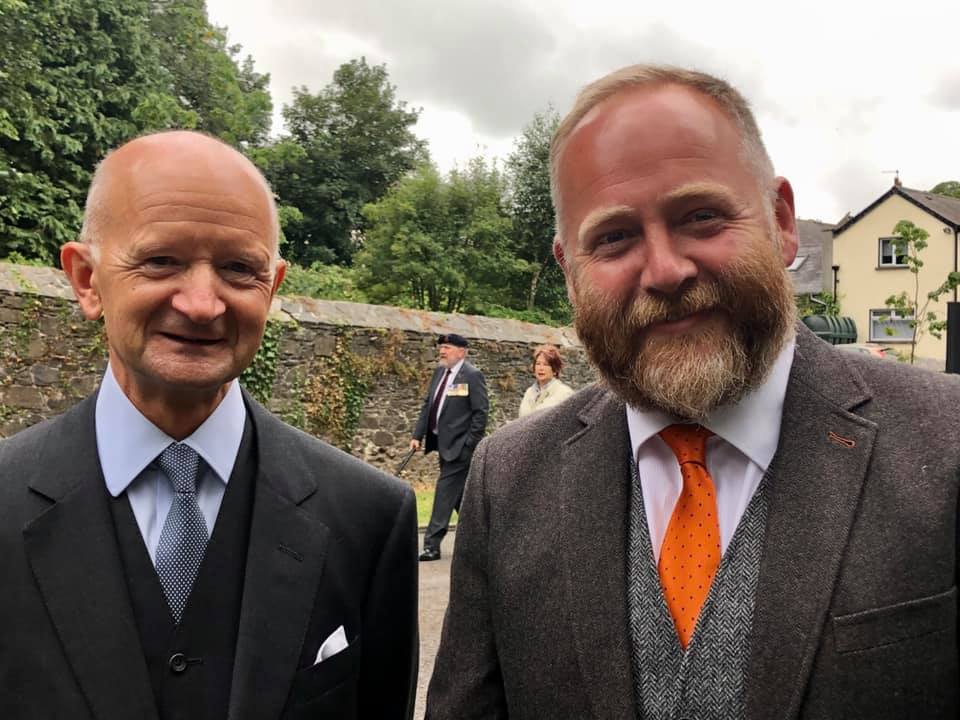
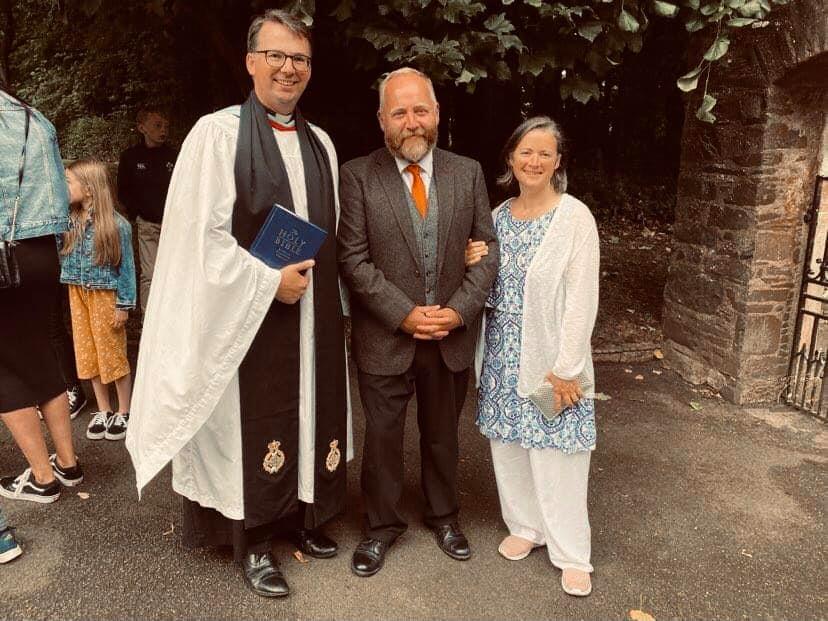
I arrived perhaps ten minutes or so before the ceremony began, and was delighted to encounter my friends Stanley Gamble and Mark and Hilary Thompson.

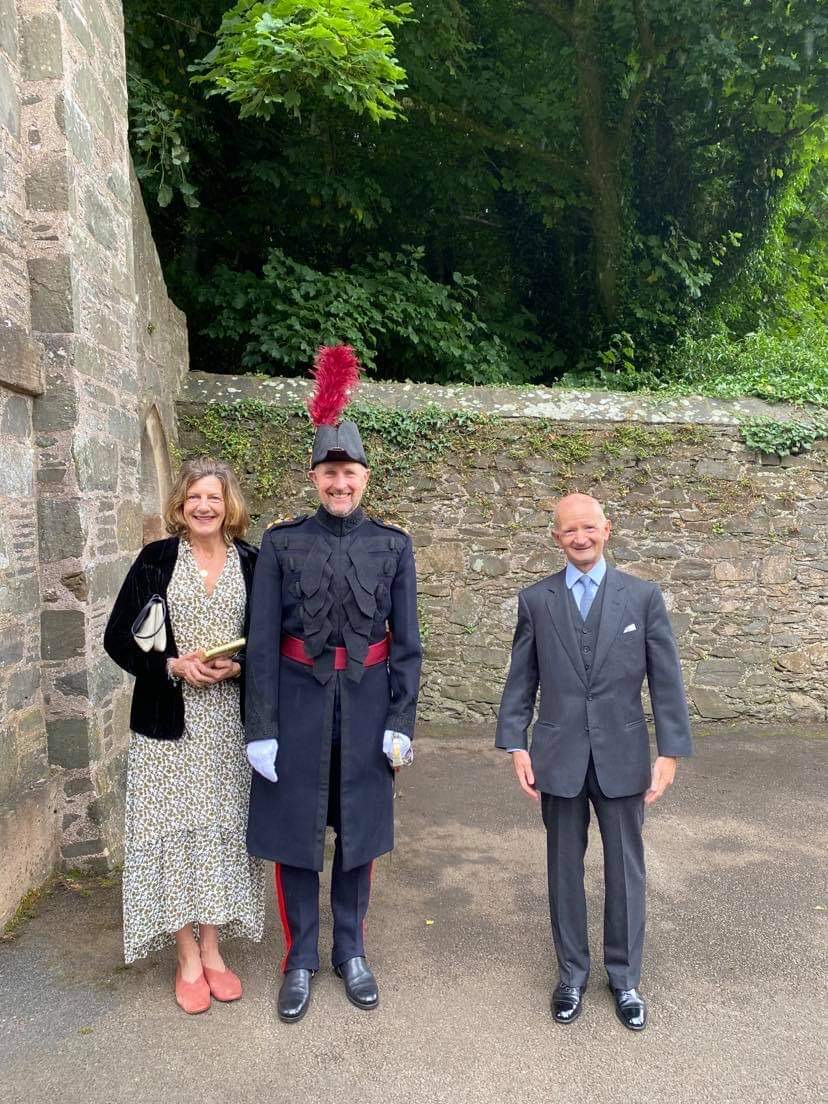
The Most Hon the Marquess and Marchioness of Downshire and Self
(Image: Rev Dr Stanley Gamble CF)

Stanley introduced me to Lord and Lady Downshire, which afforded me the opportunity to present Lord Downshire with a small token of my esteem on what was a historic event.

The Rev Dr Stanley Gamble, CF, with Mark & Hilary Thompson (Image: Timothy Ferres, 2021)

At ten o'clock, there was a bugle fanfare, and the hereditary Constable, Colonel the Most Hon the Marquess of Downshire, arrived, accompanied by the Marchioness of Downshire.

We, the spectators, all stood on the front lawn of the Fort.

Lord and Lady Downshire in the Parade (Image: Alan Ewart, 2021)

Following a general salute, we were addressed by Lord Downshire; the Royal Charter of 1660 was proclaimed; the Chaplain, the Rev Dr Stanley Gamble, CF, led prayers and blessing.

This ceremony was followed by the investiture and the signing of warrants by the new Fort Warders.

The Mayor & Mayoress of Lisburn and Castlereagh with Self
(Image: Rev Dr Stanley Gamble CF, 2021)

Lord Downshire gave a closing address, with a response by the Right Worshipful the Mayor, Alderman Stephen Martin.

Hillsborough Fort Guard in front of the Fort (Image: Timothy Ferres, 2021)

The Fort Guard was inspected, there were closing prayers and, following the National Anthem, the parade marched off.

The Parade Appointments were as follows:-
  • Reviewing Officer, Colonel the Most Hon the Marquess of Downshire
  • Parade Chaplain, the Rev Dr Stanley Gamble CF
  • Parade Sergeant-Major, HFG Sergeant-Major P F Shields VR
  • Parade Bugler, HFG Sergeant Andrew Carlisle
  • Parade Drummer, Colour Sergeant G Chambers, Irish Guards
  • Parade Fifer, Colour Sergeant P Carson, Irish Guards
  • Sergeant-at-Arms, Mr Colin Ward
Guard members on parade:-
  • HFG Corporal Simon Walker
  • HFG Corporal Robert Finn
  • HFG Warder Alan Finn
  • HFG Warder Charles Diett
  • HFG Warder Jackie McQuillan

The Irish Guard musicians were in attendance by kind permission of Lieutenant-Colonel R P Money, Commanding Officer, 1st Battalion, Irish Guards.

The Most Hon the Marquess of Downshire, Hereditary Constable,
Hillsborough Fort Guard (Image: Timothy Ferres, 2021)

The end of the ceremony gave us an opportunity to meet others, including a former fellow Young Unionist, the Right Hon Sir Jeffrey Donaldson MP.

I should explain that four decades ago Jeffrey and I belonged to the Young Unionists, a branch of the Ulster Unionist Party. 

We used to meet at the party GHQ in Glengall Street, behind the Grand Opera House.

Jeffrey did remember me, and we reminisced a bit about the days of the Rt Hon Enoch Powell MBE MP, who represented South Down in parliament.

I left the UUP very many years ago, and indeed politics.

It was a great honour to be present at Hillsborough Fort yesterday, and I'd only wish to express my gratitude to everybody who made the occasion possible and so memorable.

Sunday, 5 July 2020

Hillsborough Forest

Hillsborough Fort. Image: Timothy Ferres, 2020

Hillsborough, County Down, is undoubtedly one of the pleasantest and most interesting villages in Northern Ireland.

It has been ages since I last paid Hillsborough Forest a visit, so I wasn't disappointed today.

Hillsborough Forest Lake. Image: Timothy Ferres, 2020

The Fort, former home of the Hills, Earls of Hillsborough and Marquesses of Downshire, stands overlooking the lake in the forest.

It seems to be in good order, and the old stone steps leading down through the undergrowth towards the parish church can still be seen.

The church and fort are adjacent to each other.

It was a joy to see so many young families with their toddlers and children enjoying the forest walks and the swans, geese, and ducks feeding at the edge of the lake.

Today I walked around its circumference, then out through the gates, via Park Lane, to the Square; and down the main street to the junction where the parish church can be seen from its long avenue.

Image: Timothy Ferres, 2020

The statue of Arthur, 4th Marquess of Downshire, KP, faces the church directly from across the road.

The town-houses on the hilly main street, with their courtyards and mews, are simply charming; as are the little artisan shops and gastro-bars.

Image: Timothy Ferres, 2020

At the top of the main street, on the Square, stands the old court-house, which itself stands opposite the main entrance to Hillsborough Castle, former home of the Downshires, then the Governors of Northern Ireland, Royalty, and Secretaries of State.