Showing posts with label County Longford Landowners. Show all posts

Friday, 17 July 2026

Carrigglas Manor

THE LEFROYS WERE MAJOR LANDOWNERS IN COUNTY LONGFORD, WITH 4,229 ACRES


The LEFROYS are of Flemish extraction, and emigrated from Cambrai to England in the time of the Duke of Alva's persecutions, settling at Canterbury, Kent.

The first settler, about 1559, was ANTOINE LEFROY, a native of Cambrai, who settled in Canterbury ca 1587, where his descendants followed the business of silk dying.

His descendent in the fourth generation, 

THOMAS LEFROY (1680-1723), of Canterbury, married Phœbe, daughter of Thomas Thomson, of Kenfield, by Phœbe his wife, daughter of William Hammond, of St Alban's Court, Kent, and granddaughter of the Rt Hon Sir Dudley Digges, of Chilham Castle, Kent, Master of the Rolls, and had a son,

ANTHONY LEFROY (1703-79), of Leghorn and Canterbury, who married, in 1738, Elizabeth, sister of  Benjamin Langlois MP, many years Under Secretary of State, and had (with one daughter, Phoebe, married to an Italian nobleman), two sons,
ANTHONY PETER;
Isaac Peter George.
The elder son, 

ANTHONY PETER LEFROY (1742-1819), Lieutenant-Colonel, 9th Dragoons, married, in 1765, Anne, daughter of Colonel Gardiner, and had issue,
THOMAS LANGLOIS, of whom hereafter;
Anthony, an army captain;
Benjamin, ancestor of Jeremy John Elton Lefroy MP;
Christopher;
Henry (Rev), Vicar of Santry.
The eldest son, 

THE RT HON THOMAS LANGLOIS LEFROY  (1776-1869), of Carrigglas Manor, LORD CHIEF JUSTICE OF IRELAND, espoused, in 1799, Mary, only daughter and heir of Jeffry Paul, of Silver Spring, County Wexford, member of the younger branch of the family of Sir Robert Paul Bt, and had issue,
ANTHONY, his heir;
THOMAS PAUL, succeeded his brother;
Jeffry (Very Rev), Dean of Dromore;
George Thomson, High Sheriff of Co Longford, 1845;
Jane Christmas; Anne; Mary Elizabeth.
Lord Chief Justice Lefroy, one of the most distinguished lawyers of his time, was called to the Bar in 1797, and appointed a Bencher of the King's Inn, 1819.

He was MP for Trinity College, Dublin, from 1830 until his elevation to the Bench, which took place in 1841, when he was appointed a Baron of the Exchequer.

He was appointed Lord Chief Justice in 1852.


The eldest son,

ANTHONY LEFROY JP DL (1800-90), of Carrigglas Manor, MP for Trinity College, Dublin, 1858-70, County Longford, 1830-47, High Sheriff of County Longford, 1849, married, in 1824, Jane, eldest daughter of Robert Edward, 1st Viscount Lorton, and granddaughter of Robert, 2nd Earl of Kingston, and had issue,
Thomas, died an infant;
Frances Jane; Mary Louisa.
Mr Lefroy was succeeded by his brother,

THOMAS PAUL LEFROY QC (1806-91), of Carrigglas Manor, County Court Judge of Down, Chancellor of the Diocesan Court of Down, Connor and Dromore, Bencher of the King's Inns, who wedded, in 1835, the Hon Elizabeth Massy, daughter of Hugh, 3rd Baron Massy, and had issue,
THOMAS LANGLOIS HUGH, his heir;
AUGUSTINE HUGH, successor to his brother;
Anthony William Hamon (Rev);
Charles Edward;
George Henry;
Alfred Henry;
Margaret Everina; Mary Georgina; Millicent Elizabeth; Grace Elizabeth; Frances Anna.
Judge Lefroy was succeeded by his eldest son,

THOMAS LANGLOIS HUGH LEFROY JP DL (1836-1902), of Carrigglas Manor, High Sheriff of County Longford, 1892, Barrister, who espoused, in 1894, Dorothy Winifred, daughter of Robert Carreg DL, of Carreg, Carnarvonshire.

He dsp 1902, and was succeeded by his brother,

AUGUSTINE HUGH LEFROY JP DL (1839-1915), of Carrigglas Manor and The Lodge, Boxted, Colchester, Essex, High Sheriff of County Longford, 1909, who wedded, in 1878, Isabel Mary, eldest daughter of John Hebblethwaite, of St Clair, Cheltenham, Gloucestershire, and had issue,
HUGH PERCIVAL THOMSON, his heir;
Augustine George Victor;
Mary Elizabeth; Kathleen Grace.
The eldest son,

HUGH PERCIVAL THOMSON LEFROY DSO MC (1880-1954).

It is believed that Jeffry and Tessa Lefroy were the last of the family to live at Carrigglas.

They had moved in to the house in 1976 and opened to visitors in 1985.

Sadly, the cost of maintaining the mansion house was unsustainable and, after twenty-nine years, they sold the estate in 2005.
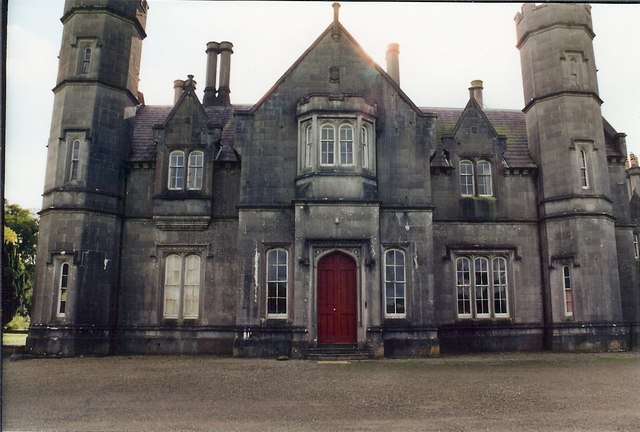

CARRIGGLAS MANOR, near Longford, County Longford, is one of the larger and more impressive country estates still extant in that county.

It features buildings from two distinct periods and in two different architectural styles.

The present manor house is built on, or close to, the site of an earlier house.

The estate was originally a manor of the Anglican Bishops of Ardagh.

It was left to Trinity College, Dublin, in the 17th century and was later leased by Trinity College, ca 1695, to the Newcomen family (later the Gleadowe-Newcomen family).


The estate appears to have been later bought by the Newcomens in 1772.

The owner or resident at the turn of the 19th-century, Sir William Gleadowe-Newcomen, commissioned the eminent neoclassical architect James Gandon (1742-1823) to design for him an unusual house/villa.

Gleadowe-Newcomen later went bankrupt, following financial troubles that led to the eventual collapse of the Newcomen Bank, before work could start on this house/villa.

However, a magnificent stable block and farmyard with central pedimented archways, and an elegant triumphal arch gateway incorporating gate lodges to either side, designed by Gandon were built at Carrigglas.

An unusual walled garden on oval-plan and a gardener's house may also have been built to designs by Gandon.

Carrigglas was leased to, and later bought by, Thomas Lefroy (1776-1869) ca 1833.

Reputedly the character Mr Darcy in Jane Austen's Pride and Prejudice was based on Judge Lefroy (they met in England when Lefroy was attending college there during the late-18th century).

Lefroy engaged the architect Daniel Robertson (d 1849) to design a new house for him at Carrigglas, ca 1837, demolishing the earlier country house to site.

Robertson designed the new house in an Elizabethan/Tudor architectural idiom, creating a highly picturesque building with a dramatic roof-line of tall Tudoresque chimney-stacks, crenellated turrets and gabled projections that ranks as one of the finest buildings of its type in Ireland.

Robertson was also an accomplished landscape architect, well-known for his work on the Italian gardens at Powerscourt, and he also carried out extensive landscaping at Carrigglas.

The Lefroy family remained at Carriglass Manor until about 2005, when they sold the estate and grounds. 

Other former seat ~ The Lodge, Boxted, Colchester, Essex.

First published in June, 2012.

Thursday, 14 May 2026

Edgeworthstown House

THE EDGEWORTHS OWNED 3,255 ACRES OF LAND IN COUNTY LONGFORD

In the reign of ELIZABETH I, about 1563, two brothers, EDWARD and FRANCIS EDGEWORTH, went to Ireland, probably under the patronage of the Earl of Essex and Robert Cecil, as those names have since continued in the family.

The elder brother,

THE RIGHT REV DR EDWARD EDGEWORTH, who was beneficed by Her Majesty, was appointed Lord Bishop of Down and Connor, 1593.

He died without issue, and was succeeded by his brother,

FRANCIS EDGEWORTH, Clerk of the Hanaper, 1619, who married Jane, daughter of Edward Tuite, and sister of Sir Edmond Tuite, and by her (who founded an Irish convent near St Germain, near Paris) had issue,
JOHN, his heir;
Anne; Mary; Margaret.
He died in 1625, and was succeeded by his only son,

CAPTAIN JOHN EDGEWORTH, of Cranallagh Castle, County Longford, High Sheriff of County Longford, 1646, MP, 1646-9, who wedded firstly, Anne, daughter of Sir Hugh Culme, of Cloughoughter Castle, County Cavan, by whom he had a son,
JOHN, his heir.
He espoused secondly, Mrs Bridgman, widow of Edward Bridgman, brother to Sir Orlando Bridgman, the Lord Keeper.

Captain Edgeworth was succeeded by his only son,

SIR JOHN EDGEWORTH (1638-c1700), MP for St Johnstown (Longford), 1661-99, knighted by CHARLES II, 1672, who married firstly, Mary, only daughter and heir of Edward Bridgman, and acquired with her an estate in Lancashire, besides a considerable fortune in money, and had by her six sons.

By his second wife, Anne, he had three sons and two daughters.

Among his issue were,
FRANCIS, his heir;
Robert, ancestor of EDGEWORTH of Kilshrewly;
Henry, of Lissard;
Essex (Rev), of Templemichael.
The eldest son,

COLONEL FRANCIS EDGEWORTH (1657-1709), of Edgeworthstown, MP for Longford Borough, 1703-9, raised a regiment for WILLIAM III.

He wedded firstly, Dorothy, daughter of Hugh Culme, of County Cavan, by whom he had a son, Francis, who died unmarried; and secondly, Dorothy, daughter of Sir Charles Hamilton Bt, of Castle Hamilton, County Cavan, and had a son, John, who dsp, and a daughter, Francelina.

Colonel Edgeworth espoused thirdly, Mary, widow of John Bradstone, and had a son and successor,

RICHARD EDGEWORTH (1701-70), of Edgeworthstown, High Sheriff of County Longford, 1742, MP for Longford Borough, 1737-60, who married, in 1731, Rachel Jane, daughter of Sir Salathiel Lovell, of Harleston, Northamptonshire, and had issue,
RICHARD LOVELL, his heir;
Mary; Margaret.
Mr Edgeworth was succeeded by his only son,

RICHARD LOVELL EDGEWORTH (1744-1817), of Edgeworthstown, MP for St Johnstown, 1798-1800, born at Bath, the celebrated writer on education and inventions.

By four wives he was father of no less than twenty-two children.

Mr Edgeworth was succeeded by his eldest surviving son,

LOVELL EDGEWORTH JP DL (1775-1842), of Edgeworthstown, High Sheriff of County Longford, 1819, who died unmarried, and was succeeded by his half-brother,

CHARLES SNEYD EDGEWROTH DL (1786-1864), of Edgeworthstown, who married, in 1813, Henrica, daughter of John Broadhurst, of Foston Hall, Derbyshire, which lady dsp 1846.

He dsp 1864, and was succeeded by his nephew,

ANTONIO EROLES EDGEWORTH JP DL (1842-1911), of Edgeworthstown, High Sheriff of County Longford, 1890, who wedded, in 1874, Françoise, daughter of Colonel Delcher, of the French Service.

Mr Edgeworth dsp 1911, and was succeeded by his cousin,

FRANCIS YSIDRO EDGEWORTH (1845-1926), son of Richard Lovell Edgeworth and his fourth wife, Frances Ann Beaufort, of Edgeworthstown, who died unmarried.


EDGEWORTHSTOWN HOUSE, Edgeworthstown, County Longford, is an early 18th century mansion erected by Richard Edgeworth MP.

It comprises two storeys over a basement, with two adjoining fronts.


The entrance front has three bays between two tripe windows in the upper storey; while the adjoining front has a three-bay breakfront which rises above the roofline as a pedimented attic.


Richard Lovell Edgeworth enlarged and renovated the house after 1770, and added many ingenious devices, including leather straps to prevent doors banging, sideboards on wheels, and even a water-pump which automatically dispensed a halfpenny to beggars who worked it for half an hour.


Following Francis Ysidro Edgeworth's decease in 1926, Edworstown estate was inherited by Mrs C F Montagu (née Sanderson), whose mother was an Edgeworth.

Mrs Montagu sold the property to Bernard Noonan, who bequeathed it, in 1947, to an order of nuns which used it as a nursing home.

The exterior of the house was subsequently greatly altered; and the interior was gutted and rebuilt.

First published in June, 2018.

Thursday, 12 March 2026

Farragh House

THE BONDS WERE MAJOR LANDOWNERS IN COUNTY LONGFORD, WITH 6,574 ACRES


EPHRAIM BOND, from Yorkshire, settled in the city of Londonderry about 1650, and acquired a considerable property by commercial pursuits there.

He married Miss Dewin, and had two sons,
WILLIAM, his heir;
John, of County Londonderry.
The elder son,  

WILLIAM BOND, of Glenlough, County Londonderry, was father of,

JAMES BOND, of Glenlough, who married Miss Burns, and had five sons, viz,
William;
JAMES;
Oliver;
Thomas;
Saint.
The second son,

THE REV JAMES BOND (-1762), a Presbyterian minister, of Corboy, County Longford, espoused Catherine, daughter of the Rev Thomas Wensley, of Lifford, County Donegal, and had, with four daughters, as many sons, viz.
Wensley (Very Rev), Dean of Ross;
James (Sir), 1st Baronet, of Coolamber;
WILLIAM, of whom presently;
Thomas.
The third son,

WILLIAM BOND (-1811), of Edgeworthstown, County Longford, High Sheriff of County Longford, 1794, married Elizabeth, daughter of Alexander Perry, and had issue,
James Wensley, 1822-43;
Alexander Perry;
Thomas;
WILLOUGHBY, of whom we treat.
The youngest son,

WILLOUGHBY BOND JP DL (1790-1875), of Farragh, County Longford, High Sheriff of County Longford, 1832, wedded, in 1829, Alicia Sidney, daughter of William Gosselin, of Abbey Derg, County Longford, and had issue,
William Wensley, 1834-54;
JAMES WILLOUGHBY, his heir;
Sidney Margaret.
The only surviving son,

JAMES WILLOUGHBY BOND JP DL (1837-1918), of Farragh, High Sheriff of County Longford, 1870, espoused, in 1864, Emma Georgiana Charlotte, daughter of William Hunter Little, DL, of Llanvair Grange, Monmouthshire, and had issue,
WILLOUGHBY JAMES, his heir;
Wensley Hunter, b 1876;
Georgiana Sidney; Henrietta Letitia; Alicia Mabel; Ethel Emma Louisa.
The eldest son,

WILLOUGHBY JAMES BOND JP DL (1867-1942), of Farragh, High Sheriff of County Longford, 1905, married, in 1892, Mary Rosa Kerr, daughter of Captain William Bond, of Newtown Bond, County Longford, and had issue,
BRIAN WILLOUGHBY, of Farragh;
Francis Willoughby, 1901-53;
Mary Hunter; Kathleen Sidney.

FARRAGH, or Farraghroe House, was originally a shooting-box, though considerably enlarged by Willoughby Bond between 1811-33, the architect being Hargrave of Cork.

Additions were also made during the Victorian era.

The entrance front comprises three storeys and five bays; Wyatt windows in the centre above a pillared porch.

The side elevation was of two storeys and three bays framed by huge, plain pilasters.

There was a large, two-storey central hall with a gallery; stained-glass incorporated the Bond family motto, Deus Providebit.


Farragh was sold ca 1960 by Mr Brian Willoughby Bond (1894-1963) and subsequently demolished.

First published in March, 2012.  Bond arms courtesy of the NLI.

Friday, 19 December 2025

Ardagh House

THE FETHERSTON BARONETS, OF ARDAGH, WERE MAJOR LANDOWNERS IN COUNTY LONGFORD, WITH 8,711 ACRES

The founder of this family, CUTHBERT FETHERSTON, of the ancient stock of the Fetherstons of Heathery Cleugh, County Durham, settled in Ireland after the battle of Worcester, 1651, in which Sir Thomas Fetherstonhaugh was made prisoner, and afterwards beheaded at Chester.

The eldest son of this Cuthbert, 

CUTHBERT FETHERSTON, had three sons,
Cuthbert, ancestor of Fetherston of Bracklyn;
THOMAS, of whom hereafter;
Francis.
The second son,

THOMAS FETHERSTON, settled at Ardagh, County Longford, and marrying Miss Sherlock, had four sons,
John (Very Rev), Dean of Raphoe;
William, of Carrick;
Francis;
RALPH, of whom we treat.
The youngest son,

RALPH FETHERSTON (c1731-80), of Ardagh, High Sheriff of County Longford, 1756, MP for Longford County, 1765-6, was created a baronet in 1776, designated of Ardagh, County Longford.

He wedded firstly, Elizabeth, eldest daughter of Samuel Achmuty, of Brianstown, County Longford, by whom he had an only daughter, Elizabeth; and secondly, Sarah, daughter of Godfrey Wills, of Will's Grove, County Roscommon, by whom he had issue,
THOMAS, his heir;
Godfrey, killed in the East Indies;
John;
Francis;
Sarah; Maria; Letitia; Elizabeth.
Sir Ralph was succeeded by his eldest son,

SIR THOMAS FETHERSTON, 2nd Baronet (1759-1819),  High Sheriff of County Longford, 1781, MP for County Longford, 1783-1800, who married Catherine, daughter of George Boleyn Whitney, of New Pass, County Westmeath, and had issue,
GEORGE RALPH, his successor;
John;
THOMAS, succeeded his brother;
Elizabeth; Catherine; Isabella; Sarah; Octavia.
Sir Thomas was succeeded by his eldest son,

SIR GEORGE RALPH FETHERSTON, 3rd Baronet (1784-1853), High Sheriff of County Longford, 1834, MP for County Longford, 1819-30, who espoused, in 1821, Frances Elizabeth, eldest daughter of Richard Solly, of York Place, Portman Square, London, though the marriage was without issue.
Sir George and Lady Fetherston landscaped the demesne grounds and the village of Ardagh. The conversion of the old house into the mansion within its demesne may have been completed at this time, and involved the re-siting of the village street or road. The village clock-tower and surrounding buildings were erected in 1863 in remembrance of Sir George and of his life-long devotion to the moral and social improvement of his tenantry, and the site whereon they stand purchased by Frances Elizabeth, his widow. A memorial stone in the old church records his death on 12th July 1853, and that his wife died in London twelve years later and was buried in Walthamstow. 
Sir George was succeeded by his youngest brother,

THE REV SIR THOMAS FRANCIS FETHERSTON, 4th Baronet (1800-53), who married firstly, in 1823, Adeline Godley; and secondly, Anne L'Estrange, of Moystown, County Offaly, and had issue,
George Ralph, died in infancy;
THOMAS JOHN, his successor;
Edmund Whitney;
John Henry;
Albert William Boleyn;
Boleyn Henry Francis;
Henry Ernest Wiliam;
Rosa Elizabeth; Catherine.
Sir Thomas was succeeded by his eldest surviving son,

SIR THOMAS JOHN FETHERSTON, 5th Baronet (1824-69), High Sheriff of County Longford, 1858, who espoused, in 1848, Sarah, daughter of Henry Alcock, and had issue,
GEORGE RALPH, his successor;
Adeline Margaret; Caroline Louisa.
Sir Thomas was succeeded by his only son,

THE REV SIR GEORGE RALPH FETHERSTON (1852-1923), 6th and last Baronet, High Sheriff of County Longford, 1897,  who died unmarried, when the baronetcy expired.

Sir George was born in Dublin and educated at Brighton College.

In his mid-twenties he entered Salisbury Theological College to prepare for ordination into the ministry of the Church of England.  

He served as curate in Tenby and Worcester City, and for six years as Rector or Vicar of the Parish of Pydeltrenthide in Dorset.

He served also as an honorary chaplain to Millbank Military Hospital, London, during the 1914-18 War.

He was one of the first two men in Holy Orders to serve as Sheriff in their Counties until the disestablishment of the Church of Ireland clerics of the Anglican Communion were not permitted to hold such Office.

Being Sheriff in 1897 he received the Diamond Jubilee Medal and preached his Jubilee Sermon in St. Patrick's Church, Ardagh.

Sir George was a man of many interests and hobbies — music, travel, cycling, fishing, photography, collecting ancient china and stamps, bird-watching and study of insects.

He travelled widely in Europe, Africa, North and South America.

This must have absorbed some of the Ardagh estate income.

He was Fellow and Vice-President of the Guild of Church Musicians and of the Victoria College of Music London. 

Who's Who credited him with the composition of 150 alternative tunes for Hymns Ancient & Modern, various chants, songs and other music, but none of these are to be found in current chant and Hymn books.

His publications have been listed as The Malvern Hills, Through Corsica with a Pencil. The Mystery of Maple Street, A Poem: The Rose of England. An Incident in the Siege of Antwerp, A Legend of Corpus Christi College, and four books of Sermons and Addresses.

These may have been published privately for limited sale or distribution.

Sir George may not have had much interest in the ownership and management of the estate.

He entered into voluntary agreements with over 300 tenants to sell to them the freehold of their farms, under the Irish Land Act 1903. 

The Ardagh estate was not acquired or purchased by the Irish Land Commission, which, however, advanced the money required by the tenants and others, and the holdings were vested in them by the Commission in 1922-23.

An area of 427 acres of bog land was vested in trustees for the use of purchasing new freeholders.

Sir George retained Ardagh House and demesne acres until his death in a Worcester City Nursing Home, and burial in Tenby, South Wales, in 1923. 


An attempt to destroy the house by fire in 1922 may have been a local expression of dissatisfaction with allocation of estate land or an effort to hasten sale of the last remnants of the estate.

Manuscripts written in Irish were salvaged from the 1922 flames of Ardagh House.


ARDAGH HOUSE is an eight-bay, two-storey (originally three-storey) over-basement house, originally built ca 1730 and altered ca 1826 and ca 1863. 

A Three-bay, two-storey block (formerly the ballroom) was attached to the south-east end, having hipped slate roof with overhanging bracketed eaves.

A single-bay porch with tetra-style porch to the centre of the front façade (south), adjoined to the east by a four-bay single-storey additional conservatory with pilasters and lean-to roof. 


(Image: Longford Tourism)

Ardagh House was acquired as training college by the Sisters of Mercy ca 1927, with multiple extensions to the east and the north-east.

It retains much of its early character despite a fire in 1948 that resulted in it being reduced to two storeys in height.

Much interesting fabric remains, such as some timber sliding sash windows, and console brackets to the porch. 

Although probably early-to-mid 18th century in date, this structure now has a predominantly early-to-mid 19th century appearance.

The elegant porch and conservatory, and the former ballroom/block to the east, were also added at this time. 

It also retains some of its early fabric to the interior, despite the fire in 1948, including plasterwork and fireplaces.

THE POET and novelist Oliver Goldsmith (1728-74), when a young man, once loitered on his way between Ballymahon and Edgeworthstown, strayed from the direct road, and found himself benighted on the street  of Ardagh.

Wishing to find an inn, but inquiring "for the best house in the place", he was wilfully misunderstood by a wag and directed to the large, old-fashioned residence of Sir Ralph Fetherston, 1st Baronet.

Sir Ralph, whom the poet found seated by a good fire in the parlour, immediately perceived the young man's mistake; and being humorous and well-acquainted with Goldsmith's family, he for some time encouraged the deception.

The incidents of the occasion form the groundwork of Goldsmith's well-known comedy "Mistakes of a Night."

First published in December, 2011.

Tuesday, 9 September 2025

Castle Forbes

THE EARLS OF GRANARD WERE THE SECOND LARGEST LANDOWNERS IN COUNTY LONGFORD, WITH 14,978 ACRES 


The surname of Forbes is said to be a corruption of Forebeast, which was originally assumed by the founder of the family in Scotland, to commemorate the achievement of having destroyed a ferocious bear which had infested the country.

THE HON PATRICK FORBES, armour bearer to JAMES III, King of Scots, third son of 2nd Lord Forbes and Egidia, his wife, daughter of William Keith, 1st Earl Marischal of Scotland, and grandson of 1st Lord Forbes, by Elizabeth his wife, only daughter of 1st Earl of Angus, and granddaughter of ROBERT III, King of Scots.

He had a charter of Corse, 1482, and founded the house of Forbes of Corse.

His son,

DAVID FORBES, of Corse, Aberdeenshire, called "Trail the Axe," was father of

PATRICK FORBES, who married Marjory Lumsden, and was succeeded by his son,

WILLIAM FORBES, of Corse, who wedded Elizabeth Strachan, daughter of the Laird of Thornton, and had issue,
Patrick (1564-1635), Bishop of Aberdeen;
William, of Craigievar;
John, minister of Delft in Holland;
Alexander;
James;
ARTHUR, of whom we treat;
Robert.
The sixth son, 

SIR ARTHUR FORBES (c1590-1632), settled in Ireland, 1620, and was made, by patent dated at Dublin, 1622, a free denizen of that kingdom. 

In 1628, Sir Arthur was created a baronet; and having, by petition to the King, made discovery that several royal fishings in the province of Ulster belonged to the Crown, an inquiry was thereupon instituted, and Sir Arthur was eventually rewarded by a grant of such proportion of the said fisheries as he thought proper to demand, besides the sum of £300 from the first profits of the remainder. 

He had previously obtained extensive territorial possessions from the Crown, particularly a grant of sundry lands in County Longford, in all 1,266 acres, which were erected into the manor of Castle Forbes, with the usual manorial privileges.

Sir Arthur wedded Jane Lowther, and falling in a duel at Hamburg, 1632, where he had accompanied his regiment (he was lieutenant-colonel in the army) to assist Gustavus Adolphus of Sweden, was succeeded by his eldest son,

THE RT HON SIR ARTHUR FORBES, 2nd Baronet (1623-95), who zealously espoused the royal cause in Scotland, and was rewarded, after the Restoration, by being sworn of the Privy Council in Ireland, and appointed marshal of the army in that kingdom.

In 1671, Sir Arthur was constituted one of the Lords Justices of Ireland, and again in 1675, when he was elevated to the peerage, in the dignities of Baron Clanehugh and Viscount Granard.

In 1684, his lordship was appointed Colonel of the Royal Regiment of Foot in Ireland, and Lieutenant-General in the army; and in the same year was advanced to the dignity of an earldom, as EARL OF GRANARD.

He married Catherine, daughter of Sir Robert Newcomen Bt, by whom he had five sons and a daughter, Catherine, wedded to Arthur, 3rd Earl of Donegall.

His lordship died in 1695, he was succeeded by his eldest son,

ARTHUR, 2nd Earl (c1656-1734), who wedded, in 1678, Mary, eldest daughter of Sir George Rawdon Bt, of Moira, County Down, and had three sons and two daughters.

His lordship was succeeded by his only surviving son,

GEORGE, 3rd Earl (1685-1765), who had been called to the House of Lords in the lifetime of his father, as Lord Forbes.

His lordship was a naval officer of great eminence and rank, and at the time of his decease, was senior admiral of the Royal Navy.

In 1733, he was appointed envoy extraordinary and minister plenipotentiary to the court of Muscovy; and upon his recall, in 1734, was highly complimented by the Empress.

He espoused, in 1709, Mary, eldest daughter of Sir William Stewart, 1st Viscount Mountjoy, of that family (now extinct), and widow of Phineas Preston, of Ardsallagh, County Meath, and had issue,
GEORGE, his successor;
John, Admiral of the Fleet.
His lordship was succeeded by his elder son, 

GEORGE, 4th Earl (1710-69), Lieutenant-General in the Army, Colonel, 29th Regiment of Foot, MP for Mullingar, 1749-65, who wedded, in 1736, Letitia, daughter of Arthur Davys, and was succeeded at his decease, in 1769, by his only son,

GEORGE, 5th Earl (1740-80), MP for St Johnstown, 1762-8, who married firstly, in 1759, Dorothea, second daughter of Sir Nicholas Bayley Bt, and sister of Henry, 1st Earl of Uxbridge, by whom he had one surviving son, GEORGE, his successor.

His lordship espoused secondly, in 1766, Georgiana Augusta, eldest daughter of Augustus, 4th Earl of Berkeley, and had issue,
Henry;
Frederick;
Georgiana Anne; Augusta; Louisa Georgiana; Elizabeth.
His lordship was succeeded by his eldest son,

GEORGE, 6th Earl (1760-1837), who was created a peer of the United Kingdom, in the dignity of Baron Granard, of Castle Donington, Leicestershire.

He wedded, in 1779, Selina Frances, fourth daughter of John, 1st Earl of Moira, and had issue,
GEORGE JOHN, father of GEORGE ARTHUR HASTINGS;
Francis Reginald;
Hastings Brudenell;
Elizabeth Maria Theresa; Adelaide Dorothea; Caroline Selina.
His lordship, who was a general in the army, and Clerk of the Crown and Hanaper in Ireland died at Paris, 1837, and was succeeded by his grandson,

GEORGE ARTHUR, 7th Earl (1833-89), KP, Vice-Admiral of Connaught, Knight of the Order of Malta, and Knight Grand Cross of the Order of St Gregory the Great, who married firstly, in 1858, Jane Colclough, younger daughter and co-heiress of Hamilton Knox Grogan Morgan MP, of Johnstown Castle, County Wexford, and by her had issue, two daughters,
Adelaide Jane Frances; Sophia Maria Elizabeth.
His lordship wedded secondly, 1873, Frances Mary, eldest daughter of 12th Baron Petre, and had further issue,
BERNARD ARTHUR WILLIAM PATRICK, his successor;
Fergus Reginald George;
Reginald George Benedict;
Donald Alexander, DSO, MVO, JP;
Bertram Aloysius, CMG, OBE;
Fergus George Arthur;
Eva Mary Margaret (twin with Reginald); Margaret Mary Theresa.
His lordship was succeeded by his eldest son,

BERNARD ARTHUR WILLIAM PATRICK, 8th Earl (1874-1948), KP, GCVO, PC, who espoused, in 1909, Beatrice, OBE, (73, Rue de Varenne, Paris VII), daughter of Ogden Mills, of Staatsburg, Dutchess County, New York, USA, and had issue,
ARTHUR PATRICK HASTINGS, his successor;
John, father of 10th Earl;
Moira Mary; Eileen Beatrice.
His lordship was succeeded by his elder son,

ARTHUR PATRICK HASTINGS, 9th Earl (1915-92), AFC, Vice-Admiral of Connaught, who married, in 1949, Marie-Madeleine Eugenie, princess of Faucigny Lucinge, and had issue, two daughters,
Moira Beatrice; Georgina.
His lordship died without male issue, and the family honours reverted to his nephew,

PETER ARTHUR EDWARD HASTINGS, 10th Earl (1957-), son of the Hon John Forbes (see above), who married, in 1980, Nora Anne, daughter of Robert Mitchell, of Portarlington, County Laois, and has issue,
JONATHAN PETER HASTINGS, styled Viscount Forbes;
David Robert Hastings;
Edward Hastings;
Lisa Ann.
The 8th Earl was the last Lord-Lieutenant of County Longford, from 1916 until 1922.


CASTLE FORBES, near Newtownforbes, County Longford, is a 19th century castle of random ashlar, built about 1830.

It replaced an earlier house destroyed by fire.

It has two storeys over a high basement, with two adjoining fronts dominated by a lofty, round corner tower.

The house is prolonged by a low service wing and a gateway to the yard in the French style, with a high roof and conical-roofed turret and bartizan added about 1870.

Castle Forbes has heavy battlements and machiolations; lancet windows separated by stone mullions; and a few Early English tracery windows.


There are also corbelled stone balconies with pierced balustrades.

The Castle remains the private home of the Forbes family, Earls of Granard.

The village of Newtownforbes takes its name from the Forbes family, having resided in the region since 1691.

The village church, built in the late 17th century, is one of the few Regency buildings of its type in the county.

Castle Forbes has its entrance in the centre of the village.

The Forbes family changed the name of the village from Lisbrack to Newtownforbes ca 1750.

There is no public access to the Castle or grounds, which are strictly private.

Although Newtownforbes geographically has always been in the shadow of Castle Forbes, it cannot be regarded as an estate village.

There are only a few houses in the centre of the village, near the main entrance to the estate, which were built by the estate owners for the workers on the estate.

They were some of the first houses in the county to have flush toilets.

The Lady Georgina Forbes, aunt of the present 10th Earl, is thought to divide her time between France (as of 1990) and Ireland, where she uses the castle occasionally during the year.

Lady Georgina is an accomplished horse breeder and owner.

Residences ~ 73, Rue de Varenne, Paris VII, France; Forbes House, Halkin Street, London.

First published in May, 2011.  

Tuesday, 11 February 2025

Newcastle House

THE KING-HARMANS WERE THE LARGEST LANDOWNERS IN COUNTY LONGFORD, WITH 28,779 ACRES

NICHOLAS HARMAN, of Carlow, settled in Ireland during the reign of JAMES I. He was one of the first burgesses of Carlow, named in the charter granted to that borough by JAMES I in 1614, and was High Sheriff of County Carlow in 1619.

By Mary his wife he was father of 

HENRY HARMAN, of Dublin, who had by Marie his wife, five sons and as many daughters, viz.
Edward;
Anthony, dsp before 1684;
THOMAS, of whom hereafter;
William;
Henry;
Anne; Mary; Jane; Margaret; Mabel.
Mr Harman died before 1649, and was succeeded by his third son, 

MAJOR SIR THOMAS HARMAN, Knight, of Athy, knighted by the Lord Deputy of Ireland, Thomas, Earl of Ossory, 1664, MP for Carlow, 1659, Kildare Borough, 1661.

Sir Thomas obtained a grant of considerable estates in County Longford, under the Act of Settlement, dated 1607.

He married Anne Jones, who also obtained a grant of lands in County Carlow, 1668.

Sir Thomas died in 1667, and they were both buried in Christ Church Cathedral, Dublin, having had issue, with a daughter, Mary, a son,

WENTWORTH HARMAN (ante 1655-1714), of Castle Roe, County Carlow, Captain of the Battle-Axe Guards, 1683, MP for County Longford, 1695-9, Granard, 1703-13, who wedded firstly, in 1679, Margaret, daughter of Garrett Wellesley, of Dangan, and had issue, with one daughter, two sons, namely,
Thomas, b 1681, dsp;
WENTWORTH, of whom hereafter.
Mr Harman married secondly, in 1691, Frances, sister and heir of Anthony Sheppard, of Newcastle, County Longford, and had further issue,
ROBERT, successor to his nephew;
Francis, died 1714;
Anthony;
William;
CUTTS (Very Rev), successor to his brother;
ANNE, m Sir Anthony Parsons Bt, of Birr Castle.
Mr Harman died in 1714, and was succeeded by his eldest son,

WENTWORTH HARMAN, of Moyne, County Carlow, MP for Lanesborough, 1713-27, who espoused, in 1714, Lucy, daughter of Audley Mervyn, of Trillick, County Tyrone, and sister and heir of Henry Mervyn, of the same place, and had issue,
WESLEY, his heir;
Thomas.
Mr Harman died in 1757, and was succeeded by his eldest son,

WESLEY HARMAN, of Moyle, who wedded Mary, daughter of the Rev Dr Nicholas Milley, Prebendary of Ullard, Diocese of Leighlin, by whom he had an only son,
Wentworth, who dsp in his father's lifetime.
Mr Harman died in 1758, and was succeeded by his uncle,

ROBERT HARMAN (1699-1765), of Newcastle, County Longford, and Millicent, County Kildare, MP for Kildare County, 1755, County Longford, 1761, who married Ann, daughter of John Warburton, third son of George Warburton, of Garryhinch, King's County, and dsp 1765, when he was succeeded by his only surviving brother,

THE VERY REV CUTTS HARMAN (1706-84), of Newcastle, Dean of Waterford, who espoused, in 1751, Bridget, daughter of George Gore, of Tenelick, County Longford, Justice of the Court of Common Pleas in Ireland, and sister of John, Lord Annaly, by whom he had no issue.

The Dean presented to his cathedral the very fine organ which it possesses.

He bequeathed his estates to his nephew, the son of his sister ANNE, who espoused, as above, Sir Lawrence Parsons.

LAWRENCE PARSONS-HARMAN (1749-1807), of Newcastle, MP for County Longford, 1775-92, assumed the additional surname of HARMAN in 1792, on succeeding to his uncle's estates, who wedded, in 1772, the Lady Jane King, daughter of Edward, 1st Earl of Kingston, and had an only daughter,
FRANCES, of whom hereafter.
Mr Parsons-Harman was created, in 1792, Lord Oxmantown; and, in 1806, advanced to the dignity of an earldom, as EARL OF ROSSE, with special remainder, in default of male issue, to his nephew, Sir Lawrence Parsons, 5th Baronet, of Birr Castle.

His lordship died in 1807, when his peerage passed, according to the limitation, and his Harman estates devolved upon his only daughter and heir,

THE LADY FRANCES PARSONS-HARMAN, of Newcastle, who married, in 1799, Robert Edward, 1st Viscount Lorton, and had issue,
ROBERT, 2nd Viscount, succeeded as 6th Earl of Kingston;
LAWRENCE HARMAN, succeeded to the Harman estates;
Jane; Caroline; Frances; Louisa.
Her ladyship died in 1841, and was succeeded in her estates by her second son,

THE HON LAWRENCE KING-HARMAN (1816-75), of Newcastle, and Rockingham, County Roscommon, who assumed the additional surname of HARMAN.

Mr King-Harman wedded, in 1837, Mary Cecilia (d 1904), seventh daughter of James Raymond Johnstone, of Alloa, Clackmannanshire, and had, with other issue, a second son,

WENTWORTH HENRY KING-HARMAN JP DL (1840-1919), of Newcastle, High Sheriff of County Longford, 1896, Colonel, Royal Artillery, who wedded, in 1863, Annie Kate, daughter of D J Smith, of Kingston, Canada, and had issue,
WENTWORTH ALEXANDER;
Beatrice Caroline; Lilian Mary; Annette Maude.
Colonel King-Harman was succeeded by his only son,

WENTWORTH ALEXANDER KING-HARMAN DSO (1869-1949), of Newcastle, County Longford, and Mitchelstown, County Cork, Brevet Lieutenant-Colonel, Royal Irish Rifles, who died unmarried.


NEWCASTLE HOUSE, near Ballymahon, County Longford, is a large, three-storey, seven-bay, early 18th century, gable-ended house, with lower asymmetrical wings.

There is a small, central curvilinear gable on the entrance front, possibly original, which is repeated on the 19th century projecting porch.

The House has a high-pitched roof.

The drawing-room ceiling boasts painted plasterwork in low relief, with musical emblems at the corners.


Newcastle House was originally the residence of the Sheppard family, whose heiress married Wentworth Harman in 1691.

It was inherited, in 1784, by Lawrence Parsons-Harman, later 1st Earl of Rosse; and subsequently by his grandson, the Hon Lawrence King-Harman.

Newcastle House was sold ca 1950 by Captain Robert Douglas King-Harman DSO DSC RN, grandson of the Hon Lawrence King-Harman.

For several years it was a convent.

First published in April, 2013.

Sunday, 16 June 2024

Coolamber Manor

THE BLACKALLS WERE MAJOR LANDOWNERS IN COUNTY LONGFORD, WITH 4,643 ACRES


MAJOR ROBERT BLACKALL (c1765-c1855), East India Company, married, in 1793, Catherine Lewis, and had issue,

SAMUEL WENSLEY BLACKALL (1809-71),  High Sheriff of County Longford, 1833, Colonel, Royal Longford Militia, MP for Longford, 1847-5, Governor of Queensland, 1868-71, who married firstly, in 1833, Catherine Bowles; and secondly, in 1848, Catherine Bond, by whom he had issue,
Robert;
Adelaide, m, in 1864, the Hon E G Cochrane.
The only son,

ROBERT BLACKALL (1834-1906), married, in 1867, Mary Emily Gifford, and had issue, a son,

CHARLES WALTER BLACKALL (1876-1918), Lieutenant-Colonel, East Kent Regiment (The Buffs); killed in action.


COOLAMBER MANOR, near Lisryan, County Longford, is said to be the finest country house of its era and type in County Longford.

It is built in a late-Georgian/Regency classical idiom, and retains its early form, character and the majority of its early fabric despite the construction of a number of modern extensions to the rear.

The giant order pilasters between the bays of the two main façades, along with the very prominent eaves cornice and blocking course, lend this building a distinctive appearance that is reminiscent of a contemporary seaside villa.

The giant pilasters add interest to the main façade, creating a stepped profile that gives this façade a robust but surprising delicate architectural character.

The full-height three-bay bow to the east elevation is another interesting architectural element that helps to add further visual impact when approaching the building along the main avenue, and creates an imposing and handsome silhouette in the landscape.

The plan of the house is quite unusual, with the stair hall to one side of the building (west), which is lit by an enormous round-headed window opening with tripartite timber sash windows.

The house also retains many notable features and materials that enhance the building, including timber sash windows and cut limestone steps with ornate cast-iron railings to the entrance.


Coolamber Manor was built to designs by the eminent architect John Hargrave, who worked extensively in County Longford during the 1820s.

The house was built for Colonel Samuel Wesley Blackall (1809-71), though may have replaced an earlier house associated with the Blackalls (Major Robert Blackall, father of the above, lived in Longford in the late-18th century).

Cooamber subsequently became the home of the Stanley family (Burroughs Stanley in 1894); and thereafter the Wingfields.

It was sold ca 1960 and was in use as a rehabilitation centre until recently.

Extending to 15,255 square feet, the manor house is a three-bay, two-storey over basement residence, built in the late Georgian/Regency period.

Adding to its distinctive appearance, the house retains many of its original features that include timber sash windows, cut limestone steps, and ornate cast-iron railings.

Accommodation comprises four reception rooms, a large commercial kitchen and bakery, two gyms, billiards-room, two shower rooms and fourteen bedrooms.

Accessed through an arch, the two cut stone courtyards have been well maintained over the years and are in excellent condition.

These have been fully converted to include four training rooms, a number of two-bedroom apartments, laundry room, stables, tack room, and some lofted stores.

Adjoining these is the farmyard which features a number of slatted and loose-bedded sheds, silage slabs, a disused dairy, and hay sheds.

There are also two other bungalow residences on the property, both of which have their own access.

The present estate includes good stables and 157 acres.

It stands on its original splendour, to the front of Coolamber Wood, adorned by landscaped lawns and gardens, and a well kept farmyard.

First published in October, 2012.