Friday, 21 August 2026

New Armagh DL

APPOINTMENT OF DEPUTY LIEUTENANT


The Earl of Caledon KCVO, Lord-Lieutenant of County Armagh, has been pleased to appoint:
The Very Rev Thomas Shane Forster
The Deanery
Armagh
County Armagh
To be a Deputy Lieutenant of the County his Commission bearing date the 14th day of August 2026.


Lord Lieutenant of the County

Carrowdore Castle

THE DE LACHEROIS-CROMMELINS OWNED 1,082 ACRES OF LAND IN COUNTY DOWN


The CROMELLINS, though established in France and possessed of considerable property at Armancourt, Picardy, for more than a century before the revocation of the edict of Nantes, came originally from the Low Countries. ARMAND CROMMELIN resided on his estate, near Kortrijk (Courtrai) in the reign of CHARLES V; but in consequence of the persecutions of the Protestants by the Duke of Alba, in the reign of PHILIP II, his family left, and his son, JEAN, settled at Saint-Quentin, and became Seigneur de Camas, through his marriage with Marie, daughter of Jacques de Semery,

"Ce marriage fut célèbre à Folembray Château Royal entre Chauny et Coucy, le 17 Déc. 1595, honoré de la présence de Madame Catherine de France sœur du roi HENRY IV, qui y tenoit sa cœur."

Of this marriage were three sons,
PIERRE;
JEAN, of whom presently;
Adrien.
Two of Jean's grandsons, named Jacques and Adrien, received patents of letters of nobility from LOUIS XIV; and others became Seigneurs de Mézières, Senancourt, Armancourt, and De Bersy.

A granddaughter of the latter married the Comte de Stolberg in Prussia in 1733.

The second son of Jean de Camas,

JEAN CROMMELIN (1603-59), wedded Rachel Tacquelet, and died at Saint-Quentin, leaving several children, of whom the eldest,

LOUIS CROMMELIN (1625-69), espoused, in 1648, Marie Mettayer, and had issue, eight children.

At the Revocation, almost all this family fled to Holland; but the following eventually settled in Ulster:-

1.  LOUIS (1652-1727), who established the linen trade in Ulster.
In 1698, Louis, with two brothers and three sisters, and several cousins and members of his family, "was induced" by WILLIAM III to go over to Ulster, where they settled at Lisburn, County Antrim, bringing with them a number of tradesmen and a capital of £20,000 (in excess of £4 million today) with which they established the linen manufacture, which was adopted by the inhabitants, and flourished thereafter. 
In consideration of Louis having spent £10,000 on its establishment, His Majesty, who was greatly interested in its success, conferred a pension of £200 a year on his son, on whose early death it was discontinued. 
Mr Crommelin wedded, in 1680, his cousin Anne, daughter of Samuel Crommelin; left France in 1685, and settling first at Amsterdam, came to Lisburn in 1698. He had issue, one son and a daughter: Louis, died at Lisburn, 1711, unm, aged 28; and Magdaleine.
II.  Samuel, twice married and left four sons, of whom all male issue became extinct.

III. William, wedded Miss Butler, of the Ormonde family, and had a son, Louis, who died unmarried, and a daughter.

IV.  Jeane, married Abraham Gillot.

V.  Anne, espoused firstly, Isaac Cousin de Meaux; and secondly, Daniel de la Cherois, by whom she had an only daughter, Marie Angélique Madeleine (who died at Donaghadee, 1771), who wedded Thomas, 5th and last Earl of Mount Alexander, by whom, having no children, she was left all his property, and on her death she left it to be divided between her cousins, Samuel de la Cherois and Nicholas Crommelin.

VI.  MARIE, of whom we treat.

The youngest daughter,

MARIE CROMMELIN, wedded firstly, Isaac Testard de Blois; and secondly, Nicholas de la Cherois, Major, and afterwards Lieutenant-Colonel in the regiment of Comte de Marton, under WILLIAM III, and had issue,
SAMUEL, of whom presently;
Madeleine, m her cousin, Daniel Crommelin.
She died in 1706, and was succeeded by her son,

SAMUEL DE LACHEROIS (1700-84), who married, in 1731, Mlle. Sarah Cormiére, and had issue,
Daniel;
Nicholas, 1737-1829;
SAMUEL, of whom presently;
Judith.
The third son,

SAMUEL DE LACHEROIS (1744-1816), assumed, in compliance of the will of his cousin, Nicholas Crommelin, of Lisburn, the additional surname of CROMMELIN.

He espoused, in 1776, Maria, only daughter of the Rev Dr Thomas Dobbs, of Trinity College, Dublin (brother of Conway Dobbs, of Castle Dobbs, County Antrim), and had issue,
NICHOLAS, his heir;
Richard;
Mary; Sarah; Anne; Harriet Judith; Jane Suzanna.
Mr de la Cherois was succeeded by his eldest son,

NICHOLAS DE LACHEROIS-CROMMELIN JP DL (1783-1863), of Carrowdore Castle, County Down, who wedded, in 1810, Elizabeth, second daughter of William, 2nd Baron Ventry, and had issue,
SAMUEL ARTHUR HILL, his heir;
Nicholas, father of
NICHOLAS ANDREW;
William Thomas (Rev);
Anna Sarah; Maria Matilda; Clara Suzanne; Elizabeth Emily.
Mr de la Cherois-Crommelin was succeeded by his eldest son,

SAMUEL ARTHUR HILL DE LACHEROIS-CROMMELIN JP DL (1817-85), of Carrowdore Castle, who married, in 1845, Anna Maria, only daughter of John Graves Thompson, of County Tyrone, and had issue,
Louis Nicholas (1846-69);
Arthur Claude (1856-69);
FREDERICK ARMAND, of whom hereafter;
Lucy Marguerite, died 1881;
MARIA HENRIETTA, of Carrowdore Castle;
CAROLINE ANNA, m R B Shaw; she dsp 1910;
Florence Frances, died 1895;
EVELYN ANGÉLIQUE, of Carrowdore Castle.
Mr de Lacherois-Crommelin was succeeded by his only surviving son,

FREDERICK ARMAND DE LACHEROIS-CROMMELIN JP (1861-1902), of Carrowdore Castle, who espoused, in 1891, Nina, youngest daughter of the Rev Calvert Jones, of Heathfield, Swansea, though dsp 1902.

He was succeeded by his sisters,

MARIA HENRIETTA (1850-1930) and EVELYN ANGÉLIQUE DE LACHEROIS-CROMMELIN, of Carrowdore Castle (jointly with their sister, Mrs Shaw).

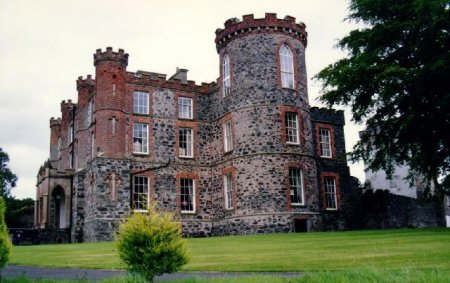
CARROWDORE CASTLE, near Donaghadee, County Down, was built in 1818-20 by Nicholas de Lacherois-Crommelin (the name is pronounced "Delasheroy Crumlin").

This three-storey rubble and brick Georgian-Gothic house was built in a rustic gothic style, with castellations, corner turrets and large projecting tower.

The interior is still largely intact, though some rooms to the rear of the house have been altered in recent times and a large, modern, glazed sun-room has also been added.


The three-storey tower to the south has a Jacobean-Gothic feel and appears to be intact; whilst the similar (but much smaller) three-storey gazebo to the east of the house is now in a ruinous condition.


There is some very graceful Gothic plasterwork fretting on the hall ceiling.

Prior to 1818 there had been a farmhouse on the site which Nicholas de la Cherois's father had used only occasionally, usually as a place to collect rents from his tenants and as a summer residence.

After its completion in 1820, Carrowdore Castle served as Nicholas’s primary residence until 1847, when pressing financial concerns forced him to live at Cushendun, County Antrim, and rent the house to his son Samuel.

The De Lacherois-Crommelin male line came to an end with the death of Samuel’s son, Frederick, in 1902.

The contents of the house were sold the same year and the building itself was leased to a number of tenants before being sold to a Mr McNeill in 1931.

The present owners acquired Carrowdore Castle in 1972 and renovated some of the rooms to the rear, as well as adding the large sun room extension.

About 1992, a new dwelling was constructed a short distance to the south-west.

Since that time Carrowdore Castle has remained largely vacant, save for two ground floor rooms to the south-east which are currently leased to Strangford College.

The outbuildings to the south have been renovated recently and now appear to be used as holiday homes.

Parkland surrounds the house and small blocks of woodland, with a shelter belt beyond.

There is a well planted and manicured ornamental garden to the east of the house, which slopes to a lake.

A stone gazebo terminates the castle battlements.

The layout of the parkland has changed remarkably little from the early 19th century, except for the presence of a modern mansion built south-west of the old house. 


The main entrance gate lodge, a surviving one of two gate lodges, is contemporary with the old house and is notable for a castellated parapet and towers, with a pair of dwellings, which have now been largely demolished.

Carrowdore Castle is the home of Dr Francis Jennings DSc, brother of Shamus Jennings CBE.

First published in January, 2011.

Thursday, 20 August 2026

Craigdun Castle

EDWARD McNEILL OWNED 609 ACRES OF LAND IN COUNTY ANTRIM

TORQUIL MacNEILL, chief of the Clan Neill, of Taynish and Gigha, born ca 1380, was constable of Castle Sween, in Knapdale, Argyllshire.

LACHLAN McNEILL, of Terfergus and Losset, Argyllshire, fourth son of Torquil MacNeill, married firstly, Mary McNeill, of Colonsay, and had a large family.

The third son,

NEILL McNEILL, settled in Cushendun, County Antrim, about 1676, and married Rose Stuart, of Garry, in the same county, and was father of

LACHLAN McNEILL, who wedded Jane Macnaghten, of Benvarden, and had several children, of whom the eldest son, 

NEILL McNEILL, of Cushendun, County Antrim, espoused Christian Hamilton, of Londonderry, and was father of

EDMUND McNEILL, of Cushendun, married Elizabeth, daughter of John Hamilton, of Londonderry, and died in 1790.

The eldest son,

EDMUND ALEXANDER McNEILL JP (1787-1879), of Cushendun, County Antrim, married, in 1817, Rose, eldest daughter of Alexander McNeile, and had an only son,

EDMUND McNEILL JP DL (1821-1915), of Craigdun and Cushendun, County Antrim, High Sheriff of County Antrim, 1879, who married, in 1851, Mary, eldest daughter of Alexander Miller, of Ballycastle, and had issue,  

1st Baron Cushendun (Image: National Portrait Gallery, London)

THE RT HON RONALD JOHN [McNEILL], 1ST BARON CUSHENDUN PC


CRAIGDUN CASTLE, near Cullybackey, County Antrim, is a Victorian-Baronial style house built of basalt, in 1867, by Edward (Eddie) McNeill.

It comprises two storeys with a gabled attic.

There is a substantial five-storey tower with pepper-pot bartizans.

The drawing-room is notable for its Classical plasterwork ceiling.

The house is said to have thirty rooms in total.


Craigdun Castle is believed to have been designed by Sir Charles Lanyon, who was responsible for many of Northern Ireland’s best known Victorian buildings, including Belfast Castle and Ballywalter House.

The Scottish baronial architecture was a fashionable style of the period, incorporating crow step gables and conical turrets and mock defensive features such as crenellations and arrow slits.

The McNeills owned 609 acres in County Antrim during the 19th century.


Although their original seat was Glenmona House, Cushendun, which was increasingly used for holidays, the family tended to reside at Craigdun.

Today Craigdun comprises a more manageable ten acres.

In 1912, the estate was purchased by a Belfast man, John Percy Stott, and it passed to his daughter Doreen on his death in 1949.

Upon the death of her son, Peter Stott-Martin, from Multiple Sclerosis in 1952, she and her husband, Commander Stott-Martin, bequeathed the castle to the National Health Service as a respite care home for MS sufferers.


Much work was carried out during the 1960-80s, including many internal alterations for the installation of a lift in the early 1980s.

The NHS sold the castle in the early 1990s. William and Romayne Baird owned Craigdun for nine years, till it was bought by Andrew Clark in 2002.

Andrew and Julie Clark were married at Craigdun in 2010 and together they restored the building into a comfortable family home, which featured in the final of the BBC House of the Year programme in 2011.


Craigdun Castle itself remained a private family home, though the walled garden and grounds could be hired as a venue for marquee weddings, receptions and photographs.

The gardens are associated in the past with the early 17th century Craigs Castle.

There are fine mature trees in the shelter belts and parkland, including exotics.


A champion parkland sycamore has a circumference of eleven yards at the base.

The walled garden is adjacent to the house and has a circular pavilion, with a conical slated roof, in one corner.

The two gate-lodges have been demolished.

First published in July, 2012.

1st Earl of Carhampton

The Luttrells of Luttrellstown, County Dublin, claimed kinship with the Luttrells of Dunster Castle, Somerset, though the armorial bearings differ. Nevertheless, the land known as Luttrellstown, in Ireland, is said to have been possessed by the Somerset branch from the era of KING JOHN.

SIR GEOFFREY DE LUTEREL (c1158-1218), who had large estates in Derbyshire, Leicestershire, Nottinghamshire, and Yorkshire, accompanying KING JOHN to Ireland, and diligent in public affairs, "obtained a grant from the crown of Luttrellstown, on the payment of twenty ounces of gold, to hold by military service, and had livery of these lands" from John Marshal, Lord Marshal of Ireland.

His son,

SIR ANDREW LUTTRELL (c1205-64), claimed certain estates, known as the barony of Irnham, in Lincolnshire, as heir to Maurice de Gaunt; and left a son,

SIR GEOFFREY LUTTRELL, whose son,

SIR ROBERT LUTTRELL, was summoned to Parliament in 1295, and died in 1297, leaving a son and heir,

SIR ANDREW LUTTRELL; whose son,

SIR GEOFFREY LUTTRELL (1276-1345), was one of the principal knights in EDWARD III's army.

ROBERT LUTTRELL (a younger brother of Sir John Luttrell, feudal baron of Dunster, Somerset, and one of the first Knights of the Bath) died in 1436, "seised of the castle and lands of Luttrellstown" (originally granted to Sir Gregory Luttrell by KING JOHN); and his great-grandson,

SIR THOMAS LUTTRELL, was Chief Justice of the Common Pleas and a Privy Counsellor in Ireland during the reign of HENRY VIII.

THOMAS LUTTRELL, MP for County Dublin in the reigns of JAMES I and CHARLES I, died in 1634.

His lineal descendant,

HENRY LUTTRELL (c1655-1717), raised and commanded five squadrons of cavalry for JAMES II.
In 1702, he was appointed a major-general in the Dutch service; but, on the death of WILLIAM III, retired to his principal residence at Luttrellstown, where he was assassinated "in his sedan chair by a band of ruffians" in the city of Dublin.
General Luttrell's two sons were educated in England. Robert, the elder, died in 1717 while travelling; the younger brother,

SIMON LUTTRELL (1713-87), a prominent politician, was elevated to the peerage, in 1768, in the dignity of Baron Irnham, of Luttrellstown, County Dublin (coat-of-arms at top).

Simon Luttrell, 1st Earl of Carhampton, in Turkish attire, 
by Jean-Étienne Liotard

The 1st Baron was advanced to a viscountcy, in 1781, as Viscount Carhampton, of Castlehaven, County Cork; and further advanced, in 1785, to the dignity of an earldom, as EARL OF CARHAMPTON.

His lordship married, in 1737, Judith Maria, daughter of Sir Nicholas Lawes, Governor of Jamaica, and had issue,
HENRY LAWES, his successor;
JOHN, 3rd Earl;
Temple Simon;
James;
Thomas;
Anne; Elizabeth; Lucy.
The 1st Earl was succeeded by his eldest son,

HENRY LAWES, 2nd Earl (1743-1821), MP for Old Leighlin, 1783-7, who wedded, in 1776, Jane, daughter of George Boyd, though died without male issue, when the family honours devolved upon his next brother,

JOHN, 3rd Earl (1739-1829), who espoused firstly, in 1766, Elizabeth, daughter of John Omnius, 1st Baron Waltham, and had issue,
John, died 1769;
James, died 1772;
Frances Maria (1768-1848).
He married secondly, in 1798, Maria, daughter of John Morgan, and had issue, a daughter, MARIA ANNE (1799-1857).

The 3rd Earl died at Devonshire Place, London, without surviving male issue, when the titles expired.

The Gentleman's Magazine, Volume 145 (1829) informs us that
"Though some distant branches of the Luttrells remain, the titles, from the failure of male heirs, have become extinct; being the thirty-third peerage of Ireland that has expired since the Union in 1801. The Irish estate at Luttrellstown was sold by the 2nd Earl; that in Jamaica now devolves on Captain Moriarty, nephew of the deceased, pursuant to the 2nd Earl's will."
First published in July, 2020.  Carhampton arms courtesy of European Heraldry.

Wednesday, 19 August 2026

Wilson of Maryville

THOMAS WILSON, of Croglin, said to have been son of John Wilson of Croglin, of an old-established family in Dumfriesshire, had a sister, Christian, married to Gilbert Grierson.

Mr Wilson wedded Agnes Grierson, and died in 1571, leaving issue,
MATTHEW, of Croglin;
Michael;
Janet; Katherine; Malic.
The elder son,

MATTHEW WILSON, of Croglin, Dumfriesshire, died about 1612, leaving two sons,
JOHN, his heir;
Thomas, merchant burgess of Edinburgh.
The elder son,

JOHN WILSON JP, of Croglin, wedded firstly, in 1610, Margaret, daughter of Robert, 1st Lord Dalzell, and died before 1641, having had issue,
JOHN, his heir;
Susanna, m 1626 John Sitlington, of Stanehouse;
Anne, m John Stewart, of Drumbeg.
He espoused secondly, Helen Maxwell, and had issue,
JAMES, of whom presently;
George;
Robert;
Jean.
The eldest son,

JOHN WILSON, of Croglin, Commissioner of War for Dumfriesshire, 1643-9, married firstly, _____ Halliday; and secondly, the daughter of _____ Gordon, and had a son,

WILLIAM WILSON, of Croglin.

His direct lineal descendant,

WALTER WILSON, of Croglin (which was sold owing to losses sustained through the failure of the Bank of Ayr), wedded, in 1795, his cousin Jane, daughter of Robert Stewart, of Drumbeg, County Antrim, and through her became possessed of Maryville, Belfast.

He died in 1807, having had issue,
Robert Gordon, died young;
ALEXANDER GEORGE, his heir;
Walter, died young;
Mary Isabella.
The only surviving son,

ALEXANDER GEORGE WILSON (1797-1856), of Maryville, married, in 1837, Emily Lawrence, daughter of the Rev Charles Boyd, Rector of Magheradroll, by Emilia Juliana Theresa, his wife, daughter of Colonel Thomas Dawson Lawrence, of Lawrencetown, County Down, and had issue,
WALTER HENRY, his heir;
Alexander Basil (1846-1913), of Maryville, Malone, Belfast;
Emily Lawrence.
The elder son,

WALTER HENRY WILSON JP (1839-1904), of Maryville, and Cranmore, married, in 1875, Sarah Elizabeth, eldest daughter and co-heir of James Owen Wynne, of Hazelwood, County Sligo, and had issue,
ALEXANDER GEORGE, his heir;
Marion Emily; Lilian Lawrence; Florence Stewart;
Dorothy Gladys; Mary Wynnefred Kathleen.
His son and heir,

ALEXANDER GEORGE WILSON JP (1876-1959), of Maryville and Cranmore, Lieutenant, Army Motor Reserve, educated at Harrow, succeeded in 1904.

*****

THE Wilson family home was Maryville, off the Malone Road.

Maryville originally belonged to the wealthy Stewart family of Ballydrain.

One member of the Stewart family built Maryville and Myrtlefield; another built Macedon.

Maryville was located close to the junction of Malone Road and Stranmillis Road.


It was located at the site of the present Osborne Park Playing Fields, opposite Bladon Park and Bladon Drive.

Maryville might originally have been a farm and it stretched from Malone Road to the present Lisburn Road at Cranmore House.


Cranmore House in 1888

Walter Wilson subsequently purchased Cranmore House and turned it into a fernery.

This part of Belfast was developing rapidly and, in 1900, Mr Wilson took a twenty-year lease of Belvoir Park, Newtownbreda, from Lord Deramore.

Mr Wilson was a partner with Lord Pirrie in the Belfast shipyard, Harland and Wolff.

His first marital home was 1, Botanic Avenue, Belfast.

Thereafter he rented Stranmillis House prior to leasing Belvoir.

The Wilsons' lease on Belvoir Park was terminated in 1918.

WILLIAM III is said to have rested at Cranmore, near Maryville, en route to Belfast, and the tree where his horse was tied is still growing.

Cranmore was formerly called Orange Grove and was inhabited by the Eccles family.

First published in February, 2012.

Bishopscourt House

THE EARLS OF CLONMELL WERE MAJOR LANDOWNERS IN COUNTY TIPPERARY, WITH 16,187 ACRES

THE BISHOPSCOURT ESTATE, COUNTY KILDARE, COMPRISED 1,906 ACRES


THOMAS SCOTT, a captain in the army of WILLIAM III, fell in the field, charging the enemy at the head of his troops.

He wedded Margaret, daughter and heir of Henry Ormsby, of Tubbervady, County Roscommon, and was father of

MICHAEL SCOTT, who married Miss Purcell, of the ancient family of Purcell, titular Barons of Loughmoe, and had issue,

THE REV THOMAS SCOTT, Vicar of Urlings, Modeshill, and Mohubber, who wedded Rachel, eldest daughter of Mark Prim, of Johnswell, County Kilkenny.

The third son,

JOHN SCOTT (1739-98), MP for Mullingar, 1769-83, Portarlington, 1783-4,
Who, being bred to the bar, arrived at the high legal offices of Solicitor-General, Attorney-General, and Prime Sergeant-at-Law of Ireland, 1774-83. In 1784, he was appointed Lord Chief Justice of the Court of King's Bench; and in the same year Mr Scott was elevated to the peerage, in the dignity of Baron Earlsfort, of Lisson Earl, County Tipperary. 
His lordship was advanced to a viscountcy, in 1789, as Viscount Clonmell; and further advanced to the dignity of an earldom, in 1793, as EARL OF CLONMELL.
He married firstly, in 1768, Catharine Anna Maria, daughter of Thomas Mathew, of Thomastown Castle, County Tipperary, and sister of the 1st Earl of Landaff, by whom he had an only son, who died in infancy.

His lordship wedded secondly, in 1779, Margaret, only daughter and heir of Patrick Lawless, of Dublin (by Mary, sister of 1st Lord Cloncurry), and had issue,
THOMAS, his successor;
Charlotte, m 3rd Earl Beauchamp.
He was succeeded by his only son,

THOMAS, 2nd Earl (1783-1838), who espoused, in 1805, Henrietta Greville, second daughter of George, 2nd Earl of Warwick, and had issue,
JOHN HENRY, his successor;
Charles Grantham;
Harriett; Louisa Augusta; Charlotte Rachael; Caroline Sophia;
Frances Mary; Sophia Louisa; Augusta Anne; Georgiana Gertrude.
His lordship was succeeded by his eldest son,

JOHN HENRY, 3rd Earl (1817-66), of Lisson Earl, County Tipperary, who married, in 1838, Anne, daughter of Ulysses, 2nd Baron Downes of Aghanville, and had issue,

JOHN HENRY REGINALD, 4th Earl (1839-91), of Birt House, Naas, County Kildare, who died unmarried, when the family honours devolved upon his brother,

THOMAS CHARLES, 5th Earl (1840-96), who married, in 1875, Agnes Arabella, daughter of Robert Godfrey Day.


His lordship died without issue at Bishop's Court, County Kildare, from typhoid fever, and was succeeded by his first cousin,

BEAUCHAMP HENRY JOHN, 6th Earl (1847-98), eldest son of Colonel the Hon Charles Grantham Scott, second son of the 2nd Earl; on whose decease the titles passed to his son,

RUPERT CHARLES, 7th Earl (1877-1928), who died without male issue, when the titles reverted to his uncle,

DUDLEY ALEXANDER CHARLES, 8th Earl (1853-1935), whose marriage was without issue.

On his death, at Tunbridge Wells, Kent, the titles became extinct.


BISHOPSCOURT, Straffan, County Kildare, is a large classical house built ca 1780-90 for the Rt Hon John Ponsonby, Speaker of the Irish House of Commons.

It has a four-bay entrance front with a pedimented portico of four huge Ionic columns.

The outer bays have pedimented ground-floor windows and circular plaques instead of windows in the upper storey.


The side elevation has a recessed centre and three-bay projection at either side, joined by a veranda of slender columns with an iron balcony.

There is a curved bow on either side of the House; and an imperial staircase.

In 1838, Bishopscourt was sold by Frederick Ponsonby to John, 3rd Earl of Clonmell.


In 1914, the house was sold on to Edward Kennedy from Baronrath, at the time the most famous breeder of racehorses in Ireland.
Kennedy’s stallion The Tetrarch, standing at Bishopscourt, is confirmed as the most successful sire in the world in 1919.
In 1938, Bishopscourt passed to Edward’s daughter Patricia (Tiggie) Kennedy and her husband, Dermot McGillycuddy, heir to Senator McGillycuddy of the Reeks, an ancient clan chiefdom from County Kerry.
Edward Kennedy's son, Major D M (John) Kennedy, won a Military Cross at Anzio whilst serving with 1st Battalion Irish Guards and was later killed at Terporten Castle in Germany in February 1945.
Bishopscourt House is now the residence of the Farrell family.

Former seat ~ Eathorpe Hall, Warwickshire.
Former town residence ~ 41 Upper Brook Street, London.


First published in June, 2013.  

Tuesday, 18 August 2026

BH Memoirs: VIII

REMINISCENCES OF LIEUTENANT-COLONEL JOHN MATTHEW BLAKISTON-HOUSTON DL (1898-1984), OF BELTRIM CASTLE, COUNTY TYRONE, AND RODDENS, COUNTY DOWN, BORN AT ORANGEFIELD HOUSE, NEAR BELFAST


HE SERVED IN THE FIRST AND SECOND WORLD WARS; WAS AIDE-DE-CAMP TO HIS EXCELLENCY THE GOVERNOR-GENERAL OF AUSTRALIA, 1929-30; HIGH SHERIFF OF COUNTY DOWN, 1944; DEPUTY LIEUTENANT OF COUNTY DOWN, 1946; HIGH SHERIFF OF COUNTY TYRONE, 1954


Just before the War the Belfast Corporation had bought Orangefield farmyard and 46 acres of land as park.

We leased the farm buildings from the purchasers at a very high rent, so I purchased Carrowreagh Farm of 220 acres and left Lettice and Joe Barbour (the land steward) the enormous task of carrying out the necessary alterations and moving into it.

My leave had been extended a further two months at the request of Basil Brooke, our Prime Minister.

As Roddens House was burnt down in 1939, Lettice and the children had temporarily been living in the land steward's house.

We purchased BELTRIM CASTLE, Gortin, County Tyrone, in 1944, but as it was occupied by American forces, we were unable to move in until 1946.

In January, 1945, I stood for the two member constituency of County Down, for the Imperial Parliament.

The Rev Dr Little and Lord Castlereagh were the two sitting members, but Castlereagh decided not to stand again.

I was one of thirteen candidates – Unionist – to present themselves to the delegates and came out top, with Sir Walter Smiles [great-grandfather of Bear Grylls] second.

Dr Little, annoyed that he was not automatically accepted as an official candidate would not allow his name to go forward on the official candidates list.

He then, with another man called Brown, elected to stand as an unofficial Unionist.

Smiles and I were thus the official candidates, and Little and Brown went to the polls against us as unofficial Unionist candidates.

The result, after a very bitter election, was Little and Smiles elected and I came next.

What a horrible life it would have been!

This was my second and last attempt to become an MP at Westminster.

I had been a member of the Down County Council since 1936.

I did not distinguish myself in local government but I’m sure I can claim to be the first member of the Down County Council to give a forwarding address for minutes and correspondence as Addis Ababa, Ethiopia!

THIS CONCLUDES MY EXTRACTS OF THE BLAKISTON-HOUSTON MEMOIRS.

First published in January, 2015.  Extracts by kind permission of RP Blakiston-Houston OBE JP DL

Crevenagh House

THE AUCHINLECKS OWNED 2,616 ACRES OF LAND IN COUNTY TYRONE


IN MEMORY OF FIELD-MARSHAL SIR CLAUDE JOHN EYRE AUCHINLECK GCB GCIE CSI DSO OBE


THE REV JAMES AUCHINLECK (1646-c1685), Rector of Cleenish, County Fermanagh, married Margaret Keith, and had issue (with others who died young),
JAMES, of whom presently;
William;
Alexander;
Katherine; Margaret; Jean.
The Rev James Auchinleck was succeeded by his son,

JAMES AUCHINLECK (1675-1746), of Thomastown, County Fermanagh, who wedded, ca 1698, Elizabeth, daughter of Colonel James Corry MP, of Castle Coole, and had, with other issue (who died young),
JAMES, his heir;
Alexander;
Rebecca; Margaret; Mary; Sarah; Elizabeth.
The elder son,

JAMES AUCHINLECK (1704-52), of Thomastown, married, in 1734, Susanna, daughter of John Corry, of Lisanock, and had issue,
Leslie;
Armar;
James;
John;
William;
George;
Corry;

ALEXANDER, of whom presently;
Anketell (Rev);
Elizabeth; Sarah.
Mr Auchinleck's eighth son,

THE REV ALEXANDER AUCHINLECK (1749-1833), of Castle Lodge, and Mullans, Fintona, County Tyrone, Rector of Rossory, wedded, in 1784, Jane, daughter of James Corry Eccles, of Shannock, County Fermanagh, and had issue,
James Eccles (Rev);
William;
John (Rev), grandfather of FIELD-MARSHAL SIR CLAUDE AUCHINLECK;
DANIEL ECCLES, of whom presently;
Anna.
The youngest son,

DANIEL ECCLES AUCHINLECK
(1797-1849), of Crevenagh, espoused, in 1833, Elizabeth Dorothea, daughter of the Rev Thomas Lindsay Stack JP, Rector of Badony, and had issue,
THOMAS his heir;
William Lowry, Brigadier-General;
Daniel;
Margaret; Anna.
The eldest son,

THOMAS AUCHINLECK JP DL (1837-93), of Crevenagh, and Shannock Green, County Fermanagh, Major, Royal Tyrone Fusiliers, High Sheriff of County Tyrone, 1872, married, in 1868, Jane, daughter of George Henry Loxdale, of Grassendale, Liverpool, and had issue,
DANIEL GEORGE HAROLD, his heir;
Bessie Sarah; Norah Lilian Loxdale.
Major Auchinleck was succeeded by his son,

DANIEL GEORGE HAROLD AUCHINLECK (1877-1914), of Crevenagh, Captain, Royal Inniskilling Fusiliers, who wedded, in 1902, Charlotte Madeleine, only daughter of Robert Scott, of Dungannon, County Tyrone, and had issue, an only son, ROBERT PATRICK AUCHINLECK, who died in infancy, 1906.

Captain Auchinleck was killed in action during the 1st World War.

*****

CREVENAGH was eventually to be inherited by Lieutenant-Colonel Ralph Reginald Auchinleck Darling JP (1897-1958), who fought in the 1st World War; was commissioned in the Royal Inniskilling Fusiliers; fought in the 2nd World War, 1939-43, when he retired due to ill-health.

His eldest son,

Gerald Ralph Auchinleck Darling RD QC DL (1921-96), was educated at Harrow; was an officer in the Royal Navy Volunteer Reserve; fought in the Second World War; was Fleet Fighter Pilot and Test Pilot Eastern Fleet; Chief Test Pilot, British Pacific Fleet.

On the death of his father in 1958 he had inherited Crevenagh House, near Omagh, where, from his school days, he had spent many happy holidays with his extended family. 

He was proud of his descent from the Auchinleck family who had always lived there, and resolved to maintain it as a family home despite his ties to life in London (in his London office there was a Donegal landscape and a map showing the wartime achievements of Ulster).

In 1990 he became a Deputy Lieutenant of County Tyrone and, in 1993, High Sheriff. 

In his obsequies address, the Right Rev Brian Hannon, Bishop of Clogher, paid tribute to Gerald Darling's contribution to the work of Edenderry parish, where he had served as parish secretary.

The Bishop related how, before a major court appearance, Darling would ease the tension by thinking of his favourite spots on the river, the snipe bogs and the mountains of Tyrone.

Strangely, after a lifetime of trout-fishing, he caught his first salmon only in 1995.

One of his family remembers the fishing picnics in childhood - "as, unfortunately, a mizzly day is good for fishing, the picnics were often rather damp affairs".

But that was balanced by the warmth of bedtime stories in the family flat in the Middle Temple where it is said the family below, willy-nilly, added to the appreciative audience for Darling's dramatic readings of Winnie the Pooh. 

He would, friends say, have been equally at home as a farmer, taking great pride in his forestry and Belted Galloway cattle and never more at home than working in ragged jeans with his chainsaw.

A permanent record of Gerald Darling his distinction as a lawyer will be his contribution to that definitive work, Halsbury's Laws of England (Admiralty and Ship Collisions), the third edition of 1952. 

In 1992 he was made an Honorary Bencher of the Northern Ireland Bar.
Born at Erganagh, Co Tyrone, 8th December, 1921; called to the Bar, Middle Temple 1950, Bencher 1972, Treasurer 1991; Barrister, Northern Ireland 1957, Honorary Bencher 1992; RD 1967; QC 1967; member, Panel of Lloyd's Arbitrators in Salvage Cases 1967-78, Appeal Arbitrator 1978-91; member, Panel of Wreck Commissioners 1967-96; QC, Hong Kong 1968; Judge, Admiralty Court of the Cinque Ports 1979-96; trustee, Royal Naval Museum 1985-90; Lloyd's Silver Medal 1991; married 1954 Susan Hobbs (one son, one daughter); died Londonderry 13 September 1996.
Photo Credit: Gordon Dunn

CREVENAGH HOUSE, near Omagh, County Tyrone, is a two-storey house built ca 1820 by Daniel Eccles Auchinleck, great-uncle of Field Marshal Sir Claude Auchinleck

It has a three-bay entrance front with Wyatt windows in both storeys and a projecting porch.

The side is also of three bays.

A lower, two-storey range was subsequently added by Auchinleck's son, Major Thomas Auchinleck, behind the original block and parallel with it.

Photo Credit: Stephen Paskin

The principal rooms in the main block have fine plasterwork ceilings; while the hall floor is of mosaic depicting the Seven Ages of Man.

There are doors made of mahogany from the Auchinleck family plantations in Demerara.

The surrounding parkland is of the same age as the house, graced by mature parkland trees and clumps of rhododendron.

Shelter woods of mature trees are maintained to the north, south and west.

The walled garden is part-cultivated, having three walled sides and one of water.

The farm buildings are listed and there is a gate lodge in good condition.

Crevenagh House was gutted by fire in February, 2026.

First published in November, 2010.

Monday, 17 August 2026

The Irvine Baronetcy

The family of IRVINE, which ranks amongst the oldest and most eminent in Scotland, acquired by marriage, at a remote period, the lands of Bonshaw, Dumfriesshire.

CHRISTOPHER IRVINE, Laird of Bonshaw, Dumfriesshire, commanded JAMES IV of Scotland's light horsemen at the battle of Flodden, and fell then, together with his son, Christopher, the father of Christopher, next Laird of Bonshaw, who held a command, and was slain at the battle of Solway Moss.

He lies buried in the village of Gretna, with a monument and epitaph. From him descended the subsequent Lairds of Bonshaw, Stapleton, Robgill and Annan.

From the Lairds of Robgill and Annan sprang

CHRISTOPHER IRVINE, who resided in Essex, until he removed to Ulster, upon a grant from JAMES I of a considerable landed property in County Fermanagh, and there erected CASTLE IRVINE.

This Christopher Irvine was intended for the Bar, and he entered the Temple in London with the view of becoming a lawyer.

He was connected with the Carletons, an English border family of Cumberland, and the Carletons were related to the Lowthers, some of whom were high in the legal profession in England.

About 1610, Gerard Lowther was appointed to be a Judge of the Court of Common Pleas in Ireland; circumstance which led to the settlement in that country of his relatives, Lancelot Carleton and Christopher Irvine.

These three gentleman subsequently obtained property in 1613: their lands, which adjoined each other, were located near Lower Lough Erne, in the barony of Lurg, County Fermanagh.

During the civil wars, Mr Irvine was firm in his devotion to the royal cause, and suffered severely in consequence.

He wedded his cousin Blanch, daughter of Edward Irvine, Laird of Stapleton, by Mary Graham, his wife, of the family of Preston, and had, with several daughters, three sons, namely,
Christopher (1618-93), physician, of Edinburgh;
GERARD, his of whom presently;
William, who fought at Worcester.
Christopher Irvine died in 1666, and was buried with his wife, Blanche, in the family burial ground at Lowtherstown, or Irvinestown Church.

The second son,

SIR GERARD IRVINE JP, of Castle Irvine, Lowtherstown, Lieutenant-Colonel to Sir Arthur Forbes, Earl of Granard, fought for CHARLES II at Worcester, and was some time after taken prisoner in Ireland, and would have been executed for his loyalty to Sir Charles Coote, 2nd Baronet and 1st Earl of Mountrath, then Governor of Derry, under Cromwell, had he not been rescued out of that city by his brother William.

In consideration of these sufferings in the royal cause, and for other eminent services to the house of Stuart, Colonel Irvine was created a baronet by CHARLES II in 1677, designated of Castle Irvine, County Fermanagh.

Sir Gerard married firstly Catherine, daughter of Captain Adam Cathcart, which lady died childless; and secondly, Mary, daughter of Major William Hamilton, Laird of Blair, by whom (who died at Castle Irvine, in 1685) he had issue,
CHRISTOPHER, b 1654, married though dsp before his father;
Charles, cornet of horse, died unmarried, 1684;
Mary, m John Crichton, of Crom, ancestor of the Earls of Erne.
Sir Gerard died in WILLIAM III's service, in the camp at Dundalk, and was buried in the chancel of the church of that town.

Following his decease, in 1689, the baronetcy expired.

Necarne Castle (Image: Irish Architectural Archive)

The village of Irvinestown in County Fermanagh was founded during the Plantation in 1618 by Sir Gerard Lowther and named Lowtherstown. Ownership later passed to the Irvines and changed name accordingly.

The Irvines had an extensive estate at Castle Irvine, which they renamed Necarne, as well as further townlands at Killadeas, where a cadet branch of the family was established. Goblusk House was on the Killadeas property.

The following is an article about the 1st Baronet:-


Sir Gerard Irvine, Baronet

Finding that the overtures made on his behalf to the Enniskillen men were rejected, Sir Gerard went to Dublin and was made Lieutenant-Colonel to the regiment of horse that the Earl of Granard was about to raise in the interest of JAMES II.

Being empowered to raise a troop in Fermanagh, he came down to the town of Cavan with such a number of pistols, carbines, swords, and other necessary equipments for the men whom he was about to enlist, that he alarmed the Protestant inhabitants.

The fact having become known, Daniel French and Henry Williams set out from Belturbet with sixty horse, captured the arms at Cavan, and sent Sir Gerard himself a prisoner to Lord Blayney. His lordship did not retain him, but sent him on as a prisoner to Enniskillen.

He told the Enniskilleners that he never meant to serve JAMES II, and that his journey to Dublin was only a scheme to obtain accoutrements for a troop which he wished to raise in the service of the Prince of Orange. If he spoke the truth about himself, he was a traitor great and mean as Lundy.

As the fortunes of JAMES II waned, he threw himself heartily into the winning side; and after the siege of Derry was raised, he collected a troop of horse, with which he joined General Schomberg and subsequently died, where so many brave men perished, in the camp at Dundalk.

First published in March, 2011

Boom Hall

The elder branch of this family was ennobled, in 1663, by the title of EARL OF STIRLING, in the person of WILLIAM ALEXANDER, of Menstrie, Clackmannanshire. The surname of ALEXANDER was assumed from the Christian name of its founder, Alexander Macdonald, of Menstrie.

This branch, on removing into Ulster, adopted into the family shield the Canton charged with the Harp of Ireland, and settled at Limavady, County Londonderry.

JOHN ALEXANDER, of Eridy, County Donegal, 1610, had issue,
ANDREW, his heir;
John;
Archibald;
William;
Robert.
The eldest son,

THE REV DR ANDREW ALEXANDER, of Eridy, married Dorothea, daughter of the Rev James Caulfeild, and had issue,

CAPTAIN ANDREW ALEXANDERof Derry, born in 1625, who wedded firstly, Miss Philips, daughter of Sir Thomas Philips, and had issue,
Jacob.
He espoused secondly, Miss Hillhouse, daughter of the Laird of Hilles, and had further issue,

JOHN ALEXANDER (c1670-1747), of Ballyclose, County Londonderry, and of Gunsland, County Donegal, who married Anne, daughter of John White, and had issue,
William;
NATHANIEL, of whom hereafter;
John;
Martha.
The second son,

NATHANIEL ALEXANDER (1689-1761), of Gunsland, Alderman of Derry, 1755, married Elizabeth, daughter of William McClintock, of Dunmore, County Donegal, and had issue,
William, of London; barrister; d 1774;
John;
Nathaniel;
ROBERT, of whom we treat;
James, created EARL OF CALEDON;
Mary Jane; Rebecca; Elizabeth; Ann; Jane.
His fourth surviving son,

ROBERT ALEXANDER (1722-90), of Boom Hall, County Londonderry, wedded, in 1759, Anne, daughter of Henry McCullogh, and had issue,
Nathaniel (Rt Hon & Rt Rev);
HENRY, of Boom Hall;
William, Lieutenant-General;
James;
Joseph Josias Du Pré;
Elizabeth; Jane; Anne; Rebecca; Dorothea.
Mr Alexander's second son,

HENRY ALEXANDER (1763-1818), of Boom Hall and Glentogher, County Donegal, MP for Londonderry, 1801-2, Old Sarum, 1802-6, espoused, in 1807, Dorothy, daughter of Francis Rivers, and had issue,
ROBERT, General in the Army;
James;
Mary; Ann; Catherine; Eliza; Frances.

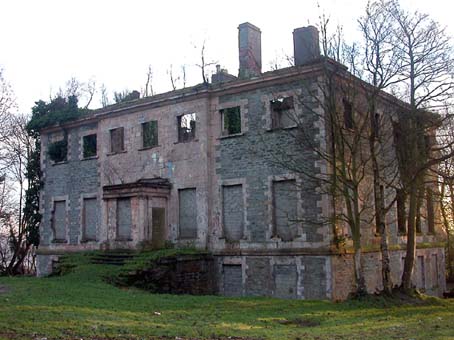
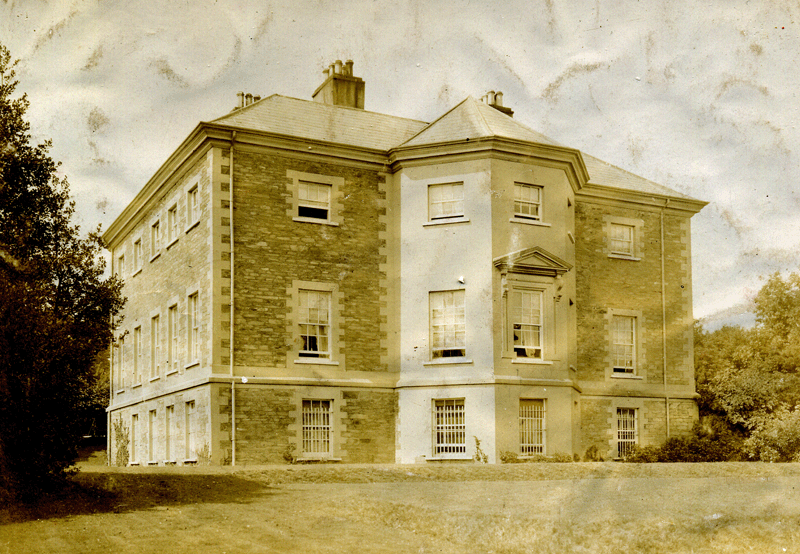
BOOM HALL, or Boomhall, was built ca 1772 by James Alexander to the designs of Michael Priestly.

He had returned from India.

Alexander was later to purchase the estate of Caledon, County Tyrone.

The house was built with cut stone; two storeys over a basement.

Boom Hall (Irish Architectural Archive)

It has a seven-bay entrance front, with a three-bay breakfront centre.

A projecting porch was added later.

The garden front has a three-sided bow and side elevation of five bays.

The window surrounds have blocking and blocked quoins.


The roof was rather high, on a cornice.

There was was a large, cubical central hall.

Boom Hall estate eventually passed to James, 3rd Earl of Caledon.

The Hall was occupied in the early 1830s by the Very Rev Thomas Bunbury Gough, Dean of Derry.

The lessee was Daniel Baird and the lessor was the Honourable The Irish Society.

Daniel Baird lived there from 1849 until his death in 1862; and his widow Barbara continued to live there until her death in 1879.

Baird was a very successful businessman, merchant and ship owner who rose to prominence from fairly humble origins in the 1830s ~ the Cookes and McCauslands were friends and business rivals.

A one-time Mayor of Londonderry and alderman of the city, he was also High Sheriff of Tyrone, where he had acquired an estate of around 5,000 acres in and around Newtownstewart.
When Daniel Baird died, his entire estate was left in trust to his only surviving descendant, his grandson Daniel Baird Maturin-Baird, then aged 13; with his widow and second wife Barbara (nee Delap) having “the benefit and living of Boom Hall for her natural life”.
On her death, Boom Hall passed into Daniel Maturin-Baird's full control.

He was aged 30 by this time and had established a life for himself in London and chose not to live at Boom Hall, instead leased the house, grounds and contents to the Cooke family (John and Joseph Cooke were both trustees of Daniel Baird’s will).

Meanwhile Mr Maturin-Baird built himself a new house on the Newtownstewart estate.

It is believed that the Cooke family continued to live there until around 1920.

Charles Edgar Maturin-Baird inherited the estate in 1924.

It was then leased to Michael Henry McDevitt, whose family ran a hosiery business, until the war when it was requisitioned by the Royal Navy.

The WRNS left the house in a deplorable state and Mr Maturin-Baird received compensation for damages.

Prior to the war, Michael Henry McDevitt had expressed an interest in buying the house, and after repairs had been carried out in 1946-47, the estate was sold.

Mr Maturin-Baird had, by this time, acquired an estate in East Anglia.

Interestingly, McDevitt chose only to buy the house, contents and immediate surroundings of around 26 acres along with the stable block, but not the stack yard or majority of parkland, which originally totalled 135 acres.

The remaining land was sold to various purchasers in the 1950s ~ although it is believed that the Maturin-Bairds still own the foreshore, as it would appear that this was never sold.

Under McDevitt’s sister the house fell into a state of serious dilapidation and the contents were routinely and systematically ransacked.
Pat, who keeps horses in one of the fields now, described how, as a teenager, he witnessed a group of vagabonds remove the contents of the dining room to outside the house, and sit down for a makeshift dinner around the table, before loading it all into a lorry and speeding away down the drive!
A fire in the early 1970s destroyed the roof, since when Boom Hall has gradually decayed.

When Miss McDevitt died, the property was left to a niece who sold off the land separately, and then the bricks and mortar to a ‘developer’.

It is thought that the local Council now owns the stable-block and some of the surrounding land, though not the building itself.

The site of Boom Hall is still a valuable open space, though it has lost many of its attributes.

It is of interest because the core of the late 18th century house remains, with some fine mature trees and a walled garden.

The Foyle bridge sweeps above the grounds, which go down to the shore of the River Foyle.

In 2018, it was announced that a conservation plan was to be developed for Boom Hall and its stables.

First published in August, 2012.   I am grateful to William Maturin-Baird for providing information.