Friday, 24 June 2022

New Vice Lord-Lieutenant

APPOINTMENT OF VICE LORD-LIEUTENANT


The Viscount Brookeborough, KG, Lord-Lieutenant of County Fermanagh, with the approval of Her Majesty The Queen, has been pleased to appoint:-
Mrs Jane Styles DL
Drumsillagh
Enniskillen
County Fermanagh
Vice Lord-Lieutenant for the said County, her Commission bearing date the 3rd day of July 2022


Lord-Lieutenant of the County

Monday, 20 June 2022

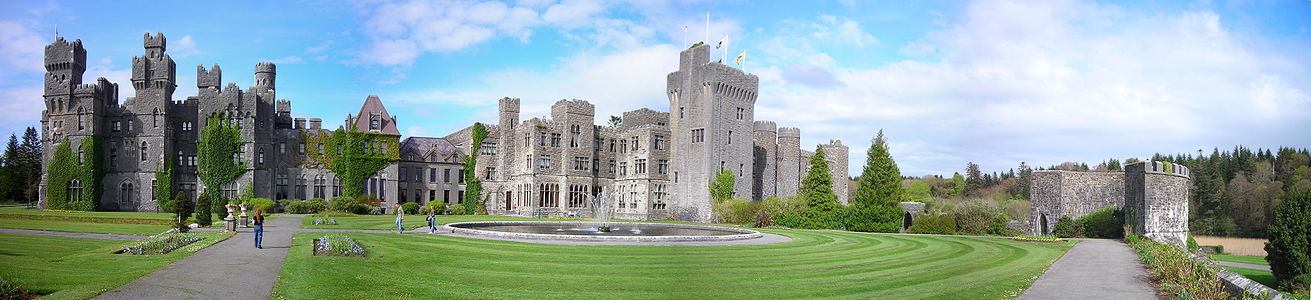
Ashford Castle

THE BARON ARDILAUN WAS A MAJOR LANDOWNER IN COUNTY GALWAY, WITH 27,111 ACRES 

The family of GUINNESS claims descent from the ancient and eminent house of MAGENNIS, in which formerly vested the viscountcy of Magennis of Iveagh. Several members of this family are interred in the churchyard of St Catherine's, Dublin, and, in the parish register, the translation of the name from Magennis to McGuinness, or Guinness, is clearly traceable.


ART ROE or ARTHUR MacGUINNESS, of Rathfriland, County Down, received the honour of knighthood, and assumed the surname of MAGENNIS.

In 1623 Sir Arthur was created Viscount Magennis of Iveagh, though that peerage expired in 1693.

He died in 1629, and was buried at Drumballyroney, near Rathfriland, County Down.

His younger son,

CON MAGENNIS, married and was father of

HUGH MAGENNIS, who wedded and had a son,

EVER MAGENNIS, who removed to, and settled in Dublin.

He married and had issue, 

RICHARD GUINNESS (c1690-1766), of Celbridge, County Kildare, said to be an innkeeper at Celbridge, who was the first of the family to assume the surname.

In 1746, Mr Guinness was described in a Bill in Equity Exchequer as "Richard Guinis, agent or receiver to the Most Rev Arthur Price, Archbishop of Cashel".

He married firstly, Elizabeth, daughter of William Read, of Huttonread, County Kildare, and had issue,
Richard;
ARTHUR, of whom we treat;
Samuel;
Benjamin;
Frances; Elizabeth.
Mr Guinness wedded secondly, ca 1752, Elizabeth Clare.

His second son,

ARTHUR GUINNESS (1725-1803), of Beaumont, County Dublin, the first of the family that established the Guinness Brewery in Dublin, espoused, in 1761, Olivia, daughter and co-heir of William Whitmore, of Dublin, and had issue,
Hosea (Rev);
ARTHUR, of whom we treat;
Edward;
Benjamin;
William Lunell;
John Grattan;
Elizabeth; Olivia; Louisa; Mary Anne.
The second son,

ARTHUR GUINNESS JP DL (1768-1855)of Beaumont, County Dublin, Governor of the Bank of Ireland, held for many years the foremost place amongst the merchants of his native city of Dublin.

He married firstly, in 1793, Anne, eldest daughter and co-heiress of Benjamin Lee, of Merrion, County Dublin, and had issue,
William Smythe Lee (Rev);
Arthur Lee;
BENJAMIN LEE, of whom we treat;
Susanna; Mary Anne; Louisa; Anne; Elizabeth; Rebecca.
Mr Guinness's eldest surviving son,

BENJAMIN LEE GUINNESS JP DL (1798-1868), Lord Mayor of Dublin, 1851, MP for Dublin City, 1865-68, married, in 1837, Elizabeth, daughter of Edward Guinness, and had issue,
ARTHUR EDWARD, his successor;
Benjamin Lee, father of the 3rd Baronet;
Edward Cecil, created EARL OF IVEAGH;
Anne Lee.
At his own expense of £150,000 (£15,445,000 in 2014) Mr Guinness restored the venerable cathedral of St Patrick, which was almost in ruins. In commemoration of this patriotic act, Queen Victoria created Mr Guinness a baronet in 1867, designated of Ashford Castle, County Galway.

Sir Benjamin was succeeded by his eldest son, 

SIR ARTHUR EDWARD GUINNESS2nd Baronet (1840-1915), JP DL, MP for Dublin City, 1868, who was elevated to the peerage, in 1880, in the dignity of BARON ARDILAUN, of Ashford, County Galway.

He married, in 1871, the Lady Olivia Charlotte White, daughter of the 3rd Earl of Bantry, though the marriage was without issue.


The barony consequently expired following his lordship's death in 1915; the baronetcy, however, devolved upon his nephew, Algernon Arthur St Lawrence Lee Guinness, as 3rd Baronet.


ASHFORD CASTLE, County Galway, is a medieval castle turned luxury hotel near Cong on the Mayo/Galway border, on the shore of Lough Corrib.

The original castle built in 1228 by the Anglo-Norman House of Burke following their defeat of the O'Connors, the Royal House of Connaught, who are still extant in the person of the O'Conor Don.

The principal legacy of the native O'Connors is to be seen at the gates of the estate in the form of the Romanesque Augustinian Abbey of Cong.


After more than three and a half centuries under the de Burgos, whose surname became Burke or Bourke, Ashford passed into the hands of a new master, following a fierce battle between the forces of the de Burgo's and those of the English official Sir Richard Bingham, Lord President of Connaught, when a truce was agreed.

In 1589, the castle fell to Bingham, who added a fortified enclave within its precincts.

In 1715, the estate of Ashford was established by the Browne Family (Barons Oranmore), and a lodge in the style of a 17th-century French chateau was added to the medieval splendour of the castle.

The Ashford estate was purchased in 1852 by Sir Benjamin Lee Guinness, 1st Baronet, who extended the estate to 26,000 acres, built new roads, planted thousands of trees and added two large Victorian style extensions.

On his death in 1868, the estate passed to his son Lord Ardilaun, an avid gardener who oversaw the development of massive woodlands and rebuilt the entire west wing of the castle.

He also subsidised the operation of several steamboats, the most notable of which was the Lady Eglinton, which plied between the villages of the Upper Lough Corrib region and Galway City, thus opening the area to increased commerce.

In a time of agitation by tenant farmers in the Land Wars of the late 19th century, epitomised by the action of tenants at nearby Lough Mask House (home of Captain Charles Boycott), he was considered by many to be an 'improving' landlord.

Some of his efforts were unsuccessful, particularly the Cong Canal, also known as 'the Dry Canal', which was built to link Lough Mask and Lough Corrib but was a failure, due to its inability to hold water.

Despite such setbacks, the love borne by him and his wife Olive, daughter of the 3rd Earl of Bantry, for the castle and the estate was deep and best epitomised by that fact that when he was ennobled in 1880 he derived his title from the island of Ardilaun, which formed part of the estate on Lough Corrib.

Ashford passed to Lord Ardilaun's nephew, Ernest Guinness, who sold it to Noel Huggard in 1939.

He opened the estate as a hotel, which became renowned for the provision of its country pursuits, such as angling and shooting.

Noel Huggard's parents had been in the hotel business in Waterville, County Kerry, since 1910 and his granddaughters, Louise and Paula, run the Butler Arms Hotel there to this day.

In 1951, the film director John Ford came to the west of Ireland to film what would become a movie classic The Quiet Man starring John Wayne and Maureen O'Hara.

The grounds of Ashford Castle as well as nearby Cong formed the backdrop for much of the action in the film.

In 1970, Ashford Castle was bought by John Mulcahy, who oversaw its complete restoration and expansion, doubling its size with the addition of a new wing in the early 1970s, building a golf course and developing the grounds and gardens.


In 1985, a group of Irish American investors, which included Chuck Feeney, purchased Ashford.

The Castle was sold by these investors in 2007 for €50 million to Galway-based property investor Gerry Barrett and his family.

Ashford was financed by Bank Of Scotland (Ireland), who placed the property in receivership in November 2011, though the hotel continues as a going concern.

In its time the castle has played host to many notable guests, including: John Lennon, George Harrison, King George V, his consort Queen Mary, Oscar Wilde (whose father, Sir William Wilde, had an estate adjacent to Ashford, where the writer spent much of his childhood), HRH The Earl of Wessex, John Wayne, HSH The Prince Rainier III of Monaco and his consort, HSH The Princess Grace.

Former seats ~ Ashford Castle, near Cong, County Galway; Macroom Castle, County Cork; St Anne's, near Clontarf, County Dublin; Muckross, Killarney, County Kerry. 

10-11 Carlton House Terrace, London

Former town house ~ 11 Carlton House Terrace, London: Gladstone took up occupation in 1856, and was there during the early years of his first great ministry, 1868-74; and finally the Guinness family took over, staying on until the 1920s (with an interruption when the house became an annexe to the Horse Guards' high command).

First published in June, 2012.
Tuesday, 14 June 2022

M Piper, Greengrocer

Self, M Piper, and Mrs D's gooseberry jam (June, 2022)

My quest for Mrs Darlington's beetroot chutney has borne fruit, in a sense.

It transpires that my local greengrocer, Michael Piper, purveyor of fine fruit, vegetables, preserves, and conserves, stocks Mrs D's products.

His shop is located at 23, Belmont Road, Strandtown, Belfast.

A dear friend is sending me two jars of Mrs D's excellent beetroot chutney, so today I purchased a jar of the gooseberry jam instead.

Monday, 13 June 2022

Castle Ward Project

A View of Castle Ward from the Doric Temple, by William Ashford (1746-1824)
(Image: the National Trust, Castle Ward)

In 2017 the National Trust announced an ambitious conservation project at CASTLE WARD, Strangford, County Down, which entailed refurbishment of the Temple and restoration of historic paths and vista points.

The man-made landscape of the Temple Water area, conceived by the Wards, Viscounts Bangor, is one of the most important late 17th and early 18th century gardens to survive in the British Isles.

Richard W Wheeler, the Trust's Gardens and Parks historian, remarked:-
"Whether intentionally or not, the whole composition mirrored the work of that great influencer of 18th century landscapes, the artist Claude Lorrain, whose painting of Landscape with Apollo and the Nine Muses provides a mythological parallel for this wonderful composition at Castle Ward."

Landscape with Apollo and the Muses, by Claude Lorrain (1604-82)
Image: National Galleries of Scotland/ Scottish National Gallery


The National Trust's general manager for South Down, Jonathan Clarke, remarked in 2017,
"Over the years the design of the landscape has become obscured by self-seeded trees, poor drainage and other changes."
"As a conservation charity we are committed to protecting our special places for ever, for everyone and so we are restoring this hidden part of Castle Ward to enhance visitor enjoyment and understanding of the area."
"We anticipate the project will take three years and will include the repair of the Temple and improvements to the parkland that will open up views of both Audley’s Castle and Strangford Lough."
The lake at Castle Ward, known as Temple Water, will be central to the restoration project.

The Temple Water, Castle Ward

Features planned for restoration include the crumbling stone sides of the Temple Water which have been weakened by tree roots over the years.

The Temple will also be refurbished and the original paths will be reinstated, creating a picturesque route around the Temple with spectacular viewpoints.


Historic paths will be reinstated along Lime Tree Walk and visitors will be able to grace the reinstated historic steps on the Yew Tree Terraces.

The viewing mound and early 18th century Ward family home, the Green House, will both be revealed and interpreted.

The walled garden will be levelled and a planting design scheme started.

It will also be opened for public viewing.

The Doric Temple

Improvements will also be made to access around the Temple Water by reinstating former pathways and steps; repairing drains; creating pockets of natural biodiversity; removing some inappropriate trees; pruning others, and planting new trees in locations based on early demesne maps. 

Enhanced interpretation will also be installed to enable everyone to share in the story of the Ward family and their grand designs.

Map of 1835 showing the Green House

A team of National Trust specialists including curators, archaeologists, historic gardens advisers and interpretation designers will be available to provide advice and work together to bring the Temple Water back to the late 17th early 18th century design.

The final picture will be a grand formal and unexpected statement in the midst of rolling landscape.

First published in 2017.

Tuesday, 7 June 2022

Carrick Lodge

THE MUSGRAVES WERE MAJOR LANDOWNERS IN COUNTY DONEGAL, WITH 23,693 ACRES


The Musgrave family may be said to have begun their connection with Belfast at the beginning of the Victorian era.

James Musgrave's father, Samuel Musgrave, was a general practitioner, who began there in 1799.

Dr Musgrave was about twenty when he started his practice.

His wife was Mary Riddel, a daughter of William Riddel, founder of Riddel & Company, Donegall Place and Fountain Street, Belfast.

The Musgrave firm was an off-shoot of the Riddel establishment.

The Musgrave family consisted of a dozen children.

When Dr Musgrave died at Lisburn aged 66 in 1834, the family soon removed to Belfast and lived in Upper Arthur Street.

By 1852 they were living at 1 Donegall Square South, and later moved to DRUMGLASS HOUSE, Malone Road, which they built ca 1855.

As young men, the brothers Robert and John Riddel were in partnership with their uncle, John Riddel, at 54 High Street in Belfast.

With their brother James they founded the firm Musgrave Brothers and opened the establishment on the 30th May 1843 (which later became Richard Patterson’s of 59 High Street).

Here the ironmongery trade was carried on successfully until expansion of business brought the manufacturing lines and, from 1860 onwards, this branch was conducted at the Ann Street Ironworks until a limited company was formed.

John and James Musgrave were the principals, Robert having died in 1867. From this time forward the firm of Musgrave & Company Ltd created what was a new industry which attained world-wide fame with the manufacture of stoves, heating apparatus, stable fittings and high-class ironwork.

John R Musgrave was the chairman and director, and represented his brothers' interests in the company. The expanding business now removed to new works at Mountpottinger.

About 1854, the other brothers, Henry and Edgar, started the wholesale tea and sugar business.

The Musgrave family were benefactors of the city of Belfast and its institutions: Sir James, when he retired, devoted a large part of his energy and abilities to developing the Port of Belfast, the possibilities of which he foresaw, the great scheme which he devised and which he lived to see completed.

His name is forever linked with the Musgrave Channel which he did so much to further from the time he was elected chairman of the Harbour Board in 1897 until a year before his death in 1904.

In recognition of these services the dignity of baronetcy was bestowed upon him.

He also proved himself a firm friend of Queen's College (now University), where he founded the chair of Pathology which bears his name.

Like his brother James, Henry gave many benefactions to the City.

When the estate at Carrick, County Donegal, was acquired a similar bold policy was adopted.

The Musgraves' old-fashioned courtesy and graciousness of manner, combined with a distinctive style of dress, gave the impression that evoked a link with the early Victorian period.

Their unbounded generosity to charitable, educational and other worthy institutions will secure for them an imperishable memory.


THE LODGE, Carrick, County Donegal, is a five-bay, two-storey, former country house or hunting lodge, built ca 1867 and extensively altered and extended ca 1910, having a central advanced single-bay projection to the main elevation.

The main central block is flanked to either side (east and west) by lower wings having advanced gable-fronted single-bay two-storey terminating blocks with crow-stepped parapets over.

A two-storey range of outbuildings is attached to the rear (north) of the terminating block to the west.

Carrick Lodge was extensively renovated about 1990, following destruction by fire in 1970.

It is now in use as a private home.


This substantial former country house or hunting lodge/retreat retains some of its early character and form despite modern alterations.

The symmetrical front elevations is notable for the good quality "Tudoresque-style" cut stone surrounds with mullions to the window openings, hood mouldings to the ground floor openings and particularly by the striking crow-stepped parapets over the advanced blocks to the centre and terminating either end.

The crow-stepped parapets are reminiscent of the Scottish Baronial architectural style, an architectural idiom that was popular during the Victorian period, and into the first decades of the 20th century, but relatively rare in County Donegal.

These crow-stepped parapets were added as part of extensive alterations and extension to the house, around 1910, when the recessed wing and advanced gable-fronted terminating block to the east, and the projecting central gable-fronted bay were added.

Prior to this, the house was a modest and plain two-storey building.

Carrick Lodge was destroyed in a fire about 1970 and remained derelict until extensive renovations two decades later.

It was originally built in 1867, when the Musgrave family purchased extensive lands around here in that year) and apparently replaced or incorporates an earlier house on the same site built sometime between 1836-47.

The Musgrave family had their main residence at Drumglass House, Belfast, which suggests that Carrick Lodge was originally built as a hunting lodge or retreat.

It was the home of James Musgrave (later a knight and a baronet) and John Musgrave in 1881, who were both Justices of the Peace; and of John Musgrave in 1894.

Although altered, this building is a striking feature in the dramatic landscape to the west of Carrick, and is an addition to the built heritage and social history of the local area.


It forms a pair of related structures along with the attendant gate lodge to the south.

The simple outbuilding and former walled gardens to the rear, and the gateways and boundary walls to site add to the setting and historical context.

First published in March, 2013.

Saturday, 4 June 2022

Wessexes in NI

The Earl and Countess of Wessex have arrived in Northern Ireland on the occasion of Her Majesty's platinum jubilee.

Their Royal Highnesses are in central Belfast, where they are joining members of the public at a 1950s-themed celebration on Royal Avenue.

TRH will afterwards visit the new City of Bangor, awarded city status in 2022.