Showing posts with label County Tipperary Landowners. Show all posts

Friday, 3 April 2026

1st Earl Landaff

The family of MATHEW originated from Wales, where at Radyr, Glamorganshire, they long resided; and possessed the town of Llandaff in that county. SIR DAVID MATHEW (1400-84), Knight, was Standard-Bearer of EDWARD IV, whose monument is still to be seen in Llandaff Cathedral, Glamorganshire.

EDWARD MATHEW, of Radyr, was possessed, in 1600, of the town of Llandaff, and other estates, which his ancestors enjoyed for time immemorial.

At his decease he left an only son,

GEORGE MATHEW, the first of the family in Ireland, who became seated at Thurles, County Tipperary, and married Elizabeth, daughter of Sir John Poyntz MP, of Iron Acton, Gloucestershire, and widow of Thomas Butler, Viscount Thurles (who died before his father Walter, 11th Earl of Ormond).

Mr Mathew died in 1636, leaving two sons and a daughter, and was succeeded by the elder son,

THEOBOLD MATHEW, of Thurles, who married Margaret, eldest daughter of Sir Valentine Browne Bt, and was succeeded by his elder son,

GEORGE MATHEW, of Thurles, who wedded Eleanor, second daughter of Edmond, 3rd/13th Baron Dunboyne, and was succeeded by his son,

GEORGE MATHEW, who erected a splendid mansion upon his estate at Thurles, containing forty bedrooms, and ample corresponding accommodation for as many guests.
This gentleman distinguished himself by hospitality upon an unprecedented and almost boundless scale. He fitted up his sumptuous residence as a guest house of the first magnitude, and his guests were informed upon their arrival, that as such they were to regard it, and to consider themselves, in every sense of the word, quite at home. 
They might either live in their own suite of rooms, or at the table d'hôte, as they pleased. There was a coffee-room, tavern, billiards-room, etc, and Mr Mathew himself appeared only as one of the guests. 
This highly accomplished and celebrated person had the degree of LL.D conferred upon him, 1677, by his half-brother James, 1st Duke of Ormond, Chancellor of the University of Oxford.
Mr Mathew wedded firstly, Catherine, third daughter of Sir John Shelley, 3rd Baronet, by Mary, eldest daughter and co-heiress of Sir John Gage Bt, of Firle, East Sussex, and had issue, an only child,
GEORGE, his heir.
He espoused secondly, in 1716, Ann, widow of James, 3rd Earl of Tyrone, by whom he no issue, and at his decease, the estates devolved upon his brother-in-law,

GEORGE MATHEW, married his cousin, Mary Anne Mathew, and had issue,
George (1733-8);
Elizabeth.
On the failure of male issue in this branch, the estates devolved to

GEORGE MATHEW, of Thomastown, who wedded firstly, Margaret, fourth daughter of Thomas Butler (grandson of the Lord Richard Butler, younger son of James, 1st Duke of Ormond, by the Lady Margaret Burke, eldest daughter of William, 7th Earl of Clanricarde, and widow of Bryan Magennis, Viscount Iveagh, and had issue, a daughter.

Mr Mathew espoused secondly, Isabella, fourth daughter of William Brownlow, of Lurgan, County Armagh (by the Lady Elizabeth Hamilton, eldest daughter of James, 6th Earl of Abercorn), and had issue, a son, who died in infancy, when the estate devolved upon a junior branch of the family,

THOMAS MATHEW, of Thurles, and subsequently of Thomastown, who married, in 1736, Miss Mary Mathews, of Dublin, and had issue,
FRANCIS, his heir;
Catherine Ann Maria.
The only son and heir,

FRANCIS MATHEW (1738-1806), wedded firstly, in 1764, Ellis, second daughter of James Smyth (son of the Rt Rev Edward Smyth, Lord Bishop of Down and Connor), and had issue,
FRANCIS JAMES, his heir;
Montague James, Lieutenant-General in the Army;
George Toby Skeffington;
Elizabeth.
He espoused secondly, in 1784, the Lady Catherine Skeffington; and thirdly, in 1799, ______ Coghlan, second daughter of Jeremiah Coghlan.

Mr Mathew, MP for Tipperary, 1768-83, High Sheriff of County Tipperary, 1769, was elevated to the peerage, in 1783, in the dignity of Baron Landaff, of Thomastown, County Tipperary.

He was advanced to a viscountcy, in 1793, as Viscount Landaff, of Thomastown, County Tipperary.

His lordship was further advanced to the dignity of an earldom, in 1797, as EARL LANDAFF.

He was succeeded by his eldest son,

FRANCIS JAMES, 2nd Earl (1768-1833), KP, MP for County Tipperary, 1801-6, Knight of St Patrick, 1831, who married, in 1797, Gertrude Cecilia, daughter of John La Touche, of Harristown, County Kildare, though the marriage was without issue.

His lordship died of syncope in Dublin, on 12 March 1833, aged 65, when the titles expired.

Dying intestate, his estates went to his sister, the Lady Elizabeth Mathew, who died in 1842, leaving the estates to a cousin, the Vicomte de Chabot, the son of her mother's sister, Elizabeth Smyth.


THOMASTOWN CASTLE, Golden, County Tipperary, was built by George Matthew and dated from ca 1670.

It comprised a long, two-storey house of pink brick.

The house in its present form was enlarged in the Gothic style by Francis, 2nd Earl Landaff, in 1812.

(Sir) Richard Morrison designed the house incorporating a veneer of Gothic openings, including the ornate polygonal and square towers to the front elevation.


The office wing to the right was also enlarged in the Gothic style.

From ca 1872 the great mansion fell into disrepair to become the impressive and spectacular ruin it is today.

Father Theobald Mathew, the famous temperance reformer whose father was a cousin of the 1st Earl, grew up at the Castle.

The 2nd Earl's sister, Lady Elizabeth Mathew, bequeathed Thomastown to her maternal cousin, the Vicomte de Rohan-Chabot, son of the Comte de Jarnac.

The estate later passed to the Daly family.

The ruinous building was purchased in 1938 by the Rt Rev David Mathew, the historian, who wished it to be kept in the family and saved from destruction.

This expectation proved to have been in vain.


The arched gate lodge to the east reflects the architecture of the main house and retains many fine details, such as the cross loops and hood mouldings.

The walled gardens provide an example of the many demesne-related activities thereby contributing context to the site.

First published in September, 2018.  Landaff arms courtesy of European Heraldry.

Thursday, 22 January 2026

Galtee Castle

THE BUCKLEYS WERE MAJOR LANDOWNERS IN COUNTY TIPPERARY, WITH 13,260 ACRES

NATHANIEL BUCKLEY DL (1821-92) was a landowner, cotton mill owner and Liberal Party politician.

By the 1870s, Buckley was a millionaire and, in 1873, he purchased the Galtee estate, near Mitchelstown in County Cork, from the Earl of Kingston.

Following a revaluation, he issued rent demands to his new tenants of between 50% and 500%.

This led to a great deal of agrarian unrest, evictions and an attempted assassination of Buckley's land agent.

His actions also demonstrated weaknesses in the Irish Land Acts which were consequently amended.

Buckley was appointed as a Deputy Lieutenant of Lancashire in 1867.

At the 1874 general election Buckley was defeated and did not return to parliament.

At the time of his death aged 71, in 1892, he had residences at Alderdale Lodge, Lancashire, and Galtee Castle, County Cork.

His nephew,

ABEL BUCKLEY JP (1835-1908) was born at Ashton-under-Lyne, Lancashire, younger son of Abel Buckley and Mary Keehan, of Alderdale Lodge, married, in 1875, Hannah Summers, and had issue, Abel, born in 1876.

The Buckley family owned two cotton mills in Ashton: Ryecroft and Oxford Road, and Abel became involved in the business.

At his death he was described as "one of the old cotton lords of Lancashire".

In 1885, Buckley inherited Ryecroft Hall from his uncle, James Smith Buckley, and was to live there for the rest of his life.

He subsequently inherited Galtee Castle.

The estate had been purchased by his uncle, Nathaniel Buckley DL, MP, in 1873.

In 1885, Abel Buckley was elected Liberal MP for the newly created Prestwich constituency.

In the general election of the following year, however, he was defeated.

Apart from his interests in the cotton industry, Buckley was a director and chairman of the Manchester and Liverpool District Banking Company and a justice of the peace.

He was a collector of fine art, and a racehorse breeder.

He died at Ryecroft Hall in 1908, aged 73.


GALTEE CASTLE, County Tipperary, was situated at the foothills of the Galtee Mountains, not far from Mitchelstown.

The original structure was built as a hunting lodge for the 2nd Earl of Kingston, ca 1780.

The 3rd Earl remodelled it ca 1825.

In the 1850s, the Kingstons were forced to sell off vast amounts of their landed estate due to debts, including the lodge and approximately 20,000 acres surrounding it.

This became a new estate, the majority of which remained leased to tenant farmers.

The building was remodelled and expanded ca 1892, when its new owner, Abel Buckley, inherited the estate from his brother Nathaniel, who had previously purchased sole ownership in

The Irish Land Commission, a government agency, acquired the demesne and house in the late 1930s, after allocating the land between afforestation and farmers.

The house was offered for sale.

An offer was accepted from Father Tobin of Glanworth, County Cork, who wished to use the stone and the slates to build a new church in his parish.

Galtee Castle was thus torn down and dismantled ca 1941.

Today, very little is left on the site of the former mansion: Some of the lower base foundations are all that remain.

Nearby are some estate cottages and two gate houses.

The woods and trails around the site have been developed as a public amenity area, known as Galtee Castle Woods.

First published in May, 2013.

Wednesday, 8 October 2025

Cahir Park

THE EARLS OF GLENGALL WERE MAJOR LANDOWNERS IN COUNTY TIPPERARY, WITH 16,616 ACRES

This is a branch of the noble house of ORMONDE, springing from

JAMES, 3rd Earl of Ormond (c1359-1405); who, besides legitimate children, had two illegitimate sons, Thomas, Prior of Kilmainham and Lord Deputy of Ireland in the reigns of HENRY IV and HENRY V; and

JAMES LE BOTELLER or BUTLER, whose descendants, by the settlement of Thomas, the 10th Earl, were made next in remainder to the house of Ormonde after the family of Dunboyne.

From this James lineally descended

THOMAS BUTLER, of Cahir, who married Ellice, daughter of the Earl of Desmond, and was father of

THOMAS BUTLER (1448-76), who wedded Catherine, daughter of Sir Piers Power, of County Waterford, by whom he had two sons; the younger of whom, Piers, was father of Theobald, 3rd Baron Cahir; and the elder,

THOMAS BUTLERwas elevated to the peerage, in 1543, in the dignity of Baron Cahir.

His lordship espoused Eleanor, fifth daughter of Piers, 8th Earl of Ormond, and was succeeded by his only surviving son,

EDMUND, 2nd Baron; who died without issue, in 1560, when the barony expired, and his two half-sisters became his heirs.

The dignity was, however, revived in 1583 by a new patent granted to his lordship's first cousin,

SIR THEOBALD BUTLER, Knight, who became thus 1st Baron Cahir of the second creation.

His lordship married Mary, daughter of Sir Thomas Cusack, of Cussington, County Meath, LORD CHANCELLOR OF IRELAND, and had issue,
THOMAS, his successor;
Edmund;
James;
Ellen; Mary.
He died in 1596, and was succeeded by his eldest son,

THOMAS, 2nd Baron, who died in 1627, and leaving an only daughter and heir, Margaret, who wedded Edmund, 3rd Baron Dunboyne, the barony devolved upon his nephew,

THOMAS, 3rd Baron, who espoused Eleanor, granddaughter of Lord Poer, by whom he had seven children.

His lordship died ca 1648, and was succeeded by his grandson,

PIERCE, 4th Baron; who died in 1676, when the family honours reverted to

THEOBALD, 5th Baron, son of Edmund (3rd son of the 1st Baron), who died in 1700, and was succeeded by his son,

THOMAS, 6th Baron; whose son,

JAMES, 7th Baron, succeeded in 1744, though died without issue, 1746, and was succeeded by his brother,

PIERCE, 8th Baron, at whose demise, unmarried, in 1788, the title reverted to his kinsman,

JAMES, 9th Baron, who was in India at the time of his predecessor's death and so never received the news of his elevation as he died a month later, in 1788.

RICHARD (1775–1819), 10th Baron (son of James Butler, of Fethard, County Tipperary, and grandson of Richard Butler, of Glengall, who was descended from Sir Theobald Butler, 1st Baron Cahir through his third son, the Hon Pierce Butler).

His lordship wedded, in 1793, Emily, youngest daughter of James St John Jefferyes, of Blarney Castle, County Cork, and had issue,
RICHARD, his successor;
Harriet Anne, m George, 3rd Marquess of Donegall;
Charlotte Butler; Emily Georgina Arabella.
His lordship was advanced, in 1816, to the dignities of Viscount Cahir and EARL OF GLENGALL.

He was succeeded by his only son,

RICHARD, 2nd Earl (1794-1858), who espoused, in 1834, Margaret Lauretta, younger daughter and co-heir of William Mellish, of Woodford, Essex, and had issue, two daughters.

Having no male issue, the titles expired on his decease in 1858.
Harriet Anne, Countess of Belfast 

The first Earl's daughter, the Lady Harriet Anne Butler (above), married George, 3rd Marquess of Donegall, in 1822.

Glengall Street in Belfast is named after this marital union.

Richard, 2nd Earl of Glengall

One of his daughters, the Lady Margaret Butler, inherited her father's extensive estate at Cahir, County Tipperary, following his death in 1858.

In that year she married Lieutenant-Colonel the Hon Richard Charteris (1822-74), and built Cahir Park as the family home.

She was succeeded by her eldest son, Lieutenant-Colonel Richard Butler Charteris (1866-1961), who continued to live at Caher until his death.


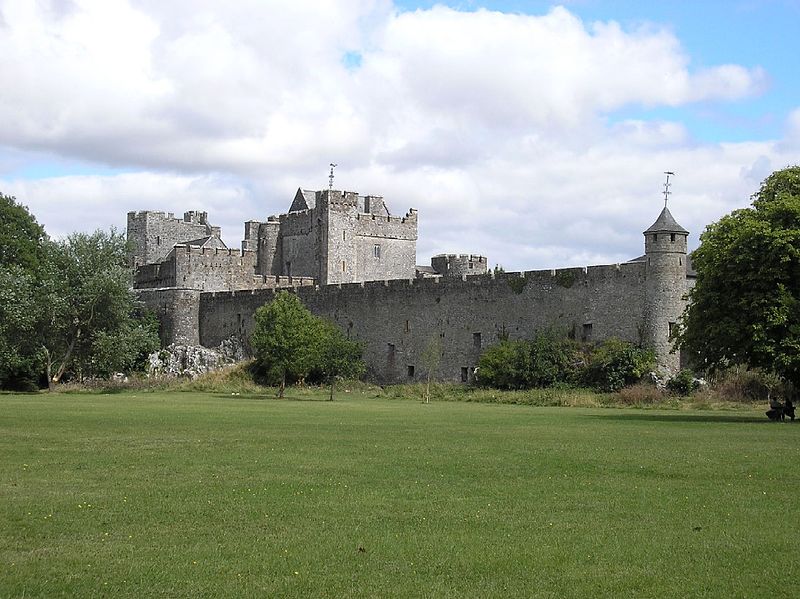
CAHIR CASTLE stands on an island in the River Suir by the town of Cahir.

It was built in the 13th century on a site of an earlier native fortification called a cathair (stone fort), which gave its name to the place.

The castle was built in two parts, with the side now by the street being built 200 years before the side now housing the audio-visual show.

Granted to the Butlers in the late 14th century, the castle was enlarged and remodelled between the 15th and 17th centuries.

It fell into ruin in the late 18th century, when the family ceased to live in it, though was partially restored in the 1840s. The Great Hall was partly rebuilt in 1840.

It is now a national monument managed by the Irish state.

Instead, they built a house of three storeys and five bays, now the Cahir House hotel, facing the main town square and backing on to the castle park.


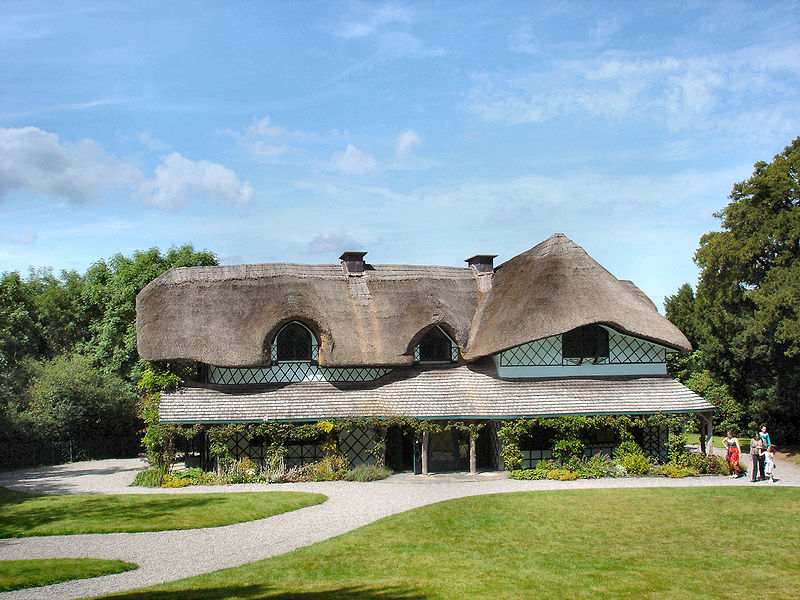
Swiss Cottage, a delightful cottage orné, was built in the early 1800s by the 1st Earl, it has been said, for a mistress, to a design by the famous Regency architect John Nash.

Its interior contains a graceful spiral staircase and some elegantly decorated rooms.

The wallpaper in the salon manufactured by the Dufour factory is one of the first commercially produced Parisian wallpapers. 

Cahir Park

Following the death of the 2nd Earl in 1858, his daughter, Lady Margaret Charteris, built the house known as Cahir Park, or Cahir Lodge, across the river from the ancient Castle.

This mansion served as the family seat from then on.

It was built about 1861, designed by Lanyon, Lynn & Lanyon; though, according by Bence-Jones, was neither "worthy of its architects, nor of its glorious setting".

It was said to be exceptionally dull and dour, quasi-Baronial, with steep gables, pointed plate-glass windows, and a turret with a pyramidal roof.

Its rooms were apparently "meanly proportioned", though redeemed with some French furniture.

During the 20th century, Colonel Charteris added a billiards-room-cum-library.

The house, somewhat ingloriously, was gutted by fire shortly after it had been sold following the Colonel's death, at the advanced age of 94, in 1961.

Former London residence ~ 54 Grosvenor Street.

First published in January, 2013.  Glengall arms courtesy of European Heraldry.

Sunday, 6 July 2025

Dundrum House

THE VISCOUNTS HAWARDEN WERE MAJOR LANDOWNERS IN COUNTY TIPPERARY, WITH 15,272 ACRES

The family of MAUDE deduces its descent from EUSTACE DE MONTE ALTO (c1045-1112), styled The Norman Hunter, who came to the assistance of Hugh Lupus, 1st Earl of Chester, at the period of the Conquest; and having participated in the glory of that great event, shared in the spoil, and obtained, amongst other considerable grants, the castle, lordship, and manor of Hawarden, Flintshire.


From the Visitation of York, by Glover, Somerset Herald, in 1585, it appears that

CONSTANTINE MONHAULT, alias MAUDE, of West Riddlesden, Yorkshire, married the daughter of Kighley of Newhall, and was succeeded by his son,

ARTHUR MAUDE, of West Riddlesden, who wedded the daughter of Lawrence Townley, and left a daughter, Agnes, and a son,

THOMAS MAUDE, of West Riddesden, who espoused Katherine, daughter of Roger Tempest, of Broughton, and had, with three daughters, three sons,
Arthur, of West Riddlesden;
Thomas;
CHRISTOPHER, of whom presently.
The third son,

CHRISTOPHER MAUDE, of Holling Hall and Woodhouse, patron of Ilkley in 1554, by Grace his wife, had issue,
THOMAS, his heir;
John;
Isabel.
The elder son,

THOMAS MAUDE, of West Riddlesden and Ripon, died in 1633.

His grandson,

ROBERT MAUDE, of West Riddlesden and Ripon, Yorkshire, patron of Ilkley, 1640, disposed of his English estates, and purchased others in counties Kilkenny and Tipperary, whither he removed.

He died in 1685, and was succeeded by his only son,

ANTHONY MAUDE (1638-1702), of Dundrum, High Sheriff of County Tipperary, 1686, MP for Cashel, 1695-9, who was succeeded by his only son and successor,

ROBERT MAUDE (1677-1750), MP for Gowran, 1703-13, St Canice, 1713-14, Bangor, 1727-50, who was created a baronet in 1705, designated of Dundrum, County Tipperary.

Sir Robert wedded Elizabeth, daughter and heir of Francis Cornwallis, of Abermarles, Carmarthenshire, by whom he had several children.

He was succeeded by his eldest son,

THE RT HON SIR THOMAS MAUDE, 2nd Baronet (1727-77), MP for Tipperary, 1761-76, High Sheriff of County Tipperary, 1765, Privy Counsellor, 1768, who was elevated to the peerage, in 1776, in the dignity of BARON DE MONTALT, of Hawarden; but dying without issue, the barony ceased, while the baronetcy devolved upon his brother,

SIR CORNWALLIS MAUDE (1729-1803), who represented the borough of Roscommon in parliament, and was elevated to the peerage, in 1793, in the dignity of VISCOUNT HAWARDEN.

His lordship married firstly, in 1756, Letitia, daughter of Thomas Vernon, of Hanbury Hall, Worcestershire, by whom he had one daughter, Elizabeth Letitia; and secondly, in 1766, Mary, daughter of Philip Allen, and niece of Ralph Allen, of Prior Park, Somerset, by whom he had further issue,
THOMAS RALPH, his successor;
Sophia Maria; Emma.
His lordship wedded thirdly, Anne Isabella, daughter of Thomas Monck, barrister, and niece of the Viscount Monck, by whom he had further issue,
CORNWALLIS, of whom hereafter;
ROBERT WILLIAM HENRY (Very Rev), 5th Viscount;
James Ashley (Sir), Captain RN; KCH, CB;
John Charles, in holy orders;
Francis, Commander RN; CB;
Isabella Elizabeth; Georgiana; Alicia; Charlotte; Mary Anne; Emily; Catherine.
His lordship died in 1803, and was succeeded by his eldest son,

THOMAS RALPH, 2nd Viscount (1767-1807), who espoused the Lady Frances Anne Agar, only daughter of His Grace Charles, Earl of Normanton, Lord Archbishop of Dublin; but dying without issue, the honours devolved upon his half-brother,

CORNWALLIS, 3rd Viscount (1780-1856), who wedded, in 1811, Jane, youngest daughter of Patrick Crawford Bruce, of Taplow lodge, Buckinghamshire, and had issue,
CORNWALLIS, his successor;
Isabella; Maria Adelaide; Florence Priscilla Alicia; Augusta.
His lordship was succeeded by his only son,

CORNWALLIS, 4th Viscount (1817-1905), who married, in 1845, Clementina Elphinstone, eldest daughter and co-heiress of Admiral the Hon Charles Fleeming, and had issue,
Cornwallis (1852-81), killed in action at the battle of Majuba Hill;
Eustace Mountstuart, died in infancy;
Isabella Grace; Clementina; Florence Elizabeth; Kathleen Maude; Elphinstone Agnes; Leucha Diana; Antonia Lillian.
His lordship was advanced to the dignity of an earldom, in 1886, as EARL DE MONTALT.

He dspms 1905, when the Earldom expired, but the Viscountcy and the Barony devolved upon his cousin,

ROBERT HENRY MAUDE, as 5th Viscount (1842-1908), eldest surviving son of the Hon and Very Rev Robert William Henry Maude, Dean of Clogher, and next brother of 3rd Viscount, who espoused, in 1881, Caroline Anna Mary, daughter of Major Arthur Ogle, and had issue, an only son,

ROBERT CORNWALLIS, 6th Viscount (1890-1914), killed in action, 1914, when the titles reverted to his cousin,

EUSTACE WYNDHAM MAUDE, as 7th Viscount (1877-1958), JP, eldest son the Hon and Very Rev R W H Maude, and brother of 5th Viscount, who married, in 1920, Marion, daughter of Albert Leslie Wright, and had issue,
EUSTACE WYNDHAM, his successor;
Kathleen Emily; Elinor Louisa; Dorothy Caroline; Alice Charlotte.
His lordship was succeeded by his son,

EUSTACE WYNDHAM, 8th Viscount (1926-91), who wedded, in 1957, Susannah Caroline Hyde, daughter of Major Philip Charles Gardner, and had issue,
ROBERT CONNAN WYNDHAM LESLIE, his successor;
Thomas Patrick Cornwallis;
Sophia-Rose Eileen.
His lordship was succeeded by his eldest son,

ROBERT CONNAN WYNDHAM LESLIE, 9th Viscount (1961-), who married, in 1995, Judith Anne, daughter of John Bates, and has issue,
VARIAN JOHN CONNAN EUSTACE, born 1997;
Isetta Clementina Effijay; Avery Joan Constance Elita.
The 9th and present Viscount lives in Kent.


DUNDRUM HOUSE, near Cashel, County Tipperary, was built about 1730, the nucleus of a fine estate once owned by the the O'Dwyers of Kilnamanagh.

The O'Dwyer estate was subsequently confiscated and Robert Maude was given all of the O'Dwyer land, including the O'Dwyer manor and castle of Dundrum.

This is a Palladian mansion, comprising a centre block of two storeys over a high basement, joined by short links to flanking pavilions.

The entrance front has seven bays, with a three-bay, pedimented breakfront.


There is an impressive, double-pedimented stable block at right-angles to the entrance front.

An additional storey, treated as an attic above the cornice, was added to the main block about 1890 by the 4th Viscount Hawarden (later 1st and last Earl de Montalt). 

Lord de Montalt was the last of the family to live at Dundrum House.

In 1909, when Dundrum House demesne was for sale, it was acquired by a religious order, who later established a Domestic Science College.

Having been acquired by Austin and Mary Crowe in 1978, with extensive renovation and restoration, Dundrum House was opened as a hotel in 1981.

Residence ~ Bossington, Adisham, Canterbury, Kent.

First published in November, 2012.

Tuesday, 1 April 2025

Templemore Abbey

THE CARDEN BARONETS OWNED 7,850 ACRES OF LAND IN COUNTY TIPPERARY

This family, which is of antiquity, removed from Lincolnshire into Ireland about the middle of the 17th century.

The name is local, being derived from the township of Cawarden, or Carden, which lies about eleven miles south-south-east from Chester, which manor was the original inheritance of the family; but the elder branch terminating in co-heiresses, the manor of Over-Carden was carried by marriage into the family of Felton, about the end of the 16th century.

A branch of the family had been settled in Kent, where it appears that it had been for several generations possessed of the manor of Hodford; but that estate was alienated during the reign of ELIZABETH I, by John Carden, to the family of Cobbe, when there is reason to believe that the Cardens of Kent removed into Lincolnshire, and that from them diverged the Irish branch, springing from

JOHN CARDEN (c1623-1728), who settled at Templemore, County Tipperary, about 1650, who married Priscilla, daughter of John Kent, of County Kilkenny, by whom he had issue,
Jonathan, ancestor of CARDEN OF BARNANE;
JOHN, of whom we treat;
William;
Margery; Anne; Abigail; Margaret; two other daughters.
Mr Carden died at the extraordinary age of 105. His second son,

JOHN CARDEN, of Templemore, wedded, in 1717, Rebecca, daughter of Humphrey Minchin, of Ballynakill, and had issue,
JOHN, his heir;
Minchin;
Paul.
The eldest son,

JOHN CARDEN (1720-74), of Templemore, espoused, in 1747, Elizabeth, daughter and heir of the Rev Robert Craven, and had (with other issue),
JOHN CRAVEN, his heir;
Christiana.
The eldest son,

JOHN CRAVEN CARDEN (c1758-1820), of Templemore, married firstly, in 1776, Mary, daughter of Arthur, 1st Viscount Harberton, and had issue,
John (1777-1811);
ARTHUR, his heir;
another son.
He wedded secondly, in 1781, Sarah, daughter of John Moore, and had issue,
Annesley;
Gertrude;
another daughter.
Mr Carden espoused thirdly, in 1788, Mary Frances, daughter of Henry Westenra, and sister of Warner William, 2nd Baron Rossmore, and had further issue,
HENRY ROBERT, 2nd Baronet;
Harriet Amelia; Frances.
He married fourthly, Anne, widow of the Viscount Monck.

Mr Carden was created a baronet in 1787, designated of Templemore, County Tipperary.

He raised and commanded the 30th Regiment of Light Dragoons, which, with many other regiments, was reduced at the peace of Amiens.

Sir John was succeeded by his eldest son,

SIR ARTHUR CARDEN, 2nd Baronet (1778-1822), High Sheriff of County Tipperary, 1820, who wedded Mary, daughter of Thomas Kemmis, of Shaen, Queen's County; but dying without issue, the title devolved upon his half-brother,

SIR HENRY ROBERT CARDEN (1789-1847), of Templemore, High Sheriff of County Tipperary, 1824, who espoused, in 1818, Louisa, daughter of Frederick Thompson, of Dublin, and had issue,
JOHN CRAVEN, his successor;
Frederick;
Henry Daniel;
Arthur (Rev);
Elizabeth Caroline; Sarah Sophia; Frances Mary.
Sir Henry was succeeded by his eldest son,

SIR JOHN CRAVEN CARDEN, 4th Baronet (1819-79), DL, High Sheriff of County Tipperary, 1849, who married firstly, in 1844, Caroline Elizabeth Mary, daughter of Sir William Mordaunt Sturt Milner Bt, and had issue,
Beatrice Georgina; three other daughters.
He wedded secondly, in 1852, Julia Isabella, daughter of Admiral Charles Gepp Robinson, and had further issue,
JOHN CRAVEN, his successor;
Henry Charles;
Frederick Richard;
Coldstream James;
Derrick Alfred, ancestor of the 8th Baronet;
Julia Ellen Beatrice; Norah Irene; Eileen Olive.
Sir John was succeeded by his eldest son,

SIR JOHN CRAVEN CARDEN, 5th Baronet (1854-1931), JP DL, High Sheriff of County Tipperary, 1882, who espoused, in 1891, Sybil Martha, daughter of General Valentine Baker, and had issue,
JOHN VALENTINE, his successor;
Audrey.
Sir John, the last of the family to live at Templemore Abbey, was succeeded by his son and heir,

SIR JOHN VALENTINE CARDEN, 6th Baronet (1892-1935), MBE, Captain, Royal Army Service Corps, who married firstly, in 1915, Vera Madeleine, daughter of William Henry Hervet-d'Egville; and secondly, in 1925, Dorothy Mary, daughter of Charles Luckraft McKinnon, by whom he had issue, an only child,

SIR JOHN CRAVEN CARDEN, 7th Baronet (1926-2008), of Jersey, Channel Islands, who wedded, in 1947, Isabel Georgette, daughter de Hart, and had issue, an only child, ISABEL MARY.

Sir John died without male issue, when the title passed to his kinsman,

SIR JOHN CRAVEN CARDEN, 8th and present Baronet.
Sir John Craven Carden, 5th Baronet (1854–1931);
Sir John Craven Carden, 7th Baronet (1926–2008);
Sir John Craven Carden, 8th Baronet (born 1953).
Templemore Abbey (Image: Robert French)

TEMPLEMORE ABBEY, County Tipperary, replaced an earlier castle which was destroyed by a fire in the mid-18th century.

In its place another house was erected, though it, too, was demolished in the early 1800s and a new residence was constructed on an elevated location some distance from the original building.

Templemore Priory (Image: Henry Brocas; R Smith)

It was called Templemore Priory, though its name was changed subsequently to Templemore Abbey.

(Image: Robert French)

This residence was relatively modest, similar to a single-storey Gothic cottage; it was, however, considerably increased in size by the architect William Vitruvius Morrison in the Tudor-Gothic style.

This was said to have cost £36,000 (£4.3 million in today's money).

The completed mansion afforded a two-storey entrance front, with finials, oriels, gables, and a castellated parapet.

There was also a long, irregular side elevation.

The Abbey was burnt to the ground in 1921 by the IRA.

Former residence ~ Nassau, Bahamas.

First published in August, 2019.

Tuesday, 3 December 2024

Cahercon House

THE HON CHARLES WILLIAM WHITE WAS THE SECOND LARGEST LANDOWNER IN COUNTY TIPPERARY, WITH 23,957 ACRES

LUKE WHITE (c1740-1824) was born at Bell's Lane (now Garfield Street), Belfast.
This bookseller, lottery operator and Whig politician was once known as "the Smithfield Millionaire." 
He started as an impecunious book dealer, first in the streets of Belfast; then, from 1778, at an auction house in Dublin, buying and reselling around the country. 
By 1798, during the Rebellion, he helped the Irish government with a loan of £1 million (at £65 per £100 share at 5%). 
He then purchased Luttrellstown Castle from Henry Luttrell, 2nd Earl of Carhampton, in 1800, and changed its name to Woodlands in order to eradicate the memory of its previous owner.
Mr White, High Sheriff of County Dublin, 1804, Longford, 1806, MP for Leitrim, 1818-24, married firstly, in 1781, Elizabeth, daughter of Peter de la Mazière, and had, with other issue,
Thomas, Colonel in the army, of Woodlands;
Samuel;
Luke;
HENRY, of whom hereafter;
Matilda, m 4th Baron Massy.
He espoused secondly, in 1800, Arabella, daughter of William Fortescue, and had further issue, one son.

Mr White died at his London residence in Park Street, Mayfair.

He left properties worth £175,000 per annum which subsequently devolved upon his fourth son,

HENRY WHITE (1791-1873), of Woodlands, County Dublin, and afterwards of Rathcline, County Longford, who wedded, in 1828, Ellen, daughter of William Soper Dempster, of Skibo Castle, Sutherland, and had issue,
LUKE, his heir;
Henry;
George Frederick;
Francis Samuel;
Charles William, of Cahercon;
Robert;
Eleanor; Emily.
Mr White was elevated to the peerage, in 1863, in the dignity of BARON ANNALY, of Annaly and Rathcline, County Longford.

He was succeeded by his eldest son,

LUKE, 2nd Baron (1829-88), KP, MP for Clare, 1859-60, Longford, 1861-2, Kidderminster, 1862-5, who espoused, in 1853, Emily, daughter of James Stuart, and had issue.

The Heir apparent is the present holder's only son, the Hon Luke Henry White.
*****

The 1st Baron's fifth son, the Hon Charles William White (1838-90), of Cahercon, inherited the County Clare estates comprising 18,226 acres, and 5,731 acres in County Tipperary.


CAHERCON HOUSE, near Kildysart, County Clare, is situated on the banks of the River Shannon, the seat of the Scott family until at least the 1850s.

The sale rental of 1854 gives a detailed description of the house which included 16 bedrooms.

Cahercon, variously known as Cahircon, Caheracon and Cahiracon, is a late-Georgian block of three storeys over a basement, with two-storey, mid-19th century wings and other additions.

The house faces across the Shannon estuary.


The main block is of five bays, with an Ionic porch; the wings have three-sided bows. The roof is prominent.

Cahercon was the seat of the Scott family until at least the 1850s and was constructed around 1790.

In 1873, the wings, conservatory and single storey bay were added.

By the 19th century James Kelly held the house in fee.

The Hon James William White, son of Lord Annally's son, lived in Cahiracon in the mid 1870s and it was still a seat of the family in 1894.

The Vandeleurs lived in Cahercon at the beginning of the 20th century.

In 1920, it was purchased by the Maynooth Mission to China, and they in turn sold it to the Salesians Sisters of St John Bosco in 1962.

Until 2002, Cahercon House operated as a secondary school, boarding school and convent.

First published in July, 2012.

Monday, 4 November 2024

Ballinacourty House

THE MASSY-DAWSONS WERE MAJOR LANDOWNERS IN COUNTY TIPPERARY, WITH
19,093 ACRES

The first of this noble family that settled in Ireland was
 
GENERAL HUGH MASSY, who had a military command to repress the rebellion of 1641.
The family of Massy derive their name from the town and ancient lordship of Massy, in Normandy, their place of residence at the time Normandy was conquered by Rollo, 1st Duke of Normandy, in the year 876, at which period they were styled lords of Massy.
HAMON DE MASSEY was created one of the eight temporal peers of Chester, by the title of Baron of  Dunham Massey, by Hugh Lupus, earl palatine of that county.
The General married Margaret Percy, and had a son,

HUGH MASSY, of Duntrileague, County Limerick, who wedded Amy, daughter of John Benson, and had issue,
HUGH, his heir;
John;
William;
CHARLES (Very Rev), Dean of Limerick, ancestor of the Massy Baronets;
Margaret; Amy.
The eldest son,

COLONEL HUGH MASSY, of Duntrileague, born in 1685, married Elizabeth, daughter of the Rt Hon George Evans, and had issue,
HUGH, of whom we treat;
George (Ven), Archdeacon of Ardfert;
John, killed in a duel;
Godfrey, in holy orders;
William, m Mary, daughter of Eyre Evans, of Portrane;
EYRE, 1st BARON CLARINA;
Charles;
Mary; Amy; Elizabeth; Catherine.
The eldest son,

HUGH MASSY, born in 1700, having represented County Limerick in several parliaments, was elevated to the peerage, in 1776, in the dignity of BARON MASSY, of Duntrileague, County Limerick.

His lordship espoused firstly, Mary, daughter and heir of James Dawson, of Ballinacourty, County Tipperary, and had issue,
Hugh, his heir;
JAMES, of whom we treat;
John;
Elizabeth.
His lordship's second son,

THE HON JAMES MASSY, born in 1736, assumed the additional surname of DAWSON after that of MASSY.

This gentleman married Mary, daughter of John Leonard, and left a son and two daughters, namely,
JAMES HEWITT, of whom presently;
Elizabeth;
Maria.
Mr Massy-Dawson's only son,

JAMES HEWITT MASSY-DAWSON (1779-1834), of Ballinacourty, MP for Clonmel, 1820-30, married, in 1800, Eliza Jane, daughter of Francis Dennis, and had issue,
JAMES, (1802-37), died unmarried;
FRANCIS DENNIS (1803-70);
John, in holy orders;
Charles, in the army;
GEORGE STAUNTON KING, of whom hereafter;
Mary; Anna; Elizabeth; Isabella; Louisa; Adelaide; Helena.
Mr Massy-Dawson's youngest son,

GEORGE STAUNTON KING MASSY-DAWSON JP DL (1816-97), of Ballinacourty, High Sheriff of County Tipperary, 1854, espoused firstly, in 1854, Grace Elizabeth, daughter of Sir William Edward Leeson, and had issue,
JAMES, his heir;
GEORGE HENRY EDWARD, succeeded his brother;
Maira; Grace; Louisa.
He married secondly, in 1869, Harriett Sophia, daughter of Walter Steele; and thirdly, in 1893, Eliza, daughter of the Rev James Rynd.

Mr Massy-Dawson was succeeded by his eldest son,

JAMES MASSY-DAWSON (1857-91), who wedded, in 1886, Alice Matilda Jones, though the marriage was without issue, and he was succeeded by his brother,

GEORGE HENRY EDWARD MASSY-DAWSON JP (1864-1916), of Ballinacourty, who wedded, in 1894, Rosalie Margaretta, daughter of Jean Hunziker, though the marriage was without issue.


Lineage of Dawson

JOHN DAWSON, of Sutterby, Lincolnshire, at the time of the Rebellion, actively employed himself in the service of CHARLES I, and therein raised a troop of horse, under the command of William, Marquess of Newcastle-upon-Tyne (afterwards 1st Duke of Newcastle-upon-Tyne).

This gentleman later followed the fortunes of CHARLES II and eventually retired into Ireland, applying himself to the practice of the Law, wherein he omitted no fit opportunity to advance the interest and restoration of his royal master.

The services of Mr Dawson were not unrewarded:
On the re-establishment of the monarchy, he received from the crown, in 1666, a grant of land in County Tipperary exceeding 2,900 acres, including the castle of Ballinacourty.
In 1703, James Dawson, of Ballinacourty, purchased land in the baronies of Coonagh and Clanwilliam, County Limerick, and Clanwilliam, County Tipperary, part of the confiscated estate of JAMES II.


BALLINACOURTY HOUSE, at the Glen of Aherlow, County Tipperary, originally the home of the Dawson family, passed by marriage to the Massy family, thereby becoming the seat of the Massy-Dawsons in the 18th and 19th centuries.

This was a plain, two-storey, cut-stone house with a polygonal, pyramidal-roofed tower; since demolished.

The Rev John Massy-Dawson occupied Ballinacourty from his father's death until his own death in 1850.

The original house was destroyed during the troubles in 1922, and became ruinous by the mid 20th century.

The old stable block has been converted into a guest-house and restaurant. 

Massy arms courtesy of European Heraldry.    First published in April, 2012.

Sunday, 4 August 2024

Kilboy House

THE BARONS DUNALLEY WERE MAJOR LANDOWNERS IN COUNTY TIPPERARY, WITH 21,081 ACRES

The founder of this noble family in Ireland was COLONEL HENRY PRITTIE or PRETTY as the name is variously spelt (whose brother was Oliver Prittie of London, Lieutenant in Cromwell's army), who served as Captain in a Kentish regiment of Horse which formed part of Cromwell's New Model Army. Prittie, who was an Independent, became Major in 1649 in Cromwell's new Regiment of Horse, and later succeeded to the command.

In 1652 he was Governor of Carlow. Colonel Prittie was High Sheriff of County Carlow, 1650, Tipperary, 1659, and had a grant, or confirmation, from CHARLES II, of Dunalley Castle, and other estates in counties Kerry and Tipperary by patent, in the 18th year of His Majesty's reign. 

Colonel Prittie wedded Honor, fifth daughter of Richard Foley, of Stourbridge, Worcestershire, and had issue,
HENRY;
Honor; Abigail; Elizabeth.
Colonel Prittie died in 1671, having had (with three daughters) a son,

HENRY PRITTIE, of Kilboy and Dunalley, Captain of Horse, High Sheriff of County Tipperary, 1706, who sustained a siege of twenty-one days, in his castle against the disbanded soldiers of of the royal army of JAMES II after the battle of the Boyne; when the besiegers at length entering, Mr Prittie was flung headlong from the top of the castle, but miraculously escaped unhurt.

He married Elizabeth, sister of Charles Alcock, of Powerstown, County Tipperary, and died in 1691, having had issue,
HENRY, his successor;
Richard;
Priscilla; Elizabeth; Honora; Catherine; Judith.
The elder son,

HENRY PRITTIE (1683-1738), of Kilboy, High Sheriff of County Tipperary, 1706, espoused, in 1702, Elizabeth, only daughter and heir of Colonel James Harrison, of Cloughjordan, MP for County Tipperary, 1707-13, and had issue, with three daughters, an only son,

HENRY PRITTIE (1708-68), of Kilboy, MP for County Tipperary, 1761-8, wedded, in 1736, Deborah, daughter of the Ven. Benjamin O'Neale, Archdeacon of Leighlin, and had issue,
HENRY, his successor;
Deborah; Elizabeth; Catherine; Martha; Margaret; Hannah.
Mr Prittie was succeeded by his son,

HENRY PRITTIE (1743-1801), of Dunalley, who espoused, in 1766, Catherine, second daughter and co-heir of Francis Sadlier, of Sopwell Hall, County Tipperary, widow of John Bury, and mother, by him, of Charles William, Earl of Charleville, and had issue,
HENRY, his successor;
Francis Aldborough, MP;
Catherine; Deborah; Mary; Martha; Elizabeth.
Mr Prittie, MP for Banagher, 1767-8, Gowran, 1769-76, County Tipperary, 1776-90, was elevated to the peerage, in 1800, in the dignity of BARON DUNALLEY, of Kilboy, County Tipperary.
The heir apparent is the present holder's son, the Hon Joel Henry Prittie.
The 4th Baron was the last Lord-Lieutenant of County Tipperary, from 1905 until 1922.

Henry Francis Cornelius Prittie, 7th and present Lord Dunalley, lives in Oxfordshire.

A note in the Dunalley Papers records the sale of the Kerry estate of this family to the Crosbies in 1742 for £1,500.


KILBOY HOUSE, near Nenagh, County Tipperary, was a middle to late 18th century house built for Henry Prittie MP, afterwards 1st Lord Dunalley, to the design of William Leeson.

It had three storeys over a basement; a five-bay entrance front with a central pediment; and four large, engaged Doric columns.

The top storey was treated as an attic above the cornice.

There was a five-bay side elevation.

Lord Dunalley & Party standing on steps

The mansion was burnt in 1922 and afterwards rebuilt minus the top storey.

About 1955, the house was demolished and a single-storey house in the Georgian style was built over the original basement.

More recently permission was granted for the reconstruction of a new Kilboy House, by the prominent businessman and philanthropist, Tony Ryan.


The project followed a fire that destroyed a large part of the property in 2005.

The local council granted planning permission for the partial demolition of the existing fire-damaged, listed, single-storey dwelling.

The former three-storey period residence over basement, based on the Georgian mansion house, has been built.


The application, in the name of Tony Ryan's son, Shane, and his wife, stated that the aim was to rebuild the house as it was originally constructed in 1780.

Before reconstruction began, the Ryans paid €60,964 to the council as a contribution to providing public infrastructure such as roads and water.

First published in January, 2012.