Tuesday, 21 February 2023

1st Marquess Curzon of Kedleston

Arms of 1st Baron Curzon of Kedleston

This family, of great and undoubted antiquity, came out of Normandy with WILLIAM THE CONQUEROR, to whom that prince gave lands and possessions for their valiant services. ROBERT DE COURÇON, Seigneur of Courçon, near Lisieux, Normandy, was granted Fishead, Oxfordshire, West Lockinge, Berkshire, etc by WILLIAM I.

Robert de Courçon's grandson,

RICHARD DE COURÇON, was granted Knights' fees of Croxall, Kedleston, Edinghall and Twyford, in the counties of Derbyshire and Staffordshire.

Richard's second son, STEPHEN, held Fauld, Staffordshire.

ROBERT OF COURÇON (also written Curzon), the celebrated English cardinal, was living in the reign of KING JOHN.

Robert of Courçon (Image: The National Trust)

The senior line terminated in Mary, daughter and heir of Sir George Curzon, of Croxall Hall, who married, in 1612, Edward Sackville, 4th Earl of Dorset KG, the second line being Curzon of Kedleston, and the third, Curzon of Waterperry.

JOHN CURZON (1598-1686), of Kedleston, MP for Brackley, 1628, Derbyshire, 1640, was created a baronet in 1641, designated of Kedleston, Derbyshire.

Sir John married Patience, daughter of Sir Thomas Crewe, and sister of Baron Crew, of Stene; and dying in 1686, was succeeded by his only surviving son,

SIR NATHANIEL CURZON, 2nd Baronet (c1640-1719), who wedded Sarah, daughter of William Penn, of Buckinghamshire, and was succeeded by his eldest son,

SIR JOHN CURZON, 3rd Baronet (c1674-1727), MP for Derbyshire, 1701-7, who died unmarried, when the title devolved upon his brother,

SIR NATHANIEL CURZON, 4th Baronet (c1676-1758), MP, who espoused Mary, daughter and co-heir of Sir Ralph Assheton Bt, by whom he had issue,
NATHANIEL, his successor;
Assheton, created Viscount Curzon, in 1802.
Sir Nathaniel was succeeded by his eldest son,

SIR NATHANIEL CURZON, 5th Baronet (1726-1804), MP, who was elevated to the peerage, in 1761, in the dignity of BARON SCARSDALE, of Scarsdale, Derbyshire.

His lordship married, in 1750, Caroline, daughter of Charles, 2nd Earl of Portmore, and had issue,
NATHANIEL, his successor;
Charles William;
John;
David Francis;
Henry;
Caroline; Juliana.
He was succeeded by his eldest son,

NATHANIEL, 2nd Baron (1751-1837), who wedded firstly, in 1777, Sophia Susanna, third daughter of Edward, 1st Viscount Wentworth, and had issue,
NATHANIEL, his successor;
Sophia Caroline.
He espoused secondly, in 1798, Felicité Anne Josephe de Wattines, a Flemish lady, and had further issue,
Augustus;
Edward;
William;
Frederick;
Ferdinand;
Alfred, grandfather of the 4th Baron;
Francis James;
Felicité; Mary; Caroline.
his lordship was succeeded by his eldest son,

NATHANIEL, 3rd Baron (1781-1856), who died unmarried, when the family honours devolved upon his cousin,

ALFRED NATHANIEL HOLDEN, 4th Baron (1831-1916), JP, who married, in 1856, Blanche, daughter of Joseph Pocklington Stenhouse, and had issue,
GEORGE NATHANIEL, his successor;
Alfred Nathaniel;
Francis Nathaniel;
Assheton Nathaniel;
Sophia; Mary; Blanche; Eveline; Elinor; Geraldine; Margaret.
His lordship was succeeded by his eldest son,

GEORGE NATHANIEL, 5th Baron (1859-1925), KG, GCSI, GCIE, PC, who wedded firstly, in 1895, Mary Victoria, daughter of Levi Zeigler Leiter, and had issue,
Mary Irene, Baroness Ravensdale of Kedleston;
Cynthia Blanche; Alexandra Naldera.
His lordship espoused secondly, in 1917, Grace Elvina, daughter of Joseph Monroe Hinds.
1st Marquess Curzon of Kedleston, KG etc 
His lordship, VICEROY AND GOVERNOR-GENERAL OF INDIA, 1899-1905, was advanced to the dignity of a marquessate, in 1921, as MARQUESS CURZON OF KEDLESTON.

Ancestral seat ~ Kedleston Hall, Derbyshire.

First published in February, 2019. 

Bishopscourt House

THE EARLS OF CLONMELL WERE MAJOR LANDOWNERS IN COUNTY TIPPERARY, WITH 16,187 ACRES

THE BISHOPSCOURT ESTATE, COUNTY KILDARE, COMPRISED 1,906 ACRES


THOMAS SCOTT, a captain in the army of WILLIAM III, fell in the field, charging the enemy at the head of his troops.

He wedded Margaret, daughter and heir of Henry Ormsby, of Tubbervady, County Roscommon, and was father of

MICHAEL SCOTT, who married Miss Purcell, of the ancient family of Purcell, titular Barons of Loughmoe, and had issue,

THE REV THOMAS SCOTT, Vicar of Urlings, Modeshill, and Mohubber, who wedded Rachel, eldest daughter of Mark Prim, of Johnswell, County Kilkenny.

The third son,

JOHN SCOTT (1739-98), MP for Mullingar, 1769-83, Portarlington, 1783-4,
Who, being bred to the bar, arrived at the high legal offices of Solicitor-General, Attorney-General, and Prime Sergeant-at-Law of Ireland, 1774-83. In 1784, he was appointed Lord Chief Justice of the Court of King's Bench; and in the same year Mr Scott was elevated to the peerage, in the dignity of Baron Earlsfort, of Lisson Earl, County Tipperary. 
His lordship was advanced to a viscountcy, in 1789, as Viscount Clonmell; and further advanced to the dignity of an earldom, in 1793, as EARL OF CLONMELL.
He married firstly, in 1768, Catharine Anna Maria, daughter of Thomas Mathew, of Thomastown Castle, County Tipperary, and sister of the 1st Earl of Landaff, by whom he had an only son, who died in infancy.

His lordship wedded secondly, in 1779, Margaret, only daughter and heir of Patrick Lawless, of Dublin (by Mary, sister of 1st Lord Cloncurry), and had issue,
THOMAS, his successor;
Charlotte, m 3rd Earl Beauchamp.
He was succeeded by his only son,

THOMAS, 2nd Earl (1783-1838), who espoused, in 1805, Henrietta Greville, second daughter of George, 2nd Earl of Warwick, and had issue,
JOHN HENRY, his successor;
Charles Grantham;
Harriett; Louisa Augusta; Charlotte Rachael; Caroline Sophia;
Frances Mary; Sophia Louisa; Augusta Anne; Georgiana Gertrude.
His lordship was succeeded by his eldest son,

JOHN HENRY, 3rd Earl (1817-66), of Lisson Earl, County Tipperary, who married, in 1838, Anne, daughter of Ulysses, 2nd Baron Downes of Aghanville, and had issue,

JOHN HENRY REGINALD, 4th Earl (1839-91), of Birt House, Naas, County Kildare, who died unmarried, when the family honours devolved upon his brother,

THOMAS CHARLES, 5th Earl (1840-96), who married, in 1875, Agnes Arabella, daughter of Robert Godfrey Day.

His lordship died without issue at Bishop's Court, County Kildare, from typhoid fever, and was succeeded by his first cousin,

BEAUCHAMP HENRY JOHN, 6th Earl (1847-98), eldest son of Colonel the Hon Charles Grantham Scott, second son of the 2nd Earl; on whose decease the titles passed to his son,

RUPERT CHARLES, 7th Earl (1877-1928), who died without male issue, when the titles reverted to his uncle,

DUDLEY ALEXANDER CHARLES, 8th Earl (1853-1935), whose marriage was without issue.

On his death, at Tunbridge Wells, Kent, the titles became extinct.


BISHOPSCOURT, Straffan, County Kildare, is a large classical house built ca 1780-90 for the Rt Hon John Ponsonby, Speaker of the Irish House of Commons.

It has a four-bay entrance front with a pedimented portico of four huge Ionic columns.

The outer bays have pedimented ground-floor windows and circular plaques instead of windows in the upper storey.


The side elevation has a recessed centre and three-bay projection at either side, joined by a veranda of slender columns with an iron balcony.

There is a curved bow on either side of the House; and an imperial staircase.

In 1838, Bishopscourt was sold by Frederick Ponsonby to John, 3rd Earl of Clonmell.


In 1914, the house was sold on to Edward Kennedy from Baronrath, at the time the most famous breeder of racehorses in Ireland.
Kennedy’s stallion The Tetrarch, standing at Bishopscourt, is confirmed as the most successful sire in the world in 1919.
In 1938, Bishopscourt passed to Edward’s daughter Patricia (Tiggie) Kennedy and her husband, Dermot McGillycuddy, heir to Senator McGillycuddy of the Reeks, an ancient clan chiefdom from County Kerry.
Edward Kennedy's son, Major D M (John) Kennedy, won a Military Cross at Anzio whilst serving with 1st Battalion Irish Guards and was later killed at Terporten Castle in Germany in February 1945.
Bishopscourt House is now the residence of the Farrell family.

Former seat ~ Eathorpe Hall, Warwickshire.
Former town residence ~ 41 Upper Brook Street, London.

First published in June, 2013.   Clonmell arms courtesy of European Heraldry.

Friday, 17 February 2023

New DL

APPOINTMENT OF DEPUTY LIEUTENANT


Mrs Alison Millar, Lord-Lieutenant of County Londonderry, has been pleased to appoint:-
Mr Ross Logan Wilson BEM
Coleraine
County Londonderry
To be a Deputy Lieutenant of the County his Commission bearing date the 8th day of February, 2023.

Lord Lieutenant of the County.

Friday, 3 February 2023

Leap Castle

THE DARBYS WERE MAJOR LANDOWNERS IN THE KING'S COUNTY, WITH 4,637 ACRES


JOHN DARBY, son of Edmund Darby, of Gaddesby, Melton Mowbray, Leicestershire, was a captain of horse in the Earl of Sussex's army, at the siege of the O'Carroll stronghold of Leim O'Bannon (the Leap of O'Bannon). 

John Darby died in 1608, and was succeeded by his grandson, 

JONATHAN DARBY, of Leap, King's County, High Sheriff of King's County, 1674, who left issue by Deborah his wife,
JONATHAN, his heir;
George;
John;
William;
Mary.
His eldest son,

JONATHAN DARBY, of Leap, living in 1708, left issue, one son and two daughters, viz.
JONATHAN;
Sarah; Mary.
The only son, 

JONATHAN DARBY JP, of Leap, espoused Anna Marie, daughter of Benjamin Frend, of Boskell, County Limerick, and had issue,
JONATHAN, his heir;
George, Vice-Admiral;
Damer, of Dublin;
Japhet;
Anne; Anne; Lucy.
The eldest son,

JONATHAN DARBY (1713-76), of Leap, wedded Susanna, daughter of Jonathan Lovett, of Dromoyle, King's County, and had issue,
JONATHAN;
Robert, 1747-64;
Henry D'Esterre (Sir), KCB, Admiral, of Leap Castle;
JOHN, of whom presently;
William Lovett;
Verney;
Christopher, a general in the army;
Edward Hawke;
Sarah.
The fourth son, 

JOHN DARBY (1751-1834), of Marklye, Sussex, and afterwards of Leap Castle, married, in 1784, Anne, daughter of Samuel Vaughan, and had issue,
Jonathan, b 1784, died unmarried;
WILLIAM HENRY, his heir;
Christopher Lovett (Rev);
George, MP for E Sussex;
Horatio D'Esterre;
John Nelson;
Susannah; Sarah; Letitia Lovett.
The eldest surviving son,

WILLIAM HENRY DARBY (1790-1880), of Leap Castle, married firstly, Laura Charlotte, daughter of Edward Jeremiah Curteis, of Windmill Hill, Sussex, and had issue,
JONATHAN, father of JONATHAN CHARLES;
Mary Charlotte.
He wedded secondly, in 1848, Elizabeth, daughter of W Drought, and had further issue,
William Henry;
John Nelson;
Elizabeth Henrietta; Wilhelmina Katharine Anne; Laura Susan Eleanor;
Theodora Lovett; Laura Caroline; Monica Gertrude; Maude Mary; Anne Vaughan.
Mr Darby was succeeded by his grandson, 

JONATHAN CHARLES DARBY JP DL, of Leap Castle, High Sheriff of King's County, 1883, who wedded, in 1889, Mildred Henrietta Gordon, younger daughter of Dr Richard Dill, of Burgess Hill, and Brighton, both in Sussex, and had issue,
Jonathan, died in infancy, 1892;
HORATION GORDON, his heir;
Augusta; Cicily Mildred O'Carroll; Florence Patricia O'Carroll.
Mr Darby died in 1943, and was succeeded by his only surviving son,

HORATIO GORDON O'CARROLL DARBY (1898-1971), of Shannon Vale, Dromineer, Nenagh, County Tipperary, wedded, in 1926, Celia Margaret, daughter of Lieutenant-Colonel Burton Henry Capel Philips, and had issue,
HORATIO ANTHONY FIONN O'CARROLL;
Jonathan Brian O'Carroll;
Christopher Henry D'Esterre O'Carroll.
The eldest son,

HORATIO ANTHONY FIONN O'CARROLL DARBY MBE (1927-), Controller of Electricity, Monserrat, lived, in 1973, in Australia.


LEAP CASTLE, near Rosscrea, County Offaly, passed to the Darby family through marriage.

It is a 16th century, three-storey tower house, with remains of a Jacobean house constructed to the north.

Leap Castle was altered and enlarged by the Darby Family ca 1760, to include flanking Neo-Gothic two-storey castellated blocks and door surround.

There are roughcast, rendered walls to the tower house with a castellated parapet with bartizans and machicolations.

The castle has a variety of window openings, including limestone pointed-arched twin lights to the tower house and pointed-arched window openings with sandstone sills to the 18th century flanking bays.

A pointed-arched door opening with flanking pointed-arched sidelights to front elevation has a "Batty Langley" style door surround comprising sandstone clustered colonnades and hood mouldings.

The tower-house and flanking bay to the south are in use as a private dwelling; whereas the two and three-storey castellated bays to the north of the tower-house are derelict.

The Darby Family remained at Leap Castle until 1922, when the castle was destroyed and the family moved from the estate.

The Castle lay in ruins until it was bought in the 1980s and it being restored at present.

To study the developments and phases on construction at Leap Castle and associated structures, including the gate lodge and stables, is to study the architectural history of Ireland.

It has been the site of practically continued occupancy since the 16th century with alterations and additions to the Castle during each century.

Leap Castle is a landmark building in the area and, in the past, played an important social and historic role in the region.

The tower-house contributes an archaeological significance to the site; while the striking door surround is of artistic interest.

Leap Castle and associated structures are important features in the architectural heritage of County Offaly.

First published in April, 2013.

Wednesday, 1 February 2023

Killeen Castle

THE EARLS OF FINGALL WERE MAJOR LANDOWNERS IN COUNTY MEATH, WITH 9,589 ACRES

This noble family was of Danish origin, but its settlement in Ireland is so remote that nothing certain can be ascertained as to the precise period. So early as the 11th century, we find JOHN PLUNKETT, of Beaulieu, County Meath, the constant residence of the elder branch of his descendants.

The successor at Beaulieu at the beginning of the 13th century,

JOHN PLUNKETT, living at the time of HENRY III, had two sons,
John, ancestor of the BARONS LOUTH;
RICHARD, of whom hereafter.
The younger son,

RICHARD PLUNKETT, of Rathregan, County Meath,
Who, with his son and heir, RICHARD PLUNKETT, by royal writs of parliamentary summons, was summoned to, and sat in, the parliaments and council of 1374; one as a baron, and the other "de consilio regis."  
To the same parliament and council was also summoned as a baron "Waltero de Cusake Militi," Lord of Killeen, whose heir general afterwards, as wife of Christopher Plunkett, was previously thought to have first brought the dignity of a parliamentary barony into this branch of the Plunkett family, but how erroneously may best be seen by reference to the writs of summons during the reign of EDWARD III, before alluded to.
The younger Richard Plunkett was father of

SIR CHRISTOPHER PLUNKETTKnight;
Who, as a recompense for the services he had rendered in the wars of Ireland, and as an indemnity for the expenses he had incurred, had a grant of a sum of money from HENRY VI, in 1426; before which time he was High Sheriff of Meath; and, in 1432, was deputy to Sir Thomas Stanley, Knight, Lord Deputy of Ireland.
Sir Christopher was created, ca 1426, BARON KILLEEN.

He married, in 1403, Joan, only daughter and heir of Sir Lucas Cusack, Knight, Lord of Killeen, Dunsany, and Gerardstown, County Meath, and became, in her right, proprietor of the Barony of Killeen, and was succeeded by his son and heir,

CHRISTOPHER, 2nd Baron (who, in an act of parliament during the reign of HENRY VI was called "Christofre Plunkett le puisne Seigneur de Killeen").

This feudal Lord wedded twice: firstly, to Genet, daughter of Bellew, of Bellewstown; by whom he had two sons.

He espoused secondly, Elizabeth, daughter of Sir William Wells, LORD CHANCELLOR OF IRELAND, by whom he had a daughter and two sons.

Sir Christopher died in 1462, and was succeeded by his elder son,

CHRISTOPHER PLUNKETT, 3rd Baron (1440-c1469); who had summons to parliament in 1463.

His lordship died without issue, and was succeeded by his brother,

EDMOND, 4th Baron (c1450-1510), who had a son and heir,

JOHN, 5th Baron, who was sworn of the privy council of HENRY VIII, and was found by inquisition to have had four sons,
Patrick, dsp;
CHRISTOPHER, heir to his brother;
Henry;
James.
The eldest son,

PATRICK, 6th Baron (1521-c1526), was succeeded by his brother,

CHRISTOPHER, 7th Baron, who succeeded to the titles and estates.

His lordship was an active and gallant nobleman, who discharged many high functions and commissions under the royal authority.

He sat in the parliament of 1509, and having married the granddaughter of the 8th Baron Slane, left issue, three daughters, his co-heirs,
Maude, m 3rd Baron Louth;
Catherine, m David Sutton;
Margaret, m Nicholas Aylmer.
He died about 1567, and was succeeded by his brother,

JAMES, 8th Baron (c1542-95), whose inheritance of the ancient family dignity was not opposed or questioned by the daughters, co-heirs of his deceased brother, and he took his place in the House of Lords in 1585.

In 1589, he enfeoffed trustees in his family estates, and was succeeded at his decease by his son and heir,

CHRISTOPHER, 9th Baron (1564-1613), who, when aged 31, sat in the parliament of 1613; and dying soon afterwards, was succeeded by his eldest son,

LUKE, 10th Baron (1589-1637), styled Lucas More.

This nobleman had a large grant of territory in 1613, and was created, in 1628, EARL OF FINGALL, JAMES I precluding the honour by a most flattering letter beginning thus:-
"That having received good testimonies of the virtuous and many good parts of his right trusty and well-beloved subject, the lord Baron Killeen, being one of the ancient nobility of Ireland, His Majesty was pleased" ... etc etc.
His lordship married four times, and by his second marriage with Susannah, fifth daughter of Edward, 1st Baron Ardee, had issue,
CHRISTOPHER, his successor;
George, ancestor of the 6th Earl.
His lordship was succeeded by his elder son,

CHRISTOPHER, 2nd Earl; who, having been made prisoner at the battle of Rathmines, died two weeks later, in 1649, at Dublin Castle, and was succeeded by his son (by Mabel, daughter of Nicholas, 1st Viscount Kingland),

LUKE, 3rd Earl (1639-84); who was restored to his estates and honours by the Court of Claims, and was succeeded at his decease by his only son,

PETER, 4th Earl (1678-1718); who was outlawed by the name of Luke, in 1691, for his loyalty to his legitimate sovereign, JAMES II, but the outlawry was reversed six years later, 1697.

His lordship wedded Frances, third daughter of Sir Edward Hales Bt, and had issue,
JUSTIN, his successor;
Margaret; Emilia; Mary.
He was succeeded by his only son,

JUSTIN, 5th Earl, who died in 1734, without issue, and intestate, and was succeeded in his titles and estates by his cousin,

ROBERT, 6th Earl, who enjoyed the honours without opposition of question on the part of the three daughters and heirs lineal of Peter, 4th Earl.

About a century later, however, the grandson of the youngest daughter, Maurice O'Connor, made claim to the Barony of Killeen, as a barony created by writ, and, as such, inheritable through females.

Like all other claims of the same nature, it has been unsuccessful, though brought forward at a time when the feelings of the Irish government were violently excited against the Earl of Fingall.

Robert, 6th Earl, was a captain in Berwick's regiment, in the service of France.

He espoused Mary, daughter of Roger Magenis, of Iveagh, County Down; and dying in 1738, left (with a daughter, Anne) a son and successor,

ARTHUR JAMES, 7th Earl (1731-93), then in his seventh year.

His lordship married, in 1755, Henrietta Maria, only daughter and heir of William Wollascot, of Woolhampton, Berkshire, and had issue,
ARTHUR JAMES, his successor;
Luke;
Robert;
William;
Theresa.
He was succeeded by his eldest son,

ARTHUR JAMES, 8th Earl (1759-1836), KP, who was created a Peer of the United Kingdom, in 1831, by the title of Baron Fingall, of Woolhampton Lodge, Berkshire.
The titles became extinct on the death of the 12th Earl.


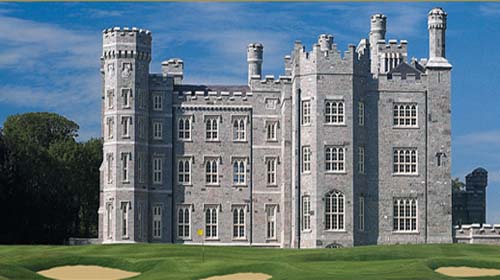
KILLEEN CASTLE, near Dunsany, County Meath, is said originally to have been a Norman fortification, built for the de Lacy magnates, and held from 1172 by the Cusack family, beginning with Geoffrey de Cusack.

The castle was then held from 1399 by successors by marriage (to Lady Joan de Cusack), the Plunketts.

Killeen Castle was originally built by Geoffrey de Cusack around 1181. The date is carved above the doorway.

The castle fell into disrepair in the late 17th century, was leased out, and was not restored until around 1779, when parts of the demesne were landscaped and some of the estate features were added.


Significant reworking was carried out from 1803-13 under the supervision of Francis Johnston, and in 1841, much of the castle was demolished and rebuilt (using much existing material) by the 9th Earl of Fingall, in the style of a small Windsor Castle.

The two towers added have the dates 1181 and 1841 inscribed, and at the time of completion, it was claimed that Killeen had 365 windows.

The 12th and last Earl sold Killeen Castle and Estate, in 1951, to Sir Victor Sassoon.

Lord Fingall remained as manager of the stud farm established near the castle.

In 1953, Lord and Lady Fingall moved to a contemporary house built in the grounds, and most of the house contents were sold.

Sassoon died in 1961 and his heirs sold the estate on in 1963, to the French art dealer and racehorse owner, Daniel Wildenstein.

Lord Fingall moved from the estate to Corballis on the Dunsany estate, then The Commons.

He died in 1984 and is buried at Dunsany Church.

In 1978, the castle and estate were sold to the advertiser Basil Brindley, who continued the stud farm operation.

In 1981, the castle was burnt out in an arson attack, being left abandoned for many years.

The lands and buildings were sold again in 1989, to Christopher Slattery.

In 1997, Snowbury Ltd purchased the castle and its grounds, with a vision to create the estate that exists today.

Fingall arms courtesy of European Heraldry.    First published in April, 2012.