Showing posts with label Hollymount. Show all posts

Sunday, 8 March 2026

Ardkeen

Ardkeen Parish Church (Timothy Ferres, 2022)

I have recently been studying the history of Hollymount demesne, and cognizant that Charles Savage (1745-79), of Ardkeen, County Down, married Ann Price, of Hollymount, my appetite was whetted to the extent that on the 16th January, 2022, I drove to Ardkeen on the Ards Peninsula in order to explore that historic site.

If you happen to know the Ards Peninsula, Ardkeen is not far from a public house called the Saltwater Brig; nor is it very far from the town of Portaferry.

Parking is difficult; I managed, however, to find a space on the grass adjacent to bed-and-breakfast accommodation called Ardkeen House.

Thence I crossed the busy road and found a metal gate tucked behind an overgrown hedge, the way to the small peninsula of Ardkeen.

One can walk along the shore for most of the way.

"ARDKEEN" (I'm quoting from the topographical dictionary of 1837), "a parish, in the barony of Ards, County Down, three miles from Portaferry."

"This place derives its name, originally ARD-COYNE, from its situation on the shores of a lake, which was formerly called Lough Coyne."

"It was one of the most important strongholds of the ancient Irish, who made it a place of refuge from the violence and rapacity of the Danes, and had a large and well-fortified camp protected on three sides by the sea, with extensive pastures in the rear for their cattle."

"On this point of land, jutting into the lough and forming a fertile peninsula nearly surrounded by every tide, Raymond Savage, one of the followers of De Courcy, erected a strong castle in 1196, which became the chief residence of that family, whose descendants throughout the whole of the insurrection remained firmly attached to the English monarchs."

"The church is situated on the peninsula and at the extreme western boundary of the parish; it is a small ancient edifice, and contains several monuments to the family of Savage, its original founders."

"A school of 76 boys and 84 girls is supported by Colonel and Lady Harriet Forde, who contribute £84 per annum; there are also a Sunday school and a private school."

"The only remains of the castle are the foundations; the fosses are tolerably perfect, and some of the gardens and orchards may be traced."

I was fortunate enough to encounter a local resident walking his dog.

We chatted for some time, and he expressed his passion for Ardkeen.

Remains of a Building at Ardkeen (Timothy Ferres, 2022)

He took me across the field, strewn with stones and some pieces of old red brick, to a spot that, he believed, may have been what remained of the former Savage dwelling house, or "Dorn House."

Historic Map of Ardkeen ca 1830

I've seen a map of the location in 1830, and there were several ruins there, so I'm not entirely convinced that the remaining corner section was the dwelling-house - it might have been.

Image from "the Savages of Ulster," by G Armstrong-Savage.  Click to Enlarge

Thence I walked over the gently rising slope, overlooking Strangford Lough, to see what seemed to be the remains of a pier.

Remains of a pier or landing-stage: Seneschal's Port (Timothy Ferres, 2022)

On a map dated about 1900, this feature is described as Seneschal's Port.

Remains of Ardkeen Castle (Timothy Ferres, 2022)

At the summit of the hill stood what was left of Ardkeen Castle.

The Historic Heritage government department has written a lot about Ardkeen.

From the top of the hill I scrambled down and made a bee-line for the ancient parish church of St Mary, roofless, surrounded by its graveyard.

Savage Tomb (Timothy Ferres, 2022)

Clearly a considerable number of people are buried in the graveyard encircling the church, including the tomb of some members of the Savage family.

I gather that a number of Savages were interred within the church, and that their grave-stones were relocated when the church was de-consecrated (if that's the term).

Self seated beside St Mary's Church

I lunched in the sunshine, leaning against the church wall; which really was heavenly, overlooking a little bay with rolling hills in the distance.

Church Interior (Timothy Ferres, 2022)

The interior of the church is quite bare, though interesting to see the features remaining therein.

Small Lancet Opening in Church (Timothy Ferres, 2022)


Exterior Sandstone Eaves Cornice (Timothy Ferres, 2022)

"During the 1750s (I'm quoting from the highly informative government heritage website about Ardkeen), Francis Savage [died 1770], whose family had lived at the adjacent tower house on Castle Hill during the middle ages and who (with his father Hugh) had built the new family residence of the ‘Dorn’ house a few hundred yards north of the church, decided to restore the church to serve as a private (Protestant) chapel for the Savage family of Ardkeen and their friends." 

"The building remained in use until shortly after 1839 when in consequence of being unroofed by the Great Wind and further damaged in a subsequent storm, the site was abandoned."

"It was replaced by a new parish church, built in Kirkistown in 1847."

Grave-Stone of G F Savage-Armstrong (Timothy Ferres, 2022)

If readers are interested in learning more about the history of the Savages of Ardkeen, I strongly recommend perusal of The Ancient and Noble Family of the Savages of the Ards, compiled by George Francis Savage-Armstrong (buried beside the parish church of Ardkeen).

Entrance to Ardkeen Church (Timothy Ferres, 2022)

Wednesday, 21 January 2026

Hollymount Demesne

RICHARD PRICE, of Greencastle, County Down, wedded Catherine, daughter of James Hamilton, of Bangor.
William Hamilton, of Bangor, County Down, fifth son of the Rev Hans Hamilton, married Jane, daughter of Sir John Melville, and dying in 1627, left issue, James Hamilton, of Newcastle, County Down, MP for Bangor, 1627, killed at Blackwater fight, 1646, who wedded Margaret, daughter of Francis Kynaston, and had issue, SIR JAMES HAMILTON MP, of Bangor, who married Sophia, daughter of John, 1st Viscount Avalon, and sister to Charles, Earl of Peterborough and Monmouth, and had issue, JAMES, MP for Bangor, 1692, dsp; CATHERINE, m firstly, Vere Essex, 4th Earl of Ardglass; secondly, Richard Price, of Hollymount.
Richard Price's son and heir,

MAJOR-GENERAL NICHOLAS PRICE (1665-1734), of Hollymount, MP for Downpatrick, 1692-3, County Down, 1695-1714, married Dorcas, fourth daughter of Roger West, of Ballydugan, County Down, and had issue,
James, his heir; ancestor of PRICE OF SAINTFIELD HOUSE;
CROMWELL, of whom we treat;
NICHOLAS;
Sophia; Margaret; Anne.
General Price was born in Greencastle, County Down; served in Lord Mountjoy's Regiment of foot, 1694; fought for WILLIAM III in Ireland; and for QUEEN ANNE in the War of the Spanish Succession. He was Colonel of the 28th Regiment of Foot, 1730-34.
His second son,

CROMWELL PRICE (1696-1776), of Hollymount, MP for Downpatrick, 1727-60, espoused firstly, in 1720, Margaret, daughter of George Anderson, of Belfast, and had issue,
Nicholas Tichborne, died young;
Catherine; Harriet; Dorcas; Elizabeth.
He married secondly, in 1741, Mary Willoughby-Montgomery, and had further issue,
CROMWELL, his heir;
Nicholas (c1753-1847);
ANNE, of whom hereafter.
The eldest surviving son,

CROMWELL PRICE (c1752-98), MP for Kinsale, 1783-90, Monaghan Borough, 1791-7, Fore, 1798, died without male issue, when the estates devolved upon his sister,

ANNE PRICE (1753-75), of Hollymount, who wedded, in 1769, Charles Savage, of ARDKEEN, County Down, and had issue, a son,

FRANCIS SAVAGE (1769-1823), of Hollymount and ARDKEEN, MP for County Down, 1801-12, who married firstly, in 1795, Jane, daughter of James Crawford, of CRAWFORDSBURN, County Down, and had issue, one daughter, dvp.

He married secondly, in 1806, the Lady Harriet Butler, daughter of Henry Thomas, 2nd Earl of Carrick.

Savage coat-of-arms

Mr Savage's second wife,

THE LADY HARRIET SAVAGE (1781-1865), of Hollymount, following her husband's death, espoused secondly, in 1829, COLONEL MATHEW FORDE, of Seaforde, County Down, though the marriage was without issue.

Following Lady Harriet's death in 1865, Hollymount passed to Francis Savage's nephew,

CLAYTON BAYLY, eldest son of Mr Savage's only sister, Mary Anne Savage; who assumed the surname of SAVAGE, in compliance with the will of his uncle.

Mr Bayly Savage, of Norelands, County Kilkenny, married, in 1821, Isabella Jane Octavia (d 1865), daughter of Mathew Forde, of SEAFORDE, though the marriage was without issue.

Subsequently, the Hollymount and Ardkeen estates passed to Clayton Bayly-Savage's sister,

MARY ANNE BAYLY (d 1855), who married Sir Henry Meredyth, 4th Baronet (1802-89), and had issue, a son,

Armorial Bearings of
the Meredyth Baronets

HENRY WILLIAM MEREDYTH JP DL (1829-78), who married, in 1862, Harriet Anne, elder daughter of the Rev William Le Poer Trench, and had issue,
HENRY BAYLY;
William Clayton (b 1865).
Mr Meredyth pre-deceased his father, the fourth baronet, in 1878, and the title passed to his elder son,

SIR HENRY BAYLY MEREDYTH, 5th Baronet (1863-1923), of Norelands, Lieutenant, 4th Brigade, North Irish Division, Royal Artillery, who dvp, when the baronetcy expired.

*****

EVER since I discovered the hidden, lost demesne of Hollymount it has captivated me.

The entire townland, which includes Ballydugan with its lake, mill, and country pub, is utterly bewitching. 

Parking is generally limited to roadside verges. 

Ballydugan and Hollymount, close to the river Quoile, are about two miles west of Downpatrick, county town of Down.

I've read that the lands here once belonged to Down Cathedral, presumably before dissolution.

The old County Down railway line used to skirt Hollymount and, I gather, Noel Killen, local landowner and business man, restored part of its structure close to the entrance to the former demesne.

Three centuries ago the land here was like a flood plain: tidal, and certainly navigable by boat at high tide. 

The first Hollymount House: A Drawing by Mrs Delany, 1745

EDWARD, 3RD BARON CROMWELL (1559-1607), great-grandson of THOMAS CROMWELL, chief minister to HENRY VIII, purchased the lands in County Down from CHARLES BLOUNT, 8th Baron Mountjoy and 1st Earl of Devonshire.

The Down Estate passed eventually to Lord Cromwell's great-granddaughter, the Lady Elizabeth Cromwell, suo jure Baroness Cromwell, wife of the Rt Hon Edward Southwell MP

In 1695, Lady Cromwell leased the lands at Hollymount and the adjacent townland of Woodgrange, comprising 1,895 acres, and the townland of Lisdalgan (473 acres), later to become Saintfield, to her half-brother, Lieutenant-Colonel (later Major-General) Nicholas Price, for £30 per annum (about £6,400 in 2020).

The original Hollymount House, quite a modest dwelling, commanded a superb prospect of the water at high tide.

This high square building, built in the early 1700s, had a handsome entrance-hall, broad staircase, and lofty rooms; and stood (and still stands) on elevated ground.

It was approached from the high-road by a very long and sweeping avenue.

The demesne was of considerable extent, and was well-wooded, and it contained a natural lake of considerable size.

Hollymount was unoccupied when the Delanys rented or borrowed it in 1744 for a number of years.

Mary Delany's husband, the Very Rev Patrick Delany, had been appointed to the deanery of Down, so Hollymount would have been most convenient to the cathedral and town of Downpatrick.

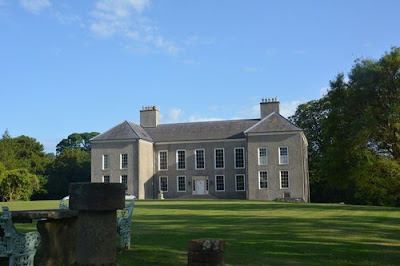
Hollymount House ( Image:Vivian Shepherd)

About a century later (DAB Dean suggests 1781; Bill Spence, the early 1800s) a new Georgian block was built, most likely adjoining the original house.

The new block was built either by General Price's grandson, Cromwell Price (c1752-98) or his granddaughter Anne's son, Francis Savage (1769-1823).

It was neat and plain, two storeys above (it's thought) a basement, judging by the ruinous remains today. 

Hollymount: Porch (Image: Vivian Shepherd)

There were five bays with a parapet at the low roof, and two prominent chimneys.

The door-case and porch seemed to be the most striking feature of the house, with four small Ionic columns supporting a pediment with fluted column.

Hollymount changed hands many times during its existence.


The owners were all interrelated through marriage, though as the decades progressed those links became more tenuous.

The last member of the Prices to live there might have been Cromwell Price, who died in 1798.

Hollymount Demesne ca 1830

The Lady Harriet Forde seems to have moved from Hollymount House to DRUMCULLEN HOUSE (further down the main drive) about 1853.

When Lady Harriet died in 1865, the estate passed to her first husband's nephew, Mr Clayton Bayly; thence to his sister, Mary Anne, who had married Sir Henry Meredyth, 4th Baronet.

It's thought that the Baylys and Meredyths never inhabited Hollymount and were, most likely, absentee landlords.

Subsequent tenants were numerous: The first tenant is believed to have been ROBERT FRANCIS GORDON; followed by Andrew McCammon; then John Greenlaw Napier and his family, who possibly purchased the estate from the Merethyths. 

Ionic Columns at Porch (Image: Vivian Shepherd)

The Kellys, farmers, purchased what remained of the old estate in the 1920s, by which stage the house, uninhabited and neglected, had become dilapidated.

After the 2nd World War the Kellys stripped Hollymount of its roof, selling the lead and slates.

Shooting Party at Hollymount (Image: Vivian Shepherd)

In 1968 Hollymount was sold to the Brownlows (James Christy Brownlow (1922-2006) lived at BALLYDUGAN HOUSE in 1976).

Hollymount House (Timothy Ferres, 2021)

The Northern Ireland forestry service purchased Hollymount in 1975, and the former demesne is now known as Hollymount Forest.

Hollymount House (Timothy Ferres, 2021)

What remains of what was once a fine demesne of great historic value is today abandoned, derelict, and run-down, at the risk of tautology; though it cannot be understated.

Hollymount House (Timothy Ferres, 2021)


EDITED EXTRACT FROM A GENEALOGICAL HISTORY OF THE SAVAGES IN ULSTER (1906)
    

The demesne of Hollymount is situated a short distance from Downpatrick, in the barony of Lecale, the old territory of the Savage family.

It is interesting as having been the temporary residence [the first house] of the celebrated Mrs Mary Delany (the friend of Dean Swift), whose husband, when Dean of Down, rented it from the family of Price.

It is described in some of her letters, written there and preserved in the work known as The Life and Correspondence of Mrs Delany.

Writing from Hollymount to Mrs Dewes, in June, 1745 (twenty-four years before the birth of Francis Savage), Mrs Delany thus speaks of it:-
This is really a sweet place, the house ordinary, but is well enough for a summer house. 
Two rooms below, that is a small parlour and drawing-room, and within the drawing- room a little room in which there is a bed, but the Dean makes it his closet. 
Above stairs four pretty good bed-chambers and a great many conveniences for the servants. 
I have a closet to my bed-chamber, the window of which looks upon a fine lake inhabited by swans, beyond it and on each side are pretty hills, some covered with wood and others with cattle. 
On the side of one of the hills is a gentleman's house with a pigeon-house belonging to it, that embellishes the prospect very much. 
About half-a-mile off is a pretty wood which formerly was enriched with very fine oaks and several other forest trees (it covers a hill of about twenty acres); it is now only a thicket of the young shoots from their venerable stocks, but it is very thick, and has the finest carpeting of violets, primroses, and meadow-sweet, with innumerable inferior shrubs and weeds, which make such a mass of colouring as is delightful. 
But thorny and dangerous are the paths, for with these sweets are interwoven treacherous nettles and outrageous brambles! 
But the Dean has undertaken to clear away those usurpers, and has already made some progress; it is called Wood Island, though it is no more than a peninsula; the large lake that almost surrounds it is often covered with three-score couple of swans at a time. 
On the other side of the lake are various slopes, and on the side of one of them the town of Downpatrick. 
The ruins of the old cathedral are on an eminence just opposite to Wood Island, from whence I have taken a drawing. 
DD [Dr Delany, Dean of Down] is making a path round the wood large enough to drive a coach; in some places it is so thick as to make it gloomy in the brightest day; in other places a view of the lake opens, and most of the trees are embroidered with woodbine and the "flaunting eglantine! 
Four extraordinary seats are already made, one in an oak, the other three in ash-trees. 
This afternoon we proposed spending some hours there, but the rain drove us back again ; on the beach of the lake are a great many pretty cockle shells,' which will not be neglected when the weather will permit me to go to it.

Hollymount: Main Entrance (Gate Lodges of Ulster, Page 79, DAB Dean)

THE main drive to Hollymount had a grand entrance, measuring about seventy feet in total width.

A pair of stately little gate-lodges or pavilions guarded the entrance, with railed screen between them.

The gates themselves were supported by a a pair of rusticated ashlar pillars with ball finials.

*****

BIBLIOGRAPHY: Dean, DAB, Plight of the Big House in Northern Ireland, 2021, and Gate Lodges of Ulster, 1994; Bill Spence, Lecale Review, Number 16, Page 31, 2018.

I wish to express my gratitude to D A B Dean, Bill Spence, Vivian Shepherd, Denese Carberry, and Margaret Ferguson for their support in compiling this article.

Price arms courtesy of the NLI.

Sunday, 10 December 2023

Hollymount Visit

At Hollymount Church (Image: Timothy Ferres, 2021)

I was drawn back to Ballydugan and Hollymount in June, 2021.

This special haven is situated deep in the luscious County Down countryside, a few miles from Downpatrick.

From Downpatrick, drive past the racecourse, under the old railway bridge, and after a mile or so, veer right towards Ballydugan.

On my arrival at Ballydugan there were several large television production lorries parked at Ballydugan Mill; classic 1960s cars were strategically parked at the Lakeside Inn and the Lake House (viz. an immaculate Ford Cortina 1600E, Austin Cambridge, Jaguar E Type, Ford Granada and some others).

Ballydugan Lake and the Lake House had, in fact, been transformed into a period film set for the television drama Dalgliesh.

THE LAKE HOUSE was transformed into an establishment called The Black Swan, with cast-iron tables and chairs on the lawn outside.

There were two police officers on traffic duty, both of whom I chatted to.

Hollymount House (Image: Timothy Ferres, 2021)

I parked the car opposite the Lakeside Inn, and from there I walked for about twenty-five minutes to the lost demesne of Hollymount, deep in the woods.

The old Georgian mansion house is not easy to find, though it is adjacent to the main track.

Hollymount House (Image: Timothy Ferres, 2021)

The remains of Hollymount are enveloped in ivy and undergrowth; even a few trees grow within the walls.

These are mature trees, perhaps ninety or one hundred years old.

Hollymount House (Image: Timothy Ferres, 2021)

The walls appear to be largely intact, though there is abundant rubble on the ground within them.

I wandered about the former cellars, and some render or plaster remains.

Not far from the mansion was the walled garden, which I looked for; no trace of it, however, exists.

There was also a bowling-green not far from the mansion house.

Hollymount Chapel of Ease (Image: Down & Connor Church Accommodation society, 1839)

Having walked back to the car I drove a mile or so past the lake to Hollymount Church, built in 1840 and recently restored.

Intriguingly, a romantic engraving of about 1840 shows a stone wall and water close to the church; whereas today the main road passes that spot.

(Image: Down and Connor Church Accommodation Society, 1839)

The proprietor of the Lakeside Inn had left a note on my car, informing me that she had in her possession a history of Hollymount, should I wish to avail of it; so I do intend to pay a visit to the inn on an evening at some stage.

Click to Enlarge (Image: Timothy Ferres, 2021)

I had a flask of coffee and egg & onion sandwiches in the church grounds.

(Image: Timothy Ferres, 2021)

In the church graveyard was the grave of CAPTAIN MICHAEL TORRENS-SPENCE DSO DSC AFC RN, of DRUMCULLEN HOUSE, Ballydugan, Lord-Lieutenant of County Armagh, 1981-9.

(Image: Timothy Ferres, 2021)

Thursday, 25 May 2023

Hollymount Visit

The Lakeside Inn, with the old mill in the distance (Image: Timothy Ferres, 2021)

During May, 2021, I visited BALLYDUGAN, a delightful place several miles from Downpatrick, County Down.

Ballydugan is one of those unspoiled spots deep in the countryside, where old barns and disused railway lines abound with ivy; wildlife thrives; and the main feature, beautiful Ballydugan Lake, is the centre of attraction.

It is mentioned briefly in the Topographical Dictionary: 
About two miles from the town is the beautiful lake of Ballydugan ; and near it is Ballydugan House, memorable as the residence of Col. White, who was murdered, and the mansion burnt in the war of 1641.
I have visited this place many times, and usually park at a little carpark beside the lake and adjacent to the inn.

Across the road there is the old mill, a large building now transformed into a hotel or guesthouse.

Carpark beside Ballydugan Lake (Image: Timothy Ferres, 2021)

I'd brought a packed lunch with me, intending to park at the lakeside car-park, though it was closed, so instead I managed to tuck my car into a space outside the park.

The LAKESIDE INN was closed.

It was a glorious sunny day, and one of my plans was to seek the historic Hollymount Demesne.

It's not easy to find. In fact, it doesn't even feature in my old OS one-inch map of South Down, though I knew that it was at Hollymount National Nature Reserve.

While I was walking along the country road in the vicinity, a farmer approached in his tractor, so I flagged him down and inquired about it.

Fortunately he was friendly and helpful, and explained how to get to Hollymount.

Hollymount is an old, overgrown, unspoiled 17th or 18th century demesne; bluebells and wild garlic thrive here, with some very old parkland trees.

Ballydugan Medieval Settlement (Image: Timothy Ferres, 2021)

En route I encountered a lady with her two children, picking wild garlic for the open day at Ballydugan Medieval Settlement, a "living history" Viking village beside Ballydugan Lake.

Eventually I emerged at what I assumed were the remains of the old mansion house, though I now know that I'd encountered the farmyard, which stands a bit north of the house.

Hollymount Farmyard (Image: Timothy Ferres, 2021)

These buildings are dilapidated, ruinous, overgrown and barely discernible from a distance; interesting, nevertheless.

I'll return to Hollymount another day to find and explore what's left of the house.

A view of Hollymount in the road to Downpatrick: A sketch by Mrs Delany, 1745

I do wonder why the demesne was abandoned by the Prices in favour of Saintfield Demesne.

Incidentally, Hollymount House features in J A K Dean's Plight of the Big House in Northern Ireland.

Hollymount Demesne ca 1830 (Click to Enlarge)


After lunch I wandered off in the other direction, towards Ballydugan Cottages at the opposite side of the lake.

The Edgington Windbreaker (Image: Timothy Ferres, 2021)

What a lovely day it was. during the drive home I stopped off at Quoile Countryside Centre for a short walk to Steamboat Quay.

First published in May, 2021.

Wednesday, 25 August 2021

Finnebrogue Soirée


Having just returned from glorious Rathlin Island, I donned the glad rags last night for a charity soirée at FINNEBROGUE HOUSE, a mere hop, skip, and jump from Downpatrick, county town of County Down.

Actually I killed two birds with one stone, as it were.

When I visited Ballydugan and HOLLYMOUNT a few months ago, Margaret Ferguson of the Lakeside Inn had left a note on my windscreen to apprise me that she had information for me pertaining to Hollymount House and its history.

Whereas Finnebrogue is a few miles north-west of Downpatrick, Ballydugan is a couple of miles to the south-west.

Close Enough with Guests (Image: © Declan Roughan Photography, 2021)

My visit to Finnebrogue House was for a charity concert in aid of Hope For Youth Northern Ireland.

Close Enough barbershop quartet entertained us all in the entrance hall of the house.

(Image: © Declan Roughan Photography, 2021)

When I sat down I could hardly believe who was seated beside me - Philip Shirley, of LOUGH FEA, County Monaghan, whom I'd met during a visit to his stately home in County Monaghan.

He told me that they were driving back to Lough Fea that evening.

(Image: © Declan Roughan Photography, 2021)

During the interval I met quite a few interesting guests including, of course, our terrific host, Noel Lamb; Danny Kinahan, LORD & LADY ERNE, JOHNNY ANDREWS; the Armstrongs (of DEAN'S HILL, Armagh); the Montgomerys (of GREY ABBEY). I also saw the HON SHANE O'NEILL, General Sir Mike Jackson; the FITZGERALDS (Randox); and ninety others!

General Sir Michael Jackson GCB CBE DSO (Image: © Declan Roughan Photography, 2021)

We were served tasty little canapés comprising smoked salmon, and cocktail sausages on sticks.

Noel Lamb DL presenting a cheque (Image: © Declan Roughan Photography, 2021)

The show concluded about eight-thirty, so I thanked Noel for his kind hospitality, bade him farewell, and slipped off in the car, in a south-westerly direction for Ballydugan.

The car-park of the Lakeside Inn is beside an utterly delightful, picturesque lake - Ballydugan Lake.

Inside the inn a cheery fire greeted me, radiating heat.

This inn is no ordinary pub: it's homely and cosy, delightfully and unashamedly old-fashioned. I love it.

Margaret Ferguson, the proprietor, welcomed me cordially and introduced me to a pal of hers seated near the fire.

She had a copy of the history of Hollymount, an old and historic estate beside Ballydugan, long associated with the Price family (now Perceval-Price of SAINTFIELD HOUSE).

We all discussed the subject, the families in the district, including the TORRENS-SPENCES who used to live at Drumcullen House, Hollymount.

When I got up to leave I remarked that I wished Margaret's lovely inn were only a bit closer to me!