Showing posts with label Birds And Wildlife. Show all posts

Saturday, 10 January 2026

Crom: Walled Garden

Although it's one of the most remote parts of the Province and almost as far from Belfast as you can get, I've been to Crom Estate in County Fermanagh many times.

I first visited it in about 1977, when the estate manager took us on a guided tour of the Castle - I'd written to Lord Erne in advance, requesting a visit.

The Walled Garden lies deep within the grounds of Crom (pronounced Crum).

You cross the White Bridge and walk several hundred yards until it appears, the former head gardener's lodge being opposite it.

Its old, red-brick walls are in good condition, the National Trust having re-built at least one side some years ago.

It extends to roughly three acres in size; and has become overgrown since its demise after the second world war.

It is to be hoped that the National Trust restores this special place as and when funds become available.

Ruinous glass-houses (Timothy Ferres, 2013)

Many fruits and vegetables were grown here for the big house.

Exotic fruits, which are nowadays taken for granted, were a rarity then and only the wealthiest families could afford to cultivate them.

In fact many people may never have seen a pineapple or a peach or known they existed.

On one side of the Walled Garden there were raspberries; and strawberries on another.

Heated glasshouses contained peaches, nectarines, pineapples, grapes and tomatoes; not to omit lettuce, marrows, cucumbers and orchards with apples, plums, pears and greengages.

There were also beehives, sweet-pea, daffodils, dahlias and magnolias.

Location of former palm-house (Timothy Ferres, 2013)

In the middle of the garden there was a large palm-house surrounded by a lily pond, now sadly gone, 25-30 feet high, where the weather-reading was taken every morning.

The whole garden swarmed with butterflies, bees and other wild insects; birds flitted in and out to help themselves to Nature's goodness.

It must have been heavenly.

Of course the main purpose of the walled garden was to maintain an abundant supply of produce, including flowers, for the Castle: a barrow was wheeled manually up to the Castle with fruit, vegetables and flowers twice daily.

When the family were staying at their London home, the freshly-picked produce was loaded on to the train at Newtownbutler station and taken to Belfast or Dublin; then put on a ferry for its long journey to the metropolis, where it would have been delivered to the Ernes' house the next day; and that was in Victorian times!

I have been in the Walled Garden and my imagination always escapes to those halcyon days, dreaming of what it must have been like.

My fervent hope is that the enchanting walled garden of Crom is resurrected back to life again some day.

This piece was first published in August, 2008. It is thought that the intention is to utilize part of the Walled Garden as community allotments.

Sunday, 13 May 2012

Percy's Peanuts!

Percy, my new name for the grey squirrel which visits the peanut feeder close to the house, made an appearance again this morning at eight-thirty.

He clings on to the feeder, seemingly wrapping his bushy tail round a branch above, and munches away to his heart's content.

Alas, there's been no sighting of any red squirrels at all.


I've had a quiet weekend. I grilled a rasher of Marks and Spencer's finest back bacon this morning and ate it with Irwin's Nutty Krust High Fibre bread, butter and honey.

I prefer to grill the bacon at the highest setting, keeping a close eye on it, so that the fatty rind crisps up, while the lean meat remains unburned.

Saturday, 25 February 2012

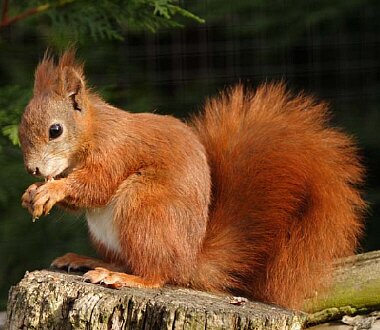
Red Squirrel in NI


The red squirrel is native to Northern Ireland, but its future is increasingly uncertain as the grey squirrel increases in number throughout the United Kingdom.

The red squirrel population is once again under severe pressure with local extinctions of reds and their replacement with greys being the recent trend in woodlands throughout the British Isles and other parts of Europe.
  • They do not hibernate over winter.
  • They store nuts in the ground in Autumn.
  • They can live to six years of age.
  • Young are called kittens.
  • They live in a drey made of twigs, leaves and moss built in a tree.
  • They can swim.

Threats to red squirrels include:

  • Greys are known to have spread a lethal pox disease to the reds in parts of the UK.
  • Competition for food sources from the increasing number of grey squirrels.Habitat loss and fragmentation – broad-leaved, mixed and coniferous woodland may be important red squirrel habitat.
  • Increasing volume of road traffic causing road deaths.Predators such as birds of prey, for example goshawks and pine marten.
  • Domestic cats are also a threat when squirrels go into gardens to feed.

The grey squirrel appears better able to exploit deciduous and mixed woodlands, utilising large tree seeds such as hazelnuts, acorns and beech mast before fully ripened. This ability gives the grey better breeding prospects and adult survival than the red in these woodlands.

Another factor giving greys the competitive edge is their lower susceptibility to a disease known as Squirrel Pox Virus. They may carry the disease and contribute to its transmission to red squirrels, with fatal consequences.

Instances of red squirrel death attributed to the virus has occurred in many parts of the UK.

Unlike the grey squirrel, red squirrels can survive in coniferous forests with their much smaller seeded tree species, and this specific habitat is often deemed a safe haven for reds. Neatly stripped conifer cones, perhaps piled up at a convenient feeding stump, will betray the presence of red squirrels in a conifer wood

A survey in 1995, included 261 sites, showed that while there was a great deal of overlap in the distributions of red and grey squirrels. Red squirrels clearly predominated in upland areas, where there was the greatest amount of coniferous forestry, and were virtually absent from the lowland areas to the north and south of Lough Neagh.

In contrast, grey squirrels occurred ubiquitously across the southern half of Northern Ireland and, west of the River Bann, as far as the north coast. At that time County Antrim was the only area without a large grey squirrel population.

Another survey, in 2002, looked at 80 sites mainly in interface areas, where both species were known to exist. Disturbingly, it identified an overall increase in the distribution of grey squirrels, particularly in the Limavady/Dungiven area, and to the south and west of County Antrim, where grey squirrels now occur widely between the River Bann and the Antrim plateau.

Counties Fermanagh and Tyrone still provide a relatively safe haven for red squirrels because of the large areas of forestry, although grey squirrels have either become established or replaced reds in forests in the Clogher valley and east Fermanagh.

In the same period in County Down grey squirrels have become established in Tollymore Forest Park and neighbouring Donard forest next to Newcastle, County Down; while Hillsborough forest, near Lisburn, and Narrow Water forest, near Warrenpoint, now have substantial populations of grey squirrels.

Of particular concern is the spread of greys into the Glens of Antrim, one of our strongholds for red squirrels in Northern Ireland, in the last 3-5 years.

The well known and loved red squirrel population at Belvoir Forest along the Lagan Valley in Belfast has been pushed almost to the point of extinction as greys have moved into their territory.

This gives particular cause for concern because, due to its large broad-leaves and mixed species composition, the forest is an attractive destination for grey squirrels moving along the wooded banks of the River Lagan and its feeders.

I have spoken to my colleague Craig McCoy:

"I’m not too sure about the exact range of the red squirrels. Although they were province-wide some years ago, they are steadily being pushed back by the greys. There are still a few strongholds for reds, however: Fermanagh, Ards Peninsula, Tollymore, Belvoir Forest,the Glens of Antrim and, I imagine, several others.


However, the greys are advancing on all fronts and, each year, the reds are getting fewer and their range decreasing. It is almost a lost cause. The Red is one of our Biodiversity Action Plan species and a few years ago, the Government set up a group to try to think up a strategy to protect it.

There had been some talk of controlling the greys in buffer zones around the remaining red populations but I don’t know how successful this has been. The last I heard, there had been suggestions to keep a breeding population of reds in Belfast Zoo".

Craig suggests that one idea worthy of exploration could be to create so-called "island sites", or colonies, in the Province for our red squirrels, including selective islands in Lough Erne and Strangford Lough. This would necessitate the introduction of the species to an island or even a peninsula.

I gratefully acknowledge the Ulster Wildlife Trust as a source of my information. First published in February, 2011.

Monday, 26 September 2011

Jay and Squirrel

Motoring up the drive of the old school this evening, I spotted a jay and a grey squirrel within yards of each other in the grounds.

Although Campbell's campus comprises about forty or so acres, there is abundant wildlife within the grounds.

Friday, 17 June 2011

2nd Pox Outbreak


BBC Northern Ireland reports that a second outbreak of a fatal red squirrel disease has been confirmed in Glenarm Forest in County Antrim.

It follows an outbreak of squirrel pox in County Down three months ago.

The disease is carried by the non-native grey squirrel which is immune to its effects. Infected red squirrels die within 15 days of contracting the virus.

The disease has already had a devastating effect on native red squirrel populations across the UK.

Northern Ireland Environment Agency (NIEA) Senior Wildlife Inspector, Dr Declan Looney, said it was becoming a real cause for concern: "The previous outbreak was three months ago and over 80 miles away in County Down,"  he said.

"We are monitoring the situation but would ask for the public to remain vigilant and immediately report any squirrels showing signs of the disease to the NIEA wildlife team or to a member of the NI Squirrel forum.

"Many of our native species such as the red squirrel are increasingly under pressure and it is very important that we do all we can to protect them".


John Griffin from the Forest Service, added: 

'We will urgently begin work with the adjacent landowner Antrim Estates [Lord Antrim], the Glens Red Squirrel Group and the other partners within the Northern Ireland Squirrel Forum to implement control measures to safeguard the local red squirrel population at Glenarm. "We acknowledge the dedication and vigilance of the Glens Red Squirrel Group which resulted in the discovery of the two suspect cases.'
The decline of red squirrels in the UK is blamed primarily on the effects of squirrel pox as well as the loss of woodlands and competition from grey squirrels.

Friday, 1 April 2011

Squirrel Pox Arrival


The latest news that a native red squirrel has died from the squirrel pox at Tollymore Forest in County Down is, indeed, cause for concern.

This is the very first recorded incidence of a red squirrel dying from the disease in Northern Ireland.

Thursday, 17 February 2011

Save Red Squirrels


The Prince of Wales has launched a conservation project which he hopes will realise his dream that red squirrels can thrive again. I am delighted that Prince Charles is lending his support to such an admirable project.

As patron of the Red Squirrel Survival Trust (RSST), Prince Charles praised the partnership between the RSST, Natural England, the Forestry Commission and the Wildlife Trusts.

HRH spoke of his own bid to save a red squirrel at home in Scotland last month:-

"I put nuts in the lobby and leave the door open and the red squirrels come up the steps into the house," he said. "Very often you get four or five running around inside the house, chasing each other to get at the nuts.

"One squirrel was found lying on the floor later on in the afternoon while I was out so we tried desperately to bring it back to life but sadly at the end of the day it died,

"So my effort is to have another small squirrel. My great ambition is to have one in the house, I hate to tell you. Sitting on the breakfast table and on my shoulder!"

Friday, 5 February 2010

Simon King OBE


I had no idea that Simon King had been appointed an OBE - Officer, Civil Division, of the Most Excellent Order of the British Empire - in the New Year Honours 2010. To my mind the award is well deserved.

I watched Simon King's Shetland Diaries, a charming documentary of time spent on the Islands with his lovely wife and daughter. This is the sort of programme I'd like to see more of on television. Incidentally, I liked his battleship-grey Land-Rover Defender, too; a car I'd opt for, were I in such circumstances.

Simon King has a fascinating biography, if one peruses his entry on Wikipedia.

Thursday, 3 December 2009

Badger Extravaganza

I was motoring up the drive of the old school earlier this evening for my customary sixty lengths when, as I turned the bend, what I suddenly saw was quite astounding: Two adult badgers sparring with each other on the grass verge.

I slowed down in order to observe them in the headlights; then, after a few seconds, they both ran into the undergrowth.

What a remarkable sight.

Sunday, 12 July 2009

Salt Island: A Guide


This is the most comprehensive information I have published, to date, about the National Trust's most wonderful little gem of an island in Strangford Lough.

If any reader wishes to contribute anything which they feel may be of further interest - historical, anecdotal or otherwise - please do feel free to share it on this site at the Comments section.


SALT ISLAND

ABOUT THE ISLAND:

Salt Island is a truly special place.

Those of us who visit it regularly cherish it as an unspoiled haven for wildlife, wild flowers and even a place to escape the pressures of everyday life.

It’s a little island which instills a sense of adventure combined with relaxation and peacefulness.

Brandy Bay, on the western side of the Island, may well inspire those of you with a vivid imagination to think of smugglers several centuries ago, who might have used the Island as a stopping-off point for illicit liquor on its way to eager customers on the mainland!

The Island itself is small, comprising about 51 acres.

It was acquired freehold in 1980 from William Thompson.

It lies 1¼ miles east of Delamont Country Park and 1¼ miles south of the nearest village, Killyleagh.

There is a small jetty near the Bothy, on the south-eastern side of the Island, which is accessible for up to 2½ hours either side of high tide.

This side of the Island has shallow water and extensive mud-flats at low tide which can be treacherous.

However, Brandy Bay, on the western side, is accessible, with care, at all times and is about five minutes' walk to the Bothy.

Brandy Bay has no jetty, so if you arrive by boat you may still need to step into shallow water or, indeed, row ashore in a tender.

Salt Island is one of eleven canoe access points of the circular Strangford Lough canoe trail.

This trail was officially launched at the Bothy on the 2nd July, 2008.

Three other National Trust access points are located at Castleward, Island Reagh and Horse Island.

For further information visit Canoe NI.

Directly behind the Bothy you will see a plantation of trees.

These were planted by volunteers in about 1987.

There is a stile at the rear of this plantation.

You shall also notice a small, fresh-water pond at Brandy Bay; and there are signs that it is being used by the occasional otter.

The Island consists mainly of clay soil.

The highest point, at the northern end, is 54 feet above sea-level.

In the past, there were several wells on the island as indicated by old maps.

THE ISLAND’S HISTORY:

Research is still being undertaken to discover more about the history of Salt Island.

However, we know that, in 1836, the island was owned by Lord Bangor (who lived at Castle Ward).

Salt Island ca 1850 (historic OS map). Click to enlarge.


Salt Island changed hands several times before the National Trust finally purchased it in 1980.

It appears that there were no dwellings on the Island in 1836.

A cottage did exist, though, at some time thereafter; and its stones were used for the construction of the present Bothy.


THE BOTHY:

The Bothy was built in the 1980s.

Its construction is triple-layered, up to one foot thick and stones from the original cottage were used on its exterior.

The Bothy provides basic shelter for visitors, ranging from campers to canoeists; youth & school groups; families and adventure organizations; indeed anyone can stay there.

It can accommodate up to ten people and offers running water, toilets, a wood-burner stove, kitchen area, table and chairs.

There is no cooker, so you need to bring your own cooking equipment, such as a Trangia or gas stove.

The Bothy has a drying-room beside the toilets.

The National Trust has provided a modest supply of kitchen utensils, cutlery and crockery.

However, it is best that you aim to be self-sufficient and bring your own.

Don’t forget to bring everything you need with you to the Island, including toilet paper, washing-up liquid, pots and pans etc.

Whilst many of these items may be in the Bothy, this cannot be taken for granted!

In fact, the National Trust would welcome any donations of useful items of furniture, cooking utensils, even the odd bottle of cooking oil or ketchup would be greatly received for future visitors.

The Island has no electricity supply, so you are welcome to bring your own portable generator in order to provide power to the Bothy’s existing power-points and fittings.

One is situated at the corner of the wall in the grassy area to the front of the Bothy.


CAMPING:

There is no charge for rough camping at the northern part of the Island, near Brandy Bay, although this means that you do not have access to the Bothy facilities.

For rough camping, there is a drinking-water tap, close to the water trough, at the fence surrounding the plantation behind the bothy.


WILDLIFE:

Otters are known to pay occasional visits to Salt Island.

They use the pond near Brandy Bay for fresh drinking water.

Otters are shy creatures and mostly nocturnal.

Porpoises are regular visitors to Strangford Lough.

They are closely related to dolphins, but smaller; and they often swim in small groups, or “schools” as the collective term is known.

The Irish hare, Lepus Timidus Hibernicus, was once prevalent on Salt Island.

These animals have long ears with black tips; the body is russet brown; and their hind legs are longer than rabbits too.

They seem to have died out, although there are still plenty of rabbits here.

Why not keep a record of the birds, insects and animals you see in the visitor-book?

Other visitors will find it fascinating and useful.


BOOKINGS:

Salt Island Bothy provides an exciting overnight camping experience for groups.

The bunkhouse provides basic shelter, accommodation and camping facilities.

It is very popular with canoeists, boat users, youth groups and families.

Salt Island is one of 11 canoe access points on the circular Strangford Lough Canoe Trail.


BOTHY FACILITIES:

The bothy can accommodate up to ten people sleeping inside and offers toilets, an outdoor barbecue and a lean-to area for hanging wet gear etc.

There are no mattresses or bedding.

There's a small table and some chairs, a wood-burning stove, a kitchen area with sink but no cooker.

Users must bring their own means of cooking such as a Trangia or gas stove, along with any fire-wood needed and drinking water.

BOOKINGS AND CHARGES:

All bookings for the Bothy are coordinated through Mount Stewart.

The charges, which go towards running, administration and maintenance costs, must be paid in full before your stay.

Charges for 2019 were as follows:
£10 per person per night sharing
£80 for exclusive use of the bothy

The Bothy can be booked by contacting Mount Stewart Estate (Tel. (028) 4278 8387).

These charges include full use of the walled camping area at the front of the Bothy.

Please note that, if you have booked exclusive use of the Bothy, you have the right to ask others to vacate these areas should you so wish.

Rough camping at the northern side of the Island is free, but does not entitle you to use of the Bothy or its facilities.

THE SALT ISLAND CODE:

We want you to have a wonderful time on Salt Island.

We’d really like you to help us to keep the Island and the Bothy in good condition for others to enjoy.

Here is the Salt Island Code:-

  • Please respect the Island, the Bothy and its contents during your visit for others to enjoy. Treat others as you’d wish to be treated yourself.
  • Do leave the Bothy and its surrounding area clean and tidy during and after your stay. In particular, leave all utensils and surfaces clean and please wash them before you leave.
  • Any breakages must be reported to the National Trust wardens.
  • Cutting or felling trees and branches on the Island is forbidden. The plantation and woodland will be unsustainable otherwise. Although there may sometimes be a small supply of fire-wood, this is not guaranteed. Fire-wood can be collected from the shore-line or from dead wood lying around the Island.
  • Please bring your own fuel and fire-wood to the Island. Coal may also be burned.
  • There is a brush, mop and bucket provided. Please wash the floor before your stay ends.
  • All litter must be taken off the Island before you leave, so please bring bin bags with this in mind.
  • Dogs are welcome on the Island, but must be kept under control due to sheep grazing.
  • Smoking is not permitted in the Bothy.
  • Please don’t climb on to the dry stone walls; the stones are heavy and loose, and accidents may occur.
  • Please remember to keep the gate at the front of the Bothy open, so that the sheep can enter to feed on the grass, thus omitting the need for a lawnmower!
  • You can help us, and others, by replenishing stocks of fire-wood. You can do this by scavenging throughout the Island for fallen branches etc. please try to keep the fire-wood container, outside the Bothy, well filled at all times.
  • Aim to leave Salt Island in an even better state than when you arrived! Good campers never leave any trace of their whereabouts. Why not spend an hour picking up any litter from the shore? This would be a great help to us; do remember to take it away from the Island when you leave, though!
  • Take care when lighting camp fires; keep them well under control and tidy up the area the next day.
  • In the event of an emergency, contact the National Trust Wardens.

THE LEAVE NO TRACE PRINCIPLES:

Seven principles which we can all aspire to:-

  • Plan ahead and prepare
  • Travel and camp on durable surfaces
  • Dispose of waste properly
  • Leave what you find
  • Minimize impact and use of fire
  • Respect wildlife
  • Be considerate of other visitors

VOLUNTEERING:

You may be interested to know that the National Trust has established a “Friends of the Bothy” group in order to help keep Salt Island and the Bothy in good condition.

Why not spend a few hours with one of the National Trust Volunteer Groups each month?

It can be rewarding and an opportunity to meet new friends with similar interests.

A typical volunteer day might even include a trip to one of our islands, building dry stone walls, hedge-laying, or possibly herding goats!

There is always plenty of wildlife to observe. Contact the Warden for more details.


ABOUT THE NATIONAL TRUST:

The National Trust is a charity and is completely independent of Government.

It relies for income on membership fees, donations and legacies, and revenue raised from our commercial operations.

It protects and opens over 300 historic houses and gardens and 49 industrial monuments and mills.

The National Trust also look after forests, woods, fens, beaches, farmland, downs, moorland, islands, archaeological remains, castles, nature reserves, villages - for ever, for everyone.

First published in July, 2009.

Sunday, 5 July 2009

Brief Divis Walk


I wanted to get home in time for the Wimbledon men's final this afternoon, so we didn't venture far at all from base today. I hadn't been to Divis for awhile and, on this occasion, we drove via the West Link road.

The car park at Divis was busy today. There was some sort of cycle race taking place. I donned my light walking shoes and left the car park. Along the way I spotted a pair of lovely little stonechats, the male bird (left) perched on a barbed-wire fence watching me; and his partner - I presume - preening itself on a tree further along.

There was also a flock of swifts feeding on the wing. I ambled over to Divis Lodge, which is still sealed with breeze-blocks and a temporary roof. Judging by its condition - the brickwork, guttering etc - I expect that, when the requisite funds are eventually raised - it shall be an expensive restoration task.

The one year old stone wall surrounding the pond is dilapidated in a few places; though there's a notice explaining that it will be repaired in due course. This could possibly be a job for volunteers.

Sunday, 14 June 2009

Bats At Castle Ward

I enjoyed an al fresco barbecue yesterday evening at the Barn on the Castle Ward estate in County Down. Craig advised us to bring the meat and drink; and he had organized everything else, including the new barbecue, coals, bread rolls, salad and sauces.

The weather was fine: sunny, dry and mild, if not exactly warm. We initially met at Terinichol and travelled the short distance to the Barn - now the wildlife centre - where we set up camp at the grassy area outside. We numbered about ten; and a good evening was had by all. I stuck to some sort of fizzy white grape juice frappé for the evening; the baby two-seater deported herself well on the journey.

Our main purpose of the evening was a Bat Count. The barn boasts an itinerant population of roughly 103 bats under the roof; and we viewed them all coming out through sky-lights at dusk. We had special high-frequency meters to hear them. Craig explained the various types of bat on the Estate; but I cannot remember which ones we saw. Craig is very knowledgeable about these little creatures; seemingly their young are known as pups.

Later on we strolled over to Temple Water to have a look, but couldn't really see anything at all.

At about 12.20 am we decided to pack up and head for home.

Saturday, 9 May 2009

The Birdman Of Belvoir


I'm going to make a point of paying Belvoir Forest Park a visit shortly. We have been visiting the Park less often since the authorities removed the feeder station beside the car park.

Nevertheless, they appear to have moved the feeders to another location and a dedicated RSPB worker, Michael Topping, henceforth to be known as the Birdman of Belvoir, has set up camp there - not literally - and is taking photographs of the wildlife.

Belvoir, on the outskirts of Belfast, still has a population of red squirrels, which can frequently be seen at the feeders, if you happen to be there at the right time.

In 1876 Belvoir Park demesne was the residence of Sir Thomas Bateson, Bt, and it extended to 6,348 acres. Sir Thomas was elevated to the Peerage in 1885 as the Lord Deramore.

The Deramore barony is now extinct.

During the early 1920s Belvoir Park, including the mansion house, was considered as an official residence for the Governor of the newly-established Northern Ireland; it was felt, however, that the demesne was too extensive and Hillsborough Castle was, eventually, chosen instead.

I am unable to find a picture of Belvoir House on the internet; if anyone knows of one which can be published online, please let me know. The picture above is of poor quality, I'm afraid.

Sunday, 12 April 2009

A Spot Of Fresh Air

Still not fully recovered, we ventured up to Divis in the two-seater this afternoon. The weather was fine: dry, clear, sunny intervals and fresh.

At the newly-opened Long Barn I spotted Craig, one of the wardens, whom I chatted to for ten minutes. Interestingly, a swallow whizzed past us as we stood outside the barn.

Further along the track three archaeologists were marking out an small area into grids. Perhaps they intend to start a dig there soon.

The car park at Divis was as busy as I've ever seen it today.

Monday, 6 April 2009

Wildlife On Fuerteventura


You shall recall that I alluded to a particularly hairy family, all sporting buck teeth, whom I encountered whilst on Fuerteventura. I am tempted to imitate that silly advertisement on television by a sofa company that invites us to Meet the Dillons.

Meet the Chipmunks! They resided in burrows inside the rocky cliffs near my hotel and they are the most endearing little creatures. I am apprised that they are really Barbary ground squirrels, though they're commonly known as chipmunks on the island.

These chipmunks must easily be half the size of a squirrel. Once they have your confidence, they'll dash over and grab a nut or piece of apple most willingly. I watched while one little fellow returned for three nuts from me and proceeded to bury two of the nuts for a rainy day (take note, Mr Brown). I viewed another chipmunk lifting its baby with its mouth and taking baby back closer to home.

Closer to the beach, on the dunes, I stood beside a pair of the most spectacular large birds I have ever seen: grey-crowned cranes. They walked about in a most stately manner, occasionally making loud, ear-piercing trumpeting calls. Apparently this exotic bird is a national symbol of Uganda.

Other birds I spotted were a hoopoe and a flock of parakeets, one of which walked over to me for several peanuts.

Wednesday, 25 February 2009

Stone Wall Day

Today has been my dry stone walling day. The weather was much more clement today: dry, mostly sunny and milder. We all assembled at the old, ruinous farm in Tullyratty and made our way - a hundred yards - to the wall itself.

The wall's reconstruction is progressing very well indeed. It's really a retaining wall; I'm sure we must have done another twenty or thirty yards today. I'm a little more confident now; I'm gradually getting a feel for the task. Most of us are novices anyway.

We spotted a number of buzzards hovering above the adjacent fields. One of the first things I did when I got home was to turn on the oven for a pizza. Nice and easy; especially since my routine dictates that I head up to the swimming-pool for six o'clock.

Saturday, 10 January 2009

London Visit


I'm back at last; I actually arrived home from London quite late last night. It was a pleasant flight, in an aircraft I've never flown on before: an Embrear 195 jet with 118 seats. The mini bottles of gin now cost a rip-off £3.50; and the tonic-water £1. I didn't buy that.

I was staying at the corner of Fitzroy Street and Maple Street, which was convenient for the Warren Street tube, about five minutes' walk. There was a Tesco Express nearby too, where I could buy food and drink, sandwiches and that sort of thing.

I used my Oyster card a lot. It's really handy on the Tube and saves time.

On Thursday evening I attended a performance of Turandot by Puccini, at the Royal Opera House in Covent Garden. I managed to get a fairly good seat: stalls circle 21a. This seat is practically four rows from the front, although it is at the side and at right-angles to the stage. I had a reasonably good view of the stage as well as the large resident orchestra (including two harpists!). The glossy programmes cost £6, by the way. The opera house was totally full, as it invariably always is anyway. A seat in the stalls costs about £180. The royal box, in the second tier and very close to the stage, had five occupants whom I did not recognize.

On Friday morning I paid a visit to Kensington Palace. It's quite a few years since I've been there. When I left the Palace, as I walked along the path between it and a formal garden, lots of squirrels were scampering about - in their winter plumage - and darting up to passers-by seeking crumbs and morsels. They are so tame. It's truly a joy to behold. One little devil snatched a piece of biscuit from a visitor's hand, ran away with it to a park-bench, stood on its hind legs and began munching away! Wonderful. These squirrels saw off the pigeons and a large carrion crow was standing, watching them and looking quite bemused too.

I also visited the completely restored church of St Martin-in-the-Fields at Trafalgar Square. It's like a new church; an astounding feat for a centuries'-old building.

I paid a brief visit to the National Gallery before walking down the steps to the Square. I stood and admired the panorama, including Nelson's Column. Admiral Lord Nelson still stands august and proud, gazing out towards Whitehall and the grateful Houses of Parliament; the greatest monument that a Nation can bestow upon one of its finest Heroes. The Trafalgar Square fountains were frozen solid, by the way; that's how cold it was!

I ambled down Whitehall to Downing Street. A grand, solid steel balustrade of steel is currently being constructed along this section of Whitehall; it will have a facing of elaborate sandstone - the iron fist in a velvet glove.

So I'm home again. It was enjoyable. I was up at eight this morning and drove to Gibb's Island to partake in a spot of hedge-laying. I'll post a piece about that tomorrow.

Tuesday, 25 November 2008

Welcome Return Of The Redpoll


One infrequent visitor to our feeders, absent for many months, has returned recently. The diminutive redpoll - a finch and, therefore, close cousin to my goldfinches - visits us when the weather conditions deteriorate. Like the goldfinch, it is quite happy to feed on njger seeds for long periods. I have counted eight redpolls this morning; the male being more distinctive by his pinkish breast. Both male and female share the characteristics of a reddish crown and a black bib beneath their beaks.

Saturday, 8 November 2008

Tackling Gorse At Ballymacormick


We were blessed with fine weather today. The sun shone most of the time and it was mild for the five of us. Parking our cars at the edge of Groomsport we walked, armed with our tools, to Ballymacormick which lies between Bangor and Groomsport in County Down.

Our task today was to cut down a patch of gorse. Essential weaponry for this job consists of thick gloves and sturdy loppers. During the morning we spotted a flock of about eight long-tailed tits, all flying past us in unison chirping away. An uncommon sight. Even more rare was a sighting, by Craig, of a long-eared owl which, we think, had been disturbed by a dog further inland. Later on I saw a stone chat and a grey heron.

Whilst having our lunch - egg and cress sandwiches, Kit-Kat and tea for me - Anna kindly produced some home-made biscuits made with apples from an ancient apple-tree on Island Taggart; and, I can say, they were very tasty!

After lunch, we collected some litter before leaving for home. Craig - the Strangford Lough Warden - invited me to a staff Christmas dinner, on the 19th December, at an Italian restaurant in Newcastle, County Down called Villa Vinci.

Incidentally, I have heard that the Lobster Pot restaurant in Strangford, County Down, has closed. If anyone knows more about this - whether it is temporary or otherwise - please do let me know.

Sunday, 7 September 2008

Belvoir Forest Park: Missing Feeders


We're just back from a short drive to Belvoir and Minnowburn. To our disappointment the bird and squirrel feeders, which are a permanent feature of the car park, have been removed. Another visitor informed me that they had been removed due to a chronic problem with rats.

I am making enquiries and shall comment further when I have been apprised of the facts.