Showing posts with label County Mayo Landowners. Show all posts

Friday, 24 July 2026

Castle Gore

THE EARLS OF ARRAN WERE MAJOR LANDOWNERS IN COUNTY MAYO, WITH 29,644 ACRES


This family deduces from

GERARD GORE (c1516-1607), an Alderman of the City of London at the close of the 16th century (son of John Gore), obtained a grant of land in Surrey during the reign of ELIZABETH I.

He married Helen, daughter of Ralph Davenant, of Davenant Land, Essex.

He died at the advanced age of 91, having had, with other issue,
John (Sir), Lord Mayor of London, 1624; ancestor of EARL TEMPLE;
PAUL (Sir), of whom presently;
Richard, MP.
The younger son,

SIR PAUL GORE (1567-1629), of Manor Gore, Captain of a Troop of Horse, went to Ireland with his regiment in the reign of ELIZABETH I, and obtaining large grants of land, which he condensed into a manor, designated Manor Gore, settled there.

Captain Gore wedded Isabella, daughter of Francis Wickliffe, and niece of Thomas, Earl of Strafford, and had issue,
RALPH (Sir), ancestor of the extinct house of GORE, Earls of Ross;
ARTHUR, of whom presently;
Henry, Lieutenant-Commander RN;
Francis (Sir), of Ardtarmon, ancestor of GORE-BOOTH Baronets.
The second son,

ARTHUR GORE (c1640-97), of Newtown Gore, County Mayo, was created a baronet in 1662, designated of Newtown, County Mayo.

He wedded Eleanor, daughter of Sir George St George Bt, of Carrick, County Leitrim, and had (with seven daughters) four sons, viz.
PAUL, predeceased his father;
Arthur;
William, of Woodford, MP for Co Leitrim;
George, an eminent lawyer.
Sir Arthur was succeeded by his grandson (son of Paul), 

SIR ARTHUR GORE, 2nd Baronet (c1682-1741), MP for Ballynakill, 1703-13, Donegal Borough, 1714-14, County Mayo, 1715-42, who married Elizabeth, eldest daughter of Maurice Annesley, of Little Rath, County Kildare, and had four sons and three daughters,
ARTHUR, his heir;
Paul Annesley;
William;
George;
Anne; Eleanor; Elizabeth.
Sir Arthur was succeeded by his eldest son,

SIR ARTHUR GORE, 3rd Baronet (1703-73), MP for Donegal Borough, 1727-58, who was created, in 1758, Baron Saunders, of Deeps, County Wexford, and Viscount Sudley, of Castle Gore (see arms at top).

His lordship was advanced to an earldom, in 1762, in the dignity of EARL OF ARRAN, of the Arran Islands, County Galway.

He espoused Jane, heiress of Richard Saunders, of Saunders Court, and relict of William Worth.


6th Earl of Arran KP (1868-1958)

ARTHUR CHARLES JOCELYN CHARLES [GORE], 6th Earl, KP, PC; Knight of St Patrick, 1909; Privy Counsellor, 1917; Lord-Lieutenant of County Donegal, 1917-20.

The 6th Earl is pictured above, wearing the robe, sash and insignia of the Most Illustrious Order of St Patrick. 

Address to 6th Earl and Countess of Arran on their marriage

"We, the Tenants on your Lordship's Mayo Estate, and their friends, have heard with the utmost pleasure of your Marriage, and in meeting assembled, unanimously and with sincere and cordial feelings have passed the following resolution ..."

The Earls of Arran were a "Patrick family", the 2nd, 4th, 5th and 6th Earls all having been appointed to the Order of St Patrick. 

The present Earl and Countess of Arran live at Castle Hill House, near Barnstaple, Devon.

*****

CASTLE GORE, or Deel Castle, near Crossmolina, County Mayo, is a 16th century tower house of the Bourkes.

It is close to the northern end of Lough Conn.

After Colonel Thomas Bourke had fought on the side of JAMES II in the Williamite War, the property was forfeited and given to the Gore family, afterwards Earls of Arran, who renamed it Castle Gore.

The tower-house had a large 18th century wing with a handsome rusticated doorway added to it, possibly incorporating a 17th century range.

They also acquired the manor of Belleek from the O'Haras, Barons Tyrawley, and owned estates in County Donegal.

The castle along with other lands was leased to James Cuff, Lord Tyrawley, towards the end of the 18th century; occupied by the Cuffs' steward for part of the 19th century.

James Cuff, Lord Tyrawley, built a house beside the Old Bourke Castle in 1791.

The house was burnt in 1922 when the Arrans removed to England. It was not rebuilt.

The old castle, which was still intact in the early 20th century, is now a ruin.

The Earls of Arran's London residence was The Pavilion, Hans Place.

First published in October, 2012.   Arran arms courtesy of European Heraldry.

Tuesday, 19 May 2026

Rock House

Coat-of-arms of 1st Baron Clive
THE CLIVES WERE MAJOR LANDOWNERS IN COUNTY MAYO, WITH 35,000 ACRES 

The family of CLIVE is descended from Robert Clive, of Styche, Shropshire.

GEORGE CLIVE JP DL (1805-80), of Ballycroy, County Mayo, and of Perrystone Court, Herefordshire, MP for Hereford, third son of Edward Clive, of Whitfield, wedded, in 1835, Ann Sybella Martha, second daughter of Sir Thomas Harvie Farquhar Bt, and had issue,
EDWARD HENRY, his heir;
Archer Anthony (1842-77), Barrister;
Charles Farquhar;
Sybella Harriet; Kathleen.
The eldest son,

GENERAL EDWARD HENRY CLIVE JP DL (1837-1916), of Perrystone Court and Ballycroy, wedded, in 1867, Isabel, daughter of Daniel Hale Webb, and had issue,
GEORGE SYDNEY, his heir;
Edward Archer Bolton;
Richard Alfred;
Henry Ambrose;
Sybil Mary; Isabel Kathleen; Laura Cicely; Judith Evelyn.
General Clive's eldest son,

LIEUTENANT-GENERAL SIR GEORGE SIDNEY CLIVE GCVO KCB CMG DSO (1874-1959), died following a catastrophic fire at the family residence, Perrystone Court, in 1959.

The Clives of Ballycroy, as they subsequently became known, distinguished themselves as parliamentarians and soldiers.

They were cousins of the celebrated Robert Clive of India.


In the vicinity of Rock House, George Clive, who acquired the estate, planted approximately 72 acres of forest, including walkways leading from The Rock House to the sea and rivers on the property.

The forest, now beautifully matured, consists of some unique species, e.g., Austrian Pine, Spanish Chest Nut, etc., some of whom were reportedly supplied by Clive of India and delivered by train to the nearby Mulranny Station.

In 1982 Jacques Maillet and his son Jean Claude established Tucson Investments, having an 80% and 20% ownership respectively.

In 1986 they purchased Rock House in Ballycroy and some 300 acres consisting of woodlands, blanket bog, non-agricultural land, stretches of the Owenduff and Ballyveeney rivers and shooting rights to approximately 32,000 acres in West Mayo.

The Maillets have already made an investment of €600,000 in the refurbishment of Rock House and nearby lodge, converting both to high quality accommodation for paying guests.


Rock House has now become an established tourist destination.

First published in July, 2012.  Clive arms courtesy of the NLI.

Thursday, 19 March 2026

Moore Hall

THE MOORES OF MOORE HALL OWNED 12,371 ACRES OF LAND IN COUNTY MAYO


The family of MOORE claimed descent from THE RT HON SIR THOMAS MORE, statesman and Lord Chancellor to HENRY VIII.


THOMAS MORE, born at Chilston, near Madley, in Herefordshire, married Mary, daughter of John ApAdam, of Flint, and had a son,

GEORGE MOORE, who settled at Ballina, County Mayo, Vice-Admiral of Connaught during the reign of WILLIAM III.

He wedded Catherine, daughter of Robert Maxwell, of Castle Tealing, Scotland, by Edith his wife, daughter of Sir John Dunbar, and was father of

GEORGE MOORE, of Ashbrook, County Mayo, living in 1717, who married Sarah, daughter of the Rev John Price, of Foxford, County Mayo, by his wife, Edith Machen, of the city of Gloucester, and by her had two sons,
George, of Cloongee;
JOHN, of whom we treat.
The younger son,

JOHN MOORE, of Ashbrook, County Mayo, born ca 1700, espoused Jane, daughter of Edmund Athy, and had issue,
Robert, dsp 1783;
GEORGE, of whom presently;
Edmund, of Moorbrook;
Sarah; Jane.
His second son,

GEORGE MOORE (1729-99), of Moore Hall, Ashbrook, and Alicante, Spain, married, ca 1765, Catherine, daughter of Dominick de Killikelly, of Lydacan Castle, County Galway, and had issue,
John, 1763-99;
GEORGE, of whom hereafter;
Thomas;
Peter.
The second son,

GEORGE MOORE (1770-1840), of Moore Hall, wedded, in 1807, Louisa, daughter of the Hon John Browne, sixth son of John, 1st Earl of Altamont, and had issue,
GEORGE HENRY, his heir;
John;
Arthur Augustus.
The eldest son,

GEORGE HENRY MOORE JP DL (1810-70), MP for County Mayo, 1847-57, 1868-70, High Sheriff of County Mayo, 1867, espoused, in 1851, Mary, eldest daughter of Maurice Blake, of Ballinafad, County Mayo, and had issue,
GEORGE AUGUSTUS, his heir;
Maurice George, CB, Colonel, Connaught Rangers;
Augustus George Martin;
Henry Julian;
Nina Mary Louisa.
He was succeeded by his eldest son,

GEORGE AUGUSTUS MOORE (1852-1933), of Moore Hall and Ebury Street, London, High Sheriff of County Mayo, 1905, who died unmarried.

George Henry Moore (Image: Wikipedia)

THE MOORES had originally been an English Protestant settler family.

The father of George Moore (1729-99), John Moore, converted to catholicism when he married Jane Lynch Athy from one of the principal Catholic families in County Galway.

Using her connections among the "Wild Geese," Irish Jacobite exiles in Spain, Jane supported her son in getting established in the wine import business in Alicante, Spain.

He subsequently changed his religion, and married, in I765, Katherine de Kilikelly, an Irish Catholic raised in Spain.

George made his fortune and returned to erect Moore Hall in 1792, above the shore of Lough Carra.
"He thus solidified the shift of the family from being New English settlers of Protestant faith to their nineteenth-century identity as Irish Catholic landlords who had never been humbled by the "Penal Laws" — that set of regulations aimed at limiting the property and power of Irish Catholics, and put in force after William of Orange routed James II at the Battle of the Boyne in 1688."

"The change in the confessional identity of the Moore family, like the circumstances of G H Moore's death, is important to the story of George Moore. These matters would one day be the occasion of a quarrel about family history that broke up the surviving Moore brothers, saw Moore Hall become vacant, and scattered the last generation of Moores abroad."

"Of the four sons of George Moore of Alicante, the eldest was John Moore (1763-99), a scapegrace trained in Paris and London for the law, and for a few days in 1798 the first President of the Republic of Connaught."

"Aided by French invaders at Killala, John Moore participated in the surprise victory of General Humbert over a British garrison at Castlebar on 27 August 1798, assumed nominal leadership of the rebels, then got captured after the rout of the small Irish forces."

"President Moore died while under house arrest in a Waterford tavern. The second son of Moore of Alicante was a mild-tempered man, also named George Moore. A gentleman scholar rarely out of his library, he wrote histories of the English and French revolution, something in the manner of Gibbon."

"Moore the historian had three sons by Louisa Browne, the first being George Henry Moore, the only one of the three not to die by a fall from a horse."
Moore Hall (Image: Robert French)

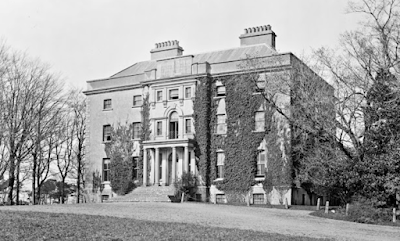
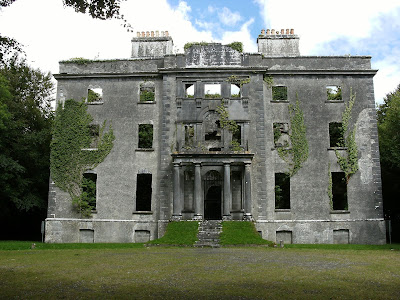
MOORE HALL, near Ballyglass, County Mayo, is a Georgian mansion built between 1792-6 by George Moore.

It comprises three storeys over a basement, with an entrance front of two bays on either side of a centre breakfront; including a triple window, and fluted pilasters on console brackets.

There is a Venetian window above the entrance doorway, beneath a single-storey Doric portico.

The house was burnt by the IRA in 1923, and is now a ruinous shell.

Colonel Maurice Moore, CB, had intended to rebuild the house, albeit on a smaller scale.

Moore Hall (Image: Comhar - Own work, Public Domain,
https://commons.wikimedia.org/w/index.php?curid=11252115

Colonel Moore's elder brother, George Augustus Moore, died in 1933, leaving  an estate valued at £70,000 (about £5.1 million in 2021).

His ashes were buried on Castle Island in Lough Carra.

First published in 2021.

Tuesday, 30 December 2025

Shaen Manor

THE CARTERS WERE MAJOR LANDOWNERS IN COUNTY MAYO, WITH
40,698 ACRES

THOMAS CARTER (c1650-1726), of Robertstown, County Meath, Sergeant-at-Arms, a gentleman whose services at the Revolution were very considerable, for he not only served WILLIAM III at the battle of the Boyne, but secured divers useful books and writings belonging to JAMES II and his secretaries when they were fleeing from the scene of the battle.

Mr Carter married firstly, Margaret Houghton, and had issue,
THOMAS;
Mary; Joanna.
He wedded secondly, in 1706, Isabella, daughter of Matthew, second son of Sir Matthew Boynton, 1st Baronet, of Barmston, Yorkshire, and widow of Wentworth, 4th Earl of Roscommon (the poet), but had no further issue.

His son and heir,

THE RT HON THOMAS CARTER (1690-1763), Master of the Rolls, Secretary of State, Privy Counsellor, 1732, of Robertstown and Rathnally, County Meath, espoused, in 1719, Mary, daughter and co-heiress (with her sister Frances) of Thomas Claxton, of Dublin, and had issue,
THOMAS, MP, of Old Leighlin;
HENRY BOYLE, of whom presently;
Frances; Susan; Mary.
The second son,

HENRY BOYLE CARTER, of Castlemartin, County Kildare, Captain, Colonel Irwin's Regiment, married, in 1750, Susanna, daughter and co-heiress of Sir Arthur Shaen, 2nd Baronet, of Kilmore, County Roscommon, and had issue,
THOMAS, his heir;
Arthur;
Henry;
Mary.
The eldest son,

THOMAS CARTER (1753-), of Castlemartin, wedded, in 1783, Catherine, daughter of the Hon John Butler (brother of Humphrey, 1st Earl of Lanesborough), and had issue,
WILLIAM HENRY, his heir;
John, Admiral RN;
Thomas;
Margaret.
The eldest son,

WILLIAM HENRY CARTER JP DL (1783-1859), of Castlemartin, County Kildare, High Sheriff of County Kildare, 1817, married firstly, in 1809, Elizabeth, third daughter of Francis Brooke, and sister of Sir Henry Brooke Bt, of Colebrooke, County Fermanagh, and had issue,
THOMAS SHAEN, his heir;
Susanna.
He espoused secondly, in 1846, Frances, sister of Robert, 5th Earl of Mayo, but by her, who predeceased him, had no issue.

The only son,

THOMAS SHAEN-CARTER JP (1813-75), of Watlington Park, Oxfordshire, married, in 1842, Maria Susan, only surviving child and heiress of Colonel John Henry Tilson, of Watlington Park (descended from the Rt Rev Henry Tilson, Lord Bishop of Elphin), and had issue,
HENRY TILSON SHAEN, of Watlington Park;
GEORGE TILSON SHAEN, of Shaen Manor;
Thomas Tilson Shaen;
Francis Tilson Shaen;
Ernest Tilson Shaen;
Basil Tilson Shaen (Rev), Rector of Watlington;
Gerald Tilson Shaen;
Lionel Tilson Shaen;
Augusta Susanna Shaen; Elizabeth Sophia Shaen.
Mr Shaen-Carter was succeeded by his eldest son,

HENRY TILSON SHAEN-CARTER (1846-82), of Watlington Park, who wedded, in 1867, Adelaide Elizabeth, eldest daughter of Denis Bingham JP, of Bingham Castle, County Mayo.


He dsp 1882, and was succeeded by his brother,

GEORGE TILSON SHAEN-CARTER JP (1848-1918), of Shaen Manor, Belmullet, County Mayo, who married firstly, in 1878, Eva Augusta, daughter of William John French, of Ardsallagh, County Meath, and had issue,
VICTOR TILSON ARTHUR SHAEN, his heir;
Ernest de Freyne Tilson Shaen;
Muriel Una Shaen.
He wedded secondly, in 1894, Grace (dsp 1908), eldest daughter of the Rev David Hughes; and thirdly, Edith Hamilton Urry.

His eldest son,

VICTOR ARTHUR TILSON SHAEN-CARTER JP (1879-1954), of Shaen Manor, and Fleet End, Berkshire, married, in 1909, Wilfreda Christine, daughter of Richard Davis; High Sheriff of County Mayo, 1922.

His only son,

GEOFFREY VICTOR TILSON SHAEN-CARTER, of Shaen Lodge, County Mayo, married firstly, in 1946, Monica Howard, daughter of Brigadier Bertie Howard Penn; and secondly, in 1968, Peggy Ismay Voake.

The Carter family of Castlemartin, County Kildare, inherited half the Shaen lands in the barony of Erris, county Mayo, through marriage with a Shaen heiress in 1750.

In the mid 1820s they founded the town of Belmullet and developed it with the assistance of John Crampton, their agent, and the engineer Patrick Knight.

Former town residence ~ 44 Tilsbury Road, Hove, Sussex.

Unfortunately I have so far been unable to find any history or images of Shaen Manor or Lodge.

The principal residence of the Carters for several generations was Castlemartin in County Kildare.

First published in March, 2012.

Thursday, 18 September 2025

1st Earl of Lucan

THE EARLS OF LUCAN WERE MAJOR LANDOWNERS IN COUNTY MAYO, WITH 60,570 ACRES


The family of BINGHAM is of Saxon origin, and of very great antiquity. It was originally seated at Sutton Bingham, Somerset; from whence it removed, during the reign of WILLIAM THE CONQUEROR, to Melcombe Bingham, Dorset. 


RALPH DE BINGHAM, of Sutton Bingham, Somerset, descended from Sir John de Bingham, Knight, during the reign of HENRY I, had issue two sons,
RALPH, his heir;
Robert (1180-1246), Bishop of Salisbury.
The elder son,

RALPH DE BINGHAM, of Sutton Bingham, who left, with other issue, a younger son,

ROBERT BINGHAM, who held lands in the manor of West Stafford, 1246, married Lucy, daughter and heiress of Robert Turberville, and had issue a son,

ROBERT BINGHAM, of Melcombe Bingham, Dorset, who wedded Eleanor, daughter of Sir Andrew Wake, and died in 1307, having had issue,

RICHARD BINGHAM, of Melcombe, who married Pernell, daughter of Sir Galfrid Warnhill, and died in 1317, having had issue,

ROBERT BINGHAM, of Melcombe, born about 1295, who wedded Catherine, daughter of Sir Thomas Aston, and had issue,

RICHARD BINGHAM, of Melcombe, who espoused Catherine, daughter of Thomas Silvester, and died ante 1404, having had issue,

ROBERT BINGHAM, of Melcombe, who married Margaret, daughter of John Frampton, and died in 1431.  

This gentleman's direct lineal descendant,

ROBERT BINGHAM, of Melcombe, wedded Alice, daughter of Thomas Coker, of Mappowder, in Dorset, and had (with two daughters), eight sons, viz.
ROBERT, ancestor of Bingham of Melcombe Bingham;
Christopher;
RICHARD, of whom hereafter;
GEORGE (Sir), Knight;
Roger, dsp;
John (Sir), Knight, an officer in Ireland;
Thomas;
Charles.
The third son,

SIR RICHARD BINGHAM (1528-99), Knight, of Melcombe, Dorset, became the most eminent person of his family, and one of the most celebrated captains of the age in which he lived.

At the time of the armada, Sir Richard was one of ELIZABETH I's military council.

He was instrumental in reducing insurrections in Ireland, in 1586, 1590, and 1593, and was eventually constituted marshal of that kingdom, and general of Leinster.

Sir Richard died at Dublin soon after attaining these honours, leaving an only daughter, when the representation of the family in Ireland devolved upon  his nephew,

HENRY BINGHAM (1573-c1658), of Castlebar, County Mayo (son of George Bingham, Governor of Sligo, who was killed by Ensign Ulick Burgh, ca 1596, which Ulick delivered up to the castle of O'Donnell and his adherents).

He was created a baronet in 1634, designated of Castlebar, County Mayo.

Sir Henry wedded Miss Byrne, of Cabinteely, near Dublin, and was succeeded by his eldest son,

SIR GEORGE BINGHAM, 2nd Baronet (1625-82), father of

SIR HENRY BINGHAM, 3rd Baronet (1654-1714), at whose decease, without issue, the titles devolved upon his half-brother,

SIR GEORGE, 4th Baronet, who was succeeded at his decease by his eldest son,

SIR JOHN BINGHAM, 5th Baronet (1696-1749), Governor and MP for County Mayo, who espoused Anne, daughter of Agmondisham Vesey, grandniece of the celebrated general (in the army of JAMES II) Patrick Sarsfield, Earl of Lucan, who fell at the battle of Landen, in Flanders; and great-granddaughter of CHARLES II, through His Majesty's illegitimate daughter, sister of the unfortunate Duke of Monmouth.

Sir John was an officer of rank on the side of JAMES II at the decisive conflict of Aughrim, and contributed to the success of WILLIAM III by deserting his colours in the very brunt of the battle.

He was succeeded by his eldest son,

SIR JOHN BINGHAM, 6th Baronet (1730-50), MP for County Mayo; but dying unmarried, the title devolved upon his brother,

SIR CHARLES BINGHAM, 7th Baronet (1735-99), MP for County Mayo, who was elevated to the peerage, in 1776, in the dignity of Baron Lucan, of Castlebar.

His lordship was advanced to the dignity of an earldom, in 1795, as EARL OF LUCAN.

He wedded, in 1760, Margaret, daughter and sole heir of John Smith, of Cannons Leigh, Devon, and Audries, Somerset, and had issue,
RICHARD, his successor;
Lavinia; Margaret; Anne.
His lordship was succeeded by his son,

RICHARD, 2nd Earl (1764-1839), who espoused, in 1794, the Lady Elizabeth Belasyse, third daughter and co-heir of Henry, 2nd Earl Fauconberg, and had issue,
GEORGE CHARLES, his successor;
Richard Camden;
Elizabeth; Anne; Louisa; Georgiana.
His lordship was succeeded by his elder son,

GEORGE CHARLES, 3rd Earl (1800-88), GCB, Field Marshal in the Army, who married, in 1829, Anne, daughter of 6th Earl of Cardigan, and had issue, with two other daughters,
CHARLES GEORGE, his successor;
Richard, Rear-Admiral;
Augusta; Lavinia.
His lordship was succeeded by his elder son,

CHARLES GEORGE, 4th Earl (1830-1914), KP, Vice-Admiral of Connaught, who wedded, in 1859, the Lady Cecilia Catherine, youngest daughter of 5th Duke of Richmond, KG, and had issue,
GEORGE CHARLES, his successor;
Cecil Edward (Sir), GCVO etc;
Francis Richard (Sir), KCB etc;
Alexander Frederik;
Albert Edward;
Lionel Ernest;
Rosalind Cecilia Caroline (Dame), DBE, m 3rd Duke of Abercorn.
His lordship was succeeded by his eldest son,

GEORGE CHARLES, 5th Earl (1860-1949), GCVO, KBE, CB, TD, PC, DL, who was created, in 1934, Baron Bingham, of Melcombe Bingham, Dorset.

He espoused, in 1896, Violet Sylvia Blanche, OBE, only daughter of Joseph Spender Clay, of Ford Manor, Surrey, and had issue,
GEORGE CHARLES PATRICK, his successor;
John Edward;
Barbara Violet; Margaret Diana.
His lordship was succeeded by his elder son,

GEORGE CHARLES PATRICK, 6th Earl (1898-1964), who married, in 1929, Kaitilin Elizabeth Anne, only child of the Hon Edward Dawson, second son of 1st Earl of Dartrey, and had issue,
RICHARD JOHN, his successor;
Hugh;
Jane; Sarah.
His lordship was succeeded by his elder son,

RICHARD JOHN, 7th Earl, born in 1934, who wedded, in 1963, Veronica Mary, daughter of Major Charles Moorhouse Duncan, and had issue,
GEORGE CHARLES, his successor;
Frances; Camilla.
His lordship has been missing since 1974, and was declared dead in 1999; a death certificate was issued in 2016.

The 7th Earl was succeeded by his son,

GEORGE CHARLES, 8th Earl, born in 1967, styled Lord Bingham until 2016, who married, in 2016, Anne-Sofie, daughter of Lars Foghsgaard, and has issue,
CHARLES LARS JOHN, his successor, styled Lord Bingham;
Daphne.
7th Earl of Lucan


DESPITE being owners of one of the largest estates in County Mayo, the Lucans were mainly absentee landlords, pursuing political and military careers elsewhere while their Mayo estates were administered by agents.
By the 19th century their estate was concentrated in the parishes of Aglish, Turlough and Ballyhean in the barony of Carra; Ballinrobe in the barony of Kilmaine; Killedan in the barony of Gallen; Kilmaclasser in the barony of Burrishoole; Oughaval and Kilgeever in the barony of Murrisk.
From, 1898, parts of the Lucan estate began to be sold to the Irish Congested Districts' Board.

In 1905, over 40,000 acres were purchased by the Board for a cost of over £100,000. In 1911, another 10,000 acres were bought.

The Lucan Estates company was set up in 1925.

The Earls of Lucan also owned an estate of over 1,000 acres at Laleham in Middlesex, now a golf club.

Its history is here.

Castlebar House, the County Mayo seat of the Lucans, was first burnt in 1798.

It was said to be
"romantically situated on the brow of a steep eminence overhanging the river, and attached to it is an extensive and well-wooded demesne, affording a pleasant promenade to the inhabitants of the town."
When resident in Castlebar during the 19th century, the Lucans lived in the lodge known as The Lawn (below), described in the Ordnance Survey Field Name Books as the residence of St Clair O'Malley, who was agent to the Earls of Lucan in the 1830s.


Castlebar House is referred to as the seat of the Earls of Lucan in 1894.

It was sold by the family in 1924.

The Lawn, or Castlebar House, suffered a fire in 1930s, was restored, and today is part of St Joseph's school.


The Earls of Lucan were seated at Laleham Abbey (or House), Surrey, from 1805-1928.

First published in January, 2012.

Friday, 28 February 2025

Belleek Manor

THE KNOX-GORE BARONETS OWNED 22,023 ACRES OF LAND IN COUNTY MAYO

JAMES KNOX (1774-1818), third son of Francis Knox, of Rappa Castle, County Mayo, was called to the bar, 1797, and returned by the borough of Taghmon to the last Irish Parliament, 1797-1800.

He settled at Broadlands Park in County Mayo, became a magistrate, 1803, and deputy governor of that county.

In 1813, Mr Knox assumed, in compliance with the will of his maternal grandfather, Annesley Gore, the surname and arms of GORE in addition to those of KNOX.

He married, in 1800, the Lady Maria Louisa Gore, eldest daughter of ARTHUR, 2ND EARL OF ARRAN, by Anna, his second wife, daughter of the Rev Boleyn Knight, of Ottley, Yorkshire, and had issue,
FRANCIS ARTHUR, his heir;
James;
Henry William;
Annesley;
George Edward;
Anna Maria; Louisa Maria; Eleanor Adelaide; Charlotte Catharine.
Mr Knox-Gore, Ranger of the Curragh of Kildare, was succeeded by his eldest son,

FRANCIS ARTHUR KNOX-GORE JP (1803-73), of Belleek Abbey, Lieutenant-Colonel, North Mayo Militia, who wedded, in 1829, Sarah, daughter of Charles Nesbitt Knox, of Castle Lacken, and had issue,
CHARLES JAMES, his successor;
Jane Louisa; Matilda.
Colonel Knox-Gore, Lord-Lieutenant of County Sligo, 1831-68, succeeded to the estates of his great-grandfather, Annesley Gore, brother of the 1ST EARL OF ARRAN, on the demise, in 1821, of the Rt Hon Henry King, who had a life interest in the property.

He was created a baronet in 1868, designated of Belleek Manor.

Sir Francis was succeeded by his son,

SIR CHARLES JAMES KNOX-GORE, 2nd Baronet (1831-90), of Belleek Manor.

The baronetcy expired following the decease of the 2nd Baronet.


BELLEEK MANOR (now Belleek Castle hotel), Ballina, County Mayo, is a large Tudor-Gothic mansion built about 1825 for Francis Knox-Gore, later 1st Baronet.

It has a symmetrical front with three stepped gables flanked by slender, polygonal, battlemented turrets and pinnacles.

There are oriels at the sides; and the central porch is surmounted by a twin corbelled oriel.

*****

The mansion and its parkland are described by the NIAH thus:-

"A COUNTRY HOUSE erected for Lieutenant-Colonel Sir Francis Arthur Knox-Gore (1803-73), first Baronet; widely accepted as a particularly important component of the early nineteenth-century domestic built heritage of County Mayo with the architectural value of the composition, 'a noble mansion in the later English style of architecture' (Lewis 1837 II, 189);"


"Confirmed by such attributes as the deliberate alignment maximising on panoramic vistas overlooking manicured lawns and the broad River Moy; 
the symmetrical frontage centred on a Tudoresque door-case showing pretty Georgian Gothic glazing patterns; 
the construction in a deep grey limestone offset by sheer dressings not only demonstrating good quality workmanship, but also compounding a ponderous monochrome palette; 
the diminishing in scale of the openings on each floor producing a graduated visual effect with the principal "apartments" defined by handsome bay windows;"


"And the elongated pinnacles embellishing a multi-gabled roof-line: meanwhile, although traditionally attributed to John Benjamin Keane of Mabbot Street [James Joyce Street], Dublin, strong comparisons with the contemporary Coolbawn House (1823-39), County Wexford, put forward Frederick Darley, Junior (1798-1872), as an equally likely design source. 
Having been well maintained, the elementary form and massing survive intact together with substantial quantities of the original fabric, both to the exterior and to the interior where contemporary joinery; 
and decorative plasterwork enrichments, all highlight the considerable artistic potential of the composition. 
Furthermore, an adjoining stable complex; the nearby Knox-Gore monument; and an eye-catching gate house, all continue to contribute positively to the group and setting values of a much depleted estate having historic connections with the Knox-Gore family, including Sir Charles James Knox-Gore, 2nd Baronet; 
and the succeeding Saunders-Knox-Gore family, including Major-General William Boyd Saunders-Knox-Gore (née Saunders) (1827-1902); 
and Matilda Saunders-Knox-Gore (née Knox-Gore) (1833-1912); Lieutenant-Colonel William Arthur Gore Saunders-Knox-Gore JP DL (née Saunders) (1854-1925); and Lieutenant-Colonel William Arthur Cecil Saunders-Knox-Gore JP DL (née Saunders) (1888-1975)."
*****

THE KNOX-GORES continued to live at Belleek Manor until the 1940s.

Marshall Doran, a merchant navy officer and an avid collector of fossils and medieval armour, acquired the run down property in 1961.

He proceeded to restore the house and opened it as a hotel in 1970.

Some of the rooms are in 19th century style, whilst most of the interior design has a medieval and nautical theme.

Today the Belleek Castle Hotel is owned by the Mayo Trust and managed by Marshall’s son, Paul Doran, and Ms Maya Nikolaeva.

First published in March, 2016.

Thursday, 20 June 2024

Kenure Park

THE PALMER BARONETS, OF CASTLE LACKIN, WERE MAJOR LANDOWNERS IN COUNTY MAYO, WITH 80,990 ACRES

THEY OWNED 3,991 ACRES OF LAND IN COUNTY DUBLIN


ROGER PALMER (alleged to have been the third son of Edward Palmer, of Nayton and Casterton, Norfolk) went over to Ireland and had a grant of Castle Lackin, and many other lands in County Mayo, in 1684. His signature appears to the address from the nobility and gentry of County Mayo to CHARLES II in 1682.

The Palmer family had come to Ireland in 1681 from Norfolk, and had acquired lands in County Mayo, where by the end of the 19th Century, they had amassed 80,000 acres. 

THOMAS PALMER, of Castle Lackin, County Mayo, second son of Roger Palmer, of Palmerstown, in the same county, was succeeded by his eldest son,

ROGER PALMER (1729-90), MP for Jamestown, 1761-8, Portarlington, 1768-83, who was created a baronet in 1777, designated of Castle Lackin.

Sir Roger wedded Miss Andrews, and had issue,
JOHN ROGER, his successor;
WILLIAM HENRY, succeeded his brother;
Sophia.
He was succeeded by his elder son,

SIR JOHN ROGER PALMER, 2nd Baronet, who married Mary, only daughter of the Rev Thomas Althem, and was succeeded at his decease, in 1819, by his brother,

SIR WILLIAM HENRY PALMER, 3rd Baronet, of Castle Lackin, who espoused Alice, daughter of _____ Franklin, and had issue,
WILLIAM HENRY ROGER, his heir;
Francis Roger;
John Roger;
Charlotte Alice; Augusta Sophia; Ellen Ambrosia.
Sir William died in 1840, and was succeeded by his eldest son,

SIR WILLIAM HENRY ROGER PALMER, 4th Baronet (1802-69), who married and was succeeded by his only son,

LIEUTENANT-GENERAL SIR ROGER WILLIAM HENRY PALMER, 5th and last Baronet (1832-1910), MP for Mayo, 1857-65, High Sheriff of County Mayo, 1888.

Kenure Park

The Palmers owned a number of seats, including Keenagh Lodge, Crossmolina, and the ruinous Castle Lackin in County Mayo; Cefn Park, near Wrexham, North Wales; Glenisland, Maidenhead, Berkshire.

Their principal Irish seat (through marriage) was Kenure Park, near Rush, County Dublin, where the estate comprised 3,991 acres.

Lieutenant-General Sir Roger Palmer, 5th and last Baronet, MP for Mayo, 1857-65, was Ellen Palmer's only brother.

He resided at Kenure with his wife, Gertrude Millicent, until his death in 1910.

Lady Palmer survived her husband for many years. She continued to spend much of her time in Kenure (above) until her death in 1929.

There are people in Rush who still remember the parties held in the house for the children of the town.

Sir Roger and Lady Palmer left no heirs, and the property devolved to Colonel Roderick Henry Fenwick-Palmer, who had fought in the 1st World War, and still bore the marks of shrapnel wounds to his face.


He had property of his own in Wrexham, North Wales, and only came to Kenure in the summer.

A plain man, he was not given to living the high life, apart from dining occasionally with friends, such as the late Lord Revelstoke.

He spent a lot of money trying to keep the house in repair.

He was finally defeated by rising costs on a property which was not making money.

Part of the estate had already been sold years before.

He eventually sold Kenure to the Irish Land Commission, in 1964, for £70.000.

Most of the land was divided up among local farmers.

The remainder was sold to Dublin County Council for housing and playing fields.

The woodland was cleared and all that now remains of the trees, which once dominated the skyline, is a small area around the main gate.

The front gate lodge is now the local Scouts' Den.

The gate lodge at Skerries Road belongs to Rush Cricket Club, which has beautifully refurbished it.

The Gate-Keeper's Lodge, the walled garden, the Steward's Lodge, the pond and shady avenues, have all gone the way of the big house itself. Only the portico remains, a stark remainder of what once was there.

The contents of the house were auctioned in September 1964, the auction lasted four days and realised £250,000, which would be over £1,000,000 in present day values.

Socially, Kenure had been a place apart from the ordinary life of the town, but it had been there for hundreds of years, an essential part of the Rush scene.

The general feeling was one of regret and disbelief that it was disintegrating.

As landlords, the Palmers had not been the worst.

However, there had been some evictions, and one action, which is still adversely remembered, was the removal of some of their tenants from their ancient holdings in order to lengthen the main avenue and have the main entrance gate near the town.

Nevertheless the Palmers were in many ways beneficent to Rush.

They gave land for the Catholic and Protestant churches, for a presbytery and for a teacher's residence.

In 1896, when the Catholic church was being refurbished, they donated the seating for the nave, and a brass memorial tablet in the church testifies to this.

A portion of the estate was allocated to the local cricket club, and it was certainly the most beautifully situated cricket pitch in north County Dublin.

Dublin County Council was left with an empty mansion, for which they could find no buyer.

The house continued to deteriorate.

During this time it was rented to a film company and a few films were made there, including "Ten Little Indians," "Rocket to the Moon," and "The Fall of Fu Manchu."

In 1978, after a series of incidents in which the house was vandalized and set on fire, with the inevitable water damage that resulted from the fire engines having to put out the blaze, the house was in a very dangerous condition structurally.

The County Council decided it had no choice but to demolish the house.

Within a few days, all that was left of this once great house was a mountain of rubble, from which the massive portico arose, forlorn and lonely against the sky.

First published in September, 2011. Select bibliography: KENURE HOUSE AND DEMESNE

Wednesday, 3 April 2024

Enniscoe House

THE PRATTS WERE MAJOR LANDOWNERS IN COUNTY MAYO, WITH 17,995 ACRES


The branch of the family of which we are treating was settled in Leicestershire in 1641, when three brothers, Joseph, Benjamin and John Pratt, migrated thence; Joseph and Benjamin to Ireland, John to Jamaica. Joseph and Benjamin obtained lands in County Meath from CROMWELL, which they divided between themselves. The elder brother was ancestor of PRATT OF CABRA; the younger, of WINTER OF AGHER.


JOSEPH PRATT, High Sheriff of County Meath, 1698, married firstly, Frances, sister and heir of Colonel Thomas Cooch, of Cabra Castle, County Cavan, and Covoaddy [sic], County Donegal; and secondly, Elizabeth, daughter of Sir Audley Mervyn, and widow of Nathaniel Poole, and had issue,
Joseph, died young;
Benjamin (Dr), Provost, Trinity College, Dublin;
John, a Lord of the Treasury;
Thomas, dsp;
MERVYN, of whom hereafter;
Margaret.
The youngest son,

MERVYN PRATT (1687-1751), MP for Cavan County, 1715, High Sheriff of County Cavan, 1722, wedded, in 1704, Elizabeth, daughter of Thomas Coote, of Cootehill in that county, and sister of the Earl of Bellamont.

Mr Pratt died in 1751, having had (with three daughters) a son and successor,

THE REV JOSEPH PRATT, of Cabra, who espoused Elizabeth, daughter of Knightley Chetwood, of Woodbrook, Queen's County, and had issue,
Mervyn, died 1798;
JOSEPH, of whom presently;
James Butler;
Elizabeth; Ann.
The second son,

THE REV JOSEPH PRATT (1738-1831), of Cabra Castle, wedded, in 1772, Sarah Morres, daughter of Harvey, 1st Viscount Mountmorres, by the Lady Letitia Ponsonby, his wife, daughter of Brabazon, Earl of Bessborough, and had issue,
JOSEPH, his heir;
Mervyn, 1823;
Harvey, of Castle Morres, County Kilkenny, 
who upon the decease of his father, succeeded his mother in the Kilkenny estates, which she and her sister, the Marchioness of Antrim, had jointly inherited as co-heiresses of their brother Redmond, Viscount Mountmorres;
Mary; Letitia.
Mr Pratt was succeeded by his eldest son,

JOSEPH PRATT JP (1775-1863), of Cabra Castle, Colonel of Militia, High Sheriff of County Cavan, 1799, who espoused firstly, in 1806, Jemima Roberta, daughter of Sir James Stratford Tynte Bt, of Tynte Park, and by her had issue,
MERVYN, his heir;
Joseph Tynte;
Fitzherbert;
Walter Caulfeild;
Fitzmaurice Caldwell Tynte;
Hannah, Sarah Emily Tynte; Elizabeth Martha.
Colonel Pratt wedded secondly, in 1826, Nicola Sophia, widow of Claudius William Cole-Hamilton, of Kingscourt, County Meath, but by her had no issue.

He was succeeded by his eldest son,

MERVYN PRATT JP DL (1807-90), of Cabra Castle, High Sheriff of County Cavan, 1841, County Mayo, 1843, and County Meath, 1875, who espoused, in 1834, Madeline Eglantine, only daughter and heir of Colonel William Jackson, of Enniscoe, County Mayo, and had issue,
JOSEPH, his heir;
Louisa Catherine Hannah; Madeline Caroline Mary; Jemima Roberta Emily Tynte.
Mr Pratt was succeeded by his eldest son,

JOSEPH PRATT JP DL (1843-1929), of Enniscoe, High Sheriff of County Cavan, 1894, County Mayo, 1876, who married, in 1870, Charlotte Eliza, only daughter of James Hamilton, of Cornacassa, County Monaghan, and had issue,
MERVYN;
Audley Charles (1874-1917);
Eglantine Madeline Georgina, died in infancy.
Mr Pratt was succeeded by his eldest son,

MERVYN PRATT DSO JP (1873-1950), of Cabra Castle and Enniscoe, Major, King's Royal Rifle Corps, High Sheriff of County Cavan, 1921.

Major Pratt was badly wounded in the Boer War and never married.

He lived permanently at Enniscoe, County Mayo, and left Cabra Castle unoccupied.

His younger brother, Colonel Audley Pratt, was killed in the 1st World war and was also unmarried.

Major Pratt died at Enniscoe and bequeathed Cabra to his nearest male relative, Mervyn Sheppard CMG MBE.


ENNISCOE HOUSE, Castlehill, Ballina, County Mayo, appears to be a classical, late-Georgian house, though it incorporates a much earlier building.

Francis Jackson, an officer in Cromwell’s army, was granted land here in the 1650s.

Jackson first lived in Crossmolina Castle but he later built a house beside Lough Conn.

His great-grandson, George, built a tall, three-storey house over a basement in the 1740s, but this was subsequently incorporated into a later building.

The new house was built in the 1790s by George’s son, also called George (the family refer to them as George One and George Two), and it was literally wrapped around the earlier building, which is still easily identifiable today.


Works were largely completed when it was occupied and damaged during the French invasion in 1798.

Today Enniscoe is a two-storey house of five bays.

While externally plain, it contains some elegant late-Georgian plasterwork and a very beautiful elliptical staircase leading to an oval landing.

The large principal rooms have decorated cornices, and the original silk wallpaper survives in the drawing room, though the pale blue has faded to mushroom pink.

George Two’s granddaughter, Madeline Eglantine Jackson, married her cousin, Mervyn Pratt.

They inherited the estate in the 1830s, restored the neglected house and created a notable garden.

Their son, Joseph, and his wife Ina continued the work, however, fortuitously, there was insufficient money for further alterations so the house remains largely unaltered today.

Their unmarried son, Major Mervyn Pratt, lived here until 1950.

After his mother’s death the house was maintained and the garden became his life’s work.

Following Major Pratt's death in 1950 his cousin, Jack Nicholson, inherited Enniscoe.

Today it is the home of his daughter, Susan Kellett, and her son and daughter-in-law, D J and Colette Kellett.

Select bibliography: Irish historic Houses Association.

Thursday, 7 September 2023

1st Viscount Dillon

THE VISCOUNTS DILLON WERE MAJOR LANDOWNERS IN COUNTY MAYO, WITH 83,749 ACRES


SIR HENRY DE LÉON, a cadet of the noble house of De Léon, Viscounts De Léon of Brittany, accompanying the Count of Mortain (afterwards KING JOHN) into Ireland, in 1185, obtained those extensive territorial grants in the counties of Longford and Westmeath. These lands were denominated Dillon's County, but altered by statute, in the reign of HENRY VIII, to the Barony of Kilkenny West.

Sir Henry married a daughter of Sir John de Courcy, Earl of Ulster, and was afterwards styled "Premier Dillon, Lord Baron of Drumraney." He completed the Franciscan monastery at Kilkenny West, and was interred in the church there (1244).

From this feudal lord lineally sprang

GERALD DILLON, of Drumraney, County Westmeath, chief of the family of Dillon towards the end of the 14th century, who left two sons, the elder of whom,

SIR MAURICE DILLON was ancestor of the Viscounts Dillon; and the younger, SIR JAMES, of the Earls of Roscommon.

Sixth in descent from Sir Maurice was

SIR THEOBALD DILLON, of Costello-Gallen, County Mayo, LORD PRESIDENT OF CONNAUGHT, who was elevated to the peerage, in 1622, in the dignity of VISCOUNT DILLON, of Costello-Gallen, County Mayo.

His lordship married Eleanor, daughter of Sir Edward Tuite, Knight, of Tuitestown, County Westmeath, and sister of William Tuite, of Tuitestown, County Westmeath.

He died at an advanced period of life, in 1624, leaving so numerous a progeny that he assembled, at one time, in his house at Killenfaghny, more than one hundred of his descendants.

His lordship was succeeded by his grandson,

LUCAS, 2nd Viscount (1610-29), who wedded, in 1625, but when fifteen years of age, the Lady Mary MacDonnell, second daughter of Randal, 1st Earl of Antrim, by whom he left at his decease an only son, his successor,

THEOBALD, 3rd Viscount (1629-30), who died in infancy, when the title reverted to his uncle,

THOMAS, 4th Viscount (1615-72), who espoused Frances, daughter of Nicholas White, of Leixlip; and was succeeded at his decease by his by his eldest surviving son,

THOMAS, 5th Viscount, who married Elizabeth, eldest daughter of Sir John Burke, Knight, of County Galway; but left no issue.

His lordship died in 1674, when the title reverted to his kinsman,

LUCAS, 6th Viscount, great-grandson of the 1st Viscount, being the eldest son of Theobald Dillon, third son of his lordship's eldest son, Sir Christopher Dillon, Knight.

His lordship, High Sheriff of County Mayo, 1662,  dying without issue in 1682, the title devolved upon

THEOBALD DILLON, of Kilmore, as 7th Viscount (refer to Sir Lucas Dillon, 2nd son of 1st Viscount), an officer in the army, attached himself to the falling fortunes of JAMES II, who was outlawed in 1690.

His lordship wedded Mary, daughter of Sir Henry Talbot, of Templeoge, County Dublin, and had, with other issue,
HENRY, his successor;
Arthur, father of 10th and 11th Viscounts.
After the decease of his lordship, in 1691, the outlawry was reversed in favour of his son and successor,

Henry, 8th Viscount Dillon

HENRY, 8th Viscount, who espoused Frances, second daughter of George, Count Hamilton, and was succeeded at his decease, in 1713, by his son,

RICHARD, 9th Viscount (1688-1737), who married the Lady Bridget Burke, second daughter of John, 9th Earl of Clanricarde, by whom he left at his decease an only daughter, Frances, who wedded her first cousin, and his lordship's successor,

CHARLES, 10th Viscount (1701-41), who died without issue and was succeeded by his brother,

HENRY, 11th Viscount (1705-87), a colonel in the French service, who espoused, in 1744, the Lady Charlotte Lee, eldest daughter of George Henry, 2nd Earl of Lichfield, of Ditchley Park, Oxfordshire, and had issue,
CHARLES, his successor;
Arthur, a general in the French service;
Henry;
Frances; Catherine; Laura; Charlotte.
His lordship was succeeded by his eldest son,

CHARLES, 12th Viscount (1745-1813), who conformed to the established church in 1767, and claimed, and was allowed the viscountcy, as 12th Viscount, by the Irish House of Lords in 1778.

His lordship, High Sheriff of County Mayo, 1787, married firstly, in 1776, Henrietta Maria Phipps, only daughter of Constantine, 1st Lord Mulgrave, and had issue,
HENRY AUGUSTUS, his successor;
Frances Charlotte.
He wedded secondly, a French lady, and by her, who died in 1833, he had a daughter, Charlotte, married in 1813 to Lord Frederick Beauclerk.

Charles, 12th Viscount Dillon. Photo Credit: The National Trust

His lordship was succeeded by his son,

HENRY AUGUSTUS, 13th Viscount (1777-1832), who espoused, in 1807, Henrietta, eldest daughter of Dominick Geoffrey Browne MP, and had issue,
CHARLES HENRY, his successor;
Theobald Dominick Geoffrey;
Arthur Edmund Denis;
Constantine Augustus;
Gerald Normanby;
Henrietta Maria; Margaret Frances Florence; Louisa Anne Rose; Helena Matilda.
His lordship, assuming the additional surname and arms of LEE, was succeeded by his eldest son,

CHARLES HENRY, 14th Viscount (1810-65).
  • Charles Henry Robert Dillon, 21st Viscount (1945–82);
  • Henry Benedict Charles Dillon, 22nd Viscount (b 1973);
The heir is his cousin, Thomas Arthur Lee Dillon (b 1983), the son of his uncle, the Hon Richard Arthur Louis Dillon (1948–2014).

LOUGHGLYNN HOUSE, County Roscommon, is a five-bay, two-storey mansion house, built ca 1715.

Although Loughglynn is in County Roscommon, the vast majority of the Dillon estate straddled the border with County Mayo.

A third attic storey was built in the 1820s, though suffered a disastrous fire in 1904, when the top storey was not replaced, nor the end bays on the garden front which were reduced to a single storey.

There are ashlar limestone walls with quoins and a with roughly tooled limestone basement.

The entrance front has a pediment and a pedimented Doric door-case.

In 1903, Loughglynn was sold to the Catholic Bishop of Elphin, who invited the Franciscan Missionaries of Mary to establish a convent.

The sisters established a dairy, and Loughglynn butter and cheese was famous all over the world until they ceased this activity in the 1960s.

They subsequently opened a nursing home.
In 2003, the property developer Gerry Gannon bought the convent for under €2m, intending to turn it into a hotel.
In 2009, it was transferred to his wife's name.
THE DILLON FAMILY lived mainly at their Oxfordshire seat, Ditchley Park.
Dillon arms courtesy of European Heraldry.