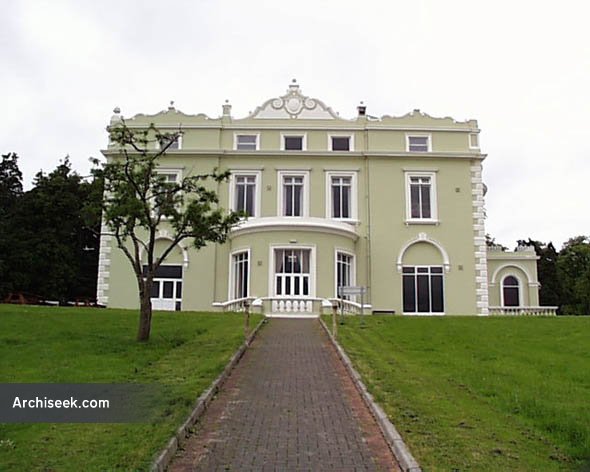
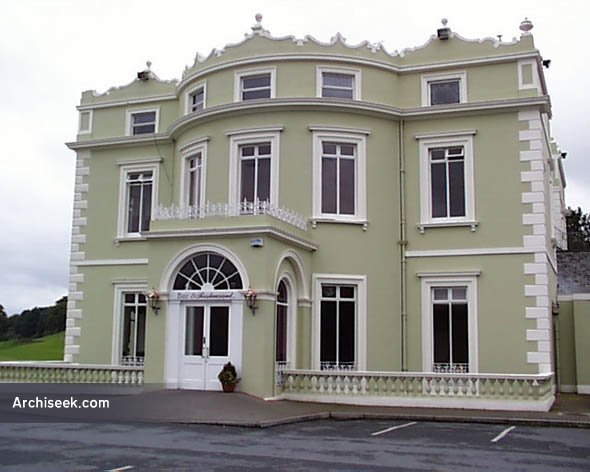
Showing posts with label County Monaghan Landowners. Show all posts

Tuesday, 4 August 2026

Ballybay House

THE LESLIES OWNED 5,556 ACRES OF LAND IN COUNTY MONAGHAN

GEORGE, 4TH EARL OF ROTHES, married thirdly, Agnes, daughter of Sir John Somerville, of Cambusnethan, and had issue,
Andrew, 5th Earl;
Peter;
JAMES, of whom we treat;
Janet; Helen.
His lordship's third son by his marriage to Agnes Somerville,

THE HON JAMES LESLIE, born in 1530, married Jane, daughter of Sir James Hamilton, of Evandale, and had issue,
George;
HENRY, of whom we treat.
The younger son,

THE MOST REV DR HENRY LESLIE (1580-1661), Lord Bishop of Meath, settled in Ireland, 1614, where he was ordained in 1617.

His lordship was chaplain to CHARLES I, with whom he shared his great adversities.

He espoused Jane Swinton, and had issue,
Robert (Rt Rev Dr);
JAMES, of whose line we treat;
William, of Prospect, Co Antrim;
Mary; Margaret.
The second son,

JAMES LESLIE (1624-1704), of Leslie Hill, County Antrim, wedded, in 1650, Jane, daughter of John Echlin, of Ardquin, County Down, and was succeeded by his eldest son,

THE VEN DR HENRY LESLIE (1651-1733), Archdeacon of Down, Chaplain to the Duke of Ormonde, Lord Lieutenant of Ireland.

In 1680 he obtained a Prebend in Down Cathedral, which he resigned, 1695, for the Archdeaconry.

Dr Leslie espoused, in 1676, Margaret, daughter and heiress of Peter Beaghan, of Ballibay, and had issue,
PETER, his heir;
Edmund, MP for Antrim;
Penelope.
The Archdeacon was succeeded by his elder son,

THE REV PETER LESLIE, born in 1686, Rector of Ahoghill, who married Jane, daughter of the Most Rev Dr Anthony Dopping, Lord Bishop of Meath, and had issue,
HENRY, his heir;
James, of Leslie Hill, Co Antrim;
Samuel;
EDMOND (Ven), Archdeacon of Down;
Margaret; Jane.
The eldest son,

THE REV HENRY LESLIE (1719-1803), of Ballybay, County Monaghan, Prebendary of Tullycorbet, Clogher, and afterwards prebendary of Tandragee, in Armagh Cathedral.

Dr Leslie married, in 1753, Catherine, daughter of the Very Rev Charles Meredyth, Dean of Ardfert, and had issue,
Peter Henry, b 1755; k/a in America;
CHARLES ALBERT, of whom hereafter;
Catherine Letitia.
The surviving son,

CHARLES ALBERT LESLIE (1765-1838), of Ballybay, High Sheriff of County Monaghan, 1805, married, in 1799, Ellen, youngest daughter of Richard Magenis MP, of Waringstown, County Down, and left at his decease an only surviving child,

EMILY ELEANOR WILHELMINA LESLIE, of Ballybay, who married firstly, in 1828, her cousin, Arthur French, of Clonsilla, County Dublin, and had issue,
ROBERT CHARLES (now LESLIE), of Ballybay;
Charles Albert Leslie Attila FRENCH;
Helena Charlotte; Albertine Caroline; Henrietta Victoria Alexandria.
She wedded secondly, in 1844, her cousin, the Rev John Charles William Leslie, son of James Leslie, of Leslie Hill, by whom she had issue,
Ferdinand Seymour;
Marion Adelaide.
Mrs Leslie died in 1844, and was succeeded by her eldest son,

ROBERT CHARLES LESLIE JP DL (1828-1904), of Ballybay, and Kilclief, County Down, High Sheriff of County Monaghan, 1854, who married, at Paris, 1867, Charlotte Philippa Mary, daughter of Captain Edward Kelso, of Kelsoland, and Horkesley Park, Essex, and had issue,
Theordore Barrington Norman;
EDWARD HENRY JOHN, succeeded his brother;
Mabel Edith.
He assumed, in 1885, the surname and arms of LESLIE, in compliance of his maternal grandfather's will.

Mr Leslie was succeeded by his second son,

EDWARD HENRY JOHN LESLIE CMG MVO JP DL (1880-1966), of Ballybay, High Sheriff of County Monaghan, 1908, who entered the Foreign Office, 1902.


BALLYBAY HOUSE, Ballybay, County Monaghan,  was a fine Classical house of 1830 by JB Keane, for Charles Albert Leslie.

It comprised two storeys over a high basement, with a three-bay entrance front, the centre of which was recessed, with a Wyatt window above a single-storey Doric portico.

The adjoining front had five bays.

Practically all of the windows in the lower storey were set in arched recesses.

A three-storey, gable-ended range was added behind the house later in the 19th century.

Ballybay House was burnt and the contents were sold in 1920.

Nothing remains.

Former London residence ~ 10 Douro Place, Kensington.

First published in July, 2013.

Thursday, 21 May 2026

Lough Fea House

THE SHIRLEYS WERE THE LARGEST LANDOWNERS IN COUNTY MONAGHAN, WITH 26,386 ACRES

This is a branch of the noble and ancient family of Shirley, EARLS FERRERS, springing from

SIR HENRY SHIRLEY, 2nd Baronet (1588-1633),
Who married, in 1616, Dorothy, youngest daughter of ELIZABETH I's accomplished but unfortunate favourite, 2nd Earl of Essex (who possessed the barony and lands of Farney, County Monaghan), and in her issue one of the co-heirs of her brother, 3rd Earl of Essex, the celebrated Parliamentarian General. 
(By this alliance the Earls Ferrers quarter the arms of France and England with their own; the Earl of Essex having descended, maternally, from Richard Plantagenet, Earl of Cambridge, grandson of EDWARD III).

SIR ROBERT SHIRLEY, 1st Earl Ferrers (1650-1717), married firstly, Elizabeth, daughter and heir of Lawrence Washington, of Garsdon, Wiltshire; and secondly, in 1699, Selina, daughter of George Finch.

The third, but, eventually, eldest surviving son of his second marriage,

THE HON GEORGE SHIRLEY (1705-87), of Ettington Park, Warwickshire, Captain, 1st Regiment of Foot Guards, wedded Mary, daughter of Humphrey Sturt, and had issue,
EVELYN, his heir;
Selina; Margaret.
Mr Shirley was succeeded by his eldest son,

EVELYN SHIRLEY (1756-1810), of Ettington Park and Lough Fea, County Monaghan, who espoused Phillis Byam, daughter of Charlton Wollaston, and had issue,
EVELYN JOHN, his heir;
Charles;
William;
James;
Horatio;
Arthur George Sewallis;
Selina; Mary; Frances; Emily Harriet.
Mr Shirley was succeeded by his eldest son, 

EVELYN JOHN SHIRLEY (1788-1856), of Ettington Park and Lough Fea, who wedded, in 1810, Eliza, daughter of Arthur Stanhope, cousin to the Earl of Chesterfield, MP for County Monaghan, 1826-31, and South Warwickshire, 1836-49, and had issue,
EVELYN PHILIP;
Arthur;
Sewallis;
George Edward;
Walter Devereux;
Selina; Louisa.
His eldest son, 

EVELYN PHILIP SHIRLEY DL (1812-82), of Ettington Park and Lough Fea, MP for South Warwickshire, 1853-65, County Monaghan, 1841-7, had issue,

SEWALLIS EVELYN SHIRLEY JP DL (1844-1904), of Ettington Park and Lough Fea, MP for County Monaghan, 1868-80, High Sheriff of Warwickshire, 1884, who had issue,

EVELYN CHARLES SHIRLEY JP DL (1889-1956), of Ettington Park and Lough Fea; High Sheriff of County Monaghan, 1914, Major, Warwickshire Yeomanry, Lieutenant-Colonel, General Staff, whose only son,

JOHN EVELYN SHIRLEY (1922-2009), of Ettington Park and Lough Fea, Major, King's Royal Rifle Corps.

He lived in 2003 at Ormly Hall, Ramsey, Isle of Man.

Major Shirley had issue,
PHILIP EVELYN , b 1955;
Emily Margaret, b 1957;
Hugh Sewallis, b 1961.
The eldest son,

PHILIP EVELYN SHIRLEY (1955-), of Lough Fea, married, in 1989, Augusta, daughter of Hugo Southern, and has issue,
Evelyn Robert, b 1990;
Horatio John, b 1993;
Nathaniel Guy, b 1995;
Perdita Rose, b 1997. 

The Shirley estate is based at Lough Fea, near Carrickmacross, County Monaghan.

It had an area of some 40 square miles, in the western half of the barony of Farney, County Monaghan, in the period 1576-1960.

The Shirley Papers are deposited at PRONI.

The Shirley Association has written a history of Lough Fea.

The Shirleys were semi-absentee landlords. Their main seat was Ettington Park in Warwickshire.

Evelyn Philip Shirley visited Lough Fea several times a year.

The estate was formerly in the ownership of the Earl of Essex, though underwent the first of several partitions: It passed in two halves to Essex's co-heirs, the Marquess of Hertford and Sir Robert Shirley.

Sir Robert himself died in 1656, imprisoned in the Tower of London for supporting the Royalist cause in the English Civil War.

His son and heir was Sir Seymour Shirley, on whose death in 1667 the estate and the rest of the family inheritance passed in turn to his second and only surviving son, Sir Robert Shirley.

Sir Robert entered the House of Lords in 1677, as Baron Ferrers of Chartley, and in 1711 was further ennobled as 1st Earl Ferrers and Viscount Tamworth.

This last title related to the family seat of Ettington in Warwickshire.

About 1750, the Shirleys built a house near Carrickmacross for their occasional visits.

It was not until 1826 that Robert's grandson, Evelyn John Shirley, laid the foundations of a mansion house worthy of the family and estate, near the banks of Lough Fea.


LOUGH FEA is a very large and unusual Tudor-Gothic house by Thomas Rickman, the English architect and architectural writer who invented the terms "Early English", "decorated" and "perpendicular" to describe the different periods of Gothic architecture.

Unlike most houses of its period and style, Lough Fea has no battlements and few gables, but a solid parapet which conceals much of the roof.

There are also hardly any projecting bows or oriels, but rather small, mullioned windows under hood mouldings; so that the elevations, of pinkish-grey ashlar, have a solid effect.


The Entrance Hall

There are several slender, square turrets with sprocketed, pyramidal roofs; also a polygonal lantern and a small tower and polygonal turret at the end of one wing; but no major tower; so that he house seems low and wide-spreading.


The Entrance Front

The entrance front, facing the lough, is flanked on one side by the chapel and on the other by a great hall, which together form a three-sided court.

The interior is of great complexity, with many corridors and ante-rooms.

There is a hall divided by a stone arcade, its walls hung with an early 19th-century wallpaper.


The Dining-Room

There is a large and handsome library, the famous library of EP Shirley, son of the builder of the house.

The chapel is on the scale of a sizeable church, with two pulpits and a gallery.


The Great Hall

The clou of the house is, however, the Great Hall: vast and baronial, with a lofty hammer-beam roof, a minstrels' gallery and an arcade at first-floor level.

It was added after the rest of the house was completed.

According to the story, Mr Shirley and Lord Rossmore vied with one another as to which of them could build the bigger room.

Lord Rossmore enlarged his drawing room at Rossmore Park five times, but in the end Mr Shirley won the contest by building his great hall.

The garden front of the house faces along a vista to an immense Celtic cross.

The demesne is noted for its magnificent woodlands.

At the end of the 19th century the estate comprised 26,386 acres, but these lands had to be sold due to the Irish Land Acts before the First World War.

The estate now has less than 1,000 acres of grass and woodland.

After the sale of the land, which had been rented to tenants, large mansions such as Lough Fea became white elephants with little revenue coming in.


The Sunken Garden, with the Devereux Tower to the right

In 1904, when Major Shirley’s grandfather died, his father moved from his Ettington Park home in Warwickshire to Carrickmacross, County Monaghan.

Between 1904 and 1977, Major Shirley’s father and his family lived there permanently.

There was a serious fire at the house in 1966, which did quite a lot of damage.

In 1977, the family moved to the Isle of Man and thus reverted to its 19th Century role of absenteeism; though because Major Shirley and his sons were brought up on the estate they have a great love of the place and they do their best to keep the main parts of the building waterproof.

First published in June, 2011.

Wednesday, 25 March 2026

Anketell Grove

THE ANCKETILLS WERE MAJOR LANDOWNERS IN COUNTY MONAGHAN, WITH 7,754 ACRES

This family was of high station in Dorset at a very remote period (its name appearing in the Domesday Book). As early as the reign of EDWARD I, several of its members represented the borough of Shaftesbury in Parliament.

The pedigree and history, as anciently of Ancketill's Place, near Shaftesbury, and east Aimer, near Sturminster Marshall, and more anciently of Lye, near Wimborne, and represented by Ancketill, of Ancketill's Grove, are given in the 3rd edition of Hutchins' History of Dorset, and there carried down to 1868; the pedigree extends to twenty-three generations, and shows intermarriages with the most distinguished of the old Dorset families.

The history shows the active part which this family took as Royalists in the time of CHARLES I in Dorset, and that its descendants and representatives in Ireland, when called upon, were not found wanting in devotion to what they considered the right cause.

The first ancestor of this line, 

CAPTAIN OLIVER ANCKETILL JP (1609-66), of County Monaghan, High Sheriff of County Monaghan, 1662, son of William Ancketill, of Shaftesbury, Dorset, married Rebecca, probably of the family of Bullingbrooke, of Galway, and and issue,
MATTHEW, his heir;
William;
Richard;
Sarah, m 1660, James Corry, ancestor of the Earls of Belmore;
Elizabeth.
Captain Ancketill was succeeded by his eldest son,

MATTHEW ANCKETILL (1651-88), of Ancketill's Grove, County Monaghan, to whom that estate was confirmed, by patent, in the reign of CHARLES II.

He was High Sheriff of County Monaghan, 1682, but was attainted by JAMES II.

Mr Ancketill wedded Matilda, daughter of Robert Moore, of Ravella and Garvey, County Tyrone, and had (with other issue),
WILLIAM, his heir;
OLIVER, succeeded his brother;
Robert;
Catherine.
Mr Ancketill was killed at the battle of Drumbanagher Hill, and was succeeded by his eldest son,

WILLIAM ANCKETILL (1677-1709), of Ancketill's Grove, High Sheriff of County Monaghan, 1707, who dsp 1709, and was succeeded by his next brother,

OLIVER ANKETELL (1676-1760), of Ancketill's Grove, MP for Monaghan Borough, 1753-60, High Sheriff of County Monaghan, 1703, who married firstly, in 1716, Sarah Caulfeild, second daughter of William, 2nd Viscount Charlemont, by Anne Margetson, his wife, only daughter of the Most Rev James Margetson, Lord Archbishop of Armagh, and had issue (with three daughters),
WILLIAM (1724-56), father of CHARLES;
Mr Ancketill espoused secondly, when about 80 years of age, Anne Stephens (née Tuton), but died immediately thereafter, and was succeeded by his grandson,

CHARLES ANKETELL (1754-1828), of Anketell Grove, who died unmarried, and was succeeded by his nephew,

WILLIAM ANKETELL JP DL (1790-1851), of Anketell Grove, High Sheriff of County Monaghan, 1830, who married, in 1809, Sarah, second daughter of Lieutenant-Colonel John Charles Frederick Waring Maxwell, of Finnebrogue, County Down, and had issue,
MATTHEW JOHN, his heir;
William Robert, of Quintin Castle, Portaferry;
Oliver Charles;
Fitz Ameline Maxwell, of Killyfaddy, Clogher;
Maxwell;
Moutray;
Anne Dorothea; Maria; Matilda Jane.
Mr Anketell was succeeded by his eldest son,

MATTHEW JOHN ANKETELL JP DL (1812-70), of Anketell Grove, High Sheriff of County Monaghan, 1834, Major, Monaghan Militia, who married, in 1840, Catherine Frances Anne, eldest daughter of David Ker MP, of Portavo and Montalto, County Down, by the Lady Selina his wife, daughter of the 1st Marquess of Londonderry, and had issue,
MATTHEW DAVID, his heir;
Oliver Frederick (1850-72);
WILLIAM, succeeded his brother;
Henry;
Robert Waring Maxwell;
Selina Sarah; Ada; Frances Emmeline; Gertrude Madelina;
Bertha Grace Phœbe; Octavia Mary; Augusta.
Major Anketell was succeeded by his eldest son,

MATTHEW DAVID ANKETELL (1841-72), of Anketell Grove, who was killed by a fall from horseback, died unmarried, and was succeeded by his next surviving brother,

WILLIAM ANCKETILL DL (1851-1931), of Ancketill's Grove, Lieutenant, Royal Tyrone Fusiliers, who married, in 1875, Jean Laing, daughter of Robert Falkner, of Broughton Park, Lancashire, and had issue, an only child,

OLIVE MAUD ANCKETILL (1876-1909), who wedded firstly, in 1901, Reginald George Petre Wymer, only son of Reginald Augustus Wymer, and grandson of Sir Henry George Petre Wymer KCB, and had issue, a daughter, Lovice Vivian Petre.

She espoused secondly, in 1907, Michael Linning Henry Melville, Egyptian Civil Service, and had issue, a daughter,

Monica Agnes Ancketill, born in 1908.


ANKETELL GROVE, near Emyvale, County Monaghan, was originally built by Captain Oliver Ancketill about 1640, on low ground.

His grandson Oliver rebuilt the house on higher ground at the head of the copper beech avenue.


This house was demolished in 1781, when a third dwelling was erected on another site: A two-storey, five-bay, gable-ended main block with a small pediment, joined by curved sweeps to single-storey, two-bay wings.

There are Georgian-Gothic windows in the wings.


The house was extensively remodelled about 1840, boasting an central Italianate attic tower at the centre, which rises from ground level.
The estate was mortgaged by William Anketell, early in 1884, to the Scottish Provident Insurance Association. Mr Anketell had been, by that stage, in financial difficulties.

Scottish Provident began evictions almost at once: The estate was put up for sale in the Encumbered Estates Court in 1886 and the Scottish Provident became absolute owners of the whole estate, with the exception of Anketell Grove House, demesne and three townlands.

In 1899, Scottish Provident received £4,800 in advances from the Government for sales to sixty two tenants.
In 1901, William Anketell received £3,820 for sales to thirty-three tenants (Dublin Gazette, 26th July, 1901, pps 1045-6).

Some time thereafter the Anketells removed to Killyfaddy, near Clogher, County Tyrone. 

Anketell Grove was purchased from the Irish Land Commission in 1922 by Patrick McKenna, of Derryhee, nearby.

In 1970, Anketell Grove and ninety acres of land were purchased by Mr Laurence Clerkin, the present owner.

 I AM GRATEFUL TO HENRY SKEATH FOR HIS INVALUABLE ASSISTANCE IN THE COMPOSITION OF THIS ARTICLE.

First published in April, 2013.

Tuesday, 13 January 2026

The Clones Estate

THE BARONS DACRE WERE MAJOR LANDOWNERS IN COUNTY MONAGHAN, WITH 7,920 ACRES 


The family of BARRETT-LENNARD originated in Essex.
The name was an amalgam of the Barrett and Lennard families, after Richard Barrett took the name LENNARD in consideration of the manor of Bell House (Belhus) in Essex, bequeathed to him by Edward, 1st Baron Barrett of Newburgh.
The surname was styled LENNARD-BARRETT until 1755, when Thomas, 17th Lord Dacre, transposed the order of the names.

The Barrett-Lennards were absentee landlords of the Clones Estate, which originated in confiscated church lands.

Prominent members of the family included Thomas Lennard, 1st Earl of Sussex, who, in 1674, married the thirteen-year-old Lady Anne FitzRoy (alias Palmer, the family name of the Earl of Castlemaine), natural daughter of CHARLES II and Lady Castlemaine, afterwards Duchess of Cleveland.

The King and her mother spent the first night of the Restoration together and she was born nine months later.

His Majesty acknowledged her as his child and granted her the royal arms with the baton sinister.

*****

ANNE, 16th Baroness Dacre (1684-1755), younger daughter of the 1st Earl of Sussex, married thrice.

By her first husband, Richard Lennard, who later assumed the surname BARRETT under the will of Sir Edward Barrett, she had an only son,

THOMAS, 17th Baron (1717-86), who took a great interest in the management of his estates, manifested by the very considerable number of letters which remain from both his Norfolk and his Irish agents, giving him full accounts of all the details of their management.

In 1740, Lord Dacre paid a visit to Ireland for the purpose of looking after his property.

Merely 23 years of age, and recently married, he was greatly interested in his intended visit, and anxious to show his new bride his town of Clones and the considerable estates which he owned surrounding it.

His lordship's agent, Todd, said that it contained
"only one parlour and three bedrooms with fireplaces, and three other little rooms without fireplaces or any furniture. In the cellar a hogshead of old French claret, very good, if not spoiled with this long frost."
*****

THE CASTLE, Clones, County Monaghan, was re-discovered in 2016.

The Barrett-Lennard Papers are held at PRONI.

First published in January, 2013.

Wednesday, 7 January 2026

Castle Shane

THE LUCASES WERE MAJOR LANDOWNERS IN COUNTY MONAGHAN, WITH 9,955 ACRES


THOMAS LUCAS, of Saxham, Suffolk, secretary to Jasper Tudor, Duke of Bedford, Solicitor to HENRY VIII, married Elizabeth, daughter of R Kemys, of Raglan, Wales, and had issue,
Jasper, of Saxham;
HENRY, of whom presently;
John;
Lettice; Anne.
The second son,

HENRY LUCAS, wedded firstly, Mary, daughter of Edward Grene, of Bury St Edmunds, and had by her nine sons and two daughters.

He espoused secondly, Alice, daughter of Simon Bradock, of Horam, Suffolk, and had further issue, FRANCIS, Henry, Thomas, and Martha.

FRANCIS LUCAS, of Hollinger, near Bury St Edmunds, married Anne, daughter of _____ Munings, of Monk's Ely, Suffolk, and was father of

FRANCIS LUCAS, of Elmsett and Grunsborrow, Suffolk, who wedded Matilda, daughter of Thomas Munings, of Monk's Ely, and had two sons,
Thomas, of Colchester;
FRANCIS, of whom hereafter.
The younger son,

FRANCIS LUCAS, Cornet in the army, the first of Castle Shane, whose will was proved in 1657, wedded Mary Poyntz, and had issue,
FRANCIS;
William;
Richard;
Charles;
Lucy.
Mr Lucas was succeeded by his eldest son, 

FRANCIS LUCAS (1646-1705), of Castle Shane, High Sheriff of County Monaghan, 1673, who had issue, by Mary his wife, three sons and three daughters, namely,
FRANCIS, his heir;
EDWARD, successor to his brother;
Robert;
Anne; Lucy; Jane.
The eldest son,

FRANCIS LUCAS (1669-1746), of Castle Shane, High Sheriff of County Monaghan, 1703, MP Monaghan Borough, 1713-46, died unmarried, and was succeeded by his brother, 

EDWARD LUCAS, of Castle Shane, High Sheriff of County Monaghan, 1709, who married firstly, in 1696, Elizabeth, daughter of Thomas Smyth, of Drumcree, County Westmeath, and had issue,
THOMAS, predeceased his son EDWARD;
Francis;
Mary; Anne; Jane.
He wedded secondly, in 1723, Abigail, widow of the Rev William Brooke, and daughter of Thomas Handcock, of Twyford, County Westmeath.

Mr Lucas died in 1756, and was succeeded by his grandson, 

EDWARD LUCAS (1720-71), of Castle Shane, MP for Monaghan, 1761-75, High Sheriff of County Monaghan, 1752, who wedded Elizabeth, daughter of Francis Savage, of ARDKEEN, and had issue,
Francis, dsp;
Edward;
Thomas;
CHARLES, of whom presently;
William;
Robert, Lt-Col in the army;
Edward (Rev);
Mary; Alice; Abigail; Elizabeth; Hester.
The eldest surviving son,

CHARLES LUCAS (1757-96), of Castle Shane, High Sheriff of County Monaghan, 1795, a barrister, wedded firstly, in 1786, Sarah, daughter of Sir James Hamilton, Knight, of Monaghan; and secondly, Louisa, daughter of Charles Avatt, of Mount Louise.

By the former he left at his decease an only child and successor,

THE RT HON EDWARD LUCAS JP DL (1787-1871), of Castle Shane, High Sheriff of County Monaghan, 1818, MP for County Monaghan, 1834-41, Privy Counsellor, 1845, who espoused, in 1812, Anne, second daughter of William Ruxton, of Ardee House, County Louth, MP for Ardee, and had issue,
Francis, died unmarried 1846;
EDWARD WILLIAM, his heir;
Fitzherbert Dacre, father of EDWARD SCUDAMORE;
Charles Pierrepoint;
Gould Arthur;
Catherine Anne; Anna Isabella; Isabella Florinda.
Mr Lucas was succeeded by his son,

EDWARD WILLIAM LUCAS JP DL (1819-74), of Castle Shane, Lieutenant, 88th Regiment, who was succeeded by his nephew,

EDWARD SCUDAMORE LUCAS-SCUDAMORE JP DL (1853-1917), of Castle Shane, and Kentchurch Court, Hereford, High Sheriff of County Monaghan, 1879, Honorary Colonel, 4th Battalion, the King's Shropshire Light Infantry, who assumed by royal licence, in 1900, the additional surname and arms of SCUDAMORE.

Mr Lucas-Scudamore espoused, in 1900, Sybil Frances, youngest daughter of Colonel George Webber CB, and had issue,
JOHN HARFORD STANHOPE;
Geraldine Clara, b 1903.
The only son and heir,

JOHN HARFORD STANHOPE LUCAS-SCUDAMORE (1902-75), of Kentchurch Court, married, in 1947, the Lady Evelyn Scudamore-Stanhope, daughter of Edward, 12th Earl of Chesterfield, and had issue,

JOHN EDWARD STANHOPE LUCAS-SCUDAMORE, of Kentchurch Court.

The family now lives at Kentchurch Court, Herefordshire.

Rear-Admiral Charles D Lucas VC
(Image: Dictionary of Ulster Biography)


Charles David Lucas VC (1834-1914), whose family once lived at Druminargle House, Scarva, County Armagh, was the most valorous member of the Lucas family.

Druminargle is now a guest-house.

Castle Shane House (Mike Olund - Harry Manley)

CASTLE SHANE HOUSE, near the village of Castleshane, County Monaghan, replaced an earlier dwelling.

The original house on the site was constructed in 1591.

The Elizabethan or Jacobean style house was built in 1836 for the Lucas family.

Castle Shane comprised a four-storey tower with corner bartizans and a main three-storey block.

The house had three centre bays with three-sided bays to each side with mullioned windows, curvilinear gables and tall Tudor chimneys.

Castle Shane House (Buildings of Ireland)

The house was burnt in 1920 and all that remains is part of a three-storey bay window and gable end, the rest having been demolished.

There is also a much extended gate lodge and an unusual bell-cote in the walled garden.

The former demesne is now mostly gone and belongs largely to the Irish forestry commission.

First published in October, 2012.

Wednesday, 24 September 2025

Castle Leslie

THE LESLIE BARONETS, OF GLASLOUGH, WERE MAJOR LANDOWNERS IN COUNTY MONAGHAN, WITH 13,674 ACRES

THE RIGHT REV DR JOHN LESLIE (1571-1671), Lord Bishop of Clogher, founder of the Glaslough branch of the Leslie family in Ireland, was the son of George Leslie, of Crichie, Aberdeenshire, second son of William Leslie, of Wardis, Falconer to JAMES VI, King of Scotland.

His lordship was born in northern Scotland, and educated first at Aberdeen and then at Oxford, of which he was Doctor of Divinity.
Of this distinguished divine, there is an interesting account in Sir James Ware's History of Ireland, edited by Harris. He was consecrated, in 1628, Bishop of the Isles in Scotland, whence he was translated to Raphoe in 1633, and thence translated to the see of Clogher, in 1661.

He died at Glaslough in 1671, aged 100 years, all but five weeks, leaving two sons, of whom John the elder, then 26 years of age, succeeded to the estate at his seat at Castle Leslie, otherwise Glaslough, in 1671.
The Bishop's second son and successor, 

THE REV CHARLES LESLIE (1650-1722), of Glaslough, County Monaghan, Chancellor of Connor Cathedral, 1686, married Jane, daughter of the Very Rev Richard Griffith, Dean of Ross, and had an only child,

ROBERT LESLIE, of Glaslough, who wedded, in 1730, Frances, daughter of Stephen Ludlow, and had issue,
CHARLES POWELL, his heir;
Annabella.
Mr Leslie died in 1743, and was succeeded by his son,

CHARLES POWELL LESLIE (1731-1800), of Glaslough, MP for Hillsborough, 1771-6, County Monaghan, 1783-1800, who married firstly, in 1765, Prudence Penelope, daughter of Arthur, 1st Viscount Dungannon, and had issue,
CHARLES POWELL, his heir;
John (Rt Rev), Lord Bishop of Elphin.
Mr Leslie wedded secondly, in 1785, Mary Anne, daughter of the Rev Joshua Tench, and had further issue,
Edward (Rev);
Emily Jane; Harriet; Mary Anne; Isabella Frances.
He was succeeded by his eldest son,

CHARLES POWELL LESLIE JP (1769-1831), Colonel, County Monaghan Militia, High Sheriff of County Monaghan, 1788, MP for County Monaghan, 1801-26, New Ross, 1830-1, who espoused firstly, Anne, daughter of the Rev Dudley Charles Ryder, and had issue, three daughters.

He married secondly, in 1819, Christiana, daughter of George Fosbery, and had further issue,
Charles Powell (1821-71);
JOHN, his heir;
Thomas Slingsby;
Prudentia Penelope; Christiana; Julia; Emily.
Colonel Leslie was succeeded by his eldest surviving son,

JOHN LESLIE JP DL (1822-1916), of Glaslough, Captain, the Life Guards, MP for County Monaghan, 1871-80, and a noted painter.

Mr Leslie was created a baronet in 1876, designated of Glaslough, County Monaghan.
The heir is the present holder's nephew, Shaun Rudolf Christopher Leslie (b 1947).
The heir's heir is his brother, (Christopher) Mark Leslie (b 1952).
The 2nd Baronet was the last Lord-Lieutenant of County Monaghan, from 1921 until 1922.

Sir John Leslie, 4th Baronet (Image: Irish Independent Newspaper)

The Leslie Baronets owned a total of 44,481 acres of land, including 28,827 acres in County Donegal, 13,674 in County Monaghan, 1,103 in County Tyrone, and 877 in County Fermanagh.


CASTLE LESLIE is adjacent to Glaslough, County Monaghan.

The mansion is fashioned in the Scottish-Baronial style, and was designed by Lanyon, Lynn and Lanyon in 1870 for Sir John Leslie, 1st Baronet, MP.

It is situated where an earlier castle stood and never had a defensive purpose.


The house presents a rather dour and austere façade and is sited in such a way so as to mask the gardens to an approaching visitor.

To the rear of the house the gardens are relieved by a Renaissance-style cloister which links the main house to a single storey wing containing the library and billiards-room.

In contrast to the exterior designed by W H Lynn, the interior shows the hands of Lanyon and John Leslie himself through its strong Italian Renaissance feel.

The estate has three lakes: the largest, Glaslough, shares its name with the local village; Kilvey Lake is to the north; and, finally, Dream Lake, which features a crannóg.

The 1,000-acre estate comprises park land, meandering streams and several forests.

The house remains the seat of the Leslies and is run by Samantha (Sammy) Leslie.

Other family members still assert their influence on the running of the estate through a family trust.

The estate is open to paying guests, who can stay in the former Hunting Lodge, the main house itself, the recently constructed traditional-style holiday cottages located in the village or the fully restored and refitted "Old Stable Mews".

While restoration of the house and grounds is ongoing, many new features have been added to the estate, including a spa, a bar and restaurant, and a cookery school.

A new pavilion, adjacent to the long gallery of the main house, facilitates conferences, weddings and other large events.

Work on restoring the walled garden is also continuing, though for now they remain overgrown and locked.

2004 saw the return to the estate of the Equestrian Centre and Hunting Lodge which had been sold out of the family twenty years previously.

The estate now features miles of new horse trails and jumps, a state-of-the-art indoor horse arena and new stabling.

Walkers are also catered for with many trails upgraded and clearly signposted, a new estate map being available from the Hunting lodge.

2005 saw five new sub-ground floor bedrooms being added to the castle, the Desmond Leslie room, the Agnes Bernelle Room, the Helen Strong Room, Sir Jack's Room and the only room in the castle not named after a family member, The Calm Room.

Castle Leslie hit the headlines in 2002 when Sir Paul McCartney married Heather Mills in the family church located on the estate.

In 2008, the castle was the venue of the launch of RAPID IRELAND (Rescue and Preparedness in Disasters, Ireland), a sister rescue charity to RAPID UK.

The event was hosted by Sir Jack and the Lord Oranmore and Browne, and attended by a number of ambassadors and dignitaries, including HRH The Duke of Gloucester.

Throughout the years many famous faces have frequented the house, including the poet WB Yeats, Sir Mick Jagger, Sir Patrick Moore and the several members of the Churchill family (to whom the Leslies are related). 

The Leslie Papers are deposited at PRONI.

Former London residence ~ 11 Stratford Place, Oxford Street.

First published in April, 2012. Leslie arms courtesy of European Heraldry.

Thursday, 6 March 2025

Blayney Castle

THE BARONS BLAYNEY WERE THE SECOND LARGEST LANDOWNERS IN COUNTY MONAGHAN, WITH 24,546 ACRES

SIR EDWARD BLAYNEY (1570-1629), Knight, a native of Wales, said to be descended from Cadwallader, King of Cambria and a younger son of the Prince of Wales, had been employed from his youth in the armies of ELIZABETH I. He accompanied Robert, Earl of Essex, as Colonel, into Ireland, 1598, where he obtained both wealth and renown in the subsequent wars.

Sir Edward, Governor of Monaghan, was granted the thirty-two townlands of Ballynalurgan and in 1611 he obtained the termon of Muckno as well.

Blayney built a castle, around which a Planter village soon began to develop.

This was the origin of the present town of Castleblayney.

Sir Edward married Anne, second daughter of the Most Rev Dr Adam Loftus, Lord Archbishop of Dublin, CHANCELLOR OF IRELAND, by whom he had, with six daughters, two sons,
HENRY (Sir), his successor;
ARTHUR (Sir), of Castle Shane.
Sir Edward was elevated to the peerage by JAMES I, in 1621, in the dignity of BARON BLAYNEY, of Monaghan.

His lordship was succeeded by his elder son,

HENRY, 2nd Baron, who wedded, in 1623, Jane, daughter of Gerald, Viscount Drogheda, by whom he had two surviving sons and five daughters.

His lordship, who was a military man, was slain at the battle of Benburb, County Tyrone, 1646, and was succeeded by his elder son,

EDWARD, 3rd Baron (c1625-69), who died unmarried, and was succeeded by his brother, 

RICHARD, 4th Baron (c1625-70), who was high in favour with CROMWELL, and had been appointed, in 1656, the usurper's custos-rotulorum of County Monaghan, and escheator of County Tyrone.

His lordship espoused firstly, in 1653, Elizabeth, eldest daughter of Mr Alderman Vincent, of Dublin, MP, by whom he had several children; and secondly, Jane, daughter of John Malloch.

His lordship was succeeded by his eldest son,

HENRY VINCENT, 5th Baron, who wedded Margaret Moore, eldest sister of John, 1st Lord Tullamore, by whom he had an only surviving child, Elinor.

His lordship fled Castleblayney at the outbreak of the Williamite wars and was chosen as commander-in-chief of the Protestant forces raised to defend Monaghan and Armagh against JAMES II, who transmitted it to his brother, 

WILLIAM, 6th Baron, who married, in 1686, Mary, eldest daughter of William, 1st Viscount Charlemont, and dying in 1705, was succeeded by his only surviving son, 

CADWALLADER, 7th Baron (1693-1732), who married Mary, daughter of the Hon John Tucket, and niece of Charles, Duke of Shrewsbury, Lord Lieutenant of Ireland, and had issue.

His lordship espoused secondly, Mary, daughter and heiress of Sir Alexander Cairnes Bt, of Monaghan.

His lordship was succeeded by his eldest son,

THE VERY REV CHARLES TALBOT, 8th Baron (1714-61), Dean of Killaloe, at whose decease, without surviving issue, the title devolved upon his brother, 

CADWALLADER, 9th Baron (1720-75), who married, in 1767, Sophia, daughter of Thomas Tipping, of Beaulieu, and had issue,
CADWALLADER DAVIS, his successor;
ANDREW THOMAS, succeeded his brother;
Sophia; Mary.
His lordship, a lieutenant-general in the army, was succeeded by his elder son,

CADWALLADER DAVIS, 10th Baron (1769-84); at whose decease, unmarried, the title reverted to his brother,

ANDREW THOMAS, 11th Baron (1770-1834), a lieutenant-general in the army, who wedded, in 1796, Mabella, eldest daughter of James, 1st Earl of Caledon, and had issue,
CADWALLADER DAVIS, his successor;
Anne; Charlotte Sophia.
His lordship was succeeded by his son,

CADWALLADER DAVIS, 12th Baron (1802-74), MP for County Monaghan, 1830-34, at whose decease, unmarried, the title expired.


The Caledon Connection
The Caledon estate in County Tyrone is just a few fields away from that of the Leslies in Glaslough, County Monaghan, and the Earls of Caledon themselves owned some land in County Monaghan.

Because of the family connection between the lst and 2nd Earls and the 11th Lord Blayney, who was their son-in-law and brother-in-law respectively, the correspondence between Blayney and the two earls yields a lot of information about his military and political careers; for example, the siege of Alexandria and as a prisoner of war in Napoleonic France.

During Blayney's long incarceration, the 2nd Earl of Caledon looked after his financial, domestic, and political affairs, thus being drawn into the Monaghan sphere.

This brought political figures such as Dawson and Leslie beating a path to Caledon's door, because during this period he was the representative of Blayney and 'the Blayney interest'.

On his return, Blayney was given a seat in parliament for Caledon's infamous 'rotten borough' of Old Sarum, Wiltshire. Later, he attempted to get Caledon to use his influence with the Government to get him elected an Irish Representative Peer.

This yields a very illuminating and often pained correspondence between the two men.
The Blayney/Hope Papers are deposited at PRONI.


HOPE CASTLE, Castleblayney, County Monaghan, formerly known as Blayney Castle after the plantation castle nearby (from which the town gets its name), has had many owners and uses over the years.

Originally a three storey, five bay Georgian block, the house received many embellishments during the Victorian era including scrolled cresting on the roof parapets and at one stage an ornamental cast iron and glass porch canopy.


In 1853, Cadwaller, 12th and last Lord Blayney, sold the Castle and estate to Henry Thomas Hope from Deepdene in Surrey, a former MP at Westminster.

Thereafter the Castle was renamed Hope Castle, as it still called.

Hope gave the Georgian Castle with its splendid prospect a Victorian makeover that the present building retains, externally at least.

After his death in 1862, Hope's wife Anne inherited the estate.

Soon after 1887, the Castle and demesne fell to the next heir, a grandson of Hope: Lord Henry Francis Hope Pelham-Clinton-Hope, famous for having sold the renowned family heirloom, the Hope Diamond.

From 1900 until 1904, the Castle became the residence of Field-Marshal HRH The Duke of Connaught,  Commander-in-Chief, Ireland.

After 1916, Lord Henry no longer resided in the Castle nor in Ireland.

On becoming 8th Duke of Newcastle in 1928, he later sold both the Castle and the estate, which was broken up and used in part for local political patronage.

In 1919-21, the Castle was used as a barracks by the British Army.

Some time afterwards it functioned as a hospital; and from 1943-74, it was occupied by Franciscan nuns who also managed an adjacent guest house.

After some years of neglect, the Castle has been used for catering and hotel purposes set in what is now a Leisure Park with golf course.

In October 2010, the Castle was burnt down in an arson attack.

The building has suffered greatly during its lifetime – after being an convent, it remained empty for many years and was taken over the the local County Council who demolished the 19th century additions to the garden and main fronts and renovated the building.

Its most interesting internal feature – a Soanesque top-lit upper stair landing, was destroyed during the building’s phase of dereliction.

The estate still has a good stable-yard and cast-iron gateway with matching gatehouses.

First published in July, 2012.