Showing posts with label The National Trust. Show all posts

Thursday, 23 July 2026

Ardress Revisited

Ensor arms
On Sunday, July 7th, 2024, I paid another visit to the delightful National Trust property of Ardress in the orchard county of Armagh.

There weren't many visitors there during my four-hour sojourn.
In the hall of the house hangs what seems to be an embroidered coat-of-arms of the Ensor family; I asked the guide if I could photograph it, given that I had no images of the family's armorial bearings.
South front, Ardress House (Timothy Ferres, 2024)

Ardress is one of the Trust's most charming properties, comprising a very manageable 100 acres, including lovely woodland walks, apple orchards, a historic farmyard complete with hens, old machinery, and, not least, the house itself.

Ardress was originally a farmhouse: over three centuries ago it was a relatively modest five-bay farm dwelling, built by a family called Clarke.

The Clarkes are thought to have come to Ulster with other planters in the retinue of Sir Anthony Cope Bt.

Sarah Clarke, of Ardress, married George Ensor in 1760.

I took a tour of the house at noon; followed by a guided tour of the farmyard.

South front, Ardress House, 1960 (National Trust)

Whereas the east entrance front is the handsomest part of the house, the sunny south front is improved by curved walls at each side; the one to the right concealing the dummy screen wall of the front (eastern) entrance façade.

A little conservatory used to lean against this curved wall until the property was purchased by the Trust in 1960 from Charles Howard Ensor.

A back porch, a bathroom block, and the said conservatory were subsequently removed by the National Trust.

Wednesday, 10 June 2026

Derrymore House

WALTER GARUTH CORRY, of Dumfriesshire, born in 1620, settled in Ulster about the time of the Plantation.

His son,

WALTER CORRY (c1635-99), a cornet in the dragoons of the usurper Cromwell's army, was granted the Rockcorry estate in County Monaghan by CHARLES II in 1667.

Mr Corry, High Sheriff of County Monaghan, 1672, built the town and castle of Newtoncorry (later renamed Rockcorry).

His son,

ISAAC CORRY, born ca 1655 at Rockcorry, High Sheriff of County Monaghan, had a son,

ISAAC CORRY (c1691-1752), of Abbey Yard, Newry, County Down, merchant, who married Cæzarea Smyth, widow, daughter of Edward Smyth, of Newry, and previously of Liverpool, and by her had issue,
EDWARD, his heir;
Isaac, of Abbey Yard, Newry;
Trevor;
Martha; Rebecca; Mary.
The third and youngest son, SIR TREVOR CORRY, was born at Newry in 1724.

Corry memorial in St Mary's Parish Church, Newry
(by West Marshall - Own work)


The eldest son,

EDWARD CORRY (1723-92), MP for Newry, 1774-76, wedded Catherine, daughter of Captain Charles Bristow, of Crebilly, County Antrim, and had issue,
ISAAC, of whom hereafter;
Edward;
Catherine; Martha; Fanny.
The elder son,

THE RT HON ISAAC CORRY (1752-1813), MP for Newry, 1776-1800, CHANCELLOR OF THE IRISH EXCHEQUER, born at Newry, County Down, was unmarried, though had an intimate friendship with Jane Symms, who bore him three sons and three daughters.


DERRYMORE HOUSE, near Bessbrook, County Armagh, is a single-storey thatched cottage ornée of Palladian form.

It comprises a bow-fronted centre block and two flanking wings, joined to the main block by small canted links.


The central bow of the main block is three-sided and glazed to the ground, with astragals and mullions; flanked by two quatrefoil windows, under hood mouldings.


Each wing has a mullioned window.

Derrymore was built at some time prior to 1787 by the Rt Hon Isaac Corry, MP for Newry and Chancellor of the Irish Exchequer.


In 1810, Isaac Corry conveyed the property to William Young, son of the Rev John Young, of Eden, County Armagh.

Young, a lieutenant-colonel in the East India Company, was created a baronet in 1821.


Sir William added an entrance hall on the north side of the U-shaped courtyard, thus enclosing it entirely.

About 1828, the Youngs moved from Derrymore to Bailieborough, County Cavan.

Derrymore was sold to Edward Smyth, of Newry, whose family retained the estate until 1859.

The demesne, which hosted 140,000 trees, was then bought by a wealthy merchant, Robert Glenny, of Trevor Hill, Newry, who in turn sold it onto the linen manufacturer John Grubb Richardson who lived in the adjoining estate, The Woodhouse.
Richardson was responsible for establishing the village of Bessbrook, and building Bessbrook Friends' Meeting House, which sits in the Derrymore demesne.
In 1952, John Stephens Wakefield Richardson donated Derrymore to the National Trust, and it was opened officially in 1957 by the Lady Wakehurst, wife of the Governor of Northern Ireland.

The National Trust subsequently undertook to repair Derrymore and to demolish Sir William Young's entrance hall and later accretions, thus restoring the house to its 18th century character.

Thatching with Norfolk reed had not been a success and in 1963 a native appearance using wheat straw and omitting the block ridge was restored.

During the period of unrest in Northern Ireland known as The Troubles, the house was bombed on five separate occasions between 1972-79.

The custodian, Edmund Baillie, carried out some of the bombs to the garden.

When interviewed in February, 2000, Mr Baillie confirmed that, due to the damage suffered by the structure, most if not all of the timbers had been replaced and that some changes had been made to the interior.

A re-thatching scheme using water reed with wheat straw for the block ridge was completed in 2003.

*****

DERRYMORE'S parkland is attributed to John Sutherland, the leading designer of the day.

Thin belts of mature, mostly deciduous trees and woodland to the north-west of the house are the only reminders of the original planting.

The elms have died out, though replanting has taken place.

The parkland to the south and east of the house was used for Nissen huts during the 2nd World War.

The parkland trees were felled and concrete bases remain in what was always poor soil.

A pond was made in the quarry where stone was used for local building.

There is a small but charming ornamental garden at the house, which has a Victorian appearance.

The walled garden is part cultivated.

It was latterly an orchard used for The Woodhouse.

The head gardener’s house is called Hortus Lodge.

There are four gate lodges, described by Dean as, ‘...disappointingly nondescript’:

One, built pre-1834, two pre-1861 and one pre-1906.

First published in April, 2014.

Sunday, 3 May 2026

Killynether House: I


I first discovered  Killynether Wood in December, 2007.

Such a beautiful spot.

Deep in the woods there is a sea of bluebells in May each year.

Killynether Wood, in County Down, lies on a hill overlooked by Scrabo Tower, that august landmark and memorial to the 3rd Marquess of Londonderry.

The nearest town is Newtownards; the Woods are roughly between Comber and Newtownards.

I had no idea, until I was told, that there used to be a large country house here, called Killynether House.

Killynether was the second property acquired by the National Trust since it became established in Northern Ireland

The owner in 1937 was Jessie Helen Weir ( b 1856).

She donated her property that year, including 42 acres of mixed woodland and an endowment of £2,000, to the Trust.

I believe that the house was built in 1858.

In 1907 Killynether House was described in the street directory as Killynether Castle, the owner being Arthur James Weir (b 1863); though in a directory of 1886 the occupier was none other than James Brownlow, a local magistrate; and shortly thereafter Brownlow resigned as Lord Londonderry's land agent.

Andrew Cowan, another local magistrate, also occupied Killynether at one stage.


Killynether and the surrounding land formed part of the Londonderry Estates; and we also know that James Brownlow was Lord Londonderry's land agent in 1886; and that there was a Cowan Inheritance in the 17th century.

This was a Victorian, Tudor-Gothic mansion with a mullioned roof and various towers.

This, at least, we can deduce from old photographs.

The house was already being used as a youth hostel in 1937, so the Trust agreed that the YHA tenancy should continue.

At the start of the Second World War, the House and grounds were requisitioned by the Army; and the tenure of the Estate, including those austere but functional Nissen huts, was not actually released by the Ministry of Defence till the 31st May, 1949.

The concrete bases of the huts remained, despite considerable pleas from the Trust to the MoD about this.

The Northern Ireland Committee of the National Trust was concerned that the property should be utilized to its full potential following the army's departure, so an umbrella group representing the YHA, Federation of Boys' Clubs, Civil Service Social Service Society and National Council of YMCAs was formed and the Trust granted them a short lease for their activities.

In June, 1947, Killynether House was still found to be in reasonably good condition.

About five years later, in 1952, the youth hostel grouping's tenure expired, though the YHA was permitted to remain until November, 1953.

Regrettably, dry rot had begun to take hold of the house; nevertheless some remedial repairs were undertaken.

At this stage the Trust wished to find suitable private tenants for the property though, sadly, during a period when the house was empty, it succumbed to inevitable vandalism.

Eventually a tenant was found in September, 1955.

The perennial problems associated with dry rot persisted and Killynether House became uninhabitable to such an extent that, by 1966, the matter came to a head and the National Trust felt that regrettably they had no option other than to demolish the old house.

First published in May, 2009.

Friday, 24 April 2026

Crom Castle

THE EARLS OF ERNE WERE THE SECOND LARGEST LANDOWNERS IN COUNTY FERMANAGH, WITH 31,389 ACRES

THURSTANUS DE CRICHTON, the first of the name appearing on record, was a witness to the foundation charter of the Abbacy of Holyrood House, in 1128.

WILLIAM DE CRICHTON, Lord of Crichton in 1240, had issue, a son, 

THOMAS DE CRICHTON, one of the great Barons who swore fealty to EDWARD I, King of England, in 1296, died ca 1300, leaving issue by Eda his wife,
NICHOLAS, of whom presently;
William, ancestor of the Barons Crichton, of Sanquhar;
Thomas, Burgess of Berwick.
The eldest son,

NICHOLAS DE CRICHTON, living during the time of Robert Bruce, left issue, a son,

SIR JOHN DE CRICHTON, Lord of Crichton ca 1340, died about 1358, leaving issue,
WILLIAM, his heir;
John.
The elder son,

SIR WILLIAM DE CRICHTON, who had a grant of the lands of West Brunstane, in Penicuik, 1373, had issue,
John (Sir), of Crichton, ancestor of the Viscount Frendraught;
Stephen, of Carnis;
Thomas;
EDWARD, of whom we treat.
The youngest son,

EDWARD CRICHTON, of Brunstane, and Gilberstoun, living in 1419 and 1425, died in 1447, leaving a son,

THOMAS CRICHTON, of Brunstane, living in 1450, and died 1456, leaving issue,
George, of Brunston;
JOHN, of whom hereafter.
The younger son,

JOHN CRICHTON, of Brunstane and Dalton, succeeded his brother and died in 1487, leaving issue,
EDWARD, his heir;
John.
The elder son,

EDWARD CRICHTON, of Brunstane, married Agnes Cockburn, daughter of the laird of Ormiston, and died in 1506, when he was succeeded by his eldest surviving son,

JOHN CRICHTON, of Brunstane, who wedded Janet, daughter of Sir Alexander Hamilton, of Innerwick, East Lothian, and died in 1536, having had issue,

ALEXANDER CRICHTON, of Brunstane,
A zealous promotor of the reformed religion, at first the supporter, but afterwards the resolute opponent of Cardinal Bethune, was employed in many diplomatic and secret missions. He was a leading protector of Wishart. He was attainted in 1548, but the attainder was reversed in 1558.
His son,

JOHN CRICHTON, of Brunstane, and of Stonyhill, sold his estates, 1597.

He espoused Margaret Adamson, daughter of the Laird of Gray Crook, near Edinburgh, and died before 1604, having had issue, four sons, of whom,
James, settled at Aghalane Castle, County Fermanagh, before 1616;
ABRAHAM, of whom hereafter.
The younger son,

ABRAHAM CREIGHTON, of Drumboory, on Lough Erne, settled in Ulster before 1616, and died before 1631, leaving issue, by Nichola his wife, 
ABRAHAM, his heir;
Jane.
The only son,

ABRAHAM  CREIGHTON (c1626-1705), of Drumboory, and afterwards jure uxoris of Crom Castle, High Sheriff of County Fermanagh, 1673, MP for County Fermanagh, 1692-3, Enniskillen, 1695-9, who commanded a regiment of foot at Aughrim, 1692,
Celebrated for his gallant defence, in 1689, of the family seat of Crom Castle, against a large body of the royal army (JAMES II's). Having repulsed the assailants, young Creighton made a sally, at the instant that a corps of Enniskilleners was approaching to the relief of the castle, which movement placed the besiegers between two fires, and caused dreadful slaughter. 
The enemy attempting to accomplish his retreat across an arm of Lough Erne, near Crom Castle, that spot became the scene of such carnage, that it bore the name of the "Bloody Pass."
He wedded, in 1655, Mary, daughter of the Rt Rev James Spottiswoode, Lord Bishop of Clogher, and Elizabeth Staunton his second wife, and widow of Thomas Perkins, of Lifford.

With her he obtained Crom Castle on Lough Erne, which had been granted, 1624, to Bishop Spottiswoode.

Colonel Abraham Creighton died in 1705, having had with other issue,
James;
Abraham;
DAVID, of whom we treat;
Jane; Marianna.
The youngest son,

DAVID CREIGHTON (c1671-1728) of Crom Castle, Major-General in the army, succeeded his nephew, 1716; distinguished himself at the defence of Crom Castle, 1689; was Master and sometime Governor of the Royal Hospital, Kilmainham.

He wedded, in 1700, Catherine, second daughter of Richard Southwell, of Castle Mattress, County Limerick, and sister of 1st Lord Southwell.

General Creighton, MP for Augher, 1695-9, Lifford, 1703-28, was succeeded by his only son,

ABRAHAM CREIGHTON 
(c1700-72), who espoused firstly, in 1729, Elizabeth, eldest daughter of the Rt Hon John Rogerson, Lord Chief Justice of the King's Bench, and had issue,

Abraham (died 1810);
JOHN, his successor;
Charlotte.
He married secondly, in 1763, Jane, daughter of John King, without further issue.

Mr Creighton was elevated to the peerage, in 1768, in the dignity of Baron Erne, of Crom Castle.

His lordship was succeeded by his surviving son,

JOHN, 2nd Baron (1731-1828), MP for Lifford, 1761-72, who was created Viscount Erne, in 1781; and advanced to the dignity of an earldom, in 1789, as EARL OF ERNE.

His lordship wedded firstly, in 1761, Catherine, second daughter of the Rt Rev Dr Robert Howard, Lord Bishop of Elphin, and sister of the Viscount Wicklow, and had issue,

ABRAHAM, his successor;
John;
Elizabeth; three other daughters.
His lordship espoused secondly, in 1776, the Lady Mary Hervey, eldest daughter of the Rt Hon and Rt Rev Frederick Augustus [Hervey], Earl of Bristol and Lord Bishop of Derry, and had an only daughter, Lady Elizabeth Caroline Mary Crichton, who wedded James Archibald, Lord Wharncliffe.
Abraham Creighton, 2nd Earl (1765–1842);
John Crichton, 3rd Earl (1802–85);
John Henry Crichton, 4th Earl (1839–1914);
Henry William Crichton, Viscount Crichton (1872–1914;)
Hon George David Hugh Crichton (1904–1904);
John Henry George Crichton, 5th Earl (1907–40);
Henry George Victor John Crichton, 6th Earl (1937-2015).
 
JOHN HENRY NINIAN, 7th and present Earl (1971-), DL, married, in 2019, Harriet, daughter of Alan Patterson, of Berwickshire.


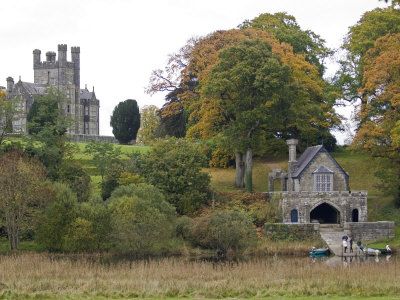
CROM CASTLE, near Newtownbutler, County Fermanagh, is one of the the finest estates in County Fermanagh and Northern Ireland.

The Castle stands in a commanding position, with the entrance front to the east, the south front looks out towards the deer-park and Old Castle; while the west front (above) has the prospect of the boat-house and Inisherk Island.

Crom is one of my favourite places.


Books have been written about Crom.

It used to be a thriving community, virtually self-contained, complete with its own post-office; stable-yard; school-house; church; riding school; turf-house and saw-mill; petrol pump; court-yard; and staff accommodation.

The old farm-yard has been transformed into visitor accommodation with a visitor centre, exhibition, tea-room, jetty and more besides.

There is the Crichton Tower, too, a stone folly built as a Famine relief project ca 1847 to serve as an observatory.

The demesne is situated in a heavily wooded lough shore and island setting, the nearest village being Newtownbutler.

The estate was established in the 17th century and the ruins of the original Plantation castle - built about 1611 and destroyed by fire in 1764 - are still accessible on the shores of Upper Lough Erne, surrounded by vestiges of a formal garden; and near to a pair of venerable old yew trees.

The formal garden resembles a garden that would have graced the old castle; but is, in fact, a later garden, made when a plan was laid out in the early 19th century for the present mansion of 1831, by Edward Blore.


It was what I have termed one of the Big Five in the county; though the total income from all the Erne estates, reaching far beyond County Fermanagh, generated £23,850 per annum by 1883 with an overall acreage of 40,365.

In today's terms, that would equate to an annual income of £1.1 million.

The mansion is on an elevated site and is surrounded by mature trees; with vistas cut through the planting to the lough,  buildings used as "eye-catchers" in the distance, including the old Castle.

The Castle combines Baronial and Tudor-Revival elements.

The entrance front has a gabled projection with a corbelled oriel at each end, though they're not totally similar; while the tall, battlemented entrance tower, incorporating a porte-cochére, is not central but to one side, against the left-hand gable.

There are stone-carvings on the south and east fronts of the Castle.

Inside there is a series of heraldic stained-glass panels in the bay window at the foot of the staircase, one of which commemorates the marriage of the 1st Earl to Lady Mary Hervey, daughter of the Earl Bishop of Derry and a sister of Lady Elizabeth Hervey (Duchess of Devonshire).
The hall and staircase at Crom Castle are among Edward Blore's finest surviving interiors: Classical in form, the staircase was given a late-Perpendicular veneer by the arcades at top and bottom - the latter rather in the feeling of a chantry chapel - while the cathedral atmosphere was enhanced by the encapsulation tiles of the floor and the armorial stained glass windows.
Although the other rooms have been greatly altered since Blore's day, Crom remains one of the most impressive Victorian houses in Northern Ireland.

The adjoining garden front is symmetrical, dominated by a very tall central tower with slender octagonal turrets.

On either side of it is a gable and oriel.

The landscaping scheme was planned by the eminent landscaper, W Gilpin, in 1838 and is one of the very few sites designed by a named English employee, at a time when English landscape design was pre-eminent.

Crom survives as an outstanding landscape park in the Picturesque style.

The natural features of lough and islands are embellished with trees, bridges and buildings.

The formal garden, with its parterre, is long gone.

The parterre was at the west front and has since, I believe, been turned to lawn.
Parterres were a common feature of large country houses: Florence Court used to have one immediately to its rear; while Castle Ward had what was known as the Windsor Garden, a parterre in the sunken garden within its walled garden.
These features were relatively easy to maintain, since a small army of gardeners was employed for the purpose!

The house is set in wonderful surroundings, affording fine views.

There are some very fine trees, including a number of a great age both in the woodland and in the parkland, which includes a small Deer Park.

Victorian bedding schemes at the house, known from contemporary photographs, have been grassed over, but the conservatory of 1851 remains.

THE WALLED GARDEN survives, with glasshouses and bothies.

It is not planted up and the buildings are presently disused.

The many attractive demesne buildings are in good repair and are listed.

The stables are used as offices and the farm is a Visitors Centre, with holiday accommodation.

I visited the Castle about 1977 with my mother.

There used to be an indoor swimming-pool, though this has been taken away and, it is thought, turned into accommodation in the west wing.


The Erne Papers are held at the Public Record Office of Northern Ireland.

The 4th Earl's time at Crom coincided with the Land Acts and the Land Courts.

The latter appreciably reduced the rents payable to the landlord in most of the land cases which were brought judicially before it, with the result that land purchase, when it came, was calculated on the basis of these new and lower 'judicial' rents.

Terence Reeves-Smyth writes:
... The large bulk of the Erne estates were sold by the 4th Earl between 1904 and 1909 under the ... Land Act of 1903. ... By April 1908 ..., [most] of the Fermanagh estates had been sold to their tenants for £240,440. Only 49 holdings remained unsold, valued at £12,770. ...
When the amounts already received for the Sligo and Donegal estates are added - £25,000 and £83,427 respectively, both sold in October 1905 - the grand total comes to £348,867, or £20 million at 2010 values.

Mr Reeves-Smyth does not mention Mayo, part of which was still unsold in 1912.

It also looks as if a further ca £70,000 remained to be realised, post-1908, out of the Donegal estate, and a further £26,000 out of the Sligo.

The Dublin estate, being entirely urban, was unaffected by the Land Acts.

The 5th Earl, for a time, served as lieutenant in the Royal Horse Guards, his father's old regiment.

Soon after the outbreak of war in 1939, he raised the North Irish Horse, which was based in Enniskillen between November 1939 and February 1940.

In 1940, Lord Erne was killed near Dunkirk, and the castle and the demesne passed into the control of trustees whose most immediate problem was to protect the castle and demesne from the depredations of, firstly, British and then American forces, for whose use it was requisitioned at the beginning of the 2nd World War.

Terence Reeves-Smyth comments:
... From 1940 ... to 1958, the castle and demesne were controlled by a board of trustees. During the war the demesne actually made a profit, but the trustees throughout this period were considering leasing or selling the property to the Ministry of Agriculture. During the war and later in the 1950s the trustees undertook a number of tree fellings in the demesne woods to raise capital for the estate.

When the 6th Earl inherited in 1958, he attempted to create a dairy farm out of the farm lands, and later a toy factory in the farm yard, but neither enterprise was totally successful. Eventually part of the demesne was sold to the Department of the Environment in 1980 and subsequently, in 1987, the National Trust acquired the rest of the demesne, in part as a gift, while the castle itself has been retained by Lord Erne...
The Crom Estate is now held inalienably by the National Trust, including crucial rights to islands in, and parts of, Upper Lough Erne.

If its sale or lease to the Ministry of Agriculture had gone ahead, its "... great wealth of wildlife would have completely vanished under a monoculture of spruce" (Reeves-Smyth), and Crom Castle "may have been turned into a hotel or perhaps even demolished."

Under the 6th Earl, many changes were made and continued to be made to render the castle suitable for present-day living.

The 6th Earl's aunt, the Dowager Duchess of Abercorn, GCVO, was Mistress of the Robes to HM Queen Elizabeth The Queen Mother.

The 5th Earl was a Page of Honour to HM King George V 1921-4, and a Lord-in-Waiting to HM King George VI 1936-9.

The 6th Earl served as HM Lord-Lieutenant of County Fermanagh, 1986-2012.

The West Wing at Crom Castle is available to rent.

The opening of the West Wing as holiday accommodation marks a new departure for Crom Castle which, as the family home, remains closed to the general public.

Erne arms courtesy of European Heraldry.  Photo credits: 6th Earl of Erne and Mr Noel Johnston.   First published in January, 2010.

Tuesday, 21 April 2026

Florence Court: My Irish Home


My dear mother gave me a wonderful hardback book when we were in County Fermanagh in 1979.

It is entitled Florence Court: My Irish Home, and written lovingly by Nancy, Countess of Enniskillen.

The book was published in 1972 by R & S Printers, The Diamond, Monaghan.

Lady Enniskillen wrote:
On the highest level of The Pleasure Grounds, there used to stand a little "summer house." Here on a warm sunny day ideally without wind and wrinkled only by the wings of birds and insects, on such a day at Florence Court, the Cole family would adjourn to drink their tea and enjoy the tonic view of the valley and the mountain.
On Thursday, the 14th August, 2014, this charming little thatched gazebo was burnt to the ground.


The National Trust has, I'm delighted to say, rebuilt it to the original specifications.

Saturday, 10 January 2026

Crom: Walled Garden

Although it's one of the most remote parts of the Province and almost as far from Belfast as you can get, I've been to Crom Estate in County Fermanagh many times.

I first visited it in about 1977, when the estate manager took us on a guided tour of the Castle - I'd written to Lord Erne in advance, requesting a visit.

The Walled Garden lies deep within the grounds of Crom (pronounced Crum).

You cross the White Bridge and walk several hundred yards until it appears, the former head gardener's lodge being opposite it.

Its old, red-brick walls are in good condition, the National Trust having re-built at least one side some years ago.

It extends to roughly three acres in size; and has become overgrown since its demise after the second world war.

It is to be hoped that the National Trust restores this special place as and when funds become available.

Ruinous glass-houses (Timothy Ferres, 2013)

Many fruits and vegetables were grown here for the big house.

Exotic fruits, which are nowadays taken for granted, were a rarity then and only the wealthiest families could afford to cultivate them.

In fact many people may never have seen a pineapple or a peach or known they existed.

On one side of the Walled Garden there were raspberries; and strawberries on another.

Heated glasshouses contained peaches, nectarines, pineapples, grapes and tomatoes; not to omit lettuce, marrows, cucumbers and orchards with apples, plums, pears and greengages.

There were also beehives, sweet-pea, daffodils, dahlias and magnolias.

Location of former palm-house (Timothy Ferres, 2013)

In the middle of the garden there was a large palm-house surrounded by a lily pond, now sadly gone, 25-30 feet high, where the weather-reading was taken every morning.

The whole garden swarmed with butterflies, bees and other wild insects; birds flitted in and out to help themselves to Nature's goodness.

It must have been heavenly.

Of course the main purpose of the walled garden was to maintain an abundant supply of produce, including flowers, for the Castle: a barrow was wheeled manually up to the Castle with fruit, vegetables and flowers twice daily.

When the family were staying at their London home, the freshly-picked produce was loaded on to the train at Newtownbutler station and taken to Belfast or Dublin; then put on a ferry for its long journey to the metropolis, where it would have been delivered to the Ernes' house the next day; and that was in Victorian times!

I have been in the Walled Garden and my imagination always escapes to those halcyon days, dreaming of what it must have been like.

My fervent hope is that the enchanting walled garden of Crom is resurrected back to life again some day.

This piece was first published in August, 2008. It is thought that the intention is to utilize part of the Walled Garden as community allotments.

Saturday, 22 November 2025

Rathlin Revisited

IN AUGUST, 2017, I STAYED FOR SEVERAL DAYS ON RATHLIN ISLAND

Rathlin Manor House in 2017


IT MUST be about four years since I last visited Rathlin Island, Northern Ireland's only inhabited off-shore island.

I'm fond of Rathlin.

I have always stayed at the Manor House, former home of Rathlin's landlords, the Gages.

Two ferries - one fast and one slower - sail regularly from the nearest town, Ballycastle in County Antrim.

The fast (passenger-only) ferry takes no more than twenty-five minutes to sail to the island.

My return ticket cost £12.

I arrived at about 10am on Tuesday, checked in early, unpacked and had a brief stroll round Church Bay before a good lunch comprising potato and leek soup in the Manor House, where I stayed for three nights.

Room Nine

I actually stayed in Room Nine, a small single room directly above what used to be the snug bar (The Auld Kitchen).

The Manor House closed down a couple of years ago for major renovation work so, subsequently, The Auld Kitchen was not replaced.

The new interior is hard to recognize if you recall the original one: partition walls have been rearranged and fresh, new, contemporary decor - all "mod-cons".

The general colour scheme seems to be painted in a kind of subtle pastel green.

My room had a oculus window and, in fact, there's another oculus window at the opposite end, too.

That evening I enjoyed a good dinner in the main restaurant comprising a lythe (pollack) with whole potatoes and kale; followed by pavlova.

Lawn in front of the Manor House

On Wednesday at 8am I had a fine cooked breakfast: two pork sausages, two lean rashers, potato-bread, soda-bread, cherry tomatoes, mushrooms, baked beans, tea and toast.

After breakfast I walked to Soerneog View hostel, where I hired a cycle for the day (£10) and rode westwards to the RSPB Seabird Centre and the West Lighthouse.

The distance from Church Bay to the West Lighthouse is about five miles.

I was rather glad to reach my destination for, although cycling is a good means of seeing the island, the terrain is uneven to the extent that it was easier for me to dismount occasionally and walk up several steep sections.

The benefit, however, is that one can freewheel down!

The RSPB centre looks brand-new and they have a seating area with refreshments for sale.

The West Lighthouse now has an interesting exhibition and most of the keepers' rooms are open.

It cost £400,000 to build in 1912: that is an astounding £42 million in today's money!

Of course it's been fully automatic since the 1980s, I think.

Reinvigorated and fortified with a chilled drink, I mounted the bike and rode back to Church Bay and on towards the southern Rue Lighthouse and lovely Ushet Port.

Ushet was used almost 200 years ago by smugglers; their ruinous building still stands, as does the adjacent coastguard house.

It sounds a bit incongruous, doesn't it? Apparently the smugglers' house used to be a kelp store.

There were over a dozen seals at Ushet warily watching me.

Thence I cycled northwards, towards the East Lighthouse which is closed to the general public.

I left my bike back later in the afternoon.

I was certainly fortunate with the weather, managing to avoid the rain.

Reception

The Manor House has a little bar at Reception and this is where I installed myself during the evening before and after dinner.

Manor House breakfast menu in 2017

It's a convivial place where I encountered and struck up conversations with residents and guests.

There's a fine marble fireplace and the fire was lit in the evenings.


On Thursday morning, I opted for the veggie fry (below); thence walked to the National Trust's Ballyconaghan townland.


This walk terminates at a disused 1941 coastguard look-out on the north coast of the island.

En route, one passes a little cluster of cottages, or a clachan, called Crocknanagh.

This consists of four or five old, ruinous cottages forming what would have been a tight-knit community - probably all related in some way or other.

Ruined cottage at Roonvoolin

There are many ruined clachans and cottages on Rathlin: its population numbered 1,200 two hundred years ago; whereas today it's closer to 150.

Incidentally, Rathlin's resident population appears to be increasing: today it's closer to 150 and as I write the schoolhouse is being extended.

I was informed that there are now 9 pupils attending the school.


Rathlin still has many traditional, vernacular stone gate-posts.

By the way, I discovered a great little café called The Watershed.

It's located between the Manor House and St Thomas's Church, adjacent to the large vehicle ferry slipway.


They have a small menu and everything is home-made and delicious.

Margherita pizza & salad at the Watershed Café

I dined at the Manor House again on Thursday evening: crab cocktail and risotto.

Crab Cocktail at the Manor House

Remember to bring plenty of cash to Rathlin. I was down to my last few banknotes!

Of course most establishments accept credit and debit cards.

There is an ATM machine at McCuaig's Bar which, I think, charges a small fee for the service.

How, on earth, did the islanders cope in the past?

Stuffed it under the mattress, I imagine; or bartered a sheep for a supply of milk!

Dinner menu in 2017

I think I'll bring along my Swiss hiking boots next time, for although the terrain was mainly dry, some of it was waterlogged.

I had an absolutely terrific time on Rathlin and felt at home in the Manor House, where the company convivial; the staff very hospitable and friendly; and standards high.

First published in August, 2017.

Sunday, 26 October 2025

The Windsor Garden

The Windsor Garden painted by Mary Ward ca 1864

The Sunken Garden at CASTLE WARD, County Down, lies adjacent to the stable-yard.

To their great credit the National Trust has restored the sunken garden recently.

During the Victorian era, this parterre was particularly elaborate.

My old Nuttall's dictionary neatly describes a parterre as "a lay-out of flower-beds with intervening spaces to walk on."

Castle Ward's sunken garden had little or no grass at all, in fact.

Prior to its acquisition by the National Trust, it was known as The Windsor Garden.

(Image: The National Trust, 2018)

An extract from Irish Farming World, ca 1902 remarks:
The Windsor Garden, so called from being arranged according to a design at Windsor, is very interesting. The design is most admirably worked out of 61 beds of flowers in the flat all stocked at present with tuberous begonias, dwarf varieties of geraniums, with blue lobelia and yellow pyrethrum for bordering.

On the next terrace there are several beds of roses of the choicest and latest varieties; ascending a few steps more we came across a collection of beautiful and nicely coloured begonias...ascending to the archway is a good line of Florence Court yews here so tall and stately and the admiration of visitors...to the Pinetum where there is a beautiful collection of trees and shrubs with which his lordship manifests a great interest...
There used to be a small circular pond with a statue of Neptune brandishing his trident in the middle of the garden.

I've seen a water-colour (top) of the original Windsor Garden by MARY WARD as it was in Victorian times.

During the CASTLEWARD OPERA season  I occasionally picnicked on the terrace during the interval.

The Sunken Garden in 2013

There used to be a parterre at the elevated garden immediately to the rear of Florence Court House.

Parterres are thought to be particularly labour-intensive or time-consuming today.

 First published in May, 2009.

Monday, 1 September 2025

Florence Court House

Coat-of-arms of 1st Baron Mountflorence
THE EARLS OF ENNISKILLEN WERE MAJOR LANDOWNERS IN COUNTY FERMANAGH, WITH 29,635 ACRES


The first of the family who settled in Ulster was SIR WILLIAM COLE (c1571-1653), Knight, a professional soldier born in London, but belonging to the Cole family of Slade, in Devon, who descended (or who, on the evidence of a magnificently emblazoned pedigree in the archive, could plausibly claim to descend) from an ancient Conquest family.

Sir William fixed his abode, early in the reign of JAMES I, in County Fermanagh, and becoming an undertaker in the plantation of Ulster, had an assignment, in 1611, of 1,000 acres of escheated lands in the said county; to which, in 1612, were added 312 acres in the same county, 80 whereof were assigned for the town of Enniskillen, and that town was then incorporated by charter, consisting of a provost and twelve burgesses, Sir William being the first provost. He raised a regiment, which he commanded against the rebels, in 1643, with important success.

Sir William married Susannah, daughter and heir of John Croft, of Lancashire, and widow of Stephen Segar, Lieutenant of Dublin Castle, by whom he left at his decease in 1653,
MICHAEL, his heir;
John, of Newland, father of 1st BARON RANELAGH;
Mary; Margaret.
The elder son,

MICHAEL COLE, wedded, in 1640, Catherine, daughter of Sir Laurence Parsons, of Birr, 2nd Baron of the Irish Exchequer, and dvp, administration being granted 1663 to his only surviving child,

SIR MICHAEL COLE, Knight (1644-1710), of Enniskillen Castle, MP for Enniskillen, 1692-3, 95-9, 1703-11, who espoused firstly, Alice (dsp 1671), daughter of Chidley Coote, of Killester; and secondly, 1672, his cousin, Elizabeth (d 1733), daughter of Sir J Cole Bt.

Sir Michael was succeeded by his only surviving child,

JOHN COLE (1680-1726), of Florence Court, MP for Enniskillen, 1703-26, who espoused, in 1707, Florence, only daughter of Sir Bourchier Wrey Bt, of Trebitch, in Cornwall, and had issue,
Henry (Rev);
JOHN, his heir;
Letitia; Florence.
Mr Cole was succeeded by his younger son,

JOHN COLE (1709-67), of Florence Court, MP for Enniskillen, 1730-60, who married, in 1728, Elizabeth, daughter of Hugh Willoughby Montgomery, of Carrow, County Fermanagh, and had issue,
WILLIAM WILLOUGHBY, his heir;
Arthur, m in 1780 Caroline Hamilton;
Flora Caroline; Catherine.
Mr Cole was elevated to the peerage, in 1760, in the dignity of Baron Mountflorence, of Florence Court, County Fermanagh.

His lordship was succeeded by his elder son,

WILLIAM WILLOUGHBY2nd Baron (1736-1803), MP for Enniskillen, 1761-7, who was created Viscount Enniskillen in 1776; and advanced to the dignity of an earldom, in 1789, as EARL OF ENNISKILLEN.

His lordship wedded, in 1763, Anne, daughter of Galbraith Lowry Corry, of Ahenis, County Tyrone, and sister of Armar Corry, Earl of Belmore, and had issue,
JOHN WILLOUGHBY, his successor;
Galbraith Lowry (Sir), GCB, a general in the army;
William Montgomery (Very Rev), Dean of Waterford;
Arthur Henry, MP for Enniskillen;
Henry, died young;
Sarah; Elizabeth Anne; Anne; Florence; Henrietta Frances.
His lordship was succeeded by his eldest son,

JOHN WILLOUGHBY, 2nd Earl (1768-1840), KP, who espoused, in 1805, the Lady Charlotte Paget, daughter of Henry, 1st Earl of Uxbridge, and had issue,
WILLIAM WILLOUGHBY, his successor;
Henry Arthur;
John Lowry;
Lowry Balfour;
Jane Anne Louisa Florence.
His lordship was succeeded by his eldest son,

WILLIAM WILLOUGHBY, 3rd Earl (1807-86), Honorary Colonel, 3rd Battalion, Royal Inniskilling Fusiliers, who married firstly, in 1844, Jane, daughter of James Casamaijor, and had issue,
John Willoughby Michael, styled Viscount Cole (1844-50);
LOWRY EGERTON, 4th Earl;
Arthur Edward Casamaijor;
Florence Mary; Alice Elizabeth; Charlotte June; Jane Evelyn.
He wedded secondly, in 1865, Mary Emma, daughter of Charles, 6th Viscount Midleton.

His lordship was succeeded by his eldest surviving son,

LOWRY EGERTON, 4th Earl (1845-1924), KP JP DL MP, who wedded, in 1869, Charlotte Marion, daughter of Douglas Baird, and had issue,
William Willoughby, died in infancy;
JOHN HENRY MICHAEL, his successor;
Galbraith Lowry Egerton, father of 6th Earl;
Reginald Berkeley;
Charlotte Jane Christian; Kathleen Mary; Marion; Florence Anne; Muriel Augusta Mary.
His lordship was succeeded by his eldest surviving son,

JOHN HENRY MICHAEL, 5th Earl (1876-1963), CMG, Aide-de-camp to the Lord Lieutenant of Ireland, 1918, Lieutenant-Colonel, North Irish Horse, who espoused firstly, in 1907, Irene Frances, daughter of Alfred Edward Miller Mundy, and had issue,
MICHAEL GALBRAITH LOWRY, his successor;
Ann Florence Vernay; Frances Jane; Kathleen Irene.
He wedded secondly, in 1932, Mary Cicely, daughter of Hugh Nevill.

His lordship's only son,

MICHAEL GALBRAITH LOWRY (1921-56), styled Viscount Cole, Lieutenant, Irish Guards, died unmarried, and the family honours devolved upon his first cousin,

DAVID LOWRY, 6th Earl (1918-89), MBE JP DL, Captain, Irish Guards, Captain, Ulster Defence Regiment, 1971-73, who married firstly, in 1940, Sonia Mary, daughter of Major Thomas Seyers, and had issue,
ANDREW JOHN GALBRAITH, his successor;
Linda Mar.
He wedded secondly, in 1955, Nancy Henderson, daughter of Dr John Alexander MacLennan.

His lordship was succeeded by his only son,

ANDREW JOHN GALBRAITH, 7th Earl (1942-), Captain, Irish Guards, 1965, Managing Director, Kenya Airways, 1979-81, who married, in 1964, Sarah Frances Caroline, daughter of Major-General John Keith Edwards, and has issue,
Amanda Mary; Emma Frances; Lucy Caroline.
Further reading about the Cole family is available in the Enniskillen Papers.


FLORENCE COURT HOUSE, County Fermanagh, having been a property of the National Trust since 1953, is a tall, early to mid-18th century block of three storeys over a basement.

It consists of seven bays, its front heavily enriched with rustication, balustrades, pedimented niches and other features.

The main block is joined by long arcades with rusticated pilasters to pedimented and pilastered single-storey pavilions.


The central block was probably built by John Cole MP, later 1st Lord Mountflorence, whose mother was the Florence after whom the mansion is named.

There was probably another property on the site, such as a shooting lodge, in the days when the family inhabited Enniskillen Castle.

The 5th Earl of Enniskillen gave Florence Court to the National Trust in 1953.

Two years later the centre of the mansion was severely damaged by fire; indeed, the 6th Earl was staying at the Ulster Club in Belfast when Lady Enniskillen broke the news to him.

He is said to have cried,  “What the hell do you think I can do about it?”

Fortunately, most of the House has been totally restored, though the attic and nursery rooms on the top floor were not, it is thought, reinstated to their former glory.

The Hall in the 19th Century

The demesne stands in a very fine natural setting and the mansion-house contributes to making it an outstanding site.

When the house was built, it was enhanced by formal planting, which was in vogue at the time.

There were prominent straight avenues, only one of which (the west) survives today.

Traces of massive ditches indicate where the others were.

A curving main avenue replaced the earlier ones, when the park was radically altered in the 1780s under the direction of William King.

This was undertaken in accordance with the then fashion for informal landscapes.

The view from the house became a wide vista to parkland studded with trees and sweeping away to distant woodland.

This exists today, with fine specimens of parkland trees dotted about as originally intended.

The National Trust have replanted clumps from the early 1980s to maintain continuity.

The ornamental gardens, known as the Pleasure Grounds, cover seven acres close to the house.

This planting dates from the 1840s in an area of grass, paths, flowering shrubs and exotic trees.

The summer-house, known as the Heather House, is currently being restored.

The partly walled garden has a stream at one boundary.

It has been adapted for low maintenance and to provide interest for visitors and not filled, as originally intended with fruit, flowers and vegetables for family use.

The parkland today includes several good woodland walks, one of which leads to the original Florence Court yew (Taxus baccata ‘Fastigiata’) in the Cottage Wood.

It is the survivor of two trees discovered in the 1760s, from which all upright yew trees descend.

There are many listed demesne buildings in good repair, including the fine Grand Gates, which adorn a pair of identical lodges of ca 1778.


THE 5TH EARL had been pre-deceased by his only son, Michael, Viscount Cole (1921-56), who died unmarried.

Shortly before this, in 1954, Lord Cole, the legal owner of the property, had, in conjunction with his father, given Florence Court and the fourteen acres immediately surrounding it to the National Trust.

In 1955, the above-mentioned very serious fire broke out, which would have had far worse consequences but for the presence of mind of the 5th Earl's wife.

However, it still devastated the drawing room, the staircase hall and the Venetian Room, which have since been very largely, though not entirely, restored by the National Trust.

Lord and Lady Enniskillen continued to live in the house but, as Nancy Lady Enniskillen put it, '... with [a] reduced number of rooms and of staff - also new discomforts and inconveniences. ...'

Lord Cole died in 1956, leaving the rest of his County Fermanagh estate to David Cole, 6th Earl.

From his succession to the title in 1963 until 1973, the 6th Earl and his second wife Nancy, Lady Enniskillen, lived at Florence Court. During this period, the 6th Earl considerably developed the estate.

Between 1963-69 he served as a member of Fermanagh County Council, being Chairman of its General Purposes and Finance Committee.

From 1971-73, despite a weak heart, he was on active duty as a captain in the 4th (Fermanagh) Battalion of the Ulster Defence Regiment, whose new headquarters in Enniskillen he opened in March 1973.

In 1973, following disagreements with the National Trust which, happily, were laid to rest in 1997, Lord and Lady Enniskillen left Florence Court and Northern Ireland.

They brought most of the contents of the house with them, although there was an auction in 1973, at which the 5th Duke of Westminster purchased a number of important Cole family portraits (his widow Viola, Duchess of Westminster, presented these to the National Trust in 1980.)

Though no longer living in Northern Ireland, Lord Enniskillen continued to serve as a DL for County Fermanagh, and never failed to attend the House of Lords when Northern Ireland issues were under discussion, particularly issues relating to the police.

In 1974, he transferred nearly all his Florence Court land to the NI Department of Agriculture to enable it to create a forest park.

The 6th Earl died in 1989. He was succeeded by Andrew, Viscount Cole, his only son (by his first marriage) who became the 7th Earl.

The 7th Earl, following family tradition, lives in Kenya, where he is married with three daughters.

The heir presumptive to the earldom is therefore the 6th Earl's first cousin, Berkeley Arthur Cole (b 1949).

The 6th Earl's widow, Nancy, Countess of Enniskillen lived, until her death in February 1998, in Scotland.

First published in January, 2010.  Mountflorence arms courtesy of the NLI.