Thursday, 24 April 2025

Bryansford

EDITED EXTRACTS FROM THE PARLIAMENTARY GAZETTEER OF IRELAND, PUBLISHED IN 1846


BRYANSFORD, a village in the parish of Kilcoo, barony of Upper Iveagh, County Down.

It stands two miles south of Castlewellan, and about the same distance west of Newcastle.

Though small, it is a pretty village; and it stands amidst compositions of beauty, romance, and grandeur in landscape, inferior to few in Ireland.

In its vicinity are the noble and brilliant demesne of Tollymore, the surprising coast scenes adjacent to Newcastle, and many of the most interesting features of the mountains of Mourne.

Bryansford (Image: Robert John Welch (1859-1936)

The Guide through Ireland informs us that "the traveller, anxious to know this beautiful part of the country, will find comfortable accommodation at the inns of Bryansford, Newcastle, or Dundrum, which are about three miles from each other."

The Bryansford rivulet tumbles, leaps, and makes grand falls along a channel of rocks and precipices, and leads out to a magnificent view of the coast and sea.

The village gives name to a Roman Catholic parish.

Fairs are held on Ascension Day and June 3rd.

Population in 1831, 185.

First published in March, 2021.

Wednesday, 23 April 2025

Corick House

THE STORYS OWNED 2,065 ACRES OF LAND IN COUNTY TYRONE 

JOHN STORY (1648-1725), of Bingfield Hall, Hexham, Northumberland, settled in Ulster about 1697. Mr Story was established on church land at Corick, County Tyrone, by the Rt Rev St George Ashe (1658-1718), Lord Bishop of Clogher.  He was the elder brother of the Rt Rev Joseph Story, Lord Bishop of Kilmore.

Mr Story sold his estate at Bingfield Hall and removed to Ulster under the auspices of Bishop Ashe. He and his son, Thomas, acquired an estate within the See of Clogher, where they built their first residence.

Mr Story died at Corick in 1725, leaving issue,
THOMAS, of whom presently;
Joseph, ancestor of STORY of Bingfield;
John, b 1681;
Samuel, b 1683.
The eldest son,

THOMAS STORY (1678-1768), of Corick, wedded, in 1707, Rebecca ______, and had five sons and two daughters, of whom,
JOHN, of whom presently;
Joseph (Rev), rector of Monaghan (1711-84);
Thomas, 1715-44;
Benjamin, father of JOHN BENJAMIN, s his uncle.
The eldest son,

JOHN STORY (1708-80), died unmarried, and was succeeded by his nephew,

THE REV JOHN BENJAMIN STORY (1764-1844), of Corick, Canon Chancellor of Clogher, who married, in 1790, Jane, daughter of Alexander Young, of Coolkeeragh, County Londonderry, by Catherine his wife, daughter of Richard Hassard, of Gardenhill, County Fermanagh, and had issue,
JOHN BENJAMIN, his heir;
Alexander, died unmarried;
Anne; Kate; Elizabeth; Jane; Letitia; Frances Thomasina; Maria.
The eldest son,

JOHN BENJAMIN STORY, of Corick, wedded, in 1840, Catherine, daughter of Captain Valentine Munbee, of Horringer, Suffolk; though dsp in 1862, and was succeeded by his only surviving brother,

THE REV WILLIAM STORY, of Corick, Rector of Aghabog, who espoused Sarah, daughter of John Black, and had issue,
JOHN BENJAMIN, his heir;
William George Theaker, b 1863;
Marion Letitia; Alice Gertrude; Emma Mary Geraldine.
He died in 1888, and was succeeded by his eldest son,

JOHN BENJAMIN STORY, MB, M.Ch, FRCSI, (1850-1926), of Corick and 6 Merrion Square North, Dublin, High Sheriff of County Tyrone, 1911, who married, in 1892, Blanche Christabel, daughter of the Rev J W Hallowell, and had issue,
Eleanor Constance, OBE;
Joan Blanche.
Dr Story was educated at Winchester; and Trinity College Dublin; Surgeon Oculist to GEORGE V in Ireland; President of the Royal College of Surgeons in Ireland; and of the Ophthalmological Society of the United Kingdom, 1918-19,
The King has appointed Mr John Benjamin Story, MB, FRCSI, to be Honorary Surgeon Oculist to His Majesty in Ireland, in room of Mr Charles Edward Fitzgerald, MD, deceased.

CORICK HOUSE, near Clogher, County Tyrone, was originally built at the end of the 17th century, as a double gable-ended block of two storeys over a basement, with five bays.

In 1863, on the instructions of William Story, the house was enlarged and altered to the design of the Belfast firm of Sir Charles Lanyon.

A new garden front with a large canted bay in its centre and a three-storey tower with Italianate hipped slate roof were added. The original dining room remained unaltered.


The house sits on an elevated site above the River Blackwater, and is approached from the north by a straight avenue, laid down in the 1690s, lined with mature beech trees.

The enclosing parkland, some of whose trees were considered very fine as early as 1835, was developed in the later 18th century.

It is bordered to the south by the river Blackwater, and contains mature trees in set, undulating ground, including a planted rath.

The area around the house is enhanced by a maintained, ornamental garden.

The walled garden is partly cultivated, with a glasshouse.

There are three gate lodges, all of which pre-date the 1850s.
The last member of the Story family, a granddaughter of Dr John Benjamin Story, sold Corick to Mrs Jean Beacom; and the surrounding farmland to local farmers.
Corick House is now a country house hotel.

First published in January, 2013.

Tuesday, 22 April 2025

1st Baron Dunleath

THE BARONS DUNLEATH WERE MAJOR LANDOWNERS IN COUNTY DOWN, WITH
13,506 ACRES

The family of MULHOLLAND claims to be a branch of the ancient sept of MacLellan, Argyllshire, and was first established in Ulster, in County Antrim, whence they spread into counties Londonderry, Carlow, Kilkenny and Monaghan. In the last-named county, Captain John Mulholland held the estate of Conaghy by grant from the Crown, and his lineal descendant, John Mulholland, served as High Sheriff, 1766.

THOMAS MULHOLLAND (1756-1820), of Belfast, wedded, in 1784, Anne Doe, and had numerous issue (reputedly eleven children), including
ANDREW, his heir;
Sinclair Kelburn, of EGLANTINE, Hillsborough, County Down.
The celebrated Belfast historian, George Benn, remarked that Thomas Mulholland ran a very small business in 1804, and likely a number of years prior to this. His wife, Anne, died in 1858 at the advanced age of 92.

They had numerous offspring: two of whom, Thomas and William, are interred at the New Burying Ground (Clifton Street Cemetery); their two other sons, Andrew and Sinclair Kelburn, "have no doubt been interred near the country houses which they owned at the time of their decease." 

Andrew and Sinclair K were educated at the Belfast Academy in Academy Street. Benn notes that the Christian names, Sinclair Kelburn, affirm the Presbyterianism of the family at the time of his birth. 
Thomas Mulholland worshipped at Rosemary Street Presbyrterian Church. (probably the third church, given that the Rev Sinclair Kelburn was Minister).
The elder son,

ANDREW MULHOLLAND JP DL (1792-1866), of Springvale House, Ballywalter, County Down, Mayor of Belfast, 1845, High Sheriff of County Down, 1855, County Antrim, 1858-9, married, in 1818, Elizabeth, daughter of Thomas McDonnell, of Belfast.

Andrew Mulholland. Photo Credit: Irish Linen Museum

Mr Mulholland had issue,
JOHN, his heir;
Thomas (1832-52);
Annie; Sarah Jane; Mary; Elizabeth; Andrina.
Mr Mulholland was succeeded by his eldest son,

JOHN MULHOLLAND JP DL (1819-95), of Springvale (renamed Ballywalter Park), High Sheriff of County Down, 1868, MP for Downpatrick, 1874-85, High Sheriff of County Tyrone, 1878, who wedded, in 1851, Frances Louisa, daughter of Hugh Lyle, of KNOCKTARNA, County Londonderry, and had issue,
Andrew Walter (1852-77);
HENRY LYLE, his successor;
Alfred John;
Helen Mary; Alice Elizabeth; Louisa Frances.
Mr Mulholland was elevated to the peerage, in 1892, in the dignity of BARON DUNLEATH, of Ballywalter, County Down.

His lordship was succeeded by his second son,

HENRY LYLE, 2nd Baron (1854-1931), JP DL, of Ballywalter Park, High Sheriff of County Down, 1883, Major, 5th Battalion, Royal Irish Rifles, who espoused, in 1881, Norah Louisa Fanny, daughter of the Hon Somerset Ward, and had issue,
Andrew Edward Somerset, killed in action at Ypres);
CHARLES HENRY GEORGE, his successor;
Henry George Hill, created a baronet; father of the 5th Baron;
Godfrey John Arthur Murray Lyle;
Eva Norah Helen.
His lordship was succeeded by his second son,

CHARLES HENRY GEORGE, 3rd Baron (1886-1956), CBE DSO JP DL, of Ballywalter Park, High Sheriff of County Down, 1931, who married firstly, in 1920, Sylvia Henrietta, daughter of Sir Arthur Douglas Brooke, 4th Baronet; and secondly, in 1932, Henrietta Grace, daughter of the Most Rev Charles Frederick D'Arcy, Archbishop of Armagh, by whom he had issue, an only child,

CHARLES EDWARD HENRY JOHN, 4th Baron (1933-93), TD DL, of Ballywalter Park, Lieutenant-Colonel, North Irish Horse (TA), who wedded, in 1959, Dorinda Margery, daughter of Lieutenant-General Arthur Ernest Percival CB DSO OBE MC DL, though the marriage was without issue, and the barony reverted to his cousin,

SIR MICHAEL HENRY MULHOLLAND, 2nd Baronet and 5th Baron (1915-97), Major, Oxfordshire and Buckinghamshire Light Infantry, who espoused firstly, in 1942, Rosemary, daughter of Major David Alfred William Ker; and secondly, in 1949, Elizabeth, daughter of Laurence B Hyde, by whom he had an only child,

BRIAN HENRY, 6th Baron, DL, born in 1950, of Ballywalter Park, who married firstly, in 1976, Mary Joan, daughter of Major Robert John Fuller Whistler, and had issue,
Tara Miranda, b 1980;
ANDREW HENRY, b 1981;
William alexander, b 1986.
The 6th Baron (third Mulholland Baronet) wedded secondly, in 2006, Vibeke (Vibse) Lunn.

*****

IN 1803, Thomas Mulholland, described as a dealer, bought two houses in Upper Church Lane, Belfast, signing the contract with a simple cross (X), an indication of illiteracy and, presumably, of fairly modest origins.

About 1815, the family entered the flourishing cotton industry by purchasing a mill.

Thomas Mulholland & Co. operated a calico-weaving business with his sons at Winetavern Street in Belfast.

Thomas died in 1820, and the business flourished: in 1822 his sons built a very large spinning mill in the Point Field, near York Street.
One Sunday morning in June, 1828, however, disaster struck when this mill was almost totally destroyed by fire. Yet in fact time was to prove this a most fortuitous disaster for the Mulhollands. The brothers, Thomas, Andrew and Sinclair, with the support of their partner John Hind, decided to rebuild the mill, but for the spinning of flax not of cotton.
In addition to their business interests, the Mulhollands also took an active part in civic affairs: Sinclair was a JP for County Down and High Sheriff of County Louth and in 1865 he donated money for the erection of a new wing at what was to become the Royal Victoria Hospital.

His elder brother, Andrew, had married Elizabeth McDonnell in 1818 and had one son and four daughters.

He was elected Mayor of Belfast for the year 1845.

He built Ballywalter Park, to which he moved in 1846; and he is perhaps best remembered in Belfast today for having provided the Ulster Hall with its fine Grand Organ in 1862.

Andrew Mulholland bought the Ballywalter estate from the Matthews family in 1846 for the sum of £23,000 (£2 million in 2010).

Andrew's eldest and only son John (1819-95) was educated at the Royal Academy in Belfast and eventually assumed control of the family interests, which aside from the mills included a substantial amount of land: 13,500 acres in County Down and over 1,000 acres near Cookstown in County Tyrone.

John was noted for his business and financial acumen which carried him well beyond the linen industry.

He was, for instance, involved in 1860 in advising HM Government during negotiations with the French over an important commercial treaty regulating trade between the two countries – and, among various other provisions, lowering French duties on flax and linen.

He also played a prominent part in organising the finances of the Church of Ireland after it was disestablished in 1869.

He was a JP and High Sheriff for both counties Down and Tyrone.
In 1868 he stood as a Conservative candidate, with Sir Charles Lanyon, the architect of Ballywalter, for the seat of Belfast. Both, however, were defeated, with John coming bottom of the poll. Yet John persevered and in 1874 he was returned unopposed for Downpatrick, a seat he retained until 1885 [and where his influence, as ground landlord of most of the town, was very strong].
Although he held no political office, he spoke frequently on Irish questions and was a strong supporter of Tory policies.

Mr Mulholland was created BARON DUNLEATH in 1892, on the recommendation of the outgoing Conservative Prime Minister, Lord Salisbury.

Following his decease in 1895, the 1st Baron's estate was valued at almost £600,000, the equivalent of almost £71 million today.

In 1878 he owned 13,506 acres of land in County Down, and 1,182 in County Tyrone.

The 4th Baron was instrumental in the restoration of the grand Mulholland organ in Belfast's Ulster Hall.

The present 6th Baron Dunleath is also the 3rd Mulholland Baronet.

The 6th Baron's father, the 5th Baron, was better known as Sir Michael Mulholland Bt, and lived formerly at Storbrooke House in Massey Avenue, Belfast.

When Sir Michael succeeded to the titles the barony it merged with the baronetcy.

The Dunleath Papers are held at PRONI.


BALLYWALTER PARK, one of the finest stately homes in Northern Ireland, is on the Ards Peninsula in County Down.

The estate today comprises about 1,000 acres of beautiful parkland, woodland and forest.


The present Lord Dunleath formerly managed the Duke of Abercorn's Belle Isle estate in County Fermanagh until he succeeded his father as 6th Baron.

Lord Dunleath has three children: his eldest son and heir, the Hon Andrew Mulholland; the Hon Tara Mulholland; and the Hon William Mulholland.

First published in June, 2010.

Monday, 21 April 2025

Fenagh House

THE PACK-BERESFORDS WERE MAJOR LANDOWNERS IN COUNTY CARLOW, WITH 7,679 ACRES

SIR CHRISTOPHER PACKE (c1593-1682), Lord Mayor of London, son of Thomas Packe, of Northamptonshire, married thrice; and by his second wife, Anne, daughter of Simon Edmonds, he had issue,
Christopher;
SIMON, of whom hereafter;
Anne; Mary; Susanna.
The younger son,

SIMON PACK (1653-1701), was father of

THOMAS PACK (c1680-1758), of Ballynakill, Queen's County, married a daughter of ______ Kelly, of Ballynakill, and had issue, three sons, of whom the eldest,

THE VERY REV THOMAS PACK (1719-95), Dean of Ossory, married Catherine, daughter of Denis Sullivan, and had issue,
Thomas, died young;
DENIS, of whom hereafter;
Catherine; Anne.
The surviving son,

MAJOR-GENERAL SIR DENIS PACK KCB (1775-1823), wedded, in 1816, the Lady Elizabeth Louisa Beresford, daughter of George de la Poer, 1st Marquess of Waterford, and had issue,
Arthur John (Lt-Col);
DENIS WILLIAM, of whom we treat;
Elizabeth Catherine; Anne Elizabeth.
The younger son,

DENIS WILLIAM PACK-BERESFORD JP DL MP (1818-81), Captain, Royal Artillery, High Sheriff of County Carlow, 1858, MP for County Carlow, espoused, in 1863, Annette Caroline, daughter of Robert Clayton Browne, and had issue,
DENIS ROBERT, his heir;
Arthur William;
Charles George, Major (1869-1914), killed in action;
Henry John, father of DENIS JOHN PACK-BERESFORD;
Reynell James;
Hugh de la Poer;
Algernon Dunbar;
Elizabeth Harriet; Annette Louisa.
In 1854 Captain Pack inherited the Irish estates from his uncle, General the Rt Hon William Carr Beresford, 1st Viscount Beresford.

He assumed the additional surname and arms of BERESFORD, in compliance with the will of Lord Beresford.

The eldest son,

DENIS ROBERT PACK-BERESFORD JP DL (1864-1942), of Fenagh House, High Sheriff of County Carlow, 1890, married, in 1891, Alice Harriet, only daughter of the James Acheson Lyle, of Portstewart House, though the marriage was without issue.

Mr Pack-Beresford was succeeded by his nephew,

DENIS JOHN PACK-BERESFORD (1905-86), of Fenagh House, Commander RN, who married firstly, in 1928, Basante Hoskins, in 1928; and secondly, in 1933, Daphne, daughter of Lieutenant Horace Robert Martineau VC, and had issue,
DENIS RAYMOND;
Elizabeth Ann.
Commander Pack-Beresford was Founder and President of the Irish Pedigree Pig Breeders Association, sometime representative to the Council of Aberdeen-Angus Cattle Society of Scotland; Vice-President of the Irish Aberdeen-Angus Association; and member of the Council of the Royal Dublin Society.


FENAGH HOUSE, Bagenalstown, County Carlow, is a plain and austere stone dwelling, built ca 1829.

Fenagh House ca 1903

It is irregular in plan and extensive, though it has a symmetrical entrance front of three bays, the centre bay of which is recessed with a pillared porch.

First published in November, 2011.

Ardnargle House

THE OGILBYS WERE MAJOR LANDOWNERS IN COUNTY LONDONDERRY, WITH
9,735 ACRES


This branch settled in Ulster during the Plantation. All the records of the family (originally Ogilvie) were destroyed by fire in Scotland, 1784. The original residence was at Calhame, Aberdeenshire.


DR JOHN OGILVIE, of Aberdeen, who settled in Limavady, was a great friend of the celebrated Bishop Burnet.

He married Elizabeth Agnew, of the Scottish family of that name, who settled in County Antrim.

He was succeeded by his son,

ALEXANDER OGILBY, who changing the spelling of the name from Oglivie, married firstly, Ann Smith, and had issue,
ALEXANDER, his heir;
Mary Ann.
Mr Ogilby wedded secondly, Mary Campbell, and had further issue,
George;
Robert (Dr), of Spring Hill, Limavady.
He was succeeded by his eldest son,

ALEXANDER OGILBY, who wedded Mary, eldest daughter of James Alexander, of Limavady (whose family came originally from Clackmannanshire in Scotland), by his wife Elizabeth Ross, and had issue,
JOHN, his heir;
Alexander;
James, dsp;
William;
Robert, of Pellipar;
David (Sir), East India Company;
Lesley, of Strangmore;Ann; Elizabeth; Mary; Jane.
The fourth son, Robert Ogilby, of PELLIPAR HOUSE, Dungiven, purchased the entire Manor of Limavady from the Conolly family, also large properties in County Tyrone, and estates at Woolwich in Kent.

He was also lessee of the estates of the Skinners' Company in County Londonderry.

Mr Alexander Ogilby was succeeded by his eldest son,

JOHN OGILBY, of Ardnargle, who married Jane, daughter of James Simpson, of Armagh, and had issue,
Alexander, dsp;
John, dsp;
JAMES, his heir;
David, dsp;
Leonard;
ROBERT LESLIE, of whom presently;
William, of Kilcatten;
Ann; Jane; Mary.
Mr Ogilby was succeeded by his third son,

JAMES OGILBY, of Ardnargle, who wedded Bridget Rush, and dsp 1849. 

Mr Ogilby was succeeded by his brother,

ROBERT LESLIE OGILBY JP DL (1795-1871), of Ardnargle, High Sheriff of County Londonderry, 1854, who espoused, in 1844, Elizabeth Matilda, daughter of Major William Henry Rainey, of the East India Company, and had issue,
ROBERT ALEXANDER, his heir;
John W H, dsp;
David Leslie;
Margaret Harriet; Jane Ann; Elizabeth; Mary Isabella.
Mr Ogilby was succeeded by his eldest son,

ROBERT ALEXANDER OGILBY JP DL (1850-1902), of Ardnargle, and Pellipar House, High Sheriff of County Londonderry, 1887, Captain, 4th King's Own Regiment, served in Zulu War.

Under the will of his great uncle, Robert Ogilby, he succeeded on the death of his cousin, James Ogilby, to the Limavady, Pellipar, Tyrone and Woolwich estates.

Mr Ogilby married, in 1875, Helen Sarah, second daughter of the Rev George Bomford Wheeler, Rector of Ballysax, County Kildare, and had issue,
ROBERT JAMES LESLIE, his heir;
Ethel Maude; Eileen Leslie; Mabel Norah; Esther Gladys; Mildred Constance.
Captain Ogilby was succeeded by his only son,

LIEUTENANT-COLONEL ROBERT JAMES LESLIE OGILBY DSO JP DL (1880-1964), of Ardnargle and Pellipar, High Sheriff of County Londonderry, 1911, who married, in 1936, Isabel Katherine, daughter of Captain P C J Webster, though the marriage was without issue.

*****

THE Ogilbys were kinsmen of the Earl Alexander of Tunis and the Viscount Montgomery of Alamein, through the line of the Alexanders of Limavady.

The Woolwich estate was bought at public auction in 1812 by Robert Ogilby (younger brother of John Ogilby), who also leased, in 1803, the Skinners estate at Dungiven and lived at Pellipar House.

Ardnargle was not strictly, therefore, a dower house for Pellipar, although it was used as such when R A Ogilby (1850-1902) inherited both properties from 1885 onwards.
The Ogilby family has had a proud military tradition: Major Robert Alexander Ogilby married Sarah Wheeler, daughter of Rev George Bomford Wheeler, a founder of the Irish Times, TCD classic scholar and contributor to Dickens' magazine, "All Year Round"; a DL for County Londonderry; captain 4th King's Own Regiment; and took part in the Zulu war (1879, medal). 
In 1902, Maurice Marcus McCausland, of Drenagh, married Eileen Leslie, daughter of R A Ogilby DL, of Pellipar.


(Image: Rohan Boyle)

ARDNARGLE HOUSE, near Limavady, County Londonderry, was built by John Ogilby ca 1790.

It is a plain, two-storey, five bay house.

(Image: Jochen Lueg)

About 1854, a porch, three-sided bow, window surrounds with console brackets, and a modillion cornice were added by R L Ogilby.


Ardnargle House (Image: UAHS)

John Ogilby purchased the farm from the Wilsons in 1781, built the house in 1790 and planted the trees.

Robert Leslie Ogilby extended it in 1840 and created the terrace.

Photo credit: http://northernireland-awealthofhistory.doomby.com/

The interior has classical Victorian plasterwork in the main reception rooms and hall.

First published in April, 2011. Ogilby arms courtesy of the NLI.

Sunday, 20 April 2025

Dromore Palace

THE foundation of this diocese is ascribed to St Colman in the 6th century.

St Colman founded an abbey here for Canons Regular, which afterwards became the head of a see, of which he was made the first bishop.

The abbey had acquired extensive possessions early in the 10th century, and was frequently plundered by the Danes; it also suffered materially from the continued feuds of the powerful septs of the O'Neills, Magennises, and the Macartans.

In the 14th century, Sir John Holt and Sir Robert Belknap, being convicted of treason against RICHARD II, were condemned to death, but on the intercession of the clergy, were banished for life to Dromore, County Down.

At the reformation the cathedral was in ruins, and the town had greatly participated in the devastations of the preceding periods; in this situation it remained till 1610, when JAMES I re-founded the see by letters patent, rebuilt the cathedral, and gave to the bishop extensive landed possessions in this and several adjoining parishes.

An episcopal palace was commenced by Bishop Buckworth, but previously to its completion the war of 1641 broke out, and the cathedral, the unfinished palace, and the town were entirely destroyed by the parliamentarian forces.

From this point the town remained in ruins till the Restoration, when CHARLES II gave the see in commendam to the celebrated Jeremy Taylor, with Down and Connor, by whom the present church, which is also parochial, was built on the site of the ruined cathedral. 


THE SEE of Dromore is extremely compact, and the smallest in extent of any in the island of Ireland, which is not annexed to another see.

It extends only 35 miles from north to south; and 21 from east to west; yet it includes some part of three counties, namely Down, Armagh, and Antrim.

The lordship of Newry claimed the same exemption from episcopal jurisdiction, to which it was entitled when it appertained to a monastery before the Reformation.

The proprietor of the lordship, the EARL OF KILMOREY, exercised the jurisdiction in his peculiar court, granting marriage licences, probates to wills etc under the old monastic seal.


THE PALACE, Dromore, County Down, afterwards called Dromore House or Bishopscourt, was a three-storey, Georgian house built in 1781 by the Rt Rev and Hon William Beresford, Lord Bishop of Dromore, 1780-82.

The palace was enhanced by Bishop Beresford's successor, the Rt Rev Thomas Percy (1729-1811), who laid out plantations, gardens and a glen, adorned with obelisks.

The palace was frequented by a circle of poets and painters during Bishop Percy's time, including Thomas Robinson, a pupil of the portrait painter George Romney.

Historic map of ca 1830 (OSNI)

The last prelate to reside at the palace was the Rt Rev James Saurin, Lord Bishop of Dromore, 1819-42.

It was sold in 1842, when the See of Dromore was merged with Down and Connor.

Dromore House was in use for some years in the late 1800s as a Jesuit school, when it was known as Loyola House.

Thereafter the old episcopal palace remained "untenanted and desolate."


After 1945 the trees and woods were all cut down and the house was left to decay.

I HAVE written about an early 19th century painting entitled A Group at the Bishop's Palace, Dromore.

First published in January, 2013.

Saturday, 19 April 2025

34-44 Bedford Street, Belfast

34-44 Bedford Street to the right of the Ulster Hall (Robert French/ NLI)

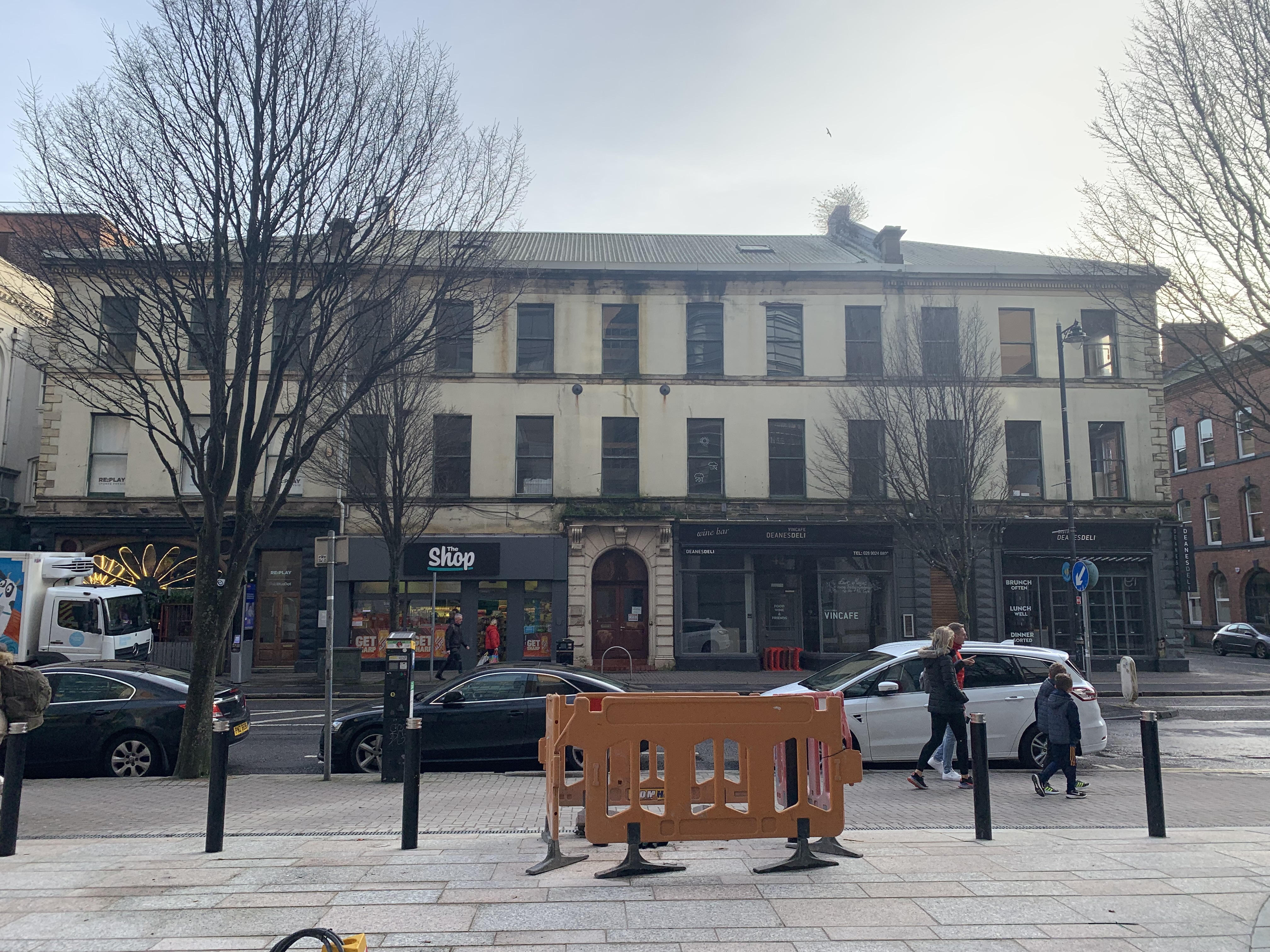
In his Central Belfast: A Historical Gazetteer, Marcus Patton OBE remarks that 34-44 Bedford Street, a three storey warehouse, was built about 1865 for the Workman family.

(Timothy Ferres, 2023)

This cream brick building, beside the Ulster Hall (erected three years earlier in 1862), today contains shop units at ground floor level.
"Now rather plain, but the doorcases with their fielded quoins and heavily corbelled balconettes give an indication of the building's former glory."
Lofty chimneys on the Bedford Street elevation have been removed.
"A slightly art nouveau stained glass and red granite shopfront at number 34 was uncovered a few years ago."
Artist's impression of The Dean hotel (Image: Belfast Live)

In February, 2023, it was announced that a new hotel is to be developed, to be known as The Dean hotel.

(Timothy Ferres, 2023)

It will comprise ninety-one bedrooms, a rooftop restaurant and terrace, and a 3 x 13 metre rooftop swimming-pool.

The 1974 Belfast street directory lists numbers 34-44 as follows:-

Click to Enlarge

More recently the Bedford Street elevation on the ground floor has contained Larry’s piano bar, Deane's Deli, and the Harlem Café.

(Timothy Ferres, 2023)


Restaurant 44 was a prominent city centre restaurant during the 1970s and 1980s.