Tuesday, 26 August 2025

Beresford Obelisk

The Beresford Obelisk (Image: Belfast Live website)

THE BERESFORD OBELISK is situated in a large field in the townland of Carrick East, Ballyquin.

It is about two miles from Limavady, on the road to Dungiven in County Londonderry.

I hadn’t much difficulty in finding it, with the assistance of Limavady tourist office and my car’s “sat-nav.”

(Image: Timothy Ferres, 2021)

Parking is difficult, because the Ballyquin Road is narrow and there is no car-park, though I managed to tuck myself into a small section of verge beside the information-board.

From the car I walked up a concrete drive to the wheat field on the right-hand side.

(Image: Timothy Ferres, 2021)

The obelisk is perhaps a hundred yards from the drive-way.

As I mentioned, access is not easy, nor even encouraged, given that it is located on private land today.

The foundation stone of the obelisk was laid on the 29th June, 1840, in the third year of Queen Victoria's reign.

(Image: Timothy Ferres, 2021)

It was erected by the tenants of Lord Waterford's estate  in County Londonderry to commemorate the "Virtues and Talents that distinguished and adorned their late Agent."

(Image: Timothy Ferres. 2021)

Henry Barré Beresford, seventh and youngest son of the RT HON JOHN BERESFORD, was born on the 25th September, 1781, at WALWORTH HOUSE, near Ballykelly, and died in London on the 15th December, 1837.

The obelisk is about 45 feet in height, and the sides face north, south, east, and west.

The Beresford Obelisk before Restoration (Image: Follies Trust)

It was restored in 2015 by the Follies Trust:-
"Thanks to the help of many donors, grant aid from the Northern Ireland Environment Agency and several charitable trusts, the Follies Trust was able to complete the conservation of the Beresford Obelisk at Ballyquin, near Limavady in the first few months of 2015."

"The obelisk was erected in 1840 in memory of Henry Barré Beresford, who was land agent for his relative the Marquess of Waterford."

"A reception was held at the Roe Valley Resort Hotel on 19 May 2015 to mark the completion of the work and the launch of an associated publication funded by The Heritage Lottery Fund, entitled The Beresford Obelisk, A Legacy in Stone in the Roe Valley."

"We were delighted to welcome Marcus de la Poer Beresford, Lord Decies, who formally launched the book."

"The event was attended by other members of the Beresford family, including the Marquess of Waterford and Agnes Beresford-Ash, widow of the late John Randal Beresford-Ash (1938-2010), who was a direct descendant of Henry Barré Beresford."

"Amongst the many others attending were most of the authors of essays in the book, Chris McCollum, Raymond Blair, Daniel Calley, Professor James Stevens Curl, Primrose Wilson, the book’s editor Dr Evelyn Mullally, and the farmer who owns the land on which the obelisk is situated, William Purcell."

"The total cost of the project including the book amounted to over £80,000."

Monday, 25 August 2025

Castle Caldwell: Walled Garden

Castle Caldwell fish pond in 2025 (Timothy Ferres)

Sir James Caldwell, 4th Baronet (c1722-84), spent a king’s ransom on his sublime demesne on the shores of Lower Lough Erne in County Fermanagh.

In its time Castle Caldwell was acknowledged to be one of the most beautiful demesnes in Ireland.

When he married Elizabeth Hort, a daughter of the Most Rev Josiah Hort, Archbishop of Tuam, Sir James received a dowry of £10,000; and he spent at least £16,000 (about £2.2 million in today's money) embellishing and improving his demesne.

Castle Caldwell: Walled garden ca 1830 (historic OS map)

According to historic maps, Castle Caldwell boasted two walled gardens, the main one being not far to the south-west of the house.

It extended to about 1¾ acres in size.

Castle Caldwell: engraving by F Newbery in 1780

This walled garden had an uncommon feature: four curved alcoves running the length of the south wall.

These alcoves were thought to be for stone fruit, perhaps damsons and plums.

Here there was another feature: a fish pond within the walls, the remains of which are still extant today, near a path.


These features can be seen on a 1780 engraving by Francis Newbery.

The remaining features at Castle Caldwell are of historic importance and in need of conservation.

Sunday, 24 August 2025

Kilmore Palace

THE bishopric of Kilmore was established in the 13th century, and in the 15th century changed its ancient name of Breffny into that of Kilmore.


It lies parallel to, and south of the diocese of Clogher, extending fifty-eight miles in length and between ten and twenty in breadth, through four counties, viz. Cavan, Leitrim, Meath, and Fermanagh in Northern Ireland.

The See House, Kilmore, County Cavan, was built by the Right Rev George de la Poer Beresford, Lord Bishop of Kilmore, 1802-39, and of Kilmore and Ardagh, 1839-41.

It was occupied by a further sixteen prelates.


It is believed that the last bishop to reside at the palace was the Right Rev Michael Mayes, Bishop of Kilmore, Elphin and Ardagh from 1993-2000.

See House, Kilmore, built in 2013

A new see house was built at a different location near the cathedral hall in 2013.

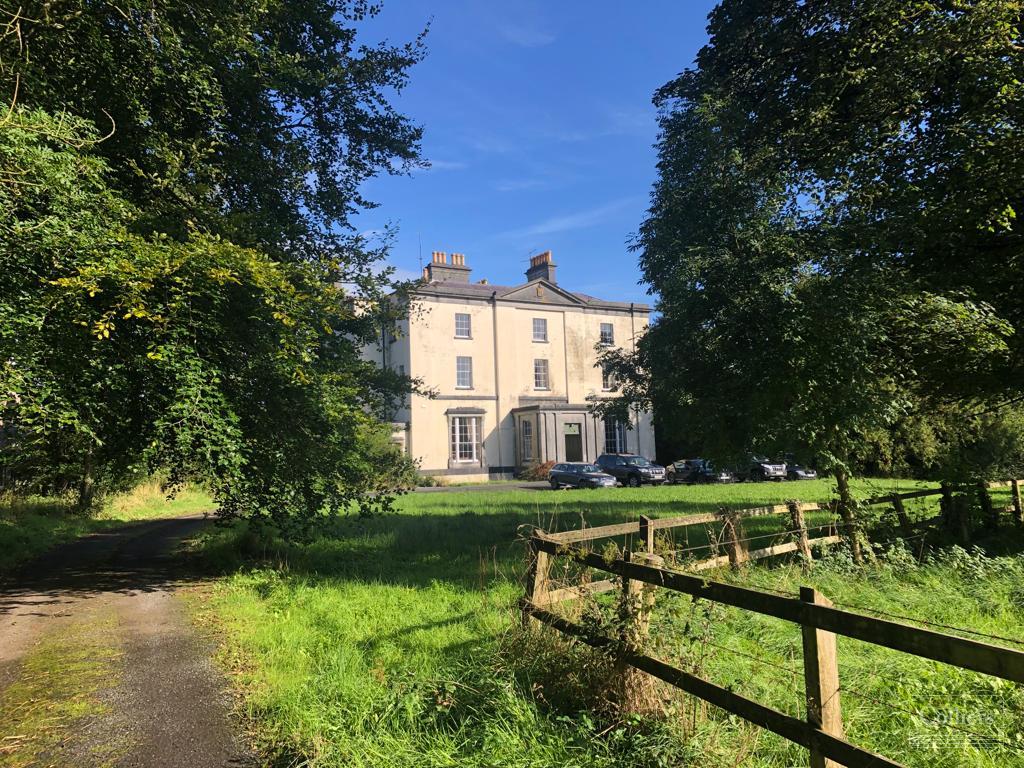
Kilmore Palace: Entrance front (Image: Colliers)


THE SEE HOUSE, Kilmore, County Cavan, is a Grecian-Revival mansion of three storeys over a basement.

It was built between 1835-7.

This former episcopal palace, attributed to William Farrell, comprises a three-bay entrance front.

Kilmore Palace: main staircase (Image: Colliers)


There is an irregular five-bay rear elevation with pilasters flanking wide east bay, and a shallow bow to central bays.

The roof is concealed by a parapet.

The house is rendered over squared rubble stone walls.

Kilmore Palace (Image: Colliers)


An ashlar pediment, and tympanum with episcopal coat-of-arms.

The ashlar portico has paired Doric pilasters.

This is an impressive classical-revival house in an austere Grecian style.


The former bishop's palace is substantially intact, retaining its original character and form, and its setting on a wooded hill surrounded by meadow, near the Cathedral.

The architectural form of the house is enriched by many original features and materials, such as cut stone details, timber sashes with historic glass, and panelled doors.


The old see house has a long ecclesiastical association, having replaced an earlier episcopal palace to the north of the former cathedral and the later 19th-century Kilmore Cathedral.

The old see house forms the centrepiece of an architectural group consisting of fine outbuildings, gate lodge, and entrance gates, and forms part of the significant ecclesiastical complex of Kilmore Cathedral, the old Cathedral, and nearby graveyard.


I ATTENDED the installation of my school friend, the Very Rev Nigel Crossey, as Dean of Kilmore in 2015.

First published in September, 2015.

Saturday, 23 August 2025

Castletown Cox

THE VILLIERS-STUARTS OWNED 2,790 ACRES OF LAND IN COUNTY KILKENNY

LORD HENRY STUART (1777-1809), fifth son of John, 4th Earl and 1st Marquess of Bute, married, in 1802, the Lady Gertrude Amelia Mason-Villiers, only daughter and heir of George, 2nd and last Earl Grandison, and had issue,
HENRY, cr BARON STUART DE DECIES;
WILLIAM, of whom presently;
Charles;
Gertrude Amelia.
The second son,

WILLIAM VILLIERS-STUART JP DL (1804-73), High Sheriff of County Kilkenny, 1848, MP for County Waterford, 1835-47, wedded, in 1833, Catherine (d 1879), only daughter of MICHAEL COX, of Castletown, County Kilkenny (by the Hon Mary Prittie his wife, daughter of Henry, 1st Baron Dunalley, and sister and heir of Sir Richard Cox, 8th Baronet, of Dunmanway, County Cork, and had issue,
HENRY JOHN RICHARD, his heir;
Dudley;
Gertrude Mary; Geraldine; Evelyn.
Mr Villiers-Stuart and his siblings assumed, in 1822, the additional surname and arms of VILLIERS.

He was succeeded by his eldest son,

HENRY JOHN RICHARD VILLIERS-STUART JP DL (1837-1914), of Castletown and Castlane, County Kilkenny, High Sheriff of County Kilkenny, 1887, who espoused, in 1870, Jane Rigby, eldest daughter of Benjamin Rigby Murray, of Parton Place, Kirkudbright, and had issue,
WILLIAM DESMOND (1872-1961), Brigadier, CBE, DSO;
Charles Herbert;
John Patrick;
Kathleen Jane; Gertrude Elsie; Marie Violet.

Family of Cox

MICHAEL COX, the youngest son of a respectable Wiltshire family (amongst whose progenitors was the learned Dr Richard Cox, one of the compilers of the Liturgy, tutor to EDWARD VI, and in the reign of ELIZABETH I, Lord Bishop of Ely), seated at Kilworth, County Cork, some time within the first quarter of the 17th century, and left, with other children, at his decease,

RICHARD COX, a man of great bodily strength and courage, who became a captain in Major-General John Jephson's regiment of dragoons, and fought successively under the royal banner of CHARLES I, and the republican one of Cromwell.

He married Catherine, daughter of Walter Bird, of Clonakilty, and died in 1651 (in consequence of a treacherous wound received from a brother officer of his own regiment, a Captain Narton) when his orphan son,

RICHARD COX (1650-1733), then not quite three years of age, was taken under the care of his maternal grandfather, Walter Bird; but that relation dying a few years later, he was placed by his uncle, John Bird, at an ordinary Latin school in the town of Clonakilty, where he soon evinced a strong disposition to learning.

In 1671, he entered himself at Lincoln's Inn, and was, in regular time, called to the bar.

Upon his return to Ireland, Mr Cox married; but in consequence of some disappointment regarding the fate of his wife, retired, in a fit of despondency, very uncharacteristic of his active mind, to a farm near Clonakilty, and there remained in obscurity for almost seven years.

The patronage of Sir Robert Southwell at length, however, recalled him into active life; and in 1680 he was Recorder of Kinsale, County Cork, when he settled at Cork and practiced as a barrister with considerable success.

In 1687, he withdrew, in consequence of the religious dissensions prevalent at that period in his native country, to Bristol, and there, at his leisure hours, compiled a "History of Ireland."

At the period of the Revolution he returned to Ireland, as secretary to Sir Robert Southwell, who accompanied William, Prince of Orange, in the capacity of principal secretary of state.

Upon his royal master's march to Dublin, after the battle of the Boyne, that prince published his manifesto, called "The King's Declaration at Finglass," which emanated from the pen of Mr Cox, and which so pleased His Majesty that he was heard to say that "Mr Cox has exactly hit my own mind."

After the surrender of Waterford, Mr Cox was made Recorder of that city, and thence, in 1690, removed to the second seat upon the bench of the Court of Common Pleas.

In 1692, he received the honour of knighthood; in 1701, Chief Justice of the Irish Common Pleas; and in 1703 was appointed LORD CHANCELLOR OF IRELAND.

In the absence of the Lord Lieutenant of Ireland, he was twice nominated one of the Lords-Justices; and created a baronet in 1706, designated of Dunmanway, County Cork.

Upon the termination of the Duke of Ormonde's government, however, in 1707, Sir Richard Cox was removed from the chancellorship, but he subsequently accepted the office of Lord Chief Justice of the Queen's Bench, from which he was removed, with the other judges, upon the accession of GEORGE I, and his conduct was subsequently censured by a vote of the House of Commons.

Sir Richard married, in 1673, Mary, daughter of John Bourne, and had issue,
Richard (1677-1725), father of RICHARD, 2nd Baronet;
Walter;
John;
William;
MICHAEL, of whom hereafter.
The youngest son,

THE MOST REV DR MICHAEL COX (1689-1779), Lord Archbishop of Cashel and Primate of Munster, Chaplain to James, 2nd Duke of Ormonde, when Lord Lieutenant of Ireland, who espoused, in 1712, Anne, daughter of the Hon James O'Brien MP,  and granddaughter of William, 3rd Earl of Inchiquin, by whom he left at his decease, in 1779, an only son,

RICHARD COX (1745-), of Castletown, County Kilkenny, who married, in 1776, Mary, daughter of Francis Burton, brother of Sir Charles Burton, 1st Baronet, and had (with two daughters), five sons,
MICHAEL, of whom hereafter;
Francis (Sir), 9th Baronet;
Richard (Rev), Rector of Caherconlish;
William;
Benjamin.
The eldest son,

MICHAEL COX (1768-), of Castletown, High Sheriff of County Kilkenny, 1819, wedded Mary, daughter of Henry, 1st Baron Dunalley, and had issue,
Richard (Sir), 8th Baronet, of Castletown, dsp 1846;
Henry, died unmarried;
CATHERINE, of whom we treat.
The only daughter,

CATHERINE COX (c1808-1879), of Castletown, heir to her brother, wedded, in 1833, LIEUTENANT-COLONEL WILLIAM VILLIERS-STUART (see above).

Entrance Front

CASTLETOWN, Piltown, County Kilkenny (popularly known as Castletown Cox to distinguish it from the celebrated Castletown in County Kildare), was the creation of the renowned architect, Davis Ducart, who was commissioned, in 1767, by the Most Rev Michael Cox, Lord Archbishop of Cashel (whose father, Sir Richard Cox, 1st Baronet, had leased the land from the Duke of Ormonde).

The Archbishop's armorial bearings adorn the garden front.

His Grace acquired the property following his first marriage to Anne Cooke, who had inherited it from her brother.

The Archbishop's second wife, Anne O'Brien, was granddaughter of the Earl of Inchiquin.

Castletown Cox has a principal centre block comprising three storeys over a basement, and seven bays.

At each side, in the Palladian style, there are stable and kitchen wings which lengthen two fronts of the mansion and then run outwards at right angles, thus forming a partly-enclosed forecourt.

The central block is said to be a variant of William Wynde's Buckingham House in London.

The roof is balustraded.

Castletown Cox is made of dressed sandstone and unpolished Kilkenny marble.

The main block is very finely cut, and the wings have rougher stonework with ashlar dressings.

Garden Front

The wings on the garden front are arcaded and terminate in pavilions with cupolas and octagonal domes.

The garden front is adorned with large, fluted Corinthian pilasters and exceptionally beautiful arcades.

Castletown was sold by the family in 1909 to Colonel William Henry Wyndham-Quin, later 5th Earl of Dunraven and Mount-Earl.

Arcade, Pavilion and Knot-Garden

The Colonel laid out the very attractive, formal knot-gardens.

There is exquisite rococo plasterwork in the main reception rooms by the celebrated Waterford stuccodore, Patrick Osborne.

Dining-Room

The hall, staircase hall, and dining-room have decorative plaster panelling on their walls, and plasterwork ceilings.

The Hall

The hall boasts a screen of monolithic, fluted Corinthian columns of unpolished Kilkenny marble, similar to that used on the exterior.

Drawing-Room Ceiling

When Colonel Wyndham-Quin succeeded to the title in 1926, he sold Castletown to Major-General E R Blaque, son-in-law of Admiral Lord Beresford.

General Blaque's son, Charles, sold the estate in 1976 to Nicholas Walsh, who never moved into the mansion.

The self-styled Baron Brian de Breffny and his wife purchased the house from Mr Walsh in 1979.

Castletown Cox estate was purchased by Mr George Morgan Magan (created a life peer in 2011, as BARON MAGAN OF CASTLETOWN) in 1999.

The property was purchased in 2020 by Mr Kelcy Warren.

First published in April, 2018.  With gratitude to Richard Corrigan, without whom this article might not have been written.

The Hippodrome


The block between Grosvenor Road and Glengall Street, Belfast, was originally a terrace of five-storey houses of ca 1835.

Georgian Terrace beside opera house pre-1905 (Image: Belfast Telegraph)

This Georgian terrace - known as Glengall Place -  was demolished in 1905 to make way for Mr Crewe's new theatre, The Hippodrome.

Glengall Place, Belfast

The Royal Hippodrome theatre (above), at the beginning of Great Victoria Street, stood next to the Grand Opera House.

It suffered an unsympathetic renovation in 1960, when much of the façade was altered.

The towers were lopped off and replaced by the hideous "face-lift" shown below.


It was subsequently renamed the Odeon cinema.

Its name changed, again, in 1974 to become the New Vic cinema.


The former Hippodrome was finally demolished in 1998 to make way for a new hotel, the Fitzwilliam Hotel, and an extension to the opera house.

First published in July, 2013.

Friday, 22 August 2025

Castle Caldwell Sign

An old notice written in 1987 about Castle Caldwell, County Fermanagh, by the former Forestry Commission of Northern Ireland proclaimed:-

THE first castle was built here by Sir Edward Blennerhassett in 1612. The castle and the estate were sold to the Caldwell family in 1662. The castle was extensively improved by Sir James Caldwell [4th Baronet]. 

Writing in 1778 to his son John who was in Canada, Sir James tells of having spent £16,000 (about £2.2 million in today's money) on Castle Caldwell.

Two large walled gardens with fish ponds were constructed and the lands which extended to 700 acres were improved. Sir John Caldwell [5th Baronet] inherited the estate after the death of his father in 1784. 

During the last decade of the 18th century Sir John also carried out extensive modifications to the castle and a museum was added to the east wing with six new rooms above it. 

The museum contained rare Irish antiquities, items from abroad and a large collection of stuffed birds and animals from other countries.

The fortunes of the estate declined during the latter half of the 19th century. The contents of the castle were auctioned in 1876 and from this date it rapidly declined into a ruin.


THE Register of Parks, Gardens and Demesne of Special Historic Interest in Northern Ireland states that "much of the demesne was sold off to the Wigan Mining Company and the Scottish Insurance Company in the 1870s, with the castle and demesne lands put up for auction in 1877. Although the castle does not appear to have been sold, it was not re-occupied by the Bloomfield family on a permanent basis, and was noted by the valuers in 1884 as "dilapidated ... [and] going to ruin." It was reduced to a shell by a fire in the early 1900s, and "in ruins" by 1912. In 1913 the demesne was bought by the Forestry Commission."

Necarne Castle

THE IRVINES OF CASTLE IRVINE OWNED 6,187 ACRES OF LAND IN COUNTY FERMANAGH 

CHRISTOPHER IRVINE 
or IRVING, Laird of Bonshaw, in Dumfriesshire, commanded JAMES IV of Scotland's light horsemen at the battle of Flodden, and was slain on that disastrous day.

From this Christopher lineally descended

CHRISTOPHER IRVINE, bred for the Bar, who resided in Essex, until he removed to Ulster, upon a grant from JAMES I of a considerable landed property in County Fermanagh, and there erected Castle Irvine.

During the civil wars, Mr Irvine was firm in his devotion to the royal cause, and suffered severely in consequence.

He wedded his cousin Blanch, daughter of Edward Irvine, Laird of Stapleton, by Mary Graham, his wife, of the family of Preston; and had, with several daughters, three sons,
Christopher (Dr) (1618-93), of Edinburgh;
Gerard, 1st Baronet;
WILLIAM, of whom presently;
Lancelot, died unmarried;
Margaret; Marion.
The third son,

WILLIAM IRVINE, of Ballindullagh, High Sheriff of County Fermanagh, 1681, was a cavalry lieutenant under CHARLES II, at the battle of Worcester, where he was wounded.

He wedded firstly, Elizabeth, daughter of Herbert Gledstanes, a colonel under GUSTAVUS ADOLPHUS, King of Sweden, and had issue,
CHRISTOPHER, of whom we treat;
John, of Killadeas;
Charles;
Lancelot;
Elizabeth; Margaret; Mary; Katherine; Magdalene.
Mr Irvine espoused secondly, Anne Armstrong, and by her had further issue,
Gerard;
Rebecca.
The eldest son,

CHRISTOPHER IRVINE, commonly called COLONEL IRVINE, High Sheriff of County Fermanagh, 1716, succeeded (on the failure of the issue male of his uncles, Dr Irvine and Sir Gerard Irvine) to the Castle Irvine estates, 1714.

He married firstly, in 1683, Mary, daughter of the Rev Dr Bernard, and by her had two daughters, Mary and Elizabeth; and secondly, in 1693, Dorothy Anne, daughter of Jeffry Brett, and had issue,
CHRISTOPHER, his heir;
Charles.
Mr Irvine died in 1723, and was succeeded by his elder son,

CHRISTOPHER IRVINE (1697-1755), of Castle Irvine, High Sheriff of County Fermanagh, 1725, wedded firstly, in 1718, Dorcas, daughter of Colonel Alexander Montgomery, but had no issue.

He espoused secondly, in 1727, Elinor, daughter and ultimately co-heir of AUDLEY MERVYN, of Trillick, County Tyrone (by the Hon Olivia Coote, daughter of Richard, 1st Lord Collooney), and had issue,
WILLIAM, his heir;
Henry;
Olivia; Mary; Elizabeth; Elinor.
Mr Irvine was succeeded by his elder son,

COLONEL WILLIAM IRVINE (1734-1814), of Castle Irvine, MP for Ratoath, 1769-76, 1790-7, High Sheriff of County Fermanagh, 1758, County Tyrone, 1768, who married firstly, in 1755, Flora Caroline (d 1757), daughter of John, 1st Baron Mount Florence, and had issue, a son, Christopher, who died young.

He wedded secondly, in 1760, Sophia, daughter of Gorges Lowther, of Kilrue, County Meath, and had eight sons and eight daughters,
GORGES MARCUS, his heir;
William Henry (Rev);
Christopher Henry Hamilton, Royal Navy;
George St George, major in the army;
Henry William;
Audley Mervyn;
John Caulfeild, captain in the army;
Hugh Lowther;
Sophia Maria; Elinor Jane; Florence Elizabeth Anne; Olivia Emily;
Frances Mary; Harriett; Patricia St Patricia Mervyn; Elizabeth Henry.
Colonel Irvine was succeeded by his eldest son,

MAJOR GORGES MARCUS IRVINE (1760-1847), of Castle Irvine, who espoused, in 1788, Elizabeth, daughter and heir of Judge D'Arcy, of Dunmoe Castle, County Meath, and had issue,
WILLIAM D'ARCY, his heir;
Richard, East India Company;
Gorges Marcus (Rev);
St George;
Somerset, Royal Navy;
Louisa; Elizabeth; Susanna Amelia; Sophia; Letitia.
Major Irvine was succeeded by his eldest son,

WILLIAM D'ARCY IRVINE (1793-1857), of Castle Irvine, Lieutenant, 1st Dragoon Guards, married, in 1817, Maria, daughter of Sir Henry Brooke Bt, of Colebrooke, County Fermanagh, and had issue,
HENRY MERVYN D'ARCY IRVINE, his heir;
Richard;
WILLIAM, heir to his nephew;
Francis;
Arthur;
John;
Elizabeth, m J C Bloomfield, of Castle Caldwell; Maria.
Mr Irvine, who assumed the additional name of D'ARCY, was succeeded by his eldest son,

HENRY MERVYN D'ARCY IRVINE (-1870), of Castle Irvine, High Sheriff of County Tyrone, 1851, who wedded, in 1862, Huntly Mary, eldest daughter of the Hon Francis Prittie, and had issue, an only son,

HENRY HUNTLY D'ARCY IRVINE (1863-82), of Castle Irvine, who died unmarried, and was succeeded by his uncle,

WILLIAM D'ARCY IRVINE JP DL (1823-1913), of Castle Irvine, Captain, 67th Regiment, High Sheriff, 1885, who espoused, in 1858, Louisa, daughter of Captain Cockburn, Royal Artillery, and had issue,
William D'Arcy, died unmarried;
CHARLES COCKBURN D'ARCY, his heir.
The elder son,

CHARLES COCKBURN D'ARCY IRVINE (1863-1910), Major, North Irish Horse, High Sheriff, 1886, married firstly, in 1884, Fanny Kathleen, daughter of Lieutenant-Colonel Jesse Lloyd, of Ballyleck, County Monaghan, and had issue,
CHARLES WILLIAM (1885-1915);
Henry Cockburn, b 1886;
Violet Kathleen, b 1888;
He wedded secondly, in 1912, Mildred, youngest daughter of Henry Haward, of Bramford, Suffolk.


NECARNE CASTLE, or Castle Irvine, Irvinestown, County Fermanagh, is a four storey, 16th century castle with round turrets and later battlements, to the front of which a two storey Tudor-Gothic range was added in 1833. 

The original castle rises above the centre of the more recent façade.

The newer Tudor-Gothic building has a Classical interior, with Corinthian columns of scagliola in the hall, which opens to form one long room with the rooms on either side.

Necarne Castle (Timothy Ferres, 2023)

The castle was built by Gerard Lowther as part of the plantation of Ulster.


In 1629, the lands were leased to Christopher Irvine and the Irvines remained there until 1922.

In 1925, Captain Richard Outram Hermon, from Sussex, bought the castle, turning it into a haven for shooting parties.

Nectarine Castle (Timothy Ferres, 2023)

Hermon himself was Championship Marksman of Great Britain in 1936.


Captain Hermon was born in 1898, so he was only 27 years old when he acquired the Necarne Castle. 
Dick Hermon, as he was known to his friends, married Coralie Porter (whose family lived at Belle Isle) in 1927; and she set in train massive renovations to both house and gardens while they set off on a world cruise.
300 guests were invited to the house warming party, the first of many glittering social occasions that included garden parties, shooting parties and sports days. Captain Hermon, a former officer in the Coldstream Guards 1916-21, was reputed to be the best shot in the Province; in fact a butler recalled over 300 birds being bagged in the estate on one particular day.
Lord Mountbatten and Prince Bernhardt of the Netherlands were once guests at Necarne.  

Necarne Castle (Timothy Ferres, 2023)

During the 2nd World War, Necarne was used as a hospital by the Royal Air Force and the American Navy.


Necarne Castle from the courtyard (Timothy Ferres, 2023)

In the castle grounds stands an easily-missed single stone mortuary slab from this time.


After the War, the castle was never inhabited again.


Captain Hermon died in 1976. 

Fermanagh District Council bought the estate in 1981; and in 1988 The NI Department of Agriculture leased the estate on a long-term basis from them.

Well over £4 million was invested in the Necarne estate, creating one of the finest equestrian centres in Europe – the Ulster Lakeland Equestrian Park
To-day this includes an impressive indoor arena with two cobbled courtyards, housing a magnificent stable complex, bar and catering facilities, visitor accommodation, a unique all weather dressage and jumping arena, within a walled garden, specially prepared grass arenas for show jumping and cross country courses – all of which are complemented by the Castle itself.The attractive façade of Necarne Castle provides a majestic backdrop for all equestrian activities.
The demesne dates from the early 17th century, and was created shortly after the foundation of the adjacent town of Irvinestown.

An impressive range of yards was built on lower ground to the house rear, while a fine walled garden (2.8 acres) was built on the east side ca 1836.

The south front of the house faces onto magnificent sweeping parkland studded with fine mature specimen trees, with views of clumps and shelter belts in the far distance.

In the middle distance there is a carefully placed classical bridge over a stream which is both spectacular and also provides practical access to the other parts of the demesne.

The 17th and early 18th century formal geometric layout around the house was removed in the later 18th century to make way for the core of the present informal 'naturalistic' landscape park.

Following the house rebuilding in the 1830s, this park was considerably enlarged, possibly to a design of the famous landscape gardener James Fraser.

The pleasure grounds, incorporating flowering trees and shrubs and a conservatory, were created beneath the tree canopy in the area south of the walled garden, while walks from this area connected with the walled garden.

This walled garden itself is no longer planted with fruit, vegetables and flowers, but has become the focal point of the Equestrian Centre, for which the demesne was adapted during the 1990s.

Many of the outbuildings are listed and have been converted for accommodation.


First published in January, 2010. D'Arcy Irvine arms courtesy of the NLI.