Sunday, 31 August 2025

Belhavel House

THE LYONS-MONTGOMERYS WERE MAJOR LANDOWNERS IN COUNTY LEITRIM, WITH 10,179 ACRES


CAPTAIN JOHN LYONS, of Drogheda, County Louth, second son of John Lyons, of Ledestown, County Westmeath, by Elizabeth his wife, daughter of Henry Williams, Deputy-Governor of Antigua, married Dorothea, daughter of Hugh Montgomery, son of Sir Thomas Montgomery, Knight, and had issue,
John, killed in a duel, 1754;
HUGH, of whom presently;
Charles, Town Major of Halifax.
The second son,

HUGH LYONS (1750-92), assuming the name of MONTGOMERY, wedded, in 1773, Catherine, daughter of Richard, 4th Viscount Boyne, and had issue,
HUGH, his heir;
Charles (Rev), Rector of Innismagrath;
Georgina; Elizabeth; Catherine.
Mr Lyons-Montgomery was succeeded by his elder son,

HUGH LYONS-MONTGOMERY (1780-1826), of Belhavel, County Leitrim, who wedded, in 1812, Elizabeth, daughter of the VERY REV STEWART BLACKER, of Carrickblacker, County Armagh, Dean of Leighlin, and by her (who wedded secondly, Monsieur de Champrè) had issue,
HUGH, his heir;
Lambert Stewart, Lt-Col, Scots Fusiliers;
Charles, Captain, 65th Bengal Infantry;
Elizabeth; Caroline; Sophia; Louisa.
Mr Lyons-Montgomery was succeeded by his eldest son,

HUGH LYONS-MONTGOMERY JP DL (1816-82), High Sheriff of County Leitrim, 1840, MP for Leitrim, 1852-8, who espoused, in 1840, Elizabeth, daughter of Henry Smith, of Annesbrook, County Meath; and had issue,
Hugh, died in 1874;
HENRY WILLOUGHBY STEWART, his heir;
Lambert de Winton;
Alfred Otho;
Kynaston Walter Otho;
Elizabeth; Caroline Matilda; Ada Louisa Mary; Evelyn Clemina;Henrietta Emily Anna;
Florence Maud; Norma Wilhelmina; Ethel Constance; Beatrice Cecilia Blanche.
Mr Lyons-Montgomery was succeeded by his eldest surviving son,

HENRY WILLOUGHBY STEWART LYONS-MONTGOMERY (1850-), of Belhavel, Lieutenant, Leitrim Militia, who married, in 1876, Jane Singer, only child of Captain Travers Crofton, of Lakefield.

*****

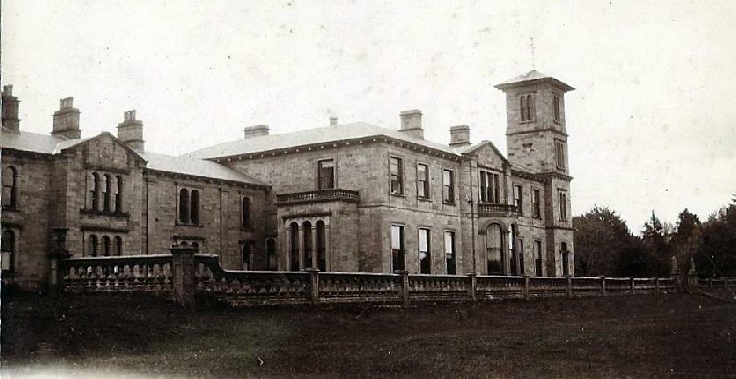
BELHAVEL HOUSE, near Killargue, County Leitrim, was built during the Irish Famine.

The family took up residence there in 1850.

Owing to Mr Lyons-Montgomery's impecunious circumstances, his house and estate were declared bankrupt by a Dublin High Court in 1880.

As a consequence, he, his wife and some family members moved to France where he died a few years later.

By 1900 the big house was in ruins and was demolished by the Irish Land Commission.

The stones were used to construct a new road.

The Irish tourist association survey in the 1940s recorded that "every stone was taken away to build houses throughout the district".

An earlier castle, also in Belhavel, is reputed to have been built by the first Montgomery to settle in the area in the 17th century. 

Do any readers have an image of Belhavel House?

First published in September, 2012.  Lyons-Montgomery arms courtesy of the NLI.

AB Simon

My Nauticalia  replica of Simon

Simon (ca 1947-49) was the ship's cat who served on the Royal Navy frigate HMS Amethyst.

In 1949, during the Yangtze Incident, he received the PDSA's Dickin Medal after surviving injuries from a cannon shell, raising morale, and killing off a rat infestation during his service.

Simon was found wandering the dockyards of Hong Kong in March 1948 by 17-year-old Ordinary Seaman George Hickinbottom, a member of the crew of HMS Amethyst, the Royal Navy frigate stationed in the city in the late 1940s.


At this stage, it is thought Simon was approximately one year old, and was very undernourished and unwell.

Hickinbottom smuggled the cat aboard ship, and Simon soon ingratiated himself with the crew and officers, particularly because he was adept at catching and killing rats on the lower decks.

Simon rapidly gained a reputation for cheekiness, leaving presents of dead rats in sailors' beds, and sleeping in the captain's cap.

The crew viewed Simon as a lucky mascot, and when the ship's commander changed later in 1948, the outgoing Ian Griffiths left the cat for his successor, Lieutenant-Commander Bernard Skinner RN, who took an immediate liking to the friendly animal.

However, Skinner's first mission in command of Amethyst was to travel up the Yangtze River to Nanking to replace the duty ship there, HMS Consort.

Halfway up the river the ship became embroiled in the "Yangtze incident", when Chinese communist gun batteries opened fire on the frigate.

One of the first rounds tore through the captain's cabin, seriously wounding Simon. Skinner died of his wounds soon after the attack.

The badly wounded cat crawled on deck, and was rushed to the medical bay, where the ship's surviving medical staff cleaned his burns, and removed four pieces of shrapnel, but he was not expected to last the night.

He did manage to survive however, and after a period of recovery, he returned to his former duties in spite of the indifference he faced from the new ship's captain, Lieutenant-Commander John Kerans RN.

While anchored in the river, the ship had become overrun with rats, and Simon took on the task of removing them with vigour, as well as raising the morale of the sailors.

Following the ship's escape from the Yangtze, Simon became an instant celebrity, lauded in British and world news, and presented with the "Animal Victoria Cross", the Dickin Medal, as well as a Blue Cross medal, the Amethyst campaign medal, and the fanciful rank of "Able Seacat".

Thousands of letters were written to him, so much that one Lieutenant Stuart Hett RN was appointed "cat officer" to deal with Simon's post.

At every port Amethyst stopped at on its route home, Simon was presented with honour, and a special welcome was made for him at Plymouth in November when the ship returned.

Simon was, however, like all animals entering the UK, subject to quarantine regulations, and was immediately sent to an animal centre in Surrey.

Whilst in quarantine, Simon contracted a virus and, despite the attentions of medical staff and thousands of well-wishers, died on the 28th November, 1949, from a complication of the viral infection caused by his war wounds.

Hundreds, including the entire crew of HMS Amethyst, attended his funeral at the PDSA Ilford Animal Cemetery in East London.


Simon is also commemorated with a bush planted in his honour in the Yangtze Incident Grove at the National Memorial Arboretum in Staffordshire.

Saturday, 30 August 2025

Theatre Royal, Belfast

Third and final Theatre Royal in Belfast: prospect from Arthur Square
I AM GRATEFUL TO MATTHEW LLOYD AND MARCUS PATTON OBE FOR THE USE OF SELECTED MATERIAL IN THE MUSIC HALL AND THEATRE HISTORY WEBSITE AND CENTRAL BELFAST: A HISTORICAL GAZETTEER

THE THEATRE ROYAL, at the corner of Arthur Street and Castle Lane, Belfast, had three incarnations.

It is known to have been running as early as 1793, when the first theatre on the site was built for Michael Atkins.

This first theatre was eventually rebuilt, with construction starting at the close of the season in March, 1870.

Third and final Theatre Royal: view from Arthur Square

It was said to be "a mere red brick enclosure," with various unsavoury smells emanating from its interior.

During construction of the original theatre, a roadway was discovered that was thought to have been a former entrance to the Jacobean Belfast Castle.

The second theatre was opened in 1871, and played host to many well known actors of the time.

Second Theatre Royal, 1871-81: from Arthur Square

The General Manager remained J F Warden, who also operated the Grand Opera House, which opened in 1895.

The second theatre suffered a catastsophic fire in June, 1881.

Despite the fire a new theatre, the third on the site, was soon under construction and was completed just six months later, for its opening in December, 1881.
Pediment detail ( Lawrence Collection/NLI)
The original pediment, containing a coat-of-arms consisting of a central shield with the royal device, flanked by a couchant lion and unicorn. was omitted following the 1881 fire.
The designer of the third Theatre Royal in Belfast was the well known and respected theatre architect, C J Phipps.

Construction was carried out by H & J Martin, who would later go on to construct the Grand Opera House in 1895.

The Era newspaper printed a report on the Theatre Royal in their 1881 edition saying:
...The new theatre, although built within the same space as the late structure, is different in almost every particular ... the elevation facing Arthur-square still retains the five entrance doorways, but their designations have been changed.

The dress circle and the upper circle both enter by the three centre doorways into a large vestibule; thence the audience to the former turn to the left hand, and the latter to the right hand, up the respective staircases.

There will be no confusion or mingling of the audience to these two parts of the house, as the vestibule will be divided by a low barrier, and when the performance is over the additional doorway to the extreme right of the façade will serve as the exit from the upper circle staircase exclusively;

the corresponding doorway on the left, next to Mr Forrester's premises, being the entrance to the pit, which is entered up a few steps from the street. The gallery is entered in Castle-lane - first doorway from the angle of the façade.

Farther along Castle-lane is another wide doorway which opens directly into the refreshment saloon, underneath the pit, and will be opened at every performance as an additional exit for the pit. The stage entrance is in the old position in Castle-lane.

Along the whole of the façade in Arthur-square a covered veranda or porch has been erected of iron and glass; so that the audience waiting for the opening of the doors will be protected when the weather is wet, and those coming in carriages will not have to cross a damp pavement previous to entering the theatre.

The vestibule before referred to is level with the street, and in the wall opposite the entrances are the offices for booking seats and pay places for the dress and upper circles. A corridor in the centre leads to the acting manager's and Mr Warden's offices, and to lavatories for gentlemen.

The floors of this vestibule and the corridor are laid with marble mosaic, from Mr Burke's manufactory, at Venice. Ascending the staircase, to the left of the vestibule are the dress circle and balcony stalls, with a cloak-room on the top of the landing. The balcony stalls have six rows of seats all fitted with the architect's patent arm-chairs, with lifting seats.

This part of the theatre is arranged somewhat after the model of the Gaiety, at Dublin (also designed by Mr Phipps), with small private boxes on either side, behind the second row of seats.

The back of the circle is enclosed from the corridor by a series of elliptical arches, filled with plate-glass sashes, which can be either opened or kept closed, thereby keeping the circle warm and snug, when not entirely fall, and affording means for those standing in the corridor on a full night to both bear and see the performance.

Behind the corridor is a refreshment saloon, adjoining the cloak-room. There are two private boxes in the proscenium, also, on this level, and on the pit tier, the upper circle and the gallery tier. The front of the upper circle tier recedes about two rows of seats behind the dress circle, the front rows of which form a balcony.

The gallery tier also recedes again from the upper circle. The mode of construction is good for sound, and also prevents the well-like appearance which small theatres present when all the fronts of the various tiers are on one perpendicular plane.

The upper-circle has six rows of seats, and a spacious corridor behind for standing - and the same arrangement of refreshment saloon and cloak-room as on the tier below. The gallery, or top tier, has ten rows of seats.

It has two means of access from the two staircases above those of the dress and upper-circle, with a communicating corridor arranged between the two, so that each side of the gallery has a good entrance and exit. 
All the entrance staircases are made of cement concrete, and are supported at either end by brick or concrete walls, with handrails.

The stage is also separated from the auditory by a solid brick wall, carried by an arch over the proscenium, and entirely through the roof, thereby rendering the stage and audience portions of the house entirely distinct from each other; in fact, forming two separate buildings, the only communication between them being two iron doors.

Water is laid on from the high-pressure mains to several parts of the theatre, both before and behind the curtain. The gas meter and supplies are entirely distinct for the stage and auditory, so that the failure of one supply will not affect the other.

In fact, every possible means have been taken, that experience could devise, to insure both the safety and comfort of the audience.

The auditory is thus arranged:— The stage opening, which is 28ft. wide, by 31ft. high, is surrounded by a frame, richly moulded and gilded; above this an arch is formed, in the tympanum of which is painted an allegorical subject, by Ballard, representing "Apollo end the Muses."

On either side of the proscenium are private boxes, one on each of the four levels of the auditory, enclosed between Corinthian columns, richly ornamented and fluted. The three tiers rise one above the other, and the whole is surmounted by a circular ceiling, enclosed in a circular moulded cornice - very richly modelled and gilded.

The flat part of the ceiling is painted in Italian Renaissance ornament, in colours, on a pale creamy white ground. Each of the fronts of the several tiers are richly modelled in ornament of the Renaissance period, and are painted and gilded - the general tone of the ornamentation being cream white and gold.

The effect of this is enhanced by the rich colour of the wall-paper, of a warm Venetian red tone - while the hangings to the private boxes are of silk tapestry, a deep turquoise blue colour, embroidered with sprigs of flowers in colour. The whole scheme of colour has been very carefully arranged by the architect, and the paper and curtains have been specially manufactured for this theatre.

Although the holding capacity of the theatre has been only enlarged by a trifling number, yet it will look much larger and more open than the late theatre, and will be decidedly more ornamental and convenient. A very charming act-drop, painted by Mr Harford, of the St. James's and Haymarket Theatres, London, represents a classical landscape, with satin draperies enclosing it.

The whole of the new and beautiful scenery has been executed by Mr Swift, Mr Beilair, and assistants. The stage occupies its old position, and the roof over it is carried up sufficiently high to admit of the large drop scenes being taken up in one piece, without any rolling or doubling.

At the back of the stage, high up even above the second tier of flies, is the painting gallery, with two frames.

The theatre is illuminated with a powerful sunlight, with a ventilating shaft round it. Subsidiary lights are also placed at the backs of the several tiers, all under the control of the gas man at the prompter's box, and capable of being turned down simultaneously when the exigencies of the scene requires a subdued light.

The various contractors who have been engaged upon the works are as follow:— Messrs H. and J. Martin, of Belfast, for the whole of the builders' work, including stage (under the direction of Mr Owen); Messrs George Jackson and Sons, of London, for the patent fibrous plaster work of box fronts, proscenium, and ceiling; Messrs Strode and Co., for the sunlight and the special gas work for stage;

Messrs Riddel of Belfast, for the general gas-fitting; Messrs Dale have erected the limelight apparatus; Mr E. Bell has executed the whole of the decorative painting and gilding; Messrs George Smith and Co., of Glasgow, have erected the iron and glass veranda porch; Burke and Co., of London, Paris, and Venice, have laid the marble mosaic to vestibule;

Wadmen, of Bath, has manufactured the patent chairs for the dress circle; Messrs N A Campbell, of Belfast, have executed the curtains and upholstery generally in and about the theatre. Mr William Browne has been clerk of works.
Arthur Lloyd is known to have performed at the theatre in 1890, and his father in law, the Drury Lane Tragedian, T C King, appeared in the earlier one in 1858; and again in 1863, in Othello.

The third incarnation of the Theatre Royal ran as a live Theatre for just 34 years before it was demolished and replaced with a new cinema building.

The Building News carried a short piece on its demise in their August 1915 edition, saying:-
Operations have been commenced in connection with the demolition of the Theatre Royal, the site of which is to be utilised for the erection of a picture house on a large scale.

Messrs. Warden, Ltd., the owners of the Theatre Royal, intend to erect a building which will bear comparison with any other structure of the kind in the United Kingdom. The plans have been prepared by Mr Crewe, who designed the Royal Hippodrome, and the contract has been let to Messrs. H. and J. Martin, Ltd., of Belfast.

The whole of the ground floor will be devoted to stalls, with upholstered chairs, and there will be a large and well equipped circle. Accommodation will be provided for an audience of about 1,500.

It is expected that the building will be ready about Christmas.
Theatre Royal: Principal entrance from Arthur Street or Square (Lawrence Collection/NLI)

Construction continued into the following year and the Building News carried another short article in their 1916 edition saying:-
A picture house is being built in Arthur Square, Belfast, from plans by Mr Bertie Crewe, of London. The contractors are Messrs H & J Martin, Ltd, of Ormeau Road, Belfast.
The new building opened as the Royal Cinema in the spring of 1916.

Designed by Bertie Crewe, the building is said to have resembled his Prince's Theatre in London, built some 5 years earlier, and was somewhat smaller than originally advertised, with 900 seats in its stalls and circle levels, and a café for refreshments.

The Royal Cinema continued for many years but is said to have become very run down in its later years and was eventually demolished and replaced with shops in 1961.

Today the site is occupied by Starbuck's café.

First published in July, 2013.

Friday, 29 August 2025

Rock House


ROCK HOUSE, Portstewart, County Londonderry, was given this name in order to distinguish it from its larger neighbour further along the coast, known as the Castle or O'Hara's Castle (Dominican College since 1917).

Rock House pre-dates O'Hara's Castle.

This house was a two-storey, late-Georgian seaside villa of ca 1820, with two bows like round towers at either end of its front.


The bows contained circular rooms.

Rock House was famous for having been the birth-place, in 1835, of FIELD-MARSHAL SIR GEORGE WHITE VC, the defender of Ladysmith.

It was built by Henry O'Hara who later constructed a mansion house on a promontory further to the north.


Rock House is referred to in 1835 as a bathing residence that was usually let during the summer.

The house was rented to James Robert White, of WHITE HALL, County Antrim, during the summer of 1835.

The building was vacant in 1856 and was the property of Alexander Shuldham.

The house was let out for some years and, in 1885, was sold to Thomas Mackey, a wine merchant of Coleraine, at which time it was said to comprise twenty-three rooms, including three reception rooms, nine bedrooms, kitchen, pantries and two WCs.

Extensive outbuildings comprised a large coach-house, stable, byre, and a house for the coachman, the whole "romantically situated on an acre of ground".

In 1908, it was recorded that the house was let for the summer season of three months a year and was otherwise vacant.

The house passed to James Leslie ca 1920; and then to the Wilson family in the 1930s.

It was run as a boarding-house in the summer, though was closed during the winter.

Notes of this period show the house with bays and porch, a rear return with dining room; pantry and scullery; and a stable block to the south which had been converted into rooms for boarders and staff.

In 1945, the property was purchased for £3,000 by Robina Young, when the interior was completely modernised, part of the building accommodating an overflow of visitors from the STRAND HOTEL.

Rock House was demolished overnight in 2001, without permission, during the construction of a block of apartments that now occupy the site:
"Planners were under fire today after ruling out legal action over the flattening of a protected historic building. The listed 19th century [Low] Rock Castle in Portstewart was pulled down in the summer of 2001 to make way for an apartment complex."

"It has taken the DoE's Planning Service almost four years to decide against prosecution. The Department had previously referred to the demolition as an "offence" and stressed that the "necessary legal procedures" were under way."

"Its decision not to go to court has been revealed in a letter to Coleraine Council. The DoE said it had been firmly advised by its lawyers that there was "no reasonable prospect" of a conviction."

"Works to Rock Castle had been "urgently necessary" on health and safety grounds and the developer had carried out the "minimum measures necessary", the letter stated."

"The Department also said that Planning Service chiefs had decided after "careful consideration" that pursuing the case "would not be in the overall public interest". The DoE took a much tougher stance in the immediate wake of the removal of the historic building."

'In a letter to the Ulster Architectural Heritage Society in October 2001, the office of the then Environment Minister, Sam Foster, stated: "The Planning Service has initiated the necessary legal procedures with a view to pursuing prosecution." 

"The Minister's office also stated that the demolition was "at variance" with a Planning Service consent, which required the "retention of the original front section of Rock Castle."

Rita Harkin from the Ulster Architectural Heritage Society said at the time:
"This fine listed building was demolished without consent, to the detriment and dismay of the community. We shared their clear expectation that a prosecution would follow. To maintain that the Department's inaction is in the public interest is risible. Will it not simply prompt others to demolish and reason later, cheating towns and villages of cherished historic buildings?"


I photographed Rock House's replacement during a visit to Portstewart in July, 2013.

The picture was taken from the shore.


At the entrance there remains a tiny fisherman's cottage of ca 1600.

First published in July, 2013.

Gartside-Tipping of Rossferry

The family of TIPPING (anciently Typpinge) had its origin from a village or hamlet of the same name, situated in the township of Clayton-le-Dale, Lancashire. The mansion house, called Tipping Hall, appears to have been possessed by a family bearing the local name certainly as early as the reign of EDWARD III, but probably much earlier.

The family became divided into two branches at the beginning of the 16th century, the elder of which was eventually dignified with a baronetcy, in the person of Sir Thomas Tipping, of Wheatfield, Oxfordshire. The younger Lancashire branch settled at Preston, and afterwards removed to Manchester, where they became possessed of good estates.

RICHARD TIPPING, an alderman of Preston, Lancashire, during the reign of HENRY VII, is recorded as such in the corporation rolls, 1500.

He was succeeded by (most probably his son),

THOMAS TIPPING, Alderman and Mayor of Preston, 1534, 1541-4, who married and had issue, four sons,
Robert, whose descendants remained at Preston;
RICHARD, of whom hereafter;
Evan;
Thomas.
Thomas Tipping was Mayor of the Guild of Preston when his four sons are recorded in the rolls as attending.

His second son,

RICHARD TIPPING, of Manchester, gave to his mansion house the name of Tipping Gates.

He married and had issue, three sons and four daughters.

Mr Tipping died in 1592, and was succeeded by his son,

RICHARD TIPPING, of Tipping Gates, Manchester, who espoused, in 1614, Alice Diggles, of Booth Hall, near Manchester, and had issue.

He died in 1621, and was succeeded by his son and heir,

GEORGE TIPPING (1618-84), of Tipping Gates, Manchester, and of Cheetham Hill, who left, by Jane his wife, a son and heir,

SAMUEL TIPPING (1649-1733), merchant, of Tipping Gates, Manchester, and Cheetham Hill, who wedded Constance, daughter (it is believed) of Adam Byrom, of Kersal, Lancashire, and had issue,

THOMAS TIPPING (1690-1760), of Cheetham Hill, who wedded, in 1716-17, Martha Taylor, of Manchester, and had issue, eleven sons and five daughters, of whom

THOMAS TIPPING (1716-83), of Cheetham Hill, married firstly, in 1741, Esther, daughter of Joseph Bancroft, of Manchester, and had issue, four sons and two daughters; and secondly, in 1773, Katherine Mundy, of Markeaton, Derbyshire, but by her had no issue.

He was succeeded by his son,

JOSEPH TIPPING (1743-1800), of Crumpsall Hall, Lancashire, who married, in 1768, Anne, daughter and heir of Robert Gartside, of Little Bolton Manor, Lancashire, and had issue, three daughters and one surviving son,

THOMAS TIPPING (1774-1886), Lord of the Manor of Bolton, Lancashire, resident at Davenport Hall, Cheshire, who wedded, in 1810, Anna, eldest daughter of Robert Hibbert, of Birtles, Cheshire, and Chalfont Park, Buckinghamshire, and had issue,
GARTSIDE, of whom hereafter;
Vernon (Rev), Rector of Lawton;
Edmond Joseph, of Davenport Hall;
Alfred, of Longparish House;
Francis Gartside (Rev).
Mr Tipping was succeeded by his eldest son,

GARTSIDE GARTSIDE-TIPPING JP (1810-90), of Bolton, Lancashire, and Ross Ferry House, County Fermanagh, who espoused, in 1844, Jane Margaret, eldest daughter of Robert Fowler, of Rahinston, County Meath, by the Lady Jane Crichton his wife, sister of John, 3rd Earl of Erne, of Crom Castle, and had issue,
Henry Thomas, late of Quarr Wood and Bolton;
ROBERT FRANCIS, CB, of whom we treat;
Cavendish Walter, Brigadier, Army Service Corps;
Louisa Letitia Jane; Anna Selina; Mildred Harriette; Alice Margaret.
Mr Gartside-Tipping's second son,

ROBERT FRANCIS GARTSIDE-TIPPING CB (1852-1926), of Ross Ferry, County Fermanagh, 1st Duke of York's Own Lancers (Skinner's Horse), Colonel, Bengal Cavalry, wedded, in 1885, Jane, daughter of James Henry Sclater, of Newick Park, Sussex, and had issue, two daughters,
Margaret Cecil;
Evelyn Rachel.
Having retired, by 1911 Colonel Gartside-Tipping was living at Davenport Hall, Cheshire, with his wife, daughter and a staff of seven.

He died at Kensington on the 16th December, 1926, and is buried at Brompton Cemetery.

Rossferry House (Image: Lisnaskea Historical Society/Richard Gordon)

ROSS FERRY HOUSE, County Fermanagh, stood directly south-east of St Hubert's, opposite the island of Inish Rath, Upper Lough Erne.

Mark Bence-Jones, in Burke's Guide to Country Houses, describes it very briefly as a house of mixed 19th century aspect; Wyatt windows with Georgian astragals; pointed gables, some with bargeboards; and a tall tower capped with fancily-bargeboarded gables. 

Ross Ferry demesne (historic OS map)

To my knowledge, little has been recounted of Ross Ferry, or Rossferry, a close neighbour of St Hubert's, located in a singularly idyllic spot on Lough Erne overlooking Inish Rath.

J A K Dean, in his Plight of the Big House in Northern Ireland, has written about Rossferry on page 108.

Rossferry (Image: Lisnaskea Historical Society/Richard Gordon)

Rossferry was leased in the late 1890s and early 1900s by Captain the Hon Cyril Ward MVO RN (1876-1930), whose brother William, 2nd Earl of Dudley (Lord Lieutenant of Ireland, 1902-5), stayed with him during the yachting season on Lough Erne.

I am grateful to Linda Swindle of Lisnaskea Historical Society for invaluable assistance in obtaining images of Rossferry House.

Thursday, 28 August 2025

The Anderson Baronetcy

ROBERT ANDERSON JP (1837-1921), son of James Anderson, of Corbofin, County Monaghan, married, in 1890, Wilhelmina, daughter of the Rev Andrew Long, of Monreagh, County Donegal.

 
Photo Credit: Belfast City Hall

Mr Anderson, High Sheriff of Belfast, 1903, Lord Mayor of Belfast, 1908-09, High Sheriff of County Monaghan, 1911, was created a baronet in 1911, designated of Parkmount, City of Belfast, and of Mullaghmore, County Monaghan.

Parkmount House

The Andersons lived at Parkmount House, Greencastle, County Antrim, which Sir Robert purchased from the McNeill family in 1905.
In 1666 Parkmount was a lodge or occasional residence of Lord Donegall, and it afterwards passed into possession of the Ludford, Cairns and McNeill families.
Sir Robert also resided at Mullaghmore House, County Monaghan; and Meadowlands, Balmoral, Belfast.


Meadowlands was beside Balmoral Cemetery, Stockman's Lane.

Mullaghmore House, County Monaghan

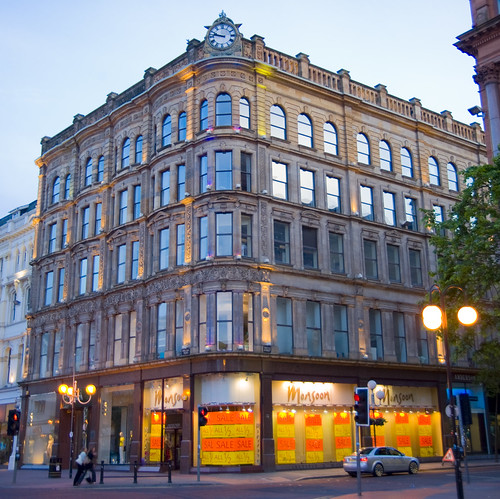
Sir Robert was the proprietor of Anderson & McAuley, the well-known department store at 1, Donegall Place, Belfast.


1, Donegall Place was originally the location of Stephen May's residence.


Anderson & McAuley was established in 1861, and initially occupied modest two-storey premises known as Donegall Place Buildings (above), built in front of Mr May’s house in 1845.

He was also a director of several other companies, including Arnott's.

IN 1861, two brothers, Robert and Alexander Anderson, went into partnership with John McAuley and established a shop at the corner of Donegall Place and Castle Street. However, the first firm did not prosper, the partnership between the brothers dissolved, and McAuley died in 1888.

Robert Anderson continued in the retail business, assisted by George Williams of Hitchcock, Williams and Company, London. By 1895, the firm had become so successful that it moved to a larger, purpose built store. Anderson and McAuley prided itself on a family atmosphere with a business-like approach. It claimed that the secret of its success was ‘courtesy and honest value’.

In 1927, it published the Anderley Gazette as a ‘guide to this house of repute’, which declared that ‘all roads lead to Anderson and McAuley’s, the shopping Centre of Ulster.’ Anderson and McAuley’s were very careful in the selection of their shop assistants, and in the 1930s a position at the store was highly coveted. New female assistants were issued with a standard black dress with snow white collar and advised that ‘scarlet nails and lips plastered with rouge are not an asset to a girl in business.’

Male employees were told that ‘long hair and dirty nails keep many men unemployed.’ In 1953, the first female member of staff was allowed to remain with the company after her marriage. In 1956, the store was one of the first in Northern Ireland to install escalators and people visited the store just to see and experience them. For over a century, shares in the store were held by members of the Anderson family. After Sir Robert’s death in 1921, his nephew James became managing director.

His place was taken by Lady Anderson until her death in 1949; then filled by W H Anderson Esq. In 1979, Anderson and McAuley was one of 200 members of the Association of Independent Stores. It had 374 staff and several stores within the store, including concession departments such as The Ormeau Coffee Shop, Revlon, Windsmoor, Slumberdown, the Minit Heel Bar, and Christy’s towel shop.

After a lengthy market research programme, a major expansion of the store took place in 1989. Customers had criticised Anderson and McAuley’s for being ‘too claustrophobic’. Floor space was increased by 20,000 square feet and six new escalators served every floor. However, the expected raise in sales did not materialise, while high interest rates on the borrowed money for the expansion contributed to the company’s financial difficulties.

Competition from Marks and Spencer, Debenhams and out of town shopping centres ate into the store’s sales. In March, 1994, the last survivor of Belfast’s family owned businesses finally closed its doors. Some 300 members of staff lost their jobs and its valuable stockpile of fixtures and fittings were auctioned.

The closure was seen as marking the end of an era in Belfast’s shopping culture. Today the premises is known as McAuley House.
Following Sir Robert's death in 1921, the baronetcy became extinct.

Sir Robert and Lady Anderson are both buried at Belfast City Cemetery.

First published in August, 2010.

Rathdaire House

THE ADAIRS WERE MAJOR LANDOWNERS IN THE QUEEN'S COUNTY, WITH 9,655 ACRES

The family of ADAIR were originally from Scotland and settled in Ireland about 1690, at the time of the battle of the Boyne.  

THOMAS ADAIRE, son of Archibald Adaire, wedded Mary Hamilton, and settled in the Queen's County (Laois).

His son,

ARCHIBALD ADAIRE, married and was father of

JOHN ADAIR, of Rath, Queen's County, High Sheriff of Queen's County, 1782, who died in 1809, and was father of

GEORGE ADAIR JP DL (1784-1873), of Rath, High Sheriff of Queen's County, 1822, who married Elizabeth, second daughter of the Very Rev Thomas Trench, Dean of Kildare (brother of the 1st Lord Ashtown), and had an only son,

JOHN GEORGE ADAIR JP DL (1823-85), of Rathdaire, Queen's County, and GLENVEAGH CASTLE, County Donegal, High Sheriff of Queen's County, 1867, County Donegal, 1874.
George and his son John George, better known as Jack, built a "state of the art" farmyard at Belgrove in 1851. To justify their investment they ejected their tenants from the best land in Ballyaddan, Rathroinsin, Belgrove, etc., expecting to run the land more efficiently in a larger unit, rather than depending on what they could extract from their tenants.
Jack himself acquired more land in Tipperary, Kildare, and Donegal, and also a large ranch in Texas called the JA Ranch. He died in 1885 on his way home from the States, aged 62 years. Thanks to Dr. Bob Spiegelman of New York we have learned a great deal more about the JA Ranch and Jack's connections with it, as well as Glenveagh in Donegal. When the Irish Land Commission acquired the Estate in 1935 they divided it among some of the Estate employees and enlarged many of the small farms in the area.
The farmyard was divided between four families, and four of the farm buildings were converted into dwellings. Later on three of the families moved elsewhere or changed from farming. As the other families left the Murphy family bought out the rest of the yard. Michael Murphy Sr. was yard-man on the estate when he was a youth and he got a quarter of the farmyard in the 1935 division; he survived to see his family own the whole farmyard eventually.
Mr Adair married Cornelia, daughter of General J S Wadsworth, US Army, in 1867, and died without issue.

Former seats - Rathdaire, Monasterevin, County Laois; Glenveagh Castle, County Donegal.


RATHDAIRE HOUSE, or Bellegrove, was a two-storey over basement Italianate house of ca 1835, with the entrance bay to the centre having full-height flanking bows.

It was burnt in 1887 and is now in ruins with the basement filled-in.

The fittings are now gone; the interior ruinous.

The house is set back from road in its own grounds, now in use as a tillage field.

Stable complex, pair of detached gate lodges, gateway and site of former winter garden to site.

First published in June, 2012.

Wednesday, 27 August 2025

1st Duke of Buckingham and Chandos

DUKEDOM OF BUCKINGHAM AND CHANDOS
1822-1889

The family of GRENVILLE, of Wotton, Buckinghamshire, was a younger branch of the Grenvilles, or Granvilles, of Devon, whose descent from Rollo, 1st Duke of Normandy, is recited and acknowledged in a warrant from CHARLES II to John Granville, 1st Earl of Bath, authorizing him to use the titles of Earl of Corboile, Thorigny, and Granville, which had been borne by his ancestor, Richard de Grenville, who died after 1142.

RICHARD GRENVILLE (1678-1727), of Wotton, married, in 1710, Hester, eldest daughter of Sir Richard Temple Bt, of Stowe, Buckinghamshire, and sister of Richard, Viscount Cobham.

On the death of her said brother, this lady, pursuant to an especial limitation in his patent of creation, became Viscountess Cobham, to her and her heirs male.

Her ladyship was further advanced, in 1749, to the dignity of COUNTESS TEMPLE OF STOWE.

The issue of Lady Temple and Richard Grenville were,
RICHARD, her successor;
GEORGE;
William Wyndham;
James;
Henry.
Her ladyship died in 1752, and was succeeded by her eldest son,

RICHARD, 2nd Earl (1711-79), KG, who wedded Anne, daughter and co-heir of Thomas Chambers, of Hanworth, Middlesex, and had an only child, ELIZABETH, who died in 1742, aged four.

2nd Earl Temple of Stowe (Image: National Portrait Gallery)

His lordship was succeeded by his nephew,

GEORGE, 3rd Earl (1753-1813), KG, KP, who obtained the royal sign manual, 1779, authorizing him to take the names of NUGENT and TEMPLE before that of GRENVILLE, and to sign the name of Nugent before before all titles of honour.

His lordship was created Marquess of Buckingham in 1784.

He married, in 1775, the Lady Mary Nugent, daughter of the 1st Earl Nugent, and had issue,
RICHARD, his successor;
George;
Mary.
His lordship was succeeded by his elder son,

RICHARD, 2nd Marquess (1776-1839), KG, who wedded, in 1796, the Lady Anne Brydges, daughter of James, 3rd and last DUKE OF CHANDOS.

His lordship was created, in 1822, Marquess of Chandos and DUKE OF BUCKINGHAM AND CHANDOS.

His Grace was succeeded by his son,

RICHARD, 2nd Duke (1797-1861), KG, GCH, who wedded, in 1819, the Lady Mary, daughter of the 1st Marquess of Breadalbane, and had issue, with a daughter, a son and successor,

RICHARD, 3rd Duke (1823-89), GCSI, who married firstly, in 1851, Caroline, daughter of Robert Harvey, and had issue,
MARY, 11th Lady Kinloss;
Anne; Caroline Jemima.
His Grace espoused secondly, in 1885, Alice, daughter of Sir Graham Graham-Montgomery Bt; the marriage, however, was without issue.

3rd Duke of Buckingham and Chandos GCSI
(Image: Buckinghamshire County Council)

The titles expired in 1889, on the decease of the 3rd and last Duke.

Former seat ~ Stowe House, Buckinghamshire.

First published in July, 2017.  Buckingham and Chandos arms courtesy of European Heraldry.

Aughentaine Castle

THE KNOX-BROWNES OWNED 10,350 ACRES OF LAND IN COUNTY TYRONE

JOHN HAMILTON BROWNE, of Cumber House, near Claudy, County Londonderry, and Aughentaine, County Tyrone, son of THOMAS BROWNE, of County Londonderry, by Elizabeth Hamilton his wife, niece of James Hamilton, Provost of Strabane ca 1720, and grandson of GEORGE BROWNE, also of Derry, by his wife Mary, daughter of Colonel Hogg, married, in 1795, Jane Matilda, daughter of William Lecky, of Castlefin, County Donegal, MP for Londonderry City, 1790-7, by Hannah his wife, daughter of Conolly McCausland, of DRENAGH, and had issue,
Conolly William Lecky, of Cumber House; died unmarried;
THOMAS RICHARDSON, his successor;
GEORGE, of Cumber House;
John Hamilton;
Hannah Sidney; Elizabeth.

Cumber House (Image: YouTube)

Mr Browne died in 1848, and was succeeded by his second, but eldest surviving son,

THOMAS RICHARDSON BROWNE JP DL (1810-82), of Aughentaine, High Sheriff of County Tyrone, 1832, who wedded, in 1839, Sarah, fourth daughter of Hervey Pratt de Montmorency, of CASTLE MORRES, County Kilkenny, and had issue,

JOHN HERVEY, his heir;
Raymond Saville;
Conolly William Lecky Browne-Lecky;
Rose Sarah; Caroline Frances; Matilda Theodosia.
Mr Browne was succeeded by his eldest son,

JOHN HERVEY KNOX-BROWNE JP DL (1841-1927), of Aughentaine Castle, High Sheriff of County Tyrone, 1887, who married, in 1867, Louisa Elizabeth, daughter of Sir Francis Arthur Knox-Gore Bt, of BELLEEK MANOR, County Mayo, by Sarah his wife, daughter of Colonel Charles Nesbitt Knox, of Castle Lacken, County Mayo, and had issue,
Charles Arthur Hervey (1870-1934), died unmarried;
MERVYN WILLIAM CHARLES NESBITT;
Sarah Hannah Madeline; Augusta Caroline; Eileen Hester Louisa.
Colonel Knox-Browne, ADC to His Grace the Duke of Abercorn, Lord Lieutenant of Ireland, Lieutenant-Colonel, 9th Brigade, North Irish Division, Royal Artillery, assumed the additional surname and arms of KNOX in 1874.

He was succeeded by his younger son,

MERVYN WILLIAM CHARLES NESBITT KNOX-BROWNE DL (1880-1954), of Aughentaine Castle, High Sheriff of County Tyrone, 1935, who wedded, in 1911, Mary, daughter of Captain Thomas Barry George, and had issue,
MERVYN HERVEY, his heir;
Louisa May (1912-69).
Mr Knox-Browne was succeeded by his only son,

MERVYN HERVEY KNOX-BROWNE MBE JP DL (1927-2022), who married, in 1956, Catherine, daughter of Hugh Ferguson, and had issue,

MAUREEN; DEIRDRE ROSEMARY.

Family of Hamilton-Stubber

Mervyn Knox-Browne, who moved to Perthshire, sold Aughentaine Castle to Lieutenant-Colonel John Henry Hamilton-Stubber.

It was subsequently demolished in 1955. 
An ancestor of the Hamilton-Stubbers, Hugh Hamilton, settled at Lisbane in County Down during the reign of JAMES I, died in 1665 and was interred at Bangor, County Down. Hugh's son was called John Hamilton, of Ballymenoch near Holywood. A second son was Alexander Hamilton, of Killyleagh.  
MAJOR ROBERT HAMILTON-STUBBER DSO (1879-1963), of MOYNE HOUSE, married, in 1920, the Lady Mabel Florence Mary Crichton, daughter of John, 4th Earl of Erne, and had issue, an only child,

JOHN HENRY HAMILTON-STUBBER DL (1921-86), Captain, Coldstream Guards, Lieutenant-Colonel, Ulster Defence Regiment, 1972, who wedded, in 1953, Fiona Patricia, daughter of Geoffrey Wyndham Breitmeyer, and had issue,
JAMES ROBERT;
Richard J, Vice Lord-Lieutenant of Co Armagh; m Susanna, dau. of 2nd Viscount Brookeborough;
Charles Geoffrey, born 1960;
David Hugh, born 1962.
The eldest son,

JAMES ROBERT HAMILTON-STUBBER DL (1954-), of Aughentaine, former Lieutenant, Coldstream Guards, married Carola E A Savill, and has issue,
HENRY JAMES HAMILTON-STUBBER, born in 1984.
Photo Credit: © McClitock of Seskinore

AUGHENTAINE CASTLE, near Fivemiletown, County Tyrone, was a large Victorian mansion, built in 1860 for Thomas Richardson Browne.

This mansion house was named after the plantation castle mentioned by Mrs Knox-Browne in 1937 for a BBC interview.

Aughentaine Castle, Entrance Front (Image: 8th Infantry Division)

It consisted of a two-storey main block and a lower two-storey wing, with two tall Italianate campaniles of equal height, one at each end.

Aughentaine Castle, Garden Front (Image:McClintock of Seskinore)

There was an open porch; two-light and three-light windows some round-headed and others rectangular. The roofing was prominent.

The image above is shown by kind permission of McClintock of Seskinore, which contains more pictures of Aughentaine.

The house was demolished ca 1955 by Colonel Hamilton-Stubber, who built a neo-classical house (below) ca 1958 to the design of the Hon Claud Phillimore.


Land was acquired in the 18th century and a demesne was set out but not walled in.

There are many fine mature trees, evidence of the planting that took place for this imposing house.

The landscape designer, Percy Cane, planned an ornamental garden for the house and this is maintained.

Excellent distant views can be seen from the house over Cane’s double terraces and tree-tops on lower ground.

Extensive rhododendron and other shrub planting cascades below the terraces and into the parkland to the south.

Expansion took place post-1958 in the planting beneath mature trees on either side of Ballyness Glen, which runs to the east of the house in an attractive declivity.

There is a lake on high ground to the north of the house, which has an island and is backed by a wood and, further back, extensive forest planting.


It is referred to as a ‘Fish Pond’ in 1858, prior to the erection of the 1860s house.

The 1860s stables are retained and beyond lies the walled garden, which is pre-1858.

It is part-cultivated and the original glasshouses have gone except one, which is in operation.

Several bridges are necessary in the park: one, built in the 1860s, was designed as part of the planned landscape.

Aughentaine estate, near Fivemiletown, is renowned for its garden and forestry.

First published in September, 2010.  Knox-Browne arms courtesy of the NLI.

Tuesday, 26 August 2025

Hamilton-Stubber of Aughentaine

HUGH HAMILTON (1572-1655), of Renfrewshire, settled at Lisbane, County Down, during the reign of JAMES I, and was made a denizen of Ireland in 1616.

He was buried at Bangor, County Down, having had issue,
John, of Ballymenoch;
ALEXANDER, of whom presently;
Robert.
The second son,

ALEXANDER HAMILTON, of Killyleagh, County Down, married Jean, daughter of John Hamilton, of Belfast, and had issue,
HUGH, his heir;
Jane, m William Sloane, of Chelsea.
Mr Hamilton died in 1676, and was succeeded by his son,

HUGH HAMILTON, of Ballybrenagh, who wedded Mary, sister of Robert Ross, of Rostrevor, and daughter of George Ross, of Portavo, by Ursula his wife, daughter of Captain Hans Hamilton, of Carnesure, and had issue,
ALEXANDER, his heir;
George, of Tyrella;
Jane.
Mr Hamilton died in 1728, and was succeeded by his elder son,

ALEXANDER HAMILTON, of Knock, County Dublin, and of Newtownhamilton, County Armagh, MP for Killyleagh, 1730-61, who espoused Isabella, daughter of Robert Maxwell, of Finnebrogue, County Down, by Jane, daughter of the Rev Simon Chichester, Vicar of Belfast (eldest son of Henry Chichester, of Marwood, by Jane, daughter of the Rt Rev Robert Maxwell, Lord Bishop of Kilmore).

He died in 1768, leaving four sons and three daughters,
HUGH (Rt Rev), Lord Bishop of Ossory;
ROBERT, of whom we treat;
George;
Charles;
Isabella; Anne; Elizabeth.
His second son,

ROBERT HAMILTON, of Gloucester Street, Dublin, married Hester, daughter of Crewe Chetwood, of Woodbrook, Queen's County, and had issue,
ALEXANDER CHETWOOD, his heir;
Robert.
Mr Hamilton died in 1790, and was succeeded by his elder son,

THE REV ALEXANDER CHETWOOD HAMILTON, Rector of Thomastown, County Kilkenny (who assumed, in 1824, the surname of STUBBER in lieu of Hamilton, and the arms of Stubber only), married, in 1801, Eleanor, daughter and co-heir of THE REV SEWELL STUBBER, and had issue,
ROBERT, his heir;
Sewell (Rev);
William, of Roundwood, father of 
CHARLES PAULET HAMILTON;
Alexander Chetwood;
Richard Hugh (Rev);
Hester Maria; Harriet Anne; Sophia Elizabeth; Anne Matilda.
The Rev Alexander Chetwood Hamilton died in 1830, and was succeeded by his eldest son,

ROBERT HAMILTON STUBBER JP DL (1803-63), of Moyne, High Sheriff, 1831, who married, in 1840, Olivia, daughter of the Rev Edward Lucas, of the Castleshane family, and widow of Henry Smyth, of Mount Henry, Queen’s County, and had issue,
ROBERT HAMILTON, his heir;
Olivia Harriet Florence Hamilton; Eleanor Frances Beatrice Hamilton.
Mr Hamilton-Stubber was succeeded by his son and heir,

ROBERT HAMILTON HAMILTON-STUBBER JP DL (1844-1916), of Moyne and Castle Fleming, Queen’s County, High Sheriff, Lieutenant, Royal Dragoons, who espoused firstly, in 1877, Adèle Grainger, daughter of Alexander Duncan, of Knossington Grange, Leicestershire, and had issue,
ROBERT, his heir;
Olive.
He wedded secondly, in 1885, Georgina Alice Mary, youngest daughter of George Power, sixth son of Sir John Power Bt, of Kilfane, County Kilkenny, and had issue, a daughter, Margery.

Mr Hamilton-Stubber, who sold the Moyne estate to his cousin, was succeeded by his son and heir,

MAJOR ROBERT HAMILTON-STUBBER DSO (1879-1963), who married, in 1920, the Lady Mabel Florence Mary Crichton, daughter of John Henry, 4th Earl of Erne, and had issue,

LIEUTENANT-COLONEL JOHN HENRY HAMILTON-STUBBER (1921-86), of Aughentaine, County Tyrone, Captain, Coldstream Guards, Major, Ulster Defence Regiment, who wedded, in 1953, Fiona Patricia, daughter of Geoffrey Wyndham Breitmeyer, and had issue,
James Robert, b 1954;
Richard John, b 1955;
Charles Geoffrey, b 1960;
David Hugh, b 1962.
Colonel Hamilton-Stubber's eldest son,

JAMES ROBERT HAMILTON-STUBBER DL (1954-), Lieutenant, the Life Guards, married Carola E A Savill, and had issue,
Henry James, b 1984; m Camilla, daughter of Martin F Trotter, and has issue.


LINEAGE OF STUBBER

Mr SEWELL, a Gentleman of the Bedchamber to CHARLES II, married Miss Ryves, daughter of the Very Rev Dr Bruno Ryves, Dean of Windsor, and had a son,

MAJOR SEWELL, who espoused Miss Stubber, an heiress, and assumed the name and arms of STUBBER.

He was father (with two daughters) of

SEWELL STUBBER, who wedded Miss Finn, daughter of Major William Finn, of Coolfin, Queen's County, by Eleanor Whitshed, and had issue,
Robert;
William;
SEWELL, of whom hereafter;
Edward;
Thomas;
Edmond;
Mary; Eleanor; Sarah.
The third son,

THE REV SEWELL STUBBER (1755-1824), Rector of Ballinakill, married Miss Flood, of Middlemount, Queen's County, and had three daughters,
Catherine;
ELEANOR, of whom we treat;
Mary.
the second daughter,

ELEANOR STUBBER, wedded, in 1801, the Rev Alexander Chetwood Hamilton, Rector of Thomastown, County Kilkenny, elder son of Robert Hamilton, of Dublin, by his wife, a daughter of the Chetwood family, and grandson of Alexander Hamilton, of Knock, County Dublin.

By this lady the Rev Alexander Hamilton (who assumed, 1824, the surname and arms of STUBBER on succeeding to his wife's property) had issue,
ROBERT, of Moyne;
Sewell;
William;
Alexander Chetwood;
Richard Hugh;
Hester Maria; Harriet Anne; Sophia Elizabeth; Anna Matilda.
The eldest son,

ROBERT HAMILTON-STUBBER JP DL (1803-63), of Moyne, Queen's County, married, in 1840, Olivia Lucas, of the Castle Shane family, and had issue,
ROBERT HAMILTON, b 1844;
Olivia Harriet Florence Hamilton; Eleanor Fanny Beatrix Hamilton.