Friday, 26 December 2025

Pheasant Percy

I like the festive tale of Percy the Pheasant, as originally revealed by BBC Northern Ireland.

Pupils at a County Down primary school took a beady-eyed friend under their wing - but the creature appears to have ruffled a few feathers.

Percy the pheasant took up residence in the grounds of Towerview Primary School in Bangor.

He lived there for two months and was particularly fond of the playground.

Percy followed the children around all day, sat in the front porch when it was raining, loitered around the dinner ladies looking for snacks, and peered through the assembly windows to listen to the songs.

As Christmas Day approached, however, the school principal, Alan Brown, suggested that Percy could soon be on a dinner plate.

Why?

Well, it seemed Percy had taken a dislike to the headmaster.

When he saw Mr Brown he attacked his shoes which became full of holes.
"The reason I dared to suggest to pupils that he would be on my Christmas dinner list was that he suddenly became a little aggressive towards my black shoes." 
"He arrived about four or five weeks ago as a small animal and he loves to walk behind me as I go to greet parents in the morning and walks out with me in the afternoon as well."
The headmaster said Percy has started to rule the roost, deliveries were having to be taken via another door and even the caretaker had taken to wearing hobnailed boots.

All the children were horrified at the headmaster's proposal and wrote letters begging for mercy for Percy.

They also made placards in protest.

Primary Seven pupil Amber McGimpsey said,
"He is great, he's very colourful. He mainly goes into the key stage one playground and we feed him at lunchtime. He likes most people except Mr Brown".
Luckily for the pupils, the principal said he had 'grown to love' Percy, so the bird remained safe for another year.

First published in December, 2012.

Thursday, 25 December 2025

Merry Christmas

Cathedral Church of Saint Anne, Belfast (Six Mile Images)
Wishing readers, followers and friends a very merry Christmas

Wednesday, 24 December 2025

The Firewood Poem

THE FIREWOOD POEM, COMPOSED BY LADY CONGREVE, IS THOUGHT TO HAVE BEEN FIRST PUBLISHED IN THE TIMES NEWSPAPER ON THE 2ND MARCH, 1930:-

Beechwood fires are bright and clear
If the logs are kept a year,

Chestnut's only good they say,
If for logs 'tis laid away.

Make a fire of Elder tree,
Death within your house will be;

But ash new or ash old,
Is fit for a queen with crown of gold.

Birch and fir logs burn too fast
Blaze up bright and do not last,

It is by the Irish said
Hawthorn bakes the sweetest bread.

Elm wood burns like churchyard mould,
E'en the very flames are cold

But ash green or ash brown
Is fit for a queen with golden crown.

Poplar gives a bitter smoke,
Fills your eyes and makes you choke,

Apple wood will scent your room
Pear wood smells like flowers in bloom.

Oaken logs, if dry and old
keep away the winter's cold

But ash wet or ash dry
a king shall warm his slippers by.

Fermanagh Rivers

EDITED EXTRACTS FROM THE TOPOGRAPHICAL DICTIONARY OF IRELAND, 1837


THE only river of any consequence is the Erne, which, entering the county a short distance from Belturbet, flows into Lough Erne at its southern extremity, and, after passing Belleek at its northern extremity, discharges itself into Donegal Bay at Ballyshannon; all the other rivers empty themselves into Lough Erne.

River Erne at Belleek (Green Collection/NMNI)

The Finn is navigable for boats as far as Cumber Bridge, on the confines of Monaghan; the Pettigo and the  Omna rise near Lough Derg, in Donegal, and after uniting their streams fall into the lake a mile south of the town of Pettigo.

The Sillees rises near Church Hill, and takes a southern direction to the lake.

There are upwards of 50 smaller streams, all contributing to augment the waters of the great central reservoir.

The Ulster Canal, intended to unite Lough Neagh and Lough Erne, will enter this county from Monaghan, not far from Clones; thence proceeding towards Belturbet, it is to fall into Lough Erne.

The roads are numerous, but for the most part badly laid out; many of them are flooded during winter, exceedingly inconvenient, and kept in indifferent repair.

First published in December, 2023.

Tuesday, 23 December 2025

1st Marquess of Downshire

This family, of Norman extraction, was originally called de la Montagne. In the reign of EDWARD III its members were styled "Hill, alias de la Montagne"; but in succeeding ages they were known by the name of HILL only.

SIR MOYSES HILL (c1554-1630), Knight, descended from the family of HILL, of Devon (two members of which were judges of England in the beginning of the 15th century, and one Lord Mayor of London, 1484), went over to Ulster, as a military officer, with the Earl of Essex, in 1573, to suppress O'Neill's rebellion.

This Moyses Hill was subsequently appointed governor of Olderfleet Castle, an important fortress at the period, as it protected Larne harbour from the Scots.

His first land purchase in County Down came in 1607, when he bought the Castlereagh estates of the hapless Con O'Neill.

Thereafter Sir Moyses acquired the 5,000 acre Kilwarlin estate (now Hillsborough)  from the Magennises.

He represented County Antrim in parliament, 1613, and having distinguished himself during a long life, both as a soldier and a magistrate.

He married firstly, Alice, sister of Sorley Boy MacDonnell, and had issue,
PETER, his heir;
Mary; Penelope; Frances.
Sir Moyses wedded secondly, Anne Grogan, and had further issue,
Arthur.
Sir Moyses was succeeded by his elder son,

PETER HILL, Provost Marshal and Sheriff of County Down, 1641; but we pass to his younger son, ARTHUR, who eventually inherited the estates, upon the demise of Peter's only son, Francis Hill, of Hill Hall, without male issue.

The said

ARTHUR HILL (c1601-63), of Hillsborough, created Constable of Hillsborough Fort, 1660, was Colonel of a regiment in the service of CHARLES I, and he sat in parliament under the usurpation of CROMWELL, as well as after the Restoration, when he was sworn of the privy council.

Colonel Hill married firstly, Anne, daughter of Sir Richard Bolton, LORD CHANCELLOR OF IRELAND, by whom he had, with other issue, Moyses, who wedded his cousin Anne, eldest daughter of Francis Hill, of Hill Hall, and left three daughters.

He espoused secondly, Mary, daughter of Sir William Parsons, one of the Lords Justices of Ireland, and had three other sons and a daughter, the eldest of whom,

WILLIAM HILL (1640-92), succeeded to the estates at the decease of his half-brother, Moyses, without male issue.

Mr Hill was of the Privy Council to CHARLES II, and JAMES II, and was MP for County Down.

He married firstly, Eleanor, daughter of the Most Rev Dr Michael Boyle, Lord Archbishop of Armagh, LORD CHANCELLOR OF IRELAND, by whom he had an only son, MICHAEL; secondly, Mary, eldest daughter of SIR MARCUS TREVOR, who was created Viscount Dungannon (1st creation) in 1662 for his signal gallantry in wounding OLIVER CROMWELL at Marston Moor, and had two other sons.

Mr Hill was succeeded by his eldest son,

MICHAEL HILL (1672-99), of Hillsborough, a member of the privy council, and of the parliaments of England and Ireland, who espoused Anne, daughter and heir of Sir John Trevor, of Brynkinalt, Denbighshire, Master of the Rolls, Speaker of the House of Commons, and first Lord Commissioner of the Great Seal, and had two sons,
TREVOR, his heir;
Arthur, 1st VISCOUNT DUNGANNON 
(2nd creation).
Mr Hill was succeeded by his elder son,

TREVOR HILL (1693-1742), of Hillsborough, who was elevated to the peerage, in 1717, in the dignities of Baron Hill, of Kilwarlin, and Viscount Hillsborough, of County Down.

His lordship wedded Mary, eldest daughter and co-heir of Anthony Rowe, of Muswell Hill, Middlesex; and left (with a daughter, Anne, wedded to JOHN, 1ST EARL OF MOIRA) an only son, his successor,

WILLS, 2nd Viscount (1718-93), who was created Viscount Kilwarlin and Earl of Hillsborough, in 1751, with remainder, in default of male issue, to his uncle Arthur Hill; and enrolled amongst the peers of Great Britain, in 1756, as Baron Harwich, in Essex.

His lordship was advanced to an English viscountcy and earldom, in 1772, in the dignities of Viscount Fairford and Earl of Hillsborough.

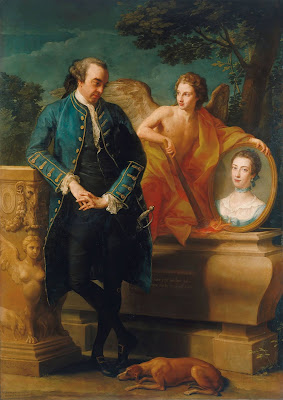
The 1st Earl was further advanced, in 1789, to the dignity of a marquessate, as MARQUESS OF DOWNSHIRE.

1st Marquess of Downshire, by Pompeo Batoni
Dickinson Gallery, London and New York, Public Domain

He married, in 1747, Margaretta, daughter of Robert, 19th Earl of Kildare, and sister of James, 1st Duke of Leinster, by whom he had surviving issue,
ARTHUR, his successor;
Mary Amelia, m  1st Marquess of Salisbury;
Charlotte, m 1st Earl Talbot.
His lordship wedded secondly, Mary, 1st Baroness Stawell, and widow of the Rt Hon Henry Bilson-Legge, son of the 1st Earl of Dartmouth, by whom he had no issue.

His lordship was succeeded by his son,

ARTHUR, 2nd Marquess (1753-1801), who espoused, in 1786, Mary, Baroness Sandys, daughter of the Hon Martyn Sandys, and his wife Mary, daughter of William Trumbull, of Easthampstead Park, Berkshire, and had issue,
ARTHUR BLUNDELL SANDYS TRUMBULL, his successor;
Arthur Moyses William;
Arthur Marcus Cecil, 3rd Baron Sandys;
Arthur Augustus Edwin;
George Augusta;
Charlotte; Mary.
The 2nd Marquess died in 1801, and the Marchioness having subsequently succeeded to the estates of her uncle, Edwin, 2nd Baron Sandys, was created, in 1802, BARONESS SANDYS, with remainder to her second and younger sons successively.

His lordship was succeeded by his eldest son,

ARTHUR BLUNDELL SANDYS TRUMBULL, 3rd Marquess (1788-1845), KP, who married, in 1811, the Lady Mary Windsor, eldest daughter of Other, 5th Earl of Portsmouth, and had issue,
ARTHUR WILLS BLUNDELL SANDYS TRUMBULL WINDSOR, his successor;
William Frederick Arthur Montagu;
Arthur Edwin;
Charlotte Augusta; Mary Penelope.
His lordship was succeeded by his eldest son,
The heir apparent is the present holder's son Edmund Robin Arthur Hill, styled Earl of Hillsborough.

The Downshire Papers are deposited at the Public Record Office of Northern Ireland.

In 1870, Lord Downshire owned 115,000 acres, mainly in County Down; and a further 5,000 acres at Easthampstead Park in Berkshire.

These estates generated an income of £80,000 per annum, or £3.6 million in today's money.


The Downshires also maintained a grand residence in London, Downshire House (above) at 24 Belgrave Square, now part of the Spanish embassy, it is thought.

Their principal seat was HILLSBOROUGH CASTLE; and they also had a marine residence, Murlough House, near Dundrum, also in County Down.

The Hillsborough Castle Guards

Lord Downshire sold Hillsborough Castle to the Government in about 1921, I think; and Murlough remained with the family till the 1940s or 50s.

Easthampstead Park was sold after the 2nd World War.

Other seats included North Aston Hall, Oxfordshire; Timweston, Buckinghamshire; and Hill Park, Kent.

Today the Downshires live at Clifton Castle, near Ripon in North Yorkshire.

First published in July, 2009.

Monday, 22 December 2025

Londonderry Rivers

EDITED EXTRACTS FROM THE TOPOGRAPHICAL DICTIONARY OF IRELAND, 1837


THE principal rivers are the Foyle, the Bann, the Roe, and the Faughan.

The Foyle, which derives its name from the smoothness of its current, intersects the liberties of the city of Derry, in a majestic course north-eastward, having descended from Lifford, where, after the union of several important streams, it first obtains its name.

At Culmore, six miles below the city, which it appears formerly to have insulated, it expands into the estuary of Lough Foyle.

The Bann, or "White River," so called from the purity of its waters, intersects the liberties of Coleraine, within four miles of its junction with the ocean; but the navigation is greatly obstructed by shallows and a very dangerous bar, where the currents of the fresh water and the tide meet.

The Roe, or "Red River," so called from the colour of its waters, receives at Dungiven the Owenreagh: hence, in its course directly north, it receives from the mountains on each side the Owenbeg, the Gelvin, the Balteagh, the Curly Burn, and the Castle River; and winding through the fertile flat by Limavady, it falls into Lough Foyle by Myroe.

The flat country bordering the lower part of its course is exposed to sudden and impetuous floods poured down from the surrounding mountains: many acres of the finest lands are with difficulty defended by embankments, and even with this protection the securing of the crop is never a matter of certainty.

The deposits brought down by this river form many shifting banks in the lough, which prevent its mouth from becoming a convenient little port, although there is sufficient depth of water at high tides.

The Faughan in its course receives numerous rills and streams from the surrounding heights, and falls into Lough Foyle.

The Moyola is a considerable stream descending into Lough Neagh.

The principal tributaries of the Bann are the Clady, Agivey, and Macosquin streams.

There are no canals connected with the county, but an inland navigation, either by a canal, or lateral cuts along the Bann, is contemplated from Lough Neagh to Coleraine, and a Bill is now being applied for, to enable the proprietors of the lands round the lough to lower it to a summer level, and thereby render the Bann navigable to Coleraine.

First published in December, 2023.

Montalto House

SIR JOHN RAWDON (1720-93), 4th Baronet, 1st Baron Rawdon and 1st Earl of Moira, established the Montalto estate.

The market town of Ballynahinch in County Down, like Moira, was laid out by the Rawdon family in the first half of the 17th century.

The Montalto Estate is located on the edge of Ballynahinch.

Montalto House (Image: HistoricHouses.org)

MONTALTO HOUSE, described by Sir Charles Brett as "a mansion of the utmost interest and with features of considerable importance..." was constructed around the mid-1750s, when Lord Moira moved there and made it his home.

The name Montalto derives from the Italian for High Mountain, and in the original construction, Italian plasterers were employed.

From the grounds the Mourne Mountains can clearly be seen.

The house has had a history of alterations and extensions and it was during the 19th Century that a ballroom and service wing were added by the grandson of the original owner.

In 1953 the 6th Earl of Clanwilliam demolished the ballroom section to the south-west and the service wing to the rear.

In 1979 the 6th Earl sold the estate to a consortium of businessmen who used the house for conferences and the land for forestry and farming.

In January, 1985, an extensive fire resulted in the demolition of the north wing, the rear apartments and part of the rear of the south wing.

The damage caused - contained in the east wing and the rear apartments - was so severe that this part of the house had to be demolished.

The present owners appointed Hobart & Heron to restore the house as a private residence.

Major works were undertaken and this included the rebuilding of the east wing.

The house is now fully reinstated to its former Italianate glory with all details of both internal and external adornment.

Original plastered ceilings, the work of Robert West of Dublin, carried out in 1758, still remain to this day and have also been restored.

Of the original two-storey house, only the small sitting-room (called the Lady's sitting-room) remains largely unaltered; while the imposing long gallery could once have been the original entrance hall.

The sitting-room ceiling contains plasterwork of exceptional quality.

Amidst the fiddle-shaped arabesques there are birds modelled in high relief, a squirrel and bunches of grapes.

At one end of the room is a triple niche, the side arches framing plaster scallop-shells, the central one containing a curious stucco relief of a fox driving a cockerel harnessed into an oval curricle.

The 2nd Earl of Moira, KG, afterwards 1st Marquess of Hastings, who distinguished himself as a soldier in the American War of Independence and was subsequently Governor-General of India, sold Montalto in 1802 to DAVID KER.

Ker enlarged the house by undertaking what must have been an exceedingly difficult operation: he excavated the rock under the two-storey house and round the foundations, thus forming a new, lower ground floor, the structure supported by many arches and pillars.

Consequently, the new ground floor was much higher than any basement would be and the operation made the mansion fully three-storey.

Close to the front of the mansion, and overlooking the ornamental lake, there is a substantial mound said to have been built with the spoil from the excavation of the under-storey of the house, which contains a peculiar grotto or bath-house.

The entrance front is of two bays on either side of a three-sided bow; the front also having end-bows.

There is a shallow Doric porch at the foot of the central bow, the original portico having been removed during the Irish famine because neighbouring paupers caused inconvenience to the Ker family by taking shelter under it.

The right-hand side of the house is of ten bays, plus the end bow of the front.

The original ground floor is now the piano nobile.

In the ground floor of 1837 there is an imposing entrance hall with eight paired Doric columns, flanked by a library and dining-room.

A double staircase leads up to the piano nobile, where there is a long gallery running the entire width of the house, which could have been the original entrance hall.

Montalto was bought ca 1912 by the 5TH EARL OF CLANWILLIAM, whose bride refused to live at Gill Hall, the family seat a few miles to the west, on account of a regrettable infestation of ghosts.

The demesne is largely walled with 17th century origins.

It extends to roughly 470 acres today though in 1872 the estate comprised 20,544 acres.

As Lord Moira was a noted botanist, planter and improver, it is likely that Montalto once boasted many exotic specimens dating from his time.

In 1770, he expended £30,000 (£4.08 million in 2010) in planting over 100,000 timber trees between that date and his death in 1793.

There are good stands of mature trees on the undulating site.

The Battle of Ballynahinch in 1798 was fought within the demesne, which suffered damage in the conflict.

It is said that many thousands of forest trees were uprooted or broken in the ‘Big Wind’ of 1839.

There is no walled garden at Montalto, but there was a productive area enclosed by a beech hedge and an orchard.

Some of this still survives.

There is a lake with an artificial shape of a fish, which can be glimpsed across the lawns from the house.

A 1960s eye-catcher gate and clumps of flowering shrubs lie beyond.

An arboretum was added to the south-west of the house, beyond a hillock which contains the spoil from the basement of the house when it was dug out.

The arboretum is small but has a good representation of exotic trees from all over the temperate world. There was a summer house in this area.

The ‘Ladies Garden’ is on the north-east of the house.

Since the property had been acquired by Lord Clanwilliam in 1912, it became somewhat neglected in the second half of the 20th century.

It was sold in 1979 and became part of a business partnership which replanted the demesne in 1986-89.

The house has been in private hands since 1995.

Main Entrance

Other listed buildings on the property include the 1830s schoolhouse; the 1840s farm complex; the Spa Gate Lodge ca 1825, possibly Morrison; West Gate Lodge, pre-1834; and the Ballynahinch Gate Screen, 1870.

The Town Lodge is demolished and several grand designs exist for un-executed gate lodges and screens.

The mansion house has been available as accommodation since March, 2010.

It has eight double bedrooms, a chef and concierge.


Circa 1840 one in every twenty acres in County Down belonged to the Ker family of Portavo, and they owned a further 6,000 acres in County Antrim.

The Kers were amongst Ireland's thirty wealthiest families.

David Stewart Ker continued from 1844 as an ideal and successful landlord, but the burning down of Portavo House in the same year led to his removal to his Montalto estate at Ballynahinch.

However, expenditure on relief work and the loss of rents during the Irish famine meant borrowing and sales of the library and 'Old Master' paintings.

David was returned as one of the Conservative MPs for County Down in the violent election of 1852, but at great financial cost to himself.

As a Liberal, he lost the 1857 election to the Conservative candidates.

His estate debts then exceeded a quarter of a million pounds, and his personal extravagance quickly disposed of the annual balance of about £6,500 available to him out of an estimated income of £31,600, once all outgoings had been paid.

He began selling off land in the Landed Estates Court in 1863.

By 1867 the estate debts had risen to £371,000 and David had taken to drink.

To add to his woes, his second wife and his 23-year old second son, Charley, ran off together in 1871 (Charlie committed suicide five years later).

In 1872, he was declared bankrupt, and management of the estates was placed in the hands of trustees, while he himself was pensioned off and his eldest son succeeded to the heavily encumbered estates.

Downpatrick had to be sold off in 1873 to one of the trustees, John Mulholland.

The surviving estates were in reality now run for the benefit of the creditors rather than the Kers (nevertheless, a modest replacement house was finally built at Portavo in 1885.)

In 1886, the current Ker incumbent of Montalto, the incorrigibly spendthrift Richard, ardent huntsman and womaniser, was receiving only £910 out of a gross income of £17,490.

In spite of the supreme efforts of his trustees and of his solicitor, William Wallace, he too ended up in the bankruptcy courts in 1898 at the age of forty-seven.

The agricultural part of the entire Ker estate was sold off in 1911 under the Wyndham Land Act and Montalto itself went to the Earl of Clanwilliam in 1912.

The house in the demesne at Portavo was to be the final Ulster home of the Kers.

However, by the 1970s the rejuvenated trust fund had been exhausted, and the overdraft had again risen to £80,000.

Home farm, demesne, house and its furnishings were sold off in 1980, and the resident Ker moved to Wiltshire, only to lose everything as a Lloyd's 'name' in 1992. 

First published in June, 2010.

Sunday, 21 December 2025

Armagh: III

Primate's Chapel, Armagh Palace

I paid a visit to the City of Armagh in May, 2013.

Arriving at the main entrance to St Patrick's Roman Catholic Cathedral in the city of Armagh, I strode up the steep hill where, at the summit, there stands augustly and loftily that great cathedral church with its twin spires, seat of many Cardinal Archbishops of Armagh.


There was a wedding taking place inside, so I bided my time by wandering round the cathedral, past Ara Coeli, the official residence of the Catholic Primate.

Ara Coeli is Latin, incidentally.

When the wedding ceremony ended, I walked in to the cathedral, an impressive church dating from about 1840, though not completed until the first years of the 20th century.

Former cardinals' galeros are suspended from the ceiling in the aisles.

Galero

THENCE I ambled on to English Street, past the Charlemont Arms Hotel and, a mere few yards further along, the De Averell guest-house.

Back at The Mall, where I'd parked the two-seater, I stopped to look at the court-house.

The old entrance posts of THE PAVILION, erstwhile home of the Lord Armaghdale, still exist.

The Royal Irish Fusiliers Museum, located at the Sovereign's House, was open; so I spent about thirty minutes there.

They have two Victoria Crosses and Field-Marshal Sir Gerald Templer's uniform is on display, as Colonel-in-Chief of the Regiment.


I drove to the Palace Demesne, well worth a visit.

I've already written about the Palace, official residence of the Church of Ireland Archbishops of Armagh and Primates of All Ireland from 1770 until 1975.


The archiepiscopal arms of Primate Robinson (later 1ST BARON ROKEBY) adorn the entrance front, above the porch.

The private primatial chapel is somewhat dwarfed by its close proximity to the Palace, though this wasn't always the case, since the Palace was originally two storeys in height.

These edifices are austere, though stately, noble and dignified; apt descriptions for archiepiscopal properties.

That concluded my visit to the city of Armagh, though I hope to revisit the city and county during the summer.

First published in May, 2013.

Saturday, 20 December 2025

Grand Opera House Ceiling


Every time I visit the Grand Opera House in Belfast I always admire the ceiling.

It originally had six painted ceiling panels, the blue sky with stars above the oriental balcony with its small potted palms.


When the opera house was being restored in the 1980s, an artist was sought who could recreate the scene in a sympathetic manner.

Cherith McKinstry was selected.

It was felt that her re-interpretation complemented the four surviving painted roundels, which were re-mounted on fibreglass saucer domes, and the cartouche of female musicians inside the segmental arch over the proscenium opening.

The roundels and cartouche were restored and cleaned by Alexander Dunluce (later the 14th Earl of Antrim).


THE GRAND OPERA HOUSE was used as a cinema for many years then closed after bomb damage.

It reopened as a theatre in 1980, after undergoing a successful scheme of renovation and restoration.
The magnificent auditorium is probably the best surviving example in the UK of the Oriental Style applied to theatre architecture - largely Indian in character with intricate detail on the sinuously curved fronts of the two balconies and an elaborate composition of superimposed boxes surmounted by turban-domed canopies.
The ceiling, which is divided into several richly-framed painted panels, is supported on arches above the gallery slips, with large elephant heads at springing level.
Proscenium, 39' 8"; stage depth, 45'; grid increased to 60' from 52'; a new, enlarged orchestra pit, the sharp single radius curve of the orchestra rail providing the only slightly jarring note in this superb auditorium. The exterior, of brick and cast stone, is in a free mixture of Baroque, Flemish and Oriental styles - typical of Matcham’s earlier work.
Frank Matcham made good use of the corner site by building up the composition of his design in stages, linked by strapwork scrolls, to the triangular-pedimented central gable which is flanked by domed minarets.

The Grand Opera House, Belfast, in 2021

The relatively recent projecting glass extension to the former first floor bar (the Crush Bar) is said to be in the spirit of Matcham’s architecture.

It's reminiscent of an elevated conservatory or glass-house.

In 1982, it was made complete by the addition of the visually important column supports.

In 1991 and 1993, the theatre was damaged by terrorist bombs.

This necessitated considerable rebuilding of the Glengall Street dressing-room block and stage door.

Fortunately the auditorium suffered only superficial damage. 

In 2006, an extension was added to the original building on the site of the former Hippodrome/New Vic cinema, costing £10.5 million.

In January, 2020, the opera house closed in order to carry out a major £12.2 million restoration of its interior, including new seating, stage and auditorium curtaining, carpeting, air conditioning, and crush bar.

The 2006 extension was virtually rebuilt, with a completely new façade and interior.

Following the 2020-21 refurbishment, and a delay caused by the Covid-19 pandemic, the opera house reopened on the 6th October, 2021, with performances of the musical Six.

Paul Coleman has provided several images of the ceiling.  First published in May, 2010.

Friday, 19 December 2025

Ardagh House

THE FETHERSTON BARONETS, OF ARDAGH, WERE MAJOR LANDOWNERS IN COUNTY LONGFORD, WITH 8,711 ACRES

The founder of this family, CUTHBERT FETHERSTON, of the ancient stock of the Fetherstons of Heathery Cleugh, County Durham, settled in Ireland after the battle of Worcester, 1651, in which Sir Thomas Fetherstonhaugh was made prisoner, and afterwards beheaded at Chester.

The eldest son of this Cuthbert, 

CUTHBERT FETHERSTON, had three sons,
Cuthbert, ancestor of Fetherston of Bracklyn;
THOMAS, of whom hereafter;
Francis.
The second son,

THOMAS FETHERSTON, settled at Ardagh, County Longford, and marrying Miss Sherlock, had four sons,
John (Very Rev), Dean of Raphoe;
William, of Carrick;
Francis;
RALPH, of whom we treat.
The youngest son,

RALPH FETHERSTON (c1731-80), of Ardagh, High Sheriff of County Longford, 1756, MP for Longford County, 1765-6, was created a baronet in 1776, designated of Ardagh, County Longford.

He wedded firstly, Elizabeth, eldest daughter of Samuel Achmuty, of Brianstown, County Longford, by whom he had an only daughter, Elizabeth; and secondly, Sarah, daughter of Godfrey Wills, of Will's Grove, County Roscommon, by whom he had issue,
THOMAS, his heir;
Godfrey, killed in the East Indies;
John;
Francis;
Sarah; Maria; Letitia; Elizabeth.
Sir Ralph was succeeded by his eldest son,

SIR THOMAS FETHERSTON, 2nd Baronet (1759-1819),  High Sheriff of County Longford, 1781, MP for County Longford, 1783-1800, who married Catherine, daughter of George Boleyn Whitney, of New Pass, County Westmeath, and had issue,
GEORGE RALPH, his successor;
John;
THOMAS, succeeded his brother;
Elizabeth; Catherine; Isabella; Sarah; Octavia.
Sir Thomas was succeeded by his eldest son,

SIR GEORGE RALPH FETHERSTON, 3rd Baronet (1784-1853), High Sheriff of County Longford, 1834, MP for County Longford, 1819-30, who espoused, in 1821, Frances Elizabeth, eldest daughter of Richard Solly, of York Place, Portman Square, London, though the marriage was without issue.
Sir George and Lady Fetherston landscaped the demesne grounds and the village of Ardagh. The conversion of the old house into the mansion within its demesne may have been completed at this time, and involved the re-siting of the village street or road. The village clock-tower and surrounding buildings were erected in 1863 in remembrance of Sir George and of his life-long devotion to the moral and social improvement of his tenantry, and the site whereon they stand purchased by Frances Elizabeth, his widow. A memorial stone in the old church records his death on 12th July 1853, and that his wife died in London twelve years later and was buried in Walthamstow. 
Sir George was succeeded by his youngest brother,

THE REV SIR THOMAS FRANCIS FETHERSTON, 4th Baronet (1800-53), who married firstly, in 1823, Adeline Godley; and secondly, Anne L'Estrange, of Moystown, County Offaly, and had issue,
George Ralph, died in infancy;
THOMAS JOHN, his successor;
Edmund Whitney;
John Henry;
Albert William Boleyn;
Boleyn Henry Francis;
Henry Ernest Wiliam;
Rosa Elizabeth; Catherine.
Sir Thomas was succeeded by his eldest surviving son,

SIR THOMAS JOHN FETHERSTON, 5th Baronet (1824-69), High Sheriff of County Longford, 1858, who espoused, in 1848, Sarah, daughter of Henry Alcock, and had issue,
GEORGE RALPH, his successor;
Adeline Margaret; Caroline Louisa.
Sir Thomas was succeeded by his only son,

THE REV SIR GEORGE RALPH FETHERSTON (1852-1923), 6th and last Baronet, High Sheriff of County Longford, 1897,  who died unmarried, when the baronetcy expired.

Sir George was born in Dublin and educated at Brighton College.

In his mid-twenties he entered Salisbury Theological College to prepare for ordination into the ministry of the Church of England.  

He served as curate in Tenby and Worcester City, and for six years as Rector or Vicar of the Parish of Pydeltrenthide in Dorset.

He served also as an honorary chaplain to Millbank Military Hospital, London, during the 1914-18 War.

He was one of the first two men in Holy Orders to serve as Sheriff in their Counties until the disestablishment of the Church of Ireland clerics of the Anglican Communion were not permitted to hold such Office.

Being Sheriff in 1897 he received the Diamond Jubilee Medal and preached his Jubilee Sermon in St. Patrick's Church, Ardagh.

Sir George was a man of many interests and hobbies — music, travel, cycling, fishing, photography, collecting ancient china and stamps, bird-watching and study of insects.

He travelled widely in Europe, Africa, North and South America.

This must have absorbed some of the Ardagh estate income.

He was Fellow and Vice-President of the Guild of Church Musicians and of the Victoria College of Music London. 

Who's Who credited him with the composition of 150 alternative tunes for Hymns Ancient & Modern, various chants, songs and other music, but none of these are to be found in current chant and Hymn books.

His publications have been listed as The Malvern Hills, Through Corsica with a Pencil. The Mystery of Maple Street, A Poem: The Rose of England. An Incident in the Siege of Antwerp, A Legend of Corpus Christi College, and four books of Sermons and Addresses.

These may have been published privately for limited sale or distribution.

Sir George may not have had much interest in the ownership and management of the estate.

He entered into voluntary agreements with over 300 tenants to sell to them the freehold of their farms, under the Irish Land Act 1903. 

The Ardagh estate was not acquired or purchased by the Irish Land Commission, which, however, advanced the money required by the tenants and others, and the holdings were vested in them by the Commission in 1922-23.

An area of 427 acres of bog land was vested in trustees for the use of purchasing new freeholders.

Sir George retained Ardagh House and demesne acres until his death in a Worcester City Nursing Home, and burial in Tenby, South Wales, in 1923. 


An attempt to destroy the house by fire in 1922 may have been a local expression of dissatisfaction with allocation of estate land or an effort to hasten sale of the last remnants of the estate.

Manuscripts written in Irish were salvaged from the 1922 flames of Ardagh House.


ARDAGH HOUSE is an eight-bay, two-storey (originally three-storey) over-basement house, originally built ca 1730 and altered ca 1826 and ca 1863. 

A Three-bay, two-storey block (formerly the ballroom) was attached to the south-east end, having hipped slate roof with overhanging bracketed eaves.

A single-bay porch with tetra-style porch to the centre of the front façade (south), adjoined to the east by a four-bay single-storey additional conservatory with pilasters and lean-to roof. 


(Image: Longford Tourism)

Ardagh House was acquired as training college by the Sisters of Mercy ca 1927, with multiple extensions to the east and the north-east.

It retains much of its early character despite a fire in 1948 that resulted in it being reduced to two storeys in height.

Much interesting fabric remains, such as some timber sliding sash windows, and console brackets to the porch. 

Although probably early-to-mid 18th century in date, this structure now has a predominantly early-to-mid 19th century appearance.

The elegant porch and conservatory, and the former ballroom/block to the east, were also added at this time. 

It also retains some of its early fabric to the interior, despite the fire in 1948, including plasterwork and fireplaces.

THE POET and novelist Oliver Goldsmith (1728-74), when a young man, once loitered on his way between Ballymahon and Edgeworthstown, strayed from the direct road, and found himself benighted on the street  of Ardagh.

Wishing to find an inn, but inquiring "for the best house in the place", he was wilfully misunderstood by a wag and directed to the large, old-fashioned residence of Sir Ralph Fetherston, 1st Baronet.

Sir Ralph, whom the poet found seated by a good fire in the parlour, immediately perceived the young man's mistake; and being humorous and well-acquainted with Goldsmith's family, he for some time encouraged the deception.

The incidents of the occasion form the groundwork of Goldsmith's well-known comedy "Mistakes of a Night."

First published in December, 2011.

Ballywalter Park

THE BARONS DUNLEATH OWNED 14,688 ACRES OF LAND IN COUNTY DOWN (in 1874)

I have written at length about the lineage of the Mulhollands HERE.

THOMAS MULHOLLAND (1756-1820) married Ann Doe in Belfast, in 1784, and appears to have had at least four sons,
William, settled in the West Indies;
Thomas (1786-1830);
ANDREW (1792-1866);
St Clair Kelburn (1798-1872).
In 1803 Thomas Mulholland senior, described as a 'dealer', bought two houses in Upper Church Lane, Belfast, signing the contract with a simple cross (X).


About 1815 the family entered the flourishing cotton industry by purchasing a mill.

Thomas died in 1820, but the business continued to expand.

In 1822, his sons built a huge spinning mill in the Point Field near York Street.

One Sunday morning in June, 1828, however, disaster struck when this mill was almost totally destroyed by fire.

Yet in fact time was to prove this a most fortuitous disaster for the Mulhollands.

The brothers, Thomas, Andrew and St Clair, with the support of their partner John Hind, decided to rebuild the mill, but for the spinning of flax not of cotton.

In addition to their business interests, the Mulhollands also took an active part in civic affairs.

St Clair was a JP for County Down and High Sheriff of County Louth and in 1865 he donated money for the erection of a new wing at what was to become the Royal Victoria Hospital.

His elder brother, Andrew, had married Elizabeth McDonnell in 1818 and had one son and four daughters.

Andrew Mulholland (1782-1866). (Image: Irish Linen Museum)

He served the office of Mayor of Belfast in 1845.

Andrew built Ballywalter Park, to which he moved in 1846; and he is perhaps best remembered in Belfast today for having provided the Ulster Hall with its fine Grand Organ in 1862.

He bought Springvale (later Ballywalter Park) from the Matthews family in 1846 for the sum of £23,000 (£2 million in 2010).

Andrew's eldest and only son John (1819-95) was educated at the Royal Academy in Belfast and eventually assumed control of the family interests, which aside from the mills included a substantial amount of land: 13,500 acres in County Down and over 1,000 acres near Cookstown in County Tyrone.

John was noted for his business and financial acumen which carried him well beyond the linen industry.

He was, for instance, involved in 1860 in advising HM Government during negotiations with the French over an important commercial treaty regulating trade between the two countries – and, among various other provisions, lowering French duties on flax and linen.

He also played a prominent part in organising the finances of the Church of Ireland after it was disestablished in 1869. He was a JP and High Sheriff for both Counties Down and Tyrone.

In 1868 he stood as a Conservative candidate, with Sir Charles Lanyon, the architect of Ballywalter, for the constituency of Belfast.

Both, however, were defeated, with John coming bottom of the poll.

Yet John persevered and in 1874 he was returned unopposed for Downpatrick, a seat he retained until 1885 [and where his influence, as ground landlord of most of the town, was very strong].

Although he held no political office, he spoke frequently on Irish questions and was a strong supporter of Tory policies.

In 1892 he was raised to the peerage, being created Baron Dunleath, of Ballywalter, on the recommendation of the outgoing Conservative Prime Minister, Lord Salisbury.

Aside from linen and politics, the 1st Baron's other great interest was sailing.

His yacht, the 77-foot schooner Egeria, built in 1865, dominated racing in her class for many years, winning in all over 60 major prizes.

Lord Dunleath died in England in 1895 and was buried at Ballywalter.

The 1st Baron became one of the wealthiest men in the Kingdom, leaving an equivalent fortune of £57 million (£583,000 in 1895).


BALLYWALTER PARK, located in the middle of the Ards Peninsula in County Down, is one of the finest private demesnes in Northern Ireland.

Dunleath Estates Limited has been administered by the Lord Dunleath; the Hon William A Mulholland; R P Blakiston-Houston, etc.

The Estate today extends to 1,500 acres though, 150 years ago, it comprised 14,688 acres (including the Downpatrick Estate).

Mulholland purchased the Downpatrick Estate from the Ker family (of Montalto, Ballynahinch) in 1874, with the exception of the Ballynahinch lands.

Although Ballywalter Park  had a different and earlier provenance (the Matthews family), the vast majority of the Ards estate derived from the Blackwood family, whose seat was Clandeboye, near Bangor in County Down.

The then head of that family, the 1st Earl of Dufferin (later 1st Marquess of Dufferin and Ava), lived much beyond his means in the period up to the late 1860s and became heavily mortgaged to John Mulholland (1st Baron) whose acquisition of the Dufferin estate in the barony of Ards, to the north of Ballywalter, was a matter of foreclosure rather than purchase.

In the short term, this was an undignified and even false position for Dufferin to be in, because he was a leading Ulster Liberal and prominent on that side in Belfast politics, whereas Mulholland was a leading Belfast Conservative.

In the longer term, however, the arrangement benefited both families, because it contributed to establishing the 1st Baron as a major County Down landowner and it forced Lord Dufferin to concentrate on what became one of the most important late 19th-century British diplomatic and proconsular careers.

By 1876 he owned 6,769 acres in the county with a yearly rental of £10,668 (almost £1 million in 2010).


He held another 1,244 acres worth £1,530 annually in County Tyrone, where he was also appointed sheriff in 1873.


Mulholland obtained Dufferin's Ards estate during the sales.

It was adjacent to his county seat, Ballywalter Park, the ownership of which obviously obviated any social need for him to buy Clandeboye House and its demesne, which Dufferin was, with a heavy heart, prepared to sell.

Ballywalter Park, his existing estates, the newly acquired Dufferin acres and his large fortune and public philanthropy, all secured Mulholland's position as an established gentleman.

His prowess was rewarded in 1892 when he was created 1st Baron Dunleath.

When he died in 1895 his estate was valued at £583,266 gross, about £78 million in 2020/.

The original Ballywalter estate consisted of a demesne of around 250 acres, with a two- storey over basement Georgian House called Springvale.

Andrew found the existing Georgian house too modest for his ambitions, since he had also become Mayor of Belfast at the time of his purchase, and so he commissioned the architect and fellow Belfast city councillor, Charles Lanyon, to build something more in keeping with his perceived status. 


Ballywalter House is stated to be Ulster's finest 19th century palazzo, with a metropolitan air and all the architectural trappings of a London club.

The Dunleath Papers are held at the Public Record Office of Northern Ireland.

The present demesne is an amalgamation of two adjoining older establishments, viz. Ballymagown, later Springvale House (the site on which the present house is constructed); and Ballyatwood, to the west.

The first house of Ballymagown, a two-storied block over a basement, was built in the 1730s by Mr Matthews following its purchase from the Montgomerys' Rosemount estate.

It was remodelled between 1805-12 and renamed Springvale.

Planting and features remain from this earlier phase.

Following the purchase of the demesne by the 1st Baron in 1846, work began on the present house by Lanyon, which was completed in 1852.

This involved remodelling and extending the existing Springvale house, subsequently renamed Ballywalter Park, in Italian Renaissance style.

In 1863, Lanyon returned to add the conservatory and the Gentleman's Wing to the north-west corner; while in 1902 the architect, W J Fennell, added the Bachelor's Wing to provide accommodation for visiting cricketers.

A balustraded entrance drive at the east front of the house overlooks parkland to the sea.

Extensive replanting followed the purchase of the property in 1846.

Older shelter belts were retained as an important element in an exposed site, while others were planted for the present house.

There are mature woodlands, with rides and extensive parkland within the walls.

Planting post-1846 was extensive and about 93,500 trees and shrubs were added in the first winter.

Mature parkland trees at the west side of the house were removed to give space for planting fashionable exotic evergreens.

Rhododendrons were introduced.

The latter collection flourished in the first half of the 20th century and the surviving plants are recorded in Mary Forrest’s, Trees and Shrubs Cultivated in Ireland, compiled in 1988, including several raised by the 3rd Baron Dunleath and, notably, Lady Dunleath.

There is a rock and water garden (restored in 1988) dwarfed beneath the now large evergreens amidst rolling lawns.

Mark Bence-Jones aptly describes the site in 1988, in A Guide to Irish Country Houses: 
The garden front of the house overlooks wide-spreading lawns with paths and statues, beyond which is a notable collection of ornamental trees and shrubs.
One vista has been cut to a modern folly of 1986. Many paths have been grassed over.

A dovecote of 1759 lies in the woods. Ornamental bridges by Lanyon span streams.

Henry, 4th Baron Dunleath (Image: Farming Life, 1982)

The walled garden, contemporary with the present house, is cultivated and adorned with a rose pergola.

A rose garden occupies the southern end of the garden and there is ornamental planting on the exterior, on the path from the house to the walled garden.

Glasshouses have recently been restored.

The head gardener, W King, contributed a regular column to Irish Garden on ‘The Flower Garden’ in the hey-day of Northern Ireland’s great country house gardens just before the 1st World War.

An Edwardian cricket pitch and 9-hole golf course are no longer present.

The retained Springvale pre-1834 stables are listed.

There were originally seven gate lodges, one of which is by Lanyon ca 1850 and another by Fennell of ca 1900.

First published in May, 2010.