Friday, 20 February 2015

Tullyratty


When you park your car along the track, step out, and walk into a field at Tullyratty, it feels as if you are entering a bygone era.

Further along the track there are the remains of an old farmstead, doubtless worthy of restoration should funds become available.

Several of the fields are like unspoiled meadows; and this is just the kind of place that the National Trust wishes to foster and protect for future generations.

Tullyratty is a townland beside the Castle Ward estate in County Down.

It can be accessed from the drive which leads to Downpatrick gate lodge in Castle Ward.

During the summer of 2009, we were uprooting and extracting some unwanted species of flora, viz. ragwort and creeping thistle.

Fortunately for us, these weeds are mostly easy to pull out; though some are larger and more resistant than others.

We spotted many caterpillars and butterflies; and heard the high-pitched cry of a buzzard.

We also saw the well-worn path of a badger family in the field.


We had our packed lunches in the meadow, the sun shining for us by now. There were four of us today.

I donned the nosebag for ox-tongue and salad cream sandwiches; washed down with two good beakers of tea.

For me, this sort of task is a labour of love.

*****

THERE used to be a lead-mine at Tullyratty. Brian Fitzsimons wrote about it in 1999,


In the late 1820s there were at least 14 lead mines working in the east of County Down, from Conlig to Dundrum. One such mine was located in the townland of Tullyratty on the farm of one Thomas Smith.

It was first opened in 1827 and the shaft reached a depth of 102 feet. There were several horizontal drifts, which are veins of ore. The mine had both lead and silver but the silver content was small at 10 ounces, pound of silver to one ton of lead.

Thirty tons of ore were extracted from the mine and were sold in Liverpool. It was assayed both there and in London to have between 75% and 80% lead content.

The ore would have been shipped from Strangford as the proprietor of the mine was the Right Hon. Lord de Ros of Old Court who also owned Strangford Harbour.
It was said that one cargo of ore sank at the bar mouth of Strangford Lough. Whether this happened in 1830 when work stopped, to be resumed in 1842 , is now uncertain.


The mine was working again in 1853 however and this is substantiated by the registration of two children baptized at Christ Church in Ballyculter.
A daughter Mary Anne born 11th March 1853 to Nancy and Alexander Hershen a miner and a daughter Elizabeth born 18th March 1853 to Grace and John Patton a labourer at the lead mine in Tullyratty.


I have no idea when the workings ceased but my great uncle Felix Rogan born 1872 from Ballintlieve, who often visited Johnny Lawson at Tullyratty, told Richard Sharvin who is the present owner of the farm where the mine is located, that he remembered the shaft being filled in.

The iron ladder in the shaft which was made b a blacksmith was too heavy to be removed and so it was buried. Flooding in the shaft was a problem but as the land there is elevated it was proposed that a horizontal shaft be dug to drain the mine to Cromie's Bog bear Carlin but it was probably too expensive. 

The entrance to the mine and the horse walk are in a field called Mine park which is at the rear of Richard Sharvin's farm yard.
The horse walk was where one or two horses were harnessed to a horizontal pole and they walked around in a circle The pole turned machinery which was used to pump water from the shaft or to winch the ore to the surface. The remains of the store house , in which the tools and equipment were kept, are still visible.

The powder house in which the explosives for blasting were stores is situated high on the north side of Slieve Triplog at a safe distance from the mine shaft.
It is completely constructed of stone with a corbelled roof and when inspected in November 1998, during a very wet spell, the walls and floor were completely dry.

The spoil from the mine may have been dumped at Buttony beside Tullyratty and Ballintlieve.
When the ground was cleared about two years ago a large amount of broken stone was found there. Lead and silver traces can still be found in rocks and stones around Tullyratty to this day.

Some years ago, when excavations were being dug for the building of a shed in Richard Sharvin's yard, I remember noticing the rock that was removed had a high quantity of lead in it. I doubt if the Tullyratty mine will ever be worked again, but who knows?"
First published in 2009.

Wednesday, 18 February 2015

New Conn's Water Series

River Conn's Water at health centre: February, 2015

Over the course of the next eighteen months it is my intention to chart pictorially the work which will transform the river Conn's Water in Belfast.

This section forms part of the ambitious and worthy Connswater Community Greenway project.

I will be taking photographs as the project progresses.

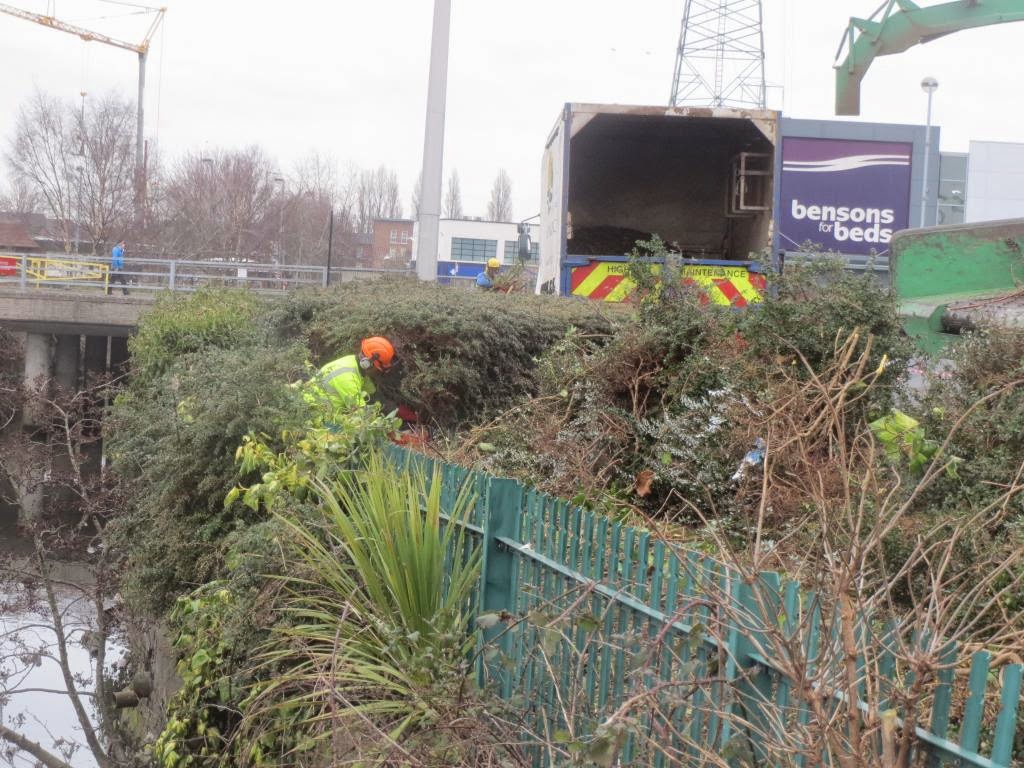
The River is currently a silted up, overgrown, neglected dumping-ground.

The Greenway Project will transform it into a beautiful aquatic artery running through the heart of east Belfast.

Riparian scrub clearance at retail park: February, 2015

I propose to focus on the River from its termination at Victoria Park to Mersey Street Bridge; from the said bridge to Holywood Arches Health Centre (where the river is culverted); and from Connswater Bridge to Harry Corry's store at Connswater Retail Park.

As many shall already be aware, Connswater retail and industrial estate was formerly the huge Belfast Rope Works.

The river Conn's Water is named after the last of the Ulster chieftains, Conn O'Neill, whose seat was in the Castlereagh hills.

The River cuts across the Newtownards and Beersbridge roads.

Monday, 9 February 2015

Operatic Matinée


We spent a delightful afternoon at the Grand Opera House, Belfast, yesterday.

Having had an aperitif (!) in the Europa Hotel's piano bar, we walked across the street and into the theatre.

We were watching a lively modern production of Salome, the one-act opera by Richard Strauss.

Beware: visit the loo before taking your seat!

The opera was performed by Northern Ireland Opera.


From our seats in one of the boxes we had a wonderful view of the heavenly ceiling in the auditorium, one of the finest in Belfast (lest we forget the sumptuous ceiling of The Great Room at Belfast's Merchant Hotel).

While I was waiting for M, I had the pleasure of meeting Michael Jay and Fionnuala Jay-O'Boyle.

Mrs Jay-O'Boyle, CBE, succeeded Dame Mary Peters as Lord-Lieutenant of Belfast in 2014.

M and self dined at Flame Restaurant, one of several good dining establishments on Howard Street.


We both had the fillet of beef, which was trimmed and cooked to perfection.


Flame is located on the ground floor of the old Presbyterian War Memorial building, a seven-storey red sandstone block of 1922-25 at the corner of Brunswick Street.


A mural plaque in the restaurant reminds us that it was laid by Lord Beatty in 1923.

Saturday, 7 February 2015

Brackenber Tie


Cognizant that this is indeed far too long a shot, I'm calling on anybody who no longer has any need of an Old Brackenbrian tie to get in touch.

Not, I hasten to add, for myself. I possess one.

Several old boys have intimated that they yearn for one.

Of course these ties are no longer made.

Perhaps readers have a relative or uncle who attended Brackenber House School and there's an old tie languishing or gathering dust in a drawer or attic.

You never know!

Brackenber Dinner


I attended the annual Brackenber House school old boys' dinner last night.

It took place, as usual, at the splendid Ulster Reform Club in Royal Avenue, Belfast.

Incidentally, Brackenber was a preparatory school located at Cleaver Avenue, off Malone Road.

Alas, it closed down many years ago and was subsequently demolished for a housing development.


We assembled outside the lift on - I think - the second floor, outside the old billiards-room.

I relish this annual function.

It's a terrific opportunity to see old faces and chin-wag with Old Brackenbrians rarely seen from one year to the next.

Gordon Harvey greeted us as we arrived.

My first encounter was with Johnny Knox, who taught me French at Campbell.

Ross Thompson (Punjana Tea) duly arrived and we chatted briefly with him.

At dinner I was sitting beside Patrick Cross, who has recently been appointed High Sheriff of County Down.


I was at Brackenber in the early seventies with Patrick's younger brother, William.

He reminded me that the Crosses used to have a flat close to the Elmwood Hall.

I spotted CT Hogg.

Our speaker this year was Councillor Tom Ekin, who served the office of Lord Mayor of Belfast ten years ago.

The meal was very good, as ever: the beef - braised, I believe - was particularly tender.

After dinner a few of us retired to one of the lounges downstairs; not before we wandered unwittingly into another private function, where the guests wore dinner jackets with miniature medals, including an OBE and several MBEs.

I got a cab home and was gratified to learn that they can now collect patrons directly outside the Club (last year I had to meet my cab at Bank Street).

By the way, there were sixty-five of us at the dinner this year, an increase of about a dozen or so since 2014.

Friday, 6 February 2015

New Vice Lord-Lieutenant

APPOINTMENT OF VICE LORD-LIEUTENANT


Mr Denis Desmond CBE, Lord-Lieutenant of County Londonderry, with the approval of Her Majesty The Queen, has been pleased to appoint

MRS STELLA BURNSIDE OBE DL,

Vice Lord-Lieutenant for the said County, her Commission bearing date 29th January, 2015.

Sunday, 1 February 2015

Greg Mausoleum


I paid a visit to Knockbreda cemetery in January, 2013. 

There are many interesting mausolea and grave-stones there, including that of the Greg family.

The Gregs were prosperous Belfast merchants in the 18th century. 

John Greg, a blacksmith, removed from Scotland to Belfast to forge (unintended pun!) a successful career as a butcher and provision merchant.


His son Thomas opened a shop in North Street, where he sold a wide range of goods.

Ultimately, Thomas Greg made his fortune in the West Indies campaign, applying to the Crown for the right to become a privateer.

First published in January, 2013.