Sunday, 28 December 2025

Derry Palace

THE see of Derry was constituted in 1158.

It originated in a monastery founded by St Columb, about 545, of which some of the abbots at a very early period were styled bishops; but the title of Bishop of Derry was not established until 1158, or even a century later, as the bishops, whose See was at Derry, were sometimes called Bishops of Tyrone.

The See first existed at Ardstraw, where St Eugene, the first bishop, died about 618.

It was subsequently transferred to Maghera, whence it was transferred to Derry.

By an inquisition in 1622, the Bishop was found to be entitled to fish for salmon on the Monday after the 4th June, within the great net fishery belonging to the London Society; also to half the tithe of salmon, etc, caught in the River Bann and Lough Foyle.

Bishop Hopkins, who died in 1690, was at great expense in beautifying the cathedral and furnishing it with organs and massive plate; and is said to have spent £1,000 in buildings and other improvements in this diocese and that of Raphoe.

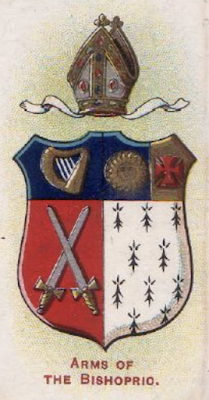
Episcopal Arms of Derry & Raphoe
(Image: Will's Cigarette Card)

Derry continued to be a separate bishopric until the death of Dr Bissett, Lord Bishop of Raphoe, 1836, when that See was annexed to the diocese of Derry, and its temporalities became vested in the Ecclesiastical Commissioners.

Its greatest length is 60 miles, and its greatest breadth 54 miles, extending into four counties.

It comprises parts of counties Londonderry, Tyrone, Donegal, and Antrim.

The Palace: Garden Front (Image: Robert French)

THE PALACE, adjoining the cathedral, was built in 1753 by the Right Rev William Barnard, Lord Bishop of Derry, 1747-68.

It comprises a square Georgian block of three storeys over a high basement.

It is thought that the palace was extended ca 1800 by the Earl-Bishop, the Right Rev Frederick Augustus Hervey.

It was damaged in 1802 while occupied as a barrack and subsequently repaired by the Right Rev and Hon William Knox.

Former Bishop's Palace (Image: Northern Regional College)

The former gardens at the sides and rear of the palace have been replaced by a more prosaic car-park.

The palace was sold by the Church of Ireland in 1945-6 to the Freemasons.

First published in October, 2015.

Saturday, 27 December 2025

Historic Lecale

LECALE, ONCE COMPRISING THE HISTORIC BARONIES OF LECALE UPPER AND LECALE LOWER, IS A FLAT PENINSULA IN COUNTY DOWN, LYING BETWEEN STRANGFORD LOUGH AND DUNDRUM BAY.

IT IS BOUNDED TO THE WEST BY THE RIVERS QUOILE AND BLACKSTAFF, AND THE MARSHES WHICH USED TO SURROUND THE LOW HILL ON WHICH DOWN CATHEDRAL STANDS.


I have two small publications which are most interesting: The Bangors and Ballyculter, an historical sketch of the parish of Ballyculter (Strangford), written in 1980 by the late Rev William Edmund Kennedy; and Lecale Miscellany, Issue Four, published in 1984 by Lecale Historical Society.

Mr Kennedy wrote much about the parish of Ballyculter and its beautiful parish church.

OLD COURT CHAPEL, nestling in the grounds of the de Ros demesne - home to Peter and Siân Maxwell (Lord and Lady de Ros) - also gets a mention.

The title of Ros apparently used to be spelt Roos, hence the latter pronunciation.

Peter Maxwell is the 28th BARON DE ROS and Premier Baron of England.


Lord Bangor owned the townlands of Audleystown, Ballincleave, Ballyculter Upper and Lower, Loughkeeland, Raholp, Castle Mahon and Castle Ward.

Lord de Ros was landlord of Cairntaggart, Killard Upper and Lower, Strangford Upper and Lower, and Tullyratty.

GIBB'S ISLAND was once a busy shipping route from the port of Downpatrick - at Quoile Quay - out to Strangford Lough and thence to the open sea.

This route must have been spectacular for sailors and passengers in various steamers, winding their way from Quoile Quay or Steamboat Quay, outside Downpatrick, in a northerly direction.

The river meandered its way up to Castle Island and Hare Island - where a great tidal barrage now blocks the river; past Gibb's Island and Gores Island; between SALT ISLAND and Moore's Point; then presumably skirting westwards of Green Island, into Strangford Lough proper.

First published in September, 2009.

Friday, 26 December 2025

Pheasant Percy

I like the festive tale of Percy the Pheasant, as originally revealed by BBC Northern Ireland.

Pupils at a County Down primary school took a beady-eyed friend under their wing - but the creature appears to have ruffled a few feathers.

Percy the pheasant took up residence in the grounds of Towerview Primary School in Bangor.

He lived there for two months and was particularly fond of the playground.

Percy followed the children around all day, sat in the front porch when it was raining, loitered around the dinner ladies looking for snacks, and peered through the assembly windows to listen to the songs.

As Christmas Day approached, however, the school principal, Alan Brown, suggested that Percy could soon be on a dinner plate.

Why?

Well, it seemed Percy had taken a dislike to the headmaster.

When he saw Mr Brown he attacked his shoes which became full of holes.
"The reason I dared to suggest to pupils that he would be on my Christmas dinner list was that he suddenly became a little aggressive towards my black shoes." 
"He arrived about four or five weeks ago as a small animal and he loves to walk behind me as I go to greet parents in the morning and walks out with me in the afternoon as well."
The headmaster said Percy has started to rule the roost, deliveries were having to be taken via another door and even the caretaker had taken to wearing hobnailed boots.

All the children were horrified at the headmaster's proposal and wrote letters begging for mercy for Percy.

They also made placards in protest.

Primary Seven pupil Amber McGimpsey said,
"He is great, he's very colourful. He mainly goes into the key stage one playground and we feed him at lunchtime. He likes most people except Mr Brown".
Luckily for the pupils, the principal said he had 'grown to love' Percy, so the bird remained safe for another year.

First published in December, 2012.

Thursday, 25 December 2025

Merry Christmas

Cathedral Church of Saint Anne, Belfast (Six Mile Images)
Wishing readers, followers and friends a very merry Christmas

Wednesday, 24 December 2025

The Firewood Poem

THE FIREWOOD POEM, COMPOSED BY LADY CONGREVE, IS THOUGHT TO HAVE BEEN FIRST PUBLISHED IN THE TIMES NEWSPAPER ON THE 2ND MARCH, 1930:-

Beechwood fires are bright and clear
If the logs are kept a year,

Chestnut's only good they say,
If for logs 'tis laid away.

Make a fire of Elder tree,
Death within your house will be;

But ash new or ash old,
Is fit for a queen with crown of gold.

Birch and fir logs burn too fast
Blaze up bright and do not last,

It is by the Irish said
Hawthorn bakes the sweetest bread.

Elm wood burns like churchyard mould,
E'en the very flames are cold

But ash green or ash brown
Is fit for a queen with golden crown.

Poplar gives a bitter smoke,
Fills your eyes and makes you choke,

Apple wood will scent your room
Pear wood smells like flowers in bloom.

Oaken logs, if dry and old
keep away the winter's cold

But ash wet or ash dry
a king shall warm his slippers by.

Fermanagh Rivers

EDITED EXTRACTS FROM THE TOPOGRAPHICAL DICTIONARY OF IRELAND, 1837


THE only river of any consequence is the Erne, which, entering the county a short distance from Belturbet, flows into Lough Erne at its southern extremity, and, after passing Belleek at its northern extremity, discharges itself into Donegal Bay at Ballyshannon; all the other rivers empty themselves into Lough Erne.

River Erne at Belleek (Green Collection/NMNI)

The Finn is navigable for boats as far as Cumber Bridge, on the confines of Monaghan; the Pettigo and the  Omna rise near Lough Derg, in Donegal, and after uniting their streams fall into the lake a mile south of the town of Pettigo.

The Sillees rises near Church Hill, and takes a southern direction to the lake.

There are upwards of 50 smaller streams, all contributing to augment the waters of the great central reservoir.

The Ulster Canal, intended to unite Lough Neagh and Lough Erne, will enter this county from Monaghan, not far from Clones; thence proceeding towards Belturbet, it is to fall into Lough Erne.

The roads are numerous, but for the most part badly laid out; many of them are flooded during winter, exceedingly inconvenient, and kept in indifferent repair.

First published in December, 2023.

Tuesday, 23 December 2025

1st Marquess of Downshire

This family, of Norman extraction, was originally called de la Montagne. In the reign of EDWARD III its members were styled "Hill, alias de la Montagne"; but in succeeding ages they were known by the name of HILL only.

SIR MOYSES HILL (c1554-1630), Knight, descended from the family of HILL, of Devon (two members of which were judges of England in the beginning of the 15th century, and one Lord Mayor of London, 1484), went over to Ulster, as a military officer, with the Earl of Essex, in 1573, to suppress O'Neill's rebellion.

This Moyses Hill was subsequently appointed governor of Olderfleet Castle, an important fortress at the period, as it protected Larne harbour from the Scots.

His first land purchase in County Down came in 1607, when he bought the Castlereagh estates of the hapless Con O'Neill.

Thereafter Sir Moyses acquired the 5,000 acre Kilwarlin estate (now Hillsborough)  from the Magennises.

He represented County Antrim in parliament, 1613, and having distinguished himself during a long life, both as a soldier and a magistrate.

He married firstly, Alice, sister of Sorley Boy MacDonnell, and had issue,
PETER, his heir;
Mary; Penelope; Frances.
Sir Moyses wedded secondly, Anne Grogan, and had further issue,
Arthur.
Sir Moyses was succeeded by his elder son,

PETER HILL, Provost Marshal and Sheriff of County Down, 1641; but we pass to his younger son, ARTHUR, who eventually inherited the estates, upon the demise of Peter's only son, Francis Hill, of Hill Hall, without male issue.

The said

ARTHUR HILL (c1601-63), of Hillsborough, created Constable of Hillsborough Fort, 1660, was Colonel of a regiment in the service of CHARLES I, and he sat in parliament under the usurpation of CROMWELL, as well as after the Restoration, when he was sworn of the privy council.

Colonel Hill married firstly, Anne, daughter of Sir Richard Bolton, LORD CHANCELLOR OF IRELAND, by whom he had, with other issue, Moyses, who wedded his cousin Anne, eldest daughter of Francis Hill, of Hill Hall, and left three daughters.

He espoused secondly, Mary, daughter of Sir William Parsons, one of the Lords Justices of Ireland, and had three other sons and a daughter, the eldest of whom,

WILLIAM HILL (1640-92), succeeded to the estates at the decease of his half-brother, Moyses, without male issue.

Mr Hill was of the Privy Council to CHARLES II, and JAMES II, and was MP for County Down.

He married firstly, Eleanor, daughter of the Most Rev Dr Michael Boyle, Lord Archbishop of Armagh, LORD CHANCELLOR OF IRELAND, by whom he had an only son, MICHAEL; secondly, Mary, eldest daughter of SIR MARCUS TREVOR, who was created Viscount Dungannon (1st creation) in 1662 for his signal gallantry in wounding OLIVER CROMWELL at Marston Moor, and had two other sons.

Mr Hill was succeeded by his eldest son,

MICHAEL HILL (1672-99), of Hillsborough, a member of the privy council, and of the parliaments of England and Ireland, who espoused Anne, daughter and heir of Sir John Trevor, of Brynkinalt, Denbighshire, Master of the Rolls, Speaker of the House of Commons, and first Lord Commissioner of the Great Seal, and had two sons,
TREVOR, his heir;
Arthur, 1st VISCOUNT DUNGANNON 
(2nd creation).
Mr Hill was succeeded by his elder son,

TREVOR HILL (1693-1742), of Hillsborough, who was elevated to the peerage, in 1717, in the dignities of Baron Hill, of Kilwarlin, and Viscount Hillsborough, of County Down.

His lordship wedded Mary, eldest daughter and co-heir of Anthony Rowe, of Muswell Hill, Middlesex; and left (with a daughter, Anne, wedded to JOHN, 1ST EARL OF MOIRA) an only son, his successor,

WILLS, 2nd Viscount (1718-93), who was created Viscount Kilwarlin and Earl of Hillsborough, in 1751, with remainder, in default of male issue, to his uncle Arthur Hill; and enrolled amongst the peers of Great Britain, in 1756, as Baron Harwich, in Essex.

His lordship was advanced to an English viscountcy and earldom, in 1772, in the dignities of Viscount Fairford and Earl of Hillsborough.

The 1st Earl was further advanced, in 1789, to the dignity of a marquessate, as MARQUESS OF DOWNSHIRE.
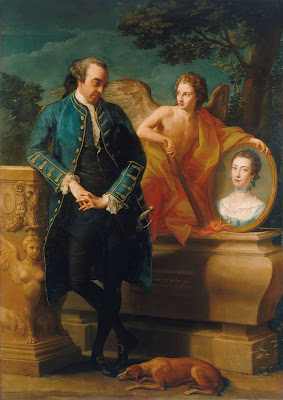
1st Marquess of Downshire, by Pompeo Batoni
Dickinson Gallery, London and New York, Public Domain

He married, in 1747, Margaretta, daughter of Robert, 19th Earl of Kildare, and sister of James, 1st Duke of Leinster, by whom he had surviving issue,
ARTHUR, his successor;
Mary Amelia, m  1st Marquess of Salisbury;
Charlotte, m 1st Earl Talbot.
His lordship wedded secondly, Mary, 1st Baroness Stawell, and widow of the Rt Hon Henry Bilson-Legge, son of the 1st Earl of Dartmouth, by whom he had no issue.

His lordship was succeeded by his son,

ARTHUR, 2nd Marquess (1753-1801), who espoused, in 1786, Mary, Baroness Sandys, daughter of the Hon Martyn Sandys, and his wife Mary, daughter of William Trumbull, of Easthampstead Park, Berkshire, and had issue,
ARTHUR BLUNDELL SANDYS TRUMBULL, his successor;
Arthur Moyses William;
Arthur Marcus Cecil, 3rd Baron Sandys;
Arthur Augustus Edwin;
George Augusta;
Charlotte; Mary.
The 2nd Marquess died in 1801, and the Marchioness having subsequently succeeded to the estates of her uncle, Edwin, 2nd Baron Sandys, was created, in 1802, BARONESS SANDYS, with remainder to her second and younger sons successively.

His lordship was succeeded by his eldest son,

ARTHUR BLUNDELL SANDYS TRUMBULL, 3rd Marquess (1788-1845), KP, who married, in 1811, the Lady Mary Windsor, eldest daughter of Other, 5th Earl of Portsmouth, and had issue,
ARTHUR WILLS BLUNDELL SANDYS TRUMBULL WINDSOR, his successor;
William Frederick Arthur Montagu;
Arthur Edwin;
Charlotte Augusta; Mary Penelope.
His lordship was succeeded by his eldest son,
The heir apparent is the present holder's son Edmund Robin Arthur Hill, styled Earl of Hillsborough.

The Downshire Papers are deposited at the Public Record Office of Northern Ireland.

In 1870, Lord Downshire owned 115,000 acres, mainly in County Down; and a further 5,000 acres at Easthampstead Park in Berkshire.

These estates generated an income of £80,000 per annum, or £3.6 million in today's money.


The Downshires also maintained a grand residence in London, Downshire House (above) at 24 Belgrave Square, now part of the Spanish embassy, it is thought.

Their principal seat was HILLSBOROUGH CASTLE; and they also had a marine residence, Murlough House, near Dundrum, also in County Down.

The Hillsborough Castle Guards

Lord Downshire sold Hillsborough Castle to the Government in about 1921, I think; and Murlough remained with the family till the 1940s or 50s.

Easthampstead Park was sold after the 2nd World War.

Other seats included North Aston Hall, Oxfordshire; Timweston, Buckinghamshire; and Hill Park, Kent.

Today the Downshires live at Clifton Castle, near Ripon in North Yorkshire.

First published in July, 2009.