Showing posts with label Obituaries. Show all posts

Wednesday, 29 April 2026

Robin Bryans, 1928-2005

Some time ago I recommended an anecdotal travel book to readers by an author called Robin Bryans.

The book is entitled Ulster: A Journey Through The Six Counties.

Merely by chance, a regular reader has drawn my attention to the fact that Mr Bryans has a website dedicated to him.

Robin Bryans was born in 1928, just off the Newtownards Road in east Belfast, his family moving shortly afterwards to Donegall Avenue in the city.

Before becoming a professional writer, he had a variety of jobs including shipyard worker and cabin boy on a dredger.

He was later to study at Barry Religious College in Wales and went to Canada as a missionary.

Later, in Canada, he lived as a trapper.

The common realities of his childhood among the Protestant working class in the 1930s – grinding poverty, mission halls, theatres, music, the ‘Bog Meadows’ – along with the desperate accident to his father which changed the life of the small family, became the subject matter of his most powerful writing,
‘We walked as though through a forest whose trees were made of steel, harshly etched against the morning sky. Instead of leaf-laden branches stretched out to catch the sun’s rays, I saw a multitude of cranes, swinging poles and a phalanx of gantries.’
During the 1960s and early 1970s, his output was prolific.

Published by Faber and Faber and acclaimed by critics worldwide, he embarked on a series of travel books celebrating Iceland (1960), Denmark (1961), Brazil (1962), the Azores (1963), Malta (1966) and Trinidad & Tobago (1967).

His Ulster: A Journey Through the Six Counties (1962) has long been regarded as a perceptive introduction at a critical moment in the history of Northern Ireland and a classic of the genre.

In the same period came the books on which his reputation as a writer rests, the four remarkable volumes of autobiography: No Surrender (1960), Song of Erne (1960) – a vivid and moving account of childhood excursions to Fermanagh.

Up Spake the Cabin Boy (1961) and The Protégé (1963) and two volumes of short stories, Tattoo Lily (1961) and The Far World (1962), also from Faber.  

No Surrender was hailed as the first book by an Ulster Protestant writer from the working class published by an international publishing house to receive national renown.

The Times described his autobiographical writing as
‘on all planes at once; humorous, detailed and objective as a Breugel village scene; quietly indignant over injustices practised by the toffs; puzzled, exploratory, expectant as a growing boy … He writes as one with a true sense of poetry.’
The volumes of autobiography have rarely been out of print since their first publication and are currently available from Blackstaff Press.

Selected Stories was published in 1996 by Lagan Press in Belfast, which occasioned a memorable reading in the Old Museum arts centre in his native city.

In his later life, Harbinson was dramatically involved in sensational and sometimes scandalous events among the political aristocracy.

A riveting account of these and of their parallels among Ulster’s political class from the 1940s until the 1960s can be read in his last three books The Dust Has Never Settled (1992), Let the Petals Fall (1993) and Checkmate, all from Honeyford Press under his own name of Robin Bryans.

A courteous, witty and gentle man, Robin Bryans’ last years were spent in London where, in addition to writing, he was involved in a school of music set up particularly to encourage the work of young composers.

He died at his home in London on Saturday, June 11, 2005. 

First published in April, 2012.

Wednesday, 15 October 2025

Sir Robert Anderson Bt, 1837-1921


From the Northern Standard, 22 July, 1921.

DEATH OF SIR ROBERT ANDERSON, BART.

A NOTED CAREER


We regret to announce the death of Sir Robert Anderson, Bart., a former Lord Mayor of Belfast, which occurred at his residence, PARKMOUNT, Antrim Road, Belfast, on Saturday morning. 

The deceased, who was in his 84th year, had occupied a prominent position in the civic, commercial, and religious life of that city for many years, and his death will be a cause of deep sorrow to a wide circle of friends and acquaintances. 

He had been in failing health for over twelve months, but was able to devote his attention to his business interests until a fortnight ago.

Born on December 8, 1837, Sir Robert Anderson was a son of the late Mr James Anderson, of Corbyfin, County Monaghan, and a grandson of the late Mr. Andrew Ker, of Newbliss.

His father was engaged in the linen industry in County Monaghan, and controlled a large business at a time when handloom weaving was still in vogue. 

Sir Robert Anderson went to Belfast when he was fifteen years of age, and early in his career he entered the employment of Messrs. John Arnott & Co., Bridge Street, of which he eventually became chairman of directors. 

In 1861, in conjunction with the late Mr. John B. McAuley, he established the now well-known firm of Anderson & McAuley. 
Sir Robert’s commercial activities increased with the progress of the years, and in addition to being chairman of the firm of which he was one of the founders, he attained a similar position of responsibility in connection with the Milfort Weaving and Finishing Co. Ltd., Wm. Ross & Co. Ltd., of the Clonard Mills, Vulcanite Ltd., the City Estates Company Ltd. And the Baltic Firewood Co. Ltd., whilst he was also a director of the Laganvale Estate Brick and Terra Cotta Works Ltd., and a member of the local board of the Ocean Accident and Guarantee Corporation Ltd. 
He also opened a factory in Monaghan, which provided employment for a large number of persons.

Sir Robert Anderson became a member of the Belfast Corporation in 1893 when he was elected one of the councillors of St. Anne’s Ward, and later he held the position of alderman for the same constituency. 

On the death of the Right Hon Sir Daniel Dixon, Bart., he was appointed chairman of the Tramways and Electricity Committee, and he occupied that position for many years. 

In 1903 he filled the office of High Sheriff of Belfast, and in August of the same year, in connection with the visit to Ireland of King Edward VII, he received the honour of a knighthood.

In 1908 Sir Robert was elected Lord Mayor and he was again elected in 1909. 

During his two years’ tenure of the office he worthily upheld the dignity of the chair.

Further honour was bestowed upon him in June, 1911, when His Majesty conferred upon him a baronetcy, designated of Parkmount in the City of Belfast.

On the death of the late Mr R J McMordie MP on 25th March, 1914, Sir Robert Anderson temporarily filled the office of Lord Mayor until the election of Sir Crawford McCullagh on 1st April following.

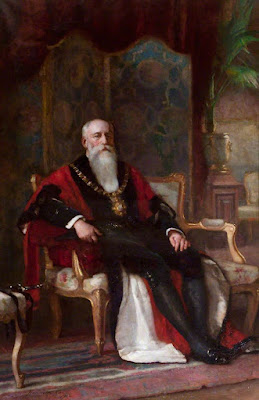
Sir Robert Anderson, 1st Baronet (Image: Belfast City Hall)

He resigned his seat in the City Council a few years ago, owing to failing health.

In 1911 he was High Sheriff of the County of Monaghan, where he owned the fine estate of Mullaghmore.

He subsequently disposed of this property.

As is well known, Sir Robert was prominently connected with several Belfast institutions, especially the City Young Men’s Christian Association, which he supported in a most generous manner.


He was a member of that organisation for the long period of 65 years, and was president for over thirty years.

He was also actively interested in the Samaritan Hospital, and the Hospital for Nervous Diseases.

He was an earnest and convinced total abstainer, and took a warm interest in the work of the Irish Temperance League.

He was connected with the Royal Ulster Agricultural Society, and his practical interest in agriculture was proved by the fact that he was a successful breeder of hacks and hunters and Angus and Kerry cattle.


Sir Robert was a Presbyterian, taking an active part in the work of the Church in its various branches of activity, and he was an elder in the Fortwilliam congregation.

He was a justice of the peace for the city and for the County of Antrim, and in politics he was a staunch Conservative.

Lady Anderson is a daughter of the late Rev Andrew Long, MA, of Monreagh, County Donegal, and she energetically seconded all her husband’s efforts in religious and philanthropic work.

The funeral took place to the Belfast City Cemetery on Tuesday last.


MULLAGHMORE


The Rose estate included 25 townlands with a total of 2,688 acres.

It was originally church lands, or termon lands, attached to St Dympna’s Church or Abbey. 

The Gaelic system of land-holding was abolished in County Monaghan in 1591.

The Tydavnet termon lands were allotted to John Connalon, parson, of Moynalty. 

James Rose bought his lands from the Bishop of Clogher in 1821 for £20,000.

Mr Rose died in 1841 and was succeeded by his daughter, Gertrude, who ran the estate until her death in 1907.

When Gertrude Rose died the holding became the property of Sir Robert Anderson who used it as his country residence.

He erected the entrance gates in 1910.

Anderson was born in 1837, son of James Anderson of Corbofin, County Monaghan.

Sir Robert Anderson died in July 1921.

Mullaghmore then became the residence of Captain S R Tufts.

On the night of 24th January 1925 a disastrous fire swept through Mullaghmore House razing all but the servants’ wing and stable block behind.

The family were away visiting friends in County Tyrone and there were no servants in the house at the time.

No cause for the fire was discovered. 

The residence was demolished and the service wing fitted out to serve as a house.

The house was bought by Luke Owens, school teacher, in 1928. 

The Owens family sold the house in 1964 to Samuel Johnston who lived there until his death in July 1972. 

It then passed by purchase to Danny Aughey who sold it on to Peadar Ronaghan later in the 1970s.

The Ronaghan family continue to live there.

Danny Aughey kept most of the land, about 120 acres.

Land Owners in Ireland in 1876 lists Gertrude Rose as the owner of 3,943 acres with a valuation of £2,187.

First published in September, 2011.  I am grateful to Henry Skeath for this article.

Saturday, 29 June 2024

Ernest Sandford, 1913-2006

ERNIE SANDFORD: A TRIBUTE TO A DISTINGUISHED PORTRUSH JOURNALIST,
FROM Coleraine Today


Ernie Sandford, known to many friends as Sandy, was born in Portrush, County Antrim, in 1913 where he was educated at Coleraine Academical Institution.

He proceeded to Queen’s University, Belfast, and after graduation he joined the Northern Constitution as a reporter.

The younger son of local grocer, Joseph Sandford, Ernie ‘had a distinguished career spanning from local reporter in Coleraine to Reuter’s office in Paris culminating in his appointment as head of press and publicity at the NI Tourist Board’.

During this career he wrote articles on local history, was a member of the amateur dramatic society – Portrush Players and at a stage secretary of the Portrush hockey club.

In the late 1930s Ernie left Coleraine and went on to work for the Belfast Newsletter, followed by a move to Fleet Street as sub-editor on the Daily Telegraph.

He was appointed the Press Association’s first war correspondent and after the War, returned to Fleet Street as chief reporter of the Sunday Chronicle.

Ernie, who was 'recognised as one of the most distinguished journalists Northern Ireland has produced’, resigned and moved to France in 1946 where he taught English for two years in a small college on the outskirts of Paris.

During his time there, he studied French language & civilisation at the Sorbonne and wrote his first book about a canoe trip from Mâcon to Lyons.

Following this he joined Reuters as head of their Paris office before going on to become information officer for the Marshall Plan (one such assignment meant that he was present at the historical singing of the Treaty of Rome).

In 1959, Ernie joined the Northern Ireland Government's London Office as publicity officer to the Ministry of Commerce and the Northern Ireland Development Council.


Some ten years later, he returned home for his appointment as Publicity Officer to the Tourist Board.

Although Ernie retired in 1978, he continued to write the guide book Discover Northern Ireland and had articles published in the Coleraine Old Boys’ Association and the Bann Disc (journal of the Coleraine Historical Society).

Ernie is survived by his wife Joyce [died 16th January, 2019], daughter Christine and son Patrick.

Do any readers possess a better image of Mr Sandford?

First published in April, 2020.

Sunday, 21 January 2024

Sir Norman Stronge Bt

DEDICATED TO THE ESTEEMED AND ILLUSTRIOUS MEMORY OF THE RIGHT HONOURABLE SIR CHARLES NORMAN LOCKHART STRONGE, BARONET, MC, JP,  AND HIS ONLY SON, JAMES MATTHEW STRONGE, BRUTALLY MURDERED ON THIS DAY IN 1981

I first had the great honour of meeting Sir Norman Stronge (1894-1981) after a concert in the late seventies, when I was still a teenager.

I was at the Northern Ireland Area British Legion Festival of Remembrance, taking place at the County Hall near Ballymena, County Antrim.

It was usually held at the Ulster Hall in Belfast but, due to "the Troubles," took place at the County Hall for several years. 


Sir Norman was Area President of the Royal British Legion.

He was an old man by then, tall and distinguished with a good head of grey hair; upright with a benign smile; distinguished-looking and wearing a double-breasted chalk-stripe suit.

He always wore a neatly clipped moustache.

Sir Norman struck me as being a true gentleman from a previous era, seldom encountered today.

Sir Norman had had an illustrious life and career.

The baronetcy was first created in 1803, and Sir Norman was the 8th Baronet.

He served as Lord Lieutenant of County Armagh from 1939 till his death in 1981 under two successive monarchs, including GEORGE VI; and sat as a member of the NI House of Commons from 1938-69, including a spell as Speaker from 1945-69.

The late Douglas Deane OBE recalled Sir Norman's passion for wildlife at Tynan Abbey:

He went to live and farm at Tynan Abbey in 1928 and always his interest was in wild things; often he told me about the wildfowl which visited the lake in winter; the groups of Bewick swans; the flocks of white-fronted geese... 

he showed me an incubating woodcock, hidden in a pool of brown leaves by the edge of the main drive at Tynan and told me that his gamekeeper had seen a woodcock carry one of its young, held between its legs, from an open patch in the woods in to cover; and many times had watched a woodcock feed its young in the same fashion as pigeons.

Every year Sir Norman would invite me to Tynan to see the azaleas in colour and the seas of bluebells in the woods and always there was talk of butterflies, painted ladies, peacock and the rest.


Mr Deane continued:

Sir Norman was the envy of his friends, being an excellent shot. He would often finish a day's shooting with close to 200 pigeons...his cousin, Sir Basil Brooke [1st Viscount Brookeborough], had the edge on him and always seemed to finish the day with more.


TYNAN ABBEY, County Armagh, was built in 1750 and enlarged in the Tudor-Gothic style around 1820-30.

It had an imposing two-storey entrance front, battlemented and pinnacled; a battlemented central tower and doorway too, with pointed Gothic windows.

Much has already been written about the Abbey by authors more knowledgeable than myself.


Originally, the estate extended to some 8,000 acres.

One quiet Wednesday evening at around nine o'clock, 21st January, 1981, Sir Norman - by now in his 87th year - and his son, James (48), were having a quiet drink in the library of Tynan Abbey following their dinner, when they heard a loud explosion in close proximity.

Unknown to them, a gang of heavily-armed men had been stalking out the Abbey and its grounds earlier and the explosion had been caused by a hand-grenade thrown at the heavy, wooden front door.

The Stronges would have had a reasonable idea, by this stage, that they were being attacked.

He kept a flare nearby, and opened the window to fire it in an attempt to alert others to the grave situation.

As it happened, a police patrol did notice the flare but, by that stage, it was too late.

The gang quickly located Sir Norman and his son in the library and opened fire on them, at point blank range, killing them instantaneously.

The gang then placed fire-bombs throughout Tynan Abbey and made their escape in a southerly direction into the relatively safe jurisdiction of the Irish Republic.

The great mansion, and its priceless contents, was utterly destroyed; indeed, its ruinous shell had to be demolished later because it was unsafe.

Although there ensued a ferocious gun-battle with the police, the gang fled.

I'd only wish to conclude by quoting from a small article by Turtle Bunbury:

We stopped first in the village of Tynan to view the High Cross, a replica of which now surmounts Bourke and Anne Cochrane's grave in New York.

We could just make out some images - perhaps Shadrach and his brothers hot-stepping it on fire-coals, maybe Adam and Eve contemplating a serpent. The Church where the Stronges are buried stands close by. 

The last baronet, Sir Norman Stronge, and his son, James, were murdered by the Provisional IRA in 1981. Sir Jack, who knew them both, says father and son were quietly watching TV when a hand grenade blew their front door of its hinges.

Sir Norman managed to let off a flare but the police got there too late. The two men were machine gunned to death and the house burned down. The perpetrators all met unhappy ends - either shot by their own comrades or captured and incarcerated.

My father and I attended their funeral at Tynan parish church.


I remember the Duke of Abercorn wearing a heavy, tweed, raglan overcoat.

Notwithstanding the passing of so many years, this vile act has continued to stick in my memory.

The mere thought of such a heinous atrocity still deeply saddens me to this very day.

First published in January, 2014.

Saturday, 9 July 2022

Sir James Henderson

A reader from New Zealand sent two photographs of Sir James Henderson (1848-1914) and his family.

Sir James served the office of Lord Mayor of Belfast in 1898, and was the first High Sheriff of the city.

He has been credited with the establishment of the City Hall, which stands in Donegall Square today.

Sir James Henderson (Image: Belfast City Hall)

James Henderson was born at Mountcollyer Park, Belfast, the home of his grandfather, Alexander Mackay.

Henderson read Law at Trinity College Dublin and was called to the Irish Bar in 1872.

He went on to become editor of the Newry Telegraph in 1873, retaining that position until 1883.

He became managing proprietor of the Belfast News Letter and Belfast Weekly News, and was appointed President of the Master Printers Federation of Great Britain and Ireland.

Sir James married Martha Pollock and they had five sons.

He was appointed a Freeman of the City of Belfast in 1912, and he received a knighthood from the Lord Lieutenant of Ireland, the 5th Earl Cadogan, at Viceregal Lodge, Phoenix Park, Dublin, in 1899.

Sir James lived at Oakley House, Windsor Park, Belfast.

The photograph above shows Martha Lady Henderson and her five sons.

It is believed that the eldest son died in the 1st World War, though little is known of the others. 

Any information would be welcome.   

The photographs had been sent out to New Zealand as the reader's grandfather emigrated there in 1881.

The Henderson family graves can be seen at Belfast City Cemetery.

First published in February, 2011.  Henderson arms courtesy of the NLI.

Tuesday, 5 May 2020

Farewell Con

I bade farewell to my old acquaintance, the Reverend John McConnell (Con) Auld, MA, this afternoon, Tuesday, the 5th May, 2020, in his home town of Holywood, County Down.

Mourners assembled at High Street in the town, and the cortège made its way to Redburn cemetery.

A service to celebrate his life was conducted at Con's graveside by the Rev Noble McNeely, Minister Emeritus of 1st Holywood Presbyterian Church.

Con's Final Journey, Redburn Cemetery

Con's memory lives on in his historical publications.

Every time I visit Portbraddan, County Antrim, I'll think of him.

Thursday, 30 April 2020

Rev John McConnell Auld MA

Photo Credit: Belfast Telegraph

I can't remember my first encounter with Con Auld. He was always quite a distant figure at first, though I was young and naïve.

I suppose it must have been at some civic function in Holywood, County Down, the town where my father was born.

I must have seen him at civic receptions in the Queen's Hall; certainly on Saturday mornings in Holywood's library.

The Reverend John McConnell Auld's main association for me was the tiny hamlet of Portbraddan, on the north County Antrim coast.

On many occasions, mainly during summer months, I made a pilgrimage to that charming gem along the coast from White Park Bay, where Con Auld had created his own holiday home from the remnants of an old mill house.

He even wrote a book about it, Letters to a Causeway Coast Millhouse, published in 2004.

His spotless, vintage, bottle-green MGB GT sports car was usually parked near the tiny church he established beside The Braddan, St Gobban's Church.

St Gobban's

If Con happened to be at home he might have been whitewashing the walls of the cottage, or painting the drainpipes.

He had amassed a remarkable collection of memorabilia and items associated with the Titanic, I seem to recall, including a deck-chair.

The Braddan, like the man himself, was oozing with character.

Con might have been a very private gentleman, though he was also intrepid.

Perhaps one of my fondest recollections was of him seated at his cast-iron table and chairs, at the flag-pole, in front of The Braddan, overlooking the sea and White Park Bay.

Con was quite content to sit there reading and sipping from a bone-china tea-cup.

The Braddan, Portbraddan, County Antrim

He made full use of his talents throughout a charitable and varied life, having gained his MA from Trinity College, Dublin.

Con Auld was educated at Sullivan Upper School in Holywood, and Belfast Royal Academy; Princeton, New Jersey, USA, and the Union Theological College, Belfast.

He went on to become senior housemaster and Head of Divinity at Belfast Royal Academical Institution (Inst) from 1958 till 1988.

Con joined the Ulster Unionist Party and was elected to North Down Borough Council, where he served from 1973 until 1988.

The Mayor and Mayoress of North Down? 

He was Mayor and Deputy Mayor between 1980-84.

Please correct me if I'm wrong, though the image above shows Con wearing morning dress as His Worship the Mayor of North Down, with the Mayoress, Councillor Mary O'Fee OBE.

These activities are merely a flavour of his colourful life. I've already spoken of his great charitable endeavours, not least at St Gobban's Church, where many an Old Instonian was married.

Click to Enlarge

Incidentally, it's a shame that St Gobban's Church, or the building, wasn't listed. It was listed in 1990, though for some reason de-listed three years later.

The photograph above shows Portbraddan, probably in the late 19th century. Con Auld's cottage can be seen as it was.

St Gobban's Church, the small building to the left of the image, once used as a byre, was demolished in 2017.

Con had intended to write an illustrated book about the old houses of east Belfast.

He had a large cardboard box with dozens of colour drawings of old villas and mansions, including Garnerville and Norwood Tower.

I was indeed saddened to learn of his death, aged 90, on the 28th April, 2020.

Be in no doubt. Northern Ireland has lost a worthy and virtuous son.

I'm not ashamed to say that a little tear was shed when I heard about his passing

Con was, I believe, a man with a strong faith, and this fortitude served him well through life's challenges.

Saturday, 13 August 2016

Ducal Tribute

REMEMBERING THE VIth DUKE OF WESTMINSTER
22 DECEMBER 1951 - 9 AUGUST 2016

THE GROSVENOR ESTATE PUBLISHED A TOUCHING TRIBUTE TO GERALD, 6TH DUKE OF WESTMINSTER, ON THE 11th AUGUST, 2016

"Gerald Cavendish [Grosvenor], 6th Duke of Westminster KG CB CVO OBE TD CD DL led a full life.

He was a passionate country man, committed soldier, an excellent shot, a true entrepreneur and, importantly, he went out of his way to be courteous and humorous with all people, regardless of status or wealth.

Distinctly down-to-earth, the Duke of Westminster was rarely seen without a Diet Coke and a cigarette (later electric).

Not much of a sleeper, one might expect emails from him at any hour of the night and an average week would see him up and down from home in Chester to London and all over the world to visit soldiers, businesses, charities and rural estates while representing and promoting numerous organisations.

His birth in Northern Ireland in December, 1951, was a celebrated occasion (his father being the last direct male descendant of the 1st Duke of Westminster).

In his own words “his childhood was idyllic” growing up with two sisters Leonora and Jane.

His parents, whilst loving and attentive, had both played their part in the Second World War and like many aristocratic families at that time had little idea of how to bring up children.

However the children were not materially spoiled or over-cosseted by their parents.

They employed a tyrannical nanny, who took any opportunity with Gerald not “to spare the rod”.

Despite this, Gerald and his sisters enjoyed much happiness and freedom playing in the islands of Lough Erne.

It was here that he learned to fish and to shoot at his father’s side.

Gerald’s father served as Member of Parliament for Fermanagh and South Tyrone and spent a good deal of time during Gerald’s early childhood at the House of Commons.

During these frequent absences Gerald was taken under the wing of the estate gamekeeper, Wesley Scott, with whom a deep friendship grew and this countryman’s earthy wisdom and knowledge was imparted to Gerald at an early age.

An empathy with country folk and a deep understanding and love of the natural world shaped his views thereafter.

This idyll was rudely interrupted at the age of eight when he was sent to boarding school for which he was little prepared.

He was schooled at Sunningdale and then Harrow.

It served to teach him that if you are happy and placed in a sympathetic environment you will learn.

Unfortunately, his time at school was not happy.

Speaking with a “broad Irish” accent he did not settle easily and his unhappiness at school was in direct proportion to his lack of achievement in the classroom, where he found little of relevance, other than History and English.

Ironically, and despite the unflattering remarks on his school reports, by the end of his life he had accumulated seven honorary degrees, which reflected the time and patronage he gave to education in the North West of England.

He was a natural sportsman and as a youth excelled on the football pitch with an ability to strike the ball equally well with either foot, but was discouraged to pursue this further by his father.

He was also a good cricketer, but his abiding love was for country sports and he was acknowledged to be one of the finest shots in the country.

When Gerald was 16 a Daily Mail reporter visited his school.

The 4th Duke had died and the title was passed to his brother Robert, Gerald’s father.

This meant that Gerald inherited the courtesy title “Earl Grosvenor”.

It was the first he had heard of it and immediately rang his father asking what it was all about.

The reply was “Ah yes, we need to talk about that!”

It was a double blow for Gerald who adored his uncle, but also realised that his life was to change forever.

On leaving Harrow he went travelling with his good friend Johnny Hesketh.

Gerald’s parents had always kept their children’s feet firmly on the ground.

When Gerald and Johnny were in Iran, Gerald found a carpet he particularly liked.

He sent a telegram to his father “Found exquisite carpet, send money” – his father replied – “Wrap carpet round head, have both examined”.

On his return he started training for his impending role within the Grosvenor Estate, and he threw himself into learning everything he could about the property business and the intricacies of the Grosvenor Estate.

He travelled in Canada, America, New Zealand and Australia, where, in 1975, he bought a 10,500 acre Estate in New South Wales known as Bull’s Run and learnt to manage land and run a farm of his own.

In 1978, Gerald married Natalia Phillips, daughter of Lieutenant-Colonel Harold Phillips and Gina, grand-daughter of Sir Julius Wernher.

Gerald and ‘Tally’ were married at Tally’s family home, Luton Hoo, and they spent their honeymoon at Bull’s Run in Australia.

Their marriage represented the dawn of a new era in the history of the Grosvenor family – a modern family with Tally at its very heart.

Gerald inherited the dukedom from his father in 1979.

The property crash of the early 1970s and the heavy mortgaging of the London Estate to pay death duties had left the business in dire straits.

Along with the 120 hectare London Estate that came into the Grosvenor family in the 17th century, Gerald inherited the heavy burden of responsibility, which was to breathe life and purpose back into the Grosvenor Estate.

He also inherited two inestimable qualities from his father, a sense of duty and a keen appreciation of what was right and fair.

These two qualities stood him in good stead in his business dealings over the years.

He wisely surrounded himself with excellent people who worked closely together to encourage his involvement in the business and to support him in the role of Chairman, but it was his own youth and enthusiasm that provided the impetus to drive the Grosvenor Estate forward to become one of the largest and most entrepreneurial privately owned international property companies in the world.

His openness coupled with a natural charm endeared him to many.

Laughter was never far away in any conversation and many were the times when a joke relieved the tension at a difficult meeting or in an awkward situation.

Like many of his forebears he was an accomplished soldier.

In April, 1992, he took Command of his regiment the Queen’s Own Yeomanry based in Newcastle.

He thought this to be the pinnacle of his Army career, instead it served to fan the flames of his future ambitions in the Army, not for himself, but for the volunteer soldier and the public’s recognition of their contribution.

In 2004, Gerald was made the Assistant Chief of the Defence Staff for Reserve Forces and Cadets.

This put him in charge of Ministry of Defence policy for the reservists and cadets of all three armed forces.

Having started his military life as a trooper thirty-five years before, he was now promoted to Major-General – making him the first reservist ‘two star’ since the 1930s.

The combination of his rank and his posting within the MoD enabled him to achieve much on behalf of the Reserve Forces during a period that saw a sea-change in their culture: reservists were now expected and wanted to serve on operations.

Not since the Second World War had such numbers been mobilised, firstly to Iraq and then increasingly to Afghanistan.

The first decade of the twenty-first century saw the Territorial Army assume an exceptionally high profile.

It moved from being a force of last resort to become the reserve of choice in support of regular army operations.

Much of this was due to Major-General the Duke of Westminster.

As the role of reservists became more and more critical, so did Gerald’s influence on policy within the MoD.

Never a man to do things by half, he gave evidence to the Public Accounts Committee in June, 2006, worked a five-day week at his desk in Whitehall and utilised almost every weekend in the year to conduct visits to reservists in training or on ceremonial events.

He also maintained a thorough knowledge of what was happening on operations, visiting the Balkans and Iraq many times throughout his tenure and travelling to Kabul and Kandahar during the critical planning phase for the intensification of operations in Helmand.

He also made trips to Bosnia, Albania, Kuwait, Estonia, Malta and Oman. Despite his punishing programme – often visiting several units in a weekend – he would not allow any of his expenses to be a cost to the taxpayer.

When his term as Head of Reserve Forces came to an end in 2007 he re-focussed his attention on the Grosvenor Estate.

No stone was left unturned.

He started his quest to perfect each of his rural estates in terms of conservation and productivity.

He met staff from each of the businesses and estates and asked them for their thoughts.

Collating the information he went about putting in place the systems and procedures to make all staff feel a part of the organisation as a whole.

He promoted the importance of the rural estates and the communities which they supported and gave the non-property businesses the confidence to excel.

This was interrupted in 2011 when he was, once again, “called up”, taking the new appointment of Deputy Commander Land Forces at a crucial time for the Territorial Army as the MoD published the Future Reserves 2020 Commission’s (FR20) Report.

It was a time of huge cultural change for the Army and General Westminster was at the heart of it.

He was able to make a unique contribution as one who had more experience of Reserve forces than anyone else in Defence.

His appointment was key to providing an experienced perspective in generating the appropriate reserve forces, re-establishing commitment, introducing a reinvigorated recruiting campaign and directing staff effort across the whole Army.

His commitment set an example for others to follow.

He more than held his own amongst Generals but was equally at home talking with the most junior trooper on the tank park.

Soldiers, sailors and airmen of all ranks knew how much he was doing for them and appreciated his commitment and support.

When the Duke left the Reserve Army after over 40 years of service he was very moved by what he had seen in Iraq and Afghanistan and particularly by the very heavy price many young people in uniform had paid for serving the nation.

He wanted to do something for them and this quickly turned into the idea of continuing the success of the clinical rehabilitation at Headley Court which was created in 1947 – by simply creating a 21st century version of it on a new site in the middle of England.

Along the way, the Secretary of State for Defence asked him if he would at the same time 'do something for the nation' – essentially by sharing Defence's renowned expertise in this field – which Gerald agreed to.

One thing led to another, and by 2011 there was strong support pan-Government for his idea and the concept of the Defence and National Rehabilitation Centre was born.

Typically, he made the founding gift of £50 million.

Other major donors have followed his lead so that his creation is now a year into construction and will open in 2018.

This year the rehabilitation opportunities for the nation stemming from the construction of the Defence establishment are being seriously examined with Government – and the Grosvenor legacy here could be even greater than he ever imagined.

It is very poignant that he will not see his remarkable initiative turn into a very significant legacy for those who are seriously injured.

Many in uniform will hope that the earth lies lightly on this soldier's bones.

His military experience was reflected in Gerald’s approach to the Grosvenor Estate, where his loyalty to his staff, whether a senior executive or a young gamekeeper, was unprecedented and all knew that the Duke would be there to support them when the going got tough.

He was a great believer in investing in people; he would present long-service awards, attend retirement parties, speak at staff open days and have lunch with small groups of staff on a regular basis.

Gerald, the countryman, had a natural affinity with the countryside.

In 1992 he published a report entitled “The Problems in Rural Areas” highlighting the difficulties being experienced in remote and isolated rural communities.

In recent years he lobbied to get “Broadband” access for isolated communities, something he knew to be a commercial and educational lifeline.

He was a man of duty.

He was loyal, unforgiving, decisive, stubborn, a fearsome opponent, prejudiced, opinionated and a brilliant strategist.

He was a contradiction.

He was brave, and yet wild horses could not drag him to the dentist.

He was both intolerant and open-minded, a loner and the best company, self-indulgent and hugely generous; he could be boastful about small things and unassuming about magnificent things.

He would not accept weakness of any kind, particularly in himself, even when suffering with depression he refused to see a doctor and decided to “heal himself”.

He hated the tags “environmentalist” and “philanthropist” believing that caring was a better word and particularly hated those who endeavoured to protect his good name and would thwart their efforts at every turn.

Like many who had to grow up too quickly he maintained a childlike quality, a smutty sense of humour, and a great sense of the ridiculous.

He never lost his love of the outdoors – a countryman at heart he was never more content than when he was on the grouse moor with a shotgun in hand.

He is survived by his wife Tally, their four children, Tamara, Edwina, Hugh and Viola; grandchildren, Jake, Louis, Zia, Wolf, Isla and Orla.

He is succeeded by his son Hugh, who becomes the 7th Duke of Westminster and leaves him a well-ordered Grosvenor Estate."

Sunday, 24 April 2016

Leslie Eulogy

The Irish Aesthete has written a fond and insightful eulogy - if that is the mot juste - of Sir John (Jack) Leslie's life:-

Wednesday, 31 December 2014

VIIIth Duke of Wellington, 1915-2014


To the illustrious memory of the Most Noble ARTHUR VALERIAN VIIIth DUKE OF WELLINGTON,
Knight Companion of the Most Noble Order of the Garter,
Lieutenant of the Royal Victorian Order,
Officer of the Military Division of the Most Excellent Order of the British Empire,
Military Cross.

Thursday, 2 October 2014

Elizabeth, Lady Sudeley, 1941-2014


I'm saddened to learn of the death of Elizabeth, Lady Sudeley, elder sister of Lady Rose Lauritzen.

The Hon Elizabeth Mairi Keppel was born at Mount Stewart, County Down, in 1941, the elder daughter of Lord and Lady Bury (later Lady Mairi Bury).

Derek William Charles Keppel held the courtesy title of Viscount Bury, as heir to the Earl of Albemarle.

As a daughter of Lady Mairi Bury, this made her a granddaughter of the 7th Marquess and Marchioness of Londonderry.

Londonderry House

As the Hon Elizabeth Mairi Keppel, she had her eighteenth birthday ball at Londonderry House, Park Lane, to which both of her future husbands came.

She married Alastair Villiers in 1962 and their wedding reception at Londonderry House was one of the very last family gatherings there before that house began to be demolished later in 1962.

Elizabeth and her first husband, Alistair Villiers, were in fact cousins via the Londonderrys, as both were directly descended from Fighting Charlie, 3rd Marquess of Londonderry, and Frances Anne his wife.

Elizabeth married secondly, in 1980, the 7th Baron Sudeley and they divorced in 1988.

Elizabeth Sudeley had two children from her first marriage.

Like her late mother, Lady Sudeley was very interested in racing and thoroughbred breeding, and enjoyed watching the horses which have run in her son Charles's colours in recent years (especially when they win!).

The top photograph shows Lady Sudeley on her way to a ball given by The Queen at Windsor Castle, which she attended with Alistair Villiers, her late husband.

I am very grateful to Charles Villiers for the photograph of his mother and information.

Tuesday, 27 May 2014

Sir John Gorman, 1923-2014

I am saddened to learn of the death of Sir John Gorman.

SIR JOHN REGINALD GORMAN CVO CBE MC DL was born at Mullaghmore House, near Omagh, County Tyrone.

He was educated at Rockport preparatory school and Portora Royal School.

Sir John served with distinction as an officer in the Irish Guards and, indeed, often wore his regimental tie.

He was a Deputy Lieutenant for County Down and received the honour of Knighthood in 1998.

In 2007, Sir John was awarded the Croix de Guerre for his actions during the 2nd World War.

Sir John also served public office as a Member of the Northern Ireland Assembly and sometime Deputy Speaker.

Sunday, 15 December 2013

Friday, 12 July 2013

Alan Whicker, 1925-2013

I am saddened to learn of the death of the journalist and broadcaster, Alan Whicker CBE.

Wednesday, 17 April 2013

Stately Epitaph

CHERISH FREEDOM

IN GLORIOUS MEMORY OF THE RIGHT HONOURABLE MARGARET HILDA BARONESS THATCHER

LADY OF THE MOST NOBLE ORDER OF THE GARTER

MEMBER OF THE ORDER OF MERIT

ONE OF HER MAJESTY'S MOST HONOURABLE PRIVY COUNCIL

PRIME MINISTER OF THE UNITED KINGDOM 1979-1990

A GREAT BRITON, A TRUE PATRIOT

Monday, 8 April 2013

The Baroness Thatcher, 1925-2013

I am profoundly saddened to learn of the death today of Lady Thatcher.

The Right Honourable Margaret Hilda [Thatcher], Baroness Thatcher, LG, OM, PC, Prime Minister of the United Kingdom, 1979-90:

The Right Honourable Margaret Hilda [Thatcher], Baroness Thatcher, Lady of the Most Noble Order of the Garter, Member of the Order of Merit, One of Her Majesty's Most Honourable Privy Council.

Lady Thatcher's coat-of-arms is illustrated at the top, including the coronet of a peer of the fifth degree; and the badge of the Order of Merit, suspended below.

Friday, 29 March 2013

Richard Griffiths, 1947-2013

I am saddened to learn that the actor Richard Griffiths, OBE, has died, aged 65, after complications following heart surgery.

He starred in the Harry Potter movies and Withnail and I.

Mr Griffiths enjoyed a long career of success on film and on TV, but also on the stage where he was a Tony-winning character actor.

He was best known for playing Vernon Dursley in the Harry Potter films and Uncle Monty in Withnail and I.

TV roles included playing a cookery-loving detective in Pie in the Sky; a role I personally associate with him.

He was appointed an OBE in the 2008 New Year Honours.

Tuesday, 27 November 2012

Charles Eager McDowell, 1923-2012


I am greatly saddened to learn of the death of my first cousin, once removed, Rear-Admiral Charles Eager McDowell, US Navy (retired), on Sunday morning, 25th November, 2012.

My cousin Charles was born at Manchester, New Hampshire, on 9th September, 1923.

He lived for a large part of his life at Alexandria, Virginia.

He served as  Judge Advocate-General of the US Navy from 1978-80.

Wednesday, 7 November 2012

Clive Dunn OBE, 1920-2012

I am saddened to learn of the death of Clive Dunn, OBE, Lance-Corporal Jones in the BBC's classic series Dad's Army.

Wednesday, 20 June 2012

9th Marquess of Londonderry, 1937-2012

I am saddened to hear of the death of the 9th Marquess of Londonderry.

The Most Hon Alexander Charles Robert [Vane-Tempest-Stewart], 9th Marquess of Londonderry, was the son of Robin [Vane-Tempest-Stewart], 8th Marquess (1902-55) and his wife, the former Romaine Combe (d 1951).

Alistair londonderry inherited his title and family estate in County Durham on the death of his father in 1955, when he was just 18.

But after devoting much effort to renovating the huge family mansion, Wynyard Park, the costs became overwhelming and in 1987 he was forced to sell the house and its 6,800-acre estate to the property developer Sir John Hall -- later Chairman of Newcastle United football club.

Inheriting the family titles in late adolescence had denied Alistair Londonderry a university life, so he created one for himself, becoming proficient in French, Italian and German, and knowledgeable about European literature.

An authority on Franz Liszt, he became an accomplished pianist, studying in America under Egon Petri, and was an early patron of John Ogdon and Leslie Howard.

Lord Londonderry was entertaining company, with a penchant for dreadful puns, but he also suffered from bouts of depression. Yet though his life was scarred by tragedy, he never succumbed to self-pity.

Alexander Charles Robert Vane-Tempest-Stewart, always known as Alistair, was born on September 7, 1937, the son of Robin Vane-Tempest-Stewart, Viscount Castlereagh, heir to the Londonderry title and Unionist MP for County Down between 1931-45.

His mother Romaine was a brewer's daughter. He had two older sisters, of whom the younger, Annabel, became better known as Lady Annabel Birley and later Lady Annabel Goldsmith, wife of Sir James Goldsmith and mother of Jemima Khan.

Lady Annabel Goldsmith recalled an idyllic, privileged childhood spent at the family's Irish seat, Mount Stewart, by Strangford Lough in Co Down, and at Wynyard, in the care of fleets of nannies and under-butlers.

Young Alistair, who suffered from a stutter as a child, was educated at Eton, where he founded a jazz band called the Eton Five. But in 1951, when he was 14, his mother succumbed to mouth cancer and his father embarked on a rapid descent into chronic alcoholism, eventually succumbing to liver failure in 1955.

The Londonderrys had been immensely rich, owning more than 50,000 acres, a colliery empire and three other houses in addition to Wynyard, Mount Stewart and Londonderry House.

But by the time Alistair inherited the title, mismanagement, taxation and the nationalisation of the coal mines had taken their toll.

Londonderry House was sold to Hilton Hotels and later demolished, while Mount Stewart, which had been bequeathed by the 7th Marquess to his daughter, Lady Mairi Bury, Alistair's aunt, was subsequently handed over to the National Trust.

He became secretly engaged to a 16-year-old blonde beauty called Nicolette Harrison, the daughter of a stockbroker. When they married in 1958, he and Nicolette, a vision in her Norman Hartnell satin gown, were hailed as an example of the new unstuffy aristocracy. The bride was barely 17 and the groom not quite 21.

They had two daughters and a son who, as heir to the Londonderry title, was initially styled Viscount Castlereagh.

When the baby was 18 months old, however, blood tests established that he was not, in fact, Lord Londonderry's, but the son of Georgie Fame, a Lancastrian weaver's apprentice-turned-pop star whose hits included The Ballad of Bonnie and Clyde. Nicolette had fallen in love with him after spotting him on Top of the Pops in 1964 and had begun an affair.

The story featured on newspaper front pages for days. Fame was named as co-respondent in the Londonderrys' subsequent divorce in 1971 and the following year he and Nicolette were married.

They had another son together but in 1993 Nicolette committed suicide by jumping off Clifton Suspension Bridge.

In 1972 Lord Londonderry married Doreen Wells, former principal dancer at the Royal Ballet, but happiness continued to elude him.

After 17 years his second marriage, too, ended in divorce and more discomfort was to follow when Lady Cosima Somerset, whom Lord Londonderry publicly accepted as his daughter by his first wife, claimed that her biological father was the nightclub pianist and writer Robin Douglas-Home, nephew of the former prime minister and a close friend of Princess Margaret who had killed himself with an overdose of pills in the Sixties.

In the Sitxties Alistair Londonderry bought a house in Tuscany, which he renovated and where he did enjoy great happiness. After the sale of Wynyard Park, he moved to Dorset.

Although he held the title for longer than any of his eight predecessors, Lord Londonderry never took his seat in the House of Lords (where his coat-hook in the cloakroom bore his English title Earl Vane), and nothing gave him greater satisfaction than to be told that he did not "look like a lord".

Lord Londonderry is survived by the two daughters of his first marriage and two sons by his second. His eldest son, Frederick Aubrey Vane-Tempest-Stewart, styled Viscount Castlereagh, shall succeed to the titles as 10th Marquess.

The 9th Marquess will be interred at Tir nan Og, the ancestral burial ground at Mount Stewart, County Down, the details of which are to be announced in due course.

Londonderry arms courtesy of European Heraldry.