|
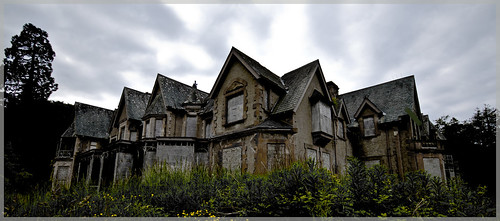
| Photo Credit: Mid & East Antrim Borough Council |
EDITH LADY DIXON DBE: A TRIBUTE
Lady Dixon
DBE (1871-1964) was the wife of the Rt Hon Sir Thomas Dixon, 1st Baronet.
The largesse and generosity of the Dixons was renowned and they donated more than £100,000 to good causes.
For this philanthropy, Lady Dixon was appointed
Dame Commander of the Most Excellent Order of the British Empire (DBE) in June, 1921, in recognition of her valuable work on behalf of the men of all the services during the 1st World War; and for her generous support and constant interest in the Sailors’ and Soldiers’ Service Club.
On 27th August, 1918, a grand summer fête was held at Cairndhu (shown in its present state below) on the County Antrim coast, near Larne, in aid of the Cairncastle Prisoners of War Fund.
The opening ceremony involved Lady Dixon and the Chairman was William Chaine
DL.
On the day the heavens opened, resulting in the outdoor activities being somewhat curtailed and the marquees overcrowded.
At the time Lady Dixon said,
“No cause more appealed to their hearts than the Prisoners-of-war Fund. These men, of their own free will, went out to fight for us, and now that they were in the hands of a cruel enemy we could not do too much to show our gratitude to them”.
The financial result, however, was gratifying with almost £500 being raised.
Her activities during World War II were no less prominent:
She was part of the Central Committee for War Hospital Supply Depots, which was formed in September, 1939, for the purpose of providing clothing and bandages to military hospitals and woollen comforts to brighten the lives of their men-folk in the services, on the seas, in the hospitals or interned in prison camps in enemy territory.
Lady Dixon held high office in many of the great national organisations such as the Royal National Lifeboat Institution and the St John Ambulance Brigade.
She was appointed President of the Larne St John Ambulance Brigade in September, 1939.
For many years she was a vice-president of the Ulster Women’s Unionist Council.
She was also honoured with the Freedom of the Borough of Larne.
As wife of HM Lord-Lieutenant, Lady Dixon took a prominent part in official ceremonies and often helped to entertain royalty, including Princess Margaret, at Cairndhu for lunch in October, 1947, as HRH toured along the Antrim Coast Road.
Although taking part in many official ceremonies during her husband’s lifetime, she was of a quiet and reserved nature and was never happier than when she was escorting friends around her immaculately kept gardens at Cairndhu.
Lady Dixon was particularly interested in nursing:
She was President of Larne District Nursing Society for 30 out of its 55 year existence until its disbandment in 1948; and was president of the “Annie Clark Trust Fund” which had been set up by her mother.
In July, 1928, a fete was organised at Cairndhu on behalf of the Maternity Hospital Building Fund, with Lady Dixon being a long-time member of the Committee of Management.
Activities included dancing, bridge, outdoor amusements including clock golf, a lawn tennis tournament, afternoon tea on the terrace and music from the Royal Ulster Constabulary.
This fund-raising event attracted over 400 people with such dignitaries as the Duke and Duchess of Abercorn.
In May 1947, Sir Thomas celebrated his 79th birthday.
They marked the occasion by announcing a generous gift: After 40 years at Cairndhu, the Dixons donated their 60-room family home, with 100 acres of the estate, to the Ministry of Health and Local Government for use as a convalescent home or hospital.
At the time Lady Dixon said that she was very sorry to be leaving the house that her father built:
“It’s too big for us now, though. It was different in the days when we could entertain.”
After Lady Dixon sold their other property, Carnfunnock House, and surrounding land to Larne Borough Council in 1957, the Council allowed her to continue to use the building and her maid, Jean McIlmoyle, remained in the summer-house for a number of years.
Additionally, the Brownlow family rented the farm and land from the Council until the early 1960s, before moving to a house in Larne.
Lady Dixon continued to live for over a decade after Sir Thomas's death.
As they were devoted to each other in life, she felt his loss deeply.
This was shown in a letter to her former chauffeur, William Sutherland:
“How broken my life is now, but I have those wonderful memories of all he was. I am very lonely without him.”
On 20th January, 1964, the elderly Lady Dixon, aged 92, died at her residence in Malone Park, Belfast, and was buried at Dundonald Cemetery beside her husband.
She left more than £100,000 to charitable institutions in Northern Ireland.
The majority of her property and effects were divided between her nephews and nieces.
For the full time employees at Carnfunnock she bequeathed £10 for each year of service.
At the time of Lady Dixon’s death, the Mayor of Larne, Councillor J W Sandford said,
Larne has lost its greatest benefactor. Both Lady Dixon and Sir Thomas always had the welfare of the town and district at heart.
In June, 1964, the contents of Carnfunnock House were sold by auction from a marquee on the front lawn with many locals taking the opportunity to purchase a small memento.
Larne Borough Council rented this property out until 1973 when it issued a long-term lease to Larne Lions Club to use the chalet as a holiday home for the elderly and disadvantaged groups.
In 1986, due to lack of sufficient funding, Cairndhu was closed down by the Department of Health and Social Services.
It subsequently lay derelict.
In 1995 the Lord Rana purchased Cairndhu House and the surrounding gardens from the council.
It remained neglected, being heavily vandalised and suffering a number of collapsed floors and water ingress due to holes in the roof.
A public consultation was to be undertaken in May, 2018, about plans to develop the site of the derelict mansion into a "retirement village," including an 80-bedroom nursing home, with the retention and restoration of the stable block at a cost of around £25-£30million.
Today, its future still remains uncertain.
First published in July, 2010.