Showing posts with label County Donegal Landowners. Show all posts

Monday, 1 June 2026

Stewart of Rockhill

THE STEWARTS, OF ARDS, OWNED 39,306 ACRES OF LAND IN COUNTY DONEGAL


ALEXANDER STEWART (1746-1831), second son of Alexander Stewart MP, of MOUNT STEWART, County Down, and younger brother of Robert, 1st Marquess of Londonderry, purchased the estate of ARDS from the Wray family, and settled there in 1782.

Mr Stewart, High Sheriff of County Donegal, 1791, espoused, in 1791, the Lady Mary Moore, younger daughter of Charles, 1st Marquess of Drogheda, by the Lady Anne Seymour his wife, daughter of Francis, 1st Marquess of Hertford, and had issue (with other children, who died young),
Alexander Robert, of Ards, his heir;
Charles Moore (Rev);
JOHN VANDELEUR, of whom we treat;
Maria Frances; Gertrude Elizabeth.
The youngest son,

JOHN VANDELEUR STEWART DL (1802-72), of Rock Hill, near Letterkenny, County Donegal, High Sheriff of County Donegal, 1838, wedded, in 1837, the Lady Helen Graham-Toler, daughter of Hector John, 2nd Earl of Norbury, and had issue,
ALEXANDER CHARLES HECTOR, his heir;
Hector Brabazon (Rear-Admiral);
Robert Seymour;
CHARLES JOHN, of whom hereafter;
Elizabeth Georgina.
Mr Stewart was succeeded by his eldest son,

ALEXANDER CHARLES HECTOR STEWART (1838-1917), of Rock Hill, a major-general in the army, High Sheriff of County Donegal, 1881, who married, in 1872, Gertrude Mary, daughter of Eric Carrington Smith, and had issue, an only child,
Kathleen, b 1875; m, 1904, Captain P A MacGregor DSO.
John Vandeleur Stewart's youngest son,

SIR CHARLES JOHN STEWART KBE (1851-1932), of Rockhill, espoused, in 1884, the Lady Mary Catherine Graham-Toler, daughter of Hector John, 3rd Earl of Norbury, and had issue,
Gerald Charles (1888-1915), killed in action;
John Maurice (1895-1915), killed in action;
Helen Margaret; Eirene Mary; Marjorie Alice.
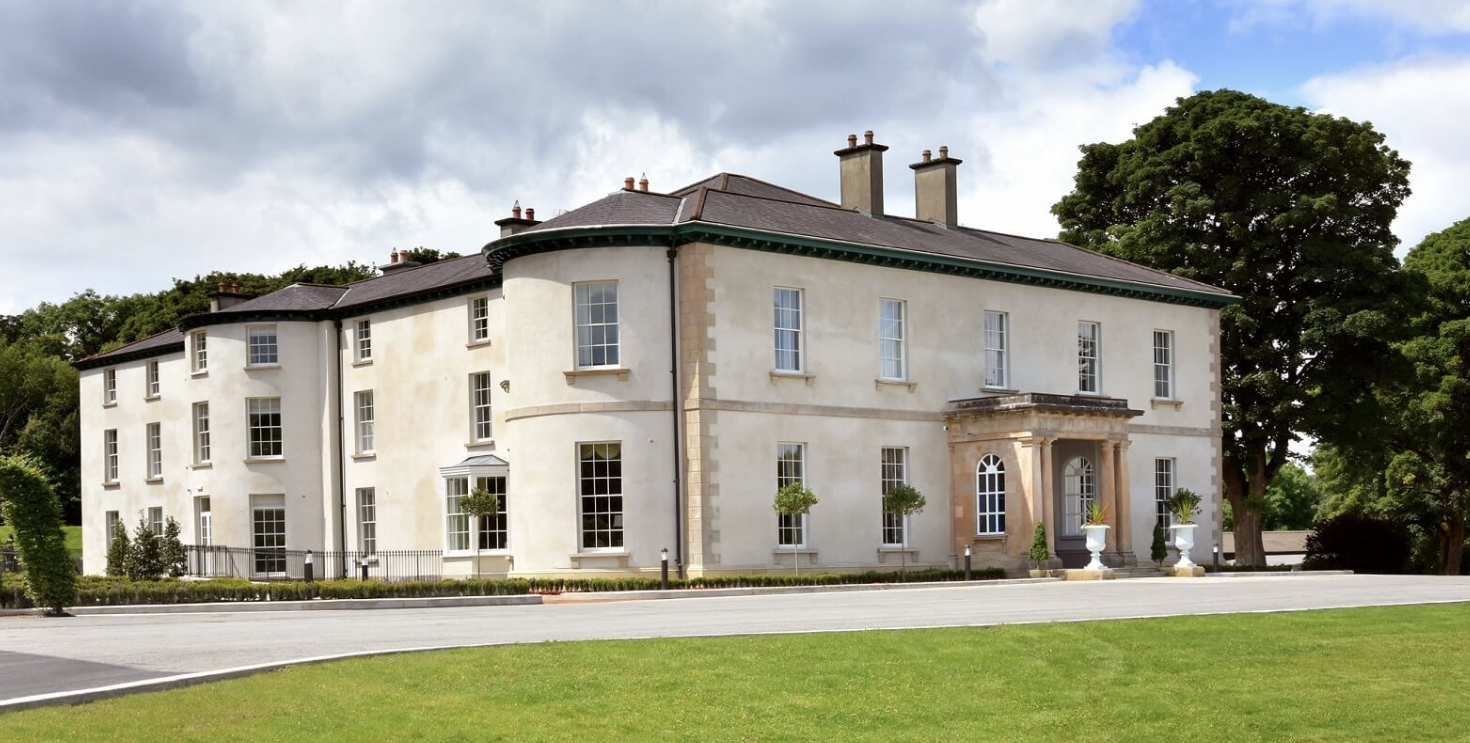
Rockhill House (Rockill House website, 2021)

ROCK HILL HOUSE, near Letterkenny, County Donegal, was originally a three-storey Georgian house of ca 1760, with basement, comprising three bays on either side of a central curved bow.

Its new owner, John Vandeleur Stewart, built a two-storey, five-bay addition to the original house about 1853.

The Victorian building was the same height as the Georgian one.

The present mansion appears to have replaced an earlier Plantation dwelling of the early 1600s, associated with the Pratt family of CABRA, County Cavan.

Captain Thomas Chambers acquired the lands in 1660, and the Chambers remained there until 1832, when Daniel Chambers sold the house and its 237 acre estate to John Vandeleur Stewart for £900 (equivalent to about £70,000 in 2021).

Rockhill House (Robert French/Lawrence Collection/NLI)

J V Stewart proceeded to build a large two-storey block, attached to the original Georgian house, ca 1853. 

His son,  Major-General Alexander Charles Hector Stewart, used Rockhill occasionally; as did his son, Sir Charles John Stewart, KBE, a barrister based in London.

Sir Charles and Lady Stewart were bereft by the deaths, in 1915, of their two sons, both killed in action during the 1st World War, and Rockhill was abandoned in 1927.

Many of the house contents were shipped to the Stewarts' new home in Scotland, and they authorized the sale of the estate.

Rockhill House: Georgian block (Rockhill House website, 2021)

With nobody occupying the estate, Rockhill was taken over by Anti-Treaty IRA forces upon the outbreak of Civil War in Ireland in 1922.

In 1927-30 Rockhill became a Preparatory College for student teachers; the estate, however, thereafter fell into decline and, in 1937, was sold in various lots to the Irish Commissioners of Public Works.

The Irish Department of Defence occupied 29 acres of grounds from the 1940s, and accommodated the Irish Army on a permanent basis from 1969 until 2009, when it closed due to government cutbacks.

Rockhill House has recently been extensively renovated and re-opened as a country house hotel.

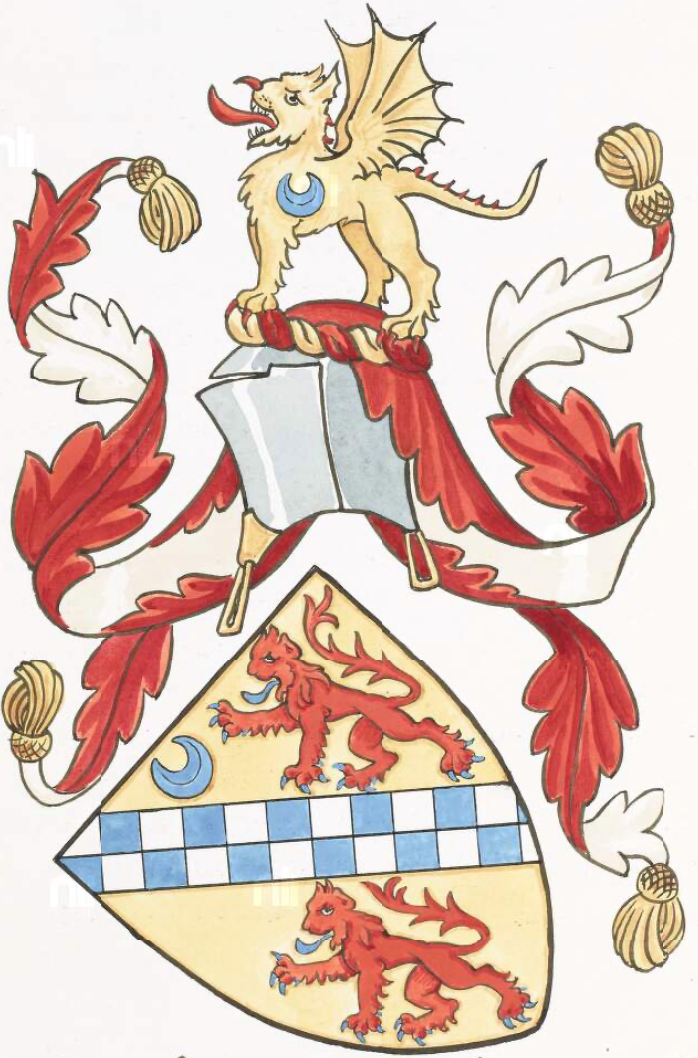
First published in May, 2022.  Stewart arms courtesy of the NLI.

Monday, 27 April 2026

Glenmore Lodge

THE STYLE BARONETS WERE MAJOR LANDOWNERS IN COUNTY DONEGAL, WITH 39,564 ACRES 


This family, which was originally of Ipswich, Suffolk, derives from

WILLIAM STYLE, of that place, whose son,

SIR JOHN STYLE, obtained an aldermanic gown in London, and wedded Elizabeth, daughter and co-heiress of Sir Guy Wolston, Knight, of London, by whom he had

SIR HUMPHREY STYLE, Knight, of Langley Park, Beckenham, High Sheriff of Kent, 1543, during the reign of HENRY VIII, and one of the Esquires of the Body to that monarch.

This gentleman espoused Bridget, daughter of Sir Thomas Baldrey, Knight, and had three sons, viz.
Edmund;
OLIVER, of whom presently;
Nicholas, Alderman of London.
The second son,

OLIVER STYLE (1542-1622), after serving the office of Sheriff of London, 1606, purchased the manor of Wateringbury, Kent, and retired there.

He was succeeded by his only surviving son, 

THOMAS STYLE (1587-1637), of Wateringbury, High Sheriff of Kent, 1634, who married Elizabeth, only daughter and heiress of Robert Foulkes, of Mountnessing, Essex, and had issue,
THOMAS, his successor;
Elizabeth; Susan; Anne.
Sir Thomas was created a baronet in 1627, designated of Wateringbury, Kent.

He was succeeded by his only son,

SIR THOMAS STYLE, 2nd Baronet (1624-1702), who married firstly, Elizabeth, daughter of Sir William Airmine Bt, of Osgodby, Lincolnshire, and had, with other issue,
Thomas;
OLIVER, succeeded his father;
Elizabeth; Mary; Susan; Anne.
Sir Thomas wedded secondly, Margaret, daughter of Sir Thomas Twisden Bt, of Bradburne, Kent, one of the judges of the Court of King's Bench, and had, with other issue,
THOMAS, succeeded as 4th Baronet;
Margaret.
Sir Thomas was succeeded by the only surviving son of his first marriage,

SIR OLIVER STYLE, 3rd Baronet (c1670-1703), who died a few months after he inherited, and leaving no issue, the title devolved upon his half-brother,

SIR THOMAS STYLE, 4th Baronet (c1685-1769), who pulled down the ancient mansion of Wateringbury Place, and erected a new seat, where he kept his shrievalty in 1710.

He espoused Elizabeth, daughter of Sir Charles Hotham Bt, and had issue, with two daughters,
CHARLES, his successor;
Robert (Rev);
William, Lieutenant-General.
Sir Thomas was succeeded at his demise by his eldest surviving son,

SIR CHARLES STYLE, 5th Baronet, who married, in 1770, Isabella, daughter of Richard, 1st Viscount Powerscourt, by whom he had Dorothy, wife of John Larking, and a son, his successor at his demise in 1774,

SIR CHARLES STYLE, 6th Baronet (d 1804), who wedded, in 1794, Camilla, eldest daughter of James Whatman, of Vintners, Kent, and had issue,
THOMAS, his successor;
THOMAS CHARLES, 8th Baronet;
Isabella Anne; Mary.
Sir Charles was succeeded by his elder son,

SIR THOMAS STYLE, 7th Baronet (d 1813), an officer in the army; at whose decease, unmarried, in Spain, the title devolved upon his brother,

SIR THOMAS CHARLES STYLE, 8th Baronet (1797-1879), MP for Scarborough, 1837-41, who wedded, in 1822, Isabella, daughter of Sir George Cayley Bt, of Brompton, Yorkshire, and had a daughter, EMMA (1828-34).
The heir apparent is the present holder's only son Shannon Gay Style (b 1969).
*****

The Rev Robert Style, younger brother of the 5th Baronet, was Vicar of Wateringbury and Rector of Mereworth.

His eldest son,

CHARLES STYLE (1777-1853), of Glenmore, Stranorlar, County Donegal, married, in 1812, Frances, eldest daughter of John Cochrane, of Edenmore, Stranorlar.

*****

SIR THOMAS CHARLES STYLE, 8th Baronet, JP DL, inherited the Glenmore estate in County Donegal. His cousin,

SIR WILLIAM HENRY MARSHAM STYLE, 9th Baronet (1826-1904), JP DL, of Glenmore.

It is thought that Sir William Frederick Style, 13th Baronet (born 1945) lives in the USA.


THE LODGE, Glenmore, County Donegal, was a Georgian house, built in the mid to late 18th century.

It was renovated for Sir William Style, in the Neo-Tudor style, in the early 20th century.


The house was demolished in the 1990s.

The Glenmore estate is renowned for its game activities.

First published in November, 2014.  Style arms courtesy of European Heraldry.

Sunday, 15 February 2026

Culdaff House

THE YOUNGS OWNED 7,989 ACRES OF LAND IN COUNTY DONEGAL


THE REV ROBERT YOUNG (1610-82), who was ordained by the RT REV ANDREW KNOX, Lord Bishop of Raphoe in 1632, instituted Rector of Clonca, 1640, and of Culdaff, 1661, is supposed to have gone over to Ulster from Devon, under the auspices of the DONEGALL family, the parishes to which he was instituted being in the gift of the Chichesters.

His son,

THE REV ROBERT YOUNG (1640-1706), Rector of Culdaff and Clonca, 1668, married firstly, about 1667, Anne Cary, and had issue (with five daughters), two sons,
Robert, born 1673;
Thomas, born 1675.
He wedded secondly, in 1679, Elizabeth Hart, of Kilderry, by whom he had further issue, one son, GEORGE, and four daughters.

His son by his second wife,

GEORGE YOUNG (1680-1729), espoused, in 1702, Elizabeth, sister of the Rev Daniel McLaughlin, Rector of Errigal, leaving, with other issue, an elder son,

ROBERT YOUNG (1703-47), who married, in 1731, Hatton, daughter of Alderman Thomas Hart, of the City of Londonderry, and had issue,
Robert;
Thomas;
Gardiner;
GEORGE, of whom hereafter;
Mary; Elizabeth (m Rev J Harvey, of MALIN HALL).
The youngest son,

GEORGE YOUNG (1731-89), of Culdaff, High Sheriff of County Donegal, 1766, wedded, in 1760, Rebecca Lamy (of French origin and almost related to the Croftons, Whalleys, and other Dublin families), and had issue,
John;
Thomas;
ROBERT, of whom presently;
George;
Ralph;
Hatton; Rebecca (m her cousin, Rev E Harvey); Susan; Elizabeth; Anne.
The third son,

ROBERT YOUNG (1764-1824), of Culdaff, espoused, in 1790, Marcia, daughter of George Nesbitt, of Woodhill, County Donegal, and had issue,
GEORGE, his heir;
Robert James;
James William;
Catherine, m REV EDWARD CHICHESTER; Marcia; Anne.
Mr young was succeeded by his eldest son,

GEORGE YOUNG JP DL (1792-1877), of Culdaff House, who married, in 1832, Mary Anne, eldest daughter of John Ffolliott, of Hollybrook, County Sligo, and had issue,
ROBERT GEORGE, his heir;
Frances.
Mr young was succeeded by his only son,

ROBERT GEORGE YOUNG JP (1834-1912), who wedded, in 1858, Letitia, youngest daughter of the Rev Robert Stavely, of St Munchin's, Limerick, and had issue,
GEORGE LAWRENCE, his heir;
Robert Stavely;
Henry Crofton;
John Ffolliott;
Mary Anne; Frances Sarah.
Mr Young was succeeded by his eldest son,

GEORGE LAWRENCE YOUNG JP (1859-1926), of Millmount, Randalstown, County Antrim, and Caratra Lodge, Culdaff, County Donegal, High Sheriff of County Donegal, 1914, who espoused, in 1883, Annie, youngest daughter of Lieutenant-Colonel Gardiner Harvey, of Islandnahoe, County Antrim, and had issue,
ROBERT CHICHESTER, his heir;
George Neville Gardiner (1893-1915, killed in action);
Guy Owen Lawrence, b 1896;
Rosetta Mary, b 1884 (died an infant); Dorothy Gage, b 1889.
The eldest son,

ROBERT CHICHESTER YOUNG (1887-1941), of Culdaff, County Donegal, and Ballymena, County Antrim, married Amy Isabel Stuart, and had issue,
GEORGE STUART (1914-71);
Olive Margaret Lawrence.
The only son,

GEORGE STUART YOUNG (1914-71), sold Culdaff estate to his sister,

OLIVE MARGARET LAWRENCE YOUNG.

Culdaff House (Image: Buildings of Ireland website)


CULDAFF HOUSE, near Moville, County Donegal, is a three-storey Georgian house of 1779,  built for George young.

It was burnt by the IRA in 1922; and rebuilt four years later, in 1926.

The house was re-modelled about 1950, when the original frontage was removed and a service wing was converted into main accommodation.

Culdaff House pre-1922 (NLI, Robert French, Lawrence Collection)

The Buildings of Ireland website remarks:-
"This fine house was originally built by George Young in 1779."

"It probably replaced an earlier Young house or houses in the area as Robert Young first came to this area in 1640 as rector of Culdaff Parish."

"The Young family remained in ownership of the estate until into the twentieth century."

"In 1856 the then owner of the estate, George Young, had amassed an estate of some 10,500 acres with an annual income of over £3,000."
Robert Chichester Young inherited Culdaff in 1926, and his son, George Stuart Young, inherited Culdaff in 1941; and sold Culdaff to his sister, Olive Margaret Lawrence Winton, ca 1945 (funded by her inheritance from her first husband, Thomas Stanley Winton).

Olive's second child, George Mills (b 1952), from her second marriage in 1950 to Angus Mills (foreman of the Culdaff estate, who saw Culdaff House burn as a 14 year-old farm hand in 1922) is the current owner of Culdaff.

Friday, 7 November 2025

Malin Hall

THE HARVEYS OWNED 12,212 ACRES OF LAND IN COUNTY DONEGAL


JAMES HARVEY, or HERVY, was presumably son of CAPTAIN GEORGE HARVEY, who had a confirmation of arms and grant of crest, 1602, for this confirmation was afterwards in his (James's) possession, and then in the possession of Robert, his fourth son, and was in the possession of George Miller Harvey, DL, of Malin Hall, a descendant.

James Harvey was a lessee under Lieutenant George Gale, of Dunmore, and his son, George Gale, of Dunmore.

His name is written "James Hervy" in a chancery bill dated 1673.

James Harvey died in 1667, having had issue, four sons,
David, of Dunmore;
John, of Imlick;
James;
ROBERT, of whom we treat.
The fourth son of the above James Harvey or Hervy, of Dunmore,

ROBERT HARVEY, of Londonderry, a storekeeper during the siege of Derry, 1688, High Sheriff of that county, 1696, married and had issue,
JOHN, of whom hereafter;
Samuel, of Londonderry;
Sarah.
The elder son,

JOHN HARVEY, of Londonderry, married, in 1685, Martha Rankin, stepdaughter of Captain Michael Browning, of the merchant ship Mountjoy, and had issue,
John;
Robert.
He wedded secondly, Jane (d 1706), daughter of Richard Godsalve, of Rigmaden, Lancashire; and thirdly, in 1706, Elizabeth (d 1708), daughter of Alexander Lecky, Alderman and Mayor of Londonderry, High Sheriff, 1677.

Mr Harvey espoused fourthly, Elizabeth, daughter of Colonel Henry Hart, of Kilderry, Inishowen, by Anne his wife, daughter of SIR TRISTRAM BERESFORD Bt, by whom he had (with other issue),
GEORGE, of whom presently;
Henry;
Thomas (Rev).
He was succeeded by his eldest son,

GEORGE HARVEY (1713-73), High Sheriff of County Donegal, 1754, who acquired a considerable estate in the manor of Malin, Inishowen, and built Malin Hall.

Mr Harvey married, in 1740, his cousin, Elizabeth, daughter of Colonel George Hart, of Kilderry, and had issue,
JOHN, his heir;
George Hart, dsp;
George;
Thomas;
Ludford (Sir), knighted 1813;
Mary Anne; Elizabeth; Mary Anne; Alice; Anne.
The eldest son,

THE REV JOHN HARVEY (1742-94), of Malin Hall, wedded, in 1766, Elizabeth, daughter of Robert Young, of Culdaff, and had issue,
George, dsp;
George, dsp;
ROBERT, his heir;
Edward;
John;
Thomas;
Henry;
William;
Mary Anne.
The eldest surviving son,

ROBERT HARVEY (1770-1820), of Malin Hall, High Sheriff of Sounty Donegal, 1804, married, in 1801, Barbara Frances, eldest daughter of ROBERT GAGE, of Rathlin Island, County Antrim, and had issue,
JOHN, his heir;
Robert;
George;
Gardiner;
Mary; Marianne; Barbara; Susan; Catherine.
Mr Harvey was succeeded by his eldest son,

JOHN HARVEY JP DL (1802-68), of Malin Hall. High Sheriff of County Donegal, 1836, who espoused, in 1831, Emily, daughter of the Rev Dr George Miller, of Armagh, and had issue,
Robert (1833-55);
GEORGE MILLER, his heir.
The son and heir,

GEORGE MILLER HARVEY JP DL (1838-1919), of Malin Hall. High Sheriff of County Donegal, 1870, married, in 1864, Julia Mary, daughter of William Charles Gage, of Drummond House, County Londonderry, and had issue,
JOHN, his heir;
Mary Gage; Julia Emily.
Mr Harvey was succeeded by his son and heir,

JOHN HARVEY (1865-1940), of Malin Hall, who wedded, in 1895, Florita, eldest daughter of J Digby O’Donoghue, of Montevideo, and had issue,
Julia Mary, b 1896;
Emily Georgina, b 1898;
Dora (1903-68).
Malin Hall (Franklin's Estate Agents)


MALIN HALL, near Clonca, County Donegal, is a two-storey, early 18th century house of 1758 with a five-bay front, the door-case having pilasters and entablature.

The range to the rear has a curvilinear gable.

Malin Hall (Franklin's Estate Agents)


Malin Hall had been lived in continuously by the Harveys since they built it in 1758 until 1973, when it was sold by George Miller Harvey.

Malin Hall (Franklin's Estate Agents)

Ian Harvey, born in 1947, left agricultural college in 1966 and lived at Malin Hall, farming the 250 acre estate until its sale seven years later.

First published in August, 2012.

Friday, 8 August 2025

Lough Eske Castle

THOMAS (YOUNG) BROOKE OWNED 15,134 ACRES IN COUNTY DONEGAL


CHARLES NICHOLAS WHITE (1754-1839), of Datchet House, Windsor, Berkshire, East India Company, Chief Secretary to the Government of Madras and Judge of the High Court, son of Captain John White RN, by Joanna Dormer his wife, of Alphington, Devon, married, in 1792, Letitia Mytton, daughter of Edward Owen Williams, of Eaton Mascott Hall, Shropshire, and had issue,
Charles;
Frederic;
HENRY, of whom presently;
Raymond.
The third son,

THE REV HENRY WHITE, of Almington Hall, Shropshire, born in 1804, sometime Lieutenant, Coldstream Guards, wedded, in 1834, Sarah Ford, daughter of George Stevens RN, and had issue,
HENRY GEORGE;
Ada Letitia; Edith.
His only son,

MAJOR-GENERAL HENRY GEORGE WHITE JP DL (1835-1906), of Lough Eske Castle, County Donegal, espoused, in 1874, Frances Cromwell, widow of Captain Raymond Henry Pelly, Royal Engineers, son of Colonel Raymond Pelly CB, and had issue,
HENRY HERBERT RONALD, his heir;
Sybil Georgina.
General White was succeeded by his only son,

MAJOR HENRY HERBERT RONALD WHITE DSO OBE JP (1879-1939), of Lough Eske Castle, High Sheriff of County Donegal, 1912, who married, in 1906, Florence Geraldine, daughter of Sir John Arnott, 1st Baronet, and had issue,
HENRY GEORGE RONALD, b 1907;
John Maxwell, b 1909.

LOUGH ESKE CASTLE, near Donegal, County Donegal, is a Elizabethan-Revival mansion of 1859-61 by the architect FitzGibbon Louch.

It was built on the site of an older castle for the Donegal branch of the Brooke family (whose ancestor erected Donegal Castle).

There is an imposing four-storey square tower at one end.

A large Gothic porch stands between two oriels; the parapet is crenellated, with two blind gables.

The tower has machiolations, crow-step battlements, and curved, corbelled oriels.

A date stone of 1621 on the plantation house displays initials "WH" for William Hamilton, father of Gavin Hamilton (progenitor of Brown Hall.) and "IM" for Joan Merbury, sister of the wife of the William Brooke of Colebrooke in Cheshire (father of Sir Basil Brooke, proprietor of Donegal Castle).

Thus the Hamilton and Merbury armorial bearings beside the central beaver of Brooke surmount the main entrance of the Lough Eske Castle Hotel.


All the stone for the ornamental stonework came from Monaghan’s Quarry, Drimkeelan, near Frosses, and the road from there to Lough Eske was built to transport the sandstone or freestone for the Castle.

Mr Brooke even brought two Clydesdale horses with cockney drivers from England to draw the stone.

His ancestors had acquired the Lough Eske estate in 1717 through a marriage with the Lough Eske Knoxes.

Thomas Brooke, who built the castle, was not a Brooke by birth.

He was born Thomas Young, but changed his surname to order inherit the property.

The Brooke coat-of-arms still stands over the door on the east and main entrance.

The tower is an impressive part of the Castle’s architecture and dominates the whole building and adjoining countryside.

The tower held the flagstaff where the family flag would have flown, visible for miles around.

Beneath the battlements, all along the front of the castle were a line of finely carved gargoyles faces, no two alike.

During the time that the estate belonged to the Irish forestry commission most of the gargoyles were stolen.

In 1859, architect-designed enhancements were installed by a local contractor.

In 1897, after visiting audience with Prince ofWales, embarked on modern improvements projects continued in 1911, with pleasure-rooms, steam-heated “Roman Bath”; master suite and guest rooms.

Colonel de Vere Brooke inherited the estate in 1884 and remained there for ten years until Lough Eske was sold, in 1894, to Major-General Henry George White.

During this period the the estate comprised 15,134 acres.

General White had a great love for the area and he was buried close to the lake, where there stands a fine Celtic high cross.

The burial site is enclosed by a wall and railings, with double gates at the entrance which bear plaques.

One of these carries the figure of a pelican, the symbol of mortality, with the inscription “Beware in Time”.

The second plaque bears the inscription Virtus Semper Vincit (Virtue Always Conquers).

The burial plot is maintained with the help of a bequest invested in the representative church body, donated by Mrs Sybil Georgina Barnes, General White's only daughter.

The Castle was operated it as a hotel from 1930 to 1939.

In 1939, a curtain in the ballroom caught fire due to a candle that hadn’t been extinguished.

The ballroom and billiards-room were destroyed, and by the time the fire brigade was able to attend (it had to come from Londonderry in Northern Ireland) most of that wing of the castle had been destroyed.

Thereafter the Knee family decided to vacate Lough Eske and sold the estate to Mr Scott Swan, who sold the castle to an American gentleman, Bernard Etzin, of Ardnamona House.

In the early 1980s the castle and estate were taken over by the Irish forestry commission, which had little interest in the castle itself.

Consequently, Lough Eske Castle became derelict.

The present owners, Solis Hotels, bought the estate (all that remained of the house at the time were the outer walls).

Trees grew inside the castle and their strengthening roots threatened to knock the castle down altogether.

After eighteen months and a considerable financial investment, Lough Eske Castle has been faithfully restored, including the interiors of the reception rooms.

First published in December, 2016.

Monday, 26 May 2025

Ards House

THE STEWARTS WERE MAJOR LANDOWNERS IN COUNTY DONEGAL, WITH 39,306 ACRES

ALEXANDER STEWART (1746-1831), second son of Alexander Stewart MP, of Mount Stewart, County Down, and younger brother of Robert, 1st Marquess of Londonderry, purchased the estate of Ards from the Wray family, and settled there in 1782.

Mr Stewart, High Sheriff of County Donegal, 1791, espoused, in 1791, the Lady Mary Moore, younger daughter of Charles, 1st Marquess of Drogheda, by the Lady Anne Seymour his wife, daughter of Francis, 1st Marquess of Hertford, and had issue (with other children, who died young),
ALEXANDER ROBERT, his heir;
Charles Moore (Rev);
John Vandeleur, of Rock Hill;
Maria Frances; Gertrude Elizabeth.
Mr Stewart was succeeded by his eldest son, 

ALEXANDER ROBERT STEWART JP DL (1795-1850), of Ards and Lawrencetown House, High Sheriff of County Donegal, 1830, who wedded, in 1825, the Lady Caroline Anne Pratt, third daughter of John, 1st Marquess Camden, and had issue,

ALEXANDER JOHN ROBERT STEWART JP DL (1827-1904), of Ards and Lawrencetown House, High Sheriff of County Donegal, 1853, County Down, 1861, who married, in 1851, the Lady Isabella Rebecca Graham-Toler, seventh daughter of Hector, 2nd Earl of Norbury, and had issue,
ALEXANDER GEORGE JOHN, his heir;
Charles Hector;
George Lawrence;
Henry Moore;
Cecil George Graham;
Caroline Helen Mary; Beatrice Charlotte Elizabeth; Ida Augusta Isabella.
Mr Stewart's eldest son,

ALEXANDER GEORGE JOHN STEWART (1852-97), a Barrister, wedded, in 1883, Julia Blanche, daughter of Charles Dingwall, of Knollys Croft, Surrey, and had issue, two daughters,
ENA DINGWALL TASCA;
Muriel Neara.
The elder daughter,

ENA DINGWALL TASCA, LADY STEWART-BAM, of Ards, wedded, in 1910, Sir Pieter Canzius van Blommestein Stewart-Bam JP, of Sea Point, Capetown (son the Johannes Andrew Bam), who assumed with his wife the prefix surname and arms of STEWART on his marriage.


ARDS HOUSE, Creeslough, County donegal, was formerly the seat of the Wray family.

In the 18th century, the last William Wray of Ards was "a celebrated figure, eccentric and autocratic, though kind and generous".

This gentleman resided at Ards in feudal state, constructing roads through mountains at his own expense; lavish in his hospitality to guests.

As a consequence of this extravagance, the Ards estate itself was purchased by Alexander Stewart Junior in 1782 (for £13,250 - probably money left to him by his father).

However, the Stewart family had a long association with the Londonderry/east Donegal area, and originally hailed from Ballylawn, County Donegal.

In the 19th century, following the falling-in of the Mercers' lease, probably in 1830, the Stewarts of Ards concentrated on Donegal, acquiring property at Doe Castle and Letterkenny, both in that county.


The Stewart, later Stewart-Bam, family, owned land mainly at Ards, Doe Castle, Dunfanaghy and Letterkenny, in County Donegal.

Ards House was rebuilt about 1830 by Mr Stewart, towards the end of his life.

The main front is of two storeys; good plasterwork in the hall; friezes in the drawing-room and dining-room.

The estate was sold in 1925.

It was acquired by the Franciscans in 1937, who demolished it about 1965. 

Ards Forest Park used to form part of the Stewart estates.

The last member of the Stewart family to own the estate was Ena, Lady Stewart-Bam, who inherited from her grandfather about 1904.
*****


Lawrencetown House, near Gilford, County Down, was for sale in June, 2016.

Other former seat ~ Lawrencetown House, Gilford, County Down. Town residence ~ 5 Old Court Mansions, Kensington, London.

First published in May, 2012.

Tuesday, 10 December 2024

Castle Grove

THE GROVES OWNED 2,140 ACRES OF LAND IN COUNTY DONEGAL

THOMAS GROVE, of Castle Shanahan, County Donegal (son of Thomas Grove), living there 1666-77, Commissioner of Assessments for the county, 1655, Collector of Customs in Londonderry, 1643-74, High Sheriff of County Donegal, 1664, married Margaret, only daughter of Peter Benson, of Elagh, Alderman of Londonderry, and had issue,
WILLIAM, his heir;
Frances; Elizabeth; Helen; Margaret; Ann; Prudentia.
Mr Grove died in 1681, and was succeeded by his only son,

WILLIAM GROVE (1662-97), of Castle Shanahan, who served through the siege of Derry, 1688, and purchased the Manor of Kingston, 1684, from the Kingsmills.

Mr Grove married firstly, in 1684, Constance, daughter of Major John Kingsmill, of Andover, Hampshire.

She died in 1687, aged 22.

He wedded secondly, in 1688, Elizabeth, eldest daughter of Sir James Leigh, Knight, of Cullionmore, County Westmeath.

Mr Grove was murdered by rebels in 1697, having had issue,
Thomas, dsp 1724;
WILLIAM, of whom presently;
James, of Grovehall;
Constance.
The second son,

WILLIAM GROVE, of Castle Grove, which he built 1730, High Sheriff of County Donegal, 1727, espoused Susanna, daughter of Philip Barry, of Kilcarra, County Meath, and had issue,
Thomas, b 1719; dsp 1792;
James, b 1725;
William, 1734-93;
Richard, d 1766;
Humphrey;
CHARLES, of whom presently;
Judith; Elizabeth.
Mr Grove died in 1742/3.

His youngest son,

THE REV CHARLES GROVE (1742-1818), Vicar of Kilmacshalgan and Templeboy, County Sligo, married Mary Gilmour, and had issue,
William (Rev), dsp 1857;
Mary Susanna, m 1794 her cousin Thomas Grove (took name of
BROOKE);
DOROTHY, of whom presently;
Helen Elizabeth.
The younger daughter,

DOROTHY GROVE, wedded, in 1802, John Wood, of 9th Light Dragoons, son of James Wood, of Woodville, County Sligo, and had issue (with a daughter), a son,

JAMES GROVE WOOD GROVE JP DL (1803-91), of Castle Grove, Barrister, High Sheriff of County Donegal, 1855, who adopted the name of GROVE in 1863 on succeeding to the Castle Grove Estate.

He wedded, in 1843, Frances Judith, daughter of Robert Montgomery, of Convop House, County Donegal, by Maria Frances Stewart his wife, niece of Robert, 1st Marquess of Londonderry, and granddaughter of the 1st Marquess of Drogheda, and had issue,
JOHN MONTGOMERY CHARLES, his heir;
Robert Thomas Wood, Captain RN;
Charles William;
Mary Susanna Frances; Dorothea Alice; Frances Mary Ellen.
Mr Grove was succeeded by his eldest son,

JOHN MONTGOMERY CHARLES GROVE JP (1847-1920), of Castle Grove, who married, in 1886, Lucy Georgina, daughter of Major-General William Maunsell Gabbett, East India Company's Artillery, and had issue,
JAMES ROBERT WOOD;
Lucy Dorothea Montgomery, 1892-1908.
Mr Grove was succeeded by his son,

MAJOR JAMES ROBERT WOOD GROVE (1888-1969), who married, in 1920, Eileen Beatrice, daughter of George Edmonstone Kirk, and had issue, an only child, Bridget Grove, who was born and died in 1927.

When Major Grove died in 1969, Castle Grove was inherited by Commander Peter Colin Drummond Campbell-Grove (Cdr Peter Campbell LVO OBE DL RN), Equerry to HM The Queen, 1957-60, who married, in 1966, the Lady Moyra Kathleen Hamilton, daughter of James, 4th Duke of Abercorn, and late sister of the present Duke of Abercorn, KG.


CASTLE GROVE, near Letterkenny, County Donegal, is a two-storey, four-bay Georgian country house, built ca 1750, though there may be elements of an earlier dwelling of ca 1695.

It was altered about 1825 by the addition of two-storey wings.

Castle Grove retains much of its early character and form, despite alterations to accommodate new uses.

Its visual appeal and integrity are enhanced by the retention of salient fabric to the main block, including timber sliding sash windows, natural slate roof, and timber panelled door.

The fine pedimented Tuscan entrance porch with sidelights and entablature provides an attractive focus and gives this building a classical architectural character that is typical of its type and date.

The door-case dates from 1750 and was probably moved from another location to the site when the house was altered ca 1825, and the present entrance front was added.

These 1825 alterations and modifications were carried out by Thomas Brooke (née Grove).

This building may contain fabric of an earlier house to site, apparently built ca 1695 by the Grove family.

The Grove family originally settled in the area in 1656.

They originally had a dwelling at nearby Castle Shanahan to the north, which was apparently burnt to the ground in 1689 by Jacobite forces retreating from the siege of Londonderry, a fate suffered by numerous properties in this part of County Donegal.

The Groves decided to rebuild a short distance to the south of their original residence.

The original house was either greatly altered or rebuilt ca 1750.

The present house originally had the Tuscan porch to the main entrance, though it was later moved following the construction of a new block to the front about 1825.

Occupying attractive mature landscape grounds to the north-east of Letterkenny, this building is one of the finest houses in the area, and is an important element of the built heritage of County Donegal.

The now-altered but appealing conservatory to the south-west of the entrance front, and the single- and two-storey wings to site add to the setting and context.

This building forms the centrepiece of a group of related structures along with the complex of outbuildings and former estate manger's residence; walled garden to the south-west; gardener's house; and gate lodge to the west.

Castle Grove is now a country house hotel and was purchased by the current owners, Mary and Raymond Sweeney, from Commander Campbell in 1989.

First published in March, 2016.

Monday, 16 September 2024

Glenveagh Castle

JOHN GEORGE ADAIR OWNED 16,308 ACRES OF LAND IN COUNTY DONEGAL


The family of ADAIR was settled in Scotland, and later in Ulster, for many generations. 

According to tradition, the family derived its descent from Thomas, 5th Earl of Desmond, who having gone on a hunting expedition, lost his way, and spent the night between Tralee and Newcastle, County Limerick, where he was received and hospitably entertained by William MacCormac, whose daughter he subsequently married. 

At this alliance his family and clan were much offended, and compelled him to flee to France, and resign his title and estates to his younger brother in 1418. He died of grief at Rouen, in 1420, where the two kings of England and France were present. 

The 5th Earl of Desmond had issue, Maurice and John. MAURICE had issue, Maurice and Robert. 
ROBERT returned to Ireland with the hope of regaining his family title and estates. 

This Robert killed Gerald, the White Knight (second son of Gerald, the then Earl of Desmond), in single combat, at Áth Dara (ford of the oaks), County Limerick, but was subsequently defeated and fled to Scotland, where he assumed the name of ADAIRE.


GEORGE ADAIR JP DL (1784-1823), of Bellegrove, and Rath, Queen's County (son of John Adair, of Rath), wedded, in 1822, Elizabeth, second daughter of the Very Rev Thomas Trench, Dean of Kildare, and had an only son,

JOHN GEORGE ADAIR (1823-85), of Glenveagh Castle, County Donegal, who married Mrs Cornelia Wadsworth Ritchie, of Philadelphia, Pennsylvania, USA, widow of Montgomery Harrison Ritchie.

 
GLENVEAGH CASTLE, near Churchill, is described by Mark Bence-Jones thus:-
A Victorian-Baronial house of rough-hewn granite at the end of a wooded promontory jutting out into Lough Veagh, surrounded by the bare and desolate hills of a deer-forest, so large as to seem a world apart.
The Castle comprises a keep with battlements, flanked by a lower round tower and other buildings. The entrance is through a walled courtyard.

The formal garden boasts terraces with busts and statuary; with a bathing pool by the side of the lough; an Italian garden; a walled garden with a Gothic orangery; and a splendid variety of rare and exotic trees and shrubs.


Glenveagh National Park lies in the heart of the Derryveagh Mountains in the north-west of County Donegal.

It is a remote and hauntingly beautiful wilderness of rugged mountains and pristine lakes.

The park, 40,000 acres in extent, consists of three areas.

The largest of these is the former Glenveagh Estate, including most of the Derryveagh Mountains.


The Glenveagh estate was created in 1857-9 by the purchase of several smaller holdings by John George Adair, a wealthy land speculator originally from County Laois.

Mr Adair was later to incur infamy throughout the county by evicting some 244 tenants in the Derryveagh evictions of 1861.


After marrying his American-born wife Cornelia, Adair began the construction of Glenveagh Castle in 1867, which was completed by 1873.

Adair, however, was never to fulfil his dream of creating a hunting estate in the highlands of Donegal and died suddenly in 1885 on return from a business trip to America.

After her husband’s death, Cornelia Adair took over the running of the estate and introduced deer stalking in the 1890s.

She continually sought to improve the Castle’s comforts and the beauty of its grounds, carrying out major improvements to the estate and laying out the gardens.

Over the next thirty years she was to become a much noted society hostess and continued to spend summers at the castle until 1916.

Following the death of Mrs Adair in London in 1921, Glenveagh fell much into decline and was occupied by both the anti-treaty and Eire army forces during the Irish civil war.

Glenveagh’s next owner was not to be until 1929 when purchased by Professor Arthur Kingsley Porter of Harvard University who came to Ireland to study Irish archaeology and culture.

The Porters mainly entertained Irish literary and artistic figures, including his close friend AE Russell whose paintings still hang in the library of the castle.

Their stay was to be short, however, as Arthur Kingsley Porter mysteriously disappeared from Inishbofin Island in 1933 while visiting the island.

The last private owner was Henry McIlhenny (1910-86), of Philadelphia, USA, who bought the estate in 1937.

Mr McIlhenny was an Irish-American whose grandfather, John, grew up in Milford, a few miles north of Glenveagh.

After buying the estate, McIlhenny devoted much time to restoring the castle and developing its gardens.

Eventually he began to find travelling to and from Ireland too demanding and the upkeep of the estate was also becoming a strain.

In 1975, he agreed the sale of the estate to the Irish government, allowing for the creation of a national park.

In 1983 he donated the castle to the Irish state, along with its gardens and much of the contents.

Glenveagh National Park opened to visitors in 1984, while the Castle itself opened in 1986.

First Published in February, 2012.  Source: GLENVEIGH NATIONAL PARK.

Thursday, 22 August 2024

Stewart of Ramelton

THE STEWART BARONETS OWNED
7,547 ACRES OF LAND IN COUNTY DONEGAL

The Stewarts of Ramelton are said to descend from the Earls of Galloway and the Lords Blantyre. They were the first of the Stewarts to be raised to the Baronetage, in 1623; and from them sprang the Viscounts Mountjoy and the Earl of Blessington.

GENERAL THE RT HON SIR WILLIAM STEWART, 1st Baronet, of Newtownstewart, County Tyrone, and Ramelton, County Donegal, went over to Ulster in 1608 as Captain Commanding a company of Scottish troops sent to serve in the Province.

He is stated by William Douglas of Glenbervie in his Historical and Genealogical Tree of the Royal Family of Scotland and name of Stewart (1750) to have been a son [or grandson] of Archibald Stewart, 3rd Laird of Fintalloch who died ca 1596, and whose family descended from Sir William Stewart, 2nd of Garlies, the ancestor of the Earl of Galloway.

He was in great favour with JAMES VI and I, and became an undertaker for the plantation of escheated lands in the province of Ulster, 1610.

He was Knighted in 1619, and created a Baronet in 1623, designated of Ramelton, County Donegal.

In the rebellion of 1641 Sir William and Sir Robert Stewart, Governor of Derry, routed Sir Phelim O'Neill near Strabane, and in other places.

Sir William received large grants of land from the Crown in counties Donegal and Tyrone.

He was a Privy Counsellor in the reigns of JAMES I and CHARLES I, and having served as a military officer in the troubles of Ireland, received in satisfaction for arrears of pay due to June, 1649, one debenture of £4,329 (equivalent to £636,500 in 2024); while his son, Sir Alexander Stewart, was allotted for his services a debenture for £2,599.

Sir William married Frances, second daughter of Sir Robert Newcomen, 1st Baronet, of Mosstown, County Longford (by Catherine his wife, daughter of Sir Thomas Molyneux), and had issue,
ALEXANDER, his successor;
Thomas, of Fort Stewart, Co Donegal; ancestor of ANNESLEY, 6th Baronet;
Catherine, m 1631 Sir J Montgomery, of Rosemount; son of 1st Viscount Montgomery.
Sir William died in 1647, and was succeeded by his eldest son,

SIR ALEXANDER STEWART, 2nd Baronet, a distinguished military commander, who wedded, ca 1648, his first cousin, Catherine, daughter of Sir Robert Newcomen, 4th Baronet.

Sir Alexander was a Covenanter heading the Logan forces, and fell at the battle of Dunbar, 1650, on The King's side, having by his wife had an only son,

SIR WILLIAM STEWART, 3rd Baronet (1653-92), who was advanced to the dignities of Baron Stewart of Ramelton, County Donegal, and Viscount Mountjoy, County Tyrone, in 1683, being constituted at the same time Master-General of the Ordnance for life, and Colonel of a regiment of foot.

He served in Hungary at the siege of Buda (1686), and upon his return to Ireland was raised to the rank of Brigadier-General with the pay of £497 10s a year.

His lordship undertaking, with the Lord Chief Baron, Sir Stephen Rice, 1688, a mission from Lord Deputy Tyrconnell to JAMES II, then at Paris, was, immediately upon his arrival in that city, thrown into the Bastille, and there confined until 1692, when, being released,  he waited upon WILLIAM III in Flanders, and lost his life, in 1692, in the battle of Steenkerque (or Steinkirk).

Sir William espoused Mary, eldest daughter of 1st Baron Coote of Coloony, and had issue,
WILLIAM, his successor;
Charles;
Mary; Catherine.
His lordship was succeeded by his eldest son,

WILLIAM, 2nd Viscount and 4th Baronet, Lieutenant-General in the Army, and Master-General of the Ordnance, who married, in 1696, Anne, younger daughter and eventually heiress of Murrough, 1st Viscount Blessington.

This lady brought into the Stewart family the Boyle estates in counties Wicklow and Kildare, and the Manor of Silchester, in Hampshire.

By her Lord Mountjoy had issue, with five sons and four daughters (died young),
WILLIAM, his successor;
Mary, m 2nd Baron Tyrawley.
His lordship died in 1728, and was succeeded by his eldest son,

WILLIAM, 3rd Viscount and 5th Baronet (1709-69), who was created, in 1745, EARL OF BLESSINGTON (first creation).

His lordship wedded, in 1733, Eleanor, daughter and heiress of Robert FitzGerald, of Castle Dodd (Castle Harrison), County Cork, and had issue,
1. William, styled Viscount Mountjoy (1734-54), dvp;
2. Lionel Robert, died young.
His lordship dsps 1769, when the Peerages expired, but the Baronetcy devolved upon his heir-at-law, 

ANNESLEY STEWART (1725-1801), of Fort Stewart, 6th Baronet, MP for Charlemont, 1763-97, who espoused, in 1755, Mary, daughter of John Moore, of Drumbanagher, County Armagh, by whom he had (with a daughter) two sons,
JAMES, his successor;
William Henry.
Sir Annesley was succeeded by his elder son,

SIR JAMES STEWART, 7th Baronet (1756-1827), MP for Enniskillen, 1783-90, and for County Donegal, 1802-18, who married, in 1778, Mary Susanna, daughter of Richard Chapell Whaley, of Whaley Abbey, County Wicklow, and had issue,
JAMES ANNESLEY, his successor;
William Henry;
Anne; Elizabeth Susanna; Sophia Frances.
Sir James was succeeded by his elder son,

SIR JAMES ANNESLEY STEWART, 8th Baronet (1798-1879), Vice-Lieutenant of County Donegal, High Sheriff of County Donegal, 1830; Colonel, Donegal Artillery; served for some time in the Inniskilling Dragoons.

He wedded, in 1830, Jane (dsp 1886), daughter of Frances Mansfield, of Castle Wray, County Donegal.

Sir James dsp 1879, and was succeeded by his kinsman,

AUGUSTUS ABRAHAM JAMES STEWART, as 9th Baronet (1832-89), JP DL, great-great-grandson of 1st Baronet, a barrister, who died unmarried, and was succeeded by his nephew, 

Armorial bearings of the 9th Baronet

SIR WILLIAM AUGUSTUS ANNESLEY STEWART
, 10th Baronet (1865-94), who died unmarried, and was succeeded by his brother,

SIR HARRY JOCELYN URQUHART STEWART, 11th Baronet (1871-1945), DL, High Sheriff of County Donegal, 1905, Major, Donegal Artillery, who married, in 1896, Isabel Mary (Dromore House, Letterkenny, County Donegal), daughter of Colonel Frances Stewart Mansfield DL, of Castle Wray, County Donegal, and had issue,
William Frances (1901-44), killed in action in Normandy;
JOCELYN HARRY, his successor;
Walter Annesley;
Malcolm Geoffrey;
Alan Robert;
Isabel; Kathleen Mary; Hester Anna Lilian; Violet May; Evelyn Frances.
Sir Harry was succeeded by his eldest surviving son,

SIR JOCELYN HARRY STEWART, 12th Baronet (1903-82), of Fort Stewart, Ramelton, County Donegal, who wedded firstly, in 1932, Constance Mary, daughter of D'Arcy Shillaber, of New South Wales, Australia, and had issue,
ALAN D'ARCY, his successor.
He married secondly, in 1946, Katherine Christina, daughter of James Sweeney, of Tamney, County Donegal, and by her had further issue,
Brian Jocelyn;
Terence Annesley;
Marie Jeanette; Katherine Benedicta.
Sir Jocelyn Harry Stewart was succeeded by his eldest son,

SIR ALAN D'ARCY STEWART, 13th Baronet (1932-2024), of One Acre House, Church Street, Ramelton, County Donegal, who married, in 1952, Patricia, daughter of Lawrence Turner, of Ramelton, County Donegal, and had issue,
NICHOLAS COURTNEY D'ARCY, his successor;
Lindsay Stephen, born 1956;
Constance Patricia; Siobhan D'Arcy.
Sir Alan was succeeded by his eldest son,

NICHOLAS COURTNEY D'ARCY STEWART, who would be 14th Baronet (1953-).
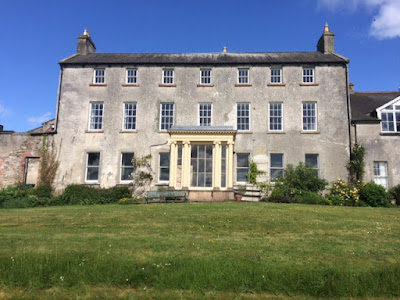
Entrance front, Fort Stewart House (Image: UAHS, 2020)

FORT STEWART, near Killydonnell, County Donegal, is a Georgian mansion built between 1730-60 to replace an earlier dwelling to the north-east.

This is a three-storey house, double gable-ended, with a seven-bay entrance front.

There are single-storey, irregular, two-bay wings.

Garden front, Fort Stewart House (Image: UAHS, 2020)

A pilastered porch was added about 1823.

Entrance porch (Image: Buildings of Ireland)

The entrance hall is adorned by four Tuscan columns, with rib-vaulting rising from them.

Outbuildings attached to Fort Stewart (Image: UAHS, 2020)

Fort Stewart House succeeded a fortified plantation dwelling, likely a bawn, erected by Sir William Stewart about 1619.

Town Address of 9th Baronet ~ 5, King's Bench Walk, Temple, London.