Showing posts with label County Dublin Landowners. Show all posts

Tuesday, 28 April 2026

1st Viscount Allen

JOHN ALLEN, the founder of this family in Ireland, settled there some time towards the close of ELIZABETH I's reign.

He came from Holland to Dublin as factor for the Dutch merchants (the family had emigrated from England to Holland in 1580), and beside amassing a very large fortune, distinguished himself by a refined taste in architecture.

Mr Allen was greatly esteemed, and consulted by the most eminent of the nobility and gentry in their buildings; particularly by the Earl of Strafford, Lord Lieutenant of Ireland, in his large, intended edifice near Naas, County Kildare.

Mr Allen laid out the plan of his own house at Mullynahack, near Dublin, leaving it to be executed by his son.

He died ca 1641, and was father of

SIR JOSHUA ALLEN, an eminent and opulent merchant of Dublin, who served the office of Lord Mayor of Dublin in 1673, and received the honour of knighthood.

Sir Joshua, High Sheriff of Dublin City, 1664, completed the house at Mullynahack begun by his father, called "Allen's Court."

He married Mary, daughter of John Wybrow, of Cheshire, and had issue,
JOHN, his heir;
Eleanor; Elizabeth; Mary.
Sir Joshua died in 1691, and was succeeded by his son,

THE RT HON JOHN ALLEN (1660-1726), Privy Counsellor, High Sheriff of County Dublin, 1691, MP for County Dublin, 1692-3, County Carlow, 1695-9, County Dublin, 1703-13, County Wicklow, 1713-14, County Dublin, 1715-17.

Mr Allen wedded, in 1684, Mary, daughter of the Rt Hon Robert FitzGerald, and sister of Robert, 19th Earl of Kildare, and had issue,
JOSHUA, his successor;
Robert;
Richard, father of the 4th and 5th Viscounts.
He was elevated to the peerage, in 1717, in the dignities of Baron Allen, of Stillorgan, County Dublin, and VISCOUNT ALLEN, County Kildare.

His lordship was succeeded by his eldest son,

JOSHUA, 2nd Viscount (1685-1742), MP for County Kildare, 1709-26, who espoused, in 1707, Margaret, daughter of Samuel du Pass, of Epsom, Surrey, and had issue,
JOHN, his successor;
Frances; Elizabeth.
His lordship was succeeded by his son and heir,

JOHN, 3rd Viscount (1713-45), MP for Carysfort, 1733-42; who, being insulted in the public streets by some disorderly dragoons, in 1742, received a wound in the hand, which occasioned a fever and caused his death soon afterwards.

Since he died unmarried, his sisters became his heirs, and the title devolved upon his first cousin (refer to the children of the Hon Richard Allen, youngest son of the 1st Viscount),

JOHN, 4th Viscount, MP for County Wicklow, 1742-5, at whose decease unmarried, in 1753, the honours passed to his next brother,

JOSHUA, 5th Viscount (1728-1816), MP for Eye, 1762-70, who married, in 1781, Frances, daughter of Gaynor Barry, and had issue,
JOSHUA WILLIAM, his successor;
Letitia Dorothea; Frances Elizabeth.
His lordship was succeeded by his son and heir,

JOSHUA WILLIAM, 6th Viscount (c1782-1845), a military officer, who served under the Duke of Wellington in the Peninsular Wars.

His lordship died unmarried, when the title expired.


STILLORGAN HOUSE, Stillorgan, County Dublin, was begun in 1695 by John Allen MP, afterwards 1st Viscount Allen.

It comprised a two-storey, seven-bay centre block, and single storey, seven-bay wings.

The house had dormered attics and high-pitched roofs.

The centre block had lofty, slender chimneys, two at each end.

The demesne had formal gardens, an obelisk, and a grotto by Sir Edward Lovett Pearce.

The mansion was demolished in 1860 and only the grotto and obelisk remain.

First published in August, 2018.  Allen arms courtesy of the NLI.

Wednesday, 18 February 2026

Terenure House

THE SHAW BARONETS OWNED 996 ACRES OF LAND IN COUNTY DUBLIN

CAPTAIN WILLIAM SHAW (c1651-1734), of Hampshire, son of Captain William Shaw, fought at the battle of the Boyne, 1690, an officer in Colonel Michelburn's foot regiment, was father of

RICHARD SHAW (1673-1729), of Ballinderry, County Tipperary, who married, in 1696, Judith, daughter of Edward Briscoe, and was father of

ROBERT SHAW (1698-1758), of Sandpits, County Kilkenny, who wedded, in 1736, Mary, daughter of Bernard Markham, and had issue,
William;
Thomas;
ROBERT, of whom presently;
Rebecca.
The youngest son,

ROBERT SHAW (1749-96), of Terenure, County Dublin, a merchant in Dublin, Accountant-General of the Post Office, espoused firstly, Mary, daughter of William Higgins, of Higginsbrook, County Meath, and had issue,
ROBERT, his heir;
Bernard;
Ponsonby;
Thomas;
John;
Mary; Charlotte.
Mr Shaw married secondly, Priscilla Cecilia, daughter of Colonel Robert Armitage, and had further issue,
George;
Lees;
Caroline; Sylvia.
The eldest son,

ROBERT SHAW (1774-1849), of Bushy Park, County Dublin, High Sheriff of County Dublin, 1806, MP for Dublin City, 1804-26, Colonel, Royal Dublin Militia, wedded firstly, in 1796, Maria, daughter of Abraham Wilkinson, of Dublin, and had issue,
ROBERT, his successor;
FREDERICK, 3rd Baronet;
Beresford William;
George Augustus (Rev);
Charles;
Charlotte; another daughter.
He espoused secondly, in 1834, Amelia, daughter of Dr Benjamin Spencer, of Bristol.

Mr Shaw was created a baronet in 1821, designated of Bushy Park, County Dublin.

He was succeeded by his eldest son,

SIR ROBERT SHAW, 2nd Baronet (1796-1869), DL, who died unmarried, and was succeeded by his next brother,

THE RT HON SIR FREDERICK SHAW, 3rd Baronet (1799-1876), Privy Counsellor, MP for Dublin, 1830-32, Dublin University, 1832-48, Recorder of Dublin, who espoused, in 1819, Thomasine Emily, daughter of the Hon George Jocelyn, and had issue,
ROBERT, his successor;
George, Major-General;
Frederic;
Edward Wingfield;
Wilkinson Jocelyn;
Thomasine Harriot; two other daughters.
Sir Frederick was succeeded by his eldest son,

SIR ROBERT SHAW, 4th Baronet (1821-95), DL, High Sheriff of County Dublin, 1848, Lieutenant-Colonel, Dublin Militia, who married, in 1852, Catherine Grace, daughter of William Barton, and had issue, a son and successor,

SIR FREDERICK WILLIAM SHAW, 5th Baronet (1858-1927), DSO JP DL, of Bushy Park, Terenure, County Dublin, Lieutenant-Colonel, Royal Irish Regiment, who wedded, in 1885, Eleanor Hester, daughter of Major Francis Horatio de Vere, and had issue,
ROBERT DE VERE, his successor;
Frederick Charleton;
Annie Kate; Mary Margaret; Grace Eleanor; Eily de Vere.
Sir Frederick was succeeded by his eldest son,

SIR ROBERT DE VERE SHAW6th Baronet (1890-1969), MC, who espoused, in 1923, Dorothy Joan, daughter of Thomas Cross, and had issue.


TERENURE HOUSE, County Dublin, is a noble 18th century house, comprising a five-bay front between two curved bows.

There are urns on the pediment.

There is a three-bay pedimented breakfront and a pillared porch.

In 1671, Major Joseph Deane, an officer in Cromwell’s army, purchased Terenure from Talbot for £4,000.

Major Deane, grandfather of the Rt Hon Joseph Deane MP, converted the castle into a mansion and his family held the property until 1789, when most of the land was sold to Abraham Wilkinson, of Bushy Park, County Dublin.


In 1785, Terenure House was leased to Robert Shaw, Accountant-General of the Post Office and a great-great uncle of George Bernard Shaw.

His son, Sir Robert Shaw, 1st Baronet, MP and Lord Mayor of Dublin, acquired the property, which was purchased for him by his father-in-law, Abraham Wilkinson, of Bushy Park, County Dublin.

Mr Wilkinson had already acquired much of the Terenure Estate in 1791.

He added almost 100 acres to the demesne and presented it, along with £10,000, to his only child Maria on her marriage to Robert Shaw, Junior.

Following the death of his father, Shaw came into possession of Terenure House and he sold it, about 1806, to Frederick Bourne, the proprietor of a stage coach business.

The Bournes occupied Terenure House until 1857, and during this period the estate was renowned for its magnificent landscaping, the planting in the grounds, and the extent and content of the glasshouses.

In 1860, the property was purchased by the Carmelite Order, which opened as a secondary school for boys.

From time to time extensions have been added and a fine church was built in 1958.

First published in August, 2018.  Shaw arms courtesy of the NLI.

Monday, 10 November 2025

Drumcondra House

THE COGHILL BARONETS OWNED 472 ACRES OF LAND IN COUNTY DUBLIN

The family of COGHILL was prominent in Yorkshire.

SIR JOHN COGHILL, of Coghill Hall, West Riding of Yorkshire, and Drumcondra, County Dublin, LL.D., Master in Chancery in Ireland, seventh in descent from John Cockhill, of Cockhill, living at Knaresborough in the reigns of RICHARD II and HENRY IV.

He married Hester, daughter of Tobias Cramer, of Ballyfoyle, County Kilkenny, and dying in 1699, left issue,
Marmaduke (Rt Hon), CHANCELLOR OF THE IRISH EXCHEQUER;
JAMES, of whom we treat;
Hester, m Oliver Cramer, mother of JOHN CRAMER;
Mary.
The younger son,

JAMES COGHILL (c1677-1734), LL.D., Registrar of the Prerogative Court, MP for Clogher, 1723-7, MP for Newcastle, 1727-34,  wedded Mary, sister of Thomas Pearson MP, of Rathmore, County Meath, and died leaving an only daughter and heir,

HESTER COGHILL, who espoused Charles, Earl of Charleville (who dsp 1764, when that dignity and the barony of Tullamore became extinct); and secondly, Major John Mayne, who assumed the name of COGHILL, and was created a baronet in 1781, designated of Richings, Buckinghamshire ; but dying in 1785 without an heir, that title expired.

The Countess of Charleville thus having no issue by either of her husbands, bequeathed her property, at her decease, to her cousin (refer to issue of Hester, daughter of Sir John Coghill, Master in Chancery),

JOHN CRAMER (1732-90), of Coghill Hall, Knaresborough, Yorkshire, who thereupon assumed the name of COGHILL, and was created a baronet in 1778, designated of Coghill, Yorkshire.

Sir John wedded Maria, daughter of the Most Rev Josiah Hort, Lord Archbishop of Tuam, and had issue,
JOHN, his successor;
JOSIAH, 3rd Baronet;
Judith; Eliza; Frances; Priscilla; Sophia.
He was succeeded by his elder son,

SIR JOHN CRAMER-COGHILL, 2nd Baronet (1766-1817), who assumed, in 1807, the surname and arms of COGHILL only.

Sir John died without issue, when the title devolved upon his brother,

VICE-ADMIRAL SIR JOSIAH COGHILL, 3rd Baronet (1773-1850), who married firstly, in 1812, Miss Dodson, and had three daughters,
Caroline Mary; Emmeline Katherine Egerton; Josephine.
He wedded secondly, in 1819, Anna Maria, eldest daughter of the Rt Hon Charles Kendal Bushe, Lord Chief Justice of the Court of King's Bench in Ireland, and had issue,
JOHN JOSCELYN, his successor;
Kendal Josiah William;
Rosanna Louisa; Sydney Alicia; Florence; Georgina; Adelaide; Sylvia.
Sir Josiah was succeeded by his eldest son,

SIR JOHN JOSCELYN COGHILL, 4th Baronet (1826-1905), JP DL, High Sheriff of County Dublin, 1859, who married, in 1851, Katherine Frances, daughter of John, 3rd Baron Plunket of Newton, and had issue,
NEVILL JOSIAH AYLMER;
EGERTON BUSHE, 5th Baronet;
Claude Plunkett;
Ethel Charlotte; Violet Alice Penrose.
Sir John's eldest son,

NEVILL JOSIAH AYLMER COGHILL VC (1852-79), Lieutenant, 24th Foot Regiment, was killed in action whilst saving the colours of his regiment.

His younger brother,

SIR EGERTON BUSHE COGHILL, 5th Baronet (1853-1921), JP DL, wedded, in 1893, Elizabeth Hildegarde Augusta, daughter of Lieutenant-Colonel Thomas Henry Somerville, and had issue,
MARMADUKE NEVILL PATRICK SOMERVILLE, his successor;
Nevill Henry Kendal Aylmer, 1899-1980;
JOSCELYN AMBROSE CRAMER, 7th Baronet;
Katherine Adelaide Hildegarde.
Sir Egerton was succeeded by his eldest son,

LIEUTENANT-COLONEL SIR MARMADUKE NEVILL PATRICK SOMERVILLE COGHILL, 6th Baronet (1896-1981), TD DL, who died unmarried, when the title devolved upon his brother,

SIR JOSCELINE AMBROSE CRAMER COGHILL, 7th Baronet.
  • Sir Joscelyn Ambrose Cramer Coghill, 7th Baronet (1902-83);
  • Sir Egerton James Nevill Tobias (Toby) Coghill, 8th Baronet (1930–2000);
  • Sir Patrick Kendal Farley Coghill, 9th Baronet (b 1960).


DRUMCONDRA HOUSE, Drumcondra, County Dublin, now All Hallows College, is an early 18th century house of considerable significance.

It comprises three storeys with two adjoining fronts.

The more august of the two has massive Corinthian pilasters which support a balustraded Corinthian entablature.

This feature is adorned with niches, aedicules and segmental pediments above the windows and two doorways.


The plainer front was designed by Sir Edward Lovett Pearce for Marmaduke Coghill, MP, Chancellor of the Irish Exchequer, and Judge of the Prerogative Court.

In the grounds is a temple with pediment and Corinthian pilasters.

Former residence ~ Drishane House, Skibbereen, County Cork; former seats ~ Randall's Park, Surrey; Glen Barrahane Castle, Castletownshend, County Cork.

First published in June, 2016.

Tuesday, 12 August 2025

Clontarf Castle

THE VERNONS OWNED
751 ACRES IN COUNTY DUBLIN

RICHARD, Lord of Vernon, was one of the barons created by Hugh Lupus, Earl of Chester during the reign of WILLIAM THE CONQUEROR, by the title of Baron of Shipbrook. According to Domesday Book, he was a considerable landed proprietor. 

The Manor of Clontarf was conferred by the Crown on Admiral Vernon and his descendants.

The lineal descendent of Richard,

SIR EDWARD VERNON (1584-1657), of Houndshill, Staffordshire, married, in 1613, his cousin Margaret, daughter and sole heiress of Henry Vernon, of Hilton and Essington, Staffordshire, and had issue, with six daughters,
Henry, of Sudbury;
Edward, of North Aston; had a grant of the castle and lands of Clontarf;
JOHN, of whom we treat.
The youngest son,

JOHN VERNON (c1618-70), of Clontarf, County Dublin, Quartermaster-General of the Army in Ireland, 1655, wedded firstly, Anne, daughter of John Huish, of Sand, Devon, and had a son, John, who died in London, unmarried.

He espoused secondly, Elizabeth, daughter of Fulke Walwyn, of Much Marcle, Herefordshire, and had issue, his son and heir,

THE REV EDWARD VERNON, of Redmile, Leicestershire, who married Lettice, daughter of John Bankes, of Uttoxeter, Staffordshire, and had issue,
JOHN, his heir;
Edward (Rev), Rector of St George's, Bloomsbury;
Catherine.
The elder son,

JOHN VERNON (ante 1693-1753), a Captain in the Army, afterwards of Clontarf Castle, County Dublin, wedded Dorothy, sister of Hans Otto Grahn, a Hanoverian nobleman, by whom he had issue,
GEORGE, his heir;
Edward, of Dublin;
Charlotte.
The elder son,

GEORGE VERNON (1722-87), of Clontarf Castle, a barrister, espoused Elizabeth Hughes, widow, and had issue,
JOHN, his heir;
George, died unmarried 1802;
Frances Dorothy; Diana.
The elder son,

JOHN VERNON (1757-1808), of Clontarf Castle, a barrister, married, in 1780, Elizabeth, daughter of Henry Fletcher, of Newtown Park, County Dublin, and had issue,
GEORGE, his heir;
John Fane, of Erne Hill;
Frances; Elizabeth; Maria.
The eldest son,

GEORGE VERNON, of Clontarf Castle, a barrister, wedded, in 1808, Henrietta Maria, daughter of Wilson Gale-Braddyll, of Conishead Priory, near Ulverston, Lancashire, and died in 1822, having had issue,
GEORGE BRADDYLL, his heir;
JOHN EDWARD VENABLES, succeeded his brother;
Charles Pierce, died unmarried 1838;
Walter Fawkes;
Braddyll Francis;
Henry Townley;
Henrietta Jane; Elizabeth Charlotte; Maria Frances.
The eldest son,

GEORGE BRADDYLL VERNON, of Clontarf Castle, died unmarried, and was succeeded by his next brother,

JOHN EDWARD VENABLES VERNON JP DL (1813-90), of Clontarf Castle, High Sheriff of County Dublin, 1847, married firstly, in 1836, Louisa Catherine (died 1853), only daughter of Charles Proby Bowles, of Park Lane, London, and by her had issue,
EDWARD VENABLES, his heir;
Charles Albert;
Forbes George;
Granville William;
John Francis Henry;
Louisa Emily.
Mr Vernon wedded secondly, in 1856, the Hon Rosa Gertrude Harriet Daly, daughter of James, 1st Baron Dunsandle, which lady dsp 1859.

He was succeeded by his eldest son,

EDWARD VENABLES VERNON JP DL (1838-1912), of Clontarf Castle, High Sheriff of County Dublin, 1904, Lieutenant-Colonel and Honorary Colonel, Royal Dublin Fusiliers, who wedded, in 1862, Jane, daughter of Matthew Brinkley, of Parsonstown, County Meath, son of the Right Rev John Brinkley DD, Lord Bishop of Cloyne, and had issue,
EDWARD KINGSTON, his heir;
Granville;
John Cuthbert Avenal, MC;
Louisa Constance; Edyth Agnes; Kathleen Louisa; Dorothy Mabel; Muriel Maud.
Clontarf Castle (Image: Celtic Castles)

CLONTARF CASTLE, County Dublin, is described by Mark Bence-Jones in his Guide to Country Houses as being 
"A Tudor-Revival house of 1836 by William Vitruvius Morrison, attached to a tall old tower on the site of a medieval commandery of the Knights Templar and afterwards of the Knights Hospitaller of St John of Jerusalem."
He goes on the describe the sombrely rich interior, with heavily moulded ceilings, dark panelling from floor to ceiling, and heraldic stained-glass.

The Castle boasts a lofty hall with a timbered roof and galleries; and a stained-glass window containing portraits of HENRY VII and Elizabeth of York.

Edward Venables Vernon (1838-1912) was the maternal grandfather of Cyril Connolly CBE.

Edward Kingston Vernon (1869-1967) was the last of the family to live at Clontarf, which has been a hotel since 1997.

Saturday, 9 August 2025

Johnstown Kennedy House

THE KENNEDY BARONETS OWNED 1,447 ACRES OF LAND IN COUNTY DUBLIN


DARBY O'KENNEDY (c1648-1745), of Ballykerogue Castle, County Waterford, wedded a daughter of Stephen Baron, of Durrow, and was father of

JOHN KENNEDY, of Johnstown Kennedy, County Dublin, who espoused Eleanor, daughter of Eaton Fagan, of Feltrim, and left issue at his decease, 1758, a son and successor,

EDWARD KENNEDY (1746-1811), of Johnstown Kennedy, who married, in 1781, Sarah, daughter of John Bayly, of Gowran, and had issue,
JOHN, his heir;
Charles Edward, of Peamount.
The elder son,

JOHN KENNEDY (1785-1848), wedded firstly, in 1819, Maria, daughter of William Beauman, of Rutland Square, Dublin, and had issue,
CHARLES EDWARD BAYLY, his heir;
William;
John;
Francis;
Robert, father of Admiral Francis W Kennedy CB;
Maria.
He wedded secondly, in 1841, Elizabeth Anne, daughter of John Beauman, of Hyde Park, County Wexford.

Mr Kennedy was created a baronet in 1836, designated of Johnstown Kennedy, County Dublin.

He was succeeded by his eldest son,

SIR CHARLES EDWARD BAYLY KENNEDY, 2nd Baronet (1820-80), who espoused, in 1854, the Lady Augusta Pery, sister of 2nd Earl of Limerick, and had issue,
JOHN CHARLES, his successor;
George Edward de Vere.
Sir Charles was succeeded by his elder son,

SIR JOHN CHARLES KENNEDY, 3rd Baronet (1856-1923), JP DL, High Sheriff of County Waterford, 1884, who married, in 1879, Sydney H Maude, daughter of Sir James Macaulay Higginson, and had issue,
JOHN RALPH BAYLY, 4th Baronet;
JAMES EDWARD, 5th Baronet;
Augusta Mabel; Gladys Maude.
Sir John was succeeded by his eldest son,

SIR JOHN RALPH BAYLY KENNEDY, 4th Baronet (1896-1968), of Johnstown, who died unmarried, when the baronetcy devolved upon his brother,

SIR JAMES EDWARD KENNEDY, 5th Baronet (1898-1974), of Johnstown, who died unmarried, when the title reverted to his cousin,

SIR DERRICK EDWARD DE VERE KENNEDY, 6th Baronet (1904-76), of Johnstown, who wedded firstly, in 1926, Phyllis Victoria Levine, daughter of Gordon Fowler; and secondly, in 1945, Barbara Mary Worthing, daughter of William Shepherd, and had issue,
GEORGE RONALD DERRICK, his successor;
Mark Gordon;
Julia Maureen Patricia.
Sir Derrick, former Major, Royal Ulster Rifles, a hotelier from 1947 until 1966, was succeeded by his eldest son,

SIR (GEORGE) RONALD DERRICK KENNEDY, 7th Baronet (1927-88), OBE, who married, in 1949, Noelle Mona, daughter of Charles Henry Green.

The 7th Baronet, Lieutenant-Colonel, Royal Artillery, and was appointed OBE (military) in 1975.

By his wife he had issue,
MICHAEL EDWARD, his successor;
Carolyn Phyllis.
He was succeeded by his son,

SIR MICHAEL EDWARD KENNEDY, 8th Baronet (1956-2012), of Otford, Kent, who wedded, in 1984, Helen Christine Jennifer, daughter of Patrick Lancelot Rae, and had issue,
GEORGE MATTHEW RAE, his successor;
Constance Andrea; Josephine Jennifer; Katherine Colleen.
Sir Michael was succeeded by his son,

SIR GEORGE MATTHEW RAE KENNEDY, 9th Baronet, born in 1993.

The present baronet has not (2013) successfully proven his succession to the baronetcy and is not therefore on the Official Roll of the Baronetage.

However, the case is under review by the Registrar of the Baronetage.


JOHNSTOWN KENNEDY HOUSE, Rathcoole, County Dublin, was a plain, three-storey Georgian house.

It had a three-bay side; with a porch which was enclosed at some later stage.

The drawing-room was notable for its acanthus plasterwork.

It was renowned as having been the residence of Major Sinclair Yeates in the television series, The Irish RM (played by the actor Peter Bowles (1936-2022).

The Irish RM  on the tennis court

The estate included a most impressive and extensive range of farm buildings.

The buildings had courtyards with high walls and dramatic gateways some with pinnacles, curved equestrian buildings, Gothicised doorways, a small dairy, and several well-constructed utilitarian buildings serving various agricultural purposes.

There was also a water mill with mill race and a cast-iron mill wheel in-situ.

A roadside forge with horseshoe shaped entrance displays the initials "E K" and the date over the door.

The remains of a later walled garden with ruined greenhouses, a gardener's house and other structures, added a further dimension to this outstanding collection of estate buildings.

Johnstown Kennedy was sold by Sir Derrick Kennedy, 6th Baronet.

The house was subsequently demolished and the estate now forms part of Beech Park Golf Club.

First published in March, 2016.

Wednesday, 28 May 2025

Santry Court

THE DOMVILE BARONETS WERE MAJOR LANDOWNERS IN COUNTY DUBLIN, WITH 6,262 ACRES

Of the family of DOMVILLE were two branches in Cheshire; the elder seated at Oxton, from the period of the conquest to its termination in females, who carried the estate through the families of Troutbeck and Hulse, into that of the Earls of Shrewsbury.

The younger at Lymm Hall, Cheshire, of which 

GILBERT DOMVILLE (1583-1637), second son and heir of William Domville, of Lymm Hall, removed into Ireland in the beginning of the reign of JAMES I, and was clerk of the Crown and Hanaper there, having for his colleague the ancestor of the Wellesley family.

Mr Domville, MP for Donegal Borough, 1634, married Margaret, daughter of the Most Rev Thomas Jones, Lord Archbishop of Dublin, LORD CHANCELLOR OF IRELAND, father of the 1st Viscount Ranelagh.

He was buried in the choir of St Patrick's Cathedral, Dublin.

His son,

THE RT HON SIR WILLIAM DOMVILLE (1609-89), Attorney-General for Ireland, 1660, MP for County Dublin, Privy Counsellor, Speaker of the General Convention of Ireland at the Restoration, wedded Miss Lake, daughter of Sir Thomas Lake, of Cannons, Middlesex, Secretary of State to JAMES I, and had issue,
William (Sir), MP for Co Dublin;
THOMAS, of whom we treat.
The younger son,

THOMAS DOMVILE (c1650-1721), of Templeogue, MP for Mullingar, 1692-3, Clerk of the Crown and Hanaper, was created a baronet in 1686, designated of Templeogue, County Dublin.

He wedded firstly, the daughter of his cousin, Sir Launcelot Lake, by whom he had a daughter (married to Barry, 3rd Lord Santry); and secondly, the Hon _____ Cole, daughter of Arthur, Lord Ranelagh, but had no issue.

Sir Thomas married thirdly, Anne, daughter of the Hon Sir Charles Compton (second son of Spencer, 2nd Earl of Northampton), and had issue,
COMPTON, his heir;
Elizabeth, mother of
CHARLES DOMVILE.
Sir Thomas was succeeded by his son,

THE RT HON SIR COMPTON DOMVILE, 2nd Baronet (1696-1768), Clerk of the Crown and Hanaper, privy counsellor, MP for Dublin, 1727-68.

At the decease of this gentleman, in 1768, the baronetcy expired, and his estates reverted to his nephew,

CHARLES POCKLINGTON (1740-1810), MP for County Dublin, 1768, who assumed, pursuant to the will of his uncle, the surname and arms of DOMVILE only.

He wedded Margaret, daughter of ______ Sheppard, and had issue,
COMPTON, his heir;
Henry Barry, in holy orders;
William, in holy orders;
Christopher;
Elizabeth; Margaret; Anna Maria; Caroline; Louisa; Mary; Bridget.
The eldest son,

COMPTON POCKLINGTON DOMVILE (1775-1857), was created a baronet in 1815, designated of Templeogue and Santry House, both in County Dublin.

He married firstly, Elizabeth Frances, daughter of the Hon and Rt Rev Charles Lindsay, Lord Bishop of Kildare, and cousin of Lord Balcarres; by whom he had a son,

SIR CHALES COMPTON WILLIAM DOMVILE, 2nd Baronet (1822-84).
  • Sir Charles Compton William Domvile, 2nd Baronet (1822-84) son of 1st baronet; married Lady Margaret St. Lawrence; no issue;
  • Sir William Compton Domvile, 3rd Baronet (1825-84) son of 1st baronet; married Caroline Meade; one son and three daughters, including Mary Adelaide, later wife of Sir Hutcheson Poë, 1st Baronet
  • Sir Compton Meade Domvile, 4th Baronet (1857-1935) son of 3rd Baronet; never married.
The baronetcy expired on the death of the 4th Baronet.


SANTRY COURT, Santry, County Dublin, was a very important, early 18th century mansion of red brick with stone facings, built in 1703 by the 3rd Lord Barry of Santry, commonly called Lord Santry.

It was of two storeys over a singularly high basement, with a dormer attic behind the roof parapet.

It had a nine-bay entrance front with a pedimented breakfront.

There were Corinthian columns at the head of a great flight of steps.

Curved wings and sweeps were added later, ca 1740-50, by the 4th and last Lord Barry (Lord Santry).


The Court had a fine interior with a large hall; good plasterwork.

Following the death of Henry, 4th Baron Barry of Santry, the Domvile family inherited the Santry estate, including Ballymun.

Santry Court and nearly 5,000 acres of land remained in the Domvile family’s hands for almost 200 years (1751-1935).


Much of the historical records for the Santry Estate date from Sir (Thomas) Compton Domvile's inheritance of Santry Estate in 1751.

There is some evidence that the Santry estate was experiencing financial difficulties, partly due to the expenses incurred building Santry Court, but also because of the lavish habits of the 4th Baron.

When Sir Charles, 2nd Baronet, inherited Santry Court, demesne and estate from his father in 1857, he began the largest renovation and building programme (gardens and house) that the Santry estate had seen since its construction in the early 18th century.
A vast number of maps, diagrams and plans have survived from this period. Sir Charles was the last member  of the Domvile family to reside permanently at Santry. He married Lady Margaret Frances St Lawrence, a daughter of the 3rd and last Earl of Howth.
After the death of Sir Charles, Santry Court passed briefly to his brother, Sir William, 3rd Baronet, and then to the Pöe family who were relatives of the Domviles by marriage.

Shortly after 1935, Santry Court became a residential care home.

The house fell into disrepair, initially at the turn of the 20th century as the estate proved not to be economically viable; but ultimately after the Domvile family left Ireland in 1921.

It came into the possession of the Irish state, which intended to repair it and use it as a mental asylum.

This plan was shelved by the start of the 2nd World War; the need to increase security around Dublin Airport meant it was used as an army depot, and part of the gardens as a firing range.

There are many theories locally about what happened next, but it appears that soldiers of the Irish army caused a fire and the house was severely damaged in 1947; followed by demolition shortly afterwards.

First published in November, 2011.

Monday, 16 December 2024

Lissen Hall

THE HELY-HUTCHINSONS OWNED 766 ACRES OF LAND IN COUNTY DUBLIN

THE RT HON JOHN HELY-HUTCHINSON (1724-94), an eminent lawyer and statesman of Ireland (son of Francis Hely, of Gortroe, County Cork, by the daughter of Christopher Earbury), married, in 1751, Christiana, daughter of Lorenzo Nickson, of Munny, County Wicklow, and niece and heir of Richard Hutchinson, of Knocklofty, County Tipperary (in consequence of which marriage he assumed the additional surname of HUTCHINSON), and had issue,
Richard Hely, cr EARL OF DONOUGHMORE ;
John, successor to his brother as 2nd Earl;
FRANCIS, of whom we treat;
Augustus Abraham;
Christopher;
Lorenzo;
Christiana; Mary; Prudence; Margaret.
Mr Hely-Hutchinson's wife, Christiana, was elevated to the peerage, in 1783, suo jure, in the dignity of BARONESS DONOUGHMORE, of Knocklofty, County Tipperary.

The third son,

FRANCIS HELY-HUTCHINSON (1759-1827), MP for Dublin University, 1790-98, Naas, 1798-1801, wedded Frances Wilhelmina, daughter and heir of Henry Nixon, of Belmont, County Wexford, and had issue,
John, 3rd Earl;
Henry, Lieutenant-Colonel;
COOTE, of whom hereafter;
George;
Richard;
Anne Louisa; Catherine Henrietta; Charlotte Sophia; Louisa Frances.
The third son,

THE HON COOTE HELY-HUTCHINSON, Captain, Royal Navy, espoused, in 1834, Sophia, youngest daughter of the Rev Sir Samuel Synge-Hutchinson Bt, and had issue,
Samuel, died in infancy;
JOHN, of whom we treat;
Francis Henry;
Sophia Dorothy.
Captain Hely-Hutchinson died in 1842.

His third son,

JOHN HELY-HUTCHINSON JP DL (1826-1919), of Seafield and Lissen Hall, County Dublin, High Sheriff of County Dublin, 1872, married, in 1865, Mary Louisa, eldest daughter of Robert Tottenham, of Annamult, second son of Charles Tottenham, of Ballycurry, County Wicklow, and had issue,
COOTE ROBERT, his heir;
Richard George, a military officer;
Ethel Mary; Cecil Frances Katharine; Eleanor Blanche.
The elder son,

COOTE ROBERT HELY-HUTCHINSON OBE (1870-1930), Lieutenant-Colonel, Reserve Battalion, Royal Fusiliers, wedded, in 1914, Julia Harriet Vere, daughter of William Clayton Browne-Clayton, and had issue,
JOHN;
Michael;
David Coote;
Mary Caroline; Julia Louisa.
The eldest son,

JOHN HELY-HUTCHINSON (1914-85), died unmarried.


LISSEN HALL, Donabate, County Dublin, was constructed in at least two different periods.

The original house was a long, plain, gable-ended dwelling of the late-17th or early 18th century.

Slightly later, though still in the first half of the 18th century, Lissen Hall was extensively remodelled and a new front built at right angles to the earlier house to form a large T-shaped building.

The new five-bay façade shows a typical mid-Georgian design, with a tripartite door-case and a Venetian window above.

Lissen Hall (Image: Historic Houses of Ireland)

The tripartite arrangement is repeated on the upper storey, where the central window is flanked by two blind sidelights.

There are projecting bows, with semi-conical roofs at either end, while the walls of the façade continue upwards without a cornice to form a parapet, adorned with urns and eagles.

These embellishments were clearly aimed at replicating Mantua, a neighbouring house now long demolished, which faced Lissen Hall across the tidal estuary of the Meadow Water.

Architectural drawings from 1765 can be seen in the house, which at that time was owned by John Hatch, MP for Swords in the old Irish Parliament before it voted itself out of existence in 1801.

Lissen Hall later passed to the politically influential Hely-Hutchinson family, of nearby Seafield House.

In the 1870s the grounds comprised 78 acres.

In 1950 Terence Chadwick purchased Lissen Hall from the Hely-Hutchinsons, and it was subsequently inherited by his daughter, Lady Davis-Goff, of Ballinacor.

As a result Lissen Hall has been sold only once in over two hundred and fifty years.

The Irish Times has published an interesting article about the Hely-Hutchinsons.

First published in January, 2018.  Donoughmore arms courtesy of European Heraldry.  Select bibliography: Irish Historic Houses Association.

Thursday, 19 September 2024

Luttrellstown Castle

THE BARONS ANNALY WERE MAJOR LANDOWNERS IN COUNTY DUBLIN, WITH 3,954 ACRES

LUKE WHITE (c1740-1824), of Woodlands, County Dublin, High Sheriff of County Dublin, 1804, and County Longford, 1806, MP for Leitrim, 1818-24, who had acquired considerable wealth, purchased Lord Carhampton's estate of Luttrelltown.

Luke White, By Gilbert Stuart - http://www.nga.gov/content/ngaweb/
Collection/art-object-page.1122.html,
Public Domain, https://commons.wikimedia.org/w/index.php?curid=50758244

He married firstly, 1781, Elizabeth, daughter of Peter de la Mazière, of Dublin, of a Huguenot family, and had issue; and secondly, in 1800, Arabella, daughter of William Fortescue, and by her had a son, William.

His fourth son, by his first marriage,

HENRY WHITE (1791-1873), of Woodlands, County Dublin, and subsequently of Rathcline, County Longford, served in the 14th Light Dragoons during the Peninsular War; was MP for County Dublin, 1823-32, County Longford, 1837-47 and 1857-61; Lord-Lieutenant of County Longford, 1841-73.

Having succeeded to the Longford estates of his next elder brother, Luke White, in 1854, he was elevated to the peerage, in 1863, in the dignity of BARON ANNALY (third creation), of Annaly and Rathcline, County Longford.

His lordship married, in 1828, Ellen, daughter of William Soper Dempster, by Hannah, only daughter and heir of John Hamilton Dempster, of Skibo Castle, Sutherland, and had issue,
LUKE, his successor;
Henry;
George Frederick;
Francis Samuel;
Charles William;
Robert;
Eleanor Eliza; Emily Beaujolais.
He died at Sunbury Park, Middlesex, and was succeeded by his eldest son,

LUKE, 2nd Baron (1829-88), KP, who wedded, in 1853, Emily, daughter of James Stuart, and had issue,
LUKE, his successor;
Henry Frederick;
Charles James;
Robert;
Francis William;
Ellen Harriet; Alice Emily; Violet.
His lordship was succeeded by his eldest son,

LUKE, 3rd Baron (1857-1922), GCVO JP DL, who wedded, in 1884, Lilah Georgiana Augusta Constance, daughter of Henry, 3rd Viscount Clifden, and had issue,
LUKE HENRY, his successor;
Lilah Charlotte Sarah; Lucia Emily Margaret.
His lordship was succeeded by his son,

LUKE HENRY, 4th Baron (1885-1970), MC JP,

LUTTRELLSTOWN CASTLE, Clonsilla, County Dublin, dates from the early 15th century (ca 1420).

It has been owned variously by the eponymous and notorious Luttrell family; the bookseller Luke White his descendants the Lords Annaly; the Guinnesses; the Primwest Group; and, since 2006, JP McManus, John Magnier and Aidan Brooks.

The Castle has hosted visits by Queen Victoria in 1844 and 1900, and its media profile was raised when David and Victoria Beckham were married there in 1999.

Luttrellstown and its remaining 560-acre demesne currently form a 5-star resort. 

Henry, 2nd Earl of Carhampton, sold Luttrellstown Castle to the publisher Luke White, described as one of the most remarkable men in Ireland.

Luke White changed its name to Woodlands, but the 3rd Lord Annaly reverted back to its former name.


In 1778, Luke White started as an impecunious book dealer, buying in Dublin and reselling around the country.

By 1798, during the rebellion, he helped the Irish government with a loan of £1 million (at £65 per £100 share at 5%).

He became MP for Leitrim, and died in 1824 leaving properties worth £175,000 per annum.

An extract from The illustrated London News of 1864 describes a series of festivities at Woodlands, "the beautiful seat of the Rt Hon. Henry White, the newly created Lord Annaly".

These festivities consisted of theatrical and social entertainments.

A new theatre was built especially for the occasion and the festivities lasted for a fort­night.

The plays `Still Waters Run Deep' and `Samuel in Search of Him­self' were performed, and a ball to which `most of the principal families of Dublin and the neighbourhood received invitations', concluded the festivities.

Queen Victoria paid two visits to Luttrellstown: Firstly in 1844, as Her Majesty passed through to visit the Duke of Leinster at Carton; secondly in 1900, when The Queen stayed at Viceregal Lodge.

To commemorate these visits, Lord Annaly erected an obelisk made of six blocks of granite from the Dublin mountains, which together measure 8 feet, 6 inches in height.

It is at the head of the Glen, near the Waterfall, where Her Majesty drank some tea.

Prince von Puckler-Muskau (c1820) remarked,
"The entrance to the demesne is indeed the most delightful in its kind that can be imagined. Scenery, by nature most beautiful, is improved by art to the highest degree of its capability, and, without destroying its free and wild character, a variety and richness of vegetation is produced which enchants the eye. 
Gay shrubs and wild flowers, the softest turf and giant trees, festooned with creeping plants, fill the narrow glen through which the path winds, by the side of the clear, dancing brook, which, falling in little cataracts, flows on, sometimes hidden in the thicket, sometimes resting like liquid silver in an emerald cup, or rushing under overhanging arches of rock, which nature seems to have hung there as triumphal gates for the beneficent Naiad of the valley to pass through."

In the dining-room (above) the architect, Mr Harbord, used the same eagles at Oving House, near Aylesbury, that he incorporated in the plasterwork here.

As a room it succeeds brilliantly. The ceiling is painted by de Wit.


The entrance hall (above) retains its Gothic character of about 1800, but the mantel and black-and- white floor are recent improvements.


It leads on to the staircase hall, which was transformed by Mr Harbord in 1963 when a magnificent painted ceiling by Thornhill, from a house in Suffolk now demolished, was inserted; the staircase and window were altered at the same time.

The far end of the Ballroom opens into the Grisaille Room (above), created to rake the series of nine Grisaille paintings by Peter de Gree, one of which, signed and dated 1788, represents Irish trade and commerce.

The library, in the centre of the south front, was originally the entrance hall and it has an unusual eighteenth century plaster ceiling with bow and arrow in full relief.

he chief glory of the house is the ballroom, which has plaster decoration that could be eighteenth century, but was most likely done for Luke White at the time of his purchase.

The design is unusual and original, and does not fit easily into any particular category of plasterwork; it was probably done by local stuccodores working in a somewhat outdated manner.

It blends in admirably with the Adamesque Grisaille room, and the magnificent dining room, with its plaster birds and painted ceiling.

The Whites were also major landowners in County Longford, with 12,560 acres.

Former residences ~ Porters, Shenley, Hertfordshire; Baldwyn's, East Grinstead, Sussex; town house: 19, Belgrave Square.


First published in September, 2011.

Monday, 19 August 2024

1st Earl of Carhampton

The Luttrells of Luttrellstown, County Dublin, claimed kinship with the Luttrells of Dunster Castle, Somerset, though the armorial bearings differ. Nevertheless, the land known as Luttrellstown, in Ireland, is said to have been possessed by the Somerset branch from the era of KING JOHN.

SIR GEOFFREY DE LUTEREL (c1158-1218), who had large estates in Derbyshire, Leicestershire, Nottinghamshire, and Yorkshire, accompanying KING JOHN to Ireland, and diligent in public affairs, "obtained a grant from the crown of Luttrellstown, on the payment of twenty ounces of gold, to hold by military service, and had livery of these lands" from John Marshal, Lord Marshal of Ireland.

His son,

SIR ANDREW LUTTRELL (c1205-64), claimed certain estates, known as the barony of Irnham, in Lincolnshire, as heir to Maurice de Gaunt; and left a son,

SIR GEOFFREY LUTTRELL, whose son,

SIR ROBERT LUTTRELL, was summoned to Parliament in 1295, and died in 1297, leaving a son and heir,

SIR ANDREW LUTTRELL; whose son,

SIR GEOFFREY LUTTRELL (1276-1345), was one of the principal knights in EDWARD III's army.

ROBERT LUTTRELL (a younger brother of Sir John Luttrell, feudal baron of Dunster, Somerset, and one of the first Knights of the Bath) died in 1436, "seised of the castle and lands of Luttrellstown" (originally granted to Sir Gregory Luttrell by KING JOHN); and his great-grandson,

SIR THOMAS LUTTRELL, was Chief Justice of the Common Pleas and a Privy Counsellor in Ireland during the reign of HENRY VIII.

THOMAS LUTTRELL, MP for County Dublin in the reigns of JAMES I and CHARLES I, died in 1634.

His lineal descendant,

HENRY LUTTRELL (c1655-1717), raised and commanded five squadrons of cavalry for JAMES II.
In 1702, he was appointed a major-general in the Dutch service; but, on the death of WILLIAM III, retired to his principal residence at Luttrellstown, where he was assassinated "in his sedan chair by a band of ruffians" in the city of Dublin.
General Luttrell's two sons were educated in England. Robert, the elder, died in 1717 while travelling; the younger brother,

SIMON LUTTRELL (1713-87), a prominent politician, was elevated to the peerage, in 1768, in the dignity of Baron Irnham, of Luttrellstown, County Dublin.

Simon Luttrell, 1st Earl of Carhampton, in Turkish attire, 
by Jean-Étienne Liotard

The 1st Baron was advanced to a viscountcy, in 1781, as Viscount Carhampton, of Castlehaven, County Cork; and further advanced, in 1785, to the dignity of an earldom, as EARL OF CARHAMPTON.

His lordship married, in 1737, Judith Maria, daughter of Sir Nicholas Lawes, Governor of Jamaica, and had issue,
HENRY LAWES, his successor;
JOHN, 3rd Earl;
Temple Simon;
James;
Thomas;
Anne; Elizabeth; Lucy.
The 1st Earl was succeeded by his eldest son,

HENRY LAWES, 2nd Earl (1743-1821), MP for Old Leighlin, 1783-7, who wedded, in 1776, Jane, daughter of George Boyd, though died without male issue, when the family honours devolved upon his next brother,

JOHN, 3rd Earl (1739-1829), who espoused firstly, in 1766, Elizabeth, daughter of John Omnius, 1st Baron Waltham, and had issue,
John, died 1769;
James, died 1772;
Frances Maria (1768-1848).
He married secondly, in 1798, Maria, daughter of John Morgan, and had issue, a daughter, MARIA ANNE (1799-1857).

The 3rd Earl died at Devonshire Place, London, without surviving male issue, when the titles expired.

The Gentleman's Magazine, Volume 145 (1829) informs us that
"Though some distant branches of the Luttrells remain, the titles, from the failure of male heirs, have become extinct; being the thirty-third peerage of Ireland that has expired since the Union in 1801. The Irish estate at Luttrellstown was sold by the 2nd Earl; that in Jamaica now devolves on Captain Moriarty, nephew of the deceased, pursuant to the 2nd Earl's will."
First published in July, 2020.  Carhampton arms courtesy of European Heraldry.

Thursday, 20 June 2024

Kenure Park

THE PALMER BARONETS, OF CASTLE LACKIN, WERE MAJOR LANDOWNERS IN COUNTY MAYO, WITH 80,990 ACRES

THEY OWNED 3,991 ACRES OF LAND IN COUNTY DUBLIN


ROGER PALMER (alleged to have been the third son of Edward Palmer, of Nayton and Casterton, Norfolk) went over to Ireland and had a grant of Castle Lackin, and many other lands in County Mayo, in 1684. His signature appears to the address from the nobility and gentry of County Mayo to CHARLES II in 1682.

The Palmer family had come to Ireland in 1681 from Norfolk, and had acquired lands in County Mayo, where by the end of the 19th Century, they had amassed 80,000 acres. 

THOMAS PALMER, of Castle Lackin, County Mayo, second son of Roger Palmer, of Palmerstown, in the same county, was succeeded by his eldest son,

ROGER PALMER (1729-90), MP for Jamestown, 1761-8, Portarlington, 1768-83, who was created a baronet in 1777, designated of Castle Lackin.

Sir Roger wedded Miss Andrews, and had issue,
JOHN ROGER, his successor;
WILLIAM HENRY, succeeded his brother;
Sophia.
He was succeeded by his elder son,

SIR JOHN ROGER PALMER, 2nd Baronet, who married Mary, only daughter of the Rev Thomas Althem, and was succeeded at his decease, in 1819, by his brother,

SIR WILLIAM HENRY PALMER, 3rd Baronet, of Castle Lackin, who espoused Alice, daughter of _____ Franklin, and had issue,
WILLIAM HENRY ROGER, his heir;
Francis Roger;
John Roger;
Charlotte Alice; Augusta Sophia; Ellen Ambrosia.
Sir William died in 1840, and was succeeded by his eldest son,

SIR WILLIAM HENRY ROGER PALMER, 4th Baronet (1802-69), who married and was succeeded by his only son,

LIEUTENANT-GENERAL SIR ROGER WILLIAM HENRY PALMER, 5th and last Baronet (1832-1910), MP for Mayo, 1857-65, High Sheriff of County Mayo, 1888.

Kenure Park

The Palmers owned a number of seats, including Keenagh Lodge, Crossmolina, and the ruinous Castle Lackin in County Mayo; Cefn Park, near Wrexham, North Wales; Glenisland, Maidenhead, Berkshire.

Their principal Irish seat (through marriage) was Kenure Park, near Rush, County Dublin, where the estate comprised 3,991 acres.

Lieutenant-General Sir Roger Palmer, 5th and last Baronet, MP for Mayo, 1857-65, was Ellen Palmer's only brother.

He resided at Kenure with his wife, Gertrude Millicent, until his death in 1910.

Lady Palmer survived her husband for many years. She continued to spend much of her time in Kenure (above) until her death in 1929.

There are people in Rush who still remember the parties held in the house for the children of the town.

Sir Roger and Lady Palmer left no heirs, and the property devolved to Colonel Roderick Henry Fenwick-Palmer, who had fought in the 1st World War, and still bore the marks of shrapnel wounds to his face.


He had property of his own in Wrexham, North Wales, and only came to Kenure in the summer.

A plain man, he was not given to living the high life, apart from dining occasionally with friends, such as the late Lord Revelstoke.

He spent a lot of money trying to keep the house in repair.

He was finally defeated by rising costs on a property which was not making money.

Part of the estate had already been sold years before.

He eventually sold Kenure to the Irish Land Commission, in 1964, for £70.000.

Most of the land was divided up among local farmers.

The remainder was sold to Dublin County Council for housing and playing fields.

The woodland was cleared and all that now remains of the trees, which once dominated the skyline, is a small area around the main gate.

The front gate lodge is now the local Scouts' Den.

The gate lodge at Skerries Road belongs to Rush Cricket Club, which has beautifully refurbished it.

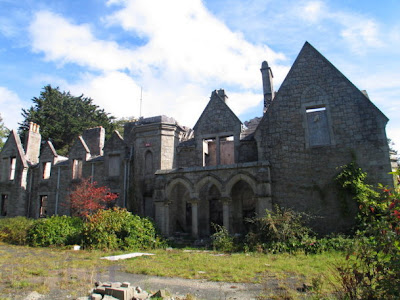
The Gate-Keeper's Lodge, the walled garden, the Steward's Lodge, the pond and shady avenues, have all gone the way of the big house itself. Only the portico remains, a stark remainder of what once was there.

The contents of the house were auctioned in September 1964, the auction lasted four days and realised £250,000, which would be over £1,000,000 in present day values.

Socially, Kenure had been a place apart from the ordinary life of the town, but it had been there for hundreds of years, an essential part of the Rush scene.

The general feeling was one of regret and disbelief that it was disintegrating.

As landlords, the Palmers had not been the worst.

However, there had been some evictions, and one action, which is still adversely remembered, was the removal of some of their tenants from their ancient holdings in order to lengthen the main avenue and have the main entrance gate near the town.

Nevertheless the Palmers were in many ways beneficent to Rush.

They gave land for the Catholic and Protestant churches, for a presbytery and for a teacher's residence.

In 1896, when the Catholic church was being refurbished, they donated the seating for the nave, and a brass memorial tablet in the church testifies to this.

A portion of the estate was allocated to the local cricket club, and it was certainly the most beautifully situated cricket pitch in north County Dublin.

Dublin County Council was left with an empty mansion, for which they could find no buyer.

The house continued to deteriorate.

During this time it was rented to a film company and a few films were made there, including "Ten Little Indians," "Rocket to the Moon," and "The Fall of Fu Manchu."

In 1978, after a series of incidents in which the house was vandalized and set on fire, with the inevitable water damage that resulted from the fire engines having to put out the blaze, the house was in a very dangerous condition structurally.

The County Council decided it had no choice but to demolish the house.

Within a few days, all that was left of this once great house was a mountain of rubble, from which the massive portico arose, forlorn and lonely against the sky.

First published in September, 2011. Select bibliography: KENURE HOUSE AND DEMESNE