Showing posts with label County Limerick Landowners. Show all posts

Wednesday, 1 April 2026

The De Burgo Baronetcy

THE DE BURGO BARONETS OWNED 4,216 ACRES OF LAND IN COUNTY LIMERICK    


This is one of the families that settled in Ireland under the banner of Richard de Clare, 2nd Earl of Pembroke, nicknamed Strongbow, and is supposed to have branched from the parent stock of the illustrious house of CLANRICARDE.

It may not be irrelevant to observe that all the French families of the name continued to write it De Bourg, and in Latin, De Burgo; and that after the De Burghs removed from Normandy into England, they also wrote De Burgo, and sometimes De Burgh, in order to accommodate the word to the English or Saxon accent.

However, in process of time, they wrote Bourk, Bourke, and Burke; but the King, by letters patent, in 1752, granted to the Earl of Clanricarde, to Ulick Bourke, of London, and to Thomas Bourke, of Ireland, and their descendants, full authority to resume the original surname of De Burgh.


RICHARD BOURKE, of Dromsally, County Limerick, died in 1764, and was succeeded by his eldest son,

RICHARD BOURKE, of Dromsally, who was succeeded by his eldest son,

RICHARD BOURKE, of Castle Connell, who assumed the original name of De Burgo, and was created a baronet in 1785, designated of Castle Conel [sic].

Sir Richard, High Sheriff of County Limerick, 1758, married firstly, in 1755, Frances, eldest daughter of David Webb, of Meadstown, County Limerick, and had issue, two daughters,
Frances; Maria Theresa.
He wedded secondly, in 1781, Elizabeth, daughter of Anthony Dwyer, of Singleton, County Limerick, by whom he left two sons; and dying in 1790, was succeeded by the elder,

SIR RICHARD DE BURGO, 2nd Baronet (c1783-c1808), at whose decease unmarried the title devolved upon his only brother,

SIR JOHN ALLEN DE BURGO, 3rd Baronet, of Castle Connell, who espoused firstly Miss Hall, sister of General Gage John Hall, but by her had no issue; and secondly, in 1820, Anna Matilda, daughter of Richard Waller, of Castle Waller, County Tipperary, and had issue,
RICHARD DONELLAN, his successor;
William Henry Frederick Waller, dsp.
Sir John died in 1839, and was succeeded by his elder son,

SIR RICHARD DONELLAN DE BURGO, 4th Baronet (1821-73), of Castle Connell, who married, in 1844, Catherine, youngest daughter of Brooke Brasier, of Rivers, County Limerick, and Mitchell's Fort, County Cork.

Sir Richard died without issue, when the baronetcy expired.

Castle Connell (Robert French/NLI)

Castle Connell, picturesquely situated on a rock overlooking the River Shannon, about six miles north of Limerick, became the principal castle of the Bourkes in West Clanwilliam.

The ruinous castle, erected on a rocky outcrop overlooking the bend on the River Shannon, was besieged and destroyed by General Ginkel’s army during the Jacobite and Williamite wars at the end of the 17th century.

Island House (Image: The Irish Times, 2022)


Island House, Cloon Island, near Castleconnell, was built ca 1840 by Sir John Allen De Burgo, 3rd Baronet.

Island House, Cloon Island (The Irish Times, 2022)

The Rev Patrick Comerford wrote an article about Island House in 2017.

De Burgo arms courtesy of European Heraldry.

Monday, 9 March 2026

Mount Trenchard House

THE SPRING-RICES, BARONS MONTEAGLE OF BRANDON, WERE MAJOR LANDOWNERS IN COUNTY LIMERICK, WITH 6,445 ACRES

EDWARD RICE, of Dingle, County Kerry, during the reign of HENRY VIII, married Anne, daughter of John Wall, of County Limerick, and was father of

ROBERT RICE, of Dingle, who wedded Julia, daughter of Sir James Whyte, Knight, of Cashel, County Tipperary, and was father of

STEPHEN RICE, of Dingle, MP for Kerry, 1613, who made a deed of settlement of his estates, 1619, and died in 1623.

He espoused Helena, daughter of Thomas Trant, of Cahirtrant, County Kerry, and had two sons, JAMES, MP for Dingle, 1635, from whom descended the RT HON THOMAS SPRING-RICE MP, of Mount Trenchard, 1st Baron Monteagle of Brandon; and

DOMINICK RICE, MP for Dingle, 1635, who married Alice, daughter of James Hussey, Baron of Galtrim, from which marriage descended

THE RT HON SIR STEPHEN RICE (1637-1715), Chief Baron of the Irish Exchequer, and a supporter of JAMES II, who wedded Mary, daughter of Thomas FitzGerald, of County Limerick, and had issue,
THOMAS;
EDWARD, of whom we treat.
Sir Stephen's elder son,

THOMAS RICE, of Mount Trenchard, wedded Mary, daughter of Maurice FitzGerald, 14th Knight of Kerry, and had issue, a son,

STEPHEN EDWARD RICE, of Mount Trenchard, who married, in 1785, Catherine, only child and heir of Thomas Spring, of Castlemaine, County Kerry, and had issue,
THOMAS, his heir;
Mary; Catherine Ann.
Mr Rice died in 1831, and was succeeded by his son,

THOMAS SPRING-RICE (1790-1866), of Brandon, County Kerry, Chancellor of the Exchequer, 1835-39, who wedded firstly, in 1811, the Lady Theodosia Pery, second daughter of Edmund, 1st Earl of Limerick, and had issue,
STEPHEN EDMUND, his successor;
Charles William Thomas, father of SIR CECIL SPRING-RICE GCMG GCVO;
Edmund Henry;
Aubrey Richard;
William Cecil;
Mary Alicia Pery; Theodosia Alicia Ellen F Charlotte; Catherine Anne Lucy.

Mr Spring-Rice was elevated to the peerage, in 1839, in the dignity of BARON MONTEAGLE OF BRANDON, of Brandon, County Kerry.

By his first wife he had issue,
STEPHEN EDMOND, his successor;
Charles William Thomas;
Edmond Henry Francis Louis;
Aubrey Richard;
William Cecil;
Theodosia Alicia Ellen F Charlotte; Mary Alicia Pery; Catherine Anne Lucy.
His lordship's eldest son,

THE HON STEPHEN EDMOND SPRING-RICE (1814-65), of Mount Trenchard, espoused, in 1839, Ellen Mary, daughter of William Frere, and had issue,
THOMAS, 2nd Baron;
FRANCIS, 4th Baron;
Aileen; Lucy; Theodosia; Mary; Alice; Frederica; Catherine Ellen; Amy.
The Hon Stephen Edmond Spring-Rice predeceased his father, and was succeeded by his elder son,

THOMAS, 2nd Baron (1849-1926), KP, of Mount Trenchard, who married, in 1875, Elizabeth, eldest daughter of the Most Rev and Rt Hon Samuel Butcher, Lord Bishop of Meath, and had issue,
Stephen Edmond (1877-1900);
THOMAS AUBREY, 3rd Baron;
Mary Ellen (1880-1924), of Mount Trenchard.
His lordship was succeeded by his younger son,

THOMAS AUBREY, 3rd Baron (1883-1934), CMG, MVO, who died unmarried, and was succeeded by his uncle,

FRANCIS, 4th Baron (1852-1937), Commander RN, who espoused firstly, in 1882, Elizabeth Ann, daughter of Sir Peter George FitzGerald, 1st Baronet, 19th Knight of Kerry, and had issue,
Francis Peter, died in infancy;
CHARLES, his successor.
He wedded secondly, in 1935, Julia Emma Isabella, widow of Stephen Edward Spring-Rice, CB.

His lordship was succeeded by his only surviving son,

CHARLES, 5th Baron (1887-1946), who married, in 1925, Emilie Frances de Kosenko, and had issue,
GERALD, his successor;
Michael;
Joan.
His lordship was succeeded by his elder son,

GERALD, 6th Baron (1926-2013), who wedded, in 1949, Anne, only daughter of Colonel Guy James Brownlow, DSO, DL, of Ballywhite, near Portaferry, County Down, and had issue,
CHARLES JAMES, his successor;
Elinor and Angela, born in 1950.
His lordship was succeeded by his only son,

CHARLES JAMES, 7th Baron, born in 1953.

The heir presumptive is the present holder's uncle, the Hon Michael Spring Rice (b 1935).

The heir presumptive's heir apparent is his son, Jonathan Spring Rice (b 1964).

The heir presumptive's heir apparent's heir apparent is his son, Jamie Alexander Spring Rice (b 2003).


MOUNT TRENCHARD HOUSE, near Foynes, County Limerick, is a late-Georgian house of three storeys over a basement, with two curved bows on its entrance front, which overlooks the River Shannon estuary.


There is a wide curved bow in the centre of its garden front, too.

One side of the house has a two-storey Victorian wing, which is almost as high as the main block; while the other side has a one bay, three storey addition and a lower two-storey wing.

Solas Mount Trenchard (Image: Booking.com)

Mount Trenchard was occupied by the Irish Army in 1944.

When the 5th Baron Monteagle of Brandon died in 1946, the estate was sold.

Lady Holland lived there for several years.

In 1954, the Sisters of Mercy acquired the estate and ran it as a private school for girls.

They extended the complex to include inter alia a large 1960s dormitory block, classrooms and a church.

Mount Trenchard House became the preserve of the nuns and continued in use as a dwelling.

Subsequent owners acquired the estate in 1996 and began restoring Mount Trenchard House for use as a centre for holistic medicine.

One aspect of the conservation plan was to restore the historic approach to the house which was originally from the south side (in the second half of the 19th century the house had been re-oriented to the north).

This involved changes to the present grounds and paths and woodlands, on the recommendation of the architects leading the project, the owners appointed me to advise them on the forestry and arboriculture aspects of the woodland, heritage, veteran/ancient and champion trees on the estate.

Mount Trenchard is currently used by an agency of the Irish government as an accommodation centre for asylum seekers.

First published in January, 2013. Monteagle of Brandon coat of arms: By Robin S. Taylor - Own work, with crest elements by Sodacan, CC BY-SA 4.0, https://commons.wikimedia.org/w/index.php?curid=81026788.

Monday, 15 December 2025

Dromore Castle

THE WALLERS WERE MAJOR LANDOWNERS IN COUNTY LIMERICK, WITH 6,996 ACRES

The ancient family of WALLER derives from

ALURED DE WALLER, of Newark, Nottinghamshire, who died in 1183, and from whom lineally descended

DAVID DE WALLER, Master of the Rolls to EDWARD III for thirty years.

This gentleman died childless; but from his only brother,

HENRY WALLER, sprang

JOHN WALLER, of Groombridge, Kent, father of

RICHARD WALLER, a gallant participator in the glories of Agincourt, who, in honour of having prisoner the Duke of Orleans in that memorable conflict, obtained, from HENRY V, the addition to his crest, of a shield of the arms of the Duke, pendent from the sinister side of a walnut tree, which his descendants have ever since borne.

The French prince, having been brought to England, was confined at Mr Waller's seat at Groombridge.

The grandson and direct successor of this gentleman,

JOHN WALLER, of Groombridge, married and was father of

WILLIAM WALLER, of Groombridge, High Sheriff of Kent, 1530, who married, in 1537, Anne Fallemar, of Eastney, near Southampton, and left two sons,
WILLIAM (Sir), his heir;
JOHN, ancestor of WALLER of Allenstown.
Mr Waller died in 1555, and was succeeded by his elder son,

WILLIAM WALLER, of Groomsbridge, who wedded Alice, daughter and co-heir of Sir Walter Hendley, and was father of

SIR WALTER WALLER, Knight, of Groombridge, who espoused Anne, daughter of Philip Choute, and had two sons,
GEORGE, his heir;
Thomas (Sir).
The elder son,

GEORGE WALLER (c1565-1622), of Groomsbridge, wedded firstly, Eliza, daughter of Michael Sondes; and secondly, Mary, widow of Sir William Ashenden, and daughter of Richard Hardress, and had a son,

SIR HARDRESS WALLER (1604-66), one of the judges who sat at the trial of CHARLES I, for which he was afterwards tried and banished.

Sir Hardress retired to Ireland, settled at Castletown, County Limerick, and became a member of the Irish Parliament.

He married Elizabeth, daughter and co-heir of Sir John Dowdall, Knight, of Kilfinny, County Limerick, and by her (with whom he acquired the Manor of Castletown), and issue,
John, Governor of Fort Limerick;
JAMES, his successor;
Elizabeth; Bridget; Mary; Anne.
Sir Hardress's second son,

JAMES WALLER (1632-1702), of Castletown Manor, Pallaskenry, Lieutenant-Governor of Kinsale, MP for Tralee, 1692-3, Kinsale, 1695-9, married Dorothy, daughter of Colonel Rondall Clayton, of Moyaloe, County Cork, and had (with four daughters) a son and successor,

JOHN WALLER (ante 1690-1742), of Castletown, MP for Doneraile, 1727-42, Lieutenant-Colonel, described by Swift as "Jack, the grandson of Sir Hardress".

He wedded Elizabeth, daughter of Thomas Dickson, of Ballybracken, County Cork, by Elizabeth his wife, heiress of Edward Bolton, of Clonrush, Queen's County, grandson of Sir Edward Bolton, Chief Baron of the Irish Exchequer, and had, with other issue, a son and successor,

JOHN THOMAS WALLER, of Castletown, High Sheriff of County Limerick, 1762, who wedded, in 1762, Elizabeth, daughter of the Rev Richard Maunsell, Rector of Rathkeale, and had issue,
JOHN, his heir;
BOLTON, successor to his brother;
Elizabeth; Katherine; Dorothea.
The elder son and heir,

JOHN WALLER (1762-1836), of Castletown, MP for County Limerick, 1790-1800, married Isabella Sarah, daughter of the Rt Hon Silver Oliver, of Castle Oliver, County Limerick, MP, by whom he had one son, John Thomas, who died unmarried.

Mr Waller was succeeded by his brother,

BOLTON WALLER JP (1769-1854), of Castletown and Shannon Grove, a barrister, High Sheriff of County Limerick, 1799, who espoused, in 1791, Elizabeth, daughter of 
William Henn, of Paradise, County Clare, and had issue,
John Thomas, died unmarried;
WILLIAM, his successor;
Richard Maunsell;
John;
Bolton Edmund;
Hardress;
Bidsey; Elizabeth; Katherine; Jane Anne; Isabella; Anne; Jane Mary.
Mr Waller was succeeded by his second son,

THE REV WILLIAM WALLER JP, of Castletown, who married, in 1820, Maria, second daughter of James O'Grady, brother of Standish, 1st Viscount Guillamore, and had issue,
Bolton, died unmarried;
James O'Grady, died unmarried;
JOHN THOMAS, succeeded to Castletown;
William, dsp;
Richard, dsp;
Hardress Edmund;
Walter de Warenne;
Standish O'Grady;
Edmund;
Maria; Elizabeth; Katherine Ellen; Julia Anna.
The Rev William Waller died in 1863, and was succeeded by his third son,

THE REV JOHN THOMAS WALLER (1827-1911), of Castletown, Rector of Kilcornan, who wedded, in 1855, Frances, daughter of John Lavallin Puxley, of Dunboy Castle, County Cork, and had issue,
WILLIAM;
Edward Hardress (Rev);
Bolton (Rev);
John Thomas (Rev);
Henry;
Rosa Maria; Elizabeth; Kate; Maria Isabella; Frances Winifred; Grace.
The Rev John T Waller was succeeded by his eldest son,

WILLIAM WALLER JP DL (1857-), of Castletown and Castle Grey, County Limerick, High Sheriff of County Limerick, 1884, who espoused, in 1886, Louisa Mary, second daughter of Samuel Hanna, and had issue,
JOHN THOMAS, born 1889;
William Hardress, born 1891;
Elizabeth Grace.
*****

Castletown Manor, near Pallaskenry, County Limerick, was a large Georgian block, built for John Waller.

It was sold by the family in 1936, and demolished in the 1940s.


Dromore Castle ca 1900 (Wikipedia)


DROMORE CASTLE, near Templenoe, County Kerry, looks out over the Kenmare River.

It was built in the 1830s for the Mahony family to a neo-gothic design by Sir Thomas Deane.

It was designed and built for Denis Mahony.

Work began in 1831, although the account books show that only a negligible amount had been carried out before 1834.

Building work was completed in 1839.

The house is in the castellated Gothic-Revival style, with an external finish of Roman cement with limestone dressings.

With the notable exception of the grand south-facing window with its pointed arch, the windows consist of pointed tracery contained within rectangular frames, a style characteristic of Deane's domestic work.


The entrance hall, which is in the form of a long gallery, takes up half of the area of the ground floor.

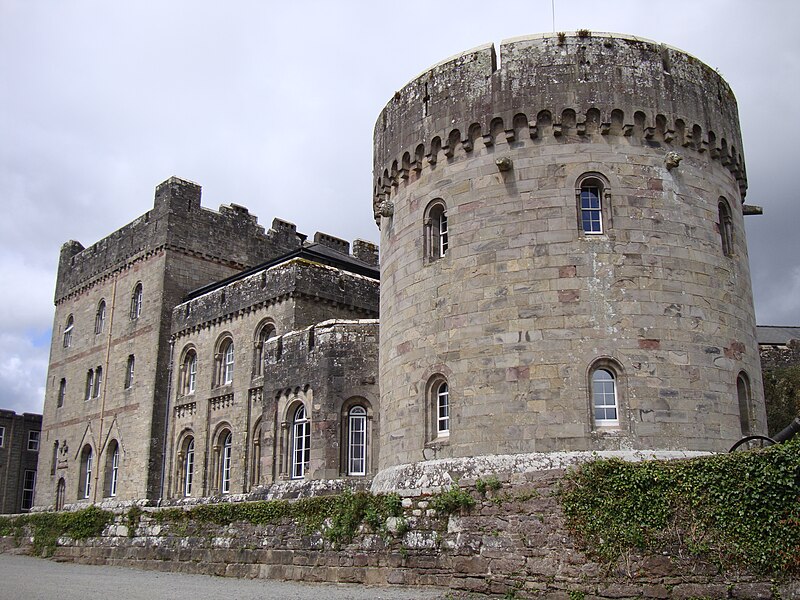
The west wing of the Castle takes the form of a round tower, with a spiral staircase contained within an attached turret.

Dromore Castle was the ancestral seat of the Mahonys.

When Harold Mahony was killed in a bicycle accident in 1905, he left no heirs, so the castle passed to his sister, Norah Hood.

She in turn left the castle to her cousin, Hardress Waller, and the castle remained in the hands of the Waller family until 1993 when it was offered for sale.

Dromore Castle is now owned by an investment company which is endeavouring to restore the building.

First published in September, 2012.

Wednesday, 3 September 2025

Glenstal Abbey

THE BARRINGTON BARONETS WERE MAJOR LANDOWNERS IN COUNTY LIMERICK, WITH 9,485 ACRES

This family claims descent from a common ancestor with the BARRINGTONS of Barrington Hall, Essex, raised to the rank of Baronet in 1611.

From a younger branch of that ancient and eminent family is said to have sprung 

SAMUEL BARRINGTON, who settled at Limerick in 1691, as appears by a monument in the cathedral of that city, who was succeeded by his son,

BENJAMIN BARRINGTON, High Sheriff of Limerick City, 1714, father of

BENJAMIN BARRINGTON, High Sheriff of Limerick City, 1729, who wedded Anne, daughter of John Waltho, of Anna, and was succeeded by his son,

MATTHEW BARRINGTON, of Limerick, who married Jane, daughter of John Canter, of Ballyvara, and left, at his decease, in 1765, an only son,

JOSEPH BARRINGTON (1764-1846), who was created a baronet in 1831, designated of Limerick, County Limerick.

He married, in 1787, Mary, daughter of Daniel Baggott, and had issue,
MATTHEW, his successor;
Daniel (1792-1842);
Croker, Lieutenant RN;
Joseph;
Samuel, barrister;
Honoria; Jane Martha.
Sir Joseph founded, with his sons, the hospital and infirmary in the city of Limerick, bearing his name, incorporated by Act of Parliament, in the eleventh year of the reign of GEORGE IV.

He was succeeded by his eldest son,

SIR MATTHEW BARRINGTON, 2nd Baronet (1788-1861), High Sheriff of County Limerick, 1846, crown solicitor for the province of Munster, who wedded, in 1814, Charlotte, daughter of William Hartigan, and had issue,
WILLIAM HARTIGAN, his successor;
CROKER, 4th Baronet;
Mary Anne; Charlotte; Jessey; Olivia; Josephine; Henrietta Victorine.
The eldest son,

SIR WILLIAM HARTIGAN BARRINGTON, 3rd Baronet (1815-72), espoused, in 1859, Elizabeth Olivia, daughter of Henry Darley, and had issue,
Maria Louisa Olivia;
Charlotte Jessy.
Sir William died without male issue, when the title devolved upon his brother,

SIR CROKER BARRINGTON, 4th Baronet (1817-90), DL, who married, in 1845, Anna Felicia, daughter of John Beatty West, and had issue,
CHARLES BURTON, his successor;
Croker;
William Matthew;
John Beatty, High Sheriff of County Limerick, 1912;
Anna Josephine; Mercy; Olivia Maria;
three other daughters.
Sir Croker was succeeded by his eldest son,

SIR CHARLES BURTON BARRINGTON, 5th Baronet (1848-1943), MBE JP DL, High Sheriff of County Limerick, 1878, Colonel, Limerick City Royal Field Reserve Artillery, who wedded, in 1895, Mary, daughter of Sir Henry Hickman Bacon Bt, and had issue,
CHARLES BACON, his successor;
ALEXANDER FITZWILLIAM CROKER, 7th Baronet;
Winifred Frances.
Sir Charles was succeeded by his elder son,

SIR CHARLES BACON BARRINGTON, 6th Baronet (1902-80).

It is thought that the present 8th Baronet, whose name does not appear on the Official Roll of the Baronetage, lives in Canada.


GLENSTAL ABBEY, formerly Glenstal Castle, Murroe, County Limerick, is a massive Norman-Revival castle by William Bardwell, of London.

It was begun in 1837, though not finished till about 1880.

The main building comprises a square, three-storey keep joined to a broad round tower by a lower range.

The entrance front is approached through a gatehouse replicated from that of Rockingham Castle, Northamptonshire.


The stonework is excellent and there is abundant carving, the entrance door being flanked by the figures of EDWARD I and Eleanor of Castille; while the look-out tower is manned by a stone soldier.

The staircase is of dark oak carved with animals, foliage and Celtic motifs, hemmed in by Romanesque columns.

The octagonal library at the base of the round tower is lit by little windows in deep recesses; the vaulted ceiling painted with blue and gold stars.


The main building faces south, and commands an unbroken view of some thirty miles towards the Galtee Mountains.

It is built on a height of some three hundred feet above sea-level, and can be seen from many miles away.

Sir Charles and Lady Barrington left Ireland permanently in 1925 and the castle and estate were purchased shortly thereafter by a priest, Monsignor James Ryan, for the nominal sum of £2,000.
EXTRACT FROM THE ORIGINS AND EARLY DAYS OF GLENSTAL BY MARK TIERNEY OSB

Glenstal Castle, in the parish of Murroe, Co Limerick, was built by the Barrington family in the 1830s. The architect, William Bardwell, designed it in the Norman-Revival style, with a gate-tower, keep, and impressive front façade. The Barringtons had acquired the Carbery estate in 1831, which stretched from the Mulcair River at Barrington's Bridge, to the Clare River on the Limerick-Tipperary Border.
In 1870, the estate consisted of 9,485 acres. This holding was considerably reduced, following a series of Land Acts, passed between 1881 and 1909. Thus, by the year 1925, when Sir Charles and Lady Barrington decided to leave Glenstal, they owned less than 1,000 acres, in and around the castle demesne. They were finding it more and more difficult to maintain the castle and estate, especially in the new Ireland, which emerged from the War of Independence and the Civil War (1922-23).
One of the main reasons why the Barringtons left Glenstal was the sad death of their only daughter, Winifred ('Winnie'), who was killed in an unfortunate incident in May, 1921. She was travelling in the company of a Black and Tan officer, Captain Biggs, when the car was ambushed by the local IRA unit near Newport, Co Tipperary. Winnie, who was in the front seat of the open car, was shot by mistake, and died that evening in Glenstal.
The family was devastated. Lady Barrington, who was a Scot and a Unionist at heart, urged her husband to leave Ireland as soon as possible, and take up residence in England. When eventually, in 1925, the time came to leave, Sir Charles made a mag­nificent gesture. He wrote to the Irish Free State government, offering Glenstal as a gift to the Irish nation, specifically suggesting that it might be a suitable residence for the Governor-General.
Mr W T. Cosgrave, the President of the Executive Council of the Irish Free State, and Mr Tim Healy, the Governor-General, visited Glenstal in July 1925, and 'were astonished at its magnificence, which far exceeded our expectations'. However, financial restraints forced them to turn down the offer. Mr Cosgrave wrote to Sir Charles, stating that 'our present economic position would not warrant the Ministry in applying to the Dail to vote the necessary funds for the upkeep of Glenstal'.
Soon after this, the Barringtons held an auction of the furniture and books in the castle, and let it be known that they were about to leave Ireland for good. The news soon spread to the village of Murroe, and caused much comment and dismay, as the Barringtons had been a major employer in the area for nearly a hundred years. It would be a local disaster, if the Glenstal demesne and castle were to be abandoned and become a ruin, like so many other big houses in Ireland.
There thus began a local campaign to save Glenstal. It should be said that the Barringtons never intended abandoning the place, and kept a skeleton staff in the castle, in the hope that someone might come along to buy it. Some months after the purchase, Msgr Ryan wrote to Celestine Golenvaux, the Abbot of the Benedictine monastery at Mared­sous, and invited him to come to Ireland and set up a daughter house in Glenstal and, by March 1927, the first two Belgian monks had arrived at Glenstal to establish the new house.
In 1932, the monks opened a Secondary School.

Glenstal is now a Benedictine abbey and a well-known boys' public school.

First published in June, 2012.

Tuesday, 4 February 2025

Woodlawn House

THE BARONS ASHTOWN WERE MAJOR LANDOWNERS IN COUNTY LIMERICK, WITH 11,273 ACRES

The family of TRENCH is descended from a French protestant family, said to have emigrated from the town of La Tranche, in the province of Poitou, to avoid the religious persecutions instituted by LOUIS XIV against those who dissented from the established church.

FEREDERIC DE LA TRANCHE came from France about 1575, and took up his abode in Northumberland.

He married, in 1576, Margaret Sutton, and had issue, with a daughter,
THOMAS, of whom hereafter;
James (Rev), Rector of Clongill;
Adam, settled in Scotland.
The eldest son,

THOMAS TRENCH, wedded, in 1610, Catherine, daughter of Richard Brooke, of Pontefract, Yorkshire, and had issue, with two daughters, an only son,

FREDERIC TRENCH, of Garbally, County Galway, who removed into Ireland in 1631, and purchasing the lands and castle of Garbally, with a considerable estate, established his residence there.

He espoused, in 1632, Anna his wife, daughter and heiress of the Rev James Trench, Rector of Clongill, and had issue,
Frederick, of Garbally, who founded the house of CLANCARTY;
JOHN, of whom we treat;
William.
Mr Trench died in 1669; his second son,

THE VERY REV DR JOHN TRENCH, Dean of Raphoe, wedded Anne, eldest daughter of Richard Warburton, of Garryhinch, in the Queen's County, and had issue,
FREDERICK, his heir;
Alexander;
Richard;
Anne; Judith.
The Dean died in 1725, and was succeeded by his eldest son,

FREDERICK TRENCH (1686-1758), of The Moate, County Galway, who married, in 1718, Mary, daughter and heiress of Richard Geering, Clerk of the Court of Chancery, and had issue,
FREDERICK, his heir;
Anne; Mary; Elizabeth.
Mr Trench was succeeded by his only surviving son,

FREDERICK TRENCH (1724-97), of The Moate and Woodlawn, County Galway, who wedded, in 1754, Mary, eldest daughter and co-heir of Francis Sadleir, of Sopwell Hall, County Tipperary, and had issue,
FREDERICK, his heir;
Francis, of Sopwell Hall, father of FREDERICK;
Thomas (Very Rev), Dean of Kildare;
William, of Cangort Castle;
Charles;
Richard;
John;
Catharine; Mary; Elizabeth; Frances; Anne; Sophia; Mary; Catherine.
Mr Trench was succeeded by his eldest son,

FREDERICK TRENCH (1755-1840), of The Moate, MP for Maryborough, 1785-90, Portarlington, 1798-1800, who espoused, in 1785, Elizabeth, only daughter and heiress of Dr Robert Robinson, and niece of the Hon Mr Justice Robinson, one of the judges of the Court of King's Bench, but had no issue.

Mr Trench was elevated to the peerage, in 1800, in the dignity of BARON ASHTOWN, of The Moate, County Galway.
The 8th and present Baron lives in East Sussex.


*****

THE TRENCHES of Woodlawn were one of a number of Trench families who came to prominence in County Galway in the 17th century.

They were all descended from Frederick Trench who came to Ireland early in the 1600s.

Strategic marriages into the Warburton and Power families led to the acquisition of more lands in East Galway.

Much of the Woodlawn estate was originally Martin and Barnewall lands which were purchased by the Trenches in the early 18th century.

Lord Ashtown was recorded as a non-resident proprietor in 1824.

In County Roscommon he held over a 1,000 acres; and in County Tipperary he held at least 21 townlands in the parishes of Ballingarry and Uskane, barony of Lower Ormond, inherited from the Sadleir family of Sopwell Hall.

In the 1870s, Lord Ashtown's main estate in County Galway amounted to over 8,000 acres and he also held land in seven other counties including County Waterford where he had purchased lands from the Earl of Stradbroke in the 1870s. 

These townlands remained in Trench ownership until purchased by the Irish Land Commission in the 1930s.

In 1852 Lord Ashtown married as his second wife Elizabeth Oliver Gascoigne, an heiress with large estates in County Limerick and Yorkshire.

In the 1870s Lord Ashtown is recorded as the owner of 11,273 acres in County Limerick and 4,526 acres in County Tipperary.


WOODLAWN HOUSE, near Kilconnell, County Galway, is a Palladian-style country house comprising a three-bay, three-storey central block built ca 1760, having slightly advanced end bays and projecting tetra-style Ionic portico to entrance bay.

There is an interesting video clip of the mansion house and ruinous outbuildings here.

The House consists of 30,000 square feet standing on 115 acres of land.

It boasts 26 bedrooms, a walled garden, courtyard, gatehouse, gardener's house and a lake.

Woodlawn was remodelled ca 1860 and flanked by four-bay two-storey wings having projecting pedimented end bay to each wing.

The central block has tripartite openings to end bays, ground floor of each end bay having segmental pediment and engaged Doric columns to slightly advanced middle light, and flanked by Doric pilasters.

The wings have tripartite windows to pedimented bays, ground floor having Venetian-style windows, middle light slightly advanced and having engaged square-plan Doric columns, flanked by Doric pilasters and having with moulded capitals and cornices.

The mansion is set in its own demesne, with outbuildings to west, and entrance gates and lodge to east.


This large house is an elaborate exercise in classical orders, the use of carved and cut limestone extending throughout the front elevation and evidence of both the skill of 19th century stonemasons and the wealth of the Trench family whose seat it was.

An unusual composition, the quoins to the central block give a vertical emphasis that is extended by the pinnacles.

Although the motifs are classical, the extensive use of dark limestone, the variety of textures and treatments, and the use of pinnacles give it a somewhat Gothic appearance typical of the late 19th century.

Extended and remodelled by the 2nd Baron Ashtown in the 1860s to designs drawn up by James F Kempster, the county surveyor for the East Riding of County Galway, it shows little evidence of the Georgian house behind the façade.

During the 1920s, the 3rd Baron was declared bankrupt and, as a result, the house was closed up and its contents sold at auction; at one point, the IRA occupied one of the wings.

The 4th Baron eventually returned to Woodlawn, but in 1947 he sold the estate to his cousin, Derek Le Poer Trench who, in turn, disposed of it in 1973.

Since then, Woodlawn has had two further owners but neither of these have lived in the house.

Michael Lally, a local publican, bought the property ca 1989.

Before that date, in 1982, a fire burnt out the east wing and caused extensive damage to the central block, partly because of the water used to put out the flames.

Much of the original decoration of the house has also been lost, not least the fireplaces in the principal reception rooms.

Woodlawn House (Image: Irish Farmers' Journal)

While all the walls still stand and the pitched slate roof remains, Woodlawn today is a mere shadow of the house it had been 100 years ago.

Other former seats ~ Lansdown, Portroe, County Tipperary; Chessel House, Southampton, Hampshire; Lotherton Hall, West Yorkshire.

Ashtown arms courtesy of European Heraldry.  First published in December, 2011.

Wednesday, 22 January 2025

The Black Knights

THE KNIGHTS OF GLIN WERE MAJOR LANDOWNERS IN COUNTY LIMERICK, WITH
5,697 ACRES


OTHER, a Baron of England, of Saxon descent, living during the reign of EDWARD THE CONFESSOR, was father of

WALTER FITZOTHER, who, at the general survey of the kingdom, 1078, was castellan of Windsor, and was appointed by WILLIAM THE CONQUEROR Warden of the Forests in Berkshire; and having wedded Gladys, daughter of Ryall ap Conyn, had issue,
GERALD FITZWALTER, of whom presently;
Robert, Baron of Easton or Estaines, Essex;
William, ancestor of the Barons Windsor and Earls of Plymouth.
The eldest son,

GERALD DE WINDSOR (c1075-1135), Castellan of Windsor, married Nest, daughter of Rhys, Prince of South Wales, and had issue,
MAURICE FITZGERALD, of whom hereafter;
William, ancestor of the Earls of Kerry;
David, Bishop of St David's.
Gerald was succeeded by his eldest surviving son,

MAURICE FITZGERALD (c1105-76), Lord of Lanstephan, who proceeded to Ireland in 1168, being sent with ten knights, twenty esquires, and 100 archers, before his countryman, Richard Strongbow, Earl of Pembroke, to assist Dermot MacMurrough, King of Leinster.

He was buried in the abbey of Greyfriars, at Wexford, leaving issue,
Gerald, ancestor of the ducal house of Leinster;
Alexander;
William, Lord of Naas;
Maurice, Lord of Kiltrany;
THOMAS, of whom we treat;
Robert;
Nest.
The fourth son,

THOMAS FITZMAURICE FITZGERALD (1175-1213), espoused Ellinor, daughter of Jordan de Marisco, and sister to Hervé de Monte Marisco, Constable of Ireland, and of Geoffrey de Marisco, Lord Justice of Ireland in the reign of KING JOHN.

He was succeeded by his son,

JOHN FITZGERALD, 1st BARON DESMOND, who married firstly, Margery, daughter and heir of Sir Thomas FitzAnthony, Lord of Decies and Desmond, by whom he acquired those demesnes which were confirmed to him by PRINCE EDWARD in 1260, as amply as they had been held by Sir Thomas during the reign of HENRY III.


By the heiress of Decies and Desmond, John FitzGerald had a son and heir,

MAURICE FITZGERALD, Lord of Decies and Desmond, ancestor of the FITZGERALDS, EARLS OF DESMOND,
Who ranked among the most powerful nobles of Ireland for more than two centuries, until Gerald, 16th Earl, entering into rebellion, waged war for nearly ten years against the whole power of the English government, and eventually lost his life in attempting to seize upon a prey of cattle, when his head was transmitted by the Earl of Ormond to ELIZABETH I, who caused it to be fixed on London Bridge. An attainder followed (1582), by which his prodigious estates, comprising 574,628 acres, became forfeited.
The son of this unfortunate nobleman, James FitzGerald,
Having been educated at the court of ELIZABETH I, embraced the Protestant faith, and Her Majesty, hoping by his influence to bring the followers of his deceased father to their allegiance, recognized him as EARL OF DESMOND, and despatched him to Ireland; but so soon as it was known that he had attended church at Balinalloch, the crowds who collected to see and follow him immediately withdrew; he was obliged, therefore, to return to London, where he died in 1601. 
The last male heir of the House of Gerald who assumed the style of Earl of Desmond was an officer in the King of Spain's and the Emperor's armies, who died in Germany, in 1632. From Maurice FitzGerald, founder of the Desmond line of the House of Gerald, derived OSBORN FITZGERALD, who removed from Ireland to Wales about the middle of the 13th century.
JOHN FITZGERALD wedded secondly, Honora, daughter of Hugh O'Connor, of Kerry, and had further issue,
GILBERT FITZJOHN, ancestor of THE WHITE KNIGHT;
SIR JOHN FITZJOHN, of whom presently;
MAURICE FITZJOHN, ancestor of THE KNIGHT OF KERRY;
THOMAS FITZJOHN, ancestor of the FITZGERALDS OF THE ISLAND OF KERRY.
JOHN FITZGERALD, 1ST BARON DESMOND, by virtue of his royal seigniory as a Count Palatine, created three of his sons, by the second marriage, knights, and their descendants have been so styled in Acts of Parliament, patents under the Great Seal, and all legal proceedings up to the present time; and having founded the monastery of Tralee, was buried there in 1261.

His second son,

SIR JOHN FITZJOHN, Knight, to whom his father gave the castles of Glyncorbury and Beagh, County Limerick, 1st KNIGHT OF GLIN, had issue,
JOHN FITZJOHN, his successor;
GERALD FITZJOHN.
SIR JOHN was succeeded by his eldest son,

SIR JOHN FITZJOHN, 2nd Knight, from whom descended,

THOMAS FITZGERALD, who was attainted with his father, and executed in the eleventh year of ELIZABETH I, leaving a daughter, Ellen, who wedded Sir Edmond FitzHarris, Knight; and a son, his successor,

EDMOND FITZGERALD, Knight of Glin, pardoned and restored to his estates in the thirtieth year of ELIZABETH I.

He espoused Honora, daughter of Owen McCarthy Reagh, and was succeeded by his son,

THOMAS FITZGERALD, Knight of Glin, who had livery of his lands in 1628.

He surrendered those estates, and had them re-granted in 1635.

He wedded Joan, daughter of James, Lord Dunboyne, widow of Edmond FitzGibbon, The White Knight, and was succeeded by his son,

GERALD FITZGERALD, 17th Knight of Glin, who made a deed of settlement of his estates in 1672.

He married Joan O'Brien, and dying before 1700, left issue,
THOMAS, his successor;
John;
Mary; Honora; Helen; Jane; Ellen.
The eldest son,

THOMAS FITZGERALD, 18th Knight of Glin, seized of an estate in tail under the deed of settlement, in 1672, wedded Mary, daughter of Edmond FitzGerald, and had three sons, successively inheritors; of whom the eldest,

EDMOND FITZGERALD, 20th Knight of Glin, dsp and was succeeded by his brother,

RICHARD FITZGERALD, 21st Knight of Glin, who was succeeded by his brother,

THOMAS FITZGERALD, 22nd Knight of Glin, who married, in 1755, Mary, daughter of John Bateman, of Oak Park, County Kerry, and had issue,
JOHN, his heir;
Elizabeth; Frances; Ellen; Catherine; Jane.
Thomas FitzGerald died before 1801, and was succeeded by his eldest son,

JOHN BATEMAN FITZGERALD, 23rd Knight of Glin, who wedded Margaretta Maria, daughter of John Fraunceis Gwynn, of Ford Abbey, Devon, and was succeeded by his only son,

LIEUTENANT-COLONEL JOHN FRAUNCEIS FITZGERALD JP DL (1791-1854), 24th Knight of Glin, of Glin Castle, County Limerick, High Sheriff of County Limerick, 1830, who espoused, in 1812, Bridgetta, fifth daughter of the Rev Joseph Eyre, of Westerham, Kent, and had issue,
JOHN FRAUNCEIS EYRE;
Edmond Urmston McLeod;
Geraldine Anne; Margaretta Sophia.
The eldest son,

JOHN FRAUNCEIS EYRE FITZGERALD, 25th Knight of Glin (1813-66), wedded, in 1835, Clara Anne, only daughter of Gerald Blennerhasset, of Riddlestown, County Limerick, and had issue,
DESMOND JOHN EDMUND;
Gerald B;
William Urmston;
John F E;
Thomas Otho;
George W M;
Geraldine Elizabeth Blennerhasset; Florence Sophia; Margaretta.
The 25th Knight was succeeded by his eldest son,

DESMOND JOHN EDMUND FITZGERALD JP DL (1840-95), 26th Knight of Glin, of Glin Castle, County Limerick, High Sheriff of County Limerick, 1871, who wedded, in 1861, Isabella Lloyd, second daughter of the Rev Michael Lloyd Apjohn, of Linfield, County Limerick, and had issue,
DESMOND FITZJOHN LLOYD;
Urmston FitzOtho;
Louis de Rottenburgh;
Clara Nesta Richarda.
The eldest son,

DESMOND FITZJOHN LLOYD FITZGERALD JP DL (1862-1936), 27th Knight of Glin, of Glin Castle, High Sheriff of County Limerick, 1904, Captain, 3rd Battalion, Royal Dublin Fusiliers, South Irish Horse, married, in 1897, the Lady Rachel Wyndham-Quin, second daughter of the 4th Earl of Dunraven and Mount-Earl, and had issue,
DESMOND WYNDHAM OTHO.
The only son,

DESMOND WYNDHAM OTHO FITZGERALD (1901-49), 28th KNIGHT OF GLIN, married Veronica Villiers, a cousin of Winston Churchill, and had issue, three children.

He died from tuberculosis in 1949.

His son and heir, the 29th and last Knight,

DESMOND JOHN VILLIERS FITZGERALD (1937-2011), 29th KNIGHT OF GLIN, was educated at the University of British Columbia and Harvard University.
The Knight worked at the Victoria and Albert Museum in London, in the furniture department; and later returned to Ireland, and became active in conservation issues, becoming involved with the Irish Georgian Society. He was appointed its president in 1991. He has also represented the Christies art auctioneers in Ireland. He died at Dublin in 2011.
As the last Knight had no sons, and the title cannot be passed to a daughter, the title became extinct.


GLIN CASTLE, Glin, County Limerick, is described by Mark Bence-Jones as
a romantic, white, castellated house overlooking the estuary of the River Shannon from among the trees of its demesne.
It was built ca 1789 by Colonel John FitzGerald, 24th Knight of Glin.

This is an eight-bay, three-storey, country house, comprising full-height curved bows to end bays of the front elevation, full-height three-sided bows with crenellated porch to garden (south) elevation.

Sixteen-bay, two-storey wing to the west, built in the late seventeenth century/early eighteenth century, having full-height canted bay and three-stage square-plan tower to garden elevation.


THIS house remains of considerable social and historic significance to the village of Glin.

Colonel John FitzGerald, who is thought to have added the hall, staircase and two reception rooms, financed much of the main house, which was built in phases.

The artist responsible for the decorative plasterwork to the interior, though unknown, is thought to be the work of a Cork master.

The symbols on the frieze in the hall underline the military background of Colonel FitzGerald, with military trophies, shields sprouting shamrocks and the Irish harp, all incorporated into the ceiling.

The staircase, which is almost unique in Ireland, as it has two lower ramps and a single flying run of steps from the half-landing to the first floor landing.

It may echo Adam's staircase at Mellerstain in Berwickshire.

The style of the joinery on the stairs and front door suggests that the craftsmen who worked here had worked with such prominent architects as Davis Duckart and Christopher Colles in the 1760s and 1770s.

The west wing is the earliest part of the house and was originally thatched.

Despite 19th century alterations, it retains some vernacular characteristics, such as its long, low asymmetric form.

Added to this association with important historical characters, Glin Castle represents more than four centuries of construction and alteration, with different architectural features representing each phase.

In 1993, the FitzGeralds decided to turn the castle into a hotel to help pay for the upkeep.

The hotel closed in 2008.

In 2011, Desmond, 29th Knight, died without a male heir.

In 2015, the castle was put on auction at Christie's by Lady FitzGerald.

The castle did not sell in auction.

In an effort to keep the castle in the family, it was purchased by Catherine FitzGerald, daughter of the last Knight of Glin, and her husband Dominic West.

First published in April, 2013. Coat of arms courtesy of European Heraldry.

Thursday, 13 June 2024

Mountshannon House

THE EARLS OF CLARE WERE MAJOR LANDOWNERS IN COUNTY LIMERICK, WITH 10,316 ACRES


The Earls of Clare are said to have represented a collateral branch of the Duke of Leinster's family; the FitzGibbons, the chief of whom was styled "The White Knight", being descended from the FitzGeralds, Barons Offaly, progenitors of the great houses of KILDARE and DESMOND; as were the Knights of Glin, of the Valley, and of Kerry, titles conferred on junior branches of the house of FitzGerald, by the Earl of Desmond, as Count Palatine.


JOHN FITZGIBBON (c1708-80), of Mount Shannon, County Limerick, fourth son of Thomas FitzGibbon, of Ballyseeda, County Limerick,and his wife, Honor, was an eminent barrister, who published a work entitled "Notes of Cases determined at Westminster", which was highly spoken of by Lord Chancellor Hardwicke.

He wedded Ellinor, daughter of John Grove, of Ballyhimmock, County Cork, and had issue,
JOHN, his successor;
Arabella; Elizabeth; Eleanor.
Mr FitzGibbon was succeeded by his son,

THE RT HON JOHN FITZGIBBON (1748-1802), who having been bred to the Bar, was appointed Attorney-General of Ireland, 1784; and, five years later, filled the high office of LORD CHANCELLOR OF IRELAND.

This gentleman was elevated to the peerage, in 1789, in the digniy of Baron FitzGibbon, of Lower Connello, County Limerick.


His lordship was advanced to a viscountcy, in 1793, as Viscount FitzGibbon, of Limerick; and further advanced to the dignity of an earldom, in 1795, as EARL OF CLARE.

He wedded, in 1786, Anne, eldest daughter of Richard Chapel Whaley, of Whaley Abbey, and had issue,
JOHN, his successor;
RICHARD HOBART, 3rd Earl;
Isabella Mary Anne; Louisa; Isabella.

His lordship was succeeded by his eldest son,

JOHN, 2nd Earl (1792-1851), KP, PC, who espoused, in 1826, Elizabeth Julia Georgiana, daughter of Peter, 1st Baron Gwydyr.

The 2nd Earl, Governor of Bombay, 1830-34, Privy Counsellor, 1830, Knight of St Patrick, 1845, Lord-Lieutenant of County Limerick, 1848-51, was succeeded by his brother,

RICHARD HOBART, 3rd Earl (1793-1864), who married, in 1825, Diana, daughter of Charles Brydges Woodcock, and had issue,
JOHN CHARLES HENRY, styled Viscount FitzGibbon (1829-54); killed in action at the Battle of Balaclava;
Eleanor Sophia Diana; Florence; Louisa Isabella Georgina.
His lordship, MP for County Limerick, 1818-41, Usher and Registrar of Affidavits in the Irish Court of Chancery 1810-36, Lord Lieutenant of County Limerick, 1831-48 and 1851-64, was pre-deceased by his son, and the titles expired. 


On display in the coach-house of Newbridge House is the sumptuous state coach made in London, in 1790, for John FitzGibbon, 1st Earl of Clare, Lord Chancellor of Ireland and a relation of the Cobbe family.

The coach had been painted black until restored by the Irish National Museum to its former golden magnificence - even the fresco panels had been painted out, probably for the funeral of Queen Victoria.


Entrance Front

MOUNTSHANNON HOUSE, near Castleconnell, County Limerick, was an 18th century mansion, bought from the White family by John FitzGibbon before 1780.

Seven-bay entrance front with pedimented porte-cochere of four massive Ionic columns; adjoining front of five bays.


The rooms were large and spacious, though boasted little internal ornament; a fine hall and library; French gilt furniture in the drawing-room and morning-room.

The 1st Earl was one of the most powerful men in Ireland at the time.

The house was re-modelled in neo-classical style after 1813 to the designs of Lewis Wyatt.

Mount Shannon appears to have been called Ballingown on the Taylor and Skinner map of the late 1770s.

Mark Bence Jones writes that it was enlarged by the 1st Earl of Clare and remodelled by the 2nd Earl.

The contents of the house were sold in 1888 and the house was purchased by the Nevin family ca 1893 (Bence Jones).

The 3rd and last Earl, who didn't have the government pension that his predecessors enjoyed, and who was most generous in providing financial succour to emigrants after the Irish famine, left the estate impoverished.

As a consequence, his daughter, who inherited the estate, was obliged to sell most of the precious contents of the house in 1888.

Abandoned Ireland has written an excellent article about the family and estate:
Lady Louisa Georgina FitzGibbon, daughter of the 3rd Earl, came into possession of Mountshannon on the death of her father. She was a very extravagant and over-charitable woman who gave lavish banquets and balls at the mansion to which all the aristocracy and landed gentry from Limerick and neighbouring counties were invited...

But the world of reality eventually took control as Lady Louisa frittered away the Fitzgibbon fortune and ran up huge debts in an effort to keep up the grand lifestyle to which she had become accustomed.

She became engaged to a Sicilian nobleman, The Marquis Della Rochella, thinking his wealth would rescue her from financial ruin, only to discover that her betroth was himself almost penniless and was marrying her for the same reason.

During a sumptuous party in the mansion to announce their engagement, the sheriff arrived to seize some of the mansion's valuable effects.

Two large paintings hanging in the main hall were among the items earmarked for confiscation, but were found to have holes burned through the canvas when the sheriff's men were removing them. The restored and still very valuable pictures were in later years hung in the hall of Dublin Castle.

It was on this occasion that the Marquis discovered that Lady Louisa, like himself, was bankrupt but, noble gentleman that he was, he went ahead with the marriage - even if it was a misguided union.

The Marquis, unaccustomed to the Irish climate, fell into bad health and died a few years later, still pining for his native sunny Sicily. Still struggling to keep face, Lady Louisa was forced to sell much of the contents of the mansion including the priceless collection of books from the family library.

Soon the lavish entertainment, the sumptuous feasting and the glittering balls were all gone and the magic that once was Mountshannon disappeared. Gone too were Lady Louisa's wealthy friends, leaving her at the mercy of her creditors who quickly foreclosed on her and she was forced to sell the mansion and the estate.

Lady Louisa left Mountshannon in 1887 and went to live in the Isle of Wight at St. Dominic's Convent where she spent the rest of her life .... The powerful FitzGibbon line that had stretched across one hundred and twenty years at Mountshannon had finally ended.

The next owner of Mountshannon was an Irishman, Thomas Nevins, who had made a large fortune in America and returned to Ireland with his wife and three daughters and purchased the mansion and estate. 

For the Nevins, who were a decent and honest Catholic family, their years at Mountshannon were fraught with trouble and ill-luck, so much so that people said the curse that many believed was on the place must surely have touched on these unfortunate people...

...Tom Nevins, like Lord Clare before him, was thrown from his horse while riding through the estate and died a few months after from his injuries. His body was also placed in the Cooling House, as was his wife's who died some years later the little building had by then become the family burial chamber ...

... So at last the tragic Nevins family rest undisturbed and entombed in what was once the cold storage house for Mountshannon Mansion.

Dermot O'Hannigan was the last owner of Mountshannon and in 1921, during the Troubles, in a spectacular and devastating fire, the flames of which could be seen, it is said, from many parts of Limerick city and county, the beautiful mansion was burned to the ground.
The estate was eventually taken over by the Irish Land Commission and divided up into several farm holdings.

Little remains of Mountshannon Mansion today but the ivy-clad shell of the great house, its four columns at the entrance still stand defiantly against the elements and even time itself, like some battle-scarred warriors still guarding the faded remnants of a grandeur that is no more.

First published in March, 2012.