Monday, 2 December 2024

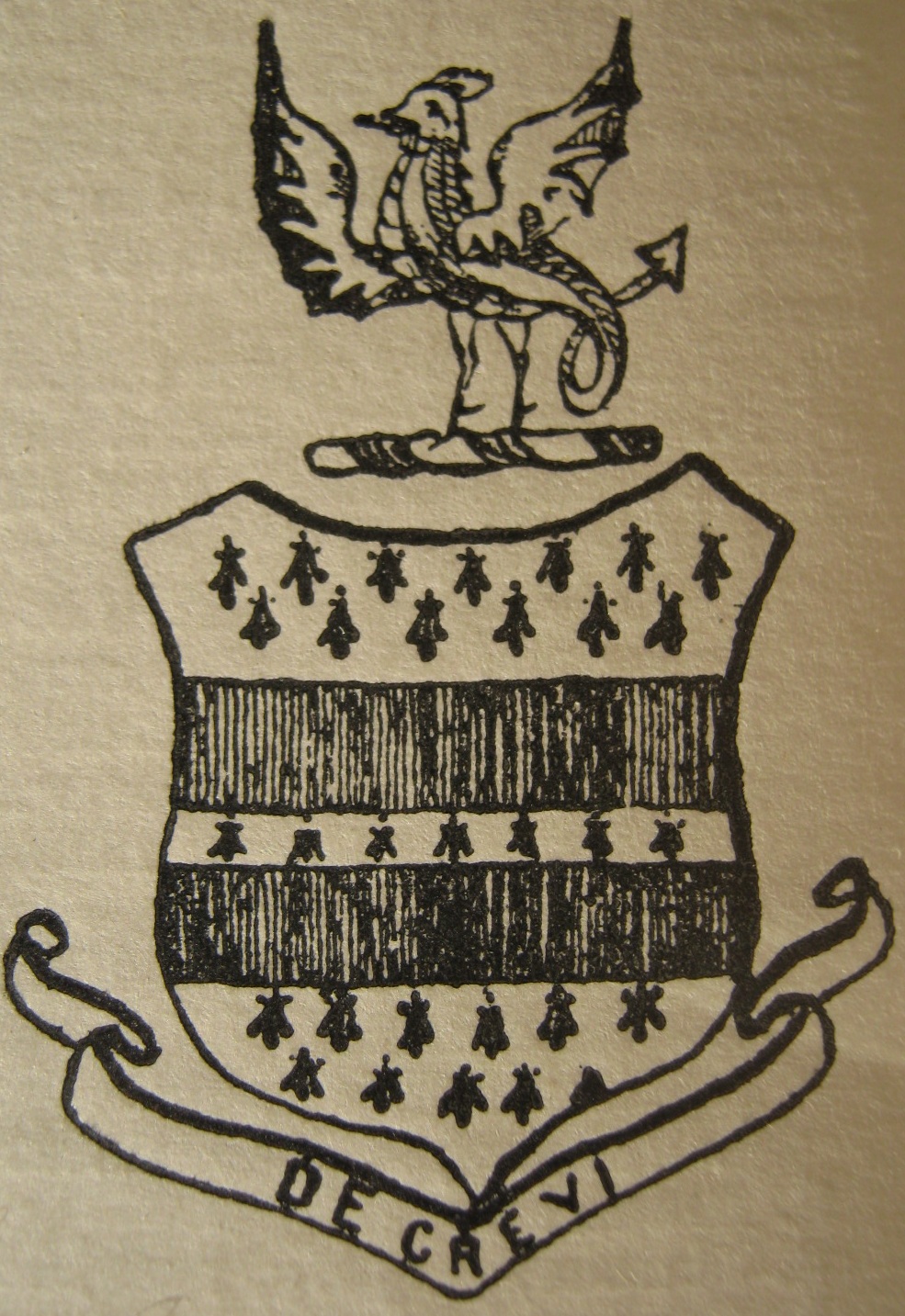
The MacDonnell Baronetcy

This noble family is descended from ALEXANDER MacDONALD  (c1480-1538), chief of one of the most numerous and powerful clans in the highlands of Scotland.

From him descended

SORLEY BOY MacDONNELL (1505-90), who was seated at Dunluce, County Antrim; and who, in 1573, was made a free denizen of Ireland; but afterwards opposing the government, was subdued; and, in 1586, was again received into The Queen's favour.

His eldest surviving son,

SIR JAMES MacDONNELL, elder brother of RANDAL, 1st EARL OF ANTRIM, married Mary, daughter of Hugh MacPhelim O'Neill, of the Claneboye family, and had numerous issue, of which the ninth son,

SIR ALEXANDER MacDONNELL, of Maye, County Antrim, was created a baronet in 1627, designated of Maye, County Antrim.

He married Evelyn, daughter of Sir Arthur Magennis, 1st Viscount Iveagh, and dying in 1634, left a son and successor,

SIR JAMES MacDONNELL, 2nd Baronet, of Maye, who wedded Mary, daughter of Sir Donough O'Brien Bt, of Dough, County Clare, and had issue,
ALEXANDER;
RANDAL, his successor;
Sarah; Honora; Anne; another daughter.
Sir James died ca 1680, and was succeeded by his eldest son,

ALEXANDER, who, in 1644, commanded the forces sent by Lord Antrim to assist Lord Montrose in Scotland, and upon his return, was appointed lieutenant-general of the province of Munster.

This gallant soldier lost his life in 1647 at the battle of Knocknanuss, against Lord Inchiquin. 

He married the Lady Elizabeth Howard, daughter of Henry, Earl of Arundel, and had a son, Randal, who died young.

Alexander MacDonnell died in 1647, and was succeeded by his next brother,

RANDAL, 3rd Baronet, who married, in 1686, Hannah, sister of David Roche, and had issue,
JAMES, his heir;
Randal;
John Richard;
Mary; Henrietta.
Sir Randal, when captain of a warship in the service of CHARLES II, achieved the memorable action of Marmora against the Moors.

Subsequently, however, joining JAMES II's army, he accompanied his ill-fated master to France.

Consequently, Sir Randal was attainted, in 1691, and the baronetcy forfeited.

In 1696, Mr MacDonnell's estate was granted to Charles Campbell, in trust for his wife and children.

His eldest son,

JAMES, who, but for the attainder, would have been the fourth baronet, died unmarried, 1728, and was buried in St James's churchyard, Dublin.

His brother,

RANDAL, of Cross, County Antrim, Colonel in the French service, succeeded his brother, but died unmarried in 1740.

First published in May, 2011.

Portaferry House

THE NUGENTS OWNED 4,638 ACRES OF LAND IN COUNTY DOWN

The very ancient Anglo-Norman house of SAVAGE was settled at Portaferry, County Down, since the time of the first conquest of Ireland by John de Courcy, Earl of Ulster, in 1117. Under that famous warrior, the original ancestor in Ireland established himself in County Down; and by a written document, dated 1205, in the Tower of London, we find Robin, son of William Savage, named as one of de Courcy's hostages for his appearance before KING JOHN.

The present barony of Lecale was anciently termed the Territory of the Savages, wherein, at Ardglass, they and their dependents erected seven castles, the ruins of which are still extant. It appears, also, that a stately monastery of Dominicans was founded at Newtownards, in 1244, by the Savages, "gentlemen of English extraction". From the extreme scarcity of records in Ireland, it is impossible, at this remote period, to determine, without liability to error, which is the senior branch of the family, that of PORTAFERRY or ARDKEEN CASTLE. 

In 1400, HENRY IV granted to Robert FitzJordan Savage the office of sheriff of the Ards; and it appears, by an indenture dated 1538, that Raymond [Savage] should have the chieftainship and superiority of his sept in the Territory of the Savages, otherwise called Lecale. However, in 1559 the Lord Deputy, Sir William FitzWilliam, made a division between Roland and Raymond Savage of several towns and territories in the Ards.

By pedigree annexed, Roland, in 1572, was in possession of Portaferry Castle, and styled himself "Lord of the Little Ards"; and Lord Deputy Chichester, some years afterwards, addressed him as such by letter. The Ardkeen family had some territories in the barony of Lecale, and also in County Antrim, that family always being sore enemies of the O'Neills. 

ROWLAND SAVAGE, Lord of the Little Ards, County Down, representative of the family in the middle of the 16th century, died at Portaferry in 1572, leaving issue,
PATRICK, his heir;
ROWLAND;
Edmund;
Richard;
James.
The eldest son,

PATRICK SAVAGE (1535-c1604), Lord of the Little Ards, wedded Anne Plunket, and left two sons, of whom the elder,

ROWLAND SAVAGE, Lord of the Little Ards, succeeded his father, and married Rose, daughter of Russel of Rathmullan, County Down.

Mr Savage was, however, succeeded by his brother, 

PATRICK SAVAGE, of Portaferry, who wedded, in 1623, Jean, only daughter of Hugh, 1st Viscount Montgomery, and had issue, 
HUGH, his heir;
ELIZABETH, co-heir to her brother;
SARAH, co-heir to her brother.
Patrick Savage died in 1644, and was succeeded by his son, 

HUGH SAVAGE, of Portaferry, who died unmarried in 1683, and was succeeded in the representation of the family by his cousin, 

PATRICK SAVAGE, of Derry, County Down, and afterwards of Portaferry, who, by his wife Anne Hall, of Narrow Water, left issue,

EDWARD SAVAGE, of Portaferry, who died unmarried in 1725, and was buried at Portaferry.

His uncle and successor, 

JAMES SAVAGE, of Portaferry, wedded Mabel, daughter of Edmund Magee, of Lisburn, and had issue, 
JOHN, his heir;
ANDREW, of whom hereafter;
James;
Margaret; Elizabeth.
The eldest son,

JOHN SAVAGE, wedded Catherine, daughter of ___ Savage, and had issue a son, James, who died young.
At his decease he was succeeded by his brother,

ANDREW SAVAGE, of Portaferry, who espoused Margaret, sister and co-heir of Governor Nugent (of Tortola), and daughter of Andrew Nugent, of Dysart, County Westmeath, by his wife, the Lady Catherine Nugent, daughter and co-heir of Thomas, Earl of Westmeath, and had a son and heir,


PATRICK SAVAGE, of Portaferry, who married, in 1765, Anne, daughter of Roger Hall, of Narrow Water, and by her had, with daughters who died unmarried,
ANDREW, his heir;
Patrick Nugent, m Hariett, daughter of Rev Henry Sandford;
Roger Hall, Captain RN, died unmarried;
John Levallin, died unmarried;
William, in holy orders;
Barbara; Dorcas Sophia.
Mr Savage died in 1797, and was succeeded by his eldest son (who assumed the surname of NUGENT and became co-heir of the barony of Delvin),

ANDREW NUGENT JP DL (1770-1846), of Portaferry House, Lieutenant-Colonel, North Down Militia, High Sheriff of County Down, 1808, who wedded, in 1800, the Hon Selina Vesey, youngest daughter of Thomas, 1st Viscount de Vesci, and had issue, 
PATRICK JOHN, his heir;
Thomas Vesey, m Frances, eldest daughter of Sir James Stronge Bt;
Andrew Savage, m Harriet, Viscountess Bangor;
Arthur, m Charlotte, only daughter of Major Brooke, of Colebrooke;
Charles Lavallin, major-general in the army;
Selina, m James, eldest son of Sir James Stronge Bt;
Anne.
Colonel Nugent succeeded his father in 1797, and assumed his present surname, on succeeding to a portion of the estate of his maternal great-uncle, Governor Nugent, in 1812.

His eldest son,

PATRICK JOHN NUGENT (1804-57), of Portaferry House, Lieutenant-Colonel, North Down Militia, High Sheriff of County Down, 1843, married, in 1833, his cousin Catherine, daughter of John 2nd Viscount de Vesci, and had issue,
ANDREW;
JOHN VESEY, lieutenant-colonel in the army;
Arthur Vesey;
Frances Isabella.
His eldest son,

LIEUTENANT-GENERAL ANDREW NUGENT JP DL (1834-1905), of Portaferry House, High Sheriff of County Down, 1882, Colonel, Royal Scots Greys, died unmarried and was succeeded by his brother,

LIEUTENANT-COLONEL JOHN VESEY NUGENT JP DL (1837-1914), of Portaferry House, who married, in 1886, Emily Georgiana, daughter of Herbert Langham.

Colonel Nugent died without issue, and was succeeded by his cousin, 

EDMOND HENRY STUART NUGENT, whose son,

ROLAND THOMAS NUGENT (1886-1962), was a Northern Ireland politician. 
He entered the diplomatic service in 1910 and served with the Grenadier Guards in 1918; and again in 1940-43; was a Director of the Federation of British Industries, 1916-17 and 1919-32; and was knighted in 1929.
In 1944, Sir Roland Thomas Nugent entered Northern Ireland politics, serving as Leader of the Senate, 1944-50; Minister without Portfolio in the Northern Ireland Government, 1944-45; Minister of Commerce, 1945-49; Minister in the Senate, 1949; and Speaker of the Senate, 1950-61. 
On his retirement from that post, Sir Roland was created a baronet, though he died in the following year, when the baronetcy became extinct.

Sir Roland, 1st and last Baronet, married, in 1917, Cynthia Maud Ramsden, daughter of Captain Frederick William Ramsden and the Lady Elizabeth Maud Conyngham (daughter of 3rd Marquess Conyngham).

The couple had three children, of whom their two sons were both tragically killed in action during the 2nd World War. 

I have written about the Nugent Baronets here.


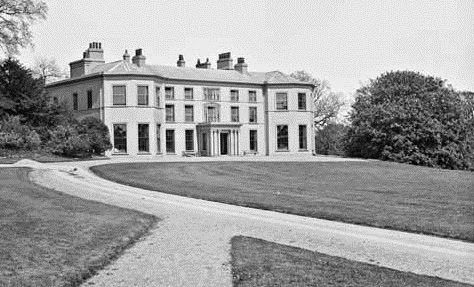
PORTAFERRY HOUSE, Portaferry, County Down, is a dignified mansion of ca 1750, designed by William Farrell for Andrew Savage.

It was extended ca 1790, and assumed its present form in 1818-20.

The central entrance front comprises five bays, with a Wyatt window in each of the two upper storeys.

The porch has paired Ionic columns and end piers.

On either side of the centre there are broad, three-sided bows of two storeys, though the same height as the main block.


The hall had Ionic columns and good plasterwork. 

Kennels were built to the north side of the demesne.

A threshing mill/horse walk was built to the north east of the farmyard.

The work to the house was completed in 1820 at a total cost of £7,140.

Portaferry House remained in the Nugent family until the 1980s, by which time sections of it had fallen into disrepair.

The present owner has done much to restore the building.

*****

THE DEMESNE is laid out as a fine landscape park for the 1760 house, enlarged in the early 1820s after additions and alterations were made to the house by Andrew Nugent.

It is placed in a splendid position overlooking lawns, pleasure grounds, a series of small lakes and parkland to Strangford Lough.

The original 1760 house stands on a site chosen because it was near ‘a beautiful well-spring up to which from the old castle’. 

The present building owes it appearance to Patrick Savage, who engaged Charles Lilley, a Dublin timber merchant in 1789-90, to start work on an enlarged house.

Later, in 1814, William Farrell was engaged to complete the building, and following Lilley’s designs, this work being completed in 1820.

The parkland incorporates extensive woodland blocks, screens and isolated park trees.

Nugent’s Wood, alongside the shore, belongs to the National Trust. 

A folly tower, which resembles a windmill stump, has far reaching views from the top.

The walled garden, near the town, which belongs to the council, has an interesting ziggurat wall to allow maximum heat to wall fruit.

It is open to the public, as it is adjacent to the 16th century tower house, Portaferry Castle.

There are listed farm buildings and three gate lodges built in 1830. 

First published in November, 2014.

Sunday, 1 December 2024

El Molino del Rey

FIELD MARSHAL THE RIGHT HONOURABLE SIR ARTHUR WELLESLEY KG GCB GCH, FIRST DUKE OF WELLINGTON


WALTER COWLEY, an English gentleman, was sent to Ireland during the reign of HENRY VII, to watch the conduct of 8th Earl of Kildare, then Lord Deputy of Ireland. He resided at Drogheda, where he acquired some property in 1506.

WALERAN DE WELLESLEY, who is stated to have been of a branch of Wellesley of Wellesley, Somerset, was Justice Itinerant for Ireland, 1261.


GARRET COLLEY-WESLEY, 2nd Baron Mornington, was born in 1735.

His lordship was further advanced, in 1760 to the dignities of Viscount Mornington and EARL OF MORNINGTON.

He married, 1759, Anne, daughter of Arthur, 1st Viscount Dungannon, of Belvoir Park, Newtownbreda, County Down.

Lady Mornington subsequently enjoyed the multiplied glories and well-earned honours of her children.

They had issue,

1.  RICHARD, 2nd Earl of Mornington and 1st Marquess Wellesley.

2.  Arthur Gerald, died in childhood.

3.  WILLIAM, Baron Maryborough.

4.  ARTHUR, Duke of Wellington, KG etc.

and five other offspring.

Hailed as the conquering hero by the nation, Wellesley was created Marquess Douro and Duke of Wellington, titles still held by his successors.

As Sir Arthur did not return to England until the Peninsular War was over, he was awarded all his patents of nobility in a unique ceremony lasting a full day.:
  •  Baron Douro, 1809
  • Viscount Wellington, 1809
  • Earl and Marquess of Wellington, 1812
  • Marquess Douro and Duke of Wellington, 1814
  • Count of Vimeiro in Portugal, 1811
  • Duke of Ciudad Rodrigo, Grandee of Spain 1st Class (Grandeza de España,) 1812
  • Duke of Vittoria and Marquess of Torres Vedras in Portugal, 1812
  • Prince of Waterloo in the Netherlands, 1815
Although the Great Duke spent nearly six years driving the French Army from Spain and removing Joseph Bonaparte from the Spanish throne, he had received little recognition in Spain.

History, as taught in Spanish schools, minimizes His Grace's contribution and those of the British and Portuguese soldiers that fought with him.

Sir Arthur received some recognition during his lifetime (the title of Duque de Ciudad Rodrigo) and the King of Spain, Ferdinand VII, allowed him to keep part of the works of art from the Royal Collection which he had recovered from the French.

Arthur Charles Valerian Wellesley, OBE, is the 10th Duke of Ciudad Rodrigo and 9th Duke of Wellington.

In addition, as a mark of gratefulness for Sir Arthur's service during the War of Independence against the Napoleonic occupation, the Government of Spain donated in perpetuity a country estate which was built at the beginning of the 19th century called “Prince of La Paz,” Manuel Godoy.


The property, also called “the Tower,” occupies all the old Low Meadow of Íllora, a large estate called El Molino del Rey [the King's Mill] which extends to about 12,000 acres.


Although the 1st Duke never visited the Molino del Rey estate, outside Íllora, near the south-western city of Granada, it was passed down to his heirs and is now the property of the 9th and present Duke.

The principal seat of the Dukes of Wellington is Stratfield Saye House in Hampshire, given to the 1st Duke by a grateful Nation; while their London home remains Apsley House in Piccadilly.

Wellington arms courtesy of European Heraldry.First published in March, 2011.

Saturday, 30 November 2024

Valedictory Letter

My parents sent me to BRACKENBER HOUSE SCHOOL, a small prep school at Cleaver Avenue, off the Malone Road, Belfast.

I can't remember why I wasn't sent to Cabin Hill, though do recall paying a visit to Rockport School with my mother and Godmother to have a look.

At any rate, I enjoyed my time at Brackenber. It seemed to suit me well.

I was there from about 1971 until 1973, or thereabouts, before moving up to Campbell College.

Some years later I (and presumably everybody else) received a letter from Brackenber's last headmaster, John Craig MA, following his retirement.

This is clearly valedictory in nature.

Unfortunately the date has been omitted.

I'm fairly sure, however, that it must have been circa 1985.

If there happen to be any Old Brackenbrians reading this, perhaps you know of the school's final month and year?

It reflects Mr Craig's feelings about Brackenber, his profound devotion and deep affection for what was literally his home (he lived on the top floor) and his life:-

Click to Enlarge
First published in August, 2009.

Friday, 29 November 2024

Ballymoyer Painting


Anthony Knight, director and trustee of Beleura House and Garden, Australia, has sent me a watercolour of Ballymoyer House, Newtownhamilton, County Armagh.
"In the early 19th century a more imposing house in the classical style, with a stucco façade of three stories and a colonnaded porch, had been added onto the earlier, rougher building, and the two were linked with creaking corridors and staircases.
"The library, the smaller bedrooms, and the servants' hall were in the old section at the back, but the principal bedrooms, drawing room, and dining room were in the grander addition, looking across the lawns and parkland to stands of beech on the hillside."
Comprising some 7,000 acres of low hills, moorland and small tenant farms, Ballymoyer was one of the largest demesnes in County Armagh.

The Synnots had made their money in the linen trade and mining and had always been resident landlords.

Ballymoyer House was later demolished and Brigadier-General Hart-Synnot gave the demesne to the National Trust ca 1938.

I have written about the Synnot family here.

First published in April, 2012.

Thursday, 28 November 2024

1st Marquess of Ailsa

THE MARQUESSES OF AILSA WERE THE GREATEST LANDOWNERS IN AYRSHIRE, WITH 76,015 ACRES


This is a very ancient and honourable Scottish family, its members being, at different periods, employed in some of the highest and most confidential public situations.

The family of KENNEDY is traditionally descended from the ancient Earls of Carrick. The first of the family mentioned in any charter, Nisbet informs us, is DUNCAN DE CARRICK, afterwards 1st Earl of Carrick, and from the document it appears that he lived in the reign of MALCOLM IV, King of Scots, which began about 1150.

The grandson of Duncan, ROLAND of Carrick, obtained from his uncle Neil, 2nd Earl of Carrick, a charter granting him and his heirs the headship of the whole clan with the office of bailiery of Carrick.

The direct ancestor,

JOHN KENNEDY, of Dunure, a very prominent person in the reigns of DAVID II and ROBERT II, had a confirmatory charter from DAVID II of the one aforementioned.

He had a charter also of the lands of CASTLYS, or Cassillis, Ayrshire, from Marjorie de Montgomerie, a cousin of the former.

He acquired the Barony of Dalrymple, 1370 and 1376, and had a charter of his lands , 1357-8, and again in 1381.

He died shortly after 1385.

He was succeeded by his eldest son,

SIR GILBERT KENNEDY, one of the hostages delivered to the English in 1357, for the liberation of DAVID II, King of Scotland.

Sir Gilbert was succeeded by his son,

SIR JAMES KENNEDY, who carried on the line of the family, and obtained from ROBERT III of Scotland a charter of confirmation of the bailliery of Carrick, and to have the command of the militia of Carrick etc.

Sir James wedded the Lady Mary Stewart, widow of George Douglas, Earl of Angus, and daughter of ROBERT III, King of Scotland; and got a confirmation from that monarch, then his father-in-law, of the lands and barony of Dalrymple, to himself, and the Princess his wife, dated at Dundonald, 1485.

His eldest son, 

SIR GILBERT KENNEDY (c1406-80), Knight, of Dunure, was elevated to the peerage in the dignity of Lord Kennedy.

His elder son,

JOHN, 2nd Lord, was father of

DAVID, 3rd Lord, who, being of the Privy Council of JAMES IV, was, by that monarch, created EARL OF CASSILLIS.

His lordship was slain at Flodden Field, and was succeeded by his son,

GILBERT, 2nd Earl, who filled the high office of Lord Treasurer of Scotland, and assisted, as a deputed Scottish peer, 1558, at the marriage of the ill-fated Mary Stuart, with Francis, Dauphin of France.

His lordship wedded Elizabeth, daughter and heiress of John Kennedy, of Culzean, by whom he had two sons, Gilbert and Thomas.

He died in 1558, he was succeeded by the elder son,

GILBERT, 4th Earl, who died in 1576 and was succeeded by his son,

JOHN, 5th Earl, who, dying without issue, the family honours devolved upon his nephew,

JOHN, 6th Earl, who died in 1702 and was succeeded by his grandson,

JOHN, 7th Earl, with whom the male branch of this family was extinguished.

Following the 7th Earl's decease, in 1759, and leaving no child, the family honours reverted to

THOMAS, the direct descendant of Thomas, son of Gilbert, the 3rd Earl.

The grandfather of this nobleman, Archibald, was created a baronet in 1682, designated of Culzean, Ayrshire.

ARCHIBALD, 12th Earl (1770-1846), was advanced to the dignity of a marquessate, in 1831, as MARQUESS OF AILSA.
The heir presumptive is the present holder's younger brother Lord David Thomas Kennedy (b 1958), married with a son.

CULZEAN CASTLE, near Maybole, Ayrshire, is one of the most splendid houses in Scotland.

Built between 1775-92, its designer was Robert Adam, perhaps the most creative late Georgian architect.

Adam was commissioned by the 10th Earl of Cassilis to enlarge and remodel a late 16th century castle, set on a cliff-top overlooking the sea. Its pepper-pot turrets, towers and battlements borrow directly from historic Scottish architecture.

The Castle's rounded towers, set with arrow slits, make the façades bulge in and out.

However, the front is rigorously symmetrical, unlike most medieval castles.

Apart from the arrow slits, the windows are regular Georgian sashes, and evenly spaced.

There are even classical columns framing the large central windows.

It incorporates a large drum tower with a circular saloon inside (which overlooks the sea), a grand oval staircase and a suite of well-appointed apartments.

Inside, all is made clear: the stunning interiors are Neo-Classical.

In 1945, the family gave the castle and its grounds to the National Trust for Scotland (thus avoiding inheritance tax).

In doing so, they stipulated that the apartment at the top of the castle be given to General Dwight D Eisenhower in recognition of his role as Supreme Commander of the Allied Forces in Europe during the 2nd World War.

Eisenhower first visited Culzean Castle in 1946 and stayed there four times, including once while US President.

An Eisenhower exhibition occupies one of the rooms, with mementoes of his lifetime.

The Ayrshire (Earl of Carrick's Own) Yeomanry, a yeomanry cavalry regiment, was formed by Lord Cassillis at Culzean Castle ca 1794.

In 1961, the Regiment returned to the castle to be presented with its first guidon by General Sir Horatius Murray KBE CB DSO.

The castle re-opened in April, 2011, after a refurbishment funded by a gift in the will of the American millionaire William Lindsay to the National trust for Scotland.

Lindsay, who had never visited Scotland, requested that a significant portion of his $4 million go towards Culzean.

Mr Lindsay was reportedly interested in Eisenhower's holidays at the castle.


CASSILLIS HOUSE, near Kirkmichael, Ayrshire, was another seat of the Earls of Cassillis.

The mansion featured in a BBC series, Restoration Home.

The house was sold by Lord Ailsa in 2009.

First published in November, 2013.   Ailsa arms courtesy of European Heraldry.

House of Stewart


According to a document in the Historic Buildings Branch of the Northern Ireland Department for Communities,
"Alexander Stewart was the great-grandson of John McGregor, a Scots Highlander who had migrated to Co. Donegal in the early 1600s, and who appears to have changed his name to 'Stewart' in an attempt to disassociate himself from the then attainted McGregor clan. Alexander became a successful linen merchant, working in both Belfast and London, who served in the Irish House of Commons as MP for Londonderry city for a short period."
WILLIAM STEWART, of Ballylawn Castle, County Donegal (great-grandson of John Stewart, who had a grant from CHARLES I of Stewart's Court Manor, where he erected Ballylawn Castle), took an active part in Ulster affairs in order to prevent the subversion of the constitution, which JAMES II and his chief governor, the Earl of Tyrconnell, were attempting to effect.

He raised a troop of horse at his own expense when the city of Londonderry was occupied, and actively promoted the Protestant interest there by protecting those who were favourably disposed to WILLIAM III.

Mr Stewart was appointed lieutenant-colonel in the regiment commanded by Sir William Stewart, Viscount Mountjoy.

He married the daughter of William Stewart, of Fort Stewart, County Donegal (grandson of the Rt Hon Sir William Stewart Bt, whose descendant was created Baron Stewart of Ramelton and Viscount Mountjoy), and died leaving issue, a daughter,

MARTHA, who wedded John Kennedy, of Cultra, County Down; and two sons, of whom

THOMAS KENNEDY, the eldest, succeeded at Ballylawn Castle, and served as a captain in Lord Mountjoy's regiment.

He espoused Mary, second daughter of Bernard Ward (ancestor of the Viscounts Bangor), by Mary, sister of the Rt Rev Michael Ward, Lord Bishop of Derry; and dying without issue, 1740, was succeeded by his only brother,

ALEXANDER STEWART (1699-1781), of Ballylawn Castle and Stewart Court, County Donegal, linen merchant of Belfast and London, who purchased the lands of Templecrone on the shore of Strangford Lough, County Down, later named MOUNT STEWART, from the Colville family.

Alexander Stewart (Image: the National Trust)

He married, in 1737, his cousin Mary, only daughter and heiress of Alderman JOHN COWAN, of Londonderry (by Anne Stewart, second daughter of Alexander Stewart, of Ballylawn Castle, and sister and sole heir of Sir Robert Cowan, Governor of Bombay), and had issue,
ROBERT, his heir;
William, died in infancy;
John, 1744-62;
Alexander;
Anne; Frances; Mary.
The eldest son,

ROBERT STEWART (1739-1821), of Ballylawn Castle, County Donegal, and Mount Stewart, County Down, who, having represented the latter county in parliament, and having been sworn a member of the Privy Council, was elected to the Irish peerage, in 1789, in the dignity of Baron Londonderry.

He was advanced to a viscountcy, in 1795, as Viscount Castlereagh and, in 1796, Earl of Londonderry.

(Image: the National Trust)

His lordship was further advanced, in 1816, to the dignity of a marquessate, as MARQUESS OF LONDONDERRY.

He wedded firstly, in 1766, the Lady Sarah Frances Seymour-Conway, second daughter of Francis, 1st Marquess of Hertford, and had issue,
Alexander Francis, 1767-9;
ROBERT, his successor.
He wedded secondly, in 1775, the Lady Frances Pratt, eldest daughter of Charles, 1st Earl Camden, and had further issue,
CHARLES WILLIAM, 3rd Marquess;
Alexander John, 1783-1800;
Thomas Henry, 1790-1810;
Frances Anne; Elizabeth Mary; Caroline; Georgiana;
Selina Sarah Juliana; Matilda Charlotte; Emily Jane; Catharine Octavia.
His lordship was succeeded by his eldest son,

ROBERT, 2nd Marquess (1769-1822), KG, GCH, PC.
The heir presumptive is his brother Lord Reginald Alexander Vane-Tempest-Stewart (b. 1977).
The heir presumptive's heir is his son Robin Gabriel Vane-Tempest-Stewart (b 2004).
Former seats ~ Mount Stewart, County Down; Wynyard Park, County Durham; Seaham Hall, near Stockton-on-Tees.

Former London residence ~ Londonderry House, Park Lane.

First published in March, 2012.