Thursday, 30 December 2021

Mount Bellew House

THE GRATTAN-BELLEW BARONETS OWNED
10,516 ACRES OF LAND IN COUNTY GALWAY

This family springs from a common ancestor with the BARONS BELLEW, of Barmeath Castle.

MICHAEL BELLEW, of Mount Bellew, County Galway, married Jane, daughter of Henry Dillon, and had issue,
CHRISTOPHER DILLON, his heir;
Mary Catherine. 
Mr Bellew died in 1797, and was succeeded by his son,

CHRISTOPHER DILLON BELLEW (1763-1826), of Mount Bellew, who wedded, in 1794, Olivia Emily, only daughter of Anthony, 4th Baron Nugent of Riverston, and had issue,

MICHAEL DILLON BELLEW (1796-1855), of Mount Bellew, who espoused, in 1816, Helena Maria, daughter of Thomas Dillon, of Dublin, and had numerous issue, of whom
CHRISTOPHER, his heir;
Thomas Arthur, father of 3rd Baronet.
Mr Bellew was created a baronet in 1838, designated of Mount Bellew, County Galway.

He was succeeded by his eldest son,

THE REV SIR CHRISTOPHER BELLEW, 2nd Baronet (1818-67), a Catholic priest, whose brother,

THOMAS ARTHUR BELLEW (1820-63), married, in 1858, Pauline, daughter of the Rt Hon James Grattan MP, and had issue,
HENRY CHRISTOPHER, his heir;
Mary Helena.
Mr Bellew added the name and arms of GRATTAN in 1859.

He was succeeded by his son,

HENRY CHRISTOPHER GRATTAN-BELLEW (1860-1942), of Mount Bellew, who, succeeding his uncle as 3rd Baronet, wedded, in 1885, the Lady Sophia Maria Elizabeth Forbes, daughter of George, 7th Earl of Granard, and had issue,
Herbert Michael, 1886-1906;
CHARLES CHRISTOPHER;
William Arthur;
Thomas Henry;
Arthur John (Sir), Knight, CMG;
Helena Barbara; Moira Jane; Angela Mary.
Sir Henry was succeeded by his eldest surviving son,

SIR CHARLES CHRISTOPHER GRATTAN-BELLEW, 4th Baronet (1887-1948), MC, who wedded, in 1923, Maureen Peyton, daughter of Sir Thomas George Segrave, and had issue,
HENRY CHARLES, his successor;
Deirdre Maureen.
Sir Charles, Lieutenant-Colonel, King's Royal Rifle Corps, was succeeded by his son,

SIR HENRY CHARLES GRATTAN-BELLEW, 5th and present Baronet, born in 1933, who married firstly, in 1956, Naomi, daughter of Dr Charles Cyril Morgan; secondly, in 1967, Gillian Hulley; and thirdly, in 1978, Elzabe Amy, daughter of Henry Gilbert Body.

By his second wife he had issue,
PATRICK CHARLES, b 1971;
Deirdre Sophia, b 1967.
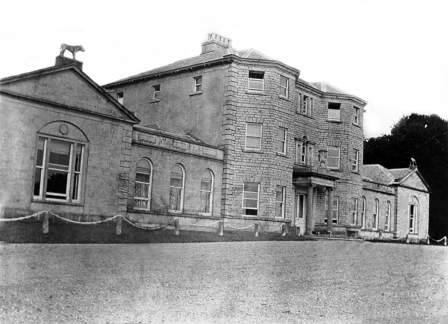
Photo credit: Dr Patrick Melvin & Eamonn de Burca

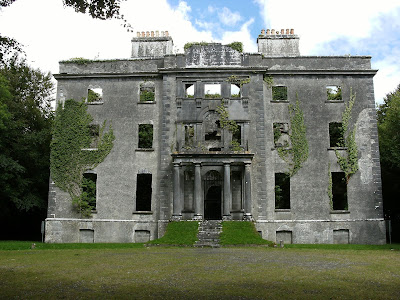
MOUNT BELLEW HOUSE, Mount Bellew Bridge, County Galway, was a house of mainly late-Georgian style.

It was remodelled ca 1820 by Christopher Dillon Bellew.

Mount Bellew comprised a three-storey centre block, with a single-bay entrance front.

The central block had a Venetian window at the top storey of the centre block.

It boasted a notable library which was said to have held one of the finest collections of books during its era.


Mount Bellew was sold about 1938 and subsequently demolished.

The Grattan-Bellews owned a further 10,593 acres in the Queen's County, and 1,895 in County Roscommon.

First published in March, 2016.

Tuesday, 28 December 2021

Terenure House

THE SHAW BARONETS OWNED 996 ACRES OF LAND IN COUNTY DUBLIN

CAPTAIN WILLIAM SHAW (c1651-1734), of Hampshire, son of Captain William Shaw, fought at the battle of the Boyne, 1690, an officer in Colonel Michelburn's foot regiment, was father of

RICHARD SHAW (1673-1729), of Ballinderry, County Tipperary, who married, in 1696, Judith, daughter of Edward Briscoe, and was father of

ROBERT SHAW (1698-1758), of Sandpits, County Kilkenny, who wedded, in 1736, Mary, daughter of Bernard Markham, and had issue,
William;
Thomas;
ROBERT, of whom presently;
Rebecca.
The youngest son,

ROBERT SHAW (1749-96), of Terenure, County Dublin, a merchant in Dublin, Accountant-General of the Post Office, espoused firstly, Mary, daughter of William Higgins, of Higginsbrook, County Meath, and had issue,
ROBERT, his heir;
Bernard;
Ponsonby;
Thomas;
John;
Mary; Charlotte.
Mr Shaw married secondly, Priscilla Cecilia, daughter of Colonel Robert Armitage, and had further issue,
George;
Lees;
Caroline; Sylvia.
The eldest son,

ROBERT SHAW (1774-1849), of Bushy Park, County Dublin, High Sheriff of County Dublin, 1806, MP for Dublin City, 1804-26, Colonel, Royal Dublin Militia, wedded firstly, in 1796, Maria, daughter of Abraham Wilkinson, of Dublin, and had issue,
ROBERT, his successor;
FREDERICK, 3rd Baronet;
Beresford William;
George Augustus (Rev);
Charles;
Charlotte; another daughter.
He espoused secondly, in 1834, Amelia, daughter of Dr Benjamin Spencer, of Bristol.

Mr Shaw was created a baronet in 1821, designated of Bushy Park, County Dublin.

He was succeeded by his eldest son,

SIR ROBERT SHAW, 2nd Baronet (1796-1869), DL, who died unmarried, and was succeeded by his next brother,

THE RT HON SIR FREDERICK SHAW, 3rd Baronet (1799-1876), Privy Counsellor, MP for Dublin, 1830-32, Dublin University, 1832-48, Recorder of Dublin, who espoused, in 1819, Thomasine Emily, daughter of the Hon George Jocelyn, and had issue,
ROBERT, his successor;
George, Major-General;
Frederic;
Edward Wingfield;
Wilkinson Jocelyn;
Thomasine Harriot; two other daughters.
Sir Frederick was succeeded by his eldest son,

SIR ROBERT SHAW, 4th Baronet (1821-95), DL, High Sheriff of County Dublin, 1848, Lieutenant-Colonel, Dublin Militia, who married, in 1852, Catherine Grace, daughter of William Barton, and had issue, a son and successor,

SIR FREDERICK WILLIAM SHAW, 5th Baronet (1858-1927), DSO JP DL, of Bushy Park, Terenure, County Dublin, Lieutenant-Colonel, Royal Irish Regiment, who wedded, in 1885, Eleanor Hester, daughter of Major Francis Horatio de Vere, and had issue,
ROBERT DE VERE, his successor;
Frederick Charleton;
Annie Kate; Mary Margaret; Grace Eleanor; Eily de Vere.
Sir Frederick was succeeded by his eldest son,

SIR ROBERT DE VERE SHAW, 6th Baronet (1890-1969), MC, who espoused, in 1923, Dorothy Joan, daughter of Thomas Cross, and had issue.


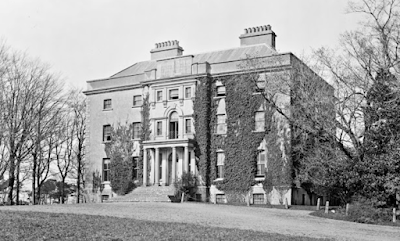
TERENURE HOUSE, County Dublin, is a noble 18th century house, comprising a five-bay front between two curved bows.

There are urns on the pediment.

There is a three-bay pedimented breakfront and a pillared porch.

In 1671, Major Joseph Deane, an officer in Cromwell’s army, purchased Terenure from Talbot for £4,000.

Major Deane, grandfather of the Rt Hon Joseph Deane MP, converted the castle into a mansion and his family held the property until 1789, when most of the land was sold to Abraham Wilkinson, of Bushy Park, County Dublin.


In 1785, Terenure House was leased to Robert Shaw, Accountant-General of the Post Office and a great-great uncle of George Bernard Shaw.

His son, Sir Robert Shaw, 1st Baronet, MP and Lord Mayor of Dublin, acquired the property, which was purchased for him by his father-in-law, Abraham Wilkinson, of Bushy Park, County Dublin.

Mr Wilkinson had already acquired much of the Terenure Estate in 1791.

He added almost 100 acres to the demesne and presented it, along with £10,000, to his only child Maria on her marriage to Robert Shaw, Junior.

Following the death of his father, Shaw came into possession of Terenure House and he sold it, about 1806, to Frederick Bourne, the proprietor of a stage coach business.

The Bournes occupied Terenure House until 1857, and during this period the estate was renowned for its magnificent landscaping, the planting in the grounds, and the extent and content of the glasshouses.

In 1860, the property was purchased by the Carmelite Order, which opened as a secondary school for boys.

From time to time extensions have been added and a fine church was built in 1958.

First published in August, 2018.

Sunday, 26 December 2021

Mussenden Temple Revived

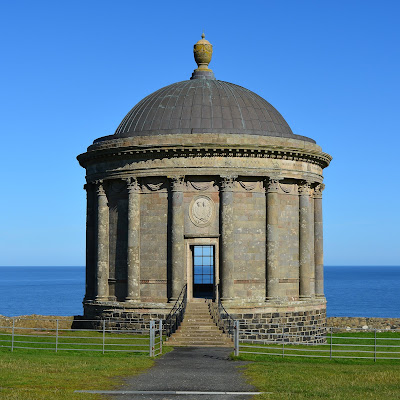
Mussenden Temple (Image: By D LN, Wikipedia)

As part of the students' National Diploma at Northern Regional College, Ballymoney, County Antrim, they have researched and created a "3D" graphical reconstruction of Mussenden Temple, 
DOWNHILL DEMESNE, County Londonderry, as it is looked around the early 1800s.

Below is a short, three-minute video clip providing us with a flavour of how the interior of the Temple might have appeared two centuries ago.


The interior of the Temple afforded exquisite beauty and grandeur, with copious gilding and elegant plasterwork.

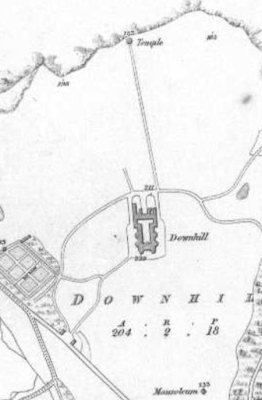
A broad path and wall originally existed in front of the Temple.

OS map of ca 1830

The cliff has been receding to the extent that, in the late 1990s, bolts and anchors were inserted into the rock in order to stablilize the cliff face.

Downhill is a property of the National Trust.

Downhill Revived


As part of the students' National Diploma at Northern Regional College, Ballymoney, County Antrim, they have researched and created a "3D" graphical reconstruction of DOWNHILL HOUSE, County Londonderry, as it is looked around the early 1800s.


Staff and Students have produced this reconstruction as a concept of what to expect from future interpretation plans for Downhill.

Downhill Demesne is a property of the National Trust.

First published in September, 2018.

Friday, 24 December 2021

New DL

APPOINTMENT OF DEPUTY LIEUTENANT


Dr Angela Garvey, Lord-Lieutenant of the County Borough of Londonderry, has been pleased to appoint:-
The Rev Nigel John Cairns
Prehen
County Londonderry
To be a Deputy Lieutenant of the County Borough, his Commission bearing date the 17th day of December, 2021.


Signed: Angela Garvey

Lord Lieutenant of the County Borough

Thursday, 23 December 2021

A Peculiar Tea

Still recovering from retinal surgery, with a depleting gas bubble in one eye, I decided to cycle down to the railway station and get a train to Botanic, a mere hop, skip, and jump from University Road, Belfast.

The ancient Burberry trench coat was unearthed; the trusty whangee brolly brandished.

When I alighted at Botanic station I had some time to spare, so I wandered into the Oxfam charity book-shop on Botanic Avenue (where the Arts Theatre used to be).

They invariably have a selection of vintage books, if not exactly "antiquarian."

It was approaching five o'clock, so I strode the short distance from Botanic Avenue, along LOWER CRESCENT, and on to University Road.

A Peculiar Tea is almost directly opposite Holohan's restaurant.

I recall the premises fondly as Beatrice Kennedy's, a delightful establishment which offered the most delectable wheaten bread and perhaps Mr McCarthy's signature dish, seared scallops on Clonakilty black pudding. Sublime.

I dined at BK's on my birthday in 2008.


A Peculiar Tea was established by the local and celebrated chef, Gemma Austin.

Its decor and ambiance are different from BK's, and the theme is somewhat akin to Alice in Wonderland.


I had the six-course Tasting Menu last night.


Since it was the occasion of my birthday, the staff very kindly offered me a complimentary drink, so I had a glass of Prosecco, with a juicy raspberry floating on top.

Guinea fowl, bone marrow, jus

The presentation and service were very good indeed, and, given the amount of time that must have been expended in preparing six delicious and quite exquisite courses, all the crockery and cutlery needed, it was good value at £45.

Cod, champagne sauce, capers

Guinea fowl, cod, venison, sorbet, and other delicacies were presented beautifully and with culinary craftsmanship.

I'm sure Aunt Dahlia's chef Anatole, that master of the gastronomic taste-buds, would have approved.

Venison, celeriac, etc

The final course, a minute pudding, was served with a little lighted candle on top; and I was treated to a rendition of Happy Birthday To You by staff and patrons in the dining-room.

Tuesday, 21 December 2021

Mayoral Rolls-Royce

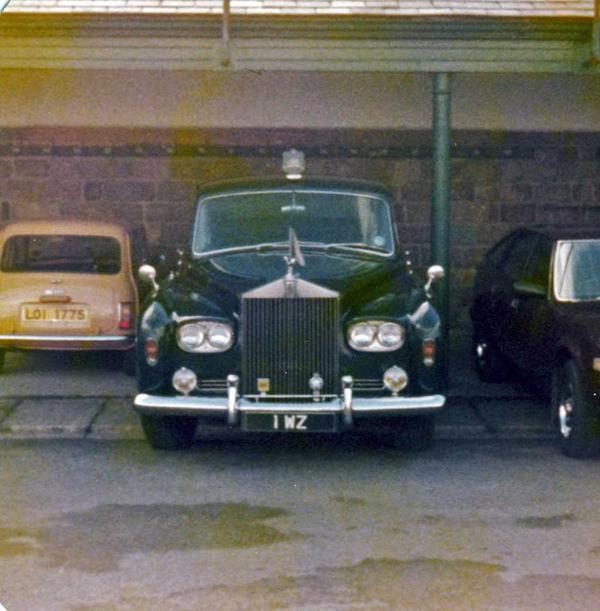
Royal Ulster Constabulary Training Depot, Enniskillen, County Fermanagh, 1978
 (Image: David Irvine)

This stately Rolls-Royce Phantom VI was the official limousine in use by the Rt Hon the Lord Mayor of Belfast between 1968-78.

It was purchased by Belfast Corporation for the official use of the Lord Mayor.

The traditional navy blue colour is still on the bonnet, roof and boot, though elsewhere it has been re-painted.

The bonnet's considerable length is reminiscent of a concert grand piano.


Its original registration number was 1 WZ.

Of course the Council should have kept the car and continued to use it.

It could even have been converted to run on bio-fuel.


This car was the first Phanton VI off the production line: 1969 Rolls-Royce Phantom VI limousine. Coachwork by H J Mulliner, Park Ward. Registration number WVO 338G. Chassis number PRH4108. Engine number 4108. Sold for £36,700, including premium.


FOOTNOTES

The Rolls-Royce in-house coach-builder Park Ward Limited (later H J Mulliner, Park Ward) produced what was, in effect, the standard seven-passenger limousine coachwork for the Phantom V.

This timeless design would survive until 1990, being built in near-identical Phantom VI form from 1968, when separate air conditioning for front and rear compartments was standardised alongside the Silver Shadow-specification 6,230cc V8 engine.

The usual upholstery for the front compartment was leather, which was also included in the list of alternatives for the rear along with West of England cloth.


As one would expect in a car of this class, a cocktail cabinet incorporated into the rear compartment’s cabinet-work was one of a host of options that also included electric windows.

Phantom development tended to lag behind that of the contemporary Shadow range, and it was not until 1978 that the model received the three-speed automatic transmission and 6.75-litre engine that had featured on the latter for many years.

By this time the opulent Phantom VI was being built to special order only, with prices on application.

The very first Phantom VI produced, chassis number PRH 4108, was sold new to Belfast City Corporation for use by the Lord Mayor (as referenced in Martin Bennet's book, Rolls-Royce & Bentley: The Crewe Years) and was mostly maintained by the Crewe factory until sold by the Corporation in 1978.

The car enjoyed three subsequent owners before passing into the vendor's hands in 1991, and comes with numerous invoices for this period issued by recognised Rolls-Royce specialists.

Since acquisition it has been maintained by the engineer owners and used regularly on R-REC events, most notably Her Majesty The Queen's Golden Jubilee celebrations at Windsor Castle in 2002.

Restored in the early 1990s, the vehicle is reported as being to factory specification apart from the addition of an electric radiator cooling fan.


AUCTION NOTICES

This, four previous owner car, was acquired by the current vendors in 1991 when it was then comprehensively restored underneath and new rear springs fitted.

It has since been enjoyed at many club events.

In addition to regular servicing, the car has benefited from a new radiator, brake overhaul, three new tyres, rear fog lamps and an electric radiator fan together with new front and rear bumpers.

The car comes with all MOT certificates dating back to 1977 and numerous invoices from recognised Rolls-Royce specialists.

Handbook, jack and wheel brace are all included and the cocktail cabinet is complete with decanters and glasses.

First published in August, 2012.

Friday, 10 December 2021

New DL

APPOINTMENT OF DEPUTY LIEUTENANT


Mr Gawn Rowan-Hamilton, Lord-Lieutenant of County Down, has been pleased to appoint:-
Mr John Gerard Gordon
Whiterock
Killinchy
County Down

To be a Deputy Lieutenant of the County his Commission bearing date the day of 30th November 2021

Lord Lieutenant of the County.

Ballywillwill House

RICHARD McDOWELL-JOHNSTON
, son of William Johnston, of Netherlaw Park, Kirkcudbright, (whose sister married Captain, subsequently Colonel, James McDowell, son of Colonel John McDowell, and Janet Ross, his wife, sister of the Countess of Stair), assumed the surname and arms of McDOWELL, in compliance with the will of his uncle, Colonel James McDowell, who bequeathed him the estates of Gillespie and Craignarget, Galloway, Dumfriesshire.
He married Jane Crooks, and had two sons,
WILLIAM, his heir;
Henry, died young.
Mr McDowell-Johnston died in 1772, and was succeeded by his son,

WILLLIAM McDOWELL-JOHNSTON, of Ballywillwill, who wedded, in 1768, Rebecca, daughter of the REV GEORGE VAUGHAN, Rector of Dromore, County Down (whose father, John Vaughan, and grandfather, George Vaughan, had been Rectors of the same place).

Mr McDowell-Johnston died in 1784, leaving a son and heir,

THE REV GEORGE HENRY McDOWELL-JOHNSTON JP, of Ballywillwill, County Down, Vicar of Donegore and Kilbride, 1814-64, who married, in 1811, the Lady Anna Maria Annesley, second daughter of Richard, 2nd Earl Annesley, which lady dsp 1835. 

Ballywillwill House (Image: UAHS)

BALLYWILLWILL HOUSE, near Castlewellan, County Down, is an elegant two-storey, five-bay house, built ca 1815, by the Rev George McDowell-Johnston.

The central upper storey and outer bays have Wyatt windows.

Ballywillwill House: Portico (Image: UAHS)

Ballywillwill has an exceptionally long portico with ten Ionic columns, urns, and a large prostrate lion on its entablature (a lion is a supporter on several Johnston coats-of-arms).

Ballywillwill House (Image: Stuart Blakley: Lavender's Blue)

Four columns in the centre protrude slightly.

Extract from UAHS Publication. Click to Enlarge.

Ballywillwill House features in the Ulster Architectural Heritage Society's publication Historic Buildings in the Mourne Area of South Down, written by the late Peter Rankin in 1975.

Thursday, 25 November 2021

Moore Hall

THE MOORES OF MOORE HALL OWNED 12,371 ACRES OF LAND IN COUNTY MAYO

The family of MOORE claimed descent from THE RT HON SIR THOMAS MORE, statesman and Lord Chancellor to HENRY VIII.

THOMAS MORE, born at Chilston, near Madley, in Herefordshire, married Mary, daughter of John ApAdam, of Flint, and had a son,

GEORGE MOORE, who settled at Ballina, County Mayo, Vice-Admiral of Connaught during the reign of WILLIAM III.

He wedded Catherine, daughter of Robert Maxwell, of Castle Tealing, Scotland, by Edith his wife, daughter of Sir John Dunbar, and was father of

GEORGE MOORE, of Ashbrook, County Mayo, living in 1717, who married Sarah, daughter of the Rev John Price, of Foxford, County Mayo, by his wife, Edith Machen, of the city of Gloucester, and by her had two sons,
George, of Cloongee;
JOHN, of whom we treat.
The younger son,

JOHN MOORE, of Ashbrook, County Mayo, born ca 1700, espoused Jane, daughter of Edmund Athy, and had issue,
Robert, dsp 1783;
GEORGE, of whom presently;
Edmund, of Moorbrook;
Sarah; Jane.
His second son,

GEORGE MOORE (1729-99), of Moore Hall, Ashbrook, and Alicante, Spain, married, ca 1765, Catherine, daughter of Dominick de Killikelly, of Lydacan Castle, County Galway, and had issue,
John, 1763-99;
GEORGE, of whom hereafter;
Thomas;
Peter.
The second son,

GEORGE MOORE (1770-1840), of Moore Hall, wedded, in 1807, Louisa, daughter of the Hon John Browne, sixth son of John, 1st Earl of Altamont, and had issue,
GEORGE HENRY, his heir;
John;
Arthur Augustus.
The eldest son,

GEORGE HENRY MOORE JP DL (1810-70), MP for County Mayo, 1847-57, 1868-70, High Sheriff of County Mayo, 1867, espoused, in 1851, Mary, eldest daughter of Maurice Blake, of Ballinafad, County Mayo, and had issue,
GEORGE AUGUSTUS, his heir;
Maurice George, CB, Colonel, Connaught Rangers;
Augustus George Martin;
Henry Julian;
Nina Mary Louisa.
He was succeeded by his eldest son,

GEORGE AUGUSTUS MOORE (1852-1933), of Moore Hall and Ebury Street, London, High Sheriff of County Mayo, 1905, who died unmarried.

George Henry Moore (Image: Wikipedia)

THE MOORES had originally been an English Protestant settler family.

The father of George Moore (1729-99), John Moore, converted to catholicism when he married Jane Lynch Athy from one of the principal Catholic families in County Galway.

Using her connections among the "Wild Geese," Irish Jacobite exiles in Spain, Jane supported her son in getting established in the wine import business in Alicante, Spain.

He subsequently changed his religion, and married, in I765, Katherine de Kilikelly, an Irish Catholic raised in Spain.

George made his fortune and returned to erect Moore Hall in 1792, above the shore of Lough Carra.
"He thus solidified the shift of the family from being New English settlers of Protestant faith to their nineteenth-century identity as Irish Catholic landlords who had never been humbled by the "Penal Laws" — that set of regulations aimed at limiting the property and power of Irish Catholics, and put in force after William of Orange routed James II at the Battle of the Boyne in 1688."

"The change in the confessional identity of the Moore family, like the circumstances of G H Moore's death, is important to the story of George Moore. These matters would one day be the occasion of a quarrel about family history that broke up the surviving Moore brothers, saw Moore Hall become vacant, and scattered the last generation of Moores abroad."

"Of the four sons of George Moore of Alicante, the eldest was John Moore (1763-99), a scapegrace trained in Paris and London for the law, and for a few days in 1798 the first President of the Republic of Connaught."

"Aided by French invaders at Killala, John Moore participated in the surprise victory of General Humbert over a British garrison at Castlebar on 27 August 1798, assumed nominal leadership of the rebels, then got captured after the rout of the small Irish forces."

"President Moore died while under house arrest in a Waterford tavern. The second son of Moore of Alicante was a mild-tempered man, also named George Moore. A gentleman scholar rarely out of his library, he wrote histories of the English and French revolution, something in the manner of Gibbon."

"Moore the historian had three sons by Louisa Browne, the first being George Henry Moore, the only one of the three not to die by a fall from a horse."
Moore Hall (Image: Robert French)

MOORE HALL, near Ballyglass, County Mayo, is a Georgian mansion built between 1792-6 by George Moore.

It comprises three storeys over a basement, with an entrance front of two bays on either side of a centre breakfront; including a triple window, and fluted pilasters on console brackets.

There is a Venetian window above the entrance doorway, beneath a single-storey Doric portico.

The house was burnt by the IRA in 1923, and is now a ruinous shell.

Colonel Maurice Moore, CB, had intended to rebuild the house, albeit on a smaller scale.

Moore Hall (Image: Comhar - Own work, Public Domain,
https://commons.wikimedia.org/w/index.php?curid=11252115

Colonel Moore's elder brother, George Augustus Moore, died in 1933, leaving  an estate valued at £70,000 (about £5.1 million in 2021).

His ashes were buried on Castle Island in Lough Carra.

Thursday, 18 November 2021

Belfast IMAX


A giant of the cinema world arrived in Northern Ireland in 2001, and opened its doors on the banks of the River Lagan, at Queen's Quay.

The £1.5 million (equivalent to about £2.5 million in 2021) IMAX screen at Belfast's Odyssey Pavilion was higher than four double-decker buses.

Its projector was the size of a small car.

It was the biggest cinema screen in the Province.

A local entrepreneur, Peter Curistan, who brought the large screen to Northern Ireland, said at the time:
"The experience is immersive and you do really feel that you are part of the action. I'm very proud to bring it to Odyssey. 
I'm very proud to bring it to Northern Ireland and I think we really have something of truly European standard."
The first film to be shown at the IMAX was Everest.

The chief projectionist at the centre stated that the staff had to undergo weeks of training to get to grips with the new technology:
"It's very, very hi tech actually. We would have three computers to manage the system. 
The soundtrack is put onto disc into a hard drive, so you have to synchronise the film with the soundtrack which is very, very important. 
It's a totally different concept to what normal film would use."
The Belfast IMAX unfortunately closed down in September, 2007.

Mr Curistan was declared bankrupt in 2013.

I enjoyed the experience and went to quite a few movies there.

I was sorry about its demise.


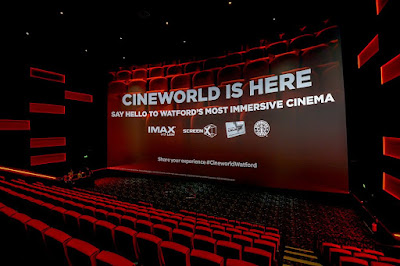
It is wonderful, however, to hear that Cineworld, based in London, and currently the world's second-largest cinema chain, is to open a brand new thirteen-screen cinema complex at Belfast's Odyssey Pavilion.

The new screens will include an IMAX Laser auditorium, a multi-sensory 4DX extreme cinema experience, and Screen X, a 270-degree wrap-around screen which is the first of its kind in Northern Ireland.

The new cinema is expected to open on the 10th December, 2021.

First published in April, 2014; revised November, 2021.

Sunday, 14 November 2021

The Prince of Wales


THE PRINCE OF WALES is 73 today.

His Royal Highness The Prince Charles Philip Arthur George, Prince of Wales and Earl of Chester, Duke of Cornwall and Rothesay, Earl of Carrick and Baron of Renfrew, Lord of the Isles and Great Steward of Scotland, KG, KT, GCB, OM.

His Royal Highness is heir apparent and first in line to the Throne.

Born at Buckingham Palace on the 14th November, 1948, HRH was educated at Cheam School; Gordonstoun; and Trinity College, Cambridge.

His Royal Highness is Admiral of the Fleet in the Royal Navy, Field Marshal in the Army, and Marshal of the Royal Air Force in the RAF.

These ranks are known as "Five Star" in the United States.

  • Royal Knight of the Most Noble Order of the Garter 
  • Royal Knight of the Most Ancient and Most Noble Order of the Thistle 
  • Grand Master of the Most Honourable Order of the Bath 
  • Member of the Order of Merit.
His Royal Highness shall ascend the throne as CHARLES III.

Friday, 12 November 2021

New Vice Lord-Lieutenant

APPOINTMENT OF VICE LORD-LIEUTENANT

Mr Gawn Rowan-Hamilton, Lord-Lieutenant of County Down, with the approval of Her Majesty The Queen, has been pleased to appoint:-
Mrs Catherine June Champion DL
Newtownards
County Down
Vice Lord-Lieutenant for the said County, her Commission bearing date the 29th day of October. 2021.


Lord-Lieutenant of the County

Tuesday, 2 November 2021

Princess Royal in NI

The Princess Royal has arrived in Northern Ireland.

Her Royal Highness this morning visited the Siege Museum, 13 Society Street, Londonderry, and was received by Her Majesty's Lord-Lieutenant of the County Borough of Londonderry (Dr. Angela Garvey).

HRH this afternoon visited Seating Matters Limited, 131 Carnamuff Road, Ballykelly, and was received by Dr. William McGinnis (Deputy Lieutenant of County Londonderry).

The Princess Royal afterwards visited the Limavady Community Development Initiative, Roe Valley Hospital, 24D Benevenagh Drive, Limavady, and was received by Her Majesty's Lord-Lieutenant of County Londonderry (Mrs. Alison Millar).

Friday, 29 October 2021

New Vice DL

APPOINTMENT OF VICE LORD-LIEUTENANT


Mrs Alison Millar, Lord-Lieutenant of County Londonderry, with the approval of Her Majesty The Queen, has been pleased to appoint:-

Professor Patrick Gerald McKenna DL
Portrush
County Antrim

Vice Lord-Lieutenant for the said County, his Commission bearing date the 22nd day of October, 2021.


Lord-Lieutenant of the County

Wednesday, 27 October 2021

Stackallan House

THE VISCOUNTS BOYNE OWNED 2,739 ACRES OF LAND IN COUNTY MEATH


This is a branch of the ducal house of ABERCORN; CLAUD HAMILTON, created 1st Lord Paisley, in 1587, being the common ancestor of both.

THE HON SIR FREDERICK HAMILTON (c1590-1647), of Manor Hamilton, Dromahair, County Leitrim, youngest son of Claud, 1st Lord Paisley, by his wife, Margaret, daughter of George, 6th Lord Seton, married firstly, Sidney, daughter and heiress of Sir John Vaughan, Governor of Derry, and had issue,
James, of Manor Hamilton;
GUSTAVUS, of whom we treat;
Christina, m Sir George Munro.
He wedded secondly, Agnes or Alice, daughter of Sir Robert Hepburn, of Alderstown, without further issue.

Sir Frederick signalized himself in the armies of GUSTAVUS ADOLPHUS, King of Sweden, and was afterwards made Governor of Ulster.

The second son,

GUSTAVUS HAMILTON (1642-1723), having abandoned the fortunes of JAMES II, to whom he was a privy counsellor, and distinguished himself as a military officer in the service of WILLIAM III, particularly at the battle of the Boyne, and the siege of Derry, was sworn of the Privy Council of the latter monarch, appointed Brigadier-General of his armies, and further rewarded with a grant of forfeited lands.

General Hamilton was MP for County Donegal, 1692-1713, and for Strabane, 1713-15.

In the reign of QUEEN ANNE he was advanced to the rank of Lieutenant-General; and by Her Majesty's successor, GEORGE I, elevated to the peerage, 1715, in the dignity of Baron Hamilton of Stackallan, County Meath.

His lordship was advanced to a viscountcy, in 1717, as VISCOUNT BOYNE.

He married Elizabeth, second daughter of SIR HENRY BROOKE, Knight, of Brookeborough, County Fermanagh, and had issue,
FREDERICK (c1663-1715), father of GUSTAVUS, 2nd Viscount;
Gustavus, father of 3rd and 4th Viscounts;
Henry, MP for Donegal, 1725-43;
Elizabeth.
His lordship was succeeded by his grandson,

2nd Viscount Boyne (Image: Scottish National Gallery)

GUSTAVUS
, 2nd Viscount (1710-46); at whose decease, unmarried, the honours devolved upon his cousin,

FREDERICK, 3rd Viscount (1718-72), who wedded, in 1737, Elizabeth, daughter of Benjamin Hodley; but dying without issue, he was succeeded by his brother,

RICHARD, 4th Viscount (1724-89), who espoused Georgiana, second daughter of William Bury, by whom he had issue, seventeen children, including,
GUSTAVUS, his successor;
Charles;
Richard;
Catherine; Mary; Barbara; Sophia; Anne.
His lordship was succeeded by his eldest son,

GUSTAVUS, 5th Viscount (1749-1816), who married, in 1773, Martha Matilda, only daughter of Sir Quaile Somerville Bt, of Somerville, County Meath, and had issue,
GUSTAVUS, his successor;
Richard Somerville, Royal Navy;
Sarah; Georgiana.
His lordship was succeeded by his eldest son,

GUSTAVUS, 6th Viscount (1777-1855), who wedded, in 1796, Harriet, only daughter of Benjamin Baugh, of Burwarton House, Shropshire, and had issue.
  • Gustavus Frederick Hamilton-Russell, 7th Viscount (1798–1872);
  • Gustavus Russell Hamilton-Russell, 8th Viscount (1830–1907);
  • Gustavus William Hamilton-Russell, 9th Viscount (1864–1942);
  • Gustavus Michael Stucley Hamilton-Russell, 11th Viscount (b 1965).
The heir apparent is the present holder's eldest twin son, the Hon Gustavus Archie Edward Hamilton-Russell (b 1999).

Burwarton House, Bridgnorth, Shropshire, is today the seat of the Viscounts Boyne.


STACKALLAN HOUSE, near Navan, County Meath (originally called Boyne House) was built ca 1716 for Gustavus Hamilton, afterwards 1st Viscount Boyne.

It has been attributed to Colonel Thomas de Burgh, the military engineer, architect and MP.

It comprises three storeys and two adjoining pedimented fronts, one of nine bays and the other, seven bays.

The house has bold quoins and and distinctive window surrounds.

The roof is high-pitched with a modillion cornice.


The staircase is adorned with the Hamilton coat-of-arms surrounded by various military trophies, enclosed in a stucco wreath.

The house remained in the Hamilton family until 1920, when it was sold to Daniel O’Mahoney Leahy. 
During the 2nd World War the Irish army was based at Stackallan House.

In 1953 Stackallan was bought by Major Anthony and Mrs Elzabeth Burke, whose late husband was the grandson of Sir Henry Farnham Burke KCVO CB, Garter Principal King of Arms.

Mrs Burke opened a stud farm at Stackallan in 1960.

In 1964 Major Burke was killed when a horse collapsed on top of him while hunting with the Ward Union. 

It is believed that Stackallan is now the property of Mr Martin Lawrence Naughton KBE.

In 2015 Mr Naughton, CBE, was appointed an Honorary Knight Commander of the British Empire (KBE) for services to the Northern Ireland economy, art and philanthropic causes.

First published in April, 2018. 

Sunday, 24 October 2021

The Black Causeway Incident

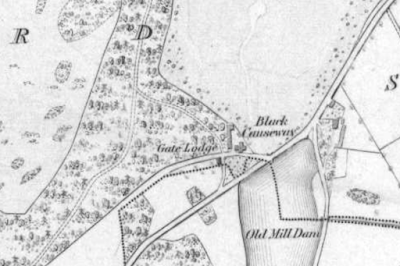
The Location of the Incident (Image: Timothy Ferres, 1989)

Castle Ward demesne, County Down, was as idyllic in the 1970s as it is today.

A little caravan site had been established at what used to be called The Screen, a heavily wooded part of the estate beside Strangford Bay.

Black Causeway House still stands at the bay, just outside the side entrance to the estate, beside a small bridge.

This house remains part of the estate, and used to be available for rent by National Trust members and staff.

In the 1970s, the Right Hon Walter Topping QC, Recorder of Belfast, and his family took Black Causeway House for a month every summer (I recall his Ford Granada parked outside).

The National Trust's custodian of Castle Ward in the 1970s was Lieutenant-Colonel Terence P Kyd or Kydd (who retired to Black Causeway House; followed by Mrs Kyd; followed by the Macks).

Beside this house there is a side entrance, with gate pillars, to the estate; in fact, according to a Georgian map, there used to be a gate lodge, too.

Click to Enlarge

The drive from this side entrance passes through beautiful shady woodland, skirting the bay, towards the grounds of Castle Ward House.

One day, forty summers ago, my mother and I were walking along this drive, just beyond the entrance gates.

On an elevated position to our left was the caravan site warden's cottage, a modest bungalow which stood some distance from the drive.

Another drive forked upwards towards the cottage.

At that time the warden divided his duties between the caravan park and the grounds on the estate.

Incidentally, the very first warden was Ernest Swail, an old man who told us that he was Lord Bangor's last boatman.

We were strolling along the drive, and as we passed the warden's cottage we heard a loud bang.

It had come from the cottage.

I was nearest to the cottage; my mother was beside me to my right.

I instantaneously heard and felt a whoosh of air on my left cheek.

We must have been quite stunned, because we stopped immediately and looked at each other.

Thereafter I looked up at the warden's cottage on the little hill above us.

The door was closed and there was no sign of anybody.

I am absolutely convinced that the shot came from the porch of the warden's cottage.

I don't remember whether I told mother about it all; however, we simply resumed our walk.

Tuesday, 19 October 2021

Shaen Manor

THE CARTERS WERE MAJOR LANDOWNERS IN COUNTY MAYO, WITH 40,698 ACRES

THOMAS CARTER (c1650-1726), of Robertstown, County Meath, Sergeant-at-Arms, a gentleman whose services at the Revolution were very considerable, for he not only served WILLIAM III at the battle of the Boyne, but secured divers useful books and writings belonging to JAMES II and his secretaries when they were fleeing from the scene of the battle.

Mr Carter married firstly, Margaret Houghton, and had issue,
THOMAS;
Mary; Joanna.
He wedded secondly, in 1706, Isabella, daughter of Matthew, second son of Sir Matthew Boynton Bt, of Barmeston, Yorkshire, and widow of Wentworth, 4th Earl of Roscommon (the poet), but had no further issue.

His son and heir,

THE RT HON THOMAS CARTER (1690-1763), Master of the Rolls, Secretary of State, Privy Counsellor, 1732, of Robertstown and Rathnally, County Meath, espoused, in 1719, Mary, daughter and co-heiress (with her sister Frances) of Thomas Claxton, of Dublin, and had issue,
THOMAS, MP, of Old Leighlin;
HENRY BOYLE, of whom presently;
Frances; Susan; Mary.
The second son,

HENRY BOYLE CARTER, of Castlemartin, County Kildare, Captain, Colonel Irwin's Regiment, married, in 1750, Susanna, daughter and co-heiress of Sir Arthur Shaen Bt, of Kilmore, County Roscommon, and had issue,
THOMAS, his heir;
Arthur;
Henry;
Mary.
The eldest son,

THOMAS CARTER (1753-), of Castlemartin, wedded, in 1783, Catherine, daughter of the Hon John Butler (brother of Humphrey, 1st Earl of Lanesborough), and had issue,
WILLIAM HENRY, his heir;
John, Admiral RN;
Thomas;
Margaret.
The eldest son,

WILLIAM HENRY CARTER JP DL (1783-1859), of Castlemartin, County Kildare, High Sheriff of County Kildare, 1817, married firstly, in 1809, Elizabeth, third daughter of Francis Brooke, and sister of Sir Henry Brooke Bt, of Colebrooke, County Fermanagh, and had issue,
THOMAS SHAEN, his heir;
Susanna.
He espoused secondly, in 1846, Frances, sister of Robert, 5th Earl of Mayo, but by her, who predeceased him, had no issue.

The only son,

THOMAS SHAEN-CARTER JP (1813-75), of Watlington Park, Oxfordshire, married, in 1842, Maria Susan, only surviving child and heiress of Colonel John Henry Tilson, of Watlington Park (descended from the Rt Rev Henry Tilson, Lord Bishop of Elphin), and had issue,
HENRY TILSON SHAEN, of Watlington Park;
GEORGE TILSON SHAEN, of Shaen Manor;
Thomas Tilson Shaen;
Francis Tilson Shaen;
Ernest Tilson Shaen;
Basil Tilson Shaen (Rev), Rector of Watlington;
Gerald Tilson Shaen;
Lionel Tilson Shaen;
Augusta Susanna Shaen; Elizabeth Sophia Shaen.
Mr Shaen-Carter was succeeded by his eldest son,

HENRY TILSON SHAEN-CARTER (1846-82), of Watlington Park, who wedded, in 1867, Adelaide Elizabeth, eldest daughter of Denis Bingham JP, of Bingham Castle, County Mayo.

He dsp 1882, and was succeeded by his brother,

GEORGE TILSON SHAEN-CARTER JP (1848-1918), of Shaen Manor, Belmullet, County Mayo, who married firstly, in 1878, Eva Augusta, daughter of William John French, of Ardsallagh, County Meath, and had issue,
VICTOR TILSON ARTHUR SHAEN, his heir;
Ernest de Freyne Tilson Shaen;
Muriel Una Shaen.
He wedded secondly, in 1894, Grace (dsp 1908), eldest daughter of the Rev David Hughes; and thirdly, Edith Hamilton Urry.

His eldest son,

VICTOR ARTHUR TILSON SHAEN-CARTER JP (1879-1954), of Shaen Manor, and Fleet End, Berkshire, married, in 1909, Wilfreda Christine, daughter of Richard Davis; High Sheriff of County Mayo, 1922.

His only son,

GEOFFREY VICTOR TILSON SHAEN-CARTER, of Shaen Lodge, County Mayo, married firstly, in 1946, Monica Howard, daughter of Brigadier Bertie Howard Penn; and secondly, in 1968, Peggy Ismay Voake.

The Carter family of Castlemartin, County Kildare, inherited half the Shaen lands in the barony of Erris, county Mayo, through marriage with a Shaen heiress in 1750.

In the mid 1820s they founded the town of Belmullet and developed it with the assistance of John Crampton, their agent, and the engineer Patrick Knight.

Former town residence ~ 44 Tilsbury Road, Hove, Sussex.

Unfortunately I have so far been unable to find any history or images of Shaen Manor or Lodge.

The principal residence of the Carters for several generations was Castlemartin in County Kildare.

First published in March, 2012.