Thursday, 31 August 2023

Norwood Pictures

Norwood Tower (Image: Mrs Primrose Henderson, 2011)
A READER HAS SENT ME SOME PHOTOGRAPHS OF NORWOOD TOWER, STRANDTOWN, BELFAST, FORMER HOME OF THE HENDERSONS, PROPRIETORS OF THE NEWS-LETTER NEWSPAPER


"One of them (below) has a photograph of both my aunts, Peggy and Mary, and Mary does not want her photo to go on the Internet so you cannot put that one on the site ..."


"Sadly it is the best one of the two, as it shows the full door the other one, with the single lady in it, you can use; however I have no idea who she is, it shows a little of what is in the hallway through the door."


"I do have some information of the layout of the houses Riversdale [Co Fermanagh] and Norwood Tower from my aunt and will write it up for you ..."

"Norwood was powered by gas so had gas cookers and lights." 


"I do have a photograph of a woman standing at the front door which seems quite ornate with iron railings around it I will scan it and send later."

"I also have a photograph of my aunt sitting in front of a lion statue in the garden of Norwood Tower (above); she said that she didn't want it to go on the Internet however I have attached it for you to see."

"The lady with her was Mrs Lutton or Litton and she rented part of the servants' quarters in Norwood Tower."

"Mary said that another couple rented a different part of the house seemed to be outside of the main house but part of the surrounding building and the rent of those went to the upkeep of the house."


The photograph above shows a glass-house at Norwood Tower.

First published in May, 2011.

Wednesday, 30 August 2023

Edgeworthstown House

THE EDGEWORTHS OWNED 3,255 ACRES OF LAND IN COUNTY LONGFORD

In the reign of ELIZABETH I, about 1563, two brothers, EDWARD and FRANCIS EDGEWORTH, went to Ireland, probably under the patronage of the Earl of Essex and Robert Cecil, as those names have since continued in the family.

The elder brother,

THE RIGHT REV DR EDWARD EDGEWORTH, who was beneficed by Her Majesty, was appointed Lord Bishop of Down and Connor, 1593.

He died without issue, and was succeeded by his brother,

FRANCIS EDGEWORTH, Clerk of the Hanaper, 1619, who married Jane, daughter of Edward Tuite, and sister of Sir Edmond Tuite, and by her (who founded an Irish convent near St Germain, near Paris) had issue,
JOHN, his heir;
Anne; Mary; Margaret.
He died in 1625, and was succeeded by his only son,

CAPTAIN JOHN EDGEWORTH, of Cranallagh Castle, County Longford, High Sheriff of County Longford, 1646, MP, 1646-9, who wedded firstly, Anne, daughter of Sir Hugh Culme, of Cloughoughter Castle, County Cavan, by whom he had a son,
JOHN, his heir.
He espoused secondly, Mrs Bridgman, widow of Edward Bridgman, brother to Sir Orlando Bridgman, the Lord Keeper.

Captain Edgeworth was succeeded by his only son,

SIR JOHN EDGEWORTH (1638-c1700), MP for St Johnstown (Longford), 1661-99, knighted by CHARLES II, 1672, who married firstly, Mary, only daughter and heir of Edward Bridgman, and acquired with her an estate in Lancashire, besides a considerable fortune in money, and had by her six sons.

By his second wife, Anne, he had three sons and two daughters.

Among his issue were,
FRANCIS, his heir;
Robert, ancestor of EDGEWORTH of Kilshrewly;
Henry, of Lissard;
Essex (Rev), of Templemichael.
The eldest son,

COLONEL FRANCIS EDGEWORTH (1657-1709), of Edgeworthstown, MP for Longford Borough, 1703-9, raised a regiment for WILLIAM III.

He wedded firstly, Dorothy, daughter of Hugh Culme, of County Cavan, by whom he had a son, Francis, who died unmarried; and secondly, Dorothy, daughter of Sir Charles Hamilton Bt, of Castle Hamilton, County Cavan, and had a son, John, who dsp, and a daughter, Francelina.

Colonel Edgeworth espoused thirdly, Mary, widow of John Bradstone, and had a son and successor,

RICHARD EDGEWORTH (1701-70), of Edgeworthstown, High Sheriff of County Longford, 1742, MP for Longford Borough, 1737-60, who married, in 1731, Rachel Jane, daughter of Sir Salathiel Lovell, of Harleston, Northamptonshire, and had issue,
RICHARD LOVELL, his heir;
Mary; Margaret.
Mr Edgeworth was succeeded by his only son,

RICHARD LOVELL EDGEWORTH (1744-1817), of Edgeworthstown, MP for St Johnstown, 1798-1800, born at Bath, the celebrated writer on education and inventions.

By four wives he was father of no less than twenty-two children.

Mr Edgeworth was succeeded by his eldest surviving son,

LOVELL EDGEWORTH JP DL (1775-1842), of Edgeworthstown, High Sheriff of County Longford, 1819, who died unmarried, and was succeeded by his half-brother,

CHARLES SNEYD EDGEWROTH DL (1786-1864), of Edgeworthstown, who married, in 1813, Henrica, daughter of John Broadhurst, of Foston Hall, Derbyshire, which lady dsp 1846.

He dsp 1864, and was succeeded by his nephew,

ANTONIO EROLES EDGEWORTH JP DL (1842-1911), of Edgeworthstown, High Sheriff of County Longford, 1890, who wedded, in 1874, Françoise, daughter of Colonel Delcher, of the French Service.

Mr Edgeworth dsp 1911, and was succeeded by his cousin,

FRANCIS YSIDRO EDGEWORTH (1845-1926), son of Richard Lovell Edgeworth and his fourth wife, Frances Ann Beaufort, of Edgeworthstown, who died unmarried.


EDGEWORTHSTOWN HOUSE, Edgeworthstown, County Longford, is an early 18th century mansion erected by Richard Edgeworth MP.

It comprises two storeys over a basement, with two adjoining fronts.


The entrance front has three bays between two tripe windows in the upper storey; while the adjoining front has a three-bay breakfront which rises above the roofline as a pedimented attic.


Richard Lovell Edgeworth enlarged and renovated the house after 1770, and added many ingenious devices, including leather straps to prevent doors banging, sideboards on wheels, and even a water-pump which automatically dispensed a halfpenny to beggars who worked it for half an hour.


Following Francis Ysidro Edgeworth's decease in 1926, Edworstown estate was inherited by Mrs C F Montagu (née Sanderson), whose mother was an Edgeworth.

Mrs Montagu sold the property to Bernard Noonan, who bequeathed it, in 1947, to an order of nuns which used it as a nursing home.

The exterior of the house was subsequently greatly altered; and the interior was gutted and rebuilt.

First published in June, 2018.

Tuesday, 29 August 2023

Dromore Castle

THE EARLS OF LIMERICK OWNED 4,083 ACRES OF LAND IN COUNTY LIMERICK


The ancestors of this noble family were originally of Lower Brittany, in France; and the first of the family upon record in Ireland is EDMUND PERY, a son of William Pery, Bailiff of Exeter, 1578, who settled in Limerick.

This Edmund Pery, erstwhile Mayor of Limerick, died in 1655, leaving by Susannah his wife, only daughter and heir of Stephen Sexten, and heiress of her nephew, Edmond Sexten, of St Mary's Abbey, a son and successor,

COLONEL EDMUND PERY, of Stackpole Court, County Clare, who married Dymphna, daughter of Bartholomew Stackpole, of Stackpole Court, and had issue,
SEXTEN, his heir;
STACKPOLE, succeeded his brother;
four daughters.
Colonel Pery died in 1721, and was succeeded by his elder son,

SEXTEN PERY, of Stackpole Court, who died in 1730, and was succeeded by his brother,

THE REV STACKPOLE PERY MA, who wedded, in 1716, Jane, daughter and heir of the Ven William Twigge, Archdeacon of Limerick (by Diana, daughter and heir of Sir Drury Wray Bt, by Albinia, daughter and co-heir of Edward, Viscount Wimbledon, third son of 1st Earl of Exeter KG), and had, with other issue,
EDMUND SEXTEN, 1st Viscount Pery;
WILLIAM CECIL, succeeded his brother;
Diana; Dymphna; Lucy; Jane.
The elder son,

EDMUND SEXTON PERY (1719-1806), MP for Limerick City, 1761-76, who having filled the office of Speaker of the House of Commons in Ireland from 1771 until 1785, received upon his retirement the unanimous thanks of the House, and at the express solicitation of that branch of the legislature, was elevated to the peerage, in 1785, in the dignity of VISCOUNT PERY, of Newtown Pery, Limerick.

His lordship married firstly, in 1756, Patricia, youngest daughter of John Martin; and secondly, in 1762, Elizabeth, daughter of John, 1st Baron Knapton, and had issue,
Diana, m to Thomas, Earl of Ranfurly;
Frances, m to Nicholson Calvert MP.
His lordship died in 1806, when, leaving no male issue, his honours expired and the family estates devolved upon his brother,

THE RT REV WILLIAM CECIL PERY (1721-94), consecrated Lord Bishop of Killaloe, 1781, and translated to the bishopric of Limerick, 1784.

The Bishop was elevated to the peerage, in 1790, in the dignity of Baron Glentworth, of Mallow, County Cork.

He wedded firstly, in 1755, Jane, eldest daughter of John Walcott, of Croagh, and had issue,
EDMUND HENRY, his successor;
Eleanor, m to Sir Vere Hunt Bt.
He espoused secondly, in 1792, Dorothea, daughter of Richard Maunsell, of Limerick, and widow of General Crump, but had no further issue.

His lordship was succeeded by his only son,

EDMUND HENRY, 2nd Baron (1758-1844), who was created, in 1800, Viscount Limerick. 

His lordship was advanced to the dignity of an earldom, in 1803, as EARL OF LIMERICK (2nd creation), and enrolled amongst the peers of the United Kingdom at large, as Baron Foxford.


DROMORE CASTLE, near Pallaskenry, County Limerick, was designed ca 1867-70 by E W Godwin for the 3rd Earl of Limerick.

Built as a keep in a Gothic-Revival style, the building is archaeologically convincing both in its design and its display of distinctively Irish Gothic features, such as the round tower and stepped battlements.

Godwin studied and measured several Irish Gothic castles before producing his plans for Dromore.

He also designed much of the interior including the wall paintings, fireplaces, ceiling decoration, sculpture, tiles, stained and painted glass, brass work and ironwork, as well as furniture, to whom the commission for furniture went to William Watts of Grafton Street.

Henry Stacey Marks commenced the wall paintings; however, work was abandoned due to severe damp.

To combat this, Godwin designed a brick lining with a cavity of about two inches from the stonework, in addition the internal walls and vaults, with the exception of the main entrance vault, were also of brick.

Following the death of the 3rd Earl, the 4th Earl used the castle very little and had it boarded up in the early 1900s.

Dromore Castle was sold by the 4th Earl in 1939 to the McMahon family, who occupied it until 1960.

An attempt was then made to find a buyer for it; and when this proved unsuccessful, the castle was dismantled.

However, the ruin remains a striking feature in the landscape and is visible for miles due to its prominent elevated position.

Dromore Castle remains an important part of the social and architectural heritage of County Limerick being one of the most archaeologically correct Gothic-Revival castles that was built at that time. 

Former residence ~ Chiddingly, West Hoathly, Sussex.

First published in August, 2013. 

Monday, 28 August 2023

The Crown Bar Acquisition

SELECTIVE ACQUISITIONS IN NORTHERN IRELAND

PROPERTY:  Crown Liquor Saloon, Belfast

DATE: 1978

EXTENT: 0.09 acres

DONOR: Messrs Edward & James Hillan

First published in December, 2014.

Saturday, 26 August 2023

Ardress Transformation


Ardress House in County Armagh was built about 1680 as a plain, two-storey farmhouse, one room deep.

Between then and ca 1810 the house was extended and evolved in four stages into a substantial gentleman's country house.

The façade of the garden front, which faces south, shows three of the principal building stages: the dining-room wing to the left of about 1810; the drawing-room gable in the middle of ca 1780; and the original right-hand gable of ca 1680 with its elegant, curved wall screen added about 1810.

The National Trust heritage directory remarks:-
"The south façade of the house clearly shows the three main building phases: the right gable belongs to the 17th century, the left gable to the 18th century and the Dining Room wing to the 19th century."

"The second George Ensor transformed this potentially ugly side view into an elegant garden front by incorporating the hotch-potch of extensions into a five-bay facade."

"At either end he added curved walls which reach out gracefully on to the lawn, the right neatly joining and concealing the screen wall of the front façade."

"Four female heads have been placed in the niches of the screen walls."

"They are known as The Four Seasons although they were probably not intended to be allegories."

"Spring, on the extreme left, is signed by Christopher Hewetson (1739-99); the other sculptors are unknown."

As can be seen from the black-and-white photograph, the façade was rather ugly in appearance before its remarkable transformation by the National Trust.

The various stages were quite obvious and discrete in appearance; the curved wall to the right was obscured by a lean-to glass-house.


Today the garden front has been completely transformed by a much-needed facelift.

Lime render and white paint gives it a uniform appearance.

First published in May, 2016.

Thursday, 24 August 2023

Glenfarne Hall

THE TOTTENHAMS WERE  MAJOR LANDOWNERS IN COUNTY LEITRIM, WITH 14,561 ACRES

This is a branch of TOTTENHAM of Tottenham Green, County Wexford, springing more immediately from TOTTENHAM of BallycurrySIR JOHN TODENHAM, Knight, the younger son of Sir Robert, and next brother to Sir Thomas Todenham, married Alice, daughter of Sir John Clifton (who died in 1447) and settled in Ireland, where he established the family of TOTENHAM, or, as now spelt, TOTTENHAM.

NICHOLAS LOFTUS TOTTENHAM (1745-1823), of Glenfarne Hall, County Leitrim, and St Stephen’s Green, Dublin, second son of CHARLES TOTTENHAM MP, of New Ross, by the Hon Anne Loftus his wife, married, in 1778, Mary, daughter and co-heir of Sir James May Bt, of Mayfield, County Waterford, and had issue,
CHARLES HENRY, his heir;
Loftus Anthony;
Anne; Mary; Letitia.
Mr Tottenham was succeeded by his elder son,

CHARLES HENRY TOTTENHAM (1786-1836), of Glenfarne Hall, High Sheriff of County Leitrim, 1820, who wedded, in 1814, Dorothea, daughter and heir of George Crowe, of Nutfield, County Clare, and had issue,
NICHOLAS LOFTUS, his heir;
Charles Henry;
Algernon;
Anne; Sarah Maria.
Mr Tottenham was succeeded by his eldest son,

NICHOLAS LOFTUS TOTTENHAM JP DL (1815-51), of Glenfarne Hall, High Sheriff of County Leitrim, 1841, who espoused, in 1835, Anna Maria, daughter of Sir Francis Hopkins Bt, MP, of Athboy, and heir of her brother, Sir Francis Hopkins, 2nd Baronet, and had issue,
ARTHUR LOFTUS, his heir;
George Charles Loftus;
Francis Loftus;
Henry Loftus;
Eleanor; Anna; Mary.
Mr Tottenham was succeeded by his eldest son,

ARTHUR LOFTUS TOTTENHAM JP DL (1838-87), of Glenfarne Hall, and Tudenham Park, County Westmeath, Captain, the Rifle Brigade, MP for Leitrim, 1880-85, Winchester, 1885-87, High Sheriff of County Leitrim, 1886, who married, in 1859, Sarah Anne, daughter of George Addenbrooke Gore, of Barrowmount, County Kilkenny, and had issue,
CHARLES GORE, his heir;
Ralph George;
Henry Arthur Leicester;
Frederick William;
Herbert Ponsonby;
Arthur Gore;
Reginald Stuart;
Blanche Mary; Edith Emily; Violet.
Mr Tottenham was succeeded by his eldest son,

CHARLES GORE TOTTENHAM JP DL (1861-1929), of Tudenham Park, High Sheriff of County Leitrim, 1898, who wedded, in 1888, Georgina Alice, second daughter of the Baron Athlumney, and had issue,
HAROLD WILLIAM LOFTUS, born 1889;
Desmond Frank Charles Loftus;
Dorothy; Aileen; Angela.

GLENFARNE HALL, County Leitrim, was located very close to the border with Northern Ireland.

The house, which overlooked Lough MacNean, was built about 1820 for Charles Henry Tottenham.

*****

AT some point between 1879 and 1881, Arthur Tottenham sought financial assistance from Sir Edward Harland Bt, of Harland and Wolff shipbuilders in Belfast.

By 1881, Mr Tottenham had become insolvent and he found it impossible to repay the loan.

Sir Edward finally requisitioned the estate as repayment of the debt. 

The Tottenhams of Glenfarne Hall provides the following information:
By his influence he got the Sligo, Letrim and Northern Counties Railway laid from Enniskillen to Sligo in the late 1870s at a total cost of £347,000. 
In the process the money ran out and he went surety for a loan from Harland & Wolfe of Belfast to finish the railway and connect up with the main line at Collooney. 
He was the first chairman of the company and eventually sole contractor for the line’s construction. Later Sir Edward Harland took over Glenfarne Hall for this debt and Arthur Loftus was disinherited of his possessions in Leitrim. He was MP for Leitrim from 1880-85.

Sir Edward Harland died at Glenfarne Hall on the 24th December, 1895, and the property was subsequently bought by Colonel John George Adamson from Northumberland.

He left in 1919 during the Irish civil war though retained ownership of the house.

During the Irish troubles of 1918-21, the Hall was initially vandalised and then burnt down.

The estate was purchased by a firm of Belfast timber merchants who constructed a four-mile-long two foot gauge railway line to connect with the Sligo and Leitrim Northern Counties Railway.

This venture didn’t last long and the estate was purchased by the Irish Government, who distributed most of the land to its former tenants.

The remainder was planted.

The ruined Hall passed to the Colonel’s daughter Muriel in the 1930s.

In 1943 Irish Tourist Association survey recorded that only the gutted ruins of the house remained.

The bare walls of the Hall were finally tossed and used for forestry roads.

Today the estate is a public forestry park with amenity areas along the shores of Lough MacNean.

The only remaining building is the gatehouse which is a listed building.

First published in December, 2011.

The Crom Acquisition

SELECTIVE ACQUISITIONS IN NORTHERN IRELAND


PROPERTY: Crom Estate, County Fermanagh
DATE: 1987
EXTENT: 1674.79 acres
DONOR: 6th Earl of Erne
*****

PROPERTY: The Old Schoolhouse
DATE: 2002
EXTENT: 2.58 acres
DONOR: Cormack
*****

PROPERTY: Holy Trinity Church, Crom Estate
DATE: 1995
EXTENT: 0.45 acres
DONOR: 6th Earl of Erne & Others

*****

PROPERTY: Erne Alms House, Crom Estate
DATE: 1997
EXTENT: 0.32 acres
DONOR: 6th Earl of Erne & Others 

First published in December, 2014.

Tuesday, 22 August 2023

Shaen House

THE KEMMISES WERE MAJOR LANDOWNERS IN QUEEN'S COUNTY, WITH 5,800 ACRES

Of the early period of the Kemeys family the accounts are somewhat confused, but it is generally agreed that their origin was Norman. They rose to prominence at the period of the conquest of Gwent and Glamorgan. The original form of the name is uncertain, though it is said to be Camois or Camys, identical with Camois in the Roll of Battle Abbey.

They were known as "Kemeys of Began" as early as the 13th century. The Irish branch claims descent from the ancient family of Kemeys of Newport, Monmouthshire, which family bore as their arms vert on a chevron argent, three pheons sable.

THOMAS KEMMIS (1710-74), of Shaen Castle, Killeen, Straboe, Rossnaclough, and Clonin, Queen's County, wedded Susan, daughter of John Long, of Derrynaseera, and had issue,
JOHN, of Shaen;
James, major-general;
THOMAS, of whom we treat;
Joshua, of Knightstown, High Sheriff of Queen's County, 1795;
William Edward;
Elizabeth.
The third son,

THOMAS KEMMIS JP (1753-1823), of Shaen Castle, Crown and Treasury Solicitor for Ireland, patron of Rosenallis, married, in 1773, Anne, daughter of Henry White, of Dublin, and had issue,
THOMAS, his heir;
Henry, father of Thomas Arthur Kemmis MP;
William;
James;
Richard;
Anne; Mary; Elizabeth.
The eldest son, 

THE REV THOMAS KEMMIS (1774-1827), of Shaen Castle, and Brockley Park, Queen's County, Patron of Rosenallis, married Mary, daughter and heir of Arthur Riley, of Airfield, County Dublin, and had issue,
THOMAS, his heir;
Arthur;
Henry;
Mary.
The eldest son, 

THOMAS KEMMIS JP, (1798-1844), of Shaen Castle and Straboe, Patron of Rosenallis, High Sheriff of Queen's County, 1832, married, in 1834, Mary Henrietta, eldest daughter of the Rev Robert Blackwood Jelly, of Portarlington, and had issue,
THOMAS, his heir;
Robert;
William;
Arthur;
Jane.
Mr Kemmis was succeeded by his eldest son,

THOMAS KEMMIS JP DL (1837-1906), of Shaen, High Sheriff of Queen's County, 1860, who married, in 1858, Victoria Alexandrina, eldest daughter of Hans H Hamilton QC, of 26 Fitzwilliam Place, Dublin, and had issue,
THOMAS HENRY, his heir;
Augusta Mary; Helen.
His only son,

THOMAS HENRY KEMMIS JP DL (1860-1915), of Shaen, captain, Royal Fusiliers, wedded, in 1904, Mary Caroline, eldest daughter of Charles Stewart Trench, of Clay Hill, Virginia, USA, and had issue,
WILLIAM FREDERICK, b 1905;
Victoria Mary, b 1908;
Elizabeth Gertrude, b 1911.

SHAEN HOUSE, near Port Laoise, formerly Maryborough, County Laois, is a house of late Georgian appearance.

It comprises two storeys over a basement.


The entrance front has two three-sided bows; pedimented one-bay projection in the centre; Greek Ionic porch with acroterion.


There is a notable castellated gateway at the demesne's main entrance.


Shaen House is now a hospital.

First published in April, 2013.

Friday, 18 August 2023

Kilkenny Castle

THE MARQUESSES OF ORMONDE WERE MAJOR LANDOWNERS IN COUNTY KILKENNY, WITH 11,960 ACRES, AND 15,765 ACRES IN COUNTY TIPPERARY


The history of the illustrious house of BUTLER of ORMONDE is, in point of fact, the history of Ireland from the time of the Anglo-Norman invasion. At the head of the great nobility of that country have ever stood the Butlers and the Geraldines, rivals in power and equals in renown.

For ages their story fills the pages of the Irish annals, from the advent of Theobald FitzWalter, in the reign of HENRY II, down to the death of James, 2nd Duke of Ormonde, at Avignon, in 1745. 

The surname, BUTLER, originated in the Chief Butlerage of Ireland, conferred by HENRY II upon the first of the family who settled in that kingdom.


HERVEY WALTER or HERVEUS WALTERI, was heir to Hubert Walteri, who is mentioned in the Sheriff's accounts for counties Norfolk and Suffolk, during the reign of HENRY II, 1156.

He married Matilda, daughter  (and, with her sister, Bertha) co-heiress of Theobald de Valognes, Lord of Parham, Suffolk, and had four sons,
THEOBALD, of whom presently;
Hubert, Archbishop of Canterbury, 1193;
Roger, witness to the Charter of Buthley;
Hamo.
Hervey Walter granted a charter of lands in Wingfield, Suffolk, to the Church of St Mary, Buthley, which charter was confirmed by his son,

THEOBALD FITZWALTER, in 1177, who accompanied HENRY II into Ireland, and was appointed HEREDITARY CHIEF BUTLER OF IRELAND in 1177.

Theobald Walter having returned into England, afterwards accompanied PRINCE JOHN into Ireland, in 1185.

He was possessed of the baronies of Upper Ormond, Lower Ormond, and numerous other territories; and dying in 1206, was succeeded by his only son, by his wife, Maud, daughter and heir of Robert de Vavasour,

THEOBALD, 2nd Butler, who first assumed the surname of Le Botiler or Butler in 1221.

He married Joan, eldest sister and co-heir of John de Marisco, a considerable baron in Ireland, to whose estates in Ireland and England his posterity succeeded; and dying about 1230 was succeeded by his eldest son,

THEOBALD, 3rd Butler, who wedded Margery, eldest daughter of Richard de Burgh (ancestor of the Earls of Clanricarde), by whom he acquired a considerable accession of landed property.

He died in 1248, and was succeeded by his son,

THEOBALD, 4th Butler (1242-85), who sat as a Baron in the Parliament of Ireland, and assisted EDWARD I in his wars in Scotland.

He espoused Joan, youngest daughter of John FitzGeoffrey, Lord of Kirtling and Sheriff of Yorkshire, Lord Justice of Ireland, and youngest son of the famous Geoffrey FitzPeter, Earl of Essex, by whom he had a numerous family.

This Theobald, who obtained a grant from EDWARD I of the prisage of wines in Ireland, died in 1285, and was succeeded by his eldest son,

THEOBALD, 5th Butler (1269-99), who sat in parliament as a Baron, his name appearing fifth upon the roll.

He died unmarried, and was succeeded in his barony and estates by his brother,

SIR EDMOND, 6th Butler (c1270-1321); who received the honour of knighthood in London, 1309.

In 1312 he was appointed Lord Deputy of Ireland; in 1314, Chief Governor, under the title of Lord Justice; and, in 1315, created EARL OF CARRICK.

His lordship wedded, in 1302, Joan, daughter of John, 1st Earl of Kildare, by whom, with two daughters, he had three sons,
JAMES, his successor;
John, from whom the Earls of Carrick derive;
Lawrence.
Lord Carrick, going on a pilgrimage to Spain, to the shrine of Santiago de Compostela, died in 1321 after his return to London, and was succeeded by his eldest son,

JAMES, 2nd Earl and 7th Butler (c1305-38), who was a minor at the decease of his father, but obtained licence four years later, for the sum of 2,000 marks, to marry whomsoever he pleased.

He accordingly wedded Eleanor, second daughter of Humphrey, 4th Earl of Hereford, High Constable of England, by the Lady Elizabeth, daughter of EDWARD I; and was created, in consequence of this alliance, by EDWARD III, in 1328, EARL OF ORMOND.

His lordship had a renewed grant of the prisage of wines (which had been resumed by the Crown), and a grant of the regalities, liberties, etc, of County Tipperary, with the rights of a palatine in that county for life.

He was succeeded by his elder son,

JAMES, 2nd Earl (1331-82), called The Noble Earl on account of being great-grandson of EDWARD I.

In 1359 and 1360, his lordship was appointed Lord Justice of Ireland; and was succeeded by his son (by Elizabeth, daughter of Sir John Darcy (Lord Justice of Ireland),

JAMES, 3rd Earl (c1359-1405); who by building and making Gowran Castle his usual residence, was commonly called Earl of Gowran.

His lordship purchased, in 1391, Kilkenny Castle from the heirs of Sir Hugh le Despencer, which he made his chief place of abode.

In 1392, 1401, and 1404, his lordship was Lord Justice of Ireland.

He wedded firstly, Anne, daugher of John, 4th Baron Welles, and had issue,
JAMES, his successor;
Richard (Sir), of Polestown;
Philip (Sir);
Ralph (Sir);
Anne.
His lordship espoused secondly, in 1399, Katherine FitzGerald, of Desmond, by whom he four children.

He was succeeded by his eldest son,

JAMES, 4th Earl (1392-1452), who was called The White Earl, and was esteemed for his learning.

His lordship prevailed upon HENRY V to create a king-of-arms in Ireland by the title Ireland King-of-Arms (a designation altered by HENRY VIII to Ulster King-of-Arms, and he gave lands forever to the heralds' college.

He was Lord Justice of Ireland in 1407, and again in 1440, in which latter year he had a grant of the temporalities of the see of Cashel for ten years after the decease of the Archbishop, Richard O'Hedian.

His lordship married firstly, in 1413, Joan, daughter of William de Beauchamp, 1st Baron Bergavenny, by whom he had three sons, successive earls, and two daughters; and secondly, in 1432, Elizabeth, daughter of Gerald, 5th Earl of Kildare, by whom he had no issue.

His lordship was succeeded by his eldest son,

JAMES, 5th Earl, KG (1420-61); who was created, by HENRY VI, in 1449, for his fidelity to the Lancastrian interest, EARL OF WILTSHIRE.

In 1451, was was made Lord Deputy of Ireland; and the next year, succeeding his father in the title of ORMOND, was appointed Lord Lieutenant of Ireland for ten years.

In 1455, he was constituted LORD HIGH TREASURER OF ENGLAND, and afterwards installed a Knight of the Garter.

Falling into the hands of the Yorkists, after the battle of Towton, his lordship was beheaded, in 1461, when the earldom of Wiltshire expired, as would that of Ormond, the Earl's brother and heir being also at the battle of Towton, and in consequence attainted, had not EDWARD IV restored him in blood, and so enabled him to succeed as

JOHN, 6th Earl, who was considered one of the first gentlemen of the age in which he lived; and EDWARD IV is reported to have said that "if good breeding and liberal qualities were lost in the world, they might all be found in the Earl of Ormond."

He was complete master of the languages of Europe, and was sent ambassador to its principal courts.

His lordship died in 1476, in the Holy Land, having, in a fit of devotion, made a visit to Jerusalem, and was succeeded by his brother,

THOMAS, 7th Earl (1426-1515); who was also attainted, but restored by HENRY VII's first parliament in 1485, and the statutes made at Westminster, in the reign of EDWARD IV, which declared him and his brothers traitors, were utterly abrogated.

He was afterwards sworn of the Privy Council, and was summoned to parliament as Lord Rochford.

Lord Ormond left two daughters, who inherited the English estates, namely,
ANNE;
MARGARET.
At the demise of his lordship, in 1515, the peerage passed to his kinsman,

SIR PIERS BUTLER (1467-1539), as 8th Earl (great-grandson of 3rd Earl); but this nobleman was obliged to relinquish it to Sir Thomas Boleyn, Viscount Rochford.

In consideration of which abandonment, however, Sir Piers was created by HENRY VIII, in 1528, EARL OF OSSORY.

Soon after this, he returned to Ireland, where he was chosen Lord Deputy by the Council, and proceeding through the city of Dublin on horseback to St Mary's Abbey, was there sworn into office.

Thomas Boleyn, Earl of Ormond, dying without issue, 1539, the King restored the Earl of Ossory to his original title of Ormond.

He wedded Margaret, second daughter of Gerald, 8th Earl of Kildare (which lady was called the Good Countess of Ormond), and had, with other issue,
JAMES, his successor;
Richard, 1st Viscount Mountgarret;
Thomas.
His lordship was succeeded by his eldest son,

JAMES, 2nd Earl of Ossory (1496-1546), who had been created, in 1535, Viscount Thurles; and was subsequently restored, 1541, to the earldom of Ormond, as 9th Earl.

He wedded Joan, daughter and heir of James, 10th Earl of Desmond, and had seven sons, namely,
THOMAS, his successor;
Edmund (Sir);
John;
Edward;
Walter;
James;
Piers.
His lordship died by poison administered at a supper at Ely Palace, Holborn, and was succeeded by his eldest son,

THOMAS, 10th Earl, KG (c1531-1614), called, from the darkness of his complexion, The Black Earl.

This nobleman was the first of his family who conformed to the Church of England.

His lordship died without surviving male issue, and was succeeded by his kinsman,

WALTER, 11th Earl, son of John, third son of the 9th Earl; who died in 1632, and was succeeded by his grandson,

JAMES, 12th Earl, KG (1610-88), six times Lord Lieutenant of Ireland.

His lordship was created, in 1642, MARQUESS OF ORMONDE, and Baron Butler, of Llanthony, and Earl of Brecknock, 1660.


This nobleman, for his fidelity to the house of STUART, and his eminent services in the royal cause, was elevated at the restoration of the monarchy, 1661, to the DUKEDOM OF ORMONDE.

His Grace was appointed Lord Lieutenant of Ireland in 1662, and continued in that high office until 1668.

He married his cousin, Elizabeth Preston, in her own right Baroness Dingwall, and had surviving issue,
THOMAS (1634-80), father of JAMES, 2nd Duke;
Richard, 1st EARL OF ARRAN;
John, 1st EARL OF GOWRAN;
Elizabeth; Mary.
His Grace was succeeded by his grandson,

JAMES, 2nd Duke, KG (1665-1745), who inherited the Scottish barony of DINGWALL from his grandmother.

This nobleman was appointed a Lord of the Bedchamber in 1685; and serving in the army, participated in the victory over the unfortunate Duke of Monmouth, at Sedgemore.

His Grace was afterwards, however, one of the first to join the standard of the Prince of Orange; and when that prince ascended the throne, His Grace obtained the Garter, and was constituted HIGH CONSTABLE OF ENGLAND for the coronation.

He attended WILLIAM III into Ireland, was at the Boyne, and subsequently entertained His Majesty most sumptuously at Kilkenny Castle.

In 1693, he was at the battle of Landen, where he received several wounds, and had a horse shot under him.

In 1702, His Grace was constituted, by QUEEN ANNE, COMMANDER-IN-CHIEF of the land forces sent against France and Spain, when he destroyed the French fleet, sunk the Spanish galleons in Vigo harbour, and took Redondela Fort, for which important services he received the thanks of both houses of parliament.

In 1711, he was declared CAPTAIN-GENERAL and COMMANDER-IN-CHIEF of the land forces in Great Britain, or which were, or should be, employed abroad in conjunction with the troops of the allies; which post he held till the treaty of Utrecht, in 1713; in which year he was made Warden of the Cinque Ports and Constable of Dover Castle.

But two years later (GEORGE I in the interim having succeeded to the throne), His Grace was impeached for high treason, and having retired into France, was attainted, when his estates became forfeited, his English honours extinguished, and Parliament passed an act which annulled the regalities and liberties of the County Palatine of Tipperary, vested his lands in the Crown, and proclaimed a reward of £10,000 for his apprehension, should he attempt to land in Ireland.

But the same parliament also passed an act, in 1721, to enable the Duke's brother, the Earl of Arran, to purchase the estate, which his lordship did accordingly.

This great but unfortunate nobleman married firstly, Anne, daughter of Viscount Hyde of Kenilworth, and had one daughter; and secondly, in 1685, Mary, eldest surviving daughter of Henry, 1st Duke of Beaufort, and left one surviving child, MARY.

His Grace resided in his exile chiefly at Avignon.

He had a pension from the Spanish court of 2,000 pistoles, and died in 1745, when his remains were brought into England, 1746, and deposited in the family vault, in HENRY VIII's chapel, Westminster Abbey.

At this period, it was supposed that the Duke's honours were all forfeited under the act of attainder passed by Parliament; but it was subsequently decided that no proceeding of the English legislature could affect Irish dignities.

According to that decision, His Grace's brother,

CHARLES (1671-1758), who, in 1683, had been created Baron Butler, and in 1693, Baron Cloughgrenan, Viscount Tullogh, and Earl of Arran, assumed the style of 14th Earl of Ormond and 3rd Duke and Marquess; but his lordship never enjoyed, assumed, or was aware of possessing the English and Irish Dukedom or Marquessate.

He wedded Elizabeth, fourth and youngest daughter of Thomas, 2nd Baron Crew, but had no issue.

He died in 1758, when his own honours expired, with the marquessate and dukedom of ORMONDE.

The Scottish barony of Dingwall passed from the Butler family to the heir of the Prestons, and the Irish earldom of Ormonde and Viscountcy of Thurles, supposed to have fallen under the English attainder, became dormant, in which state those honours remained, until restored, in 1791, by the decision of the Irish House of Lords, to

JOHN BUTLER (c1744-66), of Garryricken, great-grandson of Richard Butler, of Kilcash, younger brother of the 12th Earl, who espoused, in 1763, Bridget Stacy, but had no issue, when the family honours reverted to his cousin,

WALTER (1703-83), who did not assume the titles.

He married, in 1732, Ellen (Eleanor), eldest daughter of Nicholas Morris, of The Court, County Dublin, and had issue,
JOHN, his successor;
Frances; Susanna; Eleanor.
He was succeeded by his only son,

JOHN, 17th Earl (1740-95), by decision of the House of Lords, 1791, who wedded, in 1769, the Lady Anne Wandesford, daughter and sole heir of John, last Earl of Wandesford, and had issue,
WALTER, his successor;
John;
JAMES;
Charles Harward;
Elizabeth; Eleanor.
His lordship was succeeded by his eldest son,

WALTER, 18th Earl, KP (1770-1820); created MARQUESS OF ORMONDE, who wedded, in 1805, Anna Maria Catherine, daughter and sole heir of Joseph Hart Pryce Clarke, but had no issue.

His lordship died in 1820, when the marquessate and English barony expired, and the other honours reverted to his brother,

JAMES,19th Earl, KP (1777-1838); who was created, at the coronation of GEORGE IV, 1821, a peer of the United Kingdom, as Baron Ormonde; and, in 1825, advanced to the dignity of MARQUESS OF ORMONDE.

His lordship was appointed a Knight of St Patrick, 1821.

He wedded, in 1807, Grace Louisa, daughter of the Rt Hon John Staples, and had issue,
JOHN, his successor;
Walter Wandesford;
James Wandesford;
Richard Molesworth;
Charles Wandesford;
Anne; Louisa Grace; Elizabeth; Mary Charlotte.
His lordship, Hereditary Chief Butler of Ireland, Knight of St Patrick, Lord-Lieutenant of County Kilkenny, Colonel of the Kilkenny Militia, was succeeded by his eldest son,

JOHN, 2nd Marquess, KP (1808-54), who espoused, in 1843, Frances Jane, daughter of General the Hon Sir Edward Paget GCB, and was succeeded by his son,

JAMES EDWARD WILLIAM THEOBALD, 3rd Marquess, KP (1844-1919), Commodore, Royal Yacht Squadron, who wedded, in 1876, the Lady Elizabeth Harriett Grosvenor, daughter of the 1st Duke of Westminster, though had no issue, and the honours reverted to his brother,

JAMES ARTHUR WELLINGTON FOLEY, 4th Marquess (1849-1943), who married, in 1887, Ellen, daughter of General Anson Stager, USA, and was succeeded by his son,

JAMES GEORGE ANSON, 5th Marquess (1890-1949), Major, the Life Guards, who espoused, in 1915, Sybil Inna Mildred, daughter of the 2nd Baron de Ramsey, though had no issue, and was succeeded by his brother,

(JAMES) ARTHUR NORMAN, 6th Marquess, CVO MC (1893-1971), who married, in 1924, Jessie, daughter of Charles Carlos Clarke, though died without issue, when the titles reverted to his cousin,

JAMES HUBERT THEOBALD CHARLES, 7th Marquess, MBE (1899-1977), also Earl of Ormond, Earl of Ossory, Viscount Thurles, and Baron Ormonde.

His lordship wedded, in 1935, Nan, daughter of Garth Griffith Gilpin, and had two daughters,
CONSTANCE ANN;
VIOLET CYNTHIA LILAH.
He married secondly, in 1976, Elizabeth, daughter of Charles R Rarden, though had no issue.

Without a male heir the marquessate expired in 1997, and the earldom is dormant.

The 18th Viscount Mountgarret, who succeeded his father in 2004, is understood to be the likely heir of the 7th Marquess's related title, Earl of Ormond, but has not successfully proven the claim.


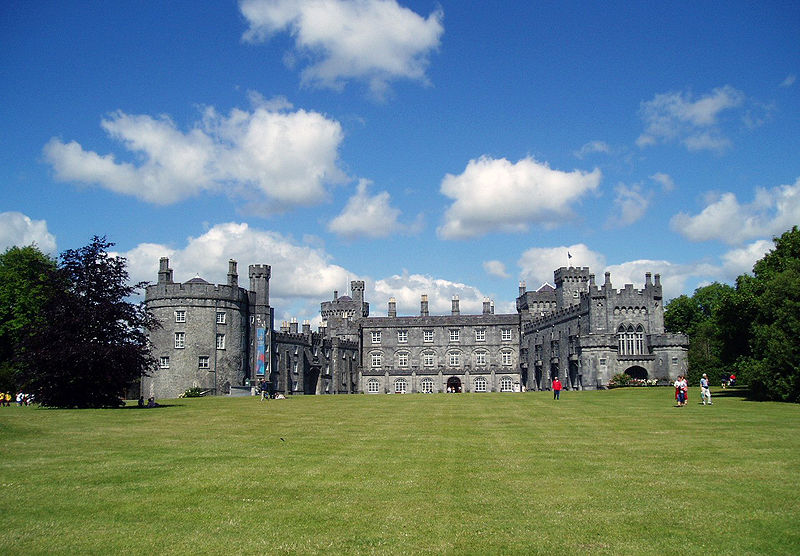
KILKENNY CASTLE, County Kilkenny, is an impressive large-scale castle, representing an artefact of great significance in the architectural heritage of the county, having long-standing historic associations with the noble and illustrious house of Butler, Dukes, Marquesses and Earls of Ormonde.

Having origins in a late 12th century earthwork castle, the site has been continuously occupied ever since, with the present Kilkenny Castle surviving from a comprehensive early to mid-19th century redevelopment programme, completed to plans devised by William Robertson (1770-1850), retaining an important element dating from the early 18th century.


An elegantly composed Classical frontispiece built for James Butler (1665-1745), 2nd Duke, possibly to designs prepared by William Robinson (d 1712) or Francis Place (1647-1728), exhibiting high quality stone masonry, is positioned almost on line with a similar breakfront in the associated stable complex, thereby enhancing the formal quality of the streetscape of The Parade.


Of particular renown is the great hall accommodated in a later range, built to the designs of Sir Thomas Newenham Deane (1827-99) and Benjamin Woodward (1816-61).


This is an exposed timber roof construction identifying the technical or engineering importance of the site, featuring a decorative scheme of artistic significance by John Hungerford Pollen (1820-1902).

A chimney-piece carved by Charles William Harrison (c.1835-1903) (also responsible for carved embellishments in the arcaded stair-hall) exhibits particularly fine craftsmanship.

The Library

Several monarchs have stayed at Kilkenny Castle during the course of its history, including RICHARD II, JAMES II, WILLIAM III, EDWARD VII, and GEORGE V.

The Long Gallery

In 1935 the Ormondes ceased to live in the castle, which stood empty and neglected for the next thirty years.

EDWARD VII leaving the Castle

In 1967, however, the 6th Marquess presented it to the local committee and it has been largely restored as a state possession.

Having been carefully restored over the course of the late 20th century by the Irish state, the castle remains a valuable anchor site contributing significantly to the character of the townscape.

First published in September, 2012.

Monday, 14 August 2023

Coolcarrigan House

THE WILSON-WRIGHTS WERE MAJOR LANDOWNERS IN COUNTY KILDARE, WITH 5,432 ACRES

The first member of the Wright family to settle in Ireland was

CAPTAIN JAMES WRIGHT (1615-1700), of Royston, Yorkshire, son of John Wright and Margaret, daughter of Richard Ratcliffe.

Captain Wright, an officer in Cromwell's army, landed at Dublin, 1649.

In 1661, he was granted lands at Golagh in County Monaghan.

Captain wright was, however, attainted by JAMES II's parliament, 1688.

His son,

JOSEPH WRIGHT (1652-1731), of Golagh, married, in 1708, Mary, daughter of Edward Own of Kilmore, County Monaghan, and was father of

JOSEPH WRIGHT, of Golagh, who married, in 1744, Eleanor Martyn, of Clogher and Dumbartagh, County Cavan.

The second son,

JOSEPH WRIGHT JP, of Carrachor Hall, Rector of Killencoole, Lurgan Green and Harristown, County Louth, married Mary Montgomery and had four sons.

His second son,

RICHARD WRIGHT, of Fortfield, Belfast, and Craigavad House, County Down, married Catherine, daughter of George Dowdall.

He died in 1788, leaving issue five sons and two daughters.

The third son,

EDWARD THOMAS WRIGHT (1810-81), of Donnybrook, County Dublin, Barrister, married, in 1832, his cousin Charlotte, daughter of Joseph Wright, of Beech Hill, Donnybrook, County Dublin.

The eldest son,

EDWARD PERCIVAL WRIGHT (1834-1910), Professor of Botany, Dublin University, married Emily, daughter of Colonel Ponsonby Shaw of the Indian Army.

His second son,

THE REV CHARLES HENRY HAMILTON WRIGHT (1836-1909), married, in 1859, Ebba Johanna, daughter of Nils Wilhelm Almroth (Director of the Royal Mint in Stockholm and a Knight of the Northern Star of Sweden).

His second son,

SIR ALMROTH EDWARD WRIGHT KBE CB (1861-1947), married, in 1889, Jane Georgina, daughter of Robert Mackay Wilson, of Coolcarrigan, County Kildare.

His second son,

LEONARD ALMROTH WILSON-WRIGHT JP, of Coolcarrigan, High Sheriff of County Kildare, 1921, who married, in 1925, Florence, eldest daughter of James Ivory JP, of Brewlands, Glenisla, Forfarshire, and had issue, an only son,

JOCK WILSON-WRIGHT (1928-), who married, in 1953, Sheila Gwendolyn Yate, only daughter of Colonel Henry Patrick Blosse-Lynch, of Partry, Claremorris, County Mayo, and had issue,
Robert (b 1956);
Jane Sheila (b 1958);
Janet, (b 1951) who married Sir Richard La Touche Colthurst, 9th Baronet, of Ardrum, County Cork, and had issue two sons, Charles (b 1955) and James (b 1957).
***** 

THE WILSONS descend from John Wilson, of Rahee, County Antrim, said to have landed in Carrickfergus in the suite of WILLIAM III.

Robert Mackay Wilson's great-grandfather Hugh Wilson (d 1822) also lived at Rashee.

Robert Mackay Wilson's grandfather William Wilson, of Daramona House, County Westmeath, and Larkhill, County Dublin, was born in 1787 and married, in 1815, Rebecca Dupre (d 1846), daughter of John Mackay of Elagh, County Tyrone, and Prospect, County Londonderry.

Robert's elder brother John (1826-1906) succeeded to Daramona House and was sometime High Sheriff for counties Westmeath and Longford.

Robert Mackay Wilson JP (b1829), High Sheriff of County Kildare, 1887, married, in 1858, Elizabeth, daughter of Murray Suffern, of Belfast.

Mr Wilson purchased Coolcarrigan.

Coolcarrigan passed to his only surviving child,

Jane Georgina Wilson (1860-1926) who married Sir Almroth Wright.


COOLCARRIGAN HOUSE, near Naas, County Kildare, is a mansion of three bays and two storeys in the Georgian style, built in the 1830s by Robert Mackay Wilson to the designs of an unknown architect.

The façade has hooded moldings over the upper windows, a simple parapet and a typical late-Georgian door with fanlight and sidelights, while the central bay is treated as a breakfront by the addition of a pair of pilasters.


Two later curved screen walls, ending in tall piers, project outwards to either side of the entrance front and disguise the fact that the house has been considerably enlarged at the rear.

These additions make Coolcarrigan a very comfortable family home.


There is a beautiful family chapel in the grounds:

Consecrated in 1885 by the Most Rev William Plunket, Lord Archbishop of Dublin and later 4th Baron Plunket, the chapel was built in the Hiberno-Romanesque Revival style, with a Round Tower and a High Cross.

It derives from the 12th century Temple Finghin at Clonmacnoise on the River Shannon.

This tiny complex, surrounded by trees and a dry moat, is the most complete example of the Celtic Revival style in Ireland and makes an attractive view from the house.

The church interior has frescoes in Gaelic script, specially chosen by Douglas Hyde, the first Irish President and a close family friend; while the very good stained glass windows, dedicated to various members of the family, are also in the Celtic Revival style.

The main avenue has a splendid display of spring bulbs while the superb twenty-acre garden has a wonderful collection of rare and unusual trees and shrubs inspired by Sir Harold Hillier, the great 20th century plants-man and collector.

An elaborate 1900s greenhouse in the walled garden has just been authentically restored.

Robert Wilson's daughter Georgina married Sir Almroth Wright, and inherited Coolcarrigan.

Her husband was an eminent physician and a colleague of Alexander Fleming, who worked on the development of vaccination and discovered the cure for typhoid.

Among his friends was the playwright George Bernard Shaw, whose play The Doctor’s Dilemma is based upon Sir Almroth.

Their descendants, the Wilson-Wright family, still live at Coolcarrigan, the sixth generation to live in the house.

First published in March, 2013.