Friday, 26 July 2024

Lighthouse Island: I

Lighthouse Island: East Jetty

IN SEPTEMBER, 2012, I SPENT A WEEKEND ON LIGHTHOUSE ISLAND, ONE OF THE COPELAND ISLANDS


THE COPELAND ISLANDS lie off the south side of the entrance of Belfast Lough, County Down.

They were the property of KER OF PORTAVO.

The Copelands take their name, however, from a family who settled in Ards, in the 12th century, during the time of John de Courcy.

Lighthouse Island lies less than a mile north-northeast of Big Island, and comprises about 40 acres of arable land, with a coastline of about a mile in circumference.

A lighthouse upon it had a square tower with walls seven feet in thickness, and seventy feet in height to the lantern.

Its light could distinctly be seen at Portpatrick and the Mull of Galloway in Scotland.


Timothy Belmont has been incommunicado for forty-eight hours, mainly due to the fact that I have spent that time at Lighthouse Island, one of the Copeland Islands, opposite Donaghadee, County Down.

I arrived at Donaghadee on Friday afternoon at about four-thirty, parked the car, and swiftly made a bee-line for Pier 36, a well-frequented establishment on the sea-front near the harbour.

At Pier 36, I seated myself up at the bar and ordered a G&T.

Rosie and Nick, two fellow National Trust volunteers, arrived soon afterwards.

We had another drink, then ordered a meal.

 I had the halibut with buttery mash and asparagus tips, which was simply delicious.

Craig and his party then arrived, and we proceeded to make for our ferry, MV Mermaid, which took about fifteen of us, including eight NT personnel, to Lighthouse Island.

This compact little island lies behind the main Copeland Island itself.

The journey took about forty-five minutes.

When we arrived at the small jetty, we disembarked and unloaded various provisions and tools for the weekend's task.

Wheelbarrows are used to take bulky items up the hill to the cottage, also known as Copeland Bird Observatory.

Having set up camp and having been told the basic house rules and regulations, I chose my bunk in the male dormitory, which sleeps nine.

Later that evening, we were all invited to join Davy, the duty officer, catching and ringing juvenile Manx Shearwaters, quite remarkable sea-birds which live in burrows and are not great on the feet.

Indeed, they are relatively easy to catch at night.

We also caught and ringed a fair number of swallows.

We were all given the opportunity to release them outside the ringing office.

When darkness fell, these wonderful little birds sat on the palm of my hand for a few minutes, before flying away.

Next episode ... ablutions and eating arrangements

Wednesday, 24 July 2024

Lighthouse Island

Click on Image to Enlarge

LIGHTHOUSE ISLAND, the second of the three Copeland Islands, is located three miles off the mouth of Belfast Lough, and is an Area of Special Scientific Interest.

The island covers an area of 24 acres.

The common name of the islands came from the family of Copeland who settled here in the 12th century in the time of John de Courcy, but the island had earlier connections with the monks of Bangor Abbey till 1612, when it became the property of Sir James Hamilton.

When it was occupied by Bangor Abbey, it was known for a time as John's Island, after a miscreant monk who refused to leave when the monastery closed its island retreat some four centuries or more ago.

He spent the remainder of his existance there as a hermit.

In 1770, DAVID KER, OF PORTAVO, purchased the Copeland Islands.

Little is known of what happened on the island between 1884 and 1941.

It has been said that a woman lived there on her own, or in the early 20th century, surviving on rabbits which she shot.

Lighthouse Island, with Mew Island in Background. Photo Credit: PSNI Air Support

It is most likely that rabbits were only introduced after 1884, because the lighthouse keepers were doubtless diligent gardeners.

The walled garden, built between 1812-16 by two stone-masons, who carved their names on the wall of the cave on the east cliff.

It has also been claimed that, during the 19th century, the walled garden contained a very fine, canker-free orchard of apple and pear trees. 

The original lighthouse and dwelling were built from stones quarried on the island by convicts.

When the tower was built, an iron chafer was erected on top of the three-storied building and the beacon fire came into operation around 1711.


The lighthouse was 44 feet high, standing on an elevation of almost 70 feet. A new light came into operation in 1796.

In 1815 a new 52-foot lighthouse was built, close to the original one.

The work was commenced in 1813 and the new light, equipped with 27 oil burning lamps set in silvered reflectors, 131 feet above high water and visible for sixteen miles, was first exhibited on the 24th January, 1815.

At sunrise on the morning of the 1st November, 1884, the ancient wick lamps of the fixed light on Lighthouse Island were extinguished for the last time; and the same evening Mew Island light and fog signal were brought into operation.


LIGHTHOUSE ISLAND was inhabited in 1742 when a family lived there.

In 1811 there were two families, comprising about fifteen islanders, some employed in looking after the light.

There was a single family on the island in 1875.

They looked after the light and there was a small boat harbour which was probably in the area of the present landing place.

The lighthouse station had two keepers with their wives and families in residence. New houses were built to accommodate them.

For island lighthouses of the time, life on Lighthouse Island was most tolerable: the island was large enough to support goats, sheep and pigs, as well as a donkey.

The two families were virtually self-sufficient in milk, mutton, pork and bacon.

Their walled garden provided ample vegetables; and their poultry gave them chicken for Sunday lunch, and eggs to complement their bacon for breakfast.

A weekly boat from Donaghadee brought provisions and mail.

For many years the island was leased to Robert McConkey for shooting rabbits and sea-birds.

Before the sporting season started, stores were ferried out to the island in readiness for the sportsmen who came out weekly.

In the season there was the harvesting of the eggs by the commercial egg collectors for market on the mainland, and within memory these have been on sale in the relevant season of the year. 


The first recorded ornithological visit was made in 1939 by Douglas Deane.

He dug out a breeding burrow, complete with egg (now in the Ulster Museum), in order to prove that Manx Shearwaters bred on the island.

Another leading ornithologist, Arnold Bennington, brought out parties of enthusiasts after the 2nd World War, between 1947-53, to evaluate the island as a suitable site for an observatory.

His last group, in 1953, was a class of Workers Educational Association adult students. They decided to establish an observatory.

Thus began Copeland Bird Observatory, with a singular lack of formality.

The proprietor of Lighthouse Island, Captain Ker of Portavo, had agreed to let the island for a peppercorn rent of one shilling.

In 1967, he leased the island to the National Trust for 999 years, on the understanding that the observatory could continue as tenants as long as the organization existed.

The observatory's structure was set up swiftly: Three Heligoland traps were erected; accommodation was secured within the derelict lighthouse buildings; and the British Trust for Ornithology sanctioned accreditation in 1956.

The lighthouse keepers' former premises and storehouse now accommodate the Copeland Bird Observatory (CBO) volunteers; and there is a laboratory where migratory birds are captured for examination, ringing, weighing, recorded and then released all within a few minutes from capture to minimise distress.

This island is an important breeding site for Manx Shearwater and Eider.

The rabbits on the island are important to the breeding of the Manx Shearwater, as their grazing keeps a short sward that is desirable for the fledglings and their burrows provide nesting sites.

The island vegetation includes large areas of rank bracken, sea Campions, elder scrub and many more.

Lighthouse Island is now owned by the National Trust, though administered by volunteer wardens of the Copeland Bird Observatory, one of sixteen observatories throughout the British Isles, monitoring bird migration and sea-bird populations.

There is self-catering accommodation at very reasonable rates, in the form of male and female dormitories, with a few family rooms.

Bear in mind, though, that the observatory is not a guest-house, nor a bed & breakfast establishment!

Its prime role is as a bird observatory.

First published in September, 2012.

Monday, 22 July 2024

Rathlin Trip

Timothy Ferres, 2024

"THE island is rather more than six miles in length and one in breadth. It contains an area of 4,000 acres, of which 1,000 are sheltered and capable of cultivation, the rest being heather and rock."

"The approach is at all times dangerous; the tide sets fiercely through the straits which divide the island from the mainland, and when the wind is from the west the Atlantic swell renders it impossible to land."

"The people are simple, laborious, honest, and possess a degree of affection for the island that may surprise strangers."

Thus wrote the Rev Canon Hugh Forde in 1928 about Rathlin Island in his book, Round the Coast of Northern Ireland.

I stayed on Rathlin for three days in July, 2024.

I've stayed on Rathlin many times before, always at the Manor House.

After a hearty breakfast on the first morning I prepared for an invigorating walk to the West Lighthouse in the townland of Kebble, a distance of about 4½ miles.

The walk takes one past quite a number of interesting features and places.

A few miles along the main tarmacked road I came to a lane veering off to the right, with a large open gate and cattle bars.

Track to Knockans and ruinous dwellings (Timothy Ferres, 2024)

It looks private; there are, however, no warning notices about trespassing or private property.

This track still has compacted limestone gravel, and is presumably original.

Famine Wall at gatepost (Timothy Ferres, 2024)

After perhaps five or more minutes a long wall is encountered, bisected by a gate; which, I think, is what's known as the Famine Wall.

This area of the island - Kilpatrick and Knockans townlands - was reputedly one of the more populous parts.

Remains of farm dwelling at Knockans (Timothy Ferres, 2024)

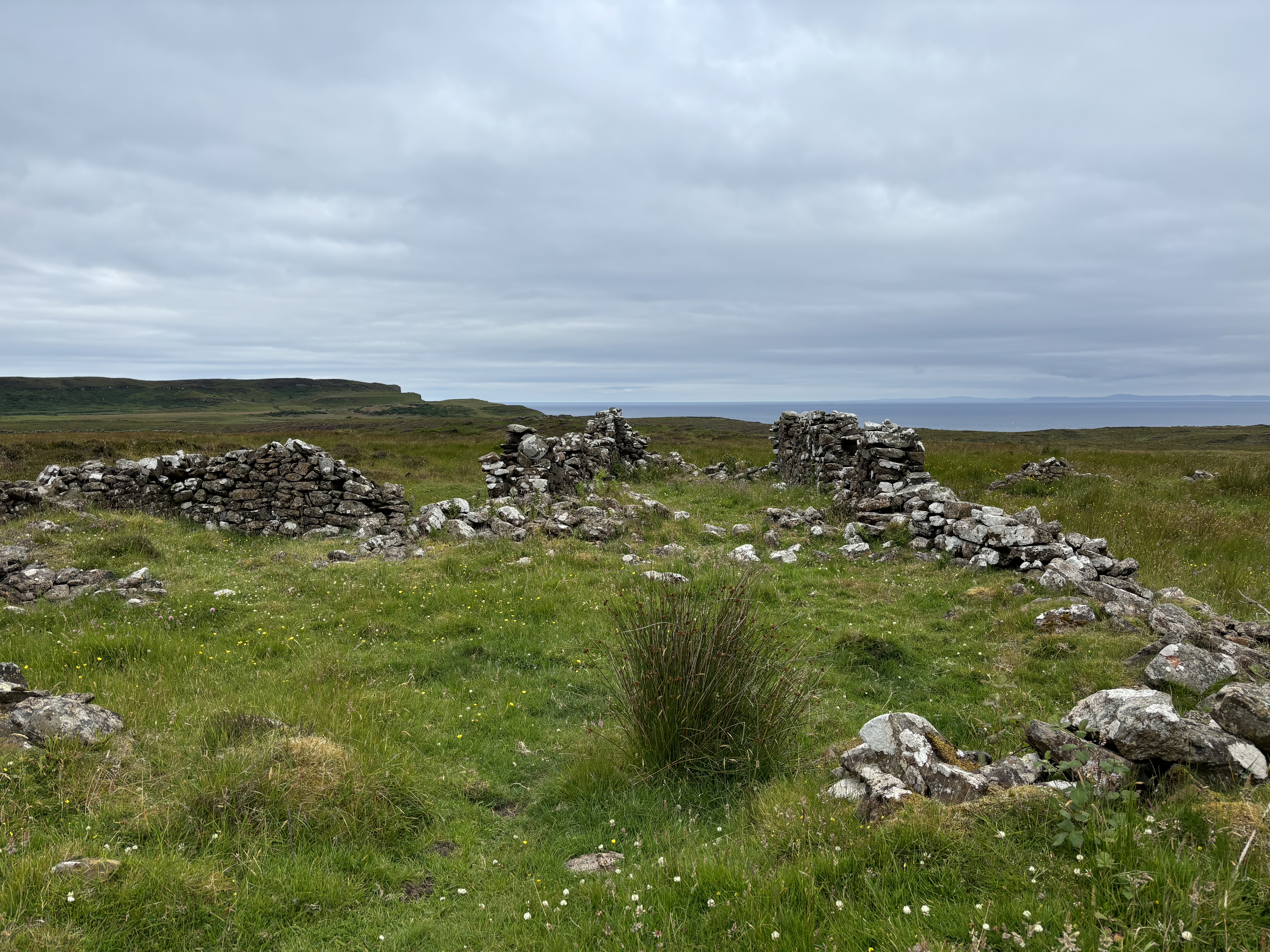
I saw a number of ruinous and dilapidated cottages, even clachans.

Retracing my way back to the main road, I went westwards and almost immediately saw another ruinous house which was, according to Nick Sebastian, a shop belonging to Hugh and Jessie Spears.

Remains of Spears' house from the main road (Timothy Ferres, 2024)

This shop must have been popular with the islanders up the hill.

Closer to the West Lighthouse, Kebble House - really a cottage - appears to be the most westerly dwelling on Rathlin today.

It has no permanent residents and seems to be owned by a government department today.

Keeper's room in lighthouse (Timothy Ferres, 2024)

The West Lighthouse, including the RSPB bird centre and a little museum, is a highlight of any trip to Rathlin.

It cost no less than £400,000 to construct in 1912 (about £38.4 million in 2024). 


Timothy Ferres, 2024

ON my second day I walked closer to the manor house; to Craigmacagan, now an RSPB walking trail.

It begins on the main road, inland a bit and not far from Mill Bay.

This is probably my favourite walk on the island: over beautiful wild grassy tracks, gently undulating and abounding with wild flora and fauna.


I took a little video clip of Craigmacagan above.

I went for a very brief dip in the sea, despite not having the bulky wetsuit with me.

I'm not - yet - a committed open water swimmer; though who knows? The water was not too cold and the old gnashers were not chattering anyway!

Three dinners and three breakfasts in the manor house; a visit to the celebrated McCuaig's bar at Church Bay (a mere hop, skip, and jump from the manor house; a few hours seated on a side bench with others who were watching England play Spain at football.

I am quite indifferent to team sports, so when I was asked about my choice of team, I pleaded neutrality.

I had reserved a sailing on the larger vehicle ferry at noon, though decided to take the 10am fast ferry back to Ballycastle, County Antrim; merely twenty minutes away.

Thursday, 11 July 2024

WILLIAM III at Belfast


WILLIAM III (copy after an original of 1677). (National Portrait Gallery)

KING WILLIAM III's PROGRESS TO THE BOYNE


 FIRST STAGE: CARRICKFERGUS TO BELFAST

About 3 o'clock on the 14th June, 1690, King William landed at Carrickfergus, accompanied by Prince George of Denmark, his brother-in-law, and attended by the Duke of Ormonde, the earls of Oxford, Portland, Scarbrough, and Manchester, besides other distinguished individuals.

His Majesty, on landing, rode through this ancient town, and most probably visited the site of what King James I designated "our royal palace of Mountjoy" [Joymount].

Artist's impression of Joymount (Image: Mid & East Antrim Council)

Crowds of people are stated to have assembled, who welcomed the King with continual shouts and acclamations.

The White House (Image: Abbey Historical Society)

As the forces disembarked at the OLD WHITE HOUSE, the King, without much delay, proceeded to place himself at their head.

The remains of a house are still shown there, where he is said to have rested; having been joined, at that place, by the DUKE OF SCHOMBERG, the Prince of Württemberg, Major-General Kirk, and others.

The former brought with him his coach, drawn by six horses, for the use of the King, having driven over the strand to Belfast, attended by a single troop of horse and a few gentlemen.

The uncertainty of the time and place of His Majesty's landing, and the suddenness of the news was such, that few of the multitude that flocked to Belfast to see it had their ends, the General's motion was so quick; yet before they got into the town there were abundance that met them, and, coming to the North Gate, he was received by the magistrates of Belfast in their formalities.

His Majesty went directly to the castle, which had been some time before prepared for him, where he alighted, and went in to an apartment appointed for him.

ON SUNDAY, 25TH APRIL, 1708, A FIRE DESTROYED BELFAST CASTLE 
WHICH RESULTED IN THE DEATHS OF THREE DAUGHTERS OF LADY DONEGALL:
 LADY JANE, LADY FRANCES AND LADY HENRIETTA CHICHESTER. 
ALSO A FRIEND OF THE GIRLS, (THE DAUGHTER OF PARSON BERKLEY) 
AND A SERVANT GIRL, CATHERINE DOUGLAS.

It has been already mentioned that the King proceeded to the CASTLE OF BELFAST; other notices of this visit state that he remained for five days, and lodged at the house of Sir William Franklin, the site of which became the Donegall Arms Hotel (now the site of Donegall Arcade, 1-15 Castle Place).

It is more probable, however, that some of his suite occupied this house.

The Corporation minutes record that His Majesty stayed five nights in Belfast, and was "very well pleased with the inhabitants and the town and its citizens," and said, when within the Castle, that it was "like Whitehall."

On Sunday, the 15th June, the King attended at the old church in High Street, where St George's now stands, and heard a sermon preached by Dr Boyse.

On that day and the next, he was waited on by the nobility, gentry, and military, and received addresses from the Episcopal and Presbyterian clergy.

The King is understood to have remained in Belfast for five days, and then to have joined his army, which consisted of sixty-two squadrons of cavalry, and fifty-two battalions of infantry, in four divisions.

The van-guard was commanded by Lieutenant-General Douglas; the right wing by Major-General Kirk; the left wing by the earls of Oxford and De Solms; and the main body by His Majesty, in person, the Duke of Schomberg, and Monsieur de Seravemoer.

First published in July, 2012.  Extracts have been taken from the Ulster Journal of Archaeology, Volume One.

Monday, 8 July 2024

Caledon Fête

In June, 2015, I spent a day at the Caledon Estate, the ancestral seat in County Tyrone of the Earl of Caledon KCVO, Lord-Lieutenant of County Armagh.

My first stop, however, was in the village of Caledon itself, a place of considerable character and charm.

Successive Earls have stamped their mark on the village.


There is a water fountain dedicated to the 4th Earl - a Knight of St Patrick -  on the main street.

I stopped opposite a little café called Café Rose, where I had a beaker of tea.

Afterwards I took a stroll along the village. The Caledon Arms Hotel is, sadly, closed down.

Alexander House, Main Street

It's a pity that such a pretty village cannot sustain a good inn or guest-house.

The main entrance to Caledon Estate is just outside the village, through a very grand entrance gate and lodges. It is unmistakable, especially since there are gleaming, gilded earl's coronets attached to the railings.

The drive must easily be a mile in length.


Caledon Park is one of the finest private estates in Northern Ireland, undoubtedly.

The garden fête today was in aid of the local parish church.

Caledon crest outside the portico porch

I arrived early. However,  when I departed in the afternoon, there were hundreds of cars parked in fields within the 3,000 acre estate.

The atmosphere was most agreeable. Lord and Lady Caledon were outside the house in the grounds.

I chatted briefly with Lady Caledon about an item for sale, viz. a pair of black and gold mini skis, presumably for children, which were emblazoned with the Bentley Motors motif.

The Lord-Lieutenant's Flag at Caledon Castle

The Lord-Lieutenant's official flag flew from the Castle's flag-pole.

Prospect from the garden front

At about twelve forty-five I was taken on a guided walk of the arboretum, yew-tree garden, stables and the grounds within the immediate vicinity of the Castle.


There were lots of displays on the lawns outside the Castle, including stalls in marquees, military displays, and police dog-handler demonstrations.

Stableyard

Of course there was no shortage of nosh, either. I could not resist the hog-roast stall.


For a fiver, you received a generous helping of roasted hog, baby roast potatoes, apple sauce, and stuffing.

Former head gardener's cottage

The fête was officially opened by the Lady Mary Peters LG CH DBE, erstwhile Lord-Lieutenant of Belfast.


I left at about three-thirty.

First published in June, 2015.

Wednesday, 3 July 2024

Colebrooke Video

The Viscount Brookeborough, KG, talks about his home, Colebrooke Park in County Fermanagh, in the short video below.

Tuesday, 2 July 2024

Nugent of Portaferry

The very ancient Anglo-Norman house of SAVAGE was settled at Portaferry, County Down, since the time of the first conquest of Ireland by John de Courcy, Earl of Ulster, in 1117.

Under that famous warrior, the original ancestor in Ireland established himself in County Down; and by a written document, dated 1205, in the Tower of London, we find Robert, son of William Savage, named as one of de Courcy's hostages for his appearance before KING JOHN.

The present barony of Lecale was anciently termed the "Territory of the Savages,” wherein, at Ardglass, they and their dependants erected seven castles, the ruins of which are still extant. It appears, also, that a stately monastery of Dominicans was founded at Newtownards, in 1244, by the Savages, "gentlemen of English extraction." 

From the extreme scarcity of records in Ireland, it is impossible, at this remote period, to determine, without liability to error, which is the senior branch of the family, that of PORTAFERRY or ARDKEEN CASTLE.

In 1400, HENRY IV granted to Robert FitzJordan Savage the office of Sheriff of the Ards; and it appears, by an indenture dated 1538, that
Raymond [Savage] should have the chieftainship and superiority of his sept in the Territory of the Savages, otherwise called Lecale. 
However, in 1559, 
The Lord Deputy, Sir William FitzWilliam, made a division between Roland and Raymond Savage of several towns and territories in the Ards.
By pedigree annexed, Roland, in 1572, was in possession of Portaferry Castle, and styled himself "Lord of the Little Ards;" and Lord Deputy Chichester, some years afterwards, addressed him as such by letter.

The ARDKEEN family had some territories in the barony of Lecale, and also in County Antrim, that family always being sore enemies of the O'Neills. 

ROWLAND SAVAGE, Lord of the Little Ards, County Down, representative of the family in the middle of the 16th century, died at Portaferry in 1572, leaving issue, 
PATRICK, his heir;
ROWLAND;
Edmund; Richard; James.
The eldest son,

PATRICK SAVAGE (1535-1603/4), Lord of the Little Ards, wedded Anne Plunket, and left two sons, of whom the elder,

ROWLAND SAVAGE, Lord of the Little Ards, succeeded his father and married Rose, daughter of Russel of Rathmullan, County Down.

He was, however, succeeded by his brother, 

PATRICK SAVAGE,  of Portaferry, who married, in 1623, Jean, only daughter of Hugh, 1st Viscount Montgomery, and had issue,
HUGH, his heir;
ELIZABETH, co-heir to her brother;
SARAH, co-heir to her brother.
Patrick Savage died in 1644 and was succeeded by his son, 

HUGH SAVAGE, of Portaferry, who died unmarried in 1683, and was succeeded in the representation of the family by his cousin, 

PATRICK SAVAGE, of Derry, Parish of Ballyphilip, and afterwards of Portaferry, who, by his wife Anne Hall, of Narrow Water, left issue,

EDWARD SAVAGE, of Portaferry, who died unmarried in 1725, was buried at Portaferry.

His uncle and successor, 

JAMES SAVAGE, of Portaferry, wedded Mabel, daughter of Edmund Magee, of Lisburn, and had issue,
JOHN, his heir;
ANDREW, of whom hereafter;
James; Margaret; Elizabeth.
The eldest son,

JOHN SAVAGE, wedded Catherine, daughter of ___ Savage, and had issue, a son James, who died young.

At his decease he was succeeded by his brother,

ANDREW SAVAGE, of Portaferry, who espoused Margaret, sister and co-heir of Governor Nugent (of Tortola), and daughter of Andrew Nugent, of Dysart, County Westmeath, by his wife, the Lady Catherine Nugent, daughter and co-heir of Thomas, Earl of Westmeath, and had a son and heir,

PATRICK SAVAGE, of Portaferry, who married, in 1765, Anne, daughter of Roger Hall, of Narrow Water, and had issue (with daughters who died unmarried),
ANDREW, of whom presently;
Patrick Nugent, m Hariett, daughter of Rev Henry Sandford;
Roger Hall, Captain RN, died unmarried;
John Levallin, died unmarried;
William, in holy orders;
Barbara; Dorcas Sophia.
Mr Savage died in 1797, and was succeeded by his eldest son  (who assumed the surname of NUGENT and became co-heir of the barony of Delvin),

ANDREW NUGENT JP DL (1770-1846), of PORTAFERRY HOUSE, Lieutenant-Colonel, North Down Militia, High Sheriff of County Down, 1808, who wedded, in 1800, Selina, youngest daughter of Thomas, 1st Viscount de Vesci, and had issue,
PATRICK JOHN, of whom presently;
Thomas Vesey, m Frances, eldest daughter of Sir James Stronge Bt;
Andrew Savage, m Harriet, Viscountess Bangor;
Arthur, m Charlotte, only daughter of Major Brooke, of Colebrooke;
Charles Lavallin, major-general in the army;
Selina, m James, eldest son of Sir James Stronge Bt;
Anne.
Colonel Nugent succeeded his father in 1797 and assumed his present surname, on succeeding to a portion of the estate of his maternal great-uncle, Governor Nugent, 1812.

His eldest son,

PATRICK JOHN NUGENT (1804-57), of Portaferry House, Lieutenant-Colonel, North Down Militia, High Sheriff of County Down, 1843, married, in 1833, his cousin Catherine, daughter of John, 2nd Viscount de Vesci, and had issue,
ANDREW;
JOHN VESEY, lieutenant-colonel;
Arthur Vesey;
Frances Isabella.
The eldest son,

LIEUTENANT-GENERAL ANDREW NUGENT JP DL (1834-1905), of Portaferry House, High Sheriff of County Down, 1882, Colonel, Royal Scots Greys, died unmarried and was succeeded by his brother, 

LIEUTENANT-COLONEL JOHN VESEY NUGENT JP DL (1837-1914), of Portaferry House, who married, in 1886, Emily Georgiana, daughter of Herbert Langham, though the marriage was without issue.

I have written about the Nugent Baronets HERE.

First published in February, 2012.