Thursday, 4 September 2025

1st Duke of Dorset

DUKEDOM OF DORSET
1720-1843

The family of SACKVILLE derived its origin from Herbrand de Sauqueville, who came into England with WILLIAM THE CONQUEROR, and had its principal seat at Buckhurst, in Sussex.

SIR RICHARD SACKVILLE (c1507-66), Chancellor of the Court of Augmentations in the reign of HENRY VIII, was father of

SIR THOMAS SACKVILLE KG (1536-1608), a celebrated statesman in the reigns of ELIZABETH I and JAMES I.

He was one of the commissioners for the trial of MARY, Queen of Scots; Lord High Steward at the trial of the unfortunate Earl of Essex; Chancellor of Oxford University; and, in 1599, appointed LORD HIGH TREASURER of England.

Sir Thomas married, in 1555, Cicely, daughter of Sir John Baker, of Sissinghurst, Kent, and had issue,
ROBERT, his successor;
Henry;
William
Thomas;
Anne; Jane; Mary.
He was elevated to the peerage, in 1604, as Earl of Dorset.

1st Earl of Dorset KG (Image: The National Trust)

His lordship was succeeded by his eldest son,

ROBERT, 2nd Earl (1561-1609), who wedded, in 1580, Margaret, only surviving daughter of Thomas, 4th Duke of Norfolk, and had issue,
RICHARD, his successor;
EDWARD, 4th Earl;
Cecily; Anne.
His lordship was succeeded by his elder son,

RICHARD, 3rd Earl (1589-1624), who espoused, ca 1608, the Lady Anne Clifford, and had issue, five children of whom the two daughters survived; though the family honours devolved upon his brother,

EDWARD, 4th Earl, KG (1591-1652), who married, in 1612, Mary, daughter and heir of Sir George Curzon, of Croxall Hall, Derbyshire, and had issue,
RICHARD, his successor;
Edward;
Mary.
His lordship was succeeded by his elder son,

RICHARD, 5th Earl (1622-77), who wedded, in 1637, the Lady Frances Cranfield, only daughter of Lionel, 1st Earl of Middlesex, and had issue, six daughters and seven sons, of whom the eldest,

CHARLES, 6th Earl, KG (1643-1706), married thrice; and by his second wife, the Lady Mary Compton, only daughter of James, 3rd Earl of Northampton, he had issue,
LIONEL CRANFIELD, his successor;
Mary.
his lordship was succeeded by his son,

LIONEL CRANFIELD, 7th Earl, KG (1688-1765), who espoused, in 1709, Elizabeth, daughter and co-heir of Lieutenant-General Walter Colyear, and had issue,
CHARLES, his successor;
John, father of JOHN FREDERICK, 3rd Duke;
GEORGE, 5th Duke;
Anne; Elizabeth; Caroline.
His lordship was advanced to the dignity of a dukedom, in 1720, as DUKE OF DORSET.

1st Duke of Dorset KG. Photo Credit: The National Trust

He was Lord Lieutenant of Ireland, 1731-37 and 1751-55.

His Grace was succeeded by his eldest son,

CHARLES, 2nd Duke (1711-69), who married, in 1744, daughter and heir of Richard, 2nd Viscount Shannon, though the marriage was without issue, and the family honours reverted to His Grace's nephew,

JOHN FREDERICK, 3rd Duke, KG (1745-99), who wedded, in 1790, Arabella Diana, eldest daughter and co-heir of Sir Charles Cope Bt, and had issue,
GEORGE JOHN FREDERICK, his successor;
Mary; Elizabeth.
His Grace was succeeded by his son,

GEORGE JOHN FREDERICK, 4th Duke (1793-1815), who died unmarried, when the titles reverted to his cousin,

CHARLES, 5th Duke, KG (1767-1843), third son of the 1st Duke.

His Grace died unmarried, when the dukedom and the other titles expired.

Former seats ~ Knole Park, Sevenoaks, Kent; Buckhurst Park, Withyham, East Sussex; Croxall Hall, Staffordshire.

Former town residence ~ Dorset House, London.

First published in July, 2017. 

Wednesday, 3 September 2025

Glenstal Abbey

THE BARRINGTON BARONETS WERE MAJOR LANDOWNERS IN COUNTY LIMERICK, WITH 9,485 ACRES

This family claims descent from a common ancestor with the BARRINGTONS of Barrington Hall, Essex, raised to the rank of Baronet in 1611.

From a younger branch of that ancient and eminent family is said to have sprung 

SAMUEL BARRINGTON, who settled at Limerick in 1691, as appears by a monument in the cathedral of that city, who was succeeded by his son,

BENJAMIN BARRINGTON, High Sheriff of Limerick City, 1714, father of

BENJAMIN BARRINGTON, High Sheriff of Limerick City, 1729, who wedded Anne, daughter of John Waltho, of Anna, and was succeeded by his son,

MATTHEW BARRINGTON, of Limerick, who married Jane, daughter of John Canter, of Ballyvara, and left, at his decease, in 1765, an only son,

JOSEPH BARRINGTON (1764-1846), who was created a baronet in 1831, designated of Limerick, County Limerick.

He married, in 1787, Mary, daughter of Daniel Baggott, and had issue,
MATTHEW, his successor;
Daniel (1792-1842);
Croker, Lieutenant RN;
Joseph;
Samuel, barrister;
Honoria; Jane Martha.
Sir Joseph founded, with his sons, the hospital and infirmary in the city of Limerick, bearing his name, incorporated by Act of Parliament, in the eleventh year of the reign of GEORGE IV.

He was succeeded by his eldest son,

SIR MATTHEW BARRINGTON, 2nd Baronet (1788-1861), High Sheriff of County Limerick, 1846, crown solicitor for the province of Munster, who wedded, in 1814, Charlotte, daughter of William Hartigan, and had issue,
WILLIAM HARTIGAN, his successor;
CROKER, 4th Baronet;
Mary Anne; Charlotte; Jessey; Olivia; Josephine; Henrietta Victorine.
The eldest son,

SIR WILLIAM HARTIGAN BARRINGTON, 3rd Baronet (1815-72), espoused, in 1859, Elizabeth Olivia, daughter of Henry Darley, and had issue,
Maria Louisa Olivia;
Charlotte Jessy.
Sir William died without male issue, when the title devolved upon his brother,

SIR CROKER BARRINGTON, 4th Baronet (1817-90), DL, who married, in 1845, Anna Felicia, daughter of John Beatty West, and had issue,
CHARLES BURTON, his successor;
Croker;
William Matthew;
John Beatty, High Sheriff of County Limerick, 1912;
Anna Josephine; Mercy; Olivia Maria;
three other daughters.
Sir Croker was succeeded by his eldest son,

SIR CHARLES BURTON BARRINGTON, 5th Baronet (1848-1943), MBE JP DL, High Sheriff of County Limerick, 1878, Colonel, Limerick City Royal Field Reserve Artillery, who wedded, in 1895, Mary, daughter of Sir Henry Hickman Bacon Bt, and had issue,
CHARLES BACON, his successor;
ALEXANDER FITZWILLIAM CROKER, 7th Baronet;
Winifred Frances.
Sir Charles was succeeded by his elder son,

SIR CHARLES BACON BARRINGTON, 6th Baronet (1902-80).

It is thought that the present 8th Baronet, whose name does not appear on the Official Roll of the Baronetage, lives in Canada.


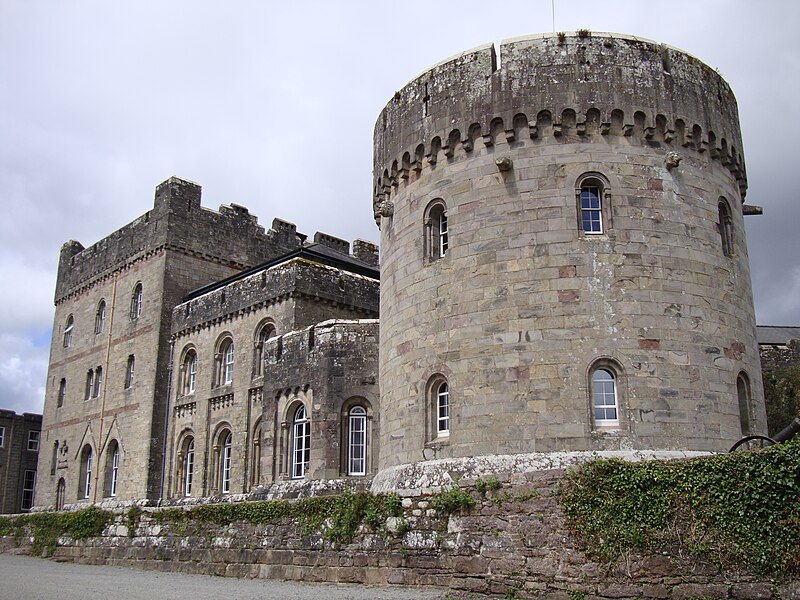
GLENSTAL ABBEY, formerly Glenstal Castle, Murroe, County Limerick, is a massive Norman-Revival castle by William Bardwell, of London.

It was begun in 1837, though not finished till about 1880.

The main building comprises a square, three-storey keep joined to a broad round tower by a lower range.

The entrance front is approached through a gatehouse replicated from that of Rockingham Castle, Northamptonshire.


The stonework is excellent and there is abundant carving, the entrance door being flanked by the figures of EDWARD I and Eleanor of Castille; while the look-out tower is manned by a stone soldier.

The staircase is of dark oak carved with animals, foliage and Celtic motifs, hemmed in by Romanesque columns.

The octagonal library at the base of the round tower is lit by little windows in deep recesses; the vaulted ceiling painted with blue and gold stars.


The main building faces south, and commands an unbroken view of some thirty miles towards the Galtee Mountains.

It is built on a height of some three hundred feet above sea-level, and can be seen from many miles away.

Sir Charles and Lady Barrington left Ireland permanently in 1925 and the castle and estate were purchased shortly thereafter by a priest, Monsignor James Ryan, for the nominal sum of £2,000.
EXTRACT FROM THE ORIGINS AND EARLY DAYS OF GLENSTAL BY MARK TIERNEY OSB

Glenstal Castle, in the parish of Murroe, Co Limerick, was built by the Barrington family in the 1830s. The architect, William Bardwell, designed it in the Norman-Revival style, with a gate-tower, keep, and impressive front façade. The Barringtons had acquired the Carbery estate in 1831, which stretched from the Mulcair River at Barrington's Bridge, to the Clare River on the Limerick-Tipperary Border.
In 1870, the estate consisted of 9,485 acres. This holding was considerably reduced, following a series of Land Acts, passed between 1881 and 1909. Thus, by the year 1925, when Sir Charles and Lady Barrington decided to leave Glenstal, they owned less than 1,000 acres, in and around the castle demesne. They were finding it more and more difficult to maintain the castle and estate, especially in the new Ireland, which emerged from the War of Independence and the Civil War (1922-23).
One of the main reasons why the Barringtons left Glenstal was the sad death of their only daughter, Winifred ('Winnie'), who was killed in an unfortunate incident in May, 1921. She was travelling in the company of a Black and Tan officer, Captain Biggs, when the car was ambushed by the local IRA unit near Newport, Co Tipperary. Winnie, who was in the front seat of the open car, was shot by mistake, and died that evening in Glenstal.
The family was devastated. Lady Barrington, who was a Scot and a Unionist at heart, urged her husband to leave Ireland as soon as possible, and take up residence in England. When eventually, in 1925, the time came to leave, Sir Charles made a mag­nificent gesture. He wrote to the Irish Free State government, offering Glenstal as a gift to the Irish nation, specifically suggesting that it might be a suitable residence for the Governor-General.
Mr W T. Cosgrave, the President of the Executive Council of the Irish Free State, and Mr Tim Healy, the Governor-General, visited Glenstal in July 1925, and 'were astonished at its magnificence, which far exceeded our expectations'. However, financial restraints forced them to turn down the offer. Mr Cosgrave wrote to Sir Charles, stating that 'our present economic position would not warrant the Ministry in applying to the Dail to vote the necessary funds for the upkeep of Glenstal'.
Soon after this, the Barringtons held an auction of the furniture and books in the castle, and let it be known that they were about to leave Ireland for good. The news soon spread to the village of Murroe, and caused much comment and dismay, as the Barringtons had been a major employer in the area for nearly a hundred years. It would be a local disaster, if the Glenstal demesne and castle were to be abandoned and become a ruin, like so many other big houses in Ireland.
There thus began a local campaign to save Glenstal. It should be said that the Barringtons never intended abandoning the place, and kept a skeleton staff in the castle, in the hope that someone might come along to buy it. Some months after the purchase, Msgr Ryan wrote to Celestine Golenvaux, the Abbot of the Benedictine monastery at Mared­sous, and invited him to come to Ireland and set up a daughter house in Glenstal and, by March 1927, the first two Belgian monks had arrived at Glenstal to establish the new house.
In 1932, the monks opened a Secondary School.

Glenstal is now a Benedictine abbey and a well-known boys' public school.

First published in June, 2012.

Dungiven Castle

THE OGILBYS WERE MAJOR LANDOWNERS IN COUNTY LONDONDERRY, WITH 9,735 ACRES


This branch settled in Ulster at the time of the Plantation. All the records of the family (originally Ogilvie) were destroyed by fire in Scotland in 1784. The original residence was at Calhame, Aberdeenshire.

DR JOHN OGILVIE, of Aberdeen, who settled in Limavady, County Londonderry, was a great friend of the celebrated Bishop Burnet.

He married Elizabeth Agnew, of the Scottish family of that name, who settled in County Antrim.

Dr Ogilvie was succeeded by his son,

ALEXANDER OGILBY, who changed the spelling of the family surname.

He married firstly, Ann Smith, and had issue,
ALEXANDER, his heir;
Mary Anne.
Mr Ogilby wedded secondly, Mary Campbell, and had issue,
George;Robert.
Mr Ogilby was succeeded by his eldest son,

ALEXANDER OGILBY, who wedded Mary, eldest daughter of James Alexander, of Limavady (whose family came originally from Clackmannanshire), by his wife Elizabeth Ross, and had issue,
JOHN, his heir;
Alexander;
James;
William;
Robert, of Pellipar;
David (Sir), East India Company;
Leslie, of Strangemore;
Ann; Elizabeth; Mary; Jane.
The fifth son, Robert, of Pellipar House, Dungiven, purchased the entire Manor of Limavady from the Conolly family, also large properties in County Tyrone, and estates at Woolwich in Kent. He was also lessee of the estates of the Skinners' Company in County Londonderry.

The sixth son, Sir David, born 1755, served in Volunteers, entered in East India Service, 1781, trained at Lockie's Royal Military Academy, Chelsea, served in India for 22 years, and retired as Major; knighted in 1804 by 3rd Earl of Hardwicke, Lord Lieutenant of Ireland, for his conspicuous services.

Mr Alexander Ogilby was succeeded by his eldest son,

JOHN OGILBY, of Ardnargle, near Limavady, born in 1746, who married Jane, daughter of James Simpson, of Armagh, and had issue,
Alexander, dsp;
John, dsp;
JAMES, his heir;
David, dsp;
Leonard;
ROBERT LESLIE, of whom presently;
William;
Ann; Jane; Mary.
Mr Ogilby was succeeded by his third son,

JAMES OGILBY, of Ardnargle, who espoused Bridget Rush, though dsp 1849, and was succeeded by his brother,

ROBERT LESLIE OGILBY JP DL (1798-1872), of Ardnargle, High Sheriff, 1854, who married, in 1844, Elizabeth Matilda, daughter of Major William Henry Rainey, of the East India Company, and had issue,
ROBERT ALEXANDER, his heir;
John W H;
David Leslie;
Margaret Harriet; Jane Ann; Elizabeth; Mary Isabella.
Mr Ogilby was succeeded by his eldest son,

ROBERT ALEXANDER OGILBY JP DL (1850-1902), of Ardnargle, and Pellipar House, Dungiven, High Sheriff, 1887, Captain, 4th King's Own Regiment,

Under the will of his great-uncle, Robert Ogilby, he succeeded on the death of his cousin, James Ogilby, to the Limavady, Pellipar, County Tyrone and Woolwich estates.

Captain Ogilby married, in 1875, Helen Sarah, second daughter of the Rev George Bomford Wheeler, Rector of Ballysax, County Kildare, and had issue,
ROBERT JAMES LESLIE, his heir;
Ethel Maude; Mabel Norah; Esther Gladys; Mildred Constance.
He was succeeded by his only son,

LIEUTENANT-COLONEL ROBERT JAMES LESLIE OGILBY DSO JP DL (1880-1964), of Ardnargle, Limavady, and Pellipar House, Dungiven, County Londonderry.

Colonel Ogilby was a kinsman of both the Earl Alexander of Tunis and the Viscount Montgomery of Alamein, through the line of the Alexanders of Limavady.

He was also brother-in-law of Brigadier-General George Delamain Crocker.
Colonel Ogilby entered the Army as a 2nd lieutenant, 4th (Royal Irish) Dragoon Guards 1903-1905; a lieutenant, 2nd Life Guards; High Sheriff, 1911; 29 Aug 1914 joined the Special reserve Officers as lieutenant; 29 Feb 1915, captain (Royal Irish) Dragoon Guards; 1916, Major and 2nd in Command of the 7th Norfolk Regiment; 1916, lieutenant-colonel commanding 2/114 London Regiment (London Scottish). He served with the British Expeditionary Force (dispatches London Gazette); served 1916-1919 in the war; Belgian Croix de Guerre, Star, 1914; DSO and bar, 1917.
The Woolwich estate was bought at public auction in 1812 by Robert Ogilby (younger brother of John Ogilby), who also leased, in 1803, the Skinners estate at Dungiven and lived at Pellipar House.

Ardnargle was not, therefore, a dower house for Pellipar, although it was used as such when R A Ogilby (1850-1902) inherited both properties from 1885 onwards.
The Ogilby family has had a proud military tradition: Major Robert Alexander Ogilby married Sarah Wheeler, daughter of Rev George Bomford Wheeler, a founder of the Irish Times, TCD classic scholar and contributor to Dickens' magazine, "All Year Round"; a DL for County Londonderry; captain 4th King's Own Regiment; and took part in the Zulu war (1879, medal).
In 1902, Maurice Marcus McCausland, of Drenagh, married Eileen Leslie, daughter of R A Ogilby DL, of Pellipar.


DUNGIVEN CASTLE, Dungiven, is a largely 19th century edifice.

It has a long, two-storey, battlemented front with a central polygonal tower; a pointed Gothic doorway and pointed window over.

Round towers are at each end.

There are five bays on either side of the centre.

Dungiven Castle (Robert French/ Lawrence Collection/ NLI)


THE CASTLE was for centuries the residence of the O'Cahans.

In 1601, after the submission of Sir Donnell O'Cahan, the Government placed a garrison there, and Sir Henry Dockwra subsequently gave to Sir John Sidney (4th son of Sir Henry Sidney) a lease of the castle and adjoining lands.

In 1604, on the restoration of the Earl of Tyrone, a dispute arose as to the ownership of these lands; but on the flight of the Earls, the Government restored the garrison and placed Captain Edward Doddington in the castle as Constable or Lieutenant.


Sir Arthur Chichester stated that the principal places to be held and garrisoned within the County of Coleraine were the castles of Annagh, Limavady, Coleraine, and Dungiven, albeit most of them were ruinous and out of repair.

At the Plantation of Ulster, this part of County Derry in which Dungiven Castle was situated was granted to the Skinners' Company, and their grant from the Honourable the Irish Society was dated 1617.

Captain Doddington was knighted and continued to hold the castle and lands from the Skinners' Company.

In the survey by Captain Nicholas Pynnar in 1618, Lady Doddington, wife of the late Sir Edward Doddington, was in possession of the castle, having taken a grant of it from the Company for 61 years:
"Here is built a strong Castle, being two stories high and a half, with a large Bawn of Lyme and Stone well fortified. In this the Lady is now dwelling, with 24 in her Family."
On the expiry of Lady Doddington's lease, in 1696, the Skinners' Company devised the "Manor of Pellipar and the Castle, town, and land of Dungiven" to Edward Carey.

His son, Henry Carey, in 1742, got a new lease at a rent of £500 on payment of a penalty.

The Careys lived in the old castle.

In 1794 Robert Ogilby paid Mr Carey for his interest in the remainder of the lease, which expired in 1803, and Mr Ogilby then acquired a new lease from the Skinners' Company on payment of a fine.

The portion of the castle which was standing in 1838 was only one storey, and there are now no traces of the old castle, though the old bawn still remains.

In 1839, Robert Ogilby expended a very large sum of money in rebuilding the castle, as it stands today.

It is at the extremity of the town of Dungiven, and is most beautifully situated, facing south, possessing an extensive foreground with views of the entire chain of the surrounding mountains.

The external appearance is that of a castellated mansion with bastions, flanking towers, etc., with a facade of about 200 feet.

Internally, it was quite unfinished, and it was a matter of regret that it was not finished more in unison with its prepossessing exterior.

Robert Ogilby was bound under his lease from the Skinners' Company to repair, and to uphold and maintain the castle, but he preferred to make his residence at Pellipar.

The bawn has three sides, the present castle forming the fourth and south side, having entrance gateways on the north, east, and west sides.

The pond of water just outside the bawn adds to its picturesqueness.

There are three turrets on the walls, and along the walls are numbers of loopholes and apertures.

On the expiry of Robert Ogilby's lease in 1873, the lands reverted to the Skinners' Company; but in 1890, when the company sold their estates, the castle and grounds were purchased by Robert Alexander Ogilby JP DL, and were inherited by his son, Robert James Leslie Ogilby.

In 1902, Dungiven Castle was inherited by Robert James Leslie Ogilby, who lived in London.

The estate was sold in 1925.

The Castle was occupied by the US Army during the 2nd World War, and later used as a dance hall during the 1950s and 1960s.

Eventually Limavady Borough Council bought Dungiven Castle and thereafter decided to demolish it.

There was public opposition and, with the help of various funding bodies, enough money was finally secured to put the neglected building into good repair.

In March, 2001, Dungiven Castle was re-opened to provide budget accommodation.

In 2009, Dungiven Castle underwent a complete redevelopment and redecoration of the entire property.

Since 2015 the Castle has been a school.

First published in September, 2013.

Tuesday, 2 September 2025

Price of Rhiwlas

 THE PRICES WERE THE LARGEST LANDOWNERS IN MERIONETHSHIRE, WITH 40,500 ACRES


The family of PRICE first became prominent through the favour shown by HENRY VII towards the great-grandfather of WYN AP CADWALADR, following his support at Bosworth. This Wyn’s grandfather was a chaplain to HENRY VIII, and profited substantially from the dissolution of the religious house at Ysbyty Ifan. Further lands, belonging formerly to the abbey of Strata Marcella in Montgomeryshire, were acquired by Wyn’s father.


WYN AP CADWALADR, of Rhiwlas, MP for Merioneth, 1559, High Sheriff of Merionethshire, 1577, married Jane, daughter and heir of Thomas ap Robert, and had issue, three sons and six daughters, including

CADWALADR PRICE, of Rhiwlas, MP for Merioneth, 1584, High Sheriff of Merionethshire, 1593, who espoused Catherine, daughter of Sir John Lloyd, of Bododris, Denbighshire, and had issue, two sons and two daughters.

His great-grandson,

WILLIAM PRICE (1619-91), of Rhiwlas, MP for Merioneth, 1640-44, colonel in the royal army, married Mary, daughter and co-heiress of David Holland, and was father of

JOHN PRICE (1644-85), who died without male issue, and was succeeded by his brother,

ROGER PRICE, High Sheriff of Merionethshire, 1710, who wedded Martha, daughter of Robert, Viscount Bulkeley, of Baron Hill, and was father of 

WILLIAM PRICE (1690-1774), High Sheriff of Merioneth, 1731, Carnarvonshire, 1732, who espoused firstly, Mary, daughter of Price Devereux, 9th Viscount Hereford, and had issue,
Willam, dsp;
RICHARD.
The younger son,

RICHARD PRICE (1720-75), MP for Beaumaris, 1754-68, married Mary, daughter and heir of Edward Thelwall, of Bathafarn Park, though the marriage was without issue.

Following his marriage, Mr Price assumed the additional surname of THELWALL.

Richard Price Thelwall had fathered an illegitimate son in London, who was known as

RICHARD TAVISTOCK WATKIN, alias RICHARD PRICE (1755-94), of Rhiwlas, High Sheriff of Merionethshire, 1778, who wedded Eliza, eldest daughter of Richard Kenrick, and had issue,

RICHARD WATKIN PRICE (1780-1860), High Sheriff of Merionethshire, 1845, who married Frances, daughter and heiress of John Lloyd, of Rhagad, near Corwen, and had issue,

RICHARD JOHN PRICE (1804-42), who wedded, in 1837, Charlotte, daughter of Edward Lloyd of Rhagad, and had issue,

RICHARD JOHN LLOYD PRICE JP DL (1843-1923), who inherited the Rhiwlas estate following the decease of his grandfather, Richard Watkin Price, in 1860.

He married, in 1869, Evelyn Gregge-Hopgood. and had issue,

ROBERT KENRICK PRICE (1870-1927).

Rhiwlas Hall (Image: Parks & Gardens)

RHIWLAS HALL, Bala, Merionethshire, was a large 19th century mansion which was demolished in the early 1950s.

The house, comprising three storeys, castellated with turrets, was rebuilt in the Gothic style in 1809 on the same site as previous dwellings.

First published in February, 2021.

The Smiley Baronets

THE SMILEY BARONETCY WAS CREATED IN 1903 FOR HUGH HOUSTON SMILEY, PRINCIPAL PROPRIETOR OF THE NORTHERN WHIG NEWSPAPER

WILLIAM SMAILLIE, of Cambusnethan, Lanarkshire, married  who died in 1597, had a brother,

THOMAS SMAILLIE, of Braidsheilburne, Cambusnethan, born ca 1554, and died 1627, having had two sons,
William;
THOMAS, of whom we treat.
The younger son,

THOMAS SMAILLIE, of Cambusnethan and afterwards of Glasgow, married Margaret Ranking, and had, with other issue, a youngest son,

ROBERT SMAILLIE or SMILLIE (1619-62), Burgess of Glasgow, who married Elizabeth Ramsey, and had two sons and two daughters, of whom the younger son,

ROBERT SMILLIE (1645-1712), of Skerry and Dunard, County Antrim, married and had issue,

SAMUEL SMILEY, who was father of

JOHN SMILEY (-1748), of Invermore, County Antrim, who married and had issue,

SAMUEL SMILEY (1720-97), of Inver, County Antrim, who wedded Christiana, daughter of Guy Robinson, of Fox Hall, Cairncastle, County Antrim, and had issue,

JOHN SMILEY (1744-1833), of Larne, County Antrim, who married Martha, daughter of Robert Love, and had issue,
Robert Love, of Islandmagee;
Samuel;
JOHN, of whom hereafter;
Mary; Christiana.
The youngest son,

JOHN SMILEY (1796-1878), of Larne, County Antrim, wedded, in 1824, Ann, daughter of John Reid, and had issue,
John MacCullough, died 1916; 
HUGH HOUSTON, of whom we treat;
Robert;
Sarah; Margaret Thompson; Martha Love; Annie.
The second son,

HUGH HOUSTON SMILEY JP DL (1851-1909), of Drumalis, Larne, County Antrim, and Gallowhill, Paisley, Renfrewshire, High Sheriff of County Antrim, 1899, principal proprietor of the Northern Whig newspaper, married, in 1874, Elizabeth Anne, daughter of Peter Kerr, and had issue,
JOHN, his heir;
Peter Kerr;
Hubert Stewart;
Eileen Margaret Kerr.
Mr Smiley was created a baronet in 1903, designated of Drumalis, County Antrim.

The Northern Whig Building, 2-10 Bridge Street, Belfast, ca 1950

He was succeeded by his eldest son,

SIR JOHN SMILEY, 2nd Baronet (1876-1930), Major, 6th Dragoon Guards, who wedded, in 1903, Valerie, daughter of Sir Claude Champion de Crespigny Bt, and had issue,
HUGH HOUSTON, his successor;
John Claude;
David de Crespigny;
Patricia Margaret.
Sir John was succeeded by his eldest son,

SIR HUGH HOUSTON SMILEY, 3rd Baronet (1905-90), JP, DL, of Ivalls, Bentworth, Alton, Hampshire, High Sheriff of Hampshire, 1959, who married, in 1933, Nancy Elizabeth Louise Hardy, daughter of Ernest Walter Hardy Beaton, and had issue,

SIR JOHN PHILIP SMILEY, 4th Baronet (1934-), of Cornerway House, Chobham, Surrey, Lieutenant-Colonel, Grenadier Guards, who married, in 1963, Davina Elizabeth, daughter of Denis Charles Griffiths, and has issue,
CHRISTOPHER HUGH CHARLES, b 1968;
William Timothy John, b 1972;
Melinda Elizabeth Eirène, b 1965.
Sir Hugh Houstom Smiley, 1st Baronet

THE SMILEYS were an old Ulster-Scots family.

Thomas Smaillie (1554-1627) lived at Lanarkshire.

His grandson, Robert Smaillie (1619-62) was Burgess of Glasgow.

Robert's son, also called Robert, moved to Ulster and lived at Dunard and Skerry in County Antrim, by which time the family surname was spelt Smiley.

Sir Hugh Houston Smiley, 1st Baronet, still had strong links with Scotland and he was a magistrate for both Renfrewshire and County Antrim.
Entrance Front

DRUMALIS HOUSE, Larne, County Antrim, is a rambling, two-storey, late Victorian or Edwardian mansion, dominated by a four-storey central tower and turret.

It has an eaved roof, camber-headed windows, a pillared porch, and a solid parapet on the tower and turret.


By the middle of the 1920s it became clear to the ageing Lady Smiley that she would have to sell Drumalis.

None of her children had decided to make their lives in Larne, and had instead settled in Scotland and England.


The religious order which was to occupy the house eventually did not do so immediately.

In the Larne of the time, the sale of one of the local ‘big houses’ to an order of nuns would have been unthinkable and so it was a more protracted process.


Garden Front

The house was first sold in 1927 to a local developer, Mr William Crawford, who had started Ireland’s first ever Electric Light Company.


There was talk that he would build houses on the land but the house was sold again in 1929 to a Mrs Magill, the wife of a local JP; who then resold it within a year to the nuns of the Cross and Passion order - its present owners. 


THE SMILEYS came to Ulster as labourers from Lanarkshire in the 17th century and settled at Larne and Inver in 1720. 

By 1824, John Smiley was a clockmaker and, by 1872, Hugh Smiley was in a position to acquire the site of Drumalis hill and commence building a house there. 

It was his marriage to Elizabeth Kerr of Gaillowhill, Paisley in 1874 however, which provided the much more substantial wealth that would enlarge the house to its present size and make it the beautiful home it would become.
As only child and heir to a fortune from the manufacture of sewing thread, Elizabeth’s connection to her parents and to Scotland was to remain strong and to be written into the fabric of the house itself, most notably in the work of the Glasgow designer George Walton, who was commissioned to work on its interior.
By the time of Sir Hugh Smiley’s death, in 1909, it was clear that both house and family occupied a central place in the life of Larne - both as employers and through the benevolence and philanthropy of the family, who had by then built and endowed a cottage hospital in the town and much more.

Sir Hugh's Estate was valued at £96,230 in 1909 which, today, would equate to £8.5 million.


The gardens at Drumalis were developed round the house of 1872.

The site shows as barren on the OS map of 1858, which is not surprising as it is an elevated and exposed spot on a headland with sea on the eastern side. 

Shelter belts of trees planted around the house have been successful in protecting the gardens, which retain many original features and are a good example of a late Victorian layout. 

The house is surrounded by lawns, embanked by balustrading on the western and southern sides.

The latter is terraced with good stonework and hedges. 

Terraces lead to southern sloping lawns, where there is a rose garden. 

The original iron pergolas and supports survive.

There is a recently restored rockery, which was probably once a fernery, and a pond. 

An extension for the present convent was built in the grounds ca 1960; land was sold in the 1930s; and recently more was lost by compulsory purchase, all of which reduced the area of the gardens. 

As it is a convent, it would be impossible to maintain the gardens in their original state but the grounds are well kept.

The attractive gate lodge on the Glenarm Road is listed. 

There is an extensive walled garden to the north of the house, which is rented out for use as a nursery garden.

Vestiges of an orchard exist to the east of the walled garden.

Other former seats ~ Great Oaks, Goring Heath, Oxfordshire; Ivalls, Bentworth, Alton, Hampshire.
Former London residence ~ 8 Hay Hill, Berkeley Square.


First published in August, 2010.  Smiley arms courtesy of the NLI.

Monday, 1 September 2025

Mount Stewart Pool

THE LATE CHARLES VILLIERS, A GRANDSON OF THE LATE LADY MAIRI BURY AND GREAT-GRANDSON OF THE 7TH MARQUESS AND MARCHIONESS OF LONDONDERRY, HAS KINDLY PROVIDED ME WITH A COLLECTION OF PHOTOGRAPHS TAKEN ABOUT 1970 AT MOUNT STEWART'S SWIMMING-POOL

The family's private swimming-pool was located at the edge of Mount Stewart estate, between the main Portaferry Road and Strangford Lough, County Down.

This was an idyllic spot, cut off from the estate by the Portaferry road.

Until it was demolished it was used by sunbathers during the day-time.

The swimming-pool was kidney-shaped. 

A wooden gazebo structure overlooked Strangford Lough.

It stood on a rotating mechanism which could be turned towards or away from the sunshine.

Parts of the retaining wall and foundations of the swimming-pool enclosure remain.

The salt-water, kidney-shaped pool was surrounded by exotic trees and tropical flowers.

 
The small figures in the pool are Charles and his sister Charlotte, being watched by their long-suffering Lancastrian nanny, Sheila.

Charles's parents were invariably present too and, on this occasion, Charles's godfather, Edward Biddulph (1934-2001) was present. 

First published in November, 2010.

Florence Court House

Coat-of-arms of 1st Baron Mountflorence
THE EARLS OF ENNISKILLEN WERE MAJOR LANDOWNERS IN COUNTY FERMANAGH, WITH 29,635 ACRES


The first of the family who settled in Ulster was SIR WILLIAM COLE (c1571-1653), Knight, a professional soldier born in London, but belonging to the Cole family of Slade, in Devon, who descended (or who, on the evidence of a magnificently emblazoned pedigree in the archive, could plausibly claim to descend) from an ancient Conquest family.

Sir William fixed his abode, early in the reign of JAMES I, in County Fermanagh, and becoming an undertaker in the plantation of Ulster, had an assignment, in 1611, of 1,000 acres of escheated lands in the said county; to which, in 1612, were added 312 acres in the same county, 80 whereof were assigned for the town of Enniskillen, and that town was then incorporated by charter, consisting of a provost and twelve burgesses, Sir William being the first provost. He raised a regiment, which he commanded against the rebels, in 1643, with important success.

Sir William married Susannah, daughter and heir of John Croft, of Lancashire, and widow of Stephen Segar, Lieutenant of Dublin Castle, by whom he left at his decease in 1653,
MICHAEL, his heir;
John, of Newland, father of 1st BARON RANELAGH;
Mary; Margaret.
The elder son,

MICHAEL COLE, wedded, in 1640, Catherine, daughter of Sir Laurence Parsons, of Birr, 2nd Baron of the Irish Exchequer, and dvp, administration being granted 1663 to his only surviving child,

SIR MICHAEL COLE, Knight (1644-1710), of Enniskillen Castle, MP for Enniskillen, 1692-3, 95-9, 1703-11, who espoused firstly, Alice (dsp 1671), daughter of Chidley Coote, of Killester; and secondly, 1672, his cousin, Elizabeth (d 1733), daughter of Sir J Cole Bt.

Sir Michael was succeeded by his only surviving child,

JOHN COLE (1680-1726), of Florence Court, MP for Enniskillen, 1703-26, who espoused, in 1707, Florence, only daughter of Sir Bourchier Wrey Bt, of Trebitch, in Cornwall, and had issue,
Henry (Rev);
JOHN, his heir;
Letitia; Florence.
Mr Cole was succeeded by his younger son,

JOHN COLE (1709-67), of Florence Court, MP for Enniskillen, 1730-60, who married, in 1728, Elizabeth, daughter of Hugh Willoughby Montgomery, of Carrow, County Fermanagh, and had issue,
WILLIAM WILLOUGHBY, his heir;
Arthur, m in 1780 Caroline Hamilton;
Flora Caroline; Catherine.
Mr Cole was elevated to the peerage, in 1760, in the dignity of Baron Mountflorence, of Florence Court, County Fermanagh.

His lordship was succeeded by his elder son,

WILLIAM WILLOUGHBY, 2nd Baron (1736-1803), MP for Enniskillen, 1761-7, who was created Viscount Enniskillen in 1776; and advanced to the dignity of an earldom, in 1789, as EARL OF ENNISKILLEN.

His lordship wedded, in 1763, Anne, daughter of Galbraith Lowry Corry, of Ahenis, County Tyrone, and sister of Armar Corry, Earl of Belmore, and had issue,
JOHN WILLOUGHBY, his successor;
Galbraith Lowry (Sir), GCB, a general in the army;
William Montgomery (Very Rev), Dean of Waterford;
Arthur Henry, MP for Enniskillen;
Henry, died young;
Sarah; Elizabeth Anne; Anne; Florence; Henrietta Frances.
His lordship was succeeded by his eldest son,

JOHN WILLOUGHBY, 2nd Earl (1768-1840), KP, who espoused, in 1805, the Lady Charlotte Paget, daughter of Henry, 1st Earl of Uxbridge, and had issue,
WILLIAM WILLOUGHBY, his successor;
Henry Arthur;
John Lowry;
Lowry Balfour;
Jane Anne Louisa Florence.
His lordship was succeeded by his eldest son,

WILLIAM WILLOUGHBY, 3rd Earl (1807-86), Honorary Colonel, 3rd Battalion, Royal Inniskilling Fusiliers, who married firstly, in 1844, Jane, daughter of James Casamaijor, and had issue,
John Willoughby Michael, styled Viscount Cole (1844-50);
LOWRY EGERTON, 4th Earl;
Arthur Edward Casamaijor;
Florence Mary; Alice Elizabeth; Charlotte June; Jane Evelyn.
He wedded secondly, in 1865, Mary Emma, daughter of Charles, 6th Viscount Midleton.

His lordship was succeeded by his eldest surviving son,

LOWRY EGERTON, 4th Earl (1845-1924), KP JP DL MP, who wedded, in 1869, Charlotte Marion, daughter of Douglas Baird, and had issue,
William Willoughby, died in infancy;
JOHN HENRY MICHAEL, his successor;
Galbraith Lowry Egerton, father of 6th Earl;
Reginald Berkeley;
Charlotte Jane Christian; Kathleen Mary; Marion; Florence Anne; Muriel Augusta Mary.
His lordship was succeeded by his eldest surviving son,

JOHN HENRY MICHAEL, 5th Earl (1876-1963), CMG, Aide-de-camp to the Lord Lieutenant of Ireland, 1918, Lieutenant-Colonel, North Irish Horse, who espoused firstly, in 1907, Irene Frances, daughter of Alfred Edward Miller Mundy, and had issue,
MICHAEL GALBRAITH LOWRY, his successor;
Ann Florence Vernay; Frances Jane; Kathleen Irene.
He wedded secondly, in 1932, Mary Cicely, daughter of Hugh Nevill.

His lordship's only son,

MICHAEL GALBRAITH LOWRY (1921-56), styled Viscount Cole, Lieutenant, Irish Guards, died unmarried, and the family honours devolved upon his first cousin,

DAVID LOWRY, 6th Earl (1918-89), MBE JP DL, Captain, Irish Guards, Captain, Ulster Defence Regiment, 1971-73, who married firstly, in 1940, Sonia Mary, daughter of Major Thomas Seyers, and had issue,
ANDREW JOHN GALBRAITH, his successor;
Linda Mar.
He wedded secondly, in 1955, Nancy Henderson, daughter of Dr John Alexander MacLennan.

His lordship was succeeded by his only son,

ANDREW JOHN GALBRAITH, 7th Earl (1942-), Captain, Irish Guards, 1965, Managing Director, Kenya Airways, 1979-81, who married, in 1964, Sarah Frances Caroline, daughter of Major-General John Keith Edwards, and has issue,
Amanda Mary; Emma Frances; Lucy Caroline.
Further reading about the Cole family is available in the Enniskillen Papers.


FLORENCE COURT HOUSE, County Fermanagh, having been a property of the National Trust since 1953, is a tall, early to mid-18th century block of three storeys over a basement.

It consists of seven bays, its front heavily enriched with rustication, balustrades, pedimented niches and other features.

The main block is joined by long arcades with rusticated pilasters to pedimented and pilastered single-storey pavilions.


The central block was probably built by John Cole MP, later 1st Lord Mountflorence, whose mother was the Florence after whom the mansion is named.

There was probably another property on the site, such as a shooting lodge, in the days when the family inhabited Enniskillen Castle.

The 5th Earl of Enniskillen gave Florence Court to the National Trust in 1953.

Two years later the centre of the mansion was severely damaged by fire; indeed, the 6th Earl was staying at the Ulster Club in Belfast when Lady Enniskillen broke the news to him.

He is said to have cried,  “What the hell do you think I can do about it?”

Fortunately, most of the House has been totally restored, though the attic and nursery rooms on the top floor were not, it is thought, reinstated to their former glory.

The Hall in the 19th Century

The demesne stands in a very fine natural setting and the mansion-house contributes to making it an outstanding site.

When the house was built, it was enhanced by formal planting, which was in vogue at the time.

There were prominent straight avenues, only one of which (the west) survives today.

Traces of massive ditches indicate where the others were.

A curving main avenue replaced the earlier ones, when the park was radically altered in the 1780s under the direction of William King.

This was undertaken in accordance with the then fashion for informal landscapes.

The view from the house became a wide vista to parkland studded with trees and sweeping away to distant woodland.

This exists today, with fine specimens of parkland trees dotted about as originally intended.

The National Trust have replanted clumps from the early 1980s to maintain continuity.

The ornamental gardens, known as the Pleasure Grounds, cover seven acres close to the house.

This planting dates from the 1840s in an area of grass, paths, flowering shrubs and exotic trees.

The summer-house, known as the Heather House, is currently being restored.

The partly walled garden has a stream at one boundary.

It has been adapted for low maintenance and to provide interest for visitors and not filled, as originally intended with fruit, flowers and vegetables for family use.

The parkland today includes several good woodland walks, one of which leads to the original Florence Court yew (Taxus baccata ‘Fastigiata’) in the Cottage Wood.

It is the survivor of two trees discovered in the 1760s, from which all upright yew trees descend.

There are many listed demesne buildings in good repair, including the fine Grand Gates, which adorn a pair of identical lodges of ca 1778.


THE 5TH EARL had been pre-deceased by his only son, Michael, Viscount Cole (1921-56), who died unmarried.

Shortly before this, in 1954, Lord Cole, the legal owner of the property, had, in conjunction with his father, given Florence Court and the fourteen acres immediately surrounding it to the National Trust.

In 1955, the above-mentioned very serious fire broke out, which would have had far worse consequences but for the presence of mind of the 5th Earl's wife.

However, it still devastated the drawing room, the staircase hall and the Venetian Room, which have since been very largely, though not entirely, restored by the National Trust.

Lord and Lady Enniskillen continued to live in the house but, as Nancy Lady Enniskillen put it, '... with [a] reduced number of rooms and of staff - also new discomforts and inconveniences. ...'

Lord Cole died in 1956, leaving the rest of his County Fermanagh estate to David Cole, 6th Earl.

From his succession to the title in 1963 until 1973, the 6th Earl and his second wife Nancy, Lady Enniskillen, lived at Florence Court. During this period, the 6th Earl considerably developed the estate.

Between 1963-69 he served as a member of Fermanagh County Council, being Chairman of its General Purposes and Finance Committee.

From 1971-73, despite a weak heart, he was on active duty as a captain in the 4th (Fermanagh) Battalion of the Ulster Defence Regiment, whose new headquarters in Enniskillen he opened in March 1973.

In 1973, following disagreements with the National Trust which, happily, were laid to rest in 1997, Lord and Lady Enniskillen left Florence Court and Northern Ireland.

They brought most of the contents of the house with them, although there was an auction in 1973, at which the 5th Duke of Westminster purchased a number of important Cole family portraits (his widow Viola, Duchess of Westminster, presented these to the National Trust in 1980.)

Though no longer living in Northern Ireland, Lord Enniskillen continued to serve as a DL for County Fermanagh, and never failed to attend the House of Lords when Northern Ireland issues were under discussion, particularly issues relating to the police.

In 1974, he transferred nearly all his Florence Court land to the NI Department of Agriculture to enable it to create a forest park.

The 6th Earl died in 1989. He was succeeded by Andrew, Viscount Cole, his only son (by his first marriage) who became the 7th Earl.

The 7th Earl, following family tradition, lives in Kenya, where he is married with three daughters.

The heir presumptive to the earldom is therefore the 6th Earl's first cousin, Berkeley Arthur Cole (b 1949).

The 6th Earl's widow, Nancy, Countess of Enniskillen lived, until her death in February 1998, in Scotland.

First published in January, 2010.  Mountflorence arms courtesy of the NLI.