Sunday, 27 February 2022
Belfast Steamship Company
Full steam ahead!
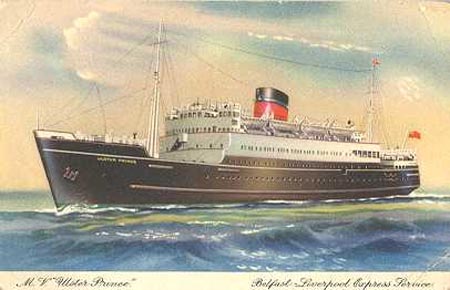
I couldn't resist posting the nostalgic advertisement (below) placed the in the 1974 street directory.
We frequently sailed to Liverpool on these ships.
They were very popular in Northern Ireland.
I seem to recall that it took ages for the ferries to negotiate the series of docks at Liverpool!
Do any readers have memories of their voyages in the MV Ulster Prince or MV Ulster Queen?
I believe there was an MV Ulster Monarch, too.
The Belfast Steamship Company was taken over by P&O in 1975.
First published in May, 2010.
Labels:
1974 Series
Saturday, 26 February 2022
Clandeboye House Guest
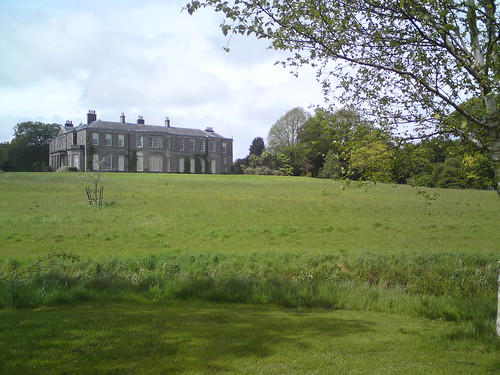
| Clandeboye House (Image: Katybird) |
Celia Lyttelton, in a Daily Telegraph article, spent some time with Lindy, Marchioness of Dufferin and Ava, at her country seat, Clandeboye, County Down. Lady Dufferin died in 2020.
CLANDEBOYE, County Down, home to the Marchioness of Dufferin and Ava, is filled with memorabilia collected by the 1st Marquess, a 19th-century diplomat, and provides a dramatic glimpse into his life.
As you pass between the cannons that flank its gates, Clandeboye seems to rise over the mist on the lake like a Chinese watercolour.
This romantic early-Georgian mansion and its 2,000-acre estate in County Down, Northern Ireland, is home to Lindy, the Marchioness of Dufferin and Ava, and is sustained by a series of enterprises.
'We are free of foundations and trusts,’ Lady Dufferin says proudly.
Helping to keep the estate self-sufficient is its golf course, the Ava art gallery, a banqueting hall used for weddings, a classical music festival and Clandeboye’s own brand of yogurt, courtesy of the estate’s award-winning herd of Holstein and Jersey cows.
The settlement dates from the 17th century, but the building we see today was built in the early 1800s by Robert Woodgate (formerly an engineer to Sir John Soane), who was commissioned by the politician Sir James Blackwood, 2nd Baron Dufferin and Clandeboye.
Incorporating elements of an earlier building, Woodgate created two wings at right angles to each other.
About 50 years later, it became home to Frederick Hamilton-Temple-Blackwood, the 5th Baron and 1st Marquess of Dufferin and Ava (Lindy was married to the last Marquess, Sheridan; the title is now extinct).
The great-grandson of the playwright Richard Sheridan, Frederick travelled widely as Governor-General of Canada and then Viceroy of India, and put his own stamp on Clandeboye.
Like many of his generation he was a passionate collector, and the interior at Clandeboye (sometimes known by its original name, Ballyleidy) is a reflection of the countries he served.
The breadth of this passion is evident the moment one enters Clandeboye through its Doric portico.
In the outer hall the walls are decorated with symmetrical displays of weaponry: daggers, pistols and cutlasses presented to the 1st Marquess.
In the pistachio-green Long Gallery there are more surprises.
The grand staircase is flanked by a pair of narwhal tusks and on either side lie two ornate daybeds.
These belonged to King Tibor of Burma.
Frederick bought them when the contents of the palace at Mandalay were auctioned off after he annexed Upper Burma.
Upstairs the names of the bedrooms recall the many places that he served as a diplomat: France, St Petersburg, Canada, Rome.
France is the most exquisite, decorated in neoclassical gilt motifs copied from a Pompeiian fresco.
The mythological Europa and the bull are pictured on the bed head.
The gilt empire furniture complements the theme.
The house was designed to take maximum advantage of the light: the south-facing corner of the L-shaped layout is made up of 16 bay windows.
Frederick also had a mania for glass roofing and skylights.
The Simla corridor on the upper floor – named after the hill station in India where the British went on holiday – illuminated by oculi, small hemispherical skylights.
'Clandeboye needs constant attention,’ Lady Dufferin, a successful artist who works using her maiden name, Lindy Guinness, says.
On the day I visited, the Rev Ian Paisley was scheduled to come and see a portrait she had painted of him.
'The studio is somewhere I feel safe,’ she says.
Several chiaroscuro black-and-white gouaches in the studio, destined for a show in Paris, are studies of light in the rooms at Clandeboye – a subject she returned to often.
Outside is a walled garden with its thousands of saplings.
It has been planted over the past 25 years by Conservation Volunteers Northern Ireland, which has brought Protestant and Catholic communities together to work in tandem.
Deeper in the woods is Helen’s Tower, a turreted folly with views over the rolling parkland, immortalised in Tennyson’s poem of the same name.
Commissioned by Frederick and completed in 1861, it was designed by the Scottish architect William Burn, its name in honour of Dufferin’s mother.
Lady Dufferin and her husband worked tirelessly to restore Clandeboye to its former glory and have created a lasting memorial to Frederick’s unique vision.
It has been a major project, and the work continues.
'This is a real, living estate with no dead hand of institutional discipline,’ she says. 'I look upon Clandeboye as a gift.’
France is the most exquisite, decorated in neoclassical gilt motifs copied from a Pompeiian fresco.
The mythological Europa and the bull are pictured on the bed head.
The gilt empire furniture complements the theme.
The house was designed to take maximum advantage of the light: the south-facing corner of the L-shaped layout is made up of 16 bay windows.
Frederick also had a mania for glass roofing and skylights.
The Simla corridor on the upper floor – named after the hill station in India where the British went on holiday – illuminated by oculi, small hemispherical skylights.
'Clandeboye needs constant attention,’ Lady Dufferin, a successful artist who works using her maiden name, Lindy Guinness, says.
On the day I visited, the Rev Ian Paisley was scheduled to come and see a portrait she had painted of him.
'The studio is somewhere I feel safe,’ she says.
Several chiaroscuro black-and-white gouaches in the studio, destined for a show in Paris, are studies of light in the rooms at Clandeboye – a subject she returned to often.
Outside is a walled garden with its thousands of saplings.
It has been planted over the past 25 years by Conservation Volunteers Northern Ireland, which has brought Protestant and Catholic communities together to work in tandem.
Deeper in the woods is Helen’s Tower, a turreted folly with views over the rolling parkland, immortalised in Tennyson’s poem of the same name.
Commissioned by Frederick and completed in 1861, it was designed by the Scottish architect William Burn, its name in honour of Dufferin’s mother.
Lady Dufferin and her husband worked tirelessly to restore Clandeboye to its former glory and have created a lasting memorial to Frederick’s unique vision.
It has been a major project, and the work continues.
'This is a real, living estate with no dead hand of institutional discipline,’ she says. 'I look upon Clandeboye as a gift.’
First published in November, 2011.
Labels:
Country Houses
Friday, 11 February 2022
Antrim DLs
APPOINTMENT OF DEPUTY LIEUTENANTS
Colonel Samuel James McCAMMOND UD VR
BallymenaCounty AntrimMr Peter Thomas Watts MACKIE
Lissanoure CastleCounty Antrim
To be Deputy Lieutenants of the County, his Commission bearing date, the 7th day of February, 2022.
Lord Lieutenant of the County
Labels:
Lord-lieutenancies
Saturday, 5 February 2022
Brackenber Dinner 2022
How marvellous to be able to attend the annual BRACKENBER HOUSE SCHOOL dinner again.
Our last winter dinner at the Ulster Reform Club occurred on the 7th February, 2020.
We were unable to have our winter dinner in 2021 due to the "Covid" pandemic.
We were then served char-grilled, eight-ounce sirloin steak with Bordelaise sauce, mashed potato, carrot, and bowls of French-fried potatoes.
Accordingly I donned the glad rags, spruced myself up, and motored into town, specifically to North Street at its junction with Rosemary Street, where I found a parking space.
On entering the threshold I was greeted by the doorman, who advised me to proceed to the top floor, where the old billiards-room is located.
Several dozen old boys had sent apologies.
Gordon has been endeavouring to get me to speak at the dinner, though so far I've been reluctant to do it.
I've never given a speech in my life!
Still, last night Jeff Dudgeon spoke to us all with great aplomb and fascinated us with reminiscences of his schooldays and career.
The Ulster Reform Club chef worked wonders, once again, by cooking the three-course meal comprising a starter of Red Tail Prawns, baked in a roast garlic and Cheddar cream, with crusty bread.
We were then served char-grilled, eight-ounce sirloin steak with Bordelaise sauce, mashed potato, carrot, and bowls of French-fried potatoes.
Pudding was apple crumble and vanilla custard.
My table was beside the lectern; to my left, Gordon Harvey, Paul, now the Lord Bew, and Jeff Dudgeon.
To my right: Dermot and the Pierce brothers (I was at school with Michael).
A thousand thanks, as ever, to Gordon Harvey and Don Bannister for organizing the event.
Labels:
Brackenber House
Subscribe to:
Comments
(
Atom
)