Sunday, 30 November 2025

Cork Palace

THE foundation of the bishopric of Cork is placed in the 7th century; that of Ross is unknown: they were united by ELIZABETH I in 1583.

The diocese of Cork has been ascribed to St Barr or Finbarr

Both sees are contained in County Cork, and are partly intermixed.

The diocese of Cork is 74 miles long from east to west, and about 16 broad.

The length of the principal part of Ross is 32 miles from east to west; and the breadth 8.


THE PALACE, CORK, is a compact three-storey block over a basement with a fanlighted doorway.


It was built ca 1782 by the Right Rev Isaac Mann, Lord Bishop of Cork and Ross, 1772-88, on the site of an earlier palace.


The palace remains the official residence of the Lord Bishop of Cork, Cloyne and Ross.

The present Bishop is the Right Rev Dr Paul Colton.

First published in October, 2015.

Saturday, 29 November 2025

Battle-Axe Guard

Theophilus Norton, Captain of the Battle-Axe Guard, ca 1823 
(Image: Journal of the Society for Historical Army Research, Volume XVII)

THE BATTLE-AXE GUARD, based at Dublin Castle, was established in 1662, and was analogous to the Yeomen Warders or Beefeaters in the Tower of London.

A 19th century description provides an insight of their ceremonial duties:
The Lord Lieutenant [of Ireland] holds a Court at the Castle; where levées are sometimes held; and His Excellency's State and Household is, in every respect, becoming a representative of Majesty.

He is allowed a company of battle-axe men, under the command of a captain, who has the rank of colonel; and two subalterns, who have the rank of captains.

The battle-axe-guards do duty in the public apartments of the Court. 
Besides this guard, the Lord Lieutenant has a bodyguard, consisting of a subaltern's guard of horse, with a captain of infantry, two subalterns, and sixty men.

This guard of honour is lodged in the Castle, and relieved every day by a detachment from the Royal Barracks.

The form of relieving guard at the Castle has always had attractions for the citizens of Dublin, who attend in great numbers every day, to witness this very interesting spectacle.

THE JACKET, or coatee, was scarlet, single-breasted, with a blue collar.

The collar was laced all round with wide gold lace showing only a narrow light of the blue in the centre.

The front edges of the coatee were also laced with this same wide gold lace, and there were loops of the same lace across the breast, the top loop extending to the shoulder, the others gradually narrowing to the waist.

A heavy gold bullion epaulette was worn on each shoulder, the straps embroidered in gold on blue cloth.

No pouch-belt was worn.

PEGGE'S "Curialia" (1791) remarks:-
"They are a body of yeomen like our own, with some peculiarities; although this institution is too modern to involve any history, being no older than the year 1704 [sic], the period now before us."

"According to the military establishment of Ireland of this date, it consists of one company of foot-guards to be armed with battle-axes, and to attend the State, comprising: a Captain, two Lieutenants, two Sergeants, fifty Yeomen."

The clothing of these yeomen is renewed every two years by virtue of the King's letter."

"The Captain bears a baton with a gold head, while the lieutenants have one with a silver head like the officers of the Yeomen of the Guard."

"The dress and appendages of both the officers and men, I am informed, are nearly the same as our yeomen; and all the places in the corps are disposed of in a similar manner, the appointment of the sergeants and private men being in the breast of the Captain."

*****

THE Battle-Axe Guard was disbanded on grounds of cost in 1831.

The official residences of His Excellency the Lord Lieutenant of Ireland were Dublin Castle, and Viceregal Lodge, Phoenix Park, County Dublin.

First published in July, 2013.

New Fermanagh DL

APPOINTMENT OF DEPUTY LIEUTENANT

The Viscount Brookeborough, KG, Lord-Lieutenant of County Fermanagh, has been pleased to appoint:
Mr Selwyn Johnston BEM
Silverhill
Enniskillen
County Fermanagh
To be a Deputy Lieutenant of the County his Commission bearing date the 22nd day of November 2025.

Lord Lieutenant of the County

Friday, 28 November 2025

County Antrim Rivers

EDITED EXTRACTS FROM THE TOPOGRAPHICAL DICTIONARY OF IRELAND, 1837


THE two largest rivers are the Lagan and the Bann, both of which rise in County Down: at Belfast the Lagan spreads into the wide estuary called the Bay of Belfast, or Belfast Lough, and above it, with the aid of several cuts, has been made navigable to Lisburn, forming part of the navigation [canal] between Belfast and Lough Neagh: the Bann flows through Lough Neagh and Lough Beg, and continues its course to Coleraine, below which it falls into the sea.

Most of the rivers strictly belonging to the county in the mountains on the coast, and owing to the rapidity and shortness of their currents, are unnavigable.

The Bush runs westward from the mountains of Lissanoure to Benvarden, and then northward to the sea at Portballintrae: the Maine [or Main] flows southward into Lough Neagh, and has three copious tributaries, the Ravel, the Braid, and the Glenwherry: the Six Mile Water also falls into Lough Neagh, at Antrim; and the Crumlin and Glenavy rivers at Sandy Bay.

The rapidity of these and the smaller rivers renders their banks peculiarly advantageous sites for bleach greens, cotton mills, and flour and corn mills, of which the last are especially numerous.

The only artificial line of navigation is the Lagan Canal: its construction was powerfully aided by the noble family of Chichester, and the expense amounted to £62,000 [about £10 million in 2023], raised by debentures.

First published in November, 2023.

Donegall House


DONEGALL HOUSE, built in 1785, was located at the corner of Donegall Place (Nos. 55-61) and Donegall Square North (Nos. 4-7), directly opposite the Donegall place elevation of the present Robinson & Cleaver building.
In 1611, the Jacobean Belfast Castle was built upon the site of the original castle, bounded by what's now Castle Place, Cornmarket and Castle Lane. 
It was surrounded with spacious gardens which extended from the river along to Cromac Woods and near Stranmillis. 
It is curious to read of hunting, hawking and other sports in the woods and meadows where now we have long streets of premises. 
The gardens, shady walks, orchards, bowling greens and cherry gardens are all gone, and nothing remains of the fish ponds; the stately town-house, once the centre of hospitality and culture, is now only a memory. 
WILLIAM III was received here in 1690. 
In 1708, Belfast Castle was accidentally burned to the ground. 
Three of Lady Donegall's daughters and two servants perished.
The Castle was never rebuilt, and the Donegalls lived for a time in Donegall House; until Ormeau House was built.
It wasn't until almost 100 years later that the Donegalls returned to live in Belfast.

From ca 1802-20, Donegall House was the residence of the 2nd Marquess and Marchioness of Donegall.

Lord Donegall rented the house from John Brown, a Belfast banker.


This large town house comprised three storeys, was stuccoed, and had a central pediment.

The gable end and a small side garden were enclosed at Donegall Square North.


In the image, taken from the White Linen Hall (predecessor of City Hall) , Donegall House is the first building on the left.

From ca 1820-98, the house became the Royal Hotel, under the auspices of Charles Kerns, Lord Donegall's former butler.

Prior to its demise, the hotel's proprietor was Miss Sarah Doyle.


Donegall House was demolished ca 1967.

Number 4-7, Donegall Square North, today called Donegall House, was erected in 1968 in the former garden of the Royal Hotel.

First published in November, 2013.

Thursday, 27 November 2025

Gussie's Predicament

FROM STIFF UPPER LIP, JEEVES, BY SIR P G WODEHOUSE KBE

BERTIE: "But what's happened?"

I faltered, if faltered's the word.

JEEVES: "I regret to inform you, sir, that Miss Bassett has insisted on Mr Fink-Nottle [Gussie] adopting a vegetarian diet. His mood is understandably disgruntled and rebellious."

I tottered.

In my darkest hour I had never anticipated anything as bad as this.

You wouldn't think it to look at him, because he's small and shrimplike and never puts on weight, but Gussie loves food.

Watching him tucking into his rations at the Drones [Club], a tapeworm would raise its hat respectfully, knowing that it was in the presence of a master.

Cut him off, therefore, from the roasts and boileds and particularly from cold steak and kidney pie, a dish of which he is inordinately fond, and you turned him into something fit for treasons, strategems and spoils, as the fellow said.

First published in June, 2013.

Tyrone Antiquities

EDITED EXTRACTS FROM THE TOPOGRAPHICAL DICTIONARY OF IRELAND, 1837


THE remains of antiquity are neither numerous nor particularly interesting.

Raths are scattered over almost every part: near the western border of the mountain called Mary Gray, more than 12 of them may be seen within the compass of a mile: they are generally in pairs; many are now scarcely discernible, in consequence of the farmers having drawn off the mould for manure.

The most perfect has a parapet six feet high, with stepping-stones projecting from the inner sides in an oblique direction to the top, like the winding of a staircase: its diameter is 33 yards.

Newtownstewart Cromlech (Green Collection/NMNI)

A very remarkable Druidical monument, called Cloghtogle, or the "lifted stone," stands on a hill a mile north of Newtownstewart: it consists of three large stones set upright in a triangular position, about seven feet high each, and covered with a broad horizontal flag, 11 feet long, 7 broad, and 15 inches thick.

On an opposite hill, at a distance of about 100 yards, was a similar relic of larger dimensions, now lying on the ground.

There is a large and very beautiful one, also called Cloghtogle, at Tamlaght, near Coagh; and there is another, but less perfect, in the demesne of Loughry, and a very noble one, a quarter of a mile above Castlederg.

At Kilmeillie [Beaghmore?], near Dungannon, are two circles of stones, in the form of the figure 8.

An urn was found in a little sandy hill near Cookstown.

Near Omagh, three small chests containing as many urns was found in 1712, under two heaps of stones.

In the parish of Errigal Keerogue is a flat stone set upright, having one side covered with carvings of a regular design, consisting of waving and circular lines: it had been the cover of a vault formed of flags set edgeways: in the vault were two earthen vessels containing ashes.

Near Dungannon were found several brazen trumpets of an uncommon construction, with a hole in the side, and the smaller end stopped, supposed to have been Danish.

The monastic institutions, od which traces yet remain, are those of Ardboe, Ardstraw, Dromore, Scarvagherin, Pubble, Grange, and Donaghmore.

Those of Clogher, Errigal Keerogue, Corickmore, Ballynasaggart, Dungannon, Omagh, Magheraglass, Strabane, and Trillick exist only in the records of history.

The remains of ancient castles are numerous, but few of them are of much importance: Benburb is the largest: near it are the ruins of one of the residences of Shane O'Neill; those of Newtownstewart, Dungannon, Strabane, and Ballygawley are noticed under their respective parishes.

First published in November, 2023.

Magenis of Finvoy

THE MAGENISES OWNED 6,816 ACRES OF LAND IN COUNTY ANTRIM,
AND 2,407 ACRES IN COUNTY DOWN


The family of MAGENIS were from very ancient times the territorial Lords of Iveagh, County Down, claiming descent from the renowned warrior, Connall Cearnagh. Sir Arthur Magennis, Lord of Iveagh, was elevated to the peerage, in 1623, in the dignity of VISCOUNT MAGENNIS OF IVEAGH.

A descendant of the ancient family of which his lordship was the chief,

RICHARD MAGENIS (c1711-57), of Dublin, married Alicia, daughter of William Caddell, of Downpatrick, County Down, and had issue,
RICHARD, his heir;
Henry, died 1759;
Mary; Jane; Alicia.
Mr Magenis was succeeded by his eldest son,

RICHARD MAGENIS (1737-1807), of Waringstown, County Down, High Sheriff of County Antrim, 1760, County Armagh, 1762, County Down, 1764; MP for Bangor, 1783-90, Fore, 1794-8, Carlingford, 1798-1800.

Mr Magenis wedded firstly, in 1760, Miss Wray (who died in the same year); and secondly, Elizabeth, daughter and heir of Colonel William Berkeley, brother of the celebrated prelate, Dr George Berkeley, Lord Bishop of Cloyne, by whom he had issue,
RICHARD, his heir;
William (Very Rev), Dean of Kilmore;
Ellen; Louisa; Emily; Alice; Harriette.
Mr Magenis was succeeded by his eldest son,

RICHARD MAGENIS (1763-1831), of Chanter Hill, Enniskillen, County Fermanagh, MP for Enniskillen, 1790-7, and 1812-28, who espoused firstly, in 1788, the Lady Elizabeth Anne Cole, daughter of William Willoughby, 1st Earl of Enniskillen, and had issue,
RICHARD WILLIAM, his heir;
William John Cole;
Henry Arthur, father of RICHARD HENRY MAGENIS AND HENRY COLE MAGENIS; grandfather of RICHARD HENRY COLE MAGENIS;
John Balfour;
Arthur Charles (Sir), GCB;
Anne Louise; Elizabeth Anne; Florence Sarah; Florence Catherine.
Mr Magenis married secondly, Elizabeth, widow of Colonel George Dashwood, and had further issue,
Frederick Richard (1816-66).
He was succeeded by his eldest son,

RICHARD WILLIAM MAGENIS JP DL (1789-1863), of Harrold Hall, Bedfordshire, Major, 7th Fusiliers, High Sheriff of County Antrim, 1830, who wedded, in 1821, Ann Maria, eldest daughter and co-heir of William Shepherd, of Bradbourne, Kent.

Major Magenis, however, dsp in 1863, and was succeeded by his nephew,

RICHARD HENRY MAGENIS JP (1831-80), of Finvoy Lodge, Ballymoney, County Antrim, High Sheriff of County Antrim, 1868, Lieutenant-Colonel Commandant, Antrim Militia Artillery, who espoused, in 1860, the Lady Louisa Anne Lowry-Corry, daughter of Armar, 3rd Earl of Belmore.

Colonel Magenis dsp 1880, and was succeeded by his brother,

MAJOR-GENERAL HENRY COLE MAGENIS JP DL (1838-1906), Royal Horse Artillery, High Sheriff of County Antrim, 1887, who died unmarried, and was succeeded by his nephew,

RICHARD HENRY COLE MAGENIS (1888-1914), of Finvoy Lodge, and Drumdoe, County Roscommon, Lieutenant, 3rd Battalion, Royal Irish Rifles, who was killed in action at the first battle of the Marne.


FINVOY LODGE, near Ballymoney, County Antrim, is a two-storey Georgian house comprising a high basement and three bays.

It is rendered, with quoins.

Finvoy Lodge (Image: Nevin Taggart and the Owners)

A prominent porch was added at a later stage.

A wing to the north is greater in length than the house itself.

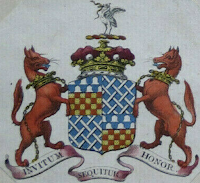
First published in November, 2021.  Magenis arms courtesy of the NLI.

Wednesday, 26 November 2025

Belloc on Wodehouse

Hilaire Belloc
"In the course of a broadcast I gave, as the best writer of English now alive, Mr P G Wodehouse."

"His object is comedy in the most modern sense of that word: that is, his object is to present the laughable, and he does this with such mastery and skill that he nearly always approaches, and often reaches, perfection."

"There is yet another perfection which I note in him. It is one which most moderns [sic], I think, would not regard as a perfection at all."

"Well! I differ from them. It is the repeated use of one set of characters."

"The English country house and its setting, the aged absent-minded earl, the young ladies and gentlemen with too much leisure or too little, too much money, or (contrariwise) embarrassment - the club of the young, idle, and very-much-to-be-liked young Englishmen of the wealthier sort and the immortal, vivid glimpses of suburban life - all these form one set of "property" scenes..."

"... If in, say, fifty years Jeeves and any other of that great company - but in particular Jeeves - shall have faded, then what we shall have so long called England will no longer be."
  
HILAIRE BELLOC (1870-1953)

First published in July, 2011.

Mount Juliet

THE EARLS OF CARRICK OWNED 1,368 ACRES OF LAND IN COUNTY KILKENNY

This family claims a common ancestor with the noble house of Ormond, namely, THEOBALD WALTER, who accompanied HENRY II into Ireland, and settled there, having acquired large possessions, and being appointed, in 1177, Chief Butler of Ireland, the duty of which office consisted in the butler for the time being attending the Kings of England at their coronation, and presenting them with the first cup of wine, for which services he was to receive certain pieces of the King's plate.

From this Theobald descended lineally,

EDMOND LE BOTILLER (1268-1321), who sat in parliament, 1302, as a Baron, by the name of Baron le Botiller, and was created, by EDWARD II, for his services against the Scots, 1315, EARL OF CARRICK, County Tipperary.

This nobleman wedded, in 1302, Joan, daughter of John, 1st Earl of Kildare, and had issue,
James, cr EARL OF ORMOND;
JOHN, of whom we treat;
Lawrence;
William;
Joan; Margaret; Alice.
From the second son of this nobleman,

JOHN BUTLER (1305-30), of Clonamicklon, County Tipperary, lineally descended

SIR PIERCE BUTLER, Knight, of Lismalin, a lieutenant-general serving under Lord Mountgarret, who was elevated to the peerage, in 1629, as Viscount Ikerrin.

His lordship married Ellen, second daughter of Walter, 11th Earl of Ormond, and was succeeded by (the son of his deceased eldest son, James, and his wife, Ellen, eldest daughter of Edmund, Lord Dunboyne) his grandson,

PIERCE, 2nd Viscount (1637-c1680), who conformed to the established church.

He wedded Ellenor, daughter of John Bryan, of Bawnmore, County Kilkenny, and was succeeded by his son,

JAMES, 3rd Viscount, who held the commission of Captain of Grenadiers in JAMES II's army.

He espoused Eleanor, eldest daughter and co-heir of Colonel Daniel Redman, of Ballylinch, and dying in 1688, was succeeded by his eldest son,

PIERCE, 4th Viscount (1679-c1710), who married firstly, Alicia, eldest daughter of Murrough, 1st Viscount Blesington, by whom he had a son, JAMES, his successor; and secondly, in 1703, Olivia, only daughter of Sir Oliver St George Bt, and widow of Sir Robert Colvil, Knight, but had no other issue.

His lordship was outlawed in 1690 for his adherence to the banner of JAMES II; his titles and lands were restored, however, in 1698.

He was succeeded by his only son,

JAMES, 5th Viscount (1698-1712); at whose decease, in minority and unmarried, the title reverted to his uncle,

THOMAS, 6th Viscount (1683-1719); in holy orders and chaplain-general to the army in Flanders under the command of James, Duke of Ormonde.

His lordship espoused Margaret, daughter and co-heir of James Hamilton, of Bangor, County Down, and was succeeded by his eldest son,

JAMES, 7th Viscount (1714-21); at whose decease, in his eighth year, the title devolved upon his brother,

SOMERSET HAMILTON, 8th Viscount (1719-74), who espoused, in 1745, Juliana, eldest daughter of Henry Boyle, of Castle Martyr, afterwards created Earl of Shannon, and had issue,
HENRY THOMAS, his successor;
James;
Pierce
Margaret, m 1st Earl of Belmore;
Henrietta, m 11th Viscount Mountgarret.
His lordship was sworn of the Privy Council, 1746, and advanced to the dignity of an earldom, in 1748, as EARL OF CARRICK (second creation).

He was succeeded by his elder son,

HENRY THOMAS, 2nd Earl (1746-1813), who wedded, in 1774, Sarah, second daughter and co-heir of Edward Taylor, of Askeaton, County Limerick, and had issue,
SOMERSET RICHARD, his successor;
HENRY EDWARD, father of HENRY THOMAS BOYLE;
Pierce;
James;
Anne; Juliana; Harriet; Sarah.
His lordship was succeeded by his eldest son,

SOMERSET RICHARD, 3rd Earl (1779-1838), who espoused firstly, in 1811, Anne, eldest daughter of Owen Wynne, of Hazelwood, County Sligo, and had two daughters, viz.
Sarah Juliana;
Anne Margaret.
He married secondly, in 1833, Lucy, third daughter of Arthur French, of French Park, and had two sons and a daughter, of whom the elder,

HENRY THOMAS, 4th Earl (1834-46), died a minor and was succeeded by his brother,

SOMERSET ARTHUR, 5th Earl,
  • Charles Henry Somerset Butler, 6th Earl (1851–1909);
  • Brian Stuart Theobald Somerset Caher Butler, 9th Earl (1931–92);
  • David James Theobald Somerset Butler, 10th Earl (1953–2008);
  • (Arion) Thomas Piers Hamilton Butler, 11th Earl (b 1975).

MOUNT JULIET, Thomastown, County Kilkenny, is an 18th century house of 1760-65, built for the 1st Earl of Carrick.

The mansion stands on the right bank of the River Nore, where the original family seat, Ballylinch Castle, stood.

It crowns a venerably wooded rising ground.

Mount Juliet comprises three storeys over a basement.

It has seven bays between two curved bows.

Its roof is notably high-pitched, with particulary large chimney-stacks.


Mount Juliet was opulently decorated by the 2nd Earl in the 1780s with plasterwork in the manner of Michael Stapleton.

The 6th Earl sold the estate in 1914 to the McCalmonts, who had leased the house for a number of years.

Major Dermot McCalmont created a new entrance from what had formerly been the rear of the house.

The demesne, extensive and magnificent, is said to be one of the finest in Ireland.

Mount Juliet has been famous for its stud, established by Major McCalmont in 1915, with The Tetrarch as first sire.

The estate was purchased in 1987 by the Killeen Group and transformed into a luxury hotel and leisure complex.

First published in September, 2015. 

County Armagh Antiquities

EDITED EXTRACTS FROM THE TOPOGRAPHICAL DICTIONARY OF IRELAND, 1837


AMONG the relics of antiquity are the remains of the fortress of Emania [Navan Fort], near Armagh, once the royal seat of the kings of Ulster.

The Danes' Cast is an extensive line of fortification in the south-eastern part of the county, and stretching into County Down.

The Danes' Cast, Scarva, County Down (Green Collection/NMNI)

The tumulus said to mark the burial place of "Nial of the Hundred Battles" [sic]* is still visible on the banks of the Callan.  (*Niall of the Nine Hostages?)

The Vicar's Cairn is situated near the city of Armagh.

Cairn Bann is in Orior barony, near Newry.

A tumulus in Killeavy parish contains an artificial cavern.

Two ancient brazen weapons were found in a bog near Carrickblacker, where a battle is said to have been fought in 941.

Spears, battle-axes, skeyns, swords, the golden torcs, and collars, rings, amulets, and gold medals, also various ornaments of silver, jet, amber, etc, have been found in different places, and are mostly preserved.

Near Hamiltonsbawn, in 1816, was found the entire skeleton of an elk, of which the head and horns were placed in the hall of the infirmary at Armagh; and in the same year also the body of a trooper was discovered in a bog near Charlemont, of which the dress and armour appeared to be of the reign of ELIZABETH I.

The religious houses, besides those of the city of Armagh, of which any memorial has been handed down to us were Clonfeacle, Killeavy, Kilmore, Straidbail-Loyce, Ballymoyer.

The most remarkable military remains are Tyrone's Ditches, near Poyntzpass, Navan Fort, the castles of Creevekeeran and Ardgonnell, Moyry Castle, and Castle Raw.

First published in November, 2023.

Tuesday, 25 November 2025

1st Earl of Ardglass

THOMAS CROMWELLBaron Cromwell, of Wimbledon, thus created, in 1536, by HENRY VIII. Being descended from the Bourchiers, he was also created EARL OF ESSEX (sixth creation), Knight of the Garter, and His Majesty's Vice-Regent.

After his lordship had served his royal master faithfully, and to the utmost, the King caused him to be beheaded, to satisfy Bishop Gardiner and the Duke of Norfolk.

But in the same year, 1540, the attainder being reversed,

SIR GREGORY CROMWEL KB (c1514-51), the son of Thomas, was created BARON CROMWELL, of Oakham, Rutland.

He married Elizabeth, daughter of Sir John Seymour, and sister of Edward, Duke of Somerset, and widow of Sir Anthony Oughtred, and had issue,
HENRY, his successor;
Edward;
Thomas;
Catherine; Frances.
His lordship was succeeded by his eldest son,

HENRY, 2nd Baron (1538-92), summoned to Parliament in the reign of ELIZABETH I, who wedded the Lady Mary Paulet, daughter of John, Marquess of Winchester, and had issue,
EDWARD, his successor;
Gregory (Sir);
Catherine.
His lordship was succeeded by his elder son,

EDWARD, 3rd Baron (1559-1607), who espoused firstly, ca 1580, Elizabeth, daughter of William Upton, of Puslinch, Devon, and had issue, an only daughter, ELIZABETH.

He wedded secondly, ca 1593, Frances, daughter of William Rugge, of Felmingham, Norfolk, and had further issue,
THOMAS, his successor;
Frances; Anne.
His lordship was with the Earl of Essex in his expedition at sea against the Spaniards, and joined in the insurrection three years afterwards, which cost Lord Essex his head.

The 3rd Baron received, however, an especial pardon in 1601. 
Lord Cromwell, having alienated his estates in England by sale, purchased the barony of Lecale in County Down from Charles Blount, 8th Baron Mountjoy, or "made an exchange thereof".
His lordship settled at Lecale, 1605, after creditors had seized his Leicestershire manors. 
He was granted lands which had been possessed by a local Irish chieftain, Phelim McCartan, on condition that he educated and provided for McCartan's son in his household.
The King also appointed him Governor of Lecale, with the power to exercise martial law.
He was succeeded by his only son,

THOMAS, 4th Baron (1594-1653), who married Elizabeth, daughter and heiress of Robert Meverell, of Throwleigh, Staffordshire, and had issue,
WINGFIELD, his heir;
VERE ESSEX, 4th Earl;
Oliver;
Mary.
His lordship was created by CHARLES I, in 1624, Viscount Lecale.

Armorial bearings of 1st Viscount Lecale

He was advanced to the dignity of an earldom, in 1645, as EARL OF ARDGLASS.
Lord Ardglass remained firmly attached to the interests of the King during the civil wars, notwithstanding his friendship with Robert Devereux, 3rd Earl of Essex

Ardglass was an important town during the middle ages, which would explain Cromwell's choice of title.
 

The 1st Earl was commander of the Regiment of Horse in Ireland for CHARLES I during the Civil War; and subsequently made his peace with Parliament, paying £460 for his "delinquency".
1st Earl of Ardglass

The 1st Earl married Elizabeth, daughter and heiress of Robert Meverell, of Throwleigh, Staffordshire, and had issue,
WINGFIELD, his heir;
VERE ESSEX, 4th Earl;
Oliver;
Mary.
His lordship was succeeded by his eldest son, 

WINGFIELD, 2nd Earl (1622-68), who wedded Mary, daughter of Sir William Russell, 1st Baronet, and had issue, an only child,

THOMAS, 3rd Earl (1653-82), who married Honoria, daughter of the Most Rev Dr Michael Boyle, Lord Archbishop of Dublin and Lord Chancellor of Ireland; but dying childless, 1682, the honours reverted to his uncle,

VERE ESSEX, 4th Earl (1623-87), PC, second son of the 1st Earl, who espoused, in 1672, Catherine, daughter of James Hamilton, of Newcastle, County Down.

His lordship died without male issue, when the titles expired except the barony of CROMWELL, originating in the writ of 1539, which devolved upon his daughter,

THE LADY ELIZABETH CROMWELL (1672-1709), as BARONESS CROMWELL suo jure, in which rank her ladyship assisted at the funeral of MARY II, and at the coronation of QUEEN ANNE.

Her ladyship wedded the Rt Hon Edward Southwell MP, Principal Secretary of State for Ireland, and had issue, two sons and a daughter, who all died sine prole; and another son, Edward, who, marrying the Hon Katherine Watson, daughter of Edward, Viscount Sondes, and sole heiress of her brothers, Lewis and Thomas, Earls of Rockingham, left a son,

EDWARD SOUTHWELL, 20TH BARON DE CLIFFORD, who, in right of his mother, succeeded to the barony of DE CLIFFORD.

Her ladyship died in 1709, and the barony of CROMWELL is now supposed to be vested in Lord de Clifford.
Dundrum Castle was held by the 1st Earl between 1605-36.
The Earls of Ardglass were landlords of most of the barony of Lecale.

The lands of Lecale were held, prior to the Reformation, either by the great religious corporations in Downpatrick or by the descendants of the early English colonists.

The Church lands, having become vested in the Crown, were leased to the Earl of Kildare and, after the expiration of that lease, came into the possession of the Cromwells, Earls of Ardglass.

They still form the Downpatrick estate, except large portions of them that have been sold or leased by the Cromwells or their descendants.

The estates held by the descendants of the early English colonists were almost all confiscated under the Act of Settlement, after the termination of the civil wars of 1641.

The 3rd Baron Cromwell and the 4th Earl of Ardglass are both interred at Down Cathedral, Downpatrick, County Down. 

First published in July, 2010.   Ardglass arms courtesy of European Heraldry.

Mary Ward, 1827-69

My article about DOWNPATRICK GATE LODGE, Castle Ward, County Down, reminded me of Mary Ward and her wonderful gift as a watercolourist.

I've seen a delightful painting of the lodge and its surroundings taken by her in the mid-19th century:
The steeply-raked roof, twin lofty chimneys, white-washed walls and decorative woodwork finials and valances in the Bangor family's shade of golden yellow, as seen on their coat-of-arms. 
The fine railings appear dark green and one of the gates is wide open. The lawns at each side are newly-mown.

Downpatrick gate lodge must have been built prior to Mary Ward's untimely death in 1869.

MARY (1827-69), daughter of the Rev Henry King, of BALLYLIN HOUSE, King's County (Offaly), married, in 1854, the Hon Henry William Ward, son of Edward, 3rd Viscount Bangor, of Castle Ward, County Down, and had issue,
Henry Somerset (1857-60);
Edward William Henry (1863-87);
MAXWELL RICHARD CROSBIE, 6th Viscount Bangor;
Harriette Mary; Kathleen Annette Norah; Bertha Jane; Henrietta; Emily Georgiana.
Mary died tragically at BIRR CASTLE, King's County, in an accident involving a self-propelled vehicle being developed by Lord Rosse.

Had she survived, Mary Ward would have become the 5th Viscountess Bangor.

Her husband, the Hon Henry Ward, succeeded as 5th Viscount; and her son, the Hon Maxwell Ward, eventually succeeded as 6th Viscount.

First published in May, 2009

Monday, 24 November 2025

Bertie and Spode

Roderick Spode, Earl of Sidcup

FROM MUCH OBLIGED, JEEVES, BY SIR P G WODEHOUSE KBE, FIRST PUBLISHED IN 1971

"Oh, hullo, Spode, hullo. There you are, what? Splendid."

"Can I have a word with you, Wooster?"

"Of course, of course. Have several."

He did not speak for a minute or so, filling in the time by subjecting me to close scrutiny.

"I can't understand it", he said. "How Madeline can contemplate marrying a man like you ... as far as I can see, Wooster, you are without attraction of any kind. Intelligence? No. Looks? No. Efficiency? No".

"She is marrying you in the hope of reforming you, and let me tell you, Wooster, that if you disappoint that hope, you will be sorry ...

... you will probably think you are safe from me when you are doing your stretch in Wormwood Scrubs for larceny, but I shall be waiting for you when you come out, and I shall tear you limb from limb. And," he added ... "dance on the fragments in hobnailed boots".

"All that can be said of you is that you don't wear a moustache. They tell me you did grow one once, but mercifully shaved it off. That is to your credit, but it is a small thing to weigh in the balance against all your other defects".

First published in August, 2013.

Ormeau House

ORMEAU HOUSE, County Down, was a large Georgian mansion of 1823, replacing Ormeau Cottage, a thatched country villa.
Ormeau Cottage had been occupied until 1803 by Lord Dungannon's agent and family (The Dungannons were seated at Belvoir Park, Newtownbreda, County Down).
The new mansion-house was designed in the Tudor-Revival style by William Vetruvius Morrison for the 2nd Marquess of Donegall, who had moved to Ormeau with his family ca 1807.

It had numerous gables; a lofty polygonal turret with a cupola at one corner; a smaller turret with a pyramidal roof at the rear of the house.

Photo Credit: Ulster Hall

Ormeau was probably the biggest private residence in Belfast, comprising some 20,000 square feet.

The floor area doubled that.
Ormeau, meaning young elm tree in French, was outside the city in a rural setting. It was separated from Belfast by the river Lagan.
It boasted a spacious entrance-hall; a long gallery; and a banqueting-hall.


There were said to be at least one dozen principal bedrooms.

Dozens of servants were required to maintain the household and grounds.


THE PARK comprised about two hundred acres.

Hay Park, the home farm, was opposite the main entrance gates on what is now the Ormeau Road.

There were two gate lodges: One was beside the Ormeau Bridge; the other at the Long Bridge.

The 2nd Marquess died at Ormeau House in 1844, leaving his son huge debts amounting to some £400,000 (£43 million in today's money).

Ormeau Park was abandoned ca 1862 by the 3rd Marquess in favour of the newly-built Belfast Castle.

The 3rd Marquess, with his son-in-law and daughter (afterwards 8th Earl and Countess of Shaftesbury), moved to Belfast Castle, a large Scottish-Baronial mansion which he had built at the opposite side of the city.

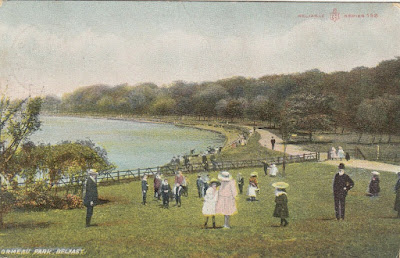
Ormeau Embankment (Image: Ebay)

In 1869, Ormeau Park was acquired by Belfast Corporation from the Donegall family.

Ormeau House was subsequently demolished.

Ormeau Park remains the largest and oldest of Belfast's municipal parks and now extends to 137 acres.

First published in November, 2013. 

1st Baron Rokeby

THE BARONY OF ROKEBY WAS CREATED IN 1777 FOR RICHARD ROBINSON, LORD ARCHBISHOP OF ARMAGH

The family of ROBINSON was of considerable antiquity in the counties of Yorkshire and Westmorland. The estate of Rokeby in the North Riding of Yorkshire was purchased in 1610 by WILLIAM ROBINSON, a merchant of London, from Sir Thomas Rokeby, whose progenitors had resided there since the Conquest.

Mr Robinson paid a composition fine for declining the honour of knighthood at the coronation of CHARLES I.

This William Robinson married Mary, daughter of Thomas Hall, of Thornton, Yorkshire, and had, with other issue,
THOMAS, father of WILLIAM ROBINSON.
Mr Robinson died in 1643, and was succeeded by his grandson,

WILLIAM ROBINSON, of Rokeby, who wedded Mary, eldest daughter and co-heir of Francis Layton, of Rawdon, West Yorkshire, and was succeeded by his only son,

THOMAS ROBINSON (1652-1719), who espoused Grace, daughter of Sir Henry Stapylton Bt, of Myton-on-Swale, North Yorkshire.

He was succeeded by his only son,

SIR WILLIAM ROBINSON (1675-1720), of Rokeby Park, Greta Bridge, Yorkshire, who married Anne, daughter and heir of Robert Walters, of Cundall, Yorkshire, and had issue,
THOMAS, cr a baronet in 1730;
William, 2nd Baronet;
Henry;
RICHARD, 1st BARON ROKEBY;
Septimus (Sir);
Anne; Grace.
The fourth son,

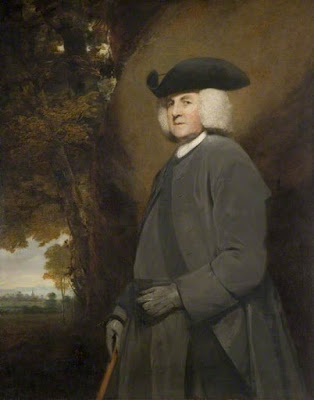
THE MOST REV AND RT HON SIR RICHARD ROBINSON, 3RD BARONET (1709-94), Lord Archbishop of Armagh, Primate of All Ireland, and prelate of the Most Illustrious Order of St Patrick, was elevated to the peerage, in 1777, in the dignity of BARON ROKEBY, of Armagh, with remainder to Matthew Robinson, the reversionary heir to the baronetcy.


This prelate went to Ireland, in 1751, as first chaplain to the Lord Lieutenant, His Grace the Duke of Dorset, and was promoted in that year to the see of Killala.

When the Duke of Bedford was viceroy, his lordship was translated to the united sees of Leighlin and Ferns, and, in 1761, to that of Kildare.

In 1765, during the government of the Duke of Northumberland, he was elevated to the primacy, and nominated Lord Almoner.

1st Baron Rokeby (Image: The Henry Barber Trust,
The Barber Institute of Fine Arts, University of Birmingham)

His Grace succeeded to the baronetcy upon the decease of his brother Sir William, 2nd Baronet, in 1785.
He died unmarried, at a great age, in 1784, when the honours devolved, according to the limitation, upon MATTHEW ROBINSON.
Sir Richard, in 1764, was, on the death of Dr Stone, elevated to the archbishopric of Armagh, and primacy of all Ireland. 
This high station he held for thirty years, during which he adorned the See by his munificence, and gained the affection and respect of the nation in a manner which was universally acknowledged, and which will hand down his name to posterity with honour. 
In his latter years, in a green old age, His Grace passed much of his time in England; dividing it principally between Bath and London, where his hospitable table was always open to the higher classes of the country whose church was under his rule, while his charities and public works commanded the esteem and gratitude of all. 
His Grace was a privy counsellor as well as being a peer, hence the prefix Right Honourable and post-nominal letters PC.
In 1774, the Archbishop founded the Armagh County Infirmary.

In 1780, His Grace gifted land for the erection of a new prison and in 1778 he founded the public library.

In 1790, he founded the Armagh Observatory as part of his plan for a university in Armagh.

Archbishop Robinson also built the archiepiscopal palace (above) at Armagh, now Council offices.


The Primate's Chapel, above, stands adjacent to the Palace.

His Grace's cousin,

MATTHEW ROBINSON, 2nd Baron (1713-1800), of Edgeley, died unmarried.


The Barony expired in 1883 following the death of the 6th Baron Rokeby, of Hazelwood, Abbots Langley, Hertfordshire.

 First published in August, 2010.