Tuesday, 2 April 2024

House of Acheson

The founder of this noble family in Ulster,

ARCHIBALD ACHESON (1583-1634), descended from a good family in Scotland, was seated at Gosford, Haddingtonshire, previous to his settlement in the Province, where we find him in 1610.

In the following year he had passed patent for a large proportion of land in County Armagh, and at the same time his younger brother,

HENRY ACHESON, passed patent for a smaller proportion in the said county, which lands he afterwards assigned to Sir Archibald.

He returned to Scotland and there died unmarried.

Sir Archibald was "so steady and zealous a friend" of the protestant interest in Ulster that seven years after he obtained this grant (according to the survey made by Nicholas Pynnar) he had 203 men upon his estate capable of bearing arms.

In 1612, he obtained another grant from JAMES I of a small proportion of land in County Cavan containing 1,000 acres.

Mr Acheson was created a baronet in 1628, designated of Market Hill, County Armagh.

In 1630, he obtained, in conjunction with Piers and Walter Crosbie, a territory in Nova Scotia, Canada, named Bonovia [sic].

Sir Archibald was Solicitor-General, Senator of Justice, and many years Secretary of State for Scotland; which latter office he continued to fill until his decease in 1634.

He died at Letterkenny, County Donegal, at his nephew's house, Sir William Semple, Knight.

Sir Archibald was succeeded in the title and estates by his eldest son,

SIR PATRICK, 2nd Baronet (1609-38), at whose decease without issue, the title devolved upon his half-brother,

SIR GEORGE, 3rd Baronet (1629-85), who was succeeded by his only son,

SIR NICHOLAS, 4th Baronet (c1655-1701), MP for County Armagh, 1695, who was succeeded by his eldest son,

SIR ARTHUR, 5th Baronet (1688-1749), who wedded Anne, daughter of the Rt Hon Philip Savage, Chancellor of the Exchequer in Ireland, by whom he had issue, five sons and two daughters.

Sir Arthur was succeeded by his eldest surviving son,

SIR ARCHIBALD, 6th Baronet (1718-90), who was elevated to the peerage, in 1776, in the dignity of Baron Gosford, of Market Hill, County Armagh; and advanced to a viscountcy, 1785, as Viscount Gosford.

His lordship married, in 1740, Mary, youngest daughter of John Richardson, of Rich Hill, County Armagh, and had issue,
ARTHUR, his successor;
Anna Maria; Nicolas; Julia Henrietta; Lucinda; Mary.
Sir Archibald was succeeded by his eldest son,

ARTHUR, 2nd Viscount (c1742-1807); who was created, in 1806, EARL OF GOSFORD.

His lordship espoused, in 1774, Millicent, daughter of Lieutenant-General Edward Pole, and had issue,
ARCHIBALD, his successor;
Edward, CB, Lieutenant-Colonel in the army;
Olivia, m Brigadier R B Sparrow, of Brampton Park;
Mary, m Lieutenant-General Lord William Bentinck, GCB;
Millicent, m Rev J H Barber MA.
He was succeeded by his only son,

ARCHIBALD, 2nd Earl (1776-1849), GCB, PC.
The heir presumptive is the present holder's first cousin Nicholas Hope Carter Acheson (b 1947).

He is the eldest son of the Hon Patrick Bernard Victor Montagu Acheson (1915–2005), second son of the 5th Earl.


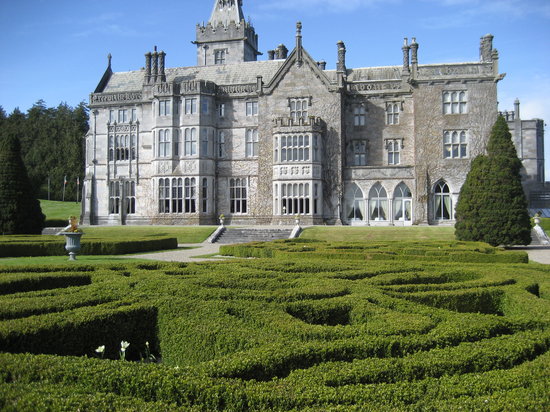
GOSFORD FOREST PARK, near Markethill, County Armagh, is one of the most beautiful demesnes in Northern Ireland.

There are woodland and forest walks; the walled garden; and a caravan and camping site within the park.


Gosford Castle is said to be the largest private mansion house in Northern Ireland.

The estate was sold to the NI Government shortly after the 2nd world war. 


The castle was restored between 2006-8 and has been divided into a number of apartments.

The Gosford Papers are deposited at PRONI.

First published in January, 2012. 

Thursday, 28 March 2024

Stephenstown House

THE FORTESCUES WERE MAJOR LANDOWNERS IN COUNTY LOUTH, WITH 5,262 ACRES

This is a cadet branch of FORTESCUE of Dromiskin (from whom descended the EARLS OF CLERMONT, and the BARONS CLERMONT and CARLINGFORD).


WILLIAM FORTESCUE, of Newrath, County Louth, younger son of SIR THOMAS FORTESCUE, of Dromiskin, married Margaret, daughter and heiress of Nicholas Gernon, of Milltown, County Louth, and died in 1734, leaving, with other issue, a third son,

CAPTAIN MATTHEW FORTESCUE, Royal Navy, who wedded, in 1757, Catherine Doogh, and had (with a daughter, Catherine) a son,

MATHEW FORTESCUE, of Stephenstown, who espoused Mary Anne, eldest daughter of John McClintock MP, of Drumcar, and had issue,
MATHEW, his heir;
Anna Maria; Harriet; Emily.
The only son,

MATHEW FORTESCUE DL (1791-1845), of Stephenstown, married, in 1811, Catherine Eglantine, eldest daughter of Colonel Blair MP, of Blair, and had issue,
Mathew Charles, died in infancy;
JOHN CHARLES WILLIAM, his heir;
Frederick Richard Norman, father of
MATTHEW CHARLES EDWARD;
William Hamilton;
Clermont Mathew Augustus.
Mr Mathew Fortescue was succeeded by his eldest surviving son,

JOHN CHARLES WILLIAM FORTESCUE JP DL (1822-91), of Stephenstown, and Corderry, Lieutenant-Colonel, RA; High Sheriff of County Louth, 1861, Vice Lord-Lieutenant of County Louth, 1868-79, who wedded, in 1857, Geraldine Olivia Mary Anne, daughter of the Rev Frederick Pare, by the Hon Geraldine de Ros his wife.

He dsp in 1891, and was succeeded by his nephew,

MATTHEW CHARLES EDWARD FORTESCUE JP DL (1861-1914), of Stephenstown, High Sheriff of County Louth, 1903, Major, 6th Battalion, Royal Irish Rifles, who wedded, in 1894, Edith Magdalen, eldest daughter of Sir Charles Arthur Fairlie-Cunninghame Bt, though the marriage was without issue.

*****

After the death of Mrs Pike-Fortescue in 1966, Stephenstown was inherited  by her nephew, Major Digby Hamilton, who sold it about 1974.


STEPHENSTOWN HOUSE, near Dundalk, County Louth, was a square Georgian house of two storeys over a basement, five bays long and five bays deep.

The house was extended in 1820 by the addition of two wings of one storey over the basement.

One of these wings was demolished later in the 19th century.

At some time in the earlier part of the 19th Century the windows were given Tudor-Revival hood mouldings, but later the house was refaced with cement and the hood mouldings replaced by classical pediments and entablatures.


Alas, the once-great mansion is now ruinous.

Although neglected in recent years, Stephenstown House continues to play a vital role in its surroundings.

It is located on the highest point in the locality dominating the skyline and providing a point of drama in the landscape.

The outlying buildings are in fair condition and their survival contributes further to Stephenstown's significance.

The house became ruinous by the 1980s.

Abandoned Ireland has an interesting article about it here.

Other former seat ~ Wymondham Cottage, Oakham, Rutland.

First published in March, 2012.

Thursday, 21 March 2024

Adare Manor

THE EARLS OF DUNRAVEN AND MOUNTEARL WERE THE SECOND LARGEST LANDOWNERS IN COUNTY LIMERICK, WITH 14,298 ACRES 


The descent of the Earls of Dunraven from the ancient Milesian princes is certified by the recognition of the pedigree of their ancestor, Thady Quin, of Adare, in a record entered in Ulster King-of-Arms' office by Sir Richard Carney, Knight, Ulster King of Arms, 1688.

Con Cead Caha, or Con of the Hundred Battles, described by genealogists as monarch in Ireland during the 2nd century, is represented as the founder of the family of QUIN; his grandson, Cormac, who is said to have reigned in AD 254, was the first who adopted the surname of QUIN, which signifies a descendant of Con. The family certainly possessed large territories in Ireland, and governed as hereditary chieftains, before the invasion of the English in the reign of HENRY II

The Earls of Dunraven descended from a branch which for many centuries possessed great feudal power in County Clare, whence their ancestors were finally expelled by the more powerful family of O'Brien, and settled in County Limerick.

JAMES QUIN, of Kilmallock, County Limerick (whose brother, John Quin, a Dominican friar, was Bishop of Limerick, 1521), had a son,

DONOUGH QUIN, who was father of

DONOUGH QUIN, who married Judith, heiress of the family of O'Riordan, which had been settled for more than five centuries in County Limerick.

He died in 1621, leaving a son,

THADY QUIN (1645-1726), of Adare, who wedded firstly, Bridget, daughter and heir of Andrew Rice, of Dingle, County Kerry; and secondly, Frances, daughter of Major Hull, son of Sir William Hull, Knight; and thirdly, Catherine, daughter of Piers Morony, by whom he had issue,
VALENTINE, his heir;
John;
James;
Catherine; Eleanor; Judith.
Thady Quin was succeeded by his eldest son,

VALENTINE QUIN, of Adare, who espoused Mary, eldest daughter and co-heir of Henry Widenham, of The Court, County Limerick, and had issue,
WINDHAM, his heir;
George, of Quinsborough;
Mary; Margaret; Alice; Catharine; Anne.
Mr Quin died in 1744, and was succeeded by his elder son,

WINDHAM QUIN (1717-89), of Adare, High Sheriff of County Limerick, 1747, MP for Kilmallock, 1768-76, who married, in 1748, Frances, daughter of Richard Dawson, of Dawson's Grove, County Monaghan, and had issue,
VALENTINE RICHARD, his successor;
Windham, lt-col in the army;
John, in holy orders;
Elizabeth; Mary; Catherine; Frances.
Mr Quin's eldest son,

VALENTINE RICHARD QUIN (1732–1824), MP for Kilmallock, 1800, was created a baronet in 1781, designated of Adare, County Limerick.

Sir Valentine was elevated to the peerage, in 1800, in the dignity of Baron Adare, of Adare, County Limerick; and advanced to a viscountcy, in 1816, as Viscount Mount-Earl.

His lordship was further advanced, in 1822, to the dignities of Viscount Adare and EARL OF DUNRAVEN AND MOUNTEARL.

He wedded firstly, in 1777, Frances, daughter of Stephen, 1st Earl of Ilchester, and had issue,
WINDHAM HENRY, his successor;
Richard George;
Elizabeth; Harriett.
His lordship espoused secondly, Mrs Blennerhasset, widow of Colonel Blennerhasset, but had no further issue.

He was succeeded by his elder son,

2nd Earl of Dunraven (Image: National Library of Wales)

WINDHAM HENRY, 2nd Earl (1782-1850), MP for County Limerick, 1802-20, who married, in 1810, Caroline, daughter of Thomas Wyndham, and had issue,
EDWIN RICHARD, his successor;
Windham Henry, father of the 5th Earl;
Anna Maria Charlotte.
His lordship was succeeded by his eldest son,

EDWIN RICHARD, 3rd Earl (1812-71), KP, MP for Glamorgan, 1837-51, who wedded firstly, in 1836, Augusta, daughter of Thomas Gould, and had issue,
WINDHAM THOMAS, his successor;
Augusta Emily; Mary Frances; Caroline Adelaide; Edith; Emily Anna.
His lordship was succeeded by his only son,

WINDHAM THOMAS, 4th Earl (1841-1926), KP CMG OBE PC, who espoused, in 1869, Florence Elizabeth, daughter of Lord Charles Lennox Kerr, and had issue, three daughters,
Florence Enid; Rachael Charlotte; Aileen May.
His lordship died without male issue, when the titles reverted to his cousin,

WINDHAM HENRY, 5th Earl (1857-1952), CB DSO DL, High Sheriff of County Kilkenny, 1914, who married, in 1885, the Lady Eva Constance Aline Bourke, daughter of Richard, 6th Earl of Mayo, and had issue,
RICHARD SOUTHWELL WINDHAM ROBERT, his successor;
Valentine Maurice;
Olein Eva Constance; Kathleen Sybil.
His lordship was succeeded by his eldest son,

RICHARD SOUTHWELL WINDHAM ROBERT, 6th Earl (1887-1965), CB CBE MC, who espoused firstly, in 1915, Helen Lindsay, daughter of John Swire; and secondly, in 1934, Nancy, daughter of Thomas B Yuille, by whom he had issue,
THADY WINDHAM THOMAS, his successor;
Melissa Eva Caroline; Caroline Olein Geraldine.
His lordship was succeeded by his only son,

THADY WINDHAM THOMAS, 7th Earl (1939-2011), who married, in 1969, Geraldine, daughter of Air Commodore Gerald Ward McAleer CBE, and had issue, an only child,

THE LADY ANNA ELIZABETH WYNDHAM-QUIN (1972-), who wedded, in 2009, Duncan Yeats, son of Patrick Johnson, and has issue,
Tarka Valentine Mary (b 2015);
India Catherine Nancy (b 2016).
Following the death of the 7th Earl without male issue, the titles expired.

Unable to bear the expense of maintaining Adare Manor, the 7th Earl sold it and its contents in 1984.

The mansion was purchased by an Irish-American businessman, Tom Kane, and subsequently converted into a hotel.


Adare Manor was originally a two-storey, seven-bay early 18th century house, most likely built about 1725 by Valentine Quin, grandfather of the 1st Earl of Dunraven.

From 1832, the 2nd Earl, started rebuilding the house in the Tudor-Revival style as a way of occupying himself (his wife was handicapped).


When the house was almost completed in 1846, A W Pugin was commissioned to design some features of the Great Hall.

Between 1850-62, the 3rd Earl finally completed the mansion by building the principal garden front.


The Great Hall is a room of vast size and height, divided down the middle by a screen of giant Gothic arches of stone.

A carved oak Minstrels' Gallery runs along one side; originally there was once an organ loft.

Mark Bence-Jones remarks that Adare Manor, as completed, is a picturesque and grey stone pile, composed of various elements that are rather loosely tied together; some of which are reproduced from Tudor originals in England. viz. the entrance tower, bearing a verisimilitude to the Cloister Court at Eton College.


The Long Gallery above is 132 feet long and 26 feet in height.

The mansion is set in a 840-acre estate and now operates as a luxury hotel, featuring the Adare Golf Club, Elemis Treatment Rooms, Townhouses and Villas on the rest of the resort.

President Clinton stayed at Adare Manor in September, 1998.

First published in August, 2011.

Monday, 18 March 2024

Kinlough House

THE JOHNSTONS WERE MAJOR LANDOWNERS IN COUNTY LEITRIM, WITH 14,395 ACRES


ROBERT JOHNSTON (1768-1843), of Kinlough House, County Leitrim, and 23 Mountjoy Square, Dublin, married Florence, daughter of Henry Rathborne, of Dunsinea, County Dublin, and had, with other issue,
WILLIAM, of whom presently;
Henry (Ven.), Archdeacon of Elphin;
St George Robert.
The eldest son,

WILLIAM JOHNSTON JP (1814-88), of Kinlough House and Mountjoy Square, High Sheriff of County Leitrim, 1850, wedded, in 1856, Sarah Jane, daughter of the Rev William Percy, Rector of Carrick-on-Shannon, and had issue,
JAMES, his heir;
Florence Elizabeth; Sophia Mary;
Emma Caroline; Lucy Katherine.
Mr Johnston was succeeded by his son,

JAMES JOHNSTON JP DL (1858-), of Kinlough House, High Sheriff of County Leitrim, 1884, who married, in 1890, Rebecca Ceely, daughter of Maurice Ceely Maude, of Lenaghan Park, County Fermanagh, and had issue,
William James, 1891-3;
ROBERT CHRISTOPHER, b 1896.
I have been unable to find much information relating to the Johnstons of Kinlough.


KINLOUGH HOUSE, originally known as Oakfield House, was the seat of the Johnston family in the early 18th century.

It was remodelled in the 1820s by Robert Johnston, who renamed it Kinlough House.

In 1943 the Irish Tourist Association Survey recorded that the house had been destroyed by fire twenty years earlier, but that the gardens were still open to the public.

Housing development is occurring on the site, adjacent to the walled garden.

It was a five-bay, two-storey over basement house, built ca 1800 by Robert Johnston; now ruinous.


Its roof has been removed.

There were two ashlar chimney-stacks with string courses; sandstone walls with ruled-and-lined render; and tooled limestone quoins and string course.

It had a Doric portico to the façade, with tripartite window and pediment above.

Segmental-arched openings to basement with cast-iron railings.

Although this impressive former country house now lies in ruins, the grandeur and elegance of the building still survives.

Detailing such as the flower motif to the tripartite window contributes to the artistic quality of the house.

First published in March, 2012.   Sir James (Jim) Kilfedder MP (1928-1995) was born at Kinlough, County Leitrim.

Thursday, 14 March 2024

House of Cole

By a deed of WILLIAM THE CONQUEROR, it appears that the Coles were of the rank of barons, and were resident in Hampshire in that monarch's reign. The first of this family who settled in Ulster was

SIR WILLIAM COLE, Knight (c1571-1653), who fixed his abode in County Fermanagh early in the reign of JAMES I.
He was the son of Emmanuel Cole (c1545-c1625), third son of Thomas Cole, of London; whose father, John, was son of William Cole, who was a younger son of John Cole, who was second son of Sir John Cole, of Nethway, Devon, by Anne, daughter and heir of Sir Nicholas Bodrugan, Knight, son of John Cole, of Hittisleigh, Devon, during the reign of EDWARD III, great-grandson of William Cole, of Hittisleigh, living in 1243.
Sir William was appointed captain of the longboats and barges at Ballyshannon and Lough Erne, by patent, in 1607.

This gentleman became an undertaker in the plantation of Ulster, and had an assignment, in 1611, of 1,000 acres of escheated lands, in the county wherein he resided; to which, in 1612, were added 320 acres in the same county.

Eighty acres whereof were assigned for the town of Enniskillen; and that town was then incorporated by charter, consisting of a provost and twelve burgesses, Sir William being the first provost.

Sir William raised a regiment, which he commanded against the rebels, in 1643, with important success.

He wedded twice: Firstly, to Susan, daughter and heiress of John Croft, of Lancashire, by whom he had two daughters.

This gentleman's second wife was Catherine, daughter of Sir Laurence Parsons, of Birr, second baron of the Irish Exchequer, by whom he left, at his decease (with at least two daughters),
MICHAEL, his successor;
John, MP for Fermanagh; cr baronet, 1660.
The elder son,

SIR MICHAEL COLE (1644-c1711), Knight, MP for Enniskillen, 1665-6, 1692-3, 1695-9, 1703-11, wedded Alice, daughter of Chidley Coote, of Killester, County Dublin, and was succeeded by his only surviving child,

SIR MICHAEL COLE, Knight, who wedded, in 1671, Elizabeth, daughter of Sir John Cole Bt; and dying in 1710, was succeeded by his eldest son,

JOHN COLE (c1680-c1726), of Florence Court, County Fermanagh, MP for Enniskillen, 1703-26, who espoused Florence, only daughter of Sir Bourchier Wrey, 4th Baronet, of Trebitch, in Cornwall, and was succeeded by his eldest son,

JOHN COLE (1709-67), of Florence Court, MP for Enniskillen, 1730-60, who was elevated to the peerage, in 1760, in the dignity of Baron Mount Florence, of Florence Court, County Fermanagh.

John, 1st Baron Mount Florence (Image: National Trust)

His lordship espoused Elizabeth, daughter of Hugh Willoughby Montgomery, of Carrow, County Fermanagh, and had, with several daughters, two sons,
WILLIAM, his successor;
Arthur, m Letitia Hamilton.
His lordship was succeeded by his elder son, 

WILLIAM WILLOUGHBY, 2nd Baron (1736-1803), who was created, in 1776, Viscount Enniskillen; and advanced to the dignity of an earldom, in 1789, as EARL OF ENNISKILLEN.

His lordship married, in 1763, Anne, daughter of Galbraith Lowry-Corry, of Aghenis , County Tyrone, and sister of Armar, 1st Earl of Belmore, and had issue,
JOHN WILLOUGHBY, his successor;
Galbraith Lowry (Sir), GCB, general in the army;
William Montgomery (Very Rev), Dean of Waterford;
Arthur Henry, MP;
Henry, died young;
Sarah; Elizabeth Anne; Anne; Florence; Henrietta Frances.
He was succeeded by his eldest son,

JOHN WILLOUGHBY, 2nd Earl (1768-1840), KP, who married, in 1805, the Lady Charlotte Paget, fourth daughter of Henry, 1st Earl of Uxbridge, and had issue,
WILLIAM WILLOUGHBY, his successor;
Henry Arthur;
John Lowry;
Lowry Balfour;
Jane Anne Louisa Florence.
His lordship was appointed a Knight of St Patrick, 1810.

He was created, in 1815, Baron Grinstead, of Grinstead, Wiltshire, in the peerage of the United Kingdom.

His Lordship was succeeded by his eldest son,

WILLIAM WILLOUGHBY, 3rd Earl (1807-86), Honorary Colonel, Royal Inniskilling Fusiliers.

The heir presumptive is the present holder's first cousin Berkeley Arthur Cole (b 1949). He is the eldest son of the Hon Arthur Gerald Cole (1920–2005), younger brother of the 6th Earl.
First Published in January, 2012.

Wednesday, 13 March 2024

Ballyfin House

THE COOTE BARONETS WERE THE GREATEST LANDOWNERS IN THE QUEEN'S COUNTY, WITH 47,451 ACRES


This is the parent stock whence the noble houses of COOTEEarls of Mountrath, and COOTE, Barons Castle Coote, both now extinct, emanated. 

This noble family derives its origin from

SIR JOHN COOTE, a native of France, who married Isabella, the daughter and heir of the Seigneur Du Bois, of that kingdom, and had issue,

SIR JOHN COOTE, Knight, who coming into England, settled in Devon, and married a daughter of Sir John Fortescue, of that county.

His lineal descendant,

JOHN COOTE, heir to his uncle, 28th Abbot of Bury St Edmund's, wedded Margaret, daughter of Mr Drury, by whom he had four sons,
Richard;
FRANCIS, of whom we treat;
Christopher;
Nicholas.
Mr Coote's second son,

FRANCIS COOTE, of Eaton, in Norfolk, served ELIZABETH I; and by Anne, his wife, had issue,

SIR NICHOLAS COOTE, living in 1636, who had two sons,
CHARLES, his heir;
William (Very Rev), Dean of Down, 1635.
Sir Nicholas's elder son,

SIR CHARLES COOTE (1581-1642), Knight, of Castle Cuffe, Queen's County,
Who served in the wars against O'Neill, Earl of Tyrone, at the head, as captain of the 100th Foot Regiment, with which corps he was at the siege of Kinsale, and was appointed, by JAMES I (in consequence of the good and faithful services he had rendered to ELIZABETH I), provost-marshal of the province of Connaught for life. 
In 1620, he was constituted vice-president of the same province; and created, in 1621, a baronet, designated of Castle Cuffe, Queen's County. Sir Charles distinguished himself, subsequently, by many gallant exploits; but the most celebrated was the relief of Birr, in 1642. 
Being dispatched, with Sir Thomas Lucas and six troops of horse, to relieve that garrison, and some other fortresses, it was necessary, in order to effect the objective, to pass the causeway broken by the rebels, who had thrown up a ditch at the end of it. 
Sir Charles, leading thirty dismounted dragoons, beat the enemy, with the loss of their captain and twenty men; relieved the castles of Birr, Borris, and Knocknamase; and having continued almost forty hours on horseback, returned to the camp with the loss of only one man.
This is the surprising passage through Mountrath woods which justly caused the title of MOUNTRATH to be entailed upon his son,

Sir Charles, who married Dorothea, youngest daughter and co-heir of Hugh Cuffe, of Cuffe's Wood, County Cork, and had issue,
CHARLES, his heir;
Chidley, of Killester, Co Dublin;
Richard, ancestor of the EARL OF BELLAMONT;
Thomas, of Coote Hill;
Letitia.
Sir Charles being slain in a sally to protect the town of Trim, in 1642, was succeeded by his eldest son,

SIR CHARLES COOTE, 2nd Baronet (c1610-61), who was elevated to the peerage, in 1661, in the dignities of Baron Coote, Viscount Coote, and EARL OF MOUNTRATH; and the baronetcy merged in the superior dignity, until the demise of

CHARLES HENRY (1725-1802), 7th Earl, without male issue, when the earldom expired.

A new barony, that of Castle Coote, which his lordship obtained, passed accordingly and ceased likewise, in 1827; while the ancient baronetcy reverted to 

SIR CHARLES HENRY COOTE, 9th Baronet (1792-1864), of Ballyfin, great-grandson of the Rev Chidley Coote DD, lineal descendant of Chidley Coote, by his second wife, Eliza Anne.


*****

Sir Algernon Charles Plumptre Coote, 12th Baronet (1847–1920), was Lord-Lieutenant of Queen's County, 1900-20.

Sir Ralph Algernon Coote (1874-1941), 13th Baronet, was the last representative of his line to occupy Ballyfin House.
Thereafter the estate was purchased by the Irish Land Commission, while the noble mansion and portion of the demesne were acquired in 1930 by the Patrician Order, a distinguished Irish teaching brotherhood long associated with successful educational work in the district.
The 14th Baronet, Rear-Admiral Sir John Coote, CB CBE DSC, was Director of Naval Ordnance, 1955-58. 

Sir Christopher John Coote, 15th Baronet (b 1928) is married and lives in Wiltshire.


BALLYFIN HOUSE, situated at the foot of the Slieve Bloom mountains near Mountrath in County Laois, is said to be "the grandest and most lavishly appointed early 19th century Classical house in Ireland" (Bence-Jones). 

The mansion was built between 1821-26 for Sir Charles Coote, 9th Baronet, replacing a house of 1778 which belonged to William Wellesley-Pole, 3rd Earl of Mornington and brother of the 1st Duke of Wellington.


Sir Charles purchased the estate from Wellesley-Pole about 1812 and apparently employed an architect called Madden to design the initial phase of Ballyfin; then switched to the Morrisons.

Ballyfin is a two-storey maansion house with a long library running at one side from front to back, extending into a curved bow in the centre of the side elevation, containing a top-lit rotunda.

The library wing is of one bay on either side of the central curved bow, fronted by a colonnade of large Ionic columns. 

The side elevation is prolonged by an elegantly-curving glass and iron conservatory of about 1850.


The principal front consists of thirteen bays with a massive Ionic, pedimented portico; the two end bays on either side being stepped back.

The interior is quite magnificent and exquisitely furnished, with a riot of notable effects and a wealth of heavy, opulent plasterwork; Scagliola columns in Siena, porphyry, green and black; inlaid parquetry floors.


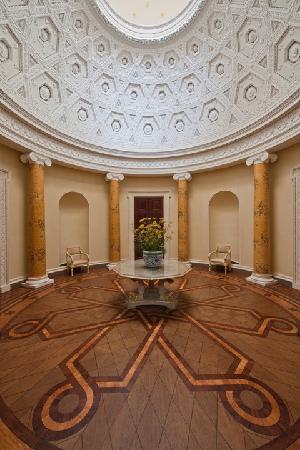
The saloon is flanked by the rotunda (above), which is surrounded by Ionic columns and has a coffered dome.

The entrance hall is said to be more constrained, with a coffered ceiling and a mosaic Roman floor. 

This leads into the splendid top-lit saloon in the centre of the mansion, which boasts a coved ceiling adorned with superlative plasterwork and a screen of Corinthian columns at either end.

The drawing-room has a typical Morrison ceiling and gilded Louis Quinze on the walls of ca 1840s.

Today the demesne comprises 600 acres of parkland, a lake and ancient woods, delightful garden buildings, follies and grottoes.

The landscape, laid out in the 18th century, is among the finest examples in Ireland of the natural style of gardening inspired by ‘Capability’ Brown.

Ballyfin House was formerly the Patrician College.

Patrician College Ballyfin operated from 1930 to 2009.

Sir Ralph Algernon Coote (1874-1941), 13th Baronet, was the last representative of his line to occupy Ballyfin House.

Thereafter the estate was purchased by the Irish Land Commission, while the noble mansion and portion of the demesne were acquired in 1930 by the Patrician Order, a distinguished Irish teaching brotherhood long associated with successful educational work in the district. 

Its architectural beauty has, however, been carefully preserved, and nothing has been lost in the change of ownership to deteriorate from the graceful lines of the building that Sir Charles Coote, 9th Baronet, expended a fortune in perfecting.

The Patrician Order sold the estate in 2009.

In 2011, Ballyfin became a country house hotel.

Among other features are a medieval-style tower, built as a folly in the 1860s and said to command a view of seven counties; and walled gardens.

London residence ~ 5 Connaught Place.

First published in May, 2011.  Images of Ballyfin House courtesy of Ballyfin Demesne.

Tuesday, 12 March 2024

Strand Hotel: Reminiscences

Strand Hotel, Portstewart: prospect from the golf links

A FRIEND OF THIS BLOG HAS KINDLY SENT FOND MEMORIES OF TIMES SPENT AT THE STRAND HOTEL, PORTSTEWART, AND THE NORTHERN COUNTIES HOTEL, PORTRUSH


I HAVE great memories of going to The Strand in the late 1970s/early 80s, when it was our regular haunt of a Saturday night.

Of course that was the heyday of disco, and there were no fewer than three separate dance floors - the most popular was the Cellar, which was accessed by an always-packed-with-people narrow staircase (not so much H&S or fire regulations in those days I suppose).

Then there was the upstairs disco frequented mostly by the young farmers, and another, more upmarket area at the other side of the hotel which seemed to us to be for a much older crowd ("older" to us then being people in their 30s).

Admission was £2, with a letter stamped on the back of the hand which was then widely copied using felt tip pens or eyeliner (and that wasn't just the girls - this was also the age of the New Romantics, don't forget).

As well as the discos they would have live music, and anyone who socialised on the North Coast in those days will have danced to Cuddles, or Plug Torrens and Dominic, legends in their own lifetimes.

Of course there were other great venues, not least Kelly's nightclub in Portrush and Spuds for live music in Portstewart, but The Strand will always hold a particular place in the affections of many, remembering that all this was happening at the height of "the Troubles", when any sort of apparent normality was welcome.

Not a comment on architecture or historical family lineages this time I'm afraid, Tim, just a fond memory of part of our more recent social history!

*****

I THINK it must have been 1989 or 1990 when it closed.

It was subsequently demolished for re-development, but the site then lay half-finished for years, until the local Council put a complete or demolish order on it in 2013.

Northern Counties Hotel, Portrush (Welch Collection/NMNI)

Another little nugget relating to the Strand's history - Jack Fawcett, who bought the hotel in partnership in 1963, also owned the old Northern Counties Hotel in Portrush.

It had started out life as The Antrim Arms, and when the Belfast and Northern Counties Railway purchased a share in it in the 1880s it was renamed.

The newly-named hotel was improved by John Lanyon in the late 1800s and by Berkeley Deane Wise in the early 1900s (Wise was chief architect to the railway company and his designs included the red brick and mock Tudor-style railway stations we see in Northern Ireland, the Portrush railway station being a fine example).

Those of us of a certain vintage will recall the big revolving entrance door of the Counties and the timber-panelled sitting room, where the two enormous resident Irish wolfhounds were usually to be found sprawled asleep and snoring in front of a roaring fire.

On warmer days they would invariably be found lying at the revolving door so that guests had to clamber over them on their way in or out.

The dogs were big genial creatures, and didn't seem at all put out by people interrupting their snoozing.

Both The Strand and the Northern Counties were the venues for many years for weddings, dinners and dances.

The Counties had an ornate grand ballroom on the first floor, where I recall taking dance classes (I can still produce a fair quickstep when the occasion demands, though unfortunately it is rather creakier these days) and a heated pool (up on the second floor I think?) where I learned to swim.

Sadly the old hotel was destroyed by fire in 1990.

The modern hotel now standing on the site makes a pleasant place for coffee.