Showing posts sorted by relevance for query castlewellan. Sort by date Show all posts

Monday, 29 December 2025

Castlewellan

EDITED EXTRACTS FROM THE PARLIAMENTARY GAZETTEER OF IRELAND, PUBLISHED IN 1846


CASTLEWELLAN, a small market and post town in the parish of Kilmegan, barony of Upper Iveagh, County Down.

It stands on the road from Newry to Downpatrick.

The beauty, symmetry, and pretending bulk of this village, with its market-house and spire [the spire was removed ca 1846]; the stirring and prosperous aspect of two bleaching establishments in an adjacent valley on the north-west; the richly planted hills which close up the environs in the direction of Clough.
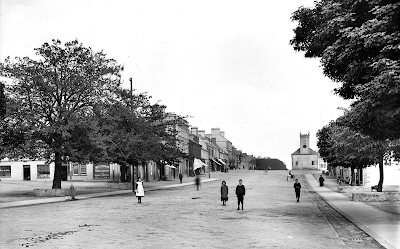
Prospect from The Square, Castlewellan (Image: William Alfred Green)

The superb grounds of CASTLEWELLAN DEMESNE, in the opposite direction, with its profuse plantations, and the spheric cone of its beautiful Gothic temple*; and the melting of this demesne into the instant and grand perspective of the Mourne mountains; render the village and its environs one of the most magnificent and imposing scenes in the county.

The mills of the two bleach-yards are turned by a stream which issues from a lake in Castlewellan demesne; and about twenty years ago, they annually finished 7,000 or 8,000 pieces of linen.

A weekly market is held for the sale of linen yarn and agricultural produce; and fairs are held on February 1st, May 1st, June 1st, September 1st, November 13th, and the Tuesday before Christmas.
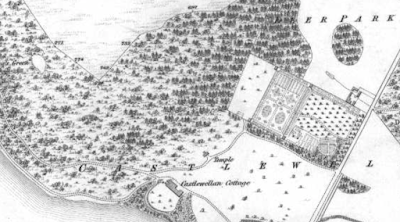
Click on image to enlarge

Castlewellan mansion is the seat of the EARL ANNESLEY; its appendages are a lodge, a Gothic temple, and a farmyard; its demesne comprehend 400 or 500 acres of hill and dale, and so richly combine artificial ornament, practical utility, and natural landscape, as to present to tourists uniqueness in blending with power and beauty.

Its views, especially from the vantage ground on which the temple stands, are such, says Mr Atkinson, as "can only be tasted with rapture by that eye through which the majesty of Nature communicates itself a silent eloquence to the imagination."

The ancestor of the Earl Annesley was created Baron Annesley, of Castlewellan, in 1758.
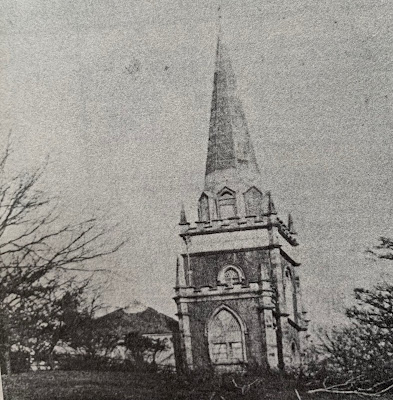
The Temple, Castlewellan demesne, ca 1855 (Image: Ulster Architectural Heritage Society)

*THE TEMPLE, formerly on the site of the present mansion house, was demolished in 1855. Its demeanour was perhaps akin to similar buildings in Tollymore Park and Hillsborough. The late Peter Rankin, who wrote Historic Buildings in the Mourne Area of South Down for the Ulster Architectural Heritage Society in 1975, dates it to ca 1820.

First published in December, 2021.

Tuesday, 10 February 2026

1st Earl Annesley

THE EARLS ANNESLEY WERE MAJOR LANDOWNERS IN COUNTY DOWN, WITH 24,221 ACRES


This ancient family derives its surname from the Lordship of Annesley, Nottinghamshire, where its ancestor,

RICHARD DE ANNESLEI, was seated at the time of the General Survey in 1079.

From this Richard descended

SIR JOHN ANNESLEY, Knight, of Headington, Oxfordshire, MP for Nottinghamshire during the reigns of EDWARD III and RICHARD II, who wedded Isabel, daughter of Sir Richard Damory, of Headington and Bucknall, Oxfordshire, and sister and co-heiress of Sir John Chandos, one of the Knights of the Garter at the institution of that noble order.

He was succeeded by his son,

THOMAS ANNESLEY MP, of Annesley; from whom descended

ROBERT ANNESLEY (1507-53), of Newport Pagnell, Buckinghamshire, who died in the first year of MARY I.

This gentleman wedded Joan, daughter of William Cloville, of Coldhall, in Essex, by whom he had (with three daughters) an only son and heir,

GEORGE ANNESLEY, of Newport Pagnell, Buckinghamshire, who married Elizabeth, daughter of Robert Dove, and had, with three daughters, eight sons, of whom the eldest,

ROBERT ANNESLEYa naval officer in the reign of ELIZABETH I, and also a captain in Her Majesty's army, raised to suppress the Earl of Desmond's rebellion, after which he became an undertaker in the plantation of Munster.

This gentleman espoused Beatrice, daughter of John Cornwall, of Moor Park, Herefordshire, and was succeeded by his elder son,

SIR FRANCIS ANNESLEY (c1585-1660), 1st Viscount Valentia, who settled in Ireland ca 1606 and, for forty years, filled several of the highest official situations in that kingdom.

Upon the institution of the Order of Baronets by JAMES I, Sir Francis was the second person advanced to that dignity, in 1620; and in the following year, Sir Francis obtained a reversionary grant, dated 1621, of the viscountcy of Valentia at the decease of the then viscount, Sir Henry Power.

He was put, however, into the more immediate position of a peerage, by the title of Baron Mount Norris, County Armagh, having been created in the previous year VISCOUNT VALENTIA, County Kerry.

His lordship wedded firstly, Dorothy, daughter of Sir John Phillips, of Picton Castle, and from this marriage the Earls of Anglesey, the Barons Altham, and the Earls of Mountnorris are descended.

This nobleman wedded secondly, Jane, daughter of Sir John Stanhope, and sister of Philip, 1st Earl of Chesterfield, and had several children, of whom the eldest,

THE HON FRANCIS ANNESLEY (1628-), fixed his abode at Castlewellan, County Down.

He wedded Deborah, daughter of the Most Rev Henry Jones, Lord Bishop of Meath, and was succeeded by his only surviving son,

FRANCIS ANNESLEY (1663-1750), who was appointed, in the reign of WILLIAM III, under an act of parliament, one of the trustees for the sale of estates in Ireland, and was a distinguished member of both the English and Irish parliaments.

He wedded firstly, Elizabeth, daughter of Sir Joseph Martin, Knight, of London, by whom he had (with several other sons and two daughters),
FRANCIS, ancestor of Annesley of Bletchingdon;
Henry, d 1728;
Martin, Rector of Frilsham, Berkshire;
John;
James;
WILLIAM, of whom we treat
Mr Annesley espoused secondly, in 1732, Elizabeth, daughter of John Cropley, of Rochester; and thirdly, Sarah, only daughter of William Sloane, of Portsmouth, and widow of Sir Richard Fowler Bt, but had no other issue.

His sixth son,

WILLIAM ANNESLEY (1710-70), barrister, MP for Midleton, 1741-58, High Sheriff of County Down, 1751, married, in 1738, the Lady Anne Beresford, eldest daughter of Marcus, 1st Earl of Tyrone, and had, with other issue,
FRANCIS CHARLES, his successor;
Marcus (1743-80);
RICHARD, succeeded his brother;
William (Very Rev), Dean of Down;
Catherine.
Mr Annesley was elevated to the peerage, in 1758, in the dignity of Baron Annesley, of Castlewellan, County Down.

His lordship was advanced to a viscountcy, in 1766, as Viscount Glerawley.

He was succeeded by his eldest son,

FRANCIS CHARLES, 2nd Viscount (1740-1802), who was created, in 1789, EARL ANNESLEY, with remainder to his brother Richard.

His lordship wedded, in 1776, Mary, daughter and heiress of Richard Grove, of County Cork; but dying without issue, in 1802, the honours devolved upon his brother,

RICHARD, 2nd Earl (1745-1824), High Sheriff of County Down, 1783, who wedded, in 1771, Anne, only daughter and heiress of Robert Lambert, of Dunlady, near Dundonald, County Down, and had issue,
WILLIAM RICHARD, his heir;
Robert;
Arthur, lieutenant-general;
Francis Charles, Commander RN;
Catherine; Anna Maria.
His lordship was succeeded by his son,

WILLIAM RICHARD, 3rd Earl (1772-1838), MP for Downpatrick, 1815-20,  High Sheriff of County Down, 1822, who espoused firstly, in 1803, the Lady Isabella St Lawrence, daughter of WILLIAM, 2ND EARL OF HOWTH, by whom he had an only daughter, MARY.

He married secondly, in 1828, Priscilla Cecilia, second daughter of Hugh Moore, of EGLANTINE, County Down, and had further issue,
WILLIAM RICHARD, his successor;
Hugh, succeeded his brother as 5th Earl;
Robert John;
Arthur;
George;
William Octavius Beresford, father of the 7th Earl.
His lordship was succeeded by his eldest son,

WILLIAM RICHARD, 4th Earl (1830-74), MP for Great Grimsby, 1852-7, who died unmarried, when the titles devolved upon his brother,

HUGH, 5th Earl (1831-1908), JP DL, MP for County Cavan, 1857-74, Lieutenant-Colonel, Scots Fusiliers, who wedded firstly, in 1877, Mabel Wilhelmina Frances, daughter of Colonel William Thomas Markham, and had issue,
FRANCIS, his successor;
Mabel Marguerite.
He espoused secondly, on 1892, Priscilla Cecilia, daughter of WILLIAM ARMYTAGE MOORE, and had further issue,
Clare; Constance Mary.
His lordship was succeeded by his son and heir,

FRANCIS, 6th Earl (1884-1914), who wedded, in 1909, Evelyn Hester, daughter of Alfred Edward Miller Mundy, though the marriage was without issue, when the family honours reverted to his cousin,

WALTER BERESFORD, 7th Earl (1861-1934), who married firstly, Maud Fleming, daughter of Haynes Bingham Higginson, and had issue,
BERESFORD CECIL BINGHAM, his successor.
He wedded secondly, in 1924, Mabel Frances, daughter of John Burnett.

His lordship was succeeded by his son,

BERESFORD CECIL, 8th Earl,
  • Beresford Cecil Bingham Annesley, 8th Earl (1894–1957);
  • Robert Annesley, 9th Earl (1900–79);
  • Patrick Annesley, 10th Earl (1924–2001);
  • Philip Harrison Annesley, 11th Earl (1927–2011);
  • Michael Robert Annesley, 12th Earl (b 1933).
The heir is the present holder's son Michael Stephen Annesley, styled Viscount Glerawly (1957).

The Earls Annesley owned 24,221 acres of land in County Cavan, and 2,489 acres in the Queen's County.


CASTLEWELLAN CASTLE, County Down, is a Scottish-baronial mansion by William Burn, built for the 4th Earl Annesley in 1856, on high ground to the north-east of the lake.

This superb estate melts into the instant and grand perspective of the Mourne mountains, rendering the adjacent village and its environs one of the most magnificent scenes in the county.

The demesne and farm comprise 400 or 500 acres of hill and dale, richly combining artificial ornament, practical utility and natural landscape.

The granodiorite for the walls of the castle was quarried locally in square blocks, the hardest of any stone in the British Isles.

It took the team of stonemasons considerably longer than expected to dress it.


The Castle's windows and door-dressings are of ashlar; while graded slates form the roof.

Castlewellan Castle cost £18,128 to build in 1856, about £1.5 million in today's money.

The castle has many bartizans and window dressings.

The entrance front is on the east side, asymmetrical with the former servants' wing to the right.

The Annesley crest adorns the principal doorway, the wooden doors of which are an estimable 2.36 inches thick.

There are also numerous loopholes, narrow slits about three feet in height with little circular ends, for ventilation and day-light.

The south front of the Castle has a a square tower at one end; and a circular tower at the other.

The demesne has been home to a succession of houses, each associated with various landscape phases.

The first house, built in the 1750s by William, 1st Viscount Glerawly, was located somewhere near the Grange, where the contemporary stable and farm building complex still survives in good repair.

A straight lime avenue close to the Grange survives from the 1750s formal park, while the west portion of the walled garden also belongs to this period.

In the Regency period the old house was succeeded by a new residence on the north shore of the lake, known as ‘Castlewellan Cottage’.

Built by 1st Earl Annesley in the 1790s and demolished ca 1861, the site of this house can be seen today to the south-west of the present castle.

Landscaping and extensive tree planting were carried out in conjunction with this house, while a monumental Gothic temple was built ca 1820 on a site above that which is now occupied by the present Victorian castle.

The temple was demolished in 1856 and the austere Scottish-baronial castle, now the focal point of the park, was built between 1856-59 by the 3rd Earl to designs of William Burn.

In front of the castle are terraces on several levels with steps in the corners to the parkland below and retaining walls in granodiorite.

A conservatory once stood at the north end of the west terrace.

The first stage towards creating Castlewellan’s famous arboretum began in the 1850s, when the area east of the 1750s walled garden was transformed into a walled pleasure-ground, complete with fashionable Victorian-style terracing, flights of steps and pools with dolphins supporting basins.

The layout was regular with a long axis path linking both the old and new enclosed gardens.

A good deal of exotic planting was associated with this pleasure ground, but it was during the 1860s that the major planting was begun by the 5th Earl, who succeeded to the property and title in 1874.

Until his death in 1908, he devoted himself to building up the present tree collection both inside and outside the walled garden.

He also added the conservatories in the garden corner and, in 1884, build the Moorish tower on an elevated spot to the west end of the lake, from which to enjoy views of the mountains.

By the early 20th century there were over 3,000 different species of rare plants from all over the world thriving in the hospitable climate at Castlewellan.

Lord Annesley wrote about the collection in Beautiful Trees and Plants in 1903.

Though scaled down, the collection was maintained and added-to in the early years of the 20th century.

In 1967 the demesne was acquired by the Northern Ireland Government.

The demesne today contains 1,144 acres within its walls.

It lies on the south-facing slopes of the Mourne Mountains, close to the sea, and benefits from a clement climate.

The large lake in the parkland covers 100 acres in extent and is a dramatic and attractive feature, around which the planting has been formulated.

The Forest Service added plantations of forest trees and the site has been open to the public as a forest park since 1969.

The arboretum has been extended to cover 100 acres and the collection enlarged.

It is designated a National Arboretum.

The gate lodge at the Town Gate was built in 1861, to the designs of Burn, as has the gate screen.

At the Drumbuck entrance there are workers cottages by Roberts ca 1860.

The Annesley estates, including land in counties Down and Cavan, were the third largest in County Down, comprising 24,221 acres in 1872.

I have written about their maritime residence at Newcastle, Donard Lodge, HERE.

The Annesley estate comprised 24,000 acres in County Cavan.

The County Down estate originally stretched from Slieve Croob to Slieve Donard, including Castlewellan and Newcastle.

The Annesley Papers are held at the Public Record Office of Northern Ireland.

First published in June, 2010.

Friday, 11 April 2025

Donard Lodge

DONARD PARK COMPRISED 783 ACRES OF LAND

The Earls Annesley derive their surname from the manor of Annesley in Nottinghamshire.

They were one of great noble families of County Down.

The vast Annesley estate stretched from Slieve Croob to Slieve Donard (Northern Ireland's highest mountain), including the village of Castlewellan and part of Newcastle.

They owned 25,000 acres of land in County Down, including 783 acres at Donard Park.

Their ancestral seat was Castlewellan Castle (which still, incidentally, looks as well as the day it was built in 1858 by the 4th Earl).

Lord Annesley and his successors also owned a "marine residence" just outside Newcastle in County Down.

Click to Enlarge

This large house, called Donard Lodge, pre-dated Castlewellan Castle by twenty-five years.


DONARD LODGE, on the southern outskirts of Newcastle, County Down, stood close to the location of the present Donard Bridge, at the foot of Thomas's Mountain and Slieve Donard, close to the location of Donard car park.

The prospect from the house towards the harbour and sea must have been spectacular.

Marine residences were popular amongst the nobility during the Victorian era: Murlough House, not far along the coast towards Dundrum, was Lord Downshire's "marine residence."


Returning to Donard Lodge, doubtless it was the finest edifice and address in Newcastle, a distinguished two-storey classical house of granite ashlar, built ca 1830 by the 3rd Earl.

The entrance front had a central, projecting bay with a strikingly projecting three-sided bow at either side; the centre being joined on each side to the projecting ends by a short Doric colonnade.

One of these colonnades served as an entrance portico, the door being in one side of the central projection.

The garden front had curved and three-sided bows and round-headed ground-floor windows.

There was a fine, semi-circular conservatory at one end of the house.

The little girl standing in the foreground to the right of the conservatory provides an indication the the mansion's size.

The ground floor also joined on to stable buildings and yards.


About 500 acres of land above the mansion were planted with trees, and a beautiful garden was created by the Rev John Moore (of Rowallane) and his sister Priscilla, 3rd Countess Annesley.

Eighty acres of the demesne became the pleasure grounds, with winding paths, ornamental trees and shrubs, waterfalls, cascades, an aviary, a hermitage, shell house, spa house, spa well, visitors' dining house, ornamental dining house, and a variety of rustic stone seats and little bridges.

This scheme may well have been inspired by the near by Tollymore Park.

Annesley Estate Office, Newcastle

The Annesley estate office still stands in the town.

Priscilla, Dowager Countess Annesley, continued to reside at Donard Lodge until her death in 1891.

Following Lady Annesley's death, Donard Lodge was leased to a number of tenants, all of whom failed to maintain the mansion to a satisfactory standard.

The Lodge suffered a serious fire in 1941.

Its sad demise continued until 1966, when the noble Donard Lodge was blown up (one year before Castlewellan Castle was sold to the Northern Ireland Government).

First published in April, 2009.

Sunday, 2 February 2014

Castlewellan Park

Castlewellan Greenhouses

I have spent a marvellous day at Castlewellan Park in County Down.

This demesne was formerly the seat of the Earls Annesley who, with about 25,000 acres, were the third largest landowners in the county.

The main purpose of my visit was to discover the Moorish Tower, a gazebo or folly to the west of the lake which afforded a commanding prospect and would have been conspicuous when it was built.

I had some difficulty in finding this gazebo, which is now concealed amongst undergrowth and forestry; in fact I walked round the lake twice before I was directed to its location by a ranger.

I intend to write a separate article about this folly tomorrow.


I AM delighted to see that the greenhouses within the walled garden have been restored.

I gather that £200,000 has been spent on this project.

The interior features await restoration, presumably in another phase; though there used to be a delightful water feature and running water in a rockery within the main glass-house.

Sunday, 8 March 2015

Moorish Tower Update

Moorish Tower, March 2015

Good progress is being made towards the restoration of The Moorish Tower at Castlewellan Park, County Down.

Moorish Tower, March 2015

Castlewellan Park was the ancestral seat of the Earls Annesley, one of the biggest landowners in the county, with 24,221 acres.

Moorish Tower, March 2015

The Moorish Tower sits on an elevated hill-side position overlooking the Lake, from its western side.

Moorish Tower, March 2015

It appears that essential pointing of the stone-work has been undertaken.

The Tower seems to be ready for its roof, too.

The Glasshouses, March 2015

CASTLEWELLAN PARK boasts one of the finest gardens in the Province.

The glasshouses have recently been restored; as has a gardener's bothy or cottage attached to the rear.

Friday, 27 March 2026

Castlewellan: Moorish Tower

During my visit to CASTLEWELLAN Park, County Down in 2014 I came upon the ruins of the Annesleys' charming little Moorish Tower.

Keyhole entrance (Timothy Ferres, 2014)

This ruinous gazebo is located at the west, or north-west, end of the lake, on the edge of a steep slope.
The Annesley crest, incidentally, features a Moor's head; and William Armytage-Moore (1806-83), coincidentally, was brother of Priscilla Cecilia, Countess Annesley (wife of the 3rd Earl) and land agent to the 3rd and 4th Earls.
The Ulster Architectural Heritage Society (UAHS) wrote about the tower in its 1976 gazetteer of historic buildings in the Mourne area of south County Down.

Fireplace (Timothy Ferres, 2014)

In 2014 the tower was obscured by forestry, its superb prospect obscured by fir and pine trees.

It was built in 1884 by Hugh, 5th Earl Annesley.

LORD ANNESLEY was the third largest landowner in County Down, with about 25,000 acres, extending from Slieve Croob to Slieve Donard.

Basement entrance (Timothy Ferres, 2014)

The UAHS described the Moorish Tower in 1976 as being in ruins, built on the edge of a steep slope.

About twenty feet in diameter inside and hexagonal in shape, the rusticated basement of great random granodiorite blocks, battered, with a doorway facing east.

The first floor made of smooth Victorian brick, a little porch on the opposite side from the door in the basement, a fireplace in the side to the left, no window in the side to the right.

Interior (Timothy Ferres, 2014)

The other three sides have Moorish, key-hole-shaped windows.

Both inside and outside, the brick walls had wooden strips for battening or plastering or, outside, slate or log-hanging.

The roof was slated (the gazebo is now roofless).


The gazebo was originally clad outside in vertical split logs, dentils under the gutter, the porch doorway under a shallow gabled roof with barge-boards.

photo credit: Follies Trust

It stood under mature trees in an idyllic position.

photo credit: Follies Trust

The prospect overlooking the lake was also idyllic (and still is), though this little gem became a neglected, ruinous, roofless shell, shut in by forestry.


THE GREAT NEWS, however, was that the Follies' Trust received a grant from the  NGO Challenge Fund, sponsored by the Northern Ireland Environment Agency and Forest Service, to undertake initial conservation work to the Tower.

When surrounding trees were cleared as part of the conservation process, the tower’s prospect of the demesne lake, Irish Sea and Mourne mountains was restored.

Work commenced during the summer, 2014.

(Timothy Ferres, March, 2015)
First published in February, 2014.  

Friday, 28 February 2014

Belfast Foray

I ventured into town this morning, paying a brief visit to House of Fraser, at Victoria Square.

A black quilted jacket by Barbour, called Liddesdale, caught my eye so, trying the garment on for size, I made a few enquiries on the iPad, before making the purchase.

Thereafter I enquired at the Linenhall Library to see if they had any images of the Annesleys' lake-side summerhouse or Moorish Tower at their former Castlewellan demesne.

Alas, I've had no joy, as yet; however, they very kindly offered to take my details and said they'd have another look.

So far, PRONI has been - let us say - unhelpful.

At Marks & Spencer's food-hall in the basement, I bagged three Gastropub meals, viz. Lasagne, Shepherd's Pie, and Rich Beef Hash.

Thursday, 6 February 2014

PRONI Visit

Public Record Office of Northern Ireland

I spent two hours at PRONI this morning. I cycled there in the trusty two-wheeler and parked it directly opposite the record office.

I timed my visit well, because PRONI doesn't open to the general public until 10am.

The purpose of my visit was to locate photographs of the Moorish Tower at Castlewellan demesne.

This little gazebo was built in 1884. This fact I can confirm, because I did see two photographs of it during construction in November, 1883.

Much of the Annesley photographic collection is Closed; that is to say, not for public consumption.

Although I searched six albums, the completed tower was not there, alas.

However, I have completed an official form, seeking permission to view more of the Annesley family albums.

EXTRAORDINARILY ENOUGH, a very large pane of glass shattered about thirty feet from me on the first floor Search Room.

I was at a computer and heard a pop or bang, not really loud at all, I suppose about 11 o'clock or thereabouts.

I have no idea of the cause. Perhaps it was caused by my glaring at it (!).

Thursday, 24 April 2025

Bryansford

EDITED EXTRACTS FROM THE PARLIAMENTARY GAZETTEER OF IRELAND, PUBLISHED IN 1846


BRYANSFORD, a village in the parish of Kilcoo, barony of Upper Iveagh, County Down.

It stands two miles south of Castlewellan, and about the same distance west of Newcastle.

Though small, it is a pretty village; and it stands amidst compositions of beauty, romance, and grandeur in landscape, inferior to few in Ireland.

In its vicinity are the noble and brilliant demesne of Tollymore, the surprising coast scenes adjacent to Newcastle, and many of the most interesting features of the mountains of Mourne.

Bryansford (Image: Robert John Welch (1859-1936)

The Guide through Ireland informs us that "the traveller, anxious to know this beautiful part of the country, will find comfortable accommodation at the inns of Bryansford, Newcastle, or Dundrum, which are about three miles from each other."

The Bryansford rivulet tumbles, leaps, and makes grand falls along a channel of rocks and precipices, and leads out to a magnificent view of the coast and sea.

The village gives name to a Roman Catholic parish.

Fairs are held on Ascension Day and June 3rd.

Population in 1831, 185.

First published in March, 2021.

Wednesday, 12 May 2010

County Down Landowners

Continuing with my county series of great landowners, I arrive at the county of Down. This county has had a high number of country estates, some vast and others more modest. This is a relative term in the 21st century, because many demesnes in the county were between five and ten thousand acres, which is very large indeed by today's standards.

I propose, initially, to focus on the ten biggest demesnes in the county. Thereafter, as with the other counties, I shall probably revisit them and write about any felt to have been inadvertently omitted.

Narcissus Batt, the Belfast banker, lived at Purdysburn House outside Belfast. Coupled with a large estate in the mountains of Mourne, Batt owned 12,010 acres. I have a paucity of information about Purdysburn House so, if anyone reading this can help, I'd be greatly obliged.

The Hon Sir Robert Henry Meade GCB, 2nd son of 3rd Earl of Clanwilliam, inherited the Meade family's Rathfriland Estate, extending to 13,492 acres.

Ballywalter Park, the fine demesne of 1st Baron Dunleath, comprised 13,506 acres in Victorian times.

The Marquess of Dufferin and Ava's principal country seat was Clandeboye House, near Bangor in County Down. It extended to 18,238 acres.

The Forde family owned 20,106 acres of land and their residence was Seaforde House.

Montalto House and its fine demesne was acquired by the Ker family, having purchased the estate from Lord Moira. It was 20,544 acres in size.

The Marquess of Londonderry was a very substantial landowner, not merely in County Down but also in County Durham. In Ulster the Londonderrys owned 23,554 acres.

Castlewellan Castle used to be the seat of the Earls Annesley. They owned much of the Mourne Mountains and the surrounding area. Their land holdings comprised 24,221 acres.

The Earls of Kilmorey owned huge amounts of land and their country seat was at Mourne Park, near Kilkeel. 40,902 acres.

The greatest landowner in County Down was the Marquess of Downshire, whose seat was Hillsborough Castle. Lord Downshire at one time owned almost 13% of the county, with 78,051 acres. This holding made the Downshires possibly Ulster's greatest landowners.

Monday, 8 July 2019

Donard Walk


Heaven knows how the poor dogsbody managed to retrieve provisions from Lord Annesley's ice-house.

This beehive-shaped stone structure was built in the late 1830s to serve Donard Lodge (probably by the 3rd Earl Annesley before he died in 1838).

It is built into the north side of Thomas’s Mountain, just above the tree-line, very close to the Glen River.

Click to Enlarge

The National Trust, which owns Slieve Donard, repaired it two decades ago, with a large section of the main dome rebuilt.

As I passed the ice-house on the other side of the river, I couldn't see any trace of a path leading to it.

I even checked a historic map of that era.

The weather forecast was good, and it had been many years since I last ascended Northern Ireland's highest mountain, Slieve Donard, so I packed the rucksack, found the trusty Swiss hiking boots, and motored in a southerly direction to Donard Park, Newcastle, County Down.

Slieve Donard is 2,790 feet high, incidentally.

This is the spot where the Mournes sweep down to the sea.

The Earls Annesley, of Castlewellan Castle, owned all the land from Slieve Donard to Slieve Croob, including Newcastle and Donard Park.

They had a holiday home, rather grandly known as a maritime residence, called Donard Lodge, which afforded a wonderful prospect of the whole area and the sea.

I parked carefully at the park, dressed appropriately, and began the ascent at 9.33am.

It wasn't very busy at this time of the day, so I made good progress.

I even asked another hiker to take my photograph at the spot close to where I thought the Mourne fell-walkers posed for the BBC "Oneness" theme.


En route I encountered many friendly people, including two lovely youngish ladies, one of whom admired my legs; and another my smile!

Eric Morecambe always used to tease Ernie Wise about his "short, fat, hairy legs."

I'm fairly fit for my age: I swim six miles a week, after all.


I reached the summit at about 11.20am, so it took me about one hour and forty-seven minutes.


There were about a dozen people there when I arrived, though many more arrived later.

Having eaten the banana sandwiches with a drink of water, it was time to make the descent.


Belmont the Conqueror, of Donard.

By the time I was leaving there was a constant stream of hikers, of all ages, making their way like a long queue of pilgrims.

The Mourne Mountains are the domain of the noble raven: I saw two today.


Back at Donard Park, it was heaving with cars; in fact there was a tailback into and out of Newcastle.

Despite the temptation to drive over to the Slieve Donard Hotel, I judged it best simply to motor home.

Monday, 12 January 2026

Burrenwood Cottage

THE MEADES OF BURRENWOOD WERE MAJOR LANDOWNERS IN COUNTY DOWN, WITH 13,492 ACRES

JOHN PERCY MEADE JP DL (1847-1919), of Burrenwood, County Down, and Earsham Hall, Norfolk, High Sheriff of County Down, 1897, Captain, Oxfordshire Light Infantry, married, in 1894, Helena Frances, daughter of Sir Allen Johnson Walsh Bt, and had issue,
JOHN WINDHAM, his heir;
Robert Percy, b 1896;
Helena Theodosia Kathleen.
Captain Meade was the elder son of John Meade, of Burrenwood, County Down, and grandson of General the Hon Robert Meade, of Burrenwood, second son of 1st Earl of Clanwilliam.

The eldest son,

JOHN WINDHAM MEADE JP (1894-1984), of Burrenwood, wedded, in 1932, Grace Dorothea, daughter of Sir Cecil Fane de Salis, and had issue,
JOHN MICHAEL, b 1935;
Francis Windham, b 1941;
Theodosia Frances, b 1932.

BURRENWOOD, near Castlewellan, County Down, is a 6,170 square foot, horseshoe shaped, rustic villa and cottage ornée, built in the late 18th century.

It stands on land, which, in the mid 1700s, belonged to Sir John Hawkins Magill, of Gill Hall, near Dromore.

When Sir John died his entire estate passed to his daughter, Theodosia.

Burrenwood (Image: Best Property Services)


Theodosia, who married Sir John Meade (later 1st Earl of Clanwilliam) in 1776, was a very able woman, who, unusually for the era, managed all of her estates personally.

Theodosia, Countess of Clanwilliam, died in 1817, and left her personal estate to her second son, General the Hon Robert Meade.

General Meade is believed to have extended the original house ca 1820, adding the new ornée cottage front section and the wing to the west, as well as increasing the planting around the house.

The newly extended "Burrenwood Cottage" is shown on a map of 1834.

General Meade lived mainly in London, using Burrenwood as a summer residence.

Burrenwood (Image: Best Property Services)

After his death, in 1852, the Meade family largely abandoned Burrenwood and the property left to the care of trusted tenants.

It was reoccupied by a Meade descendant in 1934 who, during the 2nd World War, removed the thatch for safety reasons.

The Meades sold Burrenwood to the present owners in 2007.

Burrenwood (Image: Best Property Services)

BURRENWOOD COTTAGE today is surrounded by 52 acres of woodland and two acres of lawns.

It is described as lying
"Within extensive mature woodland on the south side of the Burren River. The current owners of Burrenwood cottage occupy the southernly quarter described as Coachman’s quarters. Comprising of a kitchen, sitting room, office/utility room, bathroom and 2 bedrooms over 2 floors with 2 adjacent stables."
The Clanwilliam Papers are held at the Public Record Office of Northern Ireland.

First published in May, 2010.

Wednesday, 25 February 2026

The Close Baronetcy

RICHARD CLOSE, the first of the family who settled in Ulster, was the younger son of a respectable house in Yorkshire, and held a commission in the Army, sent from England, in the reign of CHARLES I, 1640. Mr Close acquired property in County Monaghan, but after the Restoration fixed himself at Lisnagarvey (Lisburn), County Antrim.

There he lived and died, leaving a son and heir,

RICHARD CLOSE, who inherited the County Monaghan estates, and married Mary, sister of SAMUEL WARING, of Waringstown, MP for Hillsborough.

Mr Close received a grant of lands from Mr Waring, contiguous to Waringstown, on which he built a good house and resided.
Richard Close considerably enlarged the family estate by purchasing a tract of land on the River Bann, between Rathfriland and Castlewellan, County Down, and after the disturbances in 1688, which obliged him to leave his home and join the Protestants, then united at Lisburn, under Lord Conway and Sir Arthur Rawdon, he returned (subsequently to the battle of the Boyne) having suffered great losses during the harassing conflicts of the times. 
He left at his decease five sons and three daughters.

The eldest son,

Richard Close, wedded, in 1708, Rose, daughter of Roger Hall, of NARROW WATER CASTLE, County Down, and had issue, now extinct.

The second son,

THE REV SAMUEL CLOSE, who was presented to the rectory of Stewartstown, County Tyrone, 1721, married Catherine, daughter of Captain James Butler, of Bramblestown, County Kilkenny, by Margaret, Lady Maxwell, widow of Sir Robert Maxwell Bt, and daughter and heiress of Henry Maxwell, of Elm Park, and had, with four daughters, a son and successor,

MAXWELL CLOSE, High Sheriff of County Armagh, 1780, who succeeded his grandmother, Lady Maxwell (who died in 1758), in the possession of Elm Park, County Armagh, and the lands settled upon him.

He married, in 1748, Mary, eldest daughter of  Captain Robert Maxwell, of FELLOWS HALL, County Armagh, brother of John, Lord Farnham, and had issue,
SAMUEL, his heir;
Robert, died unmarried;
BARRY, of whom we treat;
Farnham;
Grace; Catherine; Margaret; Mary; Elizabeth.
The third son,

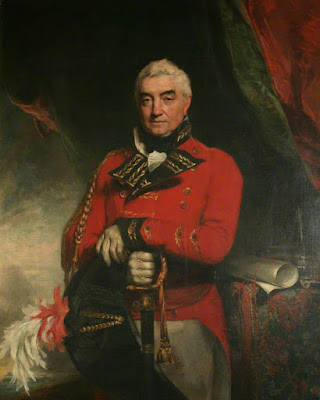
SIR BARRY CLOSE (1756-1813), born at Elm Park, a very distinguished military officer in the East India Company, attained the rank of major-general.

Sir Barry Close, 1st Baronet (Image: Manchester City Gallery)

General Close was created a baronet in December, 1812, designated of Mysore.

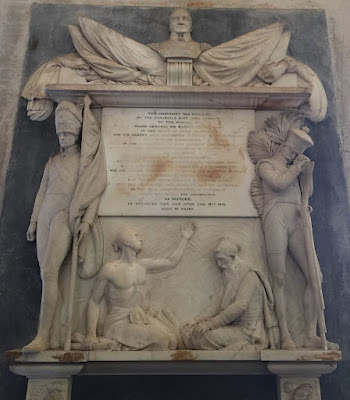
Memorial to Sir Barry Close Bt in St Mary's Church, Madras

Sir Barry died, unmarried, four months afterwards, when the title expired.

First published in January, 2014.  Close arms courtesy of the NLI.